
Note: This article contains affiliate links. If you click on these links and make a purchase, we may earn a small commission at no extra cost to you. This helps support our research and content. Read our full affiliate disclosure here.
If you need a unit that gets a chilly room up to temperature quickly, a powerful electric heater can make a big difference. You want reliable heat output, sensible controls, and safety features that let you run the unit for extended periods without worry. This guide highlights the top shortlisted options in the powerful electric heater category and explains the practical tradeoffs to consider for whole-room warming. Below you will find our top picks for powerful electric heaters and clear evaluation criteria that matter in daily use, from heat delivery and energy behavior to safety and quiet operation.
Top Picks at a Glance
| Best Overall The best all-around choice for most situations | DR. Infrared Heater DR-968 |  |
| Best Quality Built to a higher standard if you want something more solid | duraflame 3D Infrared Electric Fireplace Stove |  |
| Best Budget The cheapest option that still gets the job done reliably | Amazon Basics Ceramic Space Heater DQ1927-Y |  |
| Top Rated A top-rated pick with lots of positive feedback | DREO Space Heater DR-HSH004 |  |
| Most Popular A crowd favorite that many people choose with confidence | Lasko Ceramic Tower Heater 751320 |  |
| Best Seller A high-volume bestseller chosen again and again | DREO Space Heater HSH006 |  |
DR. Infrared Heater DR-968

| Power | 1500 Watts |
|---|---|
| Heating Coverage | 576 square feet |
| Voltage | 120 V |
| Amperage | 12.5 A |
| Temperature Range | 50 °F to 85 °F |
The DR. Infrared Heater DR-968 pairs a quartz infrared tube with a PTC element and a high-pressure low-noise blower to deliver fast, room-scale warmth while using standard 1500W power. It is typically used as a freestanding room heater for living rooms, bedrooms, home offices, and similar spaces; the unit offers Auto, Low (1000W), and High (1500W) modes plus an electronic thermostat and a 12-hour timer so you can set and maintain a target temperature without constant adjustments. Practical features include caster wheels for repositioning, a remote for one-touch control, and built-in tip-over and overheat cutoffs for safer operation around family and pets. The heater is UL certified and claims broader heat distribution compared with typical convection-only heaters, which helps warm objects and occupants directly rather than just heating air. Trade-offs are typical of a high-output portable heater: it draws full household circuit current at 12.5A and is best used on its dedicated circuit, and while quieter than many competitors the blower still produces some audible fan noise when running on high. Overall it is a solid, safety-minded choice when you need powerful supplemental heat without installing hardwired equipment.
Best for: Buyers who want a powerful, portable supplemental heater that warms rooms quickly and prioritizes safety and ease of use for everyday living spaces.
Less Ideal for: Those seeking a permanently installed or hardwired heating solution or users who need completely silent, fanless operation should consider other options.
- Hybrid dual heating (PTC plus quartz infrared) for faster perceived warmth and broader heat transfer
- Electronic thermostat with Auto mode and timer for set-and-forget temperature control
- Remote control and caster wheels make repositioning and operation convenient
- UL certified safety features including tip-over and overheat auto shut-off
- Requires a full household circuit draw at 12.5A so avoid running multiple high-draw appliances on the same circuit
- At maximum output the fan produces noticeable but moderate noise compared with totally fanless infrared panels
Verdict: A powerful, safety-focused portable heater that delivers fast, room-wide infrared warmth with convenient controls and timer for balanced all-round supplemental heating.
duraflame 3D Infrared Electric Fireplace Stove

| Power Source | Corded Electric |
|---|---|
| Heat Output | 5200 british thermal units |
| Heating Coverage | 1000 sq ft |
| Power Consumption | 1500 watts |
| Number of Batteries | 2 AAA batteries required. |
This Duraflame 3D infrared electric fireplace stove is a high-output, freestanding heater intended to supplement home heating for spaces up to about 1,000 square feet. It uses 1500 watts of power and infrared quartz elements to produce comfortable, penetrating heat while helping retain room humidity, and the unit offers a digital adjustable thermostat and timer for set-and-forget operation. The decorative stove body includes side viewing windows, an operable beveled glass door, and a patent-pending layered 3D flame effect with five brightness settings that can run with or without heat for year-round ambiance. Controls are accessible on the unit and via the included remote, and assembly is minimal — attach the legs and plug in. Limitations to note are typical for plug-in infrared heaters: it needs a standard outlet and is intended for supplemental rather than whole-house heating, and its 1500 W draw means it should be on a dedicated circuit for extended use in older homes.
Best for: Buyers who need a powerful, room-focused supplemental heater that combines strong infrared heat performance with adjustable thermostat control and a realistic fireplace appearance.
Less Ideal for: People seeking whole-home heating solutions or those who cannot dedicate a standard 1500 W circuit in their space should look at central heating upgrades instead.
- High heating coverage rated for up to 1,000 sq ft using 1500 W infrared quartz heat
- Adjustable digital thermostat and timer for precise temperature control and scheduled operation
- 3D flame effect with five brightness levels that operates with or without heat for year-round ambiance
- Remote control included for convenient adjustments from across the room
- Durable metal body with side windows and an operable glass door adds decorative realism
- 1500 watt power draw limits it to plug-in supplemental heating and may trip weak circuits
- Not intended as a whole-house furnace replacement; best as a room or zone heater
Verdict: Choose this Duraflame stove when you want a powerful 1500 W infrared room heater that pairs effective supplemental warmth with a realistic 3D flame ambiance.
Amazon Basics Ceramic Space Heater DQ1927-Y

| Heat Output | 1500 watts |
|---|---|
| Number of Speeds | 3 |
| Power Source | Corded Electric |
| Heating Method | Convection |
| Max Temperature Setting | 130 °F |
This Amazon Basics ceramic space heater is a simple, no-frills personal heater that delivers up to 1500 watts of convection heat for quickly warming small rooms or workspaces. It offers three settings—high (1500W), low (900W), and fan only—so you can choose fast, full power warming or lower output for milder conditions, and the adjustable thermostat helps keep a steady temperature. The unit is lightweight and portable, intended for tabletop or floor use, and includes tip-over and overheat protection plus a power indicator for safer everyday operation. Noise is modest at about 43 dB on heating modes, making it suitable for offices or bedrooms. The design is non-oscillating and straightforward, so it lacks advanced features like Wi-Fi, timers, or remote control, and it is not recommended for damp spaces such as bathrooms. For buyers who want a powerful, inexpensive heater for small, dry indoor areas, this delivers reliable warmth without extras.
Best for: Buyers seeking an affordable, powerful personal heater to warm small, dry indoor spaces quickly and reliably without extra smart features.
Less Ideal for: People who need whole-room heating, moisture-safe units for bathrooms, or smart/timer controls should consider other options.
- 1500W maximum output provides quick heating for small rooms
- Three settings including 900W low and fan-only give flexible control
- Built-in tip-over and overheat protection improve everyday safety
- Compact and lightweight for easy moving between rooms
- Relatively quiet operation around 43 dB suitable for offices or bedrooms
- Non-oscillating design limits heat distribution across larger areas
- No advanced controls like timers, remote, or Wi-Fi connectivity
Verdict: A cost-effective 1500W personal heater that delivers fast, reliable warmth for small indoor spaces without unnecessary features.
DREO Space Heater DR-HSH004
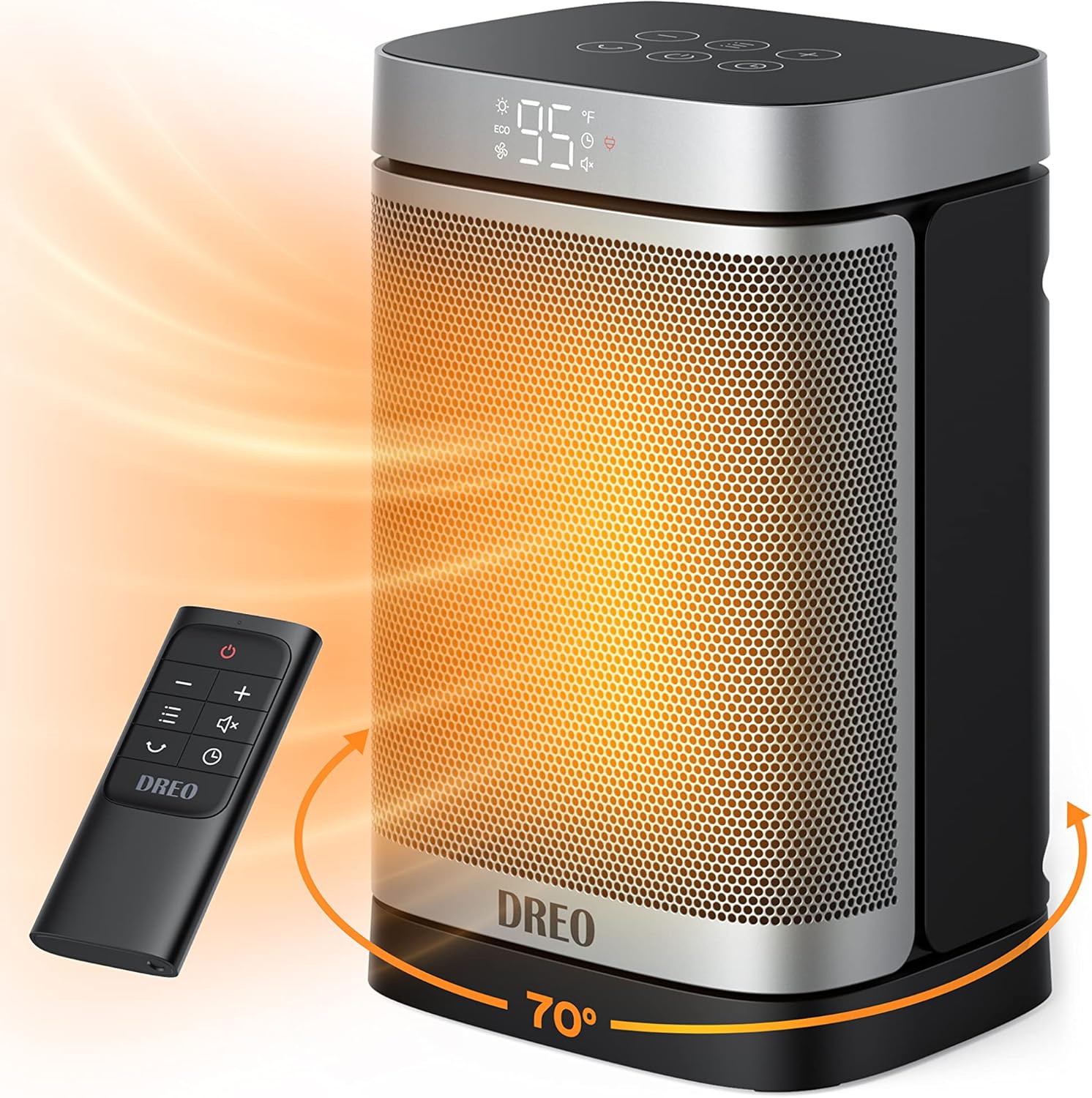
| Heat Output | 1500 watts |
|---|---|
| Heating Coverage | 200 sq.ft |
| Heating Element | PTC Ceramic |
| Special Features | Programmable Thermostat, 1-12h Timer, Oscillating |
| Number of Speeds | 5 |
The DREO DR-HSH004 is a compact 1500W tower heater designed to deliver fast, wide-reaching warmth for rooms up to about 200 sq ft. It uses PTC ceramic elements and forced-air circulation with 70° oscillation to spread heat rather than blasting a single spot, and the digital thermostat can be set from 41 to 95°F in 1°F increments so you can dial in steady comfort. Practical controls include a 1–12 hour timer, ECO mode that varies output to save energy, five speed settings, and a remote for hands-off adjustments. Safety features are well covered with ETL listing, tip-over and overheat protection, an enhanced safety plug, and flame-retardant materials. The heater is engineered to run quietly thanks to a brushless DC motor and multi-blade fan, making it suitable for bedrooms or offices. Trade-offs are typical for a compact tower design: it is intended for single-room use rather than whole-house heating and relies on a fan so it does move air, which may not suit users who prefer silent, convection-only radiators.
Best for: Buyers who prioritize a dependable, safety-minded portable heater that reaches set temperatures quickly and runs quietly in single rooms like bedrooms or home offices.
Less Ideal for: People who need whole-house heating or who prefer passive, convection-only heaters without any fan-driven airflow.
- 1500W PTC ceramic element provides rapid, consistent heat
- Digital thermostat adjustable from 41 to 95°F in 1°F increments for precise temperature control
- 70° oscillation and five speeds spread heat across a room
- Built-in safety systems including tip-over and overheat protection and ETL listing
- ECO mode and programmable 1–12 hour timer help reduce energy use
- Fan-forced design produces some airflow noise and moves air
- Rated for about 200 sq ft, so not suitable as primary heat for large open areas
Verdict: A powerful, safety-focused 1500W tower heater that reliably warms single rooms with precise thermostat control and energy-saving modes.
Lasko Ceramic Tower Heater 751320

| Heat Output | 1500 watts |
|---|---|
| Heating Element | Ceramic |
| Special Features | Adjustable Thermostat, Timer, Oscillation, Remote Control |
| Power Source | Corded Electric |
| Indoor Outdoor Usage | Indoor |
The Lasko Ceramic Tower Heater 751320 is a straightforward, no-frills electric tower heater built to deliver quick room warmth. It uses a 1500-watt ceramic element and forced-air circulation with widespread oscillation to spread heat across bedrooms, home offices, or living rooms. Controls are electronic and easy to use, and the included multi-function remote with onboard storage and a programmable timer makes it simple to change settings from across the room. Safety features such as cool-touch housing, overheat protection, and an ETL listing add reassurance for everyday use. The heater offers two heat settings plus an adjustable thermostat, so it can run quietly on low or deliver full 1500-watt output when you need faster heating. Its slim tower profile and built-in handle make it easy to move, though it lacks advanced features like app control or multiple fan speeds beyond oscillation. For buyers who want dependable, effective electric heat with helpful safety and remote convenience, this Lasko model covers the essentials well.
Best for: Buyers who prioritize proven performance and safety backed by many user reviews and want a simple, effective heater with remote control for bedrooms or living areas.
Less Ideal for: People seeking smart-home integration, detailed zone control, or more granular fan speed options should consider different models with those features.
- 1500-watt ceramic element provides fast, effective heat for small to medium rooms
- Widespread oscillation helps distribute warmth more evenly across a room
- Electronic controls plus multi-function remote and onboard storage for convenient adjustments
- Built-in safety features including overheat protection and cool-touch housing
- Only two heat settings and limited fan speed control reduce fine-grain temperature tuning
- No smart/home connectivity or advanced scheduling beyond the seven-hour timer
Verdict: A reliable, safety-minded 1500W ceramic tower heater that delivers quick, even warmth with the convenience of a remote and timer.
DREO Space Heater HSH006

| Heat Output | 1500 watts |
|---|---|
| Heating Element | PTC Ceramic |
| Heating Coverage | 200 sq.ft |
| Sound Level | 34 dB |
| Min-Max Temperature | 41 °F – 95 °F |
The DREO HSH006 is a compact tower heater that delivers quick, forced-air warmth using a 1500W PTC ceramic element and a brushless DC motor to keep noise low. It is intended for indoor spot heating in bedrooms, home offices, or small living areas and offers multiple heat modes (Power, ECO, Fan) plus four fan speeds so you can tune output and energy use. A precise thermostat (41 to 95°F in 1°F increments), 12-hour timer, memory function and included remote make it easy to set and maintain a comfortable temperature without constant interaction. Safety features include ETL listing, overheat protection, a tip-over sensor, flame retardant materials and a safety plug, which together reduce risk for cautious buyers. At about 34 dB on typical settings it stays quiet enough for night use, and the built-in handle improves portability. Trade-offs are its 200 sq ft coverage limit—so it is best for single rooms rather than whole-house heating—and like all portable electric heaters it requires a dedicated outlet and adds to electric load when running at full power.
Best for: Buyers who prioritize reliable, safe, and easy-to-use room heating for single rooms and want precise temperature control with quiet operation.
Less Ideal for: People seeking to heat large or multiple connected rooms or those looking to avoid increased household electric draw during heavy use should consider other options.
- Strong 1500W PTC ceramic output for fast spot heating
- Precise thermostat with 1°F increments and multiple modes for tailored comfort
- Quiet brushless DC motor design (~34 dB) suitable for bedrooms
- Comprehensive safety features including tip-over sensor, overheat protection and ETL listing
- Convenient remote control, 12-hour timer and portable handle for easy use
- Effective coverage is limited to about 200 sq ft so not suitable for large open areas
- Consumes full-line power when running at maximum heat like other 1500W electric heaters
Verdict: A compact, safety-focused 1500W room heater that delivers fast, quiet spot heating with precise thermostat control, ideal for risk-averse buyers heating single rooms.
Choosing the Right Powerful Electric Heater: Key Factors to Consider
Heat Output and Coverage
Heat output determines how quickly a heater raises a room's temperature. Look for units with stated wattage and a realistic coverage estimate based on room size. Higher wattage speeds warm-up times but may incur higher operating costs if run continuously.
Distribution matters as much as raw output. Convection and fan-assisted designs move heated air around a room, reducing cold spots. For larger rooms, a heater that combines strong output with effective airflow will shorten the time it takes to reach a comfortable temperature.
Thermostat and Control Precision
A precise thermostat prevents overshooting and cycling, which improves comfort and moderates energy use. Digital or well-calibrated mechanical thermostats let you set target temperatures rather than relying on fixed high/low heat settings.
Look for adjustable timers, programmable schedules, and multiple heat stages. These controls let you tailor runtime to occupancy patterns, which reduces wasted energy while keeping spaces warm when you need them.
Safety Systems and Certification
Powerful heaters produce significant surface heat and must include protections to prevent fires and burns. Important safety features include tip-over shutoff, automatic overheat cutoff, cool-touch surfaces or guards, and stable bases to resist tipping.
Check that units carry relevant safety certifications for household appliances. Built-in safeguards are essential if you plan to run a heater overnight or in occupied rooms with pets or children.
Energy Use and Operating Cost
Wattage correlates directly with electrical draw, so higher output means higher potential electricity consumption. Energy-aware features such as thermostats, ECO modes, and timer-based operation help reduce runtime and operating cost without sacrificing comfort.
Consider how often and how long you will run the heater. For intermittent use, raw output and warm-up speed matter most. For long unattended operation, prioritize models with accurate thermostats and economy modes to avoid unnecessary energy use.
Noise and Placement Considerations
Noise level impacts where a heater is practical. Fan-assisted models provide faster distribution but can be audible. Infrared and oil-filled convection units often operate quietly but may take longer to heat a space.
Think about placement relative to furniture and traffic paths. Keep heaters on stable, level surfaces away from combustible materials and ensure airflow is not obstructed to maintain efficiency and reduce noise caused by restricted vents.
Durability, Mobility, and Maintenance
A sturdy housing and quality components extend a heater's service life. Mobility features such as built-in handles, caster wheels, or manageable weight make it easier to move the heater between rooms as needs change.
Maintenance is usually minimal, but accessible grilles for dusting and straightforward user-replaceable parts improve longevity. Consider how easy it will be to clean filters or dust the heater to preserve airflow and heat transfer over time.
Choosing the Right Output for Your Room Size
Match heater wattage to room volume rather than floor area alone. Taller ceilings require more heat to reach the same perceived temperature. As a rule of thumb, estimate required wattage by calculating the cubic footage and considering insulation levels and window exposure.
If you need quick warm-up times for living areas, favor higher wattage or fan-assisted models. For steady background heat in bedrooms, a lower-output convection or oil-filled unit with a good thermostat can provide comfortable temperatures with quieter operation.
- Small rooms and bathrooms: lower wattage with moisture-appropriate protection
- Medium rooms and offices: moderate wattage with good distribution
- Large living rooms: higher wattage and active airflow for even heating
Fan-Assisted Vs Convection Vs Radiant Heat
Fan-assisted heaters push warm air around a space and shorten the time to reach set temperatures. They are effective when you need rapid spot-to-whole-room heating but tend to be louder and can stir dust.
Convection and oil-filled models warm the air more gently and maintain temperature with lower noise. They are suited to long-run, steady heating in bedrooms or quiet spaces.
Radiant infrared heaters heat objects and people directly rather than the air. They feel warm quickly and can be efficient for directional heating of occupied zones, but they are less effective when you need whole-room air temperature increases.
- Fan-assisted: fast, noisy, good circulation
- Convection/oil-filled: quiet, steady, slower warm-up
- Radiant: instant personal warmth, limited whole-room effect
Placement and Ventilation Best Practices
Place a heater where airflow is unobstructed and away from curtains, furniture, and high-traffic areas. A central position promotes even distribution, but if the heater is directional, angle it toward the main occupied zone.
Maintain at least the manufacturer-recommended clearance on all sides. Avoid placing heaters on unstable surfaces or near water sources unless the unit is explicitly rated for those environments. Regularly clear dust from inlet and outlet grilles to maintain efficient heat transfer.
- Keep clearance around the unit for safety and airflow
- Avoid confined spaces that trap heat and stress internal components
- Check for proper grounding and outlet capacity to prevent circuit overloads
Minimizing Operating Costs Without Sacrificing Comfort
Use precise thermostat control and timers to limit runtime to occupied periods. Preheating briefly before occupancy and lowering setpoints when rooms are empty reduces overall energy use while maintaining comfort when needed.
Supplemental measures such as improving insulation, sealing drafts, and closing doors can drastically lower the wattage required to maintain comfort. Pairing a powerful heater with sensible home-efficiency steps yields the best balance of warmth and cost.
- Program timers for typical occupancy patterns
- Use medium-to-low thermostat setpoints for steady comfort
- Improve room insulation to reduce heating demand
Safety Habits for Long-Term Use
Even with built-in protections, safe operation habits matter. Never leave a heater running unattended near flammable materials, and avoid using extension cords unless explicitly allowed by the manufacturer. Regularly inspect power cords for wear and tear.
If you operate a heater overnight, pick models with trusted automatic shutoffs and ensure smoke alarms are functional. Keep the unit clean and follow simple manufacturer maintenance to reduce fire risk and keep performance consistent.
- Do not block air intakes or exhausts
- Replace damaged cords and avoid makeshift repairs
- Store and position units away from moisture and combustibles
How We Chose the Best Powerful Electric Heater
We shortlisted units that meet the core demands of strong-room heating while still offering manageable energy behavior and robust safety. First, we prioritized verified heat output and how effectively the heater raises and maintains room temperature under typical household conditions. Second, we evaluated safety systems including tip-over protection, overheating cutouts, and guarded surfaces to reduce burn and fire risk during extended operation. Third, we considered control precision and usability, such as thermostatic control, multiple heat settings, and programmable timers that reduce wasted runtime. Fourth, we looked at build quality and mobility features that affect real-world handling, including durable housing, stable bases, and carry options. Finally, we assessed noise levels for living spaces where quiet operation matters. We excluded lightweight personal warmers and devices designed only for spot heating that cannot sustain whole-room temperature increases. We also excluded units lacking basic safety certification or those with insufficient heat output for medium to large rooms. The resulting selection focuses on dependable, high-output electric heaters that balance performance, safety, and everyday convenience.
Our full evaluation process is outlined in our review methodology.
FAQ
How do I estimate the wattage needed to heat my room?
Estimate wattage based on room volume and insulation. Multiply floor area by ceiling height for cubic footage and allow higher wattage for poor insulation or large windows. For quick warm-up, choose higher wattage; for steady background heat, a lower-wattage unit with a good thermostat often suffices.
Are fan-assisted heaters better than oil-filled radiators?
Fan-assisted heaters heat a room more quickly by moving warm air, but they are noisier. Oil-filled radiators run quietly and maintain steady temperatures with slower warm-up. Choose based on whether you prioritize rapid warm-up or quiet, long-duration comfort.
Can I leave a powerful electric heater running overnight?
Leaving a heater running overnight is acceptable only if it has reliable safety features such as overheat protection and tip-over shutoff and you follow safe placement guidelines. Even then, using timers and lower thermostat setpoints reduces unnecessary runtime and risk.
Will a powerful heater overload my home's circuits?
High-wattage heaters draw significant current and can trip breakers on overloaded circuits. Use a dedicated outlet rated for the heater's draw and avoid running other heavy appliances on the same circuit. If unsure about capacity, consult a qualified electrician.
How important is noise level in choosing a heater?
Noise matters in bedrooms and living areas where quiet is preferred. Fan-assisted models are generally louder due to airflow, while convection and oil-filled units are much quieter. Consider where you will use the heater and prioritize low-noise designs for sleeping spaces.
Final Verdict
Choose a powerful electric heater by balancing raw output with controllability and safety. Prioritize units that deliver the wattage needed for your room size while offering accurate thermostats and proven safety shutoffs to reduce runtime and risk. Consider noise, mobility, and energy-saving controls to match the heater to how and where you will use it. In short, pick the smallest unit that can reliably warm your target space while offering the safety and control features you will use daily. That approach gives confident warmth with manageable operating costs.