
Note: This article contains affiliate links. If you click on these links and make a purchase, we may earn a small commission at no extra cost to you. This helps support our research and content. Read our full affiliate disclosure here.
Choosing the right infrared heater for home use matters because these units heat people and objects directly rather than just warming the air. That makes them useful for spot heating, supplementing central systems, and cutting energy use in rooms you occupy most. In this guide we narrowed down the options to seven shortlisted infrared heaters that suit typical home needs, from small bedrooms to open living areas. We evaluated each pick for coverage, safety features, energy efficiency, and usability so you can find a heater that balances quick, comfortable warmth with predictable operating costs. Read on for practical guidance and clear buying criteria before the product list.
Top Picks at a Glance
| Best Overall The best all-around choice for most situations | Heat Storm HS-1500 Infrared Heater |  |
| Best Quality Built to a higher standard if you want something more solid | EdenPURE CopperPLUS 1500W Heater |  |
| Best Value The sweet spot between price and what you get | Comfort Zone Quartz Tower Heater |  |
| Best Budget The cheapest option that still gets the job done reliably | Comfort Zone Flat Panel Heater CZHTV9 |  |
| Top Rated A top-rated pick with lots of positive feedback | DR. Infrared Heater DR-968 |  |
| Most Popular A crowd favorite that many people choose with confidence | Heat Storm Phoenix HS-1500 Wi‑Fi Heater |  |
| Best Seller A high-volume bestseller chosen again and again | DR. INFRARED HEATER DR-238 |  |
Heat Storm HS-1500 Infrared Heater

| Power | 1500 watts |
|---|---|
| Heating Method | Infrared Quartz |
| Heating Coverage | 300 sq ft (Primary) 1000 sq ft (Secondary) |
| Number of Speeds | 3 |
| Max Temperature Setting | 90 °F |
The Heat Storm HS-1500 is a plug-and-play infrared quartz cabinet heater designed to provide efficient zone heat for bedrooms, home offices, and living spaces. It uses four quartz infrared elements inside a patented double-wall heat exchanger to deliver quick, comfortable warmth without reducing room humidity, and an Auto Eco mode can cut power from 1500 W to 750 W to save energy. A digital thermostat with LED display and remote control makes it easy to set and maintain temperature, and three fan speeds plus included casters help move and distribute heat where you need it. Built-in safety features include overheat protection, a child lock, a washable lifetime air filter, and a fabric-wrapped exterior to reduce hot surfaces. Practical limits: it is intended as zone heating (up to about 300 sq ft as primary heat) rather than whole-house heating, and the max temperature setting tops out at 90 F. The unit is moderately heavy but portable and best used as a supplemental heater for single rooms.
Best for: Buyers seeking a reliable, portable zone heater to warm single rooms with efficient infrared heat and straightforward electronic controls.
Less Ideal for: People who need whole-house heating or very high-temperature output should look at larger HVAC solutions or higher-capacity heaters.
- Infrared quartz elements with patented double-wall heat exchanger for quick, comfortable zone heating
- Digital thermostat with LED display and remote for easy temperature control
- Energy-saving Auto Eco mode reduces wattage from 1500 W to 750 W
- Multiple safety features including overheat protection, child lock, and washable lifetime air filter
- Designed for zone or supplemental heating and not suitable as a whole-house primary heater
- Maximum temperature limited to 90 F which may be low for very cold spaces
Verdict: Choose this heater if you want an efficient, safety-focused portable infrared unit for heating individual rooms with convenient digital controls.
EdenPURE CopperPLUS 1500W Heater

| Heating Coverage | 1000 square feet |
|---|---|
| Heat Output | 5000 BTU |
| Power Modes | 1500W / 1000W |
| Temperature Range | 40 °F to 90 °F |
| Number of Settings | 24 |
The EdenPURE CopperPLUS is a cabinet-style portable infrared heater built to warm large rooms with efficient radiant heat. It uses a copper PTC element and claims a 1500W high mode (1000W low) to deliver steady warmth without the dry forced-air feel, and it is intended for zone heating so you can heat occupied spaces rather than the whole house. Practical features include 24 preset heat levels with a 40°F–90°F range, a wireless remote, washable lifetime filter, built-in caster wheels and a 6-foot cord for easy placement. Safety is prioritized with dual overheat sensors, tip-over shutoff and a cool-touch grill, and the unit runs quietly for bedroom or office use. Trade-offs are its single-room focus—it is not a whole-home solution—and at 1500W it still draws significant power on high, so expect noticeable energy use if run continuously at top output. For performance-focused buyers who want steady infrared warmth and precise control in large rooms, this heater is a strong choice.
Best for: Buyers who prioritize strong, controllable infrared performance for heating large single rooms and want a portable, safety-focused unit for living rooms, bedrooms, or home offices.
Less Ideal for: Those seeking whole-home heating or a low-wattage supplemental option for very small spaces should consider other solutions.
- Copper PTC element designed to improve heat transfer and deliver steady radiant warmth
- 1500W high / 1000W low power with 24 precision heat settings for fine temperature control
- cETL safety features including dual overheat sensors and automatic tip-over shutoff
- Lifetime washable dust filter reduces ongoing maintenance costs
- Portable cabinet with rolling casters and included remote for convenient placement and control
- Designed for zone heating only and not intended to replace central heating for an entire home
- Significant power draw at 1500W when operating on high
Verdict: Choose this heater if you want a powerful, adjustable infrared zone heater that delivers steady warmth and strong safety features for large rooms.
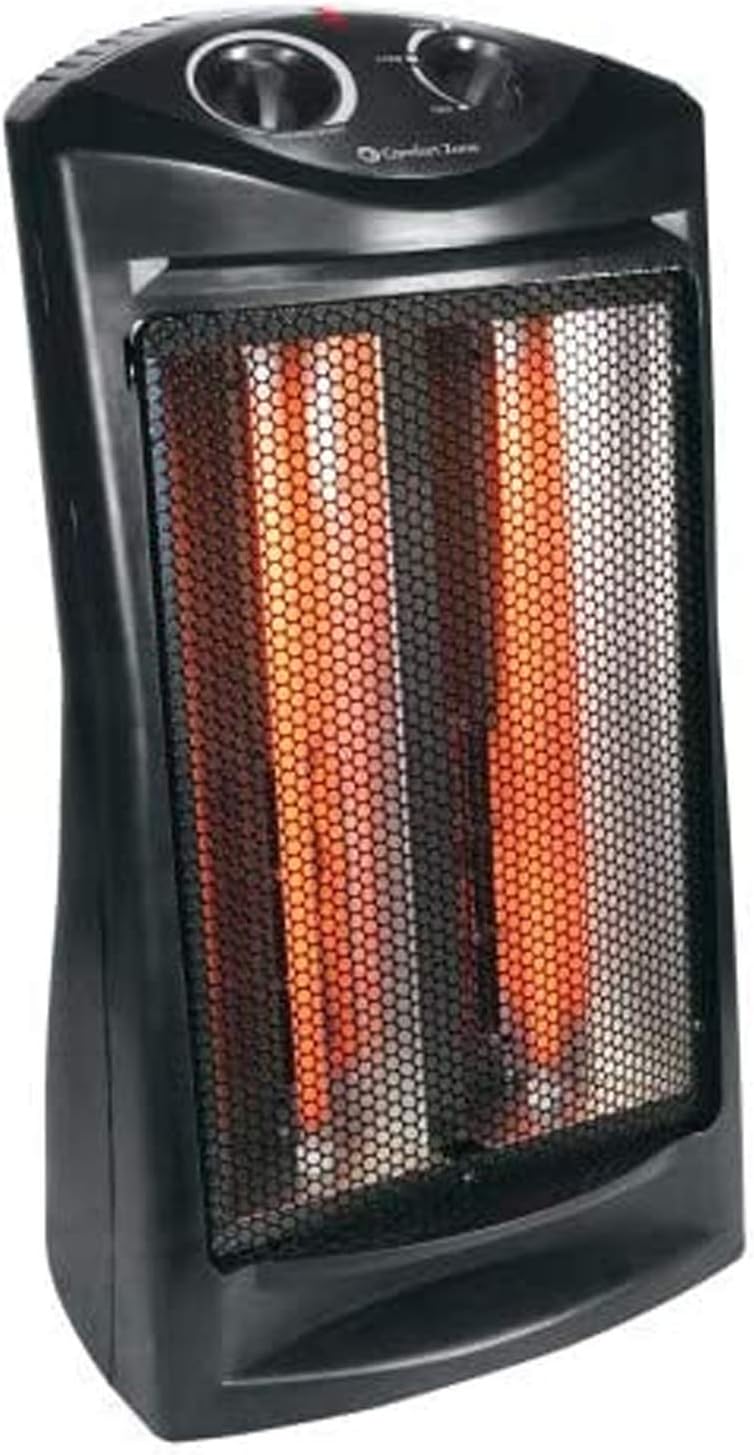
Comfort Zone Quartz Tower Heater
| Heat Output | 1500 watts |
|---|---|
| Heating Coverage | 200-300 square feet |
| Power Source | Corded Electric |
| Heating Method | Radiant |
| Number of Speeds | 3 |
The Comfort Zone Quartz Tower Heater uses dual quartz tubes and a small fan to deliver quick, focused radiant warmth to a single room. It offers two heat settings (750W/1500W) plus a manual thermostat so you can dial in comfort for bedrooms, home offices, or living rooms up to roughly 200–300 square feet. Controls are simple top-mounted knobs, and the unit is light and portable with a molded stay-cool handle for moving between rooms. Safety features include tip-over shutoff, overheat sensor, and a cool-touch exterior which make it sensible for household use. Expect direct, fast heat aimed at people and nearby objects rather than whole-house warming, and the basic control layout means no digital scheduling or precise temperature readouts. For someone who wants a straightforward, effective infrared-style heater to reduce central heating use, this is an economical, easy-to-use choice; if you need zone heating with advanced programming or very large-room coverage, look elsewhere.
Best for: Buyers who want a no-frills, energy-efficient room heater to warm the space they occupy and lower whole-home thermostat use while prioritizing simplicity and safety.
Less Ideal for: People who need whole-house heating, smart controls, or detailed temperature programming should consider larger or more feature-rich alternatives.
- Dual quartz tubes provide rapid, focused radiant heat
- Fan-assisted design helps distribute warmth beyond immediate front area
- Simple top-mounted knobs and manual thermostat for easy operation
- Built-in safety features including tip-over shutoff and overheat sensor
- Compact, lightweight tower design with stay-cool handle for portability
- No digital controls or programmable thermostat for precise temperature scheduling
- Designed for single-room use so it is not suited to heating large open areas
Verdict: A simple, portable radiant tower heater that delivers quick, targeted warmth and reliable safety for single-room use.
Comfort Zone Flat Panel Heater CZHTV9

| Heating Method | Radiant |
|---|---|
| Heat Output | 800 watts |
| Heating Coverage | 150 sq. ft. |
| Heating Element | Halogen |
| Number of Speeds | 2 |
The Comfort Zone CZHTV9 is a compact flat-panel halogen infrared heater intended to deliver quick, focused warmth in small rooms such as bedrooms and offices. It uses twin halogen tubes to radiate heat directly to people and objects in front of it, and a top-mounted knob controls two heat settings plus the oscillation mode to spread warmth across up to about 150 square feet. The slim tower shape and molded stay-cool handle make it easy to place on a floor or tabletop and move between rooms, while safety features such as a tip-over switch and overheat sensor add protection during normal use. Practical benefits include near-instant warmth without a fan and simple, no-frills controls that are easy to operate. Limitations are the focused radiant pattern — it warms what it faces rather than raising overall room air temperature quickly — and the 800 watt maximum output means it is best for small spaces rather than whole-home heating.
Best for: Buyers looking for an inexpensive, portable heater to provide fast personal warmth in small rooms or workspaces and who prioritize simple controls and safety over whole-room heat.
Less Ideal for: People who need to heat large rooms or want a unit that rapidly raises ambient air temperature across an entire space should consider higher-output or convective heaters instead.
- Radiant halogen tubes provide near-instant, directed warmth
- Slim flat-panel tower fits into small spaces and on tabletops
- Oscillation spreads heat across a wider area than a fixed radiant unit
- Built-in safety features include tip-over switch and overheat sensor
- Radiant design warms objects and people in front of it rather than quickly heating whole-room air
- Maximum 800W output limits effectiveness in larger or very cold rooms
Verdict: A budget-friendly, portable halogen radiant heater that delivers quick personal warmth for small rooms with simple controls and built-in safety features.
DR. Infrared Heater DR-968

| Wattage | 1500 Watts |
|---|---|
| Heating Coverage | 576 square feet |
| Number of Speeds | 3 |
| Voltage | 120 |
| Amperage | 12.5 A |
The DR. Infrared Heater DR-968 uses a dual heating system (PTC plus quartz infrared) and a high‑pressure low‑noise blower to warm rooms quickly and spread heat more evenly than basic convection heaters. It is typically used as a primary supplemental heater for living rooms, bedrooms or home offices and offers Auto energy‑saving mode that cycles between high and low power to hold a set temperature. The unit includes an electronic thermostat (50 to 85°F), three power modes (Auto, Low 1000W, High 1500W), a 12‑hour timer, caster wheels and an infrared remote for convenient control. Built‑in safety features include tip‑over protection and overheat auto shutoff, and the blower operates quietly around 39 dB. Tradeoffs are that it is a plug‑in freestanding unit that weighs about 19 pounds and draws typical 1500W power, so it is not intended for whole‑house heating or off‑grid use, but it excels as a fast, safe, room‑level heater with energy‑saving behavior.
Best for: Buyers who prioritize a dependable, safety‑minded supplemental heater that warms a room quickly and can run on programmed thermostat settings with minimal fuss.
Less Ideal for: People needing central or whole‑house heating, ultra‑lightweight travel heaters, or off‑grid solutions should look elsewhere.
- Dual heating system (PTC + quartz infrared) for faster, penetrating warmth than single‑element heaters
- Auto energy‑saving mode that cycles between high and low to maintain set temperature
- Remote control, electronic thermostat and timer for easy, hands‑off operation
- Safety features including tip‑over protection and overheat auto shutoff
- Quiet high‑pressure blower and caster wheels for low‑noise operation and portability
- 1500W maximum means it is best for single rooms rather than whole‑home heating
- Relatively heavy for a portable unit at about 19 pounds
Verdict: Choose the DR‑968 when you want a durable, safety‑focused infrared heater that delivers fast, room‑level warmth with programmable thermostat control.
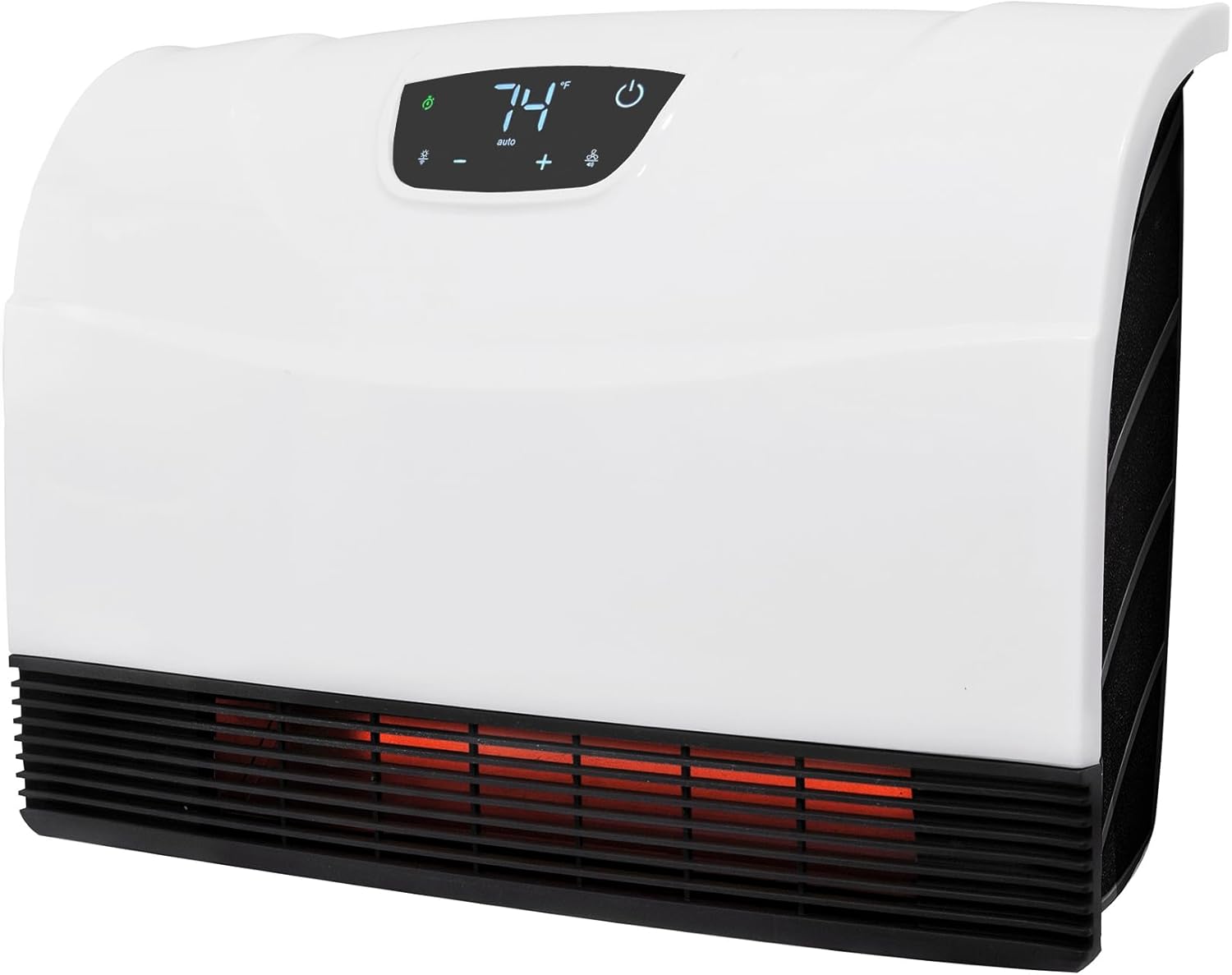
Heat Storm Phoenix HS-1500 Wi‑Fi Heater
| Power | 1500 watts |
|---|---|
| Heating Method | Infrared / Radiant |
| Voltage | 110 volts |
| Heating Coverage | 150 ft² primary, 750 ft² secondary |
The Heat Storm Phoenix HS-1500 is a compact infrared wall heater intended to warm bedrooms, bathrooms, home offices, or small garages without taking floor space. It installs on a wall over a standard outlet and delivers up to 1500 watts of radiant heat, with the manufacturer claiming primary coverage for about 150 sq ft and supplemental reach to larger areas. The unit includes Wi‑Fi for remote control and scheduling, a touch-screen digital thermostat, and a remote for quick adjustments. Because it mounts on the wall and stays cool to the touch, it is convenient where floor heaters are impractical and it includes washable filters for maintenance. Practical limitations are its single-zone focus and 110V power draw, so it suits enclosed rooms rather than whole-house heating, and users should verify circuit capacity in older homes. The built-in safety features such as tip-over shutoff (relevant for plug models) and a guarded grill make it sensible for occupied rooms where a low-profile heater is preferred.
Best for: Buyers who want a space-saving, controllable room heater with smart scheduling and reliable user feedback from other owners for heating single rooms or home offices.
Less Ideal for: Those seeking a primary heat source for large open areas or whole-home heating should look at higher-capacity or central solutions.
- Wall-mount design frees floor space and positions heat where needed
- Wi‑Fi and remote control allow scheduling and temperature control from a phone
- 1500W infrared radiant element provides quick localized warmth for small rooms
- Touch-screen digital thermostat offers precise setpoint control
- Washable filter simplifies basic maintenance
- Intended for single-room or zone heating, not whole-home use
- Requires a standard 110V circuit so performance can be limited by older wiring
Verdict: Choose this wall-mounted Wi‑Fi infrared heater when you need a compact, controllable heater that reliably warms a single room without using floor space.
DR. INFRARED HEATER DR-238

| Power settings | 900W, 1200W, 1500W |
|---|---|
| Voltage | 120 volts |
| Number of speeds | 3 |
| Mounting type | Ceiling Mount, Wall Mount |
| Indoor Outdoor Usage | Indoor |
The DR-238 is a corded electric carbon infrared heater intended for patios, garages, and other indoor or covered outdoor spaces. It mounts to a wall or ceiling and provides instant, odorless radiant heat using a carbon lamp with three output settings (900W, 1200W, 1500W) that you can change with the included remote. The unit is built from anodized aluminum with a reflective backing to boost efficiency and carries an IP55 rating and ETL listing for safer outdoor use. In practice it is best for targeted heating of seating areas or work zones rather than trying to warm a whole house, and the three power levels let you balance comfort and energy use. Installation requires mounting hardware and a nearby 120V outlet, and there is no built-in thermostat so you will control runtime manually or with the remote. For buyers who prefer a straightforward, durable infrared fixture for a patio, garage, or covered porch, this model delivers reliable, focused warmth with simple controls.
Best for: A cautious buyer wanting a factory-built, ETL-listed infrared heater for focused heating on a patio, garage, or covered porch who values straightforward installation and simple remote control.
Less Ideal for: People who need whole-room or whole-house heating, automated thermostat control, or an off-grid solution should consider other heater types.
- Three power settings (900W, 1200W, 1500W) for adjustable heat output.
- IP55 rating and ETL listing for safer use in covered outdoor environments.
- Includes wall and ceiling mounting brackets plus remote for convenient installation and control.
- Anodized aluminum body with reflective backing improves durability and heating efficiency.
- No built-in thermostat or temperature calibration for automated temperature control.
- Designed for zone heating rather than warming large open-air spaces.
Verdict: A durable, ETL-listed infrared wall/ceiling heater that reliably delivers targeted, instant warmth for patios and garages.
Choosing the Right Infrared Heater for Home Use: Key Factors to Consider
Room Size and Heat Coverage
Measure the primary rooms where you plan to use an infrared heater and match capacity to that space. Infrared heaters do not rely on heating all the air, so a smaller unit can feel effective at close range, but larger open-plan living areas will still require higher output or multiple units.
Consider placement too. Infrared warmth is directional, so think about seating positions and how furniture might block the beam. Estimating square footage and ceiling height helps determine whether a portable infrared heater will deliver comfortable warmth across the intended area.
Energy Use and Operating Cost
Check the electrical rating and any adjustable power modes to understand likely energy use. Infrared heaters often come with multiple heat settings that let you lower consumption during extended use.
Also factor thermostat accuracy and programmable timers because precise control reduces wasted run time. Energy efficiency impacts both monthly bills and how practical it is to rely on the heater as a supplement to central heating.
Safety Features and Certifications
Safety features are critical for home heaters. Look for automatic tip-over shutoff, overheat protection, and cool-touch surfaces if the unit will be in high-traffic areas or near children and pets.
Verify that the heater carries relevant electrical safety certifications for home appliances. Physical guards over heating elements and stable bases reduce the chance of accidental contact or fire risk.
Controls, Thermostat, and Programmability
Good controls let you run the heater efficiently and comfortably. A reliable thermostat maintains set temperature without frequent manual adjustments. Timers, multiple heat presets, and remote controls improve convenience for living rooms and bedrooms.
Digital displays and simple button layouts reduce user error. For overnight use, low-heat modes and accurate thermostatic control are especially important to prevent excessive cycling and noise.
Placement, Mounting, and Portability
Think about where the heater will sit. Floor-standing units are easiest to move between rooms, while wall- or ceiling-mounted infrared panels provide fixed, wide-area coverage and free floor space.
Portability features like handles, caster wheels, and light weight matter if you plan to reposition the heater often. Also consider cord length and the proximity of approved outlets to avoid unsafe extension cord use.
Durability and Maintenance
Infrared heaters generally require little maintenance, but construction quality affects long-term performance. Metal housings, corrosion-resistant elements, and tight assembly reduce failure risk.
Check for replaceable parts and a reasonable warranty period. Ease of cleaning, such as accessible grille panels and finishes resistant to dust buildup, extends reliable operation and reduces maintenance time.
How Infrared Heating Works in Homes
Infrared heaters produce radiant energy that warms objects and people directly instead of heating the air. That means you feel warmth almost immediately when seated within the heater's effective range, which can make short-term spot heating more efficient than trying to raise whole-room air temperature.
Because radiant warmth is directional, positioning matters. Placing a heater where occupants spend most time or where chilly drafts enter the room yields the biggest comfort gains. Infrared is particularly useful for supplementing existing systems rather than replacing central heating in most homes.
- Direct radiant heat reduces lag time between turning the unit on and feeling warmth
- Not all infrared heaters cover a whole room uniformly; beam shape and angle determine effective area
- Works well for targeted spots like reading nooks, home offices, or bathrooms
Placement Tips for Maximum Comfort and Safety
Position the heater so it points toward the area where people sit or sleep, keeping at least the minimum clearance distances specified by the unit. Avoid placing the heater behind curtains, too close to furniture, or where foot traffic could tip it over.
For wall-mounted panels, install at recommended heights to spread heat more evenly across a room. Floor models should sit on flat, stable surfaces and not on rugs that can block airflow or cause instability.
- Maintain manufacturer-recommended clearances from combustible materials
- Keep pathways and children's play areas free of portable heaters
- Use wall or ceiling mounts where floor space is limited
Using Infrared Heaters Efficiently
Combine an infrared heater with a reasonable ambient thermostat setting to reduce total energy use. For example, lower the central thermostat and use infrared heating in the rooms you occupy most. Use timers and precise thermostats to avoid running the heater longer than necessary.
Choose the lowest power setting that maintains comfort and avoid frequent full-power starts and stops. Periodic placement changes to match seasonal living patterns can also help you get the most value from a single unit.
- Use timers for predictable schedules like morning and evening occupancy
- Lower ambient heating and use infrared for localized warmth
- Regularly check seals around doors and windows to prevent drafts that undermine efficiency
Installation Options: Portable Vs Mounted
Portable infrared heaters offer flexibility and fast spot heating for multiple rooms. They are typically plug-in units with carry handles or wheels and are good for renters or rooms that need occasional extra warmth.
Mounted infrared panels are better for repeat, predictable coverage in a single room. They free up floor space and can provide more even distribution for living rooms or bedroom headboards when installed at the right height.
- Portable: best for ad hoc use and easy storage
- Mounted: ideal for permanent, unobtrusive installation
- Consider cord routing and available power outlets for both types
Common Mistakes to Avoid
Do not assume higher wattage always equals better comfort. Wattage increases heat output but without correct placement and coverage it may simply waste energy. Verify that the unit's output matches the intended use case and room size.
Avoid using damaged cords or inappropriate extension cords and never block inlet or outlet grilles. Ignoring recommended clearances, using heaters in wet locations not rated for them, or leaving portable units unattended can all create hazards.
- Match output to room size rather than defaulting to the most powerful unit
- Follow safety guidelines for cord use and placement
- Do not use indoor-only units outdoors or in damp environments
How We Chose the Best Infrared Heater for Home Use
We focused on practical, home-oriented performance when selecting infrared heaters for this roundup. Primary evaluation criteria included heat coverage and intensity, which reflects how effectively a heater delivers usable warmth across different room sizes. Energy efficiency and running cost were treated as distinct metrics because power draw and heat delivery determine real-world energy use. Safety and built-in protections were required qualifications for every option considered. Usability features such as thermostats, timers, controls, and portability were included to assess day-to-day convenience. Durability and warranty support rounded out our priorities so picks would hold up to routine household use. We excluded units designed exclusively for commercial or industrial spaces, outdoor-specific models, and appliances lacking basic safety certifications. Each candidate had to demonstrate consistent infrared heating performance for residential rooms and include at least one user-facing control for temperature or runtime. The four to six criteria above informed both our shortlist and the scoring framework applied to each product.
Our full evaluation process is outlined in our review methodology.
FAQ
Are infrared heaters safe to leave on overnight in a bedroom?
They can be safe if the unit is rated for overnight use and includes overheat protection and tip-over shutoff. Use a model with an accurate thermostat and follow clearance recommendations. Always place the heater on a stable surface and avoid obstructing airflow.
How quickly do infrared heaters warm a room?
Infrared heaters provide perceptible warmth almost immediately at close range because they heat objects directly. Whole-room temperature changes are slower and depend on the unit's output and room size, so they are best used for spot heating or supplemental warmth.
Can an infrared heater reduce my energy bills?
Infrared heaters can lower energy use when used to heat specific occupied areas while lowering central heating. Savings depend on run time, insulation, and how accurately you control the heater with thermostats and timers. They are most effective when used selectively rather than running constantly.
Do infrared heaters work well in rooms with high ceilings?
High ceilings reduce the efficiency of any heater that warms air because heat rises. Infrared heaters that directly warm people and objects are less affected by ceiling height for spot heating, but coverage area and placement still determine how comfortable the room will feel.
What maintenance do infrared heaters need?
Maintenance is usually minimal: keep grills and reflectors free of dust and debris, inspect cords and plugs for damage, and follow manufacturer cleaning guidelines. Periodically check that controls and safety cutoffs operate correctly.
Final Verdict
Prioritize safety features, accurate thermostatic control, and appropriate heat coverage when choosing an infrared heater for home use. Match the unit type to how you live: portable models for flexible spot heating and mounted panels for repeat, room-wide coverage. Balancing output with placement and control options will deliver the best mix of immediate comfort and reasonable operating costs. Focus on the tradeoffs between portability and fixed installation, and choose a unit with the safety features and controls that fit your daily routine. With those priorities in mind, you can confidently pick an infrared heater that meets your home heating needs.