
Note: This article contains affiliate links. If you click on these links and make a purchase, we may earn a small commission at no extra cost to you. This helps support our research and content. Read our full affiliate disclosure here.
If you want quick, targeted warmth without heating the whole house, an infrared heater can be an efficient solution. You will use these heaters to warm people and objects directly, which often feels faster at lower thermostat settings. Choosing the right unit matters because output, coverage, control, and safety features determine how comfortable and cost-effective the heater will be in real use. This guide shortlists seven top picks across typical home use cases and evaluates them on heat delivery, energy efficiency, safety, and ease of use. Read on for clear criteria and practical advice to help you pick the right infrared heater for your space.
Top Picks at a Glance
| Best Overall The best all-around choice for most situations | Duraflame Electric Tower Heater |  |
| Best Quality Built to a higher standard if you want something more solid | Dr. Infrared Heater DR-968 |  |
| Best Value The sweet spot between price and what you get | DR. INFRARED HEATER DR-298 |  |
| Best Budget The cheapest option that still gets the job done reliably | SONBION Radiant Quartz Heater LSG13 |  |
| Top Rated A top-rated pick with lots of positive feedback | Econat C-15 Infrared Heater |  |
| Most Popular A crowd favorite that many people choose with confidence | Heat Storm Phoenix HS-1500-PHX-WIFI |  |
| Best Seller A high-volume bestseller chosen again and again | Heat Storm HS-1000-WX Wi‑Fi Heater |  |
Duraflame Electric Tower Heater

| Heating Coverage | 1000 square_feet |
|---|---|
| Heat Output | 5200 british thermal units |
| Power Source | Corded Electric |
| Special Features | Electronic timer function, Infrared, Oscillating, Overheat Protection |
| Voltage | 120 volts |
This Duraflame electric tower heater uses infrared quartz elements and oscillating louvers to deliver supplemental zone heating across larger rooms. It is typically placed in living rooms, home offices, or bedrooms where you want targeted warmth without heating the whole house. Notable features include an electronic timer (30 minutes to 9 hours), remote control, adjustable thermostat, and patented Safer Plug technology that monitors plug temperature to prevent overheating. The wood veneer cabinet and curved front give it a furniture-like look so it blends with decor while providing up to 5,200 BTU of output. In practice the oscillation helps spread heat more evenly in open spaces and the timer and sleep settings make it convenient for evening use. Trade-offs are that it is a corded electric unit with a maximum surface temperature spec of 95°F and it is intended for indoor, freestanding use only, so it does not replace central heating for whole-house needs.
Best for: Buyers who want a stylish, safety-minded supplemental heater to warm specific rooms and reduce reliance on central heat while retaining convenient controls and scheduling.
Less Ideal for: People needing whole-house heating or an outdoor-rated heater should look at larger HVAC solutions or products designed for outdoor use.
- Infrared quartz heating with oscillation spreads heat through larger rooms
- Electronic timer (30 minutes to 9 hours) plus sleep timer for scheduled use
- Patented Safer Plug monitors plug temperature to reduce overheating risk
- Remote control included for convenient adjustments from across the room
- Decorative wood veneer cabinet that fits living spaces
- Corded electric unit suitable only for indoor, supplemental heating
- Not designed to replace central heating for whole-house warming
Verdict: A decorative, safety-focused infrared tower heater that delivers convenient, scheduled supplemental heat for single rooms up to about 1,000 square feet.
Dr. Infrared Heater DR-968

| Wattage | 1500 Watts |
|---|---|
| Heating Coverage | 576 square feet |
| Number of Speeds | 3 |
| Voltage | 120 |
| Timer | 12-Hour automatic shut-off |
The Dr. Infrared Heater DR-968 uses a dual heating system (quartz infrared tube plus PTC) and a high-velocity low-noise blower to deliver fast, even warmth across a room. It is typically used as a freestanding portable unit in bedrooms, living rooms, home offices, or similar indoor spaces and includes caster wheels and a 72-inch cord for easy placement. Notable features include three power settings (Auto, Low 1000W, High 1500W), an electronic thermostat with a 50 to 85 F range, tip-over and overheat protection, a 12-hour timer, and a handheld remote for convenient control. In practice the infrared element warms objects directly, which speeds perceived warmth and can feel more efficient than heaters that only heat air, while the blower helps spread heat without much noise. Practical benefits include safety certifications, quiet operation, and energy-saving auto mode that cycles between high and low to maintain temperature. Important limitations are that it is a plug-in 120V unit limited to 1500W output and is intended for indoor spot or room heating rather than whole-home heating.
Best for: Buyers who prioritize fast, performance-oriented room heating and want a portable, safety-certified infrared heater to warm living spaces efficiently.
Less Ideal for: People looking to heat an entire home, very large open-floor plans, or who need hardwired or higher-voltage commercial heating solutions.
- Dual heating system (infrared quartz + PTC) for faster, direct warmth
- High-pressure, low-noise blower that helps distribute heat quietly
- Energy-saving Auto mode that cycles between high and low to maintain set temperature
- Safety features including tip-over and overheat protection and UL certification
- Limited to 1500 watts and standard 120V plug so not suitable for large whole-house heating
- Heats objects and local space best, so larger open areas may need multiple units
Verdict: Choose this unit if you want a performance-focused portable infrared heater that delivers fast, quiet, and safety-certified room heating.
DR. INFRARED HEATER DR-298

| Power settings | 900W / 1200W / 1500W |
|---|---|
| Timer | Up to 12 hours |
| Voltage | 120 volts |
| Amperage | 12.5 A |
| Included components | Remote Control |
The DR. INFRARED HEATER DR-298 is a versatile carbon infrared heater that delivers targeted, sun-like warmth for patios, garages, and living spaces. It uses a high-efficiency carbon infrared element and reflective aluminum reflector to warm people and objects directly rather than heating the air, which makes the unit feel effective quickly and operate quietly. You can run it at 900W, 1200W, or 1500W and program the 12-hour timer from the included remote, and the freestanding base has wheels for easy repositioning while wall or ceiling mounts free floor space. Safety features include tip-over protection and over-temperature shutoff, and the heater is built from rust-resistant aluminum for outdoor durability. Expect focused radiant heat rather than whole-room convection, and note the freestanding mode will not operate without the baseplate installed which is a safety design but limits improvisational placement. Overall it is a practical, quiet heater for spot warming on patios, in garages, or near seating areas where rapid, direct warmth matters more than heating large volumes of air.
Best for: Buyers who prioritize efficient, direct warmth for specific zones—patios, garages, or seating areas—and want a durable, low-noise heater with flexible mounting and timed operation.
Less Ideal for: People seeking a heater to evenly warm large open rooms or whole-home heating should consider larger convection systems or multiple units instead.
- Direct infrared heating warms people and objects quickly without circulating dust or noise
- Three power settings (900W/1200W/1500W) and a 12-hour programmable timer for flexible energy use
- Freestanding with wheels plus wall or ceiling mounting options for placement flexibility
- Durable, rust-resistant aluminum body suitable for indoor or outdoor locations
- Built-in safety features including tip-over and over-temperature protection and ETL certification
- Radiant heating is directional and best for spot-warming rather than evenly heating large rooms
- Freestanding operation is disabled if the baseplate is not installed, which restricts makeshift placement
Verdict: A durable, quiet infrared heater that delivers fast, targeted warmth with flexible mounting and programmable controls, ideal for spot heating outdoors or in garages.
SONBION Radiant Quartz Heater LSG13

| Heating Method | Radiant |
|---|---|
| Heating Element | Halogen |
| Power Source | ac |
| Number of Speeds | 2 |
| Indoor Outdoor Usage | Indoor |
This SONBION radiant quartz heater is a lightweight, tabletop pedestal unit that delivers quick, quiet infrared heat for small indoor spaces. It uses halogen/quartz elements to produce direct radiant warmth without a fan, so it heats people and objects quickly rather than moving large volumes of air. The unit offers two power settings (reported as 500W/250W in the listing text) and a foldable holder for easier storage, and it includes tip-over and overheat protection for safer operation. Because it runs quietly and does not blow air, it is well suited to bedrooms, home offices, garages, or near a desk. Expect modest coverage—this is a small, low-wattage heater intended to supplement heating in one zone rather than replace whole-room heating. Build appears focused on affordability, so controls are simple rocker/switch operation without a programmable thermostat or remote on this model. If you want a low-cost, fuss-free infrared heater that warms quickly and stays quiet, this unit does the job with sensible safety features but limited range and advanced controls.
Best for: Buyers looking for an inexpensive, no-frills supplemental heater to quickly warm a desk area, small bedroom, or garage workspace who prioritize quiet operation and portability.
Less Ideal for: Those needing to heat larger rooms, require precise temperature control, or want programmable schedules and remote operation.
- Fast, quiet radiant heat from quartz/halogen elements
- Two power settings for lower energy use
- Built-in overheat and tip-over protection
- Compact, lightweight design with foldable holder for easy storage
- Low wattage limits coverage to a small area or single zone
- Simple switches only, no thermostat or remote control
Verdict: A budget-friendly, quiet infrared heater that delivers fast spot heating for small indoor areas.
Econat C-15 Infrared Heater

| Power | 1500W |
|---|---|
| Indoor Outdoor Usage | Indoor, Outdoor |
| Heating Coverage | 160 Square Feet |
| Voltage | 120 volts |
| Min/Max Temperature | 85 °F – 120 °F |
The Econat C-15 is a 1500W infrared heater built to deliver fast, targeted warmth for patios, garages, workshops, and indoor rooms. It mounts to a wall or ceiling to keep floor space clear and directs radiant heat to people and surfaces rather than trying to warm all the air in a space. The built-in manual thermostat lets you dial and maintain a comfortable temperature between its 85 to 120 F range, and the unit is rated for weatherproof indoor/outdoor use so it works in covered terraces and similar locations. Practical benefits include quick heat-up, focused coverage for up to about 160 square feet, and a low-profile silver housing that fits commercial or home settings. Trade-offs are that it is a fixed-mounted unit that requires installation and an adequate 120V circuit, and radiant heaters like this offer less whole-room convection compared with fan or ceramic heaters.
Best for: Buyers who prioritize a dependable, hard-mounted heater to provide fast, directed warmth in covered outdoor areas or specific indoor zones like workshops and garages.
Less Ideal for: People who need portable, whole-room convection heating or who cannot run a 120V circuit and perform a fixed installation.
- 1500W infrared output provides quick, focused warmth to people and surfaces
- Wall or ceiling mount keeps floor space clear and allows directed heating
- Built-in adjustable thermostat for simple temperature control
- Designed for indoor and covered outdoor use with weatherproofing
- Requires hard mounting and installation rather than being portable
- Radiant heating focuses on people and objects rather than evenly heating large volumes of air
Verdict: A solid, hard-mounted infrared heater that reliably delivers fast, focused warmth for covered patios and specific indoor zones.
Heat Storm Phoenix HS-1500-PHX-WIFI
| Power | 1500 W |
|---|---|
| Voltage | 110 volts |
| Heating Method | Infrared |
| Mounting Type | Wall Mount |
| Heating Coverage | 150 ft² primary, 750 ft² secondary |
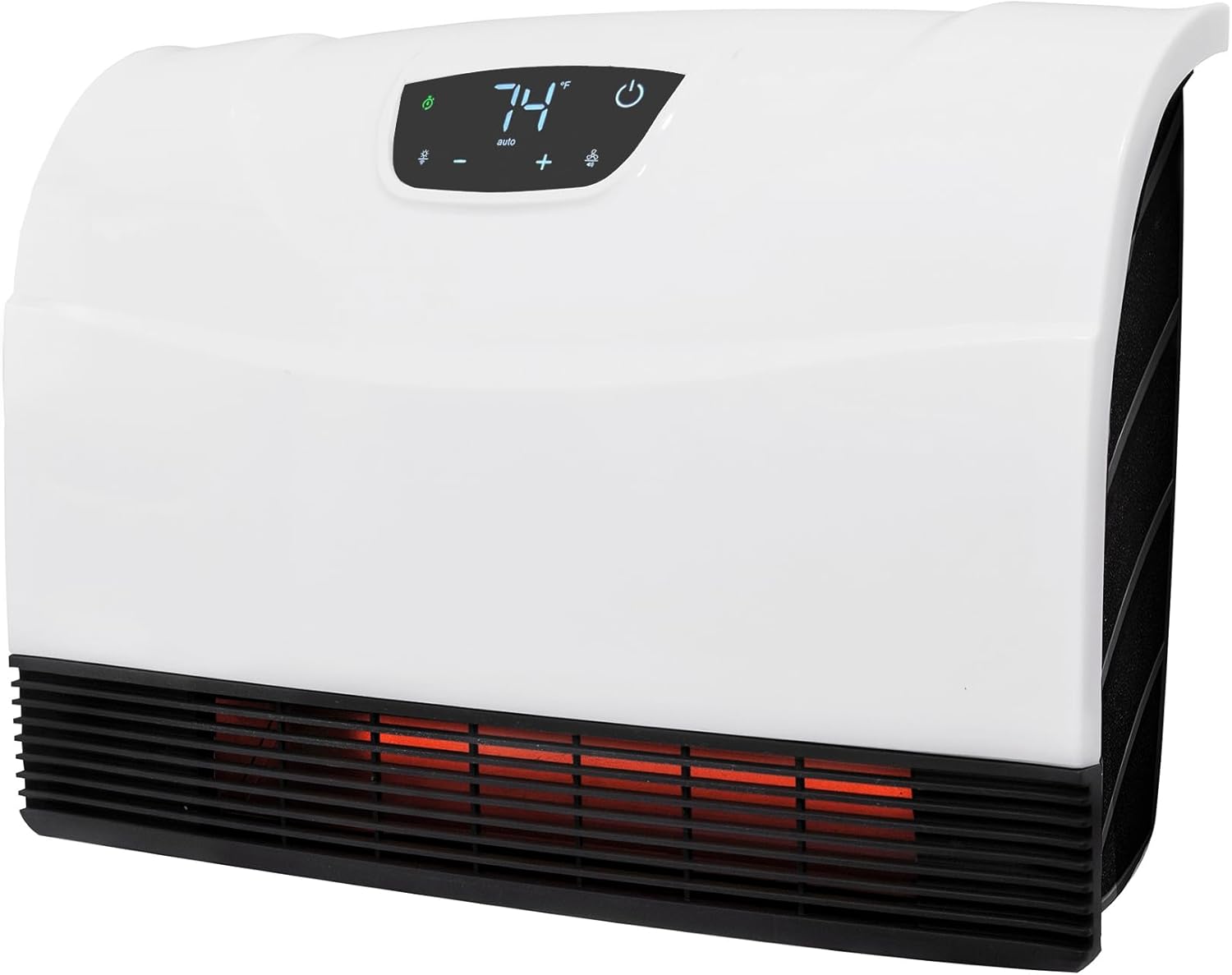
The Heat Storm Phoenix HS-1500-PHX-WIFI is a 1500 watt infrared wall heater intended as a space-saving heating option for bedrooms, bathrooms, offices, and small garages. It mounts to the wall and plugs into a standard 110V outlet, offering radiant infrared heat that the listing says can serve as a primary heater for about 150 sq ft or a supplemental source up to 750 sq ft depending on insulation. Built-in Wi-Fi with one-touch Bluetooth setup lets you control temperature and schedules from a phone, and the included remote and touchscreen thermostat give local control. Practical benefits include a cool-to-the-touch grille, tip-over safety shutoff, washable filters, and an installation that can hide the cord when mounted over an outlet. Expect efficient zone heating and minimal floor footprint, but remember this is sized for small rooms and depends on room insulation for coverage; it will not replace a whole-house system. The design favors people who want app control and a neat wall-mounted installation rather than a portable heater to move between rooms.
Best for: Buyers who value compact, wall-mounted zone heating and want remote app control plus simple installation for a single room.
Less Ideal for: People needing portable heaters to move between rooms or looking to heat large, poorly insulated spaces as a primary solution.
- Wall-mount design saves floor space and can hide the cord when installed over an outlet
- Wi‑Fi and one-touch Bluetooth setup enable remote scheduling and temperature control from a phone
- 1500W infrared element provides focused radiant heat suitable for zone heating
- Includes touchscreen thermostat, remote, washable filters, and safety features like cool-to-touch grill
- Intended coverage is limited to small rooms and depends heavily on insulation
- Requires wall mounting for intended installation and is not ideal as a portable heater
Verdict: Choose the Heat Storm Phoenix if you want a compact, wall-mounted infrared heater with Wi‑Fi that delivers reliable zone heating and easy remote scheduling.
Heat Storm HS-1000-WX Wi‑Fi Heater

| Power Source | Corded Electric |
|---|---|
| Heating Method | Convection/Infrared |
| Heating Coverage | 100 ft² Primary, 500 ft² Secondary |
| Voltage | 110 volts |
| Temperature Range | 40 °F to 99 °F |
The Heat Storm HS-1000-WX is a compact wall-mounted infrared heater intended to provide zone heat without occupying floor space. It plugs into a standard 110V outlet, mounts on the wall, and is controlled via an onboard digital display, included remote, or a smartphone app over Wi‑Fi for scheduling and temperature adjustments. The unit uses infrared/convection heating to warm objects and nearby air, offers adjustable thermostat control from 40 to 99 °F, and includes safety features such as ETL listing, tip/over and overheat protection, and a cool-touch grill. It is designed to warm primary spaces of about 100 ft² and supplement larger areas up to about 500 ft². Practical benefits include simple plug-and-play installation with a wall-mount kit, centralized app control for multiple units, and modest power draw at 1000 watts so it is unlikely to trip a standard household breaker under normal use. Limitations are its single power/speed setting and modest coverage compared with larger baseboard or forced-air systems, so it is best for targeted zone heating rather than whole-house use.
Best for: Buyers who want a safe, simple-to-install zone heater with remote and app control for bedrooms, home offices, or other small rooms and prefer reliable, tested hardware over experimental designs.
Less Ideal for: Do not choose this unit if you need whole-room or whole-house heating for large open spaces or if you require multiple power levels and stronger airflow control.
- Wi‑Fi and app control for remote scheduling and grouping multiple units
- Compact wall-mount design saves floor space and reduces trip hazards
- ETL listed with overheat protection and cool-touch grill for safer indoor use
- Adjustable digital thermostat and included remote for easy local control
- 1000-watt power draws modest electricity while providing effective zone warmth
- Single fan/speed configuration limits fine-grained airflow control
- 100 ft² primary coverage means it is not suitable as a primary heater for large rooms
Verdict: A compact, wall‑mount 1000W infrared heater with Wi‑Fi control that delivers safe, easy-to-manage zone heating for small rooms.
Choosing the Right Infrared Heater: Key Factors to Consider
Room Size and Coverage
Match heater wattage to the room you plan to warm. Infrared heaters are best for zone heating and deliver most of their perceived warmth directly to people and objects rather than heating air. For small rooms or bathrooms, lower-wattage models provide comfortable warmth; for medium living spaces, choose a heater with higher continuous output or multiple heat settings.
Room layout matters too. Open-plan spaces require either higher output or multiple units to avoid cold spots. Always check the manufacturer's recommended coverage as a guideline but focus on placement that aims the radiant panels toward seating areas or workspaces for efficient comfort.
Mounting and Placement Options
Consider whether you need a portable floor model, a wall-mounted unit, or a ceiling-mounted heater. Portable heaters are flexible and useful for moving between rooms. Wall or ceiling-mounted infrared heaters are better for permanent zone heating, freeing floor space and reducing tip-over risks.
Placement affects both effectiveness and safety. Mounting height, clearance from combustible materials, and unobstructed line of sight to the target area determine how well the heater warms the space. Confirm the installation requirements and whether the unit includes mounting hardware or a stand.
Control Features and Programmability
Look for straightforward controls that match how you will use the heater. Basic on/off and high/low settings are fine for occasional use, while thermostatic controls, timers, and remote controls are valuable for daily use in living areas or home offices. Programmable schedules let you limit run time and reduce energy waste.
Smart or remote control options add convenience but also introduce complexity. If you value simplicity, a reliable mechanical thermostat and an easy-to-read display may be preferable to networked features.
Safety and Certification
Safety is critical for any home heating appliance. Essential features include overheat protection, tip-over shutoff for portable units, cool-touch housing or guarded elements, and clear minimum-clearance requirements. Some infrared heaters also include child-lock functions or automatic shutoff if airflow is blocked.
Verify that the unit has appropriate electrical certifications for your region. Even with safety features, follow installation and clearance instructions closely and avoid placing objects directly in front of the radiant surface.
Operating Cost and Efficiency
Infrared heaters can feel more efficient because they warm people directly, but actual energy use depends on wattage and runtime. Consider whether the heater has eco modes, adjustable thermostats, or lower-wattage settings that reduce consumption when full power is not needed. Duty cycle and how often you plan to run the heater will be the main drivers of operating cost.
Estimate running costs by multiplying expected daily hours by the heater wattage and your electricity rate. Choosing a model that matches the target zone and has better controls can lower long-term energy expenses.
Durability and Maintenance
Assess build materials, the type of heating element, and warranty terms. Quartz and carbon elements have different warm-up profiles and lifespans; the choice affects how the heater performs over time. A sturdy housing and quality mounting hardware reduce the chance of damage from knocks or relocation.
Maintenance is usually minimal for infrared heaters, but you should be able to clean surfaces and access mounting points without difficult disassembly. Check for replaceable parts and straightforward service procedures if long-term reliability is important.
How Infrared Heating Works
Infrared heaters produce invisible radiant energy that directly warms people and objects in its path rather than heating the air first. This direct heating often feels faster and more immediate compared with convection heaters, which rely on circulating warm air.
Because infrared heating does not depend on moving large volumes of air, it can be effective in drafty rooms or areas with high ceilings. Understanding that infrared warmth is directional explains why placement and aiming matter more than raw wattage in many situations.
- Radiant heat feels immediate when you sit in the beam
- Objects retain heat and can warm a space indirectly
- Less heat loss from air exchange than convection-only systems
Choosing Between Portable and Fixed Units
Portable infrared heaters are useful when you need temporary warmth in different rooms or for occasional use. They are usually plug-and-play and include built-in thermostats and safety cutoffs but require floor space and careful placement to avoid tripping hazards.
Fixed wall or ceiling units provide a cleaner, out-of-the-way solution for permanent zone heating. They are ideal for rooms where you want consistent, hands-off operation and where installation clearances can be obeyed reliably. Fixed installations often produce a neater look and reduce risk from accidental knocks.
- Portables: flexible, quick to deploy, need floor space
- Wall/Ceiling: permanent, out of reach, better for set-and-forget heating
Installation Tips and Safety Best Practices
Follow the manufacturer's clearance recommendations and maintain unobstructed airflow around the radiant surface. For mounted units, ensure secure fastenings and appropriate anchors for wall or ceiling material. Keep combustible materials well away from the heater's face.
Use dedicated outlets when possible and avoid extension cords unless the heater's instructions explicitly allow them. For portable models, place the unit on a stable, level surface and avoid high-traffic pathways. Regularly inspect for damage to the housing, power cord, and controls.
- Maintain required clearances and avoid covering the heater
- Use stable mounting hardware and appropriate electrical connections
- Inspect cords and housings periodically for wear
Reducing Energy Use While Staying Comfortable
Use directional heating to warm occupied areas rather than running a heater at full power to heat an entire room. Combining infrared spot heating with a lower central thermostat setting can reduce total energy use while maintaining comfort where you need it.
Take advantage of timers, thermostats, and lower power settings to minimize runtime. For spaces with occasional use, portable units allow you to heat only the needed area and turn the unit off when you leave, which often cuts energy consumption compared with leaving a central system running.
- Heat people and objects, not the whole room
- Use timers and thermostats to limit runtime
- Pair infrared heating with insulation and draft-proofing
Common Mistakes to Avoid
Do not oversize a single unit to try to heat an open multiroom area; infrared works best as a zone heater. Oversizing can lead to wasted energy and uneven comfort. Instead, pick a unit appropriate for the immediate seating or work area and supplement as needed.
Avoid blocking the radiant surface with furniture, drapes, or storage. That reduces effectiveness and can create a fire hazard. Also, do not rely on decorative installation alone; follow clearances and safety instructions for every use case.
- Avoid using one unit for too large a space
- Do not obstruct the radiant surface
- Follow electrical and clearance guidelines
How We Chose the Best Infrared Heater
We selected the seven infrared heaters on this list using criteria focused on real-world home use and long-term ownership. Primary evaluation factors included consistent heat output across common room sizes, measured in watts and estimated coverage; energy efficiency, looking at runtime power draw and available thermostatic or eco modes; safety features such as tip-over and overheat protection plus surface temperatures; control and convenience options including thermostats, timers, remote control, and mounting flexibility; and build quality with attention to heating element type and durability. We excluded units that lacked explicit safety features or that were designed only for industrial or outdoor use. We also discounted heaters that provide minimal user controls or have unclear performance specifications. The selected products therefore emphasize predictable warmth, sensible energy use, and homeowner-friendly features. Each pick meets multiple criteria above so buyers can choose based on room size, installation preference, and desired control options.
Our full evaluation process is outlined in our review methodology.
FAQ
Are infrared heaters safe to leave on overnight?
They can be safe if the unit includes overheat protection and tip-over shutoff and is used according to the manufacturer's instructions. For uninterrupted overnight use, choose a model with certified safety features and place it away from combustible materials and high-traffic areas.
Will an infrared heater warm the entire room evenly?
Not usually. Infrared heating is directional and best for zone heating. It warms objects and people in its line of sight quickly, but you may still experience cooler spots away from the beam unless you use multiple units or complementary heating.
How much power does an infrared heater use?
Power consumption is typically given in watts and varies by model and setting. Running hours and chosen wattage determine operating cost, so models with adjustable settings or thermostats help limit energy use compared with running at full power continuously.
Can I mount an infrared heater on the ceiling?
Yes, many units are designed for ceiling or wall mounting and can provide broad, downward-directed warmth. Ensure the unit you select is rated for ceiling installation and follow the specified clearance and mounting instructions.
Do infrared heaters help in drafty rooms?
They can feel more effective in drafty spaces because they warm people and objects directly, reducing reliance on heated air that is quickly lost. However, addressing drafts and insulation will improve overall comfort and reduce run time for any heater.
Final Verdict
When choosing an infrared heater, prioritize the match between the heater's output and the specific zone you want to warm. Focus on practical features such as mounting options, usable control features, and certified safety protections rather than chasing the highest wattage. Remember the tradeoff: infrared delivers fast, directional warmth but does not replace whole-house heating. Decide by room and usage pattern. For occasional spot heating, a portable model with a thermostat and safety cutoffs is often best. For consistent zone heating, a fixed wall or ceiling unit that meets clearance and control needs will give the most reliable, low-profile performance.