
Note: This article contains affiliate links. If you click on these links and make a purchase, we may earn a small commission at no extra cost to you. This helps support our research and content. Read our full affiliate disclosure here.
If you want draft-quality beer at home, the right kegerator makes the difference between foamy pours and smooth, chilled drafts. A well-chosen unit keeps beer at the correct serving temperature, manages carbonation, and fits your available space and installation setup. This guide shortlists the top kegerators for home use, focusing on consistent cooling, pour control, and ease of setup and maintenance. Below you will find our top picks plus the criteria we used to evaluate them and practical advice to match a kegerator to your kitchen, bar, or garage.
Top Picks at a Glance
| Best Overall The best all-around choice for most situations | Kegco K309B-2 Kegerator |  |
| Best Quality Built to a higher standard if you want something more solid | Zephyr Presrv 24" Kegerator | 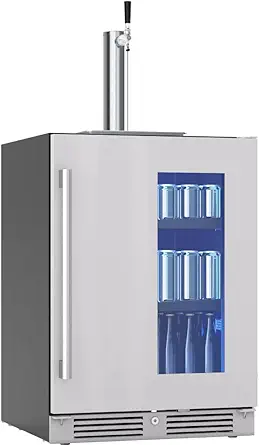 |
| Best Value The sweet spot between price and what you get | Danby DKC054A1BSL2DB Kegerator |  |
| Best Budget The cheapest option that still gets the job done reliably | SPT BD-0538 Mini Kegerator |  |
| Top Rated A top-rated pick with lots of positive feedback | EdgeStar BR3002 Kegerator Refrigerator |  |
| Most Popular A crowd favorite that many people choose with confidence | EdgeStar BR2001 Kegerator Conversion Refrigerator |  |
| Best Seller A high-volume bestseller chosen again and again | VEVOR Beer Kegerator BF152-2 |  |
Kegco K309B-2 Kegerator

| Capacity | 5.6 cubic feet |
|---|---|
| Configuration | Freestanding |
| Cooling Method | Compressor |
| Defrost System Type | Electric |
| Refrigerant | R-134A |
The Kegco K309B-2 is a freestanding two-faucet kegerator built to store and dispense draft beverages from full-size domestic kegs or multiple smaller kegs. It ships with a complete tapping kit including a CO2 tank, dual-gauge regulator, D-system couplers, beer tubing, and a polished two-faucet draft tower, so setup gets you pouring quickly. The unit uses fan-forced compressor cooling and a digital temperature display with push-button controls that let you set temperature in 1-degree increments down to about 32°F, plus a Deep Chill mode for rapid cooldowns. Internally it offers room for full-size kegs or combinations of 5-gallon D and Cornelius kegs and converts to extra refrigeration with two adjustable shelves when not dispensing. Practical features include an easy-clean drip tray, chrome guard rail, and locking casters for mobility and stability. Expect a robust, appliance-style build and reliable cold performance, though the unit is sizable and requires local filling of the shipped empty CO2 tank and occasional maintenance like any compressor refrigerator.
Best for: Buyers who want a ready-to-run, appliance-grade kegerator that balances cold performance, capacity, and included hardware for home draft service.
Less Ideal for: People who need a compact countertop solution or those unwilling to handle CO2 filling and basic refrigeration maintenance should consider other options.
- Complete two-tap dispensing kit included for quick setup
- Digital temperature control with 1-degree increments and Fahrenheit/Celsius display
- Fan-forced compressor cooling with Deep Chill for fast cooldowns
- Spacious interior that accepts full-size and multiple 5-gallon kegs
- CO2 tank ships empty and must be filled separately
- Unit is relatively heavy and takes floor space due to freestanding design
Verdict: A full-featured two-tap kegerator that delivers strong cooling, ample keg capacity, and a complete dispensing kit for buyers who want a turnkey home draft setup.
Zephyr Presrv 24" Kegerator
| Capacity | 5.2 cubic feet |
|---|---|
| Voltage | 115 volts |
| Cooling Method | Compressor |
| Defrost System Type | Automatic |
| Installation Type | Freestanding |
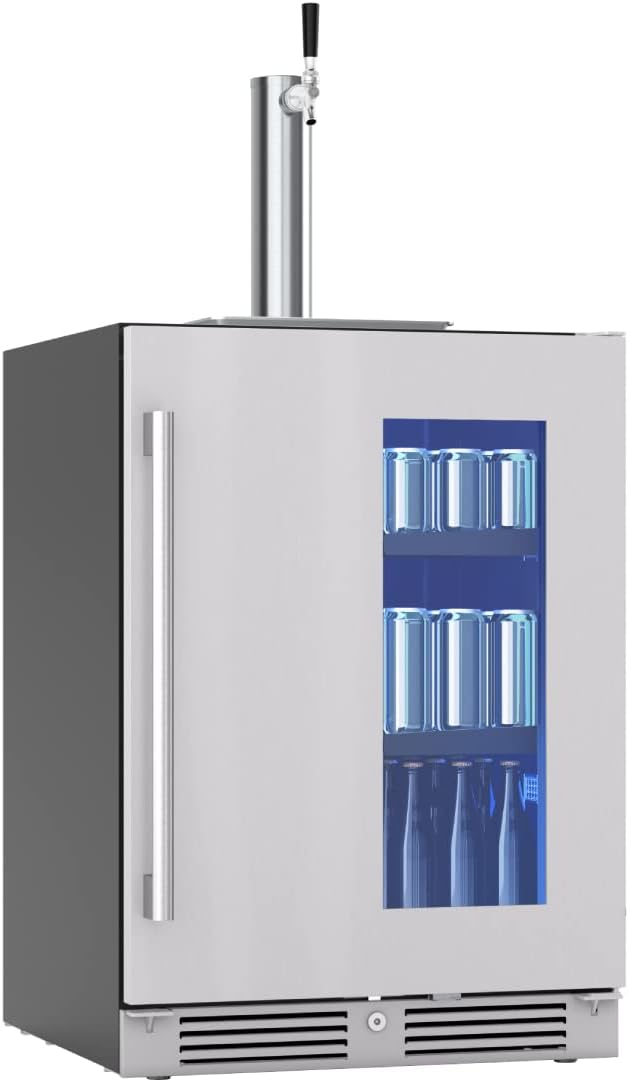
This Zephyr Presrv 24" kegerator combines a compressor-cooled beverage fridge with kegerator capability so you can run a keg or use it as a display cooler when no keg is installed. It is built in stainless steel with a reversible glass door, interior adjustable glass shelf, LED lighting, and lockable kickplate and handle, and it is intended for indoor freestanding or under-counter installations. The unit supports multiple keg configurations when paired with separately sold tap kits and offers automatic defrost and a rotary-style compressor for steady cooling. Practical benefits include its versatile conversion between keg and bottled/can storage, adjustable shelving for different bottle sizes, and a keyed lock for secure service areas. Trade-offs are that tap kits and other kegerator accessories are sold separately and the product is a full 24" cabinet so it needs appropriate space and installation planning; annual energy consumption is relatively high compared with small beverage fridges. For buyers who prioritize integrated keg performance and a robust stainless look, this is a capable option for a home bar or entertainment area.
Best for: A buyer who wants a dedicated home kegerator that can also serve as a versatile beverage display and prioritizes reliable cooling and a durable stainless finish for entertaining.
Less Ideal for: If you need a compact, low-energy countertop cooler or expect a plug-and-play keg setup with taps included, look for a simpler all-in-one kegerator that bundles tap hardware and uses less power.
- Supports multiple keg configurations when paired with optional tap kits
- Compressor cooling with automatic defrost for consistent temperatures
- Adjustable glass shelves let you switch between kegs, bottles, and cans
- Keyed lock and kickplate add security for service or public spaces
- Stainless steel finish and reversible glass door suit built-in or freestanding installs
- Tap kits and kegerator-specific accessories are not included
- Relatively high annual energy consumption compared with smaller beverage coolers
Verdict: Choose this unit if you want a robust, built-in-capable 24" kegerator that converts to a beverage cooler and delivers steady compressor cooling for home entertaining.
Danby DKC054A1BSL2DB Kegerator

| Configuration | dual-tap |
|---|---|
| Capacity | 5.4 cubic feet |
| Defrost System Type | automatic defrost |
| Cooling Method | Compressor |
| Refrigerant | R-600A |
This Danby kegerator is a practical, freestanding dual-tap cooler built for home entertaining and small bars. It holds a 5.4 cu. ft. keg setup and comes with an included CO2 tank, single-gauge regulator, American Sankey coupler, drip tray and chrome guard rail so you can get beer on tap right away. The compressor cooling, R-600A refrigerant and automatic defrost keep temperatures stable with low maintenance, while the mechanical thermostat gives simple, reliable control. The spotless-steel finish and scratch-resistant worktop make cleaning easy and the reversible door plus optional swivel castors add placement flexibility. Expect straightforward, no-frills performance rather than high-end temperature dialing or advanced digital controls, and its footprint and weight mean it suits dedicated indoor spaces. For buyers who want a ready-to-use, durable dual-tap kegerator without complicated setup, this model delivers dependable everyday function.
Best for: Buyers who want a ready-to-use, durable kegerator that prioritizes reliable cooling and easy maintenance for home entertaining or a small wet bar.
Less Ideal for: People seeking precision temperature management, ultra-compact units for tight spaces, or advanced digital features should look elsewhere.
- Dual-tap configuration with included CO2 tank, regulator, and Sankey coupler for immediate setup
- Automatic defrost and compressor cooling for steady temperatures with low upkeep
- Scratch-resistant worktop and spotless-steel finish that are easy to clean
- Reversible door and optional swivel castors for flexible placement
- Mechanical thermostat lacks precise digital temperature control
- Relatively heavy and requires dedicated floor space
Verdict: A practical, ready-to-use dual-tap kegerator that delivers dependable cooling and low-maintenance operation for home hosts.
SPT BD-0538 Mini Kegerator
| Capacity | 0.17 cubic feet |
|---|---|
| Noise | 38 db |
| Special Features | Thermoelectric Cooling, CO2 Pressure Control |
| Voltage | 120 volts |
| Wattage | 800 watts |
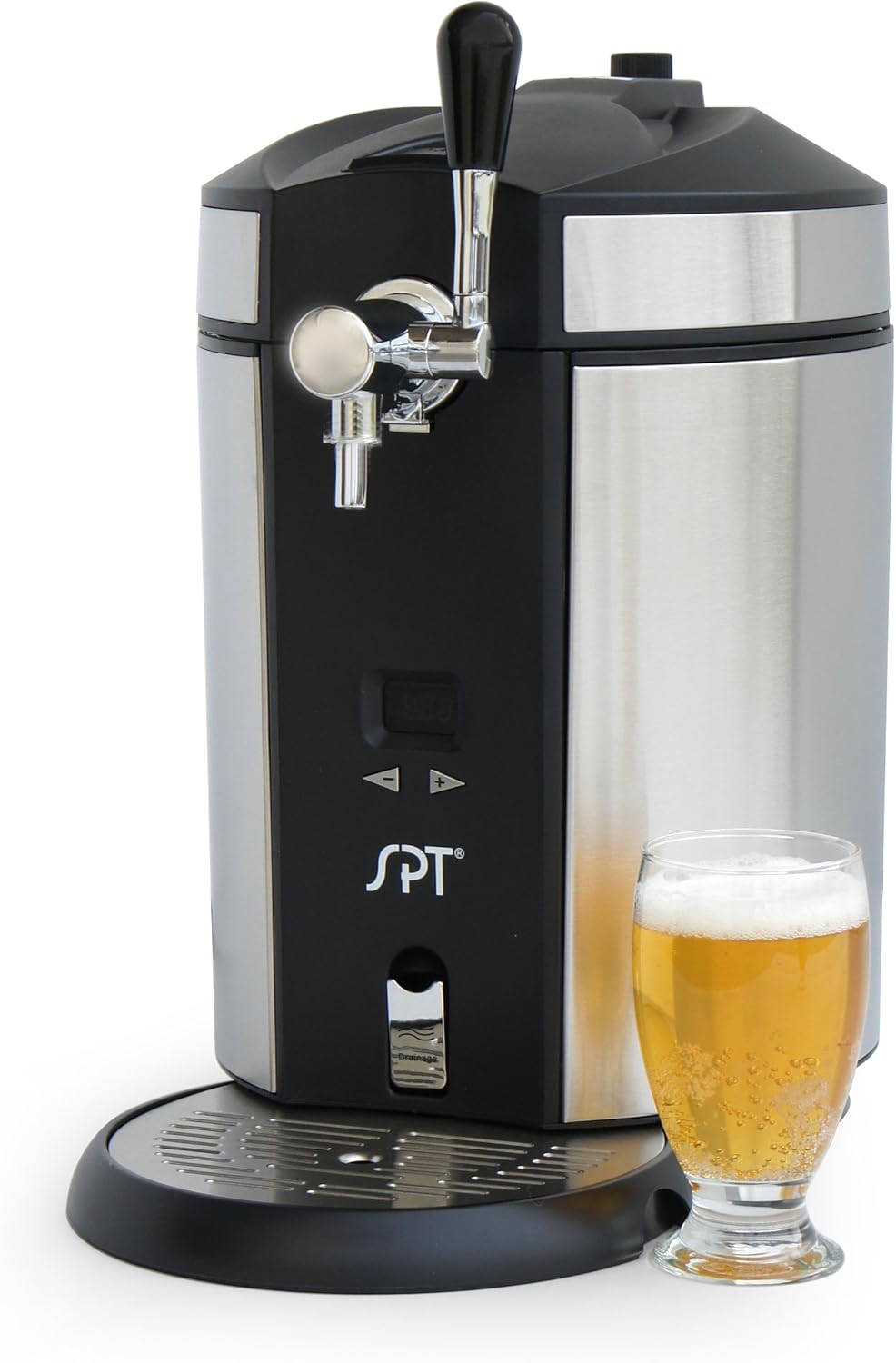
The SPT BD-0538 is a small countertop kegerator made for casual home use and small gatherings. It accepts standard 5L and 5L Heineken mini kegs and ships with three CO2 cartridges plus connectors, so you can tap a keg quickly without separate gas tanks. Thermoelectric cooling and an LED temperature display let you set and monitor serving temperature, and the removable drip tray simplifies cleanup. The stainless steel housing looks neat and should resist everyday wear, while the unit's 0.17 cubic foot capacity and freestanding form factor keep it usable on counters or small bars. Expect modest cooling power compared with compressor models and a noise level around the listed 38 dB, which is reasonable for a compact appliance. This is a straightforward, budget-focused kegerator that prioritizes convenience and portability over heavy-duty cooling or large keg sizes.
Best for: Buyers who want an affordable, compact kegerator for occasional home use or small gatherings and value a plug-and-play setup without dealing with full-size CO2 tanks.
Less Ideal for: Large households, heavy entertainers, or anyone who needs fast, commercial-grade cooling or compatibility with full-size kegs should choose a larger compressor-based unit.
- Accepts 5L and 5L Heineken mini kegs for easy sourcing and tap setup
- Includes three CO2 cartridges and connectors so you can start pouring out of the box
- Thermoelectric cooling with LED temperature display for simple temperature control
- Compact freestanding design and removable drip tray make it easy to place and clean
- Very small internal capacity limits keg size and number of pours before replacement
- Thermoelectric cooling is less effective than compressor systems in warm environments
Verdict: A budget-friendly, plug-and-play mini kegerator that gets you serving 5L mini kegs at home with minimal setup.
EdgeStar BR3002 Kegerator Refrigerator

| Configuration | Freezerless |
|---|---|
| Cooling Method | Compressor |
| Additional Features | Deep Chill Mode |
| Voltage | 120 volts |
| Refrigerant | R-600A |
The EdgeStar BR3002 is a freestanding 24-inch refrigerator designed to convert into a kegerator and accommodate a range of keg sizes, including up to three sixth-barrel or Cornelius kegs. It uses a compressor cooling system with an intuitive digital control panel and a Deep Chill mode that rapidly cools a new keg before settling to a set temperature between 32 and 50°F. The unit includes practical accessories like a guard rail, surface-mount drip tray, four casters for mobility, and two wire shelves if you want to use it as a conventional fridge. Reversible door and a rear knockout for optional CO2 tank storage make installation flexible. Because it is compact and designed for beverage duty, expect average annual energy use and a moderate weight that will need attention during placement. This model is built for steady chilled storage rather than high-end draft performance features like dual-tap systems or built-in regulators, so it is best where reliable cooling and straightforward keg compatibility are the priorities.
Best for: Buyers who want a dependable, no-frills kegerator setup that reliably chills various keg types and prioritizes consistent temperature control over premium draft extras.
Less Ideal for: People seeking built-in, dual-tap commercial draft features or the lightest, most energy-efficient countertop option should consider other models.
- Accommodates a variety of keg sizes including sixth-barrel and Cornelius kegs
- Digital control panel with temperature range from 32 to 50°F and Deep Chill mode
- Includes useful accessories: guard rail, drip tray, casters, and two wire shelves
- Reversible door and rear knockout for optional CO2 tank provide installation flexibility
- Moderate annual energy consumption compared with high-efficiency units
- Relatively heavy and bulky for frequent moves despite included casters
Verdict: Choose the EdgeStar BR3002 when you need a solid, convert-to-kegerator refrigerator that reliably chills multiple keg sizes with straightforward digital controls.
EdgeStar BR2001 Kegerator Conversion Refrigerator

| Capacity | 4.9 cubic feet |
|---|---|
| Refrigerator Net Capacity | 2 cubic feet |
| Temperature Range | Low 30s – 45 F |
| Cooling Method | Compressor |
| Defrost System Type | Automatic |
The EdgeStar BR2001 is a compact, freestanding refrigerator built with kegerator conversion in mind. It stores a full-sized half-barrel Sankey keg or smaller pony, 1/6th, or Cornelius corny kegs and includes a tower hole cap so you can run it as a refrigerator without the tap tower installed. The unit uses a compressor cooling system with automatic defrost and a temperature range from the low 30s to mid 40s Fahrenheit, which is cold enough for draft beer and other beverage storage. Practical touches include casters for mobility, a reversible stainless steel door, keyed lock, and two wire shelves for organizing bottles or parts. Trade-offs are its compact capacity—about 4.9 cubic feet with a 2 cubic foot refrigerator net—and a reciprocating compressor that is effective but can be louder than higher-end compressors. Installation is freestanding only, and the unit is aimed at buyers who plan to convert it to draft service or need a small beverage fridge with keg support rather than a full-size commercial kegerator.
Best for: Buyers who want a proven, compact refrigerator they can convert into a kegerator and who prioritize real-world user feedback and predictable performance over premium features.
Less Ideal for: Those who need large-capacity, built-in, or ultra-quiet commercial-grade kegerators for high-volume dispensing should look at bigger dedicated units.
- Designed to accept a standard 1/2-barrel Sankey keg and smaller kegs
- Freestanding with casters for easy relocation
- Reversible stainless steel door and keyed lock for secure, flexible placement
- Automatic defrost and compressor cooling deliver reliable cold temps for draft beer
- Limited internal capacity compared with full-size kegerators
- Reciprocating compressor can be louder and less refined than inverter-style compressors
Verdict: Choose this EdgeStar if you want a compact, conversion-ready refrigerator that reliably fits a standard half-barrel keg and has straightforward, familiar performance.
VEVOR Beer Kegerator BF152-2

| Capacity | 40 gallons |
|---|---|
| Temperature range | 32°F-50°F |
| Voltage | 115 volts |
| Included Components | 5 lb CO2 tank (empty), regulator, tower, wrench, 2 shelves |
This VEVOR BF152-2 kegerator is a full-size draft dispenser built to store and pour multiple keg sizes while keeping beer at serving temperature. It uses a compressor cooling system with an adjustable knob that sets the interior between 32 and 50°F and an auto-defrost function to reduce maintenance. The unit ships with a dual-tap tower, 5 lb CO2 tank (empty), regulator, beer line, drip tray, tank bracket, two shelves and casters for mobility, so setup and placement are straightforward. Inside there is room for a full-size, quarter, or two sixth kegs and the removable shelf lets you use the cabinet for bottles or cans when not running draft. Practical features such as a 9.8 ft beer line, hose clamps, and gaskets help preserve carbonation and prevent leaks. Expect a heavy appliance that needs floor space and occasional tuning of CO2 and temperature for ideal pours, and note the CO2 tank is empty so you must fill it before use.
Best for: Buyers who want a ready-to-install, full-size kegerator for home entertaining and prefer a complete kit with included hardware and simple temperature control.
Less Ideal for: People who need a compact countertop solution or a lightweight portable dispenser for occasional outdoor use should consider smaller or portable alternatives.
- Compressor cooling with 32–50°F range for proper draft serving temperatures
- Comes with tower, regulator, empty 5 lb CO2 tank, beer line and installation hardware
- Holds full-size, quarter, or two sixth kegs and includes removable shelf for fridge use
- Auto-defrost design and removable drip tray simplify cleaning and maintenance
- Built-in casters and tank bracket make positioning and mobility easier
- CO2 tank is shipped empty so you must arrange filling before pouring
- Large and heavy unit requires dedicated floor space and may be awkward to move
Verdict: Choose this VEVOR kegerator when you want a full-size, dual-tap draft setup that arrives with most of the hardware needed to start serving beer at proper temperatures.
Choosing the Right Kegerator: Key Factors to Consider
Temperature Stability
Keeping beer at a consistent serving temperature is essential for good pours and foam control. Units with better insulation, a reliable thermostat, and a compressor rated for the typical ambient range in your home will maintain a steady temperature over long pours or several kegs. Fluctuating temperatures can make beer taste off and increase foam during dispensing.
When evaluating stability, consider how often you plan to open the door and where the kegerator will sit. Frequent door openings, warm basements, or direct sunlight increase demand on the cooling system and may require a more robust compressor or better insulation.
Dispense Control and Tap Configuration
The regulator, CO2 system, and faucet setup determine how cleanly and consistently your beer pours. A precise regulator that allows fine pressure adjustments helps match carbonation levels to different beer styles and keg sizes. Look for durable faucets and options for shanks or tower configurations if you plan to use a counter-top setup.
Also consider whether the unit supports multiple taps, how easy it is to adjust or replace fittings, and whether forward or reverse-carb setups are needed for your preferred beers. Poor dispense control increases wasted beer and frustration during pours.
Keg Capacity and Fitment
Kegerators come in different internal sizes and coupler compatibility. Think about what keg types and sizes you want to run—cornelius-style, sixth-barrel, or full-size commercial kegs—and confirm interior clearance, rail or spike possibilities, and whether adapters are required.
The physical footprint matters too. Measure the installation spot and allow room for tapping lines, CO2 cylinders, and service access. A larger-capacity unit reduces the need to swap kegs frequently but may require more floor space and a sturdier surface.
Installation Flexibility
Decide whether you need a freestanding unit, a built-in model for under-counter mounting, or a countertop tap tower. Freestanding kegerators are portable and easier to service, while built-in models require proper ventilation clearances and may need specific door-swing configurations.
Also check power requirements and whether the kegerator needs to be hardwired or can run from a standard outlet. Ease of installation affects where you can place the unit and how much extra plumbing or cabinet modification may be required.
Cleaning and Maintenance
Routine cleaning of lines, faucets, and drip trays keeps beer tasting fresh and prevents bacteria or yeast buildup. Choose units with accessible components, removable drip trays, and straightforward internal layouts that allow line removal and cleaning without disassembling the whole cabinet.
Consider the frequency of required maintenance and whether replacement parts like seals, gaskets, and tubing are commonly available. Simpler designs reduce headaches for owners who prefer minimal upkeep.
Noise and Energy Use
Compressors and refrigeration fans create noise and consume power. If your kegerator will live in a common living area or near sleeping spaces, look for models with quieter compressors and well-damped cabinets. Energy-efficient compressors and good insulation also lower running costs over time.
Evaluate duty cycle and expected ambient operating range, since units working at higher duty cycles will both run louder and use more energy. Consider locations and potential noise impact before final placement.
Sizing Your Space: Where to Put a Kegerator
Decide the physical location before selecting a model. Measure floor or cabinet space, factor in ventilation clearance for built-in installations, and ensure there is an accessible electrical outlet. Allow space for CO2 cylinders and supply lines so you can service components without moving the entire unit.
Think about traffic patterns when guests are present. A kegerator placed near seating and counters improves service flow but may need extra insulation or a quieter compressor to avoid disturbing conversations.
- Measure height with tower and clearance for door swing
- Leave several inches for ventilation on built-in units
- Plan for hose routing and CO2 cylinder placement
Matching Keg Types and Couplers
Confirm which keg couplers the cabinet supports and whether adapters are needed for your preferred keg supply. Most home kegerators support common coupler types, but compatibility varies by keg shape and size.
If you plan to switch among multiple keg types, look for units with flexible fittings or easy access to swap couplers. Also verify internal depth and whether rails or keg-stabilizing accessories are included to prevent tipping.
- Check interior depth for taller kegs
- Verify coupler compatibility and adapter availability
- Consider a keg-stabilizer to secure smaller kegs
Maintaining Lines and Beer Quality
Regular line cleaning is essential to prevent off-flavors and maintain carbonation. Plan for a cleaning schedule and make sure the kegerator layout allows access to faucets, shanks, and interior tubing for chemical cleaning or replacement.
Use food-safe cleaning kits and keep spare tubing and seals on hand. Proper sanitation between keg swaps reduces the risk of contamination and preserves the intended flavor profile of each beer.
- Flush lines after each keg change
- Use recommended cleaning chemical strengths
- Keep spare O-rings and tubing for quick repairs
Noise Management and Placement Tips
Compressor noise and fan airflow are normal, but placement can reduce perceived loudness. Position the kegerator on a level, stable surface away from bedrooms or media rooms when possible. A rubber mat under the unit can reduce vibration transfer to floors.
If noise is a primary concern, prioritize units with lower-decibel ratings and consider models with variable-speed compressors that cycle more quietly under light load.
- Place on a stable, level surface
- Avoid enclosing freestanding units tightly
- Use vibration-dampening pads for reduced noise
Accessory Planning: CO2, Regulators, and Towers
Decide what accessories you need from the start. A reliable single- or dual-gauge regulator is essential for consistent carbonation control. If you want multiple beers on tap, plan for multi-line regulators and a tower configuration that matches your counter or cabinet.
Consider where the CO2 cylinder will live and whether you need a cylinder bracket or internal storage. Some setups allow cylinders inside the cabinet while others mount them externally to save interior space.
- Choose regulator type based on number of taps
- Plan cylinder placement for service access
- Select tower height to match counter depth
How We Chose the Best Kegerator
We selected units that deliver stable serving temperatures, reliable CO2 and dispensing systems, and sensible installation options for typical home environments. Our editorial filters prioritized cold-holding performance, dispensing consistency, and user-focused features such as keg capacity, footprint, and configurability. Concrete evaluation criteria included temperature stability under room-ambient conditions, the quality and adjustability of the regulator and faucet, insulation and compressor specifications that affect duty cycle, and installation or retrofitting flexibility for built-in or freestanding placement. We also considered ease of cleaning and maintenance, including drain access, removable components, and parts availability. We excluded commercial-only equipment and units intended solely for very large-volume or commercial venues because those systems have different service and power requirements. The result is a set of kegerators that suit home entertaining and regular personal use, scored by the practical dimensions that most home buyers care about.
Our full evaluation process is outlined in our review methodology.
FAQ
How often should I clean kegerator beer lines?
Typically, clean lines every two weeks for most beers and immediately after pouring dairy-based or fruit-infused taps. Heavy use or sticky beers may require more frequent cleaning to avoid off-flavors and buildup.
Can a kegerator sit in an unheated garage?
It depends on the ambient temperature range the unit supports. Many home kegerators struggle in very cold or hot unheated spaces, so check the operating range and consider a model rated for wider ambient temperatures or locate it in a climate-controlled area.
What size CO2 cylinder do I need for home use?
A 5-pound cylinder is common for casual home use and provides many kegs worth of service before refill. Larger cylinders last longer between refills but require more space and may need a bracket or external mounting.
Is it okay to run a kegerator with the door open for long periods?
No. Running with the door open forces the compressor to work harder, raises internal temperature, and can produce foamy pours. Frequent or prolonged door openings reduce efficiency and may shorten the compressor life.
Do I need special ventilation for an under-counter kegerator?
Yes. Built-in units require clearance and a ventilation slot or grille to allow heat rejection. Without proper ventilation, the compressor will run continuously and may overheat, reducing cooling performance and lifespan.
Final Verdict
Choose a kegerator that balances reliable temperature control, the dispensing flexibility you need, and an internal layout that fits your preferred keg types. Prioritize stable cooling and a solid regulator and faucet setup if pour quality is your primary concern. If space or noise matters more, focus on compact, low-noise models and plan installation to minimize impact on your living space. Weigh the tradeoffs between capacity, maintenance effort, and installation needs to find the best fit. Making those priorities clear before you buy will help you pick a kegerator that performs well in everyday home use.