
Note: This article contains affiliate links. If you click on these links and make a purchase, we may earn a small commission at no extra cost to you. This helps support our research and content. Read our full affiliate disclosure here.
Pocket knives are indispensable daily tools, and a dull folding blade quickly turns convenience into frustration. Picking the right knife sharpener for pocket knife maintenance keeps edges shaving sharp, extends blade life, and reduces the chance of slips or damage during use. This guide covers our top shortlisted sharpeners suited for pocket knives, focusing on how easily they restore an edge, how long that edge holds up, and how safe they are to use in everyday situations. Read on to understand the practical tradeoffs and which features matter most when maintaining folding knives.
Top Picks at a Glance
| Best Overall The best all-around choice for most situations | Work Sharp Precision Adjust |  |
| Best Quality Built to a higher standard if you want something more solid | HORL 2 Walnut Rolling Sharpener |  |
| Best Value The sweet spot between price and what you get | AccuSharp Knife Sharpener ACCU-001C |  |
| Best Budget The cheapest option that still gets the job done reliably | Smith's 2-Step Knife Sharpener CCKS |  |
| Top Rated A top-rated pick with lots of positive feedback | Work Sharp Guided Field Sharpener |  |
| Most Popular A crowd favorite that many people choose with confidence | SHARPAL 101N Pocket Sharpener |  |
| Best Seller A high-volume bestseller chosen again and again | KITCHELLENCE 3-Stage Knife Sharpener |  |
Work Sharp Precision Adjust

| Included components | 320 & 600 Grit Tri-Brasive, Diamond, Fine Ceramic, Angle Adjustable Chassis, Benchtop Base, Knife Clamp, Slide Rod |
|---|---|
| Angle range | 15-30 degrees (1-degree increments) |
| Material type | Acrylic, Ceramic, Neoprene, Plastic, Steel |
| Model number | WSBCHPAJ |
The Work Sharp Precision Adjust is a benchtop guided sharpening system that lets you set and repeat a precise edge angle from 15 to 30 degrees in one-degree steps. You clamp the blade in the v-block, set the angle on the adjustable chassis, and slide the three-sided tri-brasive rod (coarse diamond, fine diamond, fine ceramic) across the edge to reprofile or polish it. In practice it speeds up manual sharpening versus freehand stones and produces consistent, repeatable edges on kitchen and pocket knives. The included clamp and slide rod keep blades secure and aligned, which is helpful for users who want predictable results without advanced skill. It is a manual system, so it takes time and practice to develop efficient strokes, and it is larger than simple pocket sharpeners so it belongs on a workbench or counter. The kit covers a wide range of blades and edge finishes but does not replace stropping for final polishing or motorized systems for very fast stock removal on heavily damaged blades.
Best for: Buyers who want a reliable, repeatable guided system to maintain and reprofile pocket and kitchen knives and who value precision over absolute portability.
Less Ideal for: If you need an ultra-compact field sharpener for on-the-go use or want a motorized machine for rapid stock removal, choose a different type of sharpener.
- Adjustable, repeatable angle control from 15 to 30 degrees in 1-degree increments for consistent edges.
- Tri-brasive rod with coarse and fine diamond plus fine ceramic stones for quick reprofile and refined polish.
- Secure v-block clamp and guided chassis reduce user error and improve safety during sharpening.
- Benchtop design and included base provide stable setup for heavier or longer sharpening sessions.
- Manual system requires practice and time to achieve fast, even results.
- Larger benchtop footprint makes it less portable than compact field or pocket sharpeners.
Verdict: Choose this guided benchtop sharpener when you want precise, repeatable edges on pocket and kitchen knives without relying on freehand skill.
HORL 2 Walnut Rolling Sharpener

| Angles | 15° and 20° |
|---|---|
| Grinding disc | Diamond disc |
| Honing disc | Ceramic disc |
| Made in | Germany |
The HORL 2 Walnut is a hand-operated rolling sharpener built for precision sharpening of kitchen and pocket blades. It uses a diamond grinding disc for edge formation and a ceramic honing disc for finishing, with a magnetic angle holder that locks in either a 15° or 20° setting so you get repeatable results without whetstone skills. In practice you attach the roller, set the angle, and make a few smooth rolls to regrind or resharpen an edge; the planetary gearing and precision ball bearings help keep the motion steady and play-free. The walnut body and German construction are premium touches, and the kit includes the discs and magnetic guide so you can sharpen a range of steels from stainless to high-carbon blades. It is compact and suitable for frequent tuning of pocket knives and chef knives, but it requires a careful rolling technique and is not as fast as motorized systems for heavy re-profiling of badly damaged edges.
Best for: Buyers who prioritize razor-sharp, performance-oriented edges and want a precise, repeatable manual system for tuning pocket knives and kitchen blades.
Less Ideal for: If you need a fast, high-volume or power-driven solution for severely damaged blades, a motorized grinder or professional service is a better choice.
- Interchangeable diamond and ceramic discs for both grinding and honing.
- Magnetic angle support that fixes 15° or 20° for consistent, repeatable edges.
- Precision ball bearings and planetary gearing for smooth, stable rolling action.
- Handcrafted German build with a compact, attractive walnut body and included accessories.
- Hand-operated method is slower than powered sharpeners for heavy damage.
- Not intended for large-scale re-profiling or industrial use.
Verdict: Choose the HORL 2 if you want a premium, manual sharpening system that delivers precise, repeatable 15° or 20° edges for high-performance pocket and kitchen knives.
AccuSharp Knife Sharpener ACCU-001C

| Material Type | Acrylonitrile Butadiene Styrene |
|---|---|
| Grit Type | Coarse |
| Included Components | Sharpener |
The AccuSharp ACCU-001C is a simple, grab-and-go pull-through sharpener that restores edge on a wide range of knives in seconds. You use it by placing the blade in the V-shaped carbide slot and pulling through a few times while the ergonomically shaped handle keeps your hand clear of the edge. Its diamond-honed tungsten carbide blades (reversible for longer life) deliver a coarse, fast cut that brings dull edges back to usable sharpness almost instantly, and the full-length finger guard improves safety during use. The unit is lightweight and easy to clean, and many users report years of service before replacement blades are needed. The main limitation is the coarse-only grit and preset sharpening angle, which makes it best for basic edge repair and not for precision honing or re-profiling high-end pocket knife steels. It also cannot replicate a stropped, razor-polish finish that sharpening stones or guided systems can produce. For everyday pocket knives and utility blades this is a fast, reliable option; for collectors or very hard steels a stone or guided system is preferable.
Best for: Buyers who want a fast, no-fuss sharpener to maintain everyday pocket knives and utility blades without learning stone techniques, prioritizing speed and convenience.
Less Ideal for: Collectors, knife enthusiasts, or anyone needing precision edge geometry or a mirror-polished finish on high-end steels should choose a whetstone or guided sharpening system instead.
- Very quick to use—sharpens most blades in about ten seconds
- Diamond-honed tungsten carbide blades are durable and reversible
- Ergonomic handle with full-length finger guard improves safety
- Easy to clean and dishwasher safe
- Only offers a coarse grit and fixed angle, not suitable for precision honing
- Not ideal for producing a polished, razor-sharp stropped edge
Verdict: A fast, durable pull-through sharpener that gives pocket and utility knives a usable edge in seconds for users who value speed and simplicity.
Smith's 2-Step Knife Sharpener CCKS

| Included Components | 1 sharpener |
|---|---|
| Material Type | Synthetic |
| Grit Type | Coarse,Fine |
Smith's CCKS is a simple, portable two-step pull-through sharpener designed for quick edge restoration in the field or at home. The first stage uses crossed tungsten carbide blades at a preset angle to reshape very dull edges with three to four strokes, while the second stage of crossed ceramic rods hones and polishes the edge to a finer cutting surface. Its lightweight plastic body, non-slip rubber feet, and lanyard hole make it easy to carry on a pack or keychain and the unit even floats, which is handy for anglers. Use it for pocket knives, fillet knives, and general outdoor blades where speed and portability matter more than precision honing. Limitations are its preset angles and simple pull-through design, which do not replace a full stone or guided system for precision sharpening or restoring severely damaged blades, and the synthetic body is basic compared with metal-bodied sharpeners.
Best for: Buyers who want an inexpensive, grab-and-go sharpener for pocket knives and outdoor blades and prioritize speed and portability over precision refinement.
Less Ideal for: Users seeking fine-tuned angle control or professional-level edge restoration should choose a whetstone or guided sharpening system instead.
- Two-stage system with carbide coarse and ceramic fine stages for both rapid re-profiling and polishing
- Preset angled slots remove guesswork for quick, consistent results
- Very compact and lightweight with lanyard hole for easy carry
- Non-slip rubber feet and floating design improve safety and outdoor use
- Preset angles limit control for achieving specific bevels or mirror finishes
- Not suitable as a replacement for stones or guided systems for precise edge work
Verdict: A cheap, pocketable two-stage sharpener that reliably restores and hones pocket and fillet knives when portability and speed matter.
Work Sharp Guided Field Sharpener

| Material Type | Diamond and Ceramic Sharpener |
|---|---|
| Grit Type | Coarse, Fine |
| Included Components | WSGFS221 |
The Work Sharp Guided Field Sharpener is a portable sharpening kit aimed at anglers, hunters, and anyone who needs a reliable edge away from the bench. It bundles removable diamond plates, a rotating ceramic rod with coarse and fine faces plus a grooved surface for fish hooks, a leather strop, and guided angle slots for 20 and 25 degrees so you can reproduce a consistent edge quickly. The kit is self-contained with no tools or setup required, and the compact layout makes it easy to carry in a pack or glove box. Practical benefits include fast material removal from the diamond plates for damaged blades, a honing option for finishing on the ceramic rod, and a strop for polishing the edge. Limitations are the fixed angle choices, which suit most pocket and hunting knives but do not cover very low or specialty angles, and the small abrasive size that makes extending or reshaping large blades slower than a bench system.
Best for: Buyers who prioritize a dependable, take-anywhere sharpener for pocket, hunting, and field knives and want a straightforward guided setup that produces consistent edges.
Less Ideal for: People who need precise, variable angles beyond 20° and 25° or who regularly reshape large kitchen or chef knives should opt for a benchtop or fully adjustable system instead.
- Portable, self-contained design with removable diamond plates and strop
- Includes both diamond and ceramic abrasives for coarse sharpening and honing
- Guided 20° and 25° angles deliver consistent, repeatable edges
- Ceramic rod has grooved surface for fish hooks and dual-face honing
- Limited to preset 20° and 25° angles, so not ideal for very low or specialty bevels
- Small abrasive surfaces make heavy reshaping or large blades slower than benchtop systems
Verdict: Choose this guided field sharpener when you need a reliable, compact sharpening kit that delivers repeatable edges for pocket and hunting knives on the go.
SHARPAL 101N Pocket Sharpener

| Included Components | 6-In-1 Knife Sharpener & Tool |
|---|---|
| Material Type | Tungsten carbide, Ceramic, Monocrystalline Diamonds |
| Grit Type | Fine,Medium,Coarse |
The SHARPAL 101N is a small, portable sharpener designed for field use with pocket and hunting knives. It uses a carbide V-notch to quickly reprofile dull edges, a fine ceramic slot to hone to a smoother cutting edge, and a tapered diamond rod for serrations and gut hooks; an additional diamond rod includes a groove for fishhooks. The tool also integrates a ferrocerium fire starter and an emergency whistle, plus a lanyard hole for attaching to gear. In practice the carbide and ceramic stages make fast work of moderately dull blades and the diamond rod handles harder steels and serrations better than ceramic alone. The preset angle and compact size make it easy to use on the trail, but the fixed-angle V-slot limits sharpening geometry options and is not suitable for precision blade restoration. Build materials list tungsten carbide, ceramic, and monocrystalline diamonds which should hold up to routine use, though very damaged blades may need a true whetstone or professional stone work. For buyers looking for a lightweight, multifunction field sharpener, the 101N is a capable, no-fuss choice.
Best for: Buyers who prioritize a proven, compact field tool with visible user feedback and wide community approval and want a single device that sharpens straight and serrated edges while adding survival features.
Less Ideal for: Users seeking precision bench sharpening, custom edge angles, or restoring heavily chipped blades should choose a whetstone or professional sharpening system instead.
- Multiple abrasive types (carbide, ceramic, diamond) cover quick sharpening and finer honing
- Tapered diamond rod and hooked-groove rod address serrations and fishhooks
- Includes ferro rod fire starter and whistle for emergency outdoor use
- Compact, lanyard-ready design fits pocket or pack for EDC portability
- Fixed preset angle prevents precise bevel control for reprofiling or custom angles
Verdict: A compact, well-rounded field sharpener that delivers fast, reliable edge touch-ups and survival tools for pocket-knife users who value proven performance and social-proof reliability.
KITCHELLENCE 3-Stage Knife Sharpener
| Material Type | Plastic |
|---|---|
| Included Components | Yes |
| Model Number | KS37 P |
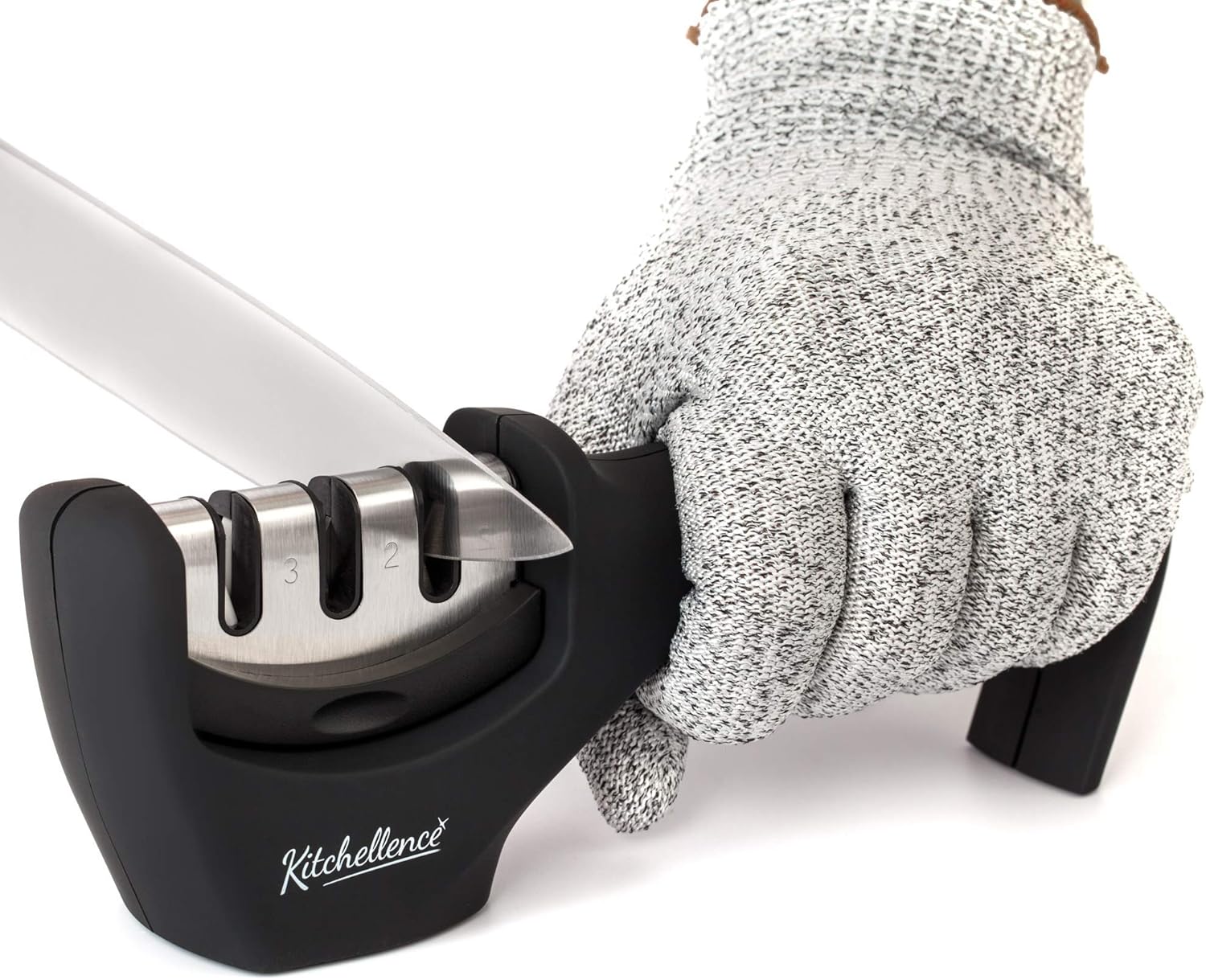
This compact 3-stage sharpener is built to repair, sharpen, and polish blades using a diamond rod for repair, a second angled slot to re-establish the edge, and a finer third slot for final honing. It is handheld with an ergonomic non-slip base for one-handed use and includes a cut-resistant glove for safer operation. For everyday pocket knives the diamond rod helps true damaged edges and the progressive slots let you go from fixing nicks to finishing a razor-like edge in a few pulls. The ABS plastic body keeps it lightweight and easy to store, and the simple pull-through method works equally for right- and left-handed users. Limitations are that it is a manual pull-through tool so aggressive material removal is modest and it provides fixed angles rather than adjustable geometry, which matters if you need custom bevels or work with very thin modern pocket-knife steels. Still, for routine maintenance and restoring dull or slightly nicked pocket blades this kit is quick, safe, and approachable for cautious buyers.
Best for: A safety-minded buyer who wants a straightforward, low-risk way to maintain and restore everyday pocket knives without learning whetstone technique.
Less Ideal for: Users who need precise angle control for specialty pocket-knife grinds or who regularly reprofile very dull or damaged high-hardness steels should consider a guided sharpener or stones instead.
- Three-stage system (diamond rod, sharpening, polishing) covers repair through finishing
- Ergonomic non-slip base and single-hand operation for stable, controlled sharpening
- Includes cut-resistant glove to reduce risk during use
- Compact, lightweight ABS construction is easy to store and carry
- Fixed sharpening angles limit ability to set custom bevels for specialty blades
- Manual pull-through design removes metal slowly compared with guided systems or stones
Verdict: A safe, easy-to-use 3-stage kit that reliably restores and polishes pocket-knife edges for routine home maintenance.
Choosing the Right Knife Sharpener for Pocket Knife: Key Factors to Consider
Sharpening Method and Abrasive Type
The sharpening method you choose determines how quickly you restore a cutting edge and how much metal is removed. Pull-through slot sharpeners use fixed abrasive angles for speed but can remove more material if used aggressively. Honing rods and ceramic rods are gentler and better for frequent touch-ups without reprofiling the blade. Diamond abrasives cut fast and handle hard steels well, while ceramic and stone surfaces produce finer finishes.
For pocket knives you often want a balance: a method that restores a usable edge quickly but also preserves steel over repeated maintenance. Consider whether the sharpener's abrasives are replaceable or serviceable, since long-term upkeep affects overall value. The abrasive type also influences the kind of edge finish you can achieve, which matters for tasks that require slicing precision versus rough outdoor cutting.
Angle Control and Edge Geometry
Pocket knives come with varying factory edge angles and tip geometries, and maintaining the intended angle preserves cutting performance. Fixed-angle systems simplify use by setting a repeatable angle, which is useful for users who prefer consistency. Adjustable-angle sharpeners let you match low-angle slicing grinds or higher-angle harder-use edges, but they require more skill to use properly.
For folding blades that are often used for everyday tasks, a moderate angle typically balances sharpness and durability. If you frequently use the knife for heavy-duty cutting, a slightly higher angle will reduce chipping. Good sharpeners offer clear angle guides or jigs so you can reproduce the desired geometry on narrow pocket-knife blades.
Tip and Spine Access
Pocket knives often have short blades and slender tips that can be damaged by bulky sharpening tools. How a sharpener handles tip access matters because an overbuilt sharpening slot or a wide stone can miss or crush a fine point. Look for tools with profiles or jigs designed to reach the full blade length and maintain consistent contact at the tip.
Spine access is also important if you want to touch up the entire bevel from heel to tip. Some sharpeners include micro-bevel options or tapered surfaces to accommodate the narrow geometry of folding knives. Devices that fail to reach the tip can leave the edge uneven and reduce real-world cutting performance.
Safety and Ease of Use
Because pocket knives are small and often handled in casual settings, safety features on a sharpener are essential. Non-slip bases, finger guards, and secure blade guides reduce the chance of slips that could injure the user or damage the blade. Ergonomic handles and clear usage markings help less-experienced users maintain a consistent stroke.
Ease of use also affects how often you will maintain your knife. A compact, intuitive sharpener that delivers predictable results encourages more frequent touch-ups. Conversely, an awkward or risky tool may be neglected, leading to more metal loss when a blade finally gets sharpened aggressively.
Portability and Storage
Many pocket-knife owners prefer sharpeners they can carry in a pack, glove box, or pocket. Weight, size, and whether a tool comes with protective covers or storage pouches influence portability. Some sharpeners are compact enough to stow alongside a knife, while others are better kept in a workshop.
Consider whether the sharpener requires additional accessories like clamps or stands that reduce its practicality in the field. Also think about weather resistance and how abrasive materials perform if exposed to moisture or grit. A portable sharpener that is simple to clean and store will be used more often, keeping blades in consistently better condition.
Durability and Maintenance
A sharpening tool should remain accurate and effective through repeated use. Durable housings, replaceable abrasive components, and corrosion-resistant materials extend a sharpener's service life. If the abrasive surface wears quickly, the device becomes less reliable and may need frequent replacement or refurbishment.
Maintenance also includes cleaning to remove metal filings and occasional reconditioning of stones or rods. Avoid sharpeners with glued or sealed abrasives that cannot be refreshed. For tools used outdoors, resilience to knocks and drops is a practical consideration because a damaged alignment will affect sharpening performance.
Field Sharpening Vs Home Maintenance
Think about where you will most often sharpen your pocket knife. Lightweight, compact systems and small diamond rods are suited to field repair and quick touch-ups. They are designed for portability and fast cutting action but may not produce a razor polish.
Larger stones, guided systems, and bench-mounted options are better for thorough regrinds and edge profiling at home. These setups take more space and time but let you control bevel angles precisely and refine the edge finish for longer-lasting performance.
- Field tools: fast, portable, limited finishing
- Home systems: precise, better finishes, less portable
- Decide based on how often you need full regrinds versus quick touch-ups
Using Guides and Jigs Effectively
Guides and jigs help reproduce consistent angles, which is especially important for small blades where slight deviations affect tip alignment. Learn the setup steps and test on less-valued blades to get a feel for the system before working on a favorite knife.
Keep strokes even and maintain light, controlled pressure. Over-pressing can remove excessive metal or alter the intended bevel. For adjustable jigs, mark your preferred setting so you can return to it quickly.
- Start with a coarse abrasive to set the bevel only if the blade is blunt
- Finish with a finer abrasive or strop for a polished cutting edge
- Record angle settings used for repeatability
Caring for Your Sharpener
Regular cleaning removes metal particles and preserves abrasive action. Wipe surfaces after use and avoid letting filings accumulate in slots or on rods. If the tool uses stones, stone flattening and occasional reconditioning will keep the surface even and predictable.
Store portable sharpeners in protective sleeves to prevent damage to abrasive surfaces. Replace worn components when performance declines rather than compensating with extra pressure, which risks damaging blades.
- Clean filings after every session
- Refresh stones or replace abrasives as needed
- Keep portable units dry and protected in transit
When to Reshape Versus Touch Up
A touch-up restores a previously sharp edge and requires less material removal, typically performed with rods or fine abrasives. Reshaping or reprofiling corrects a damaged bevel, fixes a rolled edge, or changes geometry and needs coarser abrasives or guided systems.
For pocket knives used daily, frequent light maintenance prevents the need for heavy reprofiling. Reserve aggressive reprofiling for when the blade chips, develops significant roll, or you intentionally change the edge angle.
- Touch up regularly with fine abrasives
- Reshape only when damage or angle change is needed
- Frequent light maintenance preserves blade steel
Edge Finishes and Task Matching
Different edge finishes serve different tasks. A highly polished, low-angle edge slices exceptionally well for food prep and delicate cutting but is more vulnerable to chipping in heavy use. A slightly coarser finish with a higher angle is tougher for outdoor tasks and rope cutting.
Choose a sharpener that can achieve the finish appropriate to your knife's primary use, or use a combination of abrasives to build a working edge and then refine it to the desired polish.
- Fine polish for slicing and precision
- Coarser finish for durability and outdoor work
- Multi-stage sharpening yields the best balance
How We Chose the Best Knife Sharpener for Pocket Knife
We prioritized tools that are effective on small folding blades, safe to use in casual and field conditions, and easy to carry or store. Our evaluation emphasized sharpening speed, the quality and durability of the resulting edge, compatibility with common pocket-knife steels and blade geometries, and user safety during use. We also considered portability and ease of setup for people who maintain knives at home or on the go. Products that required specialized fixtures or only worked on large fixed blades were excluded. We favored sharpeners that offer repeatable angles, protect thin tips, and have replaceable or long-lived abrasive surfaces. Finally, durability of the device and clear usage guidance were important filters, as these affect how likely a buyer is to keep a sharpener in regular rotation.
Our full evaluation process is outlined in our review methodology.
FAQ
How often should I sharpen a pocket knife?
It depends on use. For everyday light tasks, a quick touch-up every few weeks keeps the edge useful. Heavier or outdoor use may require more frequent attention. Focus on small, regular maintenance rather than letting the blade become very dull.
Can I use a regular kitchen sharpener on a pocket knife?
Often you can, but be mindful of blade length and tip access. Some kitchen-style sharpeners are bulky and may not reach the tip or may remove too much metal. Choose a tool that matches the blade geometry and size for best results.
Is a guided sharpener better for beginners?
Yes, guided systems simplify angle control and produce repeatable results, which is helpful for beginners. They reduce the learning curve and lower the risk of altering the blade profile unintentionally.
Are diamond abrasives necessary for hard-pocket-knife steels?
Diamond abrasives cut quickly and handle high-hardness steels well, making them useful when steels are harder than average. They are not always necessary for softer steels where ceramic or stone abrasives can achieve a fine edge with less aggression.
How do I protect a fine tip when sharpening?
Use a sharpener with tapered or narrow contact points that reach the tip, and employ light, controlled strokes. Guided jigs or flexible honing rods can better follow the blade profile and avoid crushing the tip.
Final Verdict
When choosing a knife sharpener for pocket knife maintenance, prioritize how you will use the tool: portability and speed for field touch-ups, or angle control and finishing for home regrinds. Balance abrasive aggressiveness with the desire to preserve steel and maintain tip geometry. Favor devices that offer consistent angle control, good tip access, and safety features so you will actually keep up with routine maintenance. With those priorities in mind, you can pick a sharpener that keeps folding blades dependable while minimizing unnecessary metal removal.