
Note: This article contains affiliate links. If you click on these links and make a purchase, we may earn a small commission at no extra cost to you. This helps support our research and content. Read our full affiliate disclosure here.
If you cook regularly, a sharp knife makes prep faster and safer. A knife sharpener on a budget can deliver consistent edge restoration without a steep learning curve or complex tooling. This guide covers seven shortlisted options that perform well for home kitchens and light professional use, and explains the practical tradeoffs between speed, ease, and edge longevity. We evaluated units for how quickly they restore a working edge, how simple they are to operate, and how long their abrasive elements last. Read on for the factors we tested and quick guidance to help you pick the right budget-friendly sharpener.
Top Picks at a Glance
| Best Overall The best all-around choice for most situations | SHARPAL 191H Knife Sharpener |  |
| Best Quality Built to a higher standard if you want something more solid | Intelitopia Knife Sharpening Stone Set |  |
| Best Value The sweet spot between price and what you get | Amazon Basics 4-in-1 Knife Sharpener |  |
| Best Budget The cheapest option that still gets the job done reliably | 4-Stage Knife Sharpener |  |
| Top Rated A top-rated pick with lots of positive feedback | AccuSharp Knife Sharpener ACCU-001C |  |
| Most Popular A crowd favorite that many people choose with confidence | KitchenIQ Edge Grip 2-Stage Sharpener |  |
| Best Seller A high-volume bestseller chosen again and again | KITCHELLENCE 3‑Stage Knife Sharpener |  |
SHARPAL 191H Knife Sharpener

| Material Type | Ceramic, Tungsten Carbide |
|---|---|
| Grit Type | Fine |
| Item Type Name | 3-Stage Sharpening Tool Knife Sharpener Professional with Suction Cup |
The SHARPAL 191H is a small three-stage sharpener that covers quick edge setting, honing, and scissors sharpening in one compact tool. You use it by placing the unit on a smooth countertop, engaging the suction base with the black switch, then running the blade through the carbide slot to reprofile a dull edge and finishing in the ceramic slot for a finer polish. A dedicated tungsten carbide slot handles scissors. The powerful suction keeps the sharpener stable so you can work safely without holding it, and its compact footprint stores easily in a drawer. Because the stages are preset, the 191H is fast and very beginner-friendly, but it does not offer angle adjustment or the finesse of stones or guided systems, so it is best for routine maintenance rather than precision reprofiling or restoring very damaged blades.
Best for: Buyers who want an inexpensive, no-fuss tool to keep everyday kitchen knives and scissors reasonably sharp with quick, repeatable passes.
Less Ideal for: Users seeking professional-level sharpening, custom edge angles, or a solution for badly damaged blades should consider whetstones or guided sharpening systems instead.
- Three-stage design covers coarse carbide setting, fine ceramic honing, and a scissors slot.
- Strong suction base for hands-free, stable sharpening on smooth surfaces.
- Compact, lightweight design that is easy to store and use for quick maintenance.
- Simple, beginner-friendly operation with no angle setup required.
- No adjustable sharpening angle or guided system for precision work.
- Not suitable for repairing heavily chipped or damaged blades.
Verdict: A compact, easy-to-use three-stage sharpener ideal for budget-minded cooks who want fast, reliable touch-ups for kitchen knives and scissors.
Intelitopia Knife Sharpening Stone Set

| Included components | Sharpening Stones |
|---|---|
| Number of Packs | 7 |
| Material Type | Stone |
| Grit Type | Coarse |
This Intelitopia set is a full whetstone kit aimed at users who want professional-style sharpening without paying for single-brand premium stones. It includes a dual-sided 400/1000 grit stone for reshaping and edge repair plus a 3000/8000 grit stone for refining and polishing, a coarse flattening stone to keep stones true, a leather strop for burr removal, bamboo non-slip base pieces, and an angle guide. In practice the 400 grit quickly removes nicks and reprofiles edges while the higher grits noticeably improve cutting smoothness and shine after a few passes and stropping. The included flattening stone and bases help keep setup stable and maintain stone performance over time. Expect some run-in time to learn consistent sharpening angles and to use water correctly, and very coarse work can be slower than with powered systems. For the price this kit gives reliable manual control and the accessories needed to keep blades razor-sharp at home.
Best for: Buyers who prioritize edge performance and want full manual control over sharpening results while keeping costs low and having the accessories needed to maintain stones.
Less Ideal for: People who prefer a quick, hands-off powered sharpener or who need to sharpen many blades fast in a professional setting.
- Dual-sided stones (400/1000 and 3000/8000) cover coarse reshaping to fine polishing
- Includes flattening stone and leather strop for maintenance and final burr removal
- Non-slip bamboo base pieces and angle guide improve stability and repeatable results
- Comprehensive kit provides all accessories needed to sharpen and finish blades at home
- Manual sharpening requires practice to hold consistent angles compared with guided or powered systems
- Very aggressive material removal is slower than dedicated powered sharpeners
Verdict: This kit delivers professional-level manual sharpening performance and the maintenance accessories you need, making it the best budget choice for performance-oriented home sharpeners.
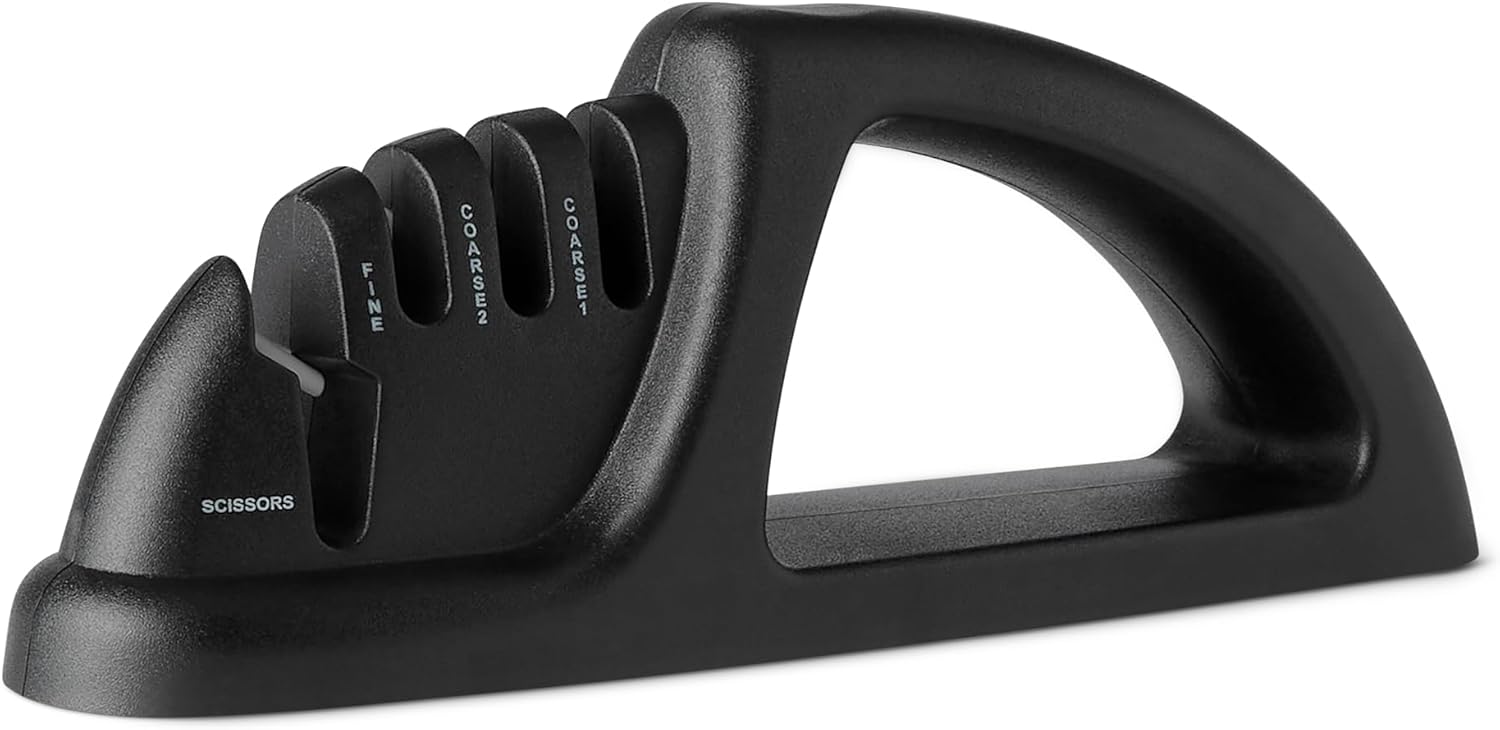
Amazon Basics 4-in-1 Knife Sharpener
| Material Type | Metal, Plastic |
|---|---|
| Grit Type | Coarse, Medium, Fine |
| Included Components | Knife Sharpener |
| Item Type Name | 4-in-1 Knife Sharpener with Safety Glove |
The Amazon Basics 4-in-1 Knife Sharpener is a simple, manual sharpener built for routine edge maintenance on straight-edge blades. It provides three stages — coarse, medium, and fine — so you can restore a dull edge, refine it, and polish it, plus a dedicated slot for scissors. A non-slip silicone base keeps the unit steady during use and the included cut-resistant glove improves safety when holding blades. It is intended for kitchen, pocket, and hunting knives and is easy to clean by rinsing or with soapy water. The design is compact and straightforward, so sharpening is quick without a learning curve, but it does not work on serrated knives and lacks power or angle guides found in some electric models. For buyers who want an inexpensive, no-frills way to maintain everyday knives, this unit delivers reliable sharpening at a low cost, though users seeking precision bevel control or sharpening for specialty blades may prefer a different tool.
Best for: Buyers who prioritize a low-cost, practical tool to keep everyday straight-edge knives sharp with minimal fuss and no technical setup.
Less Ideal for: Users who need to sharpen serrated blades, require precise angle control for professional knives, or prefer an electric sharpener for faster, more consistent results.
- Three-stage sharpening (coarse, medium, fine) covers restoration through polishing.
- Dedicated scissor slot expands usefulness beyond kitchen knives.
- Non-slip silicone base provides stable, safe operation.
- Includes cut-resistant glove for safer handling.
- Easy to clean by rinsing or with soapy water.
- Not suitable for serrated blades.
- No motorized assistance or adjustable angle control for precise bevel work.
Verdict: A budget-friendly, easy-to-use manual sharpener that reliably refreshes everyday straight-edge knives and scissors.
4-Stage Knife Sharpener

| Product type | 4-stage manual sharpener |
|---|---|
| Blade compatibility | Steel and ceramic blades; scissors slot |
This 4-stage knife sharpener provides a simple, budget-friendly way to revive dull kitchen knives and scissors. It guides blades through progressively finer stages—coarse sharpening, fine honing, and polishing—so you can repair nicks and restore an edge without power tools. The unit is handheld or countertop-stable for quick, occasional touch-ups and is suitable for most steel blades and some ceramic blades, with a dedicated slot for scissors. Its compact footprint makes it easy to store in a drawer when not in use. Expect straightforward, repeatable results for routine maintenance, though it will not replace professional sharpening for badly damaged or high-end specialty knives. Also, manual sharpening requires consistent technique to avoid uneven edges, and the abrasive elements will remove material over time, so use sparingly on premium blades. For the price this sharpener is a practical option for everyday home cooks who want decent edge restoration without spending much.
Best for: Buyers looking for the cheapest practical way to keep everyday kitchen knives and scissors serviceable between professional sharpenings; good for apartment cooks and budget-focused households.
Less Ideal for: Owners of high-end forged knives or users who need precision sharpening for specialist blades should look to professional sharpening or higher-end systems.
- Four progressive sharpening stages for coarse sharpening, honing, and polishing
- Works with steel blades and includes a slot for scissors
- Compact, easy to store and simple to use without electricity
- Provides quick edge touch-ups suitable for everyday kitchen knives
- Not a substitute for professional sharpening on severely damaged or premium knives
- Requires consistent manual technique to achieve an even edge
Verdict: An inexpensive, no-frills 4-stage sharpener that delivers reliable touch-ups for everyday knives and scissors without breaking the bank.
AccuSharp Knife Sharpener ACCU-001C

| Material Type | Acrylonitrile Butadiene Styrene |
|---|---|
| Grit Type | Coarse |
| Included Components | Sharpener |
| Model Number | ACCU-001C |
The AccuSharp pull-through sharpener is a simple, no-frills tool for bringing dull kitchen and outdoor knives back to working condition in seconds. You use it by placing the blade in the V-shaped carbide blades and pulling through a few times while the ergonomic, finger-guarded handle keeps your hand steady. The diamond-honed tungsten carbide cutting surfaces are reversible for longer life and are suitable for chef, paring, cleaver and many serrated blades, making it a versatile everyday sharpener. Its plastic ABS body is lightweight and dishwasher-safe for easy cleaning, and replacement blades are available if the factory blades eventually dull. Limitations are its coarse grit, which aggressively restores an edge but is not for fine polishing or advanced sharpening angles, and it lacks adjustable guides for precise edge geometry. For buyers seeking a reliable, quick way to recover a working edge without learning stones or rods, this hits the mark.
Best for: Buyers who prioritize dependable, low-effort maintenance and want a tool that quickly restores usable edges for kitchen and outdoor knives without special skills.
Less Ideal for: Users who want precision blade profiling, fine polishing, or advanced sharpening control should choose whetstones or guided sharpening systems instead.
- Very fast edge restoration in about 10 seconds
- Diamond-honed tungsten carbide blades are durable and reversible
- Ergonomic handle with full-length finger guard for safer use
- Dishwasher-safe ABS body makes cleaning straightforward
- Coarse grit only so it does not produce a refined, polished edge
- Not adjustable for specific sharpening angles or professional reprofiling
Verdict: A reliable, fast pull-through sharpener that restores a working edge with minimal skill, ideal for maintenance-minded buyers on a budget.
KitchenIQ Edge Grip 2-Stage Sharpener

| Material Type | Plastic |
|---|---|
| Grit Type | Fine |
| Model Number | 50009 |
| Included Components | Complete |
The KitchenIQ Edge Grip 2-Stage Sharpener is a simple pull-through tool designed to restore and maintain kitchen knives. It uses a carbide slot for quickly setting an edge on dull or damaged blades and crossed ceramic rods in a fine slot for polishing and touch-ups. The preset angled slots make sharpening straightforward: you pull the blade through the coarse stage a few times, then finish in the fine stage. Its small footprint and V-Grip base let you use it on a flat surface or hook it on the edge of a counter to avoid dragging tips across the countertop. Non-slip rubber feet and a soft-grip handle add steadiness during use, and the plastic body keeps weight and cost down. Expect fast, user-friendly sharpening for straight and many serrated blades, but do not expect the precision of a guided adjustable system or the longevity of higher-end abrasive wheels. For routine home use and quick edge restoration on common kitchen knives, it is a practical budget choice.
Best for: Buyers who want an inexpensive, easy-to-use tool to quickly restore everyday kitchen knives and prefer clear user-friendly steps over technical sharpening control.
Less Ideal for: Users seeking professional-level edge geometry, repeatable precision, or a heavy-duty long-term sharpening system should consider higher-end guided or electric sharpeners instead.
- Two-stage sharpening (carbide coarse and ceramic fine) covers both edge repair and polishing.
- Preset angled slots make sharpening easy for novices without angle adjustment.
- V-Grip base lets you use the sharpener on a countertop edge to protect knife tips and surfaces.
- Compact, lightweight design stores easily in a drawer and is convenient for small kitchens.
- Plastic construction and basic carbide/ceramic abrasives are less durable than steel- or diamond-wheel systems.
- Not a precision adjustable-angle sharpener, so results vary with blade condition and user technique.
Verdict: A no-frills, affordable two-stage pull-through sharpener that reliably refreshes household knives with minimal fuss.
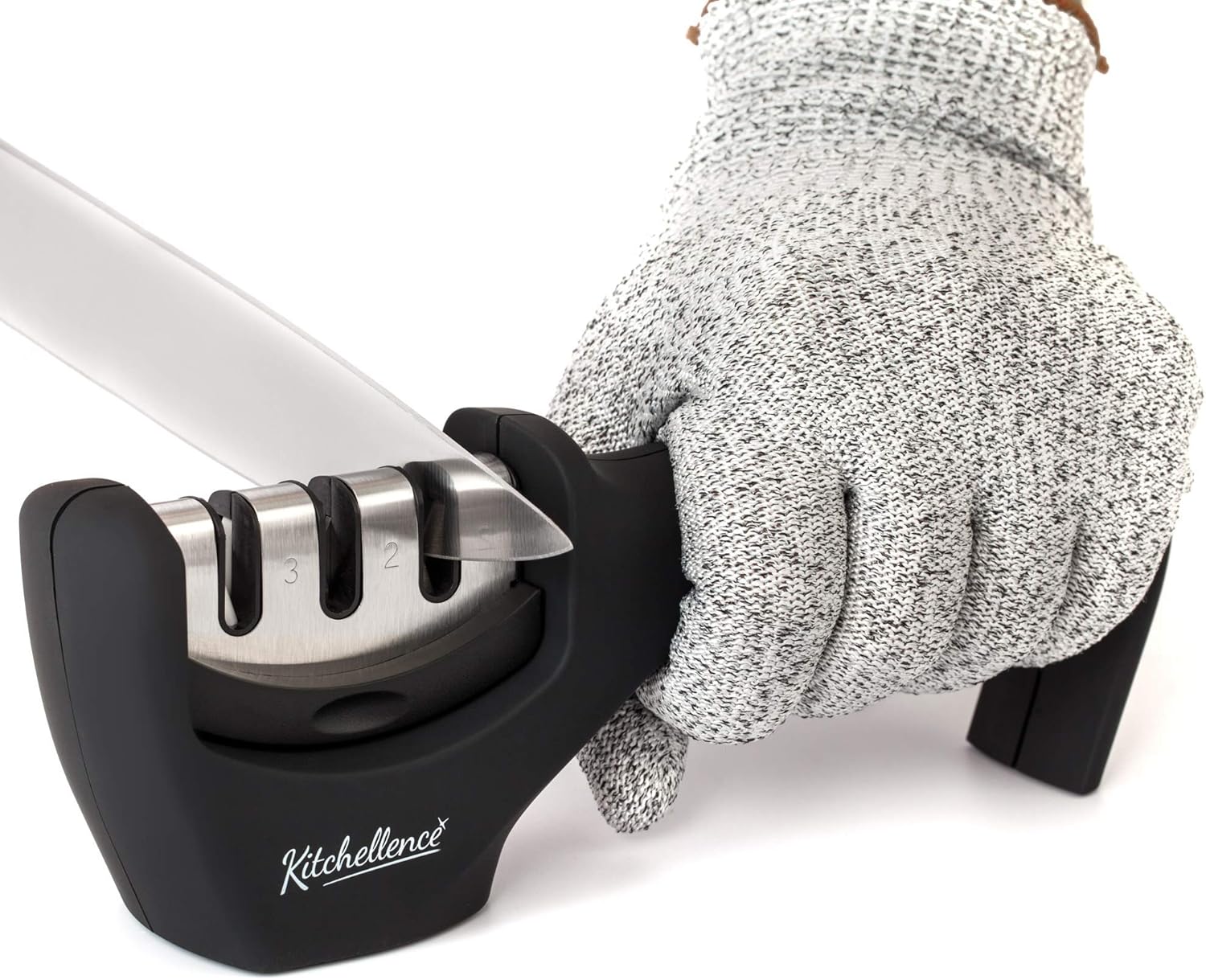
KITCHELLENCE 3‑Stage Knife Sharpener
| Material Type | Plastic |
|---|---|
| Included Components | Cut-resistant glove |
| Number of Items | 1 |
| Model Number | KS37 P |
This compact 3-stage sharpener is designed for quick, no-fuss blade maintenance at home. Start with the diamond rod slot to realign and repair nicks, pass the blade through the middle sharpening slot to restore the V-edge, then finish in the polishing stage for a smoother cutting surface. The unit has an ergonomic handle and non-slip suction base that helps keep it stable while you pull knives through by hand, and the included cut-resistant glove adds a safety buffer for less confident users. Built from ABS plastic it is lightweight and easy to store, and it works with common kitchen knives for routine touch-ups rather than blade re-profiling. Limitations are that it is a manual pull-through tool so it cannot match a professional stone or guided system for very dull or specialty blades, and repeated use on high-end knives can remove metal more quickly if used aggressively.
Best for: Buyers who want a safe, straightforward way to keep everyday kitchen knives sharp without learning honing techniques or investing in an advanced system.
Less Ideal for: Professional cooks, owners of very high-end or specialty knives, or anyone needing precise re-profiling should choose a whetstone or guided sharpening system instead.
- Three-stage system (diamond repair, sharpening, polishing) covers basic repair and finishing needs
- Ergonomic handle and suction base improve stability during use
- Includes cut-resistant glove for safer handling
- Compact, lightweight ABS construction is easy to store and clean
- Manual pull-through design cannot fully restore very damaged or specialty blades
Verdict: A simple, safety-minded 3-stage sharpener that reliably restores everyday kitchen knives for budget-conscious, risk-averse home cooks.
Choosing the Right Knife Sharpener on a Budget: Key Factors to Consider
Type of Sharpening Mechanism
Different budget sharpeners use ceramic rods, tungsten carbide slots, diamond-coated plates, or abrasive belts. The mechanism determines how aggressively metal is removed, how easy it is to reprofile a bevel, and whether you can maintain a fine, polished edge.
Ceramic and diamond surfaces are better for flattening and sharpening hardened steels, while tungsten carbide slots give fast results for very dull edges but can remove more material. Consider whether you need a tool primarily for quick touch-ups or for restoring a blunt blade. Aggressive mechanisms shorten the time to a working edge but can shorten blade life if overused.
Adjustable Angle Vs Fixed Guides
Some budget models use fixed-angle guides to simplify use, while others offer adjustable guides or freehand surfaces that let you set the bevel. Fixed guides are beginner-friendly and reduce the chance of inconsistent angles.
Adjustable-angle options add flexibility for different knife types and bevel angles, which matters if you own both Western and Asian-style blades. However, adjustable systems require more setup and attention to maintain consistent strokes. Decide whether convenience or angle versatility matters more for your typical knives.
Abrasive Grit Progression
A multi-stage grit progression lets you both reprofile a dull bevel and then refine it to a cutting edge. Entry-level sharpeners may only offer coarse and fine stages, while better budget models add a stropping or polishing stage.
A coarse stage speeds material removal but leaves a rough edge that needs follow-up. If you mostly maintain slightly dull knives, a single fine stage or ceramic rod may suffice. For occasional heavy restoration, look for a coarse stage capable of shaping the bevel without excessive heat buildup.
Build Quality and Base Stability
A sharpener that shifts while you pull a blade is unsafe and produces inconsistent results. Look for units with a heavy, non-slip base or suction anchors that keep the tool stationary during use.
Materials matter too. Plastic housings can be perfectly acceptable on budget models if they are rigid and well-molded. Pay attention to the fit of removable components and the quality of any springs or clamps; cheaply made parts can wear out and affect sharpening accuracy.
Maintenance and Replacement Parts
Abrasive elements wear with use, and the availability and cost of replacement rods, plates, or belts affects long-term ownership cost. Some budget sharpeners have replaceable cartridges or modular abrasive inserts, extending service life.
Units that are sealed with nonreplaceable abrasives may be fine if you expect light use, but heavy household or small-restaurant use benefits from replaceable components. Also consider how easy the unit is to clean; metal filings and slurry can build up and reduce effectiveness if not removed periodically.
Safety Features
Budget sharpeners vary widely in built-in safety. Features like finger guards, blade guides that keep hands away from the abrasive, and non-slip feet reduce the risk of nicks and accidents.
Also consider ergonomics. Comfortable handles or draw slots that align naturally with a user's grip make it easier to maintain control. Even a simple rubberized base can make a big difference in real-world safety and comfort when sharpening multiple knives.
Quick Maintenance Tips for Budget Sharpeners
Keep abrasive surfaces clean by brushing off metal filings after each use and occasionally wiping with a lightly oiled cloth if the manufacturer permits. This prevents buildup that dulls cutting action and ensures more consistent contact with the blade.
Don't overuse the coarse stage. For routine maintenance, a few light passes on the fine stage preserve edge geometry and extend time between more aggressive sessions. Use deliberate, even strokes and avoid applying excessive pressure.
- Run a test slice through paper to check edge improvement
- Use a consistent number of strokes per side to maintain symmetry
- Store the sharpener and blades in a dry environment to avoid corrosion
When to Reshape a Bevel Versus Touch Up
A touch-up restores a slightly rolled or dull edge and usually requires only a fine abrasive or ceramic rod. Reshaping the bevel is necessary when the edge is severely nicked or the angle has changed from heavy sharpening. Reshaping removes more metal and should be done sparingly.
If you find you need coarse work frequently, evaluate whether you are using the wrong sharpening angle or repeatedly damaging the blade during use. Frequent heavy grinding shortens blade life.
- Touch up: light burr, minor dulling
- Reshape: visible nicks, rounded bevel, or major angle change
Stropping and Polishing on a Budget
Many budget sharpeners lack a dedicated stropping stage, but a leather strop or even a piece of cardboard treated with polishing compound can refine the edge after sharpening. Stropping removes the burr and aligns microscopic teeth on the edge for improved cutting performance.
If a unit includes a polishing stage, use it sparingly to achieve a smoother, longer-lasting edge. Over-polishing can mask a poor bevel geometry, so ensure the underlying edge is correctly angled first.
- Use light pressure when stropping
- Strop in one consistent direction away from the cutting edge
- Inspect the edge between stages with a magnifier or by testing on soft produce
Common Mistakes to Avoid
Rushing the sharpening process often leads to inconsistent bevels and wasted material. Take steady, controlled strokes and count passes to produce a uniform edge. Avoid rocking the blade, which creates an irregular bevel.
Applying too much force is another common error. Let the abrasive do the work and use even pressure. Excessive force produces heat, which can affect temper and remove more metal than intended.
- Do not change angles mid-stroke
- Avoid using a single coarse stage for every maintenance session
- Keep both sides of the blade equally stropped to prevent bias
Choosing Accessories That Extend Value
A simple strop, a compact honing rod, and a soft cloth can extend the time between abrasive sharpening sessions and preserve blade geometry. Accessories are inexpensive ways to reduce wear on abrasive parts and improve daily cutting performance.
Consider a storage solution that protects both the blade and the sharpener from bumps and dust. Even modest investments in a protective sleeve or small case can preserve alignment and prevent damage during storage.
- Leather or synthetic strops for final polish
- Honing rods for quick on-the-go touch-ups
- Protective cases or dedicated drawer space
How We Chose the Best Knife Sharpener on a Budget
We focused on tools that deliver repeatable edge restoration while keeping cost and ease of use top of mind. Selection began by screening sharpeners built primarily for kitchen knives and excluding specialist systems meant only for outdoor or industrial blades. We prioritized devices with clear sharpening stages, robust abrasive materials, and built-in guides or jigs that reduce user error. Durability of the abrasive elements and the unit housing was weighted heavily because replacement parts or fragile construction undermine long-term value. We also considered user safety features such as non-slip bases and finger guards, along with how straightforward maintenance and cleaning are. Sharpening speed and consistency across common blade angles were important; we favored tools that handle typical kitchen angles without complex setup. Exclusions included single-use disposable sharpeners with extremely short lifespans and professional grinding stations that require specialized skills. The final list balances immediate usability, measurable sharpening performance, and reasonable longevity for budget-focused buyers.
Our full evaluation process is outlined in our review methodology.
FAQ
How often should I sharpen kitchen knives with a budget sharpener?
It depends on use. For home cooking, a light touch-up every few weeks is common, with a more thorough sharpening a few times per year. Frequency increases with heavier daily use.
Will a cheap sharpener damage my knives?
Not if used correctly. Aggressive mechanisms remove more metal, so use coarse stages only when necessary. Following consistent angles and light pressure prevents unnecessary wear.
Can I sharpen serrated knives with these sharpeners?
Most budget sharpeners are designed for straight-edged kitchen knives. Serrated blades usually require a tapered ceramic rod or a specialized serration tool for safe, effective maintenance.
Is it better to strop or polish after sharpening?
Stropping removes the burr and refines the edge without removing much material, which is ideal after sharpening. Polishing can improve smoothness but should follow proper bevel formation.
How do I know when abrasive elements need replacement?
Look for reduced cutting improvement after consistent technique, visible wear on abrasive surfaces, or an uneven contact pattern. Units with replaceable elements show clear replacement indicators or loose tolerance in the cartridges.
Final Verdict
For budget-minded buyers, the best knife sharpener balances simplicity, consistent angle control, and durable abrasives. Prioritize tools that offer at least a two-stage grit progression, a stable base, and straightforward safety features. Expect to trade some refinement and speed for lower cost, but with proper technique and occasional stropping you can keep kitchen knives performing well. Choose the sharpener that matches how often you use knives and whether you need occasional heavy re-profiling or mostly touch-ups, and you will get the most value from a modest investment.