
Note: This article contains affiliate links. If you click on these links and make a purchase, we may earn a small commission at no extra cost to you. This helps support our research and content. Read our full affiliate disclosure here.
Choosing the right knife sharpener matters because a good edge changes how safely and efficiently you work in the kitchen. The wrong method can remove too much metal, ruin blade geometry, or leave an inconsistent bevel that dulls quickly. This guide covers seven shortlisted Knife Sharpeners vetted for home use, from simple manual systems to guided-angle and quick-touch devices. We evaluate tools for ease of use, how well they hold or restore an edge, and whether they preserve blade life. Scroll down for clear criteria and practical tips to match a sharpener to your knives and skill level before the product list.
Top Picks at a Glance
| Best Overall The best all-around choice for most situations | Work Sharp MK2 Knife Sharpener |  |
| Best Quality Built to a higher standard if you want something more solid | Chef'sChoice Trizor 15XV |  |
| Best Value The sweet spot between price and what you get | AnySharp Knife Sharpener |  |
| Best Budget The cheapest option that still gets the job done reliably | Smith's 2-Step Knife Sharpener CCKS |  |
| Top Rated A top-rated pick with lots of positive feedback | AccuSharp Knife Sharpener ACCU-001C |  |
| Most Popular A crowd favorite that many people choose with confidence | KITCHELLENCE 3-Stage Knife Sharpener |  |
| Best Seller A high-volume bestseller chosen again and again | Intelitopia Knife Sharpening Set |  |
Work Sharp MK2 Knife Sharpener

| Included Components | Abrasive Belts, Knife Sharpener |
|---|---|
| Model Number | WSKTS2 |
| Grit Type | Medium |
| Material Type | Plastic |
The Work Sharp MK2 is an electric bench sharpener built around flexible abrasive belts that conform to a blade edge so you can sharpen kitchen knives, pocket knives, serrated edges, scissors, axes and garden tools without swapping wheels. It uses an adjustable edge guide to keep a consistent bevel and a two-speed motor for light touch-ups or heavier grinding when rebuilding an edge on tools. In practice the belts make it fast and forgiving for angled sharpening and the higher speed handles thicker steel and coarse repair work, while the lower speed gives more control for finishing. The unit comes with replacement belts in a practical size and the setup is straightforward, though it requires a stable work surface and generates some dust and noise during heavy work. If you want a single, easy-to-use electric system that covers most household and outdoor blades, the MK2 delivers reliable results with minimal learning curve.
Best for: Buyers who want one versatile, easy-to-learn sharpening system that handles kitchen knives and outdoor tools with repeatable results and minimal setup time.
Less Ideal for: Users seeking a delicate, hands-on whetstone finish for fine chefs knives or those who need a completely silent, dust-free sharpening solution.
- Flexible abrasive belts conform to different blade profiles for consistent contact
- Two-speed motor for both light finishing and heavier grinding tasks
- Includes abrasive belts so you can start sharpening out of the box
- Simple edge guide makes repeatable bevels easier to achieve
- Works on a wide range of tools from kitchen knives to axes and scissors
- Produces dust and noise during aggressive grinding
- Requires a stable benchtop for safe, repeatable sharpening
Verdict: Choose the MK2 if you want a single, versatile electric sharpener that quickly restores and maintains a wide range of household and outdoor blades.
Chef'sChoice Trizor 15XV

| Material Type | Diamond |
|---|---|
| Grit Type | Fine |
| Stages | Three |
| Included Components | Knife Sharpener |
The Chef'sChoice Trizor 15XV is a professional three-stage electric sharpener designed to convert or refine kitchen knives to a 15-degree Trizor edge. You run blades through stage one for coarse shaping with diamond abrasives, stage two for finer honing, and stage three uses patented stropping disks to polish and create a razor finish; the unit also handles serrated blades. Built-in angle guides and flexible spring guides remove guesswork and keep the blade aligned for consistent results, and the diamond abrasives sharpen quickly — first-time sharpening takes about a minute and touch-ups only seconds. Practical benefits include faster, repeatable sharpening than manual stones and a polished edge that improves slicing performance. Limitations are that it is optimized for 15-degree class knives so it is less appropriate for blades that require wider factory angles, and the electric design means less manual control for users who prefer stone-based technique. The housing is compact enough for countertop storage and the simple on/off operation keeps it easy to use for cooks focused on performance.
Best for: Buyers who prioritize high cutting performance and a fast, repeatable sharpening process for kitchen knives will appreciate this unit.
Less Ideal for: Those who prefer full manual control with whetstones, or who need to maintain non-15-degree factory edges, should consider other methods.
- Uses 100% diamond abrasives for fast, durable material removal
- Three-stage system (shape, hone, strop) produces a polished Trizor 15-degree edge
- Precision angle and spring guides provide consistent, repeatable results
- Handles both straight-edge and serrated knives
- Very quick resharpening—touch-ups take only seconds
- Optimized for 15-degree edges so it is not ideal for knives that require wider factory angles
- Electric mechanism offers less tactile control than whetstones
Verdict: Choose the Trizor 15XV when you want a fast, repeatable electric sharpener that delivers a professional 15-degree Trizor edge and polished finish.
AnySharp Knife Sharpener

| Material Type | Plastic, Tungsten Carbide |
|---|---|
| Grit Type | Fine |
| Included Components | 1 x Knife Sharpener |
The AnySharp Knife Sharpener is a small, hands-free tool designed to restore dull kitchen knives quickly without skill or electricity. You lock the unit to a smooth countertop or table with its PowerGrip suction base, then draw the blade through the tungsten carbide sharpening slots set to a 20-degree angle. That pre-set angle and fine grit carbide make it useful for routine edge maintenance on chef knives, utility blades and many serrated or hardened steels, and the compact plastic body stores easily in a drawer. Its safety-focused design keeps fingers away from the edge and the nonpowered operation means no cords or batteries to manage. Limitations include a fixed 20-degree angle that is not adjustable for specialty blades and a plastic body that is lighter-duty than metal pro sharpeners, so it is best for regular home use rather than aggressive re-profiling of damaged blades.
Best for: Buyers who want a safe, low-effort way to keep everyday kitchen knives sharp and prefer straightforward, maintenance-focused tools that fit into a busy routine.
Less Ideal for: Professional chefs, serious home sharpeners, or anyone needing adjustable angle settings or heavy-duty re-profiling should consider a different, more robust sharpener.
- Hands-free PowerGrip suction base keeps the sharpener stable and reduces slipping risk
- Tungsten carbide sharpening slots deliver quick, repeatable edge restoration
- Pre-set 20-degree angle simplifies use—no angle guessing required
- Compact, cord-free design stores easily and is ready for frequent touch-ups
- Angle is fixed at 20 degrees so it cannot be tuned for very thin or specialty edges
- Mostly plastic construction is less durable than heavier metal sharpeners
Verdict: A simple, hands-free sharpener that reliably restores everyday kitchen knives with minimal effort.
Smith's 2-Step Knife Sharpener CCKS

| Included Components | 1 sharpener |
|---|---|
| Material Type | Synthetic |
| Grit Type | Coarse,Fine |
Smith's CCKS 2-Step Knife Sharpener is a small, lightweight pull-through tool that restores and refines edges using crossed tungsten carbide blades for coarse sharpening and crossed ceramic rods for a fine finish. It is used by pulling a blade through the coarse slot three to four times to reestablish a dull edge, then through the ceramic stage to smooth and polish the bevel. The unit is designed for outdoor and everyday carry with non-slip rubber feet, a lanyard hole for attachment, and a plastic body that floats in water. Practical benefits include fast edge restoration for fillet, pocket, and hunting knives and easy cleaning with a damp cloth. Limitations are that preset angles mean you cannot change the sharpening geometry for specialty blades, and pull-through sharpeners are less suitable for high-end chef knives that require precise, repeated stone maintenance. For buyers seeking a cheap, portable way to keep blades cutting well in the field, it handles routine sharpening tasks reliably.
Best for: Buyers who want an inexpensive, portable sharpener to quickly refresh blades while camping, fishing, or doing outdoor tasks and who prioritize convenience over precision.
Less Ideal for: Collectors, professional chefs, or anyone needing precise edge geometry for high-end kitchen knives should choose a sharpening stone or guided system instead.
- Two preset stages (tungsten carbide coarse and ceramic fine) for quick edge restoration and polishing
- Very compact and lightweight with a lanyard hole, fits easily in a pocket, pack, or tackle box
- Non-slip rubber feet and a floating plastic body improve safety and outdoor usability
- Effective at restoring a working edge on dull fillet, pocket, and hunting knives with just a few strokes
- Fixed sharpening angles cannot be adjusted for custom bevels or specialty blades
- Not the best choice for precision sharpening or maintaining high-end kitchen knives
Verdict: A very affordable, pocketable two-stage sharpener that quickly restores a working edge for outdoor and everyday knives.
AccuSharp Knife Sharpener ACCU-001C

| Material Type | Acrylonitrile Butadiene Styrene |
|---|---|
| Grit Type | Coarse |
| Included Components | Sharpener |
| Model Number | ACCU-001C |
The AccuSharp Knife Sharpener is a simple handheld pull-through tool designed to restore and hone straight and serrated kitchen knives quickly. You use it by drawing the blade through the carbide sharpening slot while the full-length guard and ergonomic handle keep your hand protected and stable. Its diamond-honed tungsten carbide blades cut fast, so many users report getting a usable edge in about ten seconds, and the reversible blades effectively double blade life. The plastic housing is dishwasher-safe for easy cleaning and the compact footprint makes it convenient to store or toss in a drawer for outdoor use. It works well for routine touch-ups and bringing dull blades back to serviceable condition, but it is not a full sharpening system for rebuilding heavily damaged or very high-end specialty edges. Replacement blades are available when the carbide wears out, which supports long-term reliability for a low-maintenance kitchen tool.
Best for: Buyers who prioritize a dependable, low-effort way to keep everyday kitchen knives sharp will appreciate this tool for quick maintenance and frequent use.
Less Ideal for: If you need a precision sharpening setup for high-end chef knives, custom bevels, or repair of damaged edges, look to stones or guided sharpening systems instead.
- Fast edge restoration in roughly ten seconds for everyday knives
- Diamond-honed tungsten carbide blades that are reversible for longer life
- Ergonomic, ambidextrous handle with a full-length finger guard for safer use
- Dishwasher-safe plastic body makes cleaning simple
- Compact and portable for kitchen, workshop, or outdoor use
- Not suitable for rebuilding heavily chipped or damaged blades or creating precise professional bevels
- Coarse grit carbide may remove metal faster than finer sharpening systems
Verdict: A durable, no-fuss pull-through sharpener that reliably restores everyday knives fast and keeps them serviceable with minimal upkeep.
KITCHELLENCE 3-Stage Knife Sharpener
| Material Type | Plastic |
|---|---|
| Included Components | Yes |
| Model Number | KS37 P |
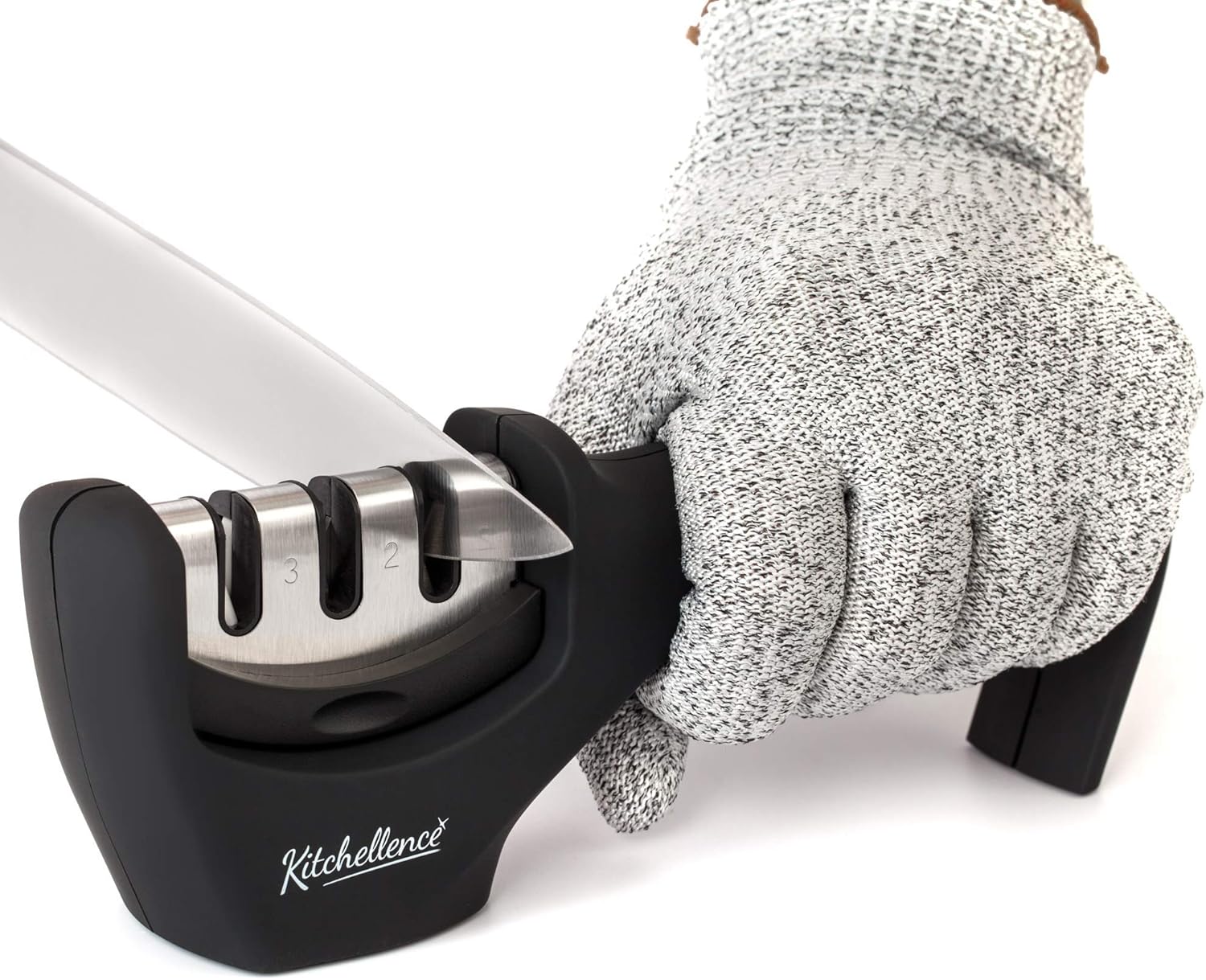
This KITCHELLENCE 3-stage sharpener is a compact, easy-to-use bench tool for quickly restoring home kitchen knives. The first slot uses a diamond rod to realign and repair damaged edges, the second rebuilds the V-shaped bevel, and the third polishes for a finer edge, so you can move a blade through each stage in sequence for predictable results. It has an ergonomic handle and non-slip base to steady the unit while you draw blades through the guides, and the included cut-resistant glove adds a layer of safety during use. Made from ABS plastic the body is lightweight and durable for everyday countertop use, though it does not offer adjustable angles or motorized consistency that some pro units provide. This makes it a practical choice for most cooks who want fast touch-ups and edge restoration rather than professional reprofiling. Easy to store and simple to operate, it delivers reliable sharpening for common kitchen knives with minimal setup.
Best for: Buyers who want a straightforward, safety-minded sharpener for routine home kitchen maintenance and prefer a tool with many positive user reviews for reassurance.
Less Ideal for: People seeking precise angle control, heavy reprofiling, or fully professional motorized sharpening should consider more advanced systems.
- Three-stage system (repair, sharpen, polish) covers common edge restoration needs
- Diamond rod in first stage helps realign and repair damaged blades
- Ergonomic handle and non-slip base improve stability during sharpening
- Includes a cut-resistant glove for safer handling
- Fixed-angle manual guides do not offer customizable sharpening angles
- Plastic construction may feel less robust than metal-bodied alternatives
Verdict: A simple, safe three-stage manual sharpener that makes quick, reliable edge restoration for home cooks who value ease of use and strong social proof.
Intelitopia Knife Sharpening Set

| Included Components | Sharpening Stones |
|---|---|
| Material Type | Stone |
| Grit Type | Coarse |
| Number of Packs | 7 |
This kit provides a full sharpening workflow for kitchen and pocket blades, combining a dual-sided 400/1000 grit stone for reshaping dull edges and a 3000/8000 grit stone for refining and polishing. The set includes a coarse flattening stone to keep the whetstones true, a bamboo non-slip base for stable sharpening, a leather strop to remove burrs and finish the edge, and an angle guide to help beginners hold consistent bevels. In practice the aluminum-oxide stones cut reasonably fast and the higher grits produce a fine, polished edge when used with light, controlled passes. The bamboo base and rubber feet reduce movement on the counter, and the included instructions make the kit approachable for someone new to wet-stone sharpening. Expect to spend a little time learning technique and maintaining flat stones, and coarse metal damage will take multiple passes; the kit is best suited to routine edge maintenance rather than heavy re-profiling of badly damaged blades.
Best for: Buyers who want a complete, ready-to-use stone kit for regular edge maintenance and prefer a setup that helps teach proper sharpening technique.
Less Ideal for: People who need a fast, power-based sharpening solution or who frequently repair heavily chipped or bent blades should consider a dedicated grinder or professional service instead.
- Includes dual-grit whetstones for both repairing and polishing edges
- Comes with flattening stone to maintain stone flatness over time
- Leather strop and angle guide help finish edges and assist beginners
- Non-slip bamboo base and rubber feet provide stable sharpening surface
- Does not include lubricant explicitly so water or oil must be sourced separately
- Not intended for heavy re-profiling of severely damaged or chipped blades
Verdict: A full, beginner-friendly whetstone kit that covers reshaping, polishing, and stropping so you can maintain razor edges at home.
Choosing the Right Knife Sharpener: Key Factors to Consider
Abrasive Type And Grit Progression
The abrasive material and available grit steps determine how quickly you can reshape and refine a blade. Coarse grits remove metal faster for repairing chips or re-profiling an edge, while finer grits polish to a keener, longer-lasting cutting surface. A sharpener that offers a logical progression from coarse to fine reduces the need for multiple tools and helps you avoid skipping stages that could leave a rough or fragile finish.
Also consider whether the abrasive is bonded ceramic, diamond, or natural stone. Diamond abrasives cut fast and stay flat, which is useful for very hard steels. Ceramic and stones can produce a different microbevel and may require flattening or dressing over time. Choosing the right abrasive affects sharpen time, the final edge texture, and how much metal is removed during routine upkeep.
Angle Control And Repeatability
Consistent bevel angle is essential for predictable cutting performance. A sharpener that fixes a stable angle—either through a guided slot, clamp, or adjustable guide—helps maintain blade geometry and reduces the chance of over-grinding. For kitchen knives, common angles range between moderate and acute; the tool should allow you to pick an angle appropriate for the blade and intended use.
Repeatable angle control matters most for users who maintain multiple knives or who lack extensive sharpening experience. Without it, each stroke can create a different bevel, producing an uneven edge that requires more work to correct. Look for mechanisms that lock securely and provide visual feedback or stops for common angles.
Compatibility With Knife Types
Not all sharpeners suit every blade. Consider whether the sharpener works with straight-edge knives, serrated edges, thin Japanese-style blades, and thicker Western chef knives. Some systems include dedicated modules or attachments for serrations and sharpening tapered points, while others are optimized only for standard straight edges.
If you own a mix of blades, choose a sharpener that explicitly supports the variety to avoid damaging thin or harder steels. Compatibility also includes blade length and handle interference; the sharpener should accommodate the full cutting edge without forcing awkward angles.
User Safety And Ergonomics
Sharpening involves direct contact with abrasive surfaces and thin metal, so a design that protects fingers and keeps the knife stable reduces risk. Non-slip bases, hand guards, and secure clamps make routine sharpening safer. Ergonomics matter too: a comfortable grip, sensible stroke length, and a tool positioned at a natural working height reduce fatigue and improve stroke consistency.
Safer, easier-to-hold tools also help novice users build correct technique. If a sharpener requires awkward wrist positions or repeated high-pressure strokes, it increases the chance of slips and uneven edges. Consider how you will hold the knife and tool during typical household sharpening sessions.
Edge Finish And Long-Term Durability
The finish left on the edge affects slicing performance and how quickly the blade returns to dullness. A smoother, properly honed edge slices better and resists microchipping. Some sharpeners leave a toothy finish that is fine for certain tasks but wears faster. Think about the finish you want for common kitchen tasks and whether the sharpener can produce and maintain it.
Durability includes the lifespan of abrasive elements and the mechanical stability of guides or clamps. Replaceable or serviceable abrasive parts extend a tool's life. Tools that require frequent part replacement or that lose alignment after repeated use increase long-term cost and reduce sharpening consistency.
Maintenance And Cleaning Requirements
Regular maintenance affects both performance and hygiene. Stone-based systems may require flattening, slurry management, or drying to prevent contamination. Bonded abrasives like diamond rods generally need less maintenance but can still collect metal particles that reduce cutting efficiency.
Consider how easy it is to clean chips and filings from the unit, whether parts are removable for washing, and if the tool requires lubrication or dressing. Lower maintenance tools save time and are more likely to be used routinely, which helps keep knives consistently sharp.
Choosing The Right System For Your Skill Level
Beginner cooks often benefit from guided systems that set the angle for every pass and reduce the learning curve. These systems trade some flexibility for consistency, which helps build confidence and keeps blades usable with minimal risk of over-grinding.
Intermediate users who want more control can opt for systems that allow angle adjustment or freehand stones for honing. Those comfortable with technique will find they can achieve finer finishes and better edge alignment by progressing through grit stages more deliberately.
Advanced hobbyists sometimes prefer traditional whetstones or diamond plates because they offer full control over bevel geometry and finish. These require more practice but can produce superior edges when used correctly.
- Guided systems: easy, consistent angles
- Adjustable guided systems: balance of control and repeatability
- Freehand stones: maximum control, higher skill needed
Maintaining A Sharp Edge Between Full Sharpening Sessions
Honing rods and stropping are low-effort ways to realign a blade and remove micro-rolls without removing significant metal. Regular light maintenance extends the period between more aggressive sharpening sessions and preserves blade geometry.
Strops and fine ceramic rods polish the edge and remove burrs created during sharpening. Use these tools more often than coarse abrasives, especially if you cook frequently, to maintain slicing performance with minimal material loss.
- Hone weekly if you use knives daily
- Strop or polish after coarse grit work to remove burrs
- Reserve coarse abrasives for when honing no longer restores the edge
Serrated Blades And Specialty Edge Profiles
Serrated knives need different care than straight edges. Many multi-function sharpeners include a dedicated slot or rod for serrations, but it is often best to use a small round file or tapered rod sized to the serration pitch to maintain the valleys without flattening the teeth.
Specialty profiles like double-bevel, single-bevel, and hollow-ground edges require appropriate techniques to preserve their intent. If you own single-bevel or very thin Japanese blades, choose a system or method designed to match those geometries to avoid over-widening the bevel.
- Use tapered rods for serrations
- Match the tool to single-bevel profiles when present
- Avoid abrasive abrasion that changes the serration shape
Routine Care For Abrasive Surfaces
Stones and plates perform best when flat and free of metal buildup. For water stones, periodic flattening with a lapping plate or flattening stone restores a true surface. Diamond plates are flatter by design but still benefit from occasional cleaning with a brass brush or mild detergent to remove suspended filings.
Follow the manufacturer's guidance for dressings and cleaning intervals. Proper care keeps a consistent cutting action and prevents contamination that can dull blades faster.
- Flatten water stones as needed
- Brush diamond plates to remove filings
- Store stones dry and dust-free
Setting And Checking Edge Angle
A simple way to check and set the edge angle is to use angle guides or a small digital protractor when learning. Many sharpeners advertise specific angles; verify with a physical guide or test cuts after sharpening to ensure you have the intended bevel.
When transitioning between blade types, keep consistent records of the angle used and how the knife performs in typical tasks. Slight adjustments of one or two degrees can affect cutting feel and edge life, so iterate gradually rather than making large jumps.
- Use a protractor or angle guide for verification
- Record angles that work well for each knife
- Make small angle adjustments and test with real tasks
How We Chose the Best Knife Sharpener
We focused on tools that help home cooks achieve consistent, usable edges without specialized training. Evaluation emphasized repeatable angle control, abrasive quality and range, material compatibility, user safety and ergonomics, and maintenance needs. We prioritized sharpeners that offer clear guidance on angle and pressure, use abrasives or stones that last without contaminating better blades, and that accommodate common kitchen knife steels and blade shapes. Excluded from consideration were one-off gimmick tools that lack abrasive substance or systems intended solely for outdoor or industrial blades. We also excluded devices that require professional servicing or extensive setup unrealistic for typical home kitchens. The dimensions that mattered most were angle repeatability, abrasive grade progression, clamp or guide stability, ease of routine cleaning, and how aggressive the tool is in metal removal. Those factors informed each pick and the scorecard metrics.
Our full evaluation process is outlined in our review methodology.
FAQ
How often should I sharpen my kitchen knives?
It depends on use. Most home cooks only need light honing weekly and a full sharpening every few months. Heavy use or harder cutting tasks may require more frequent sharpening.
Can I use one sharpener for all my knives?
Often you can, but compatibility matters. Some sharpeners handle straight edges well but not serrations or very thin single-bevel blades. Choose a system that supports the range of knives you own.
Is a guided sharpener better than freehand sharpening?
Guided systems offer consistent angles and are easier for beginners. Freehand methods give more control over bevel shape and finish but require practice to achieve consistent results.
Will a diamond sharpener damage my blades?
Diamond abrasives cut aggressively, which is useful on hard steels, but overuse can remove more metal. Use coarser diamonds for repair and finer diamonds for finishing, and avoid unnecessary heavy passes.
How do I maintain sharpening stones and rods?
Keep stones flat and clean; flatten water stones when they cup. Rinse and dry stones after use to prevent contamination. Clean diamond plates with a brush to remove filings and store abrasives in a dry place.
Final Verdict
Start by matching a sharpener's angle control and abrasive progression to the knives you use most. If you want convenience and predictable results, choose a guided system with a sensible grit range. If you prefer ultimate control and are willing to practice, stones and plates allow finer finishes and more precise bevel shaping. Weigh tradeoffs between speed and material removal, and factor in maintenance needs and compatibility with serrations or single-bevel blades. Prioritize tools that help you maintain consistent angles and that leave the edge finish you need for everyday kitchen tasks.