
Note: This article contains affiliate links. If you click on these links and make a purchase, we may earn a small commission at no extra cost to you. This helps support our research and content. Read our full affiliate disclosure here.
If you need extra warmth without spiking electricity use, a low-wattage portable heater can make a big difference. These compact heaters are designed to provide targeted heat for small rooms, home offices, and bedside use while keeping energy consumption and noise to a minimum. Choosing the right model matters because wattage, heat delivery, safety features, and thermostat control all affect comfort and operating cost. This guide covers seven shortlisted low-wattage portable heaters that are practical for everyday household use. We evaluated each option on measurable criteria so you can match a heater to the size of your space and preferred controls. Read on to see which features matter most and how to pick the right compact heater for your needs.
Top Picks at a Glance
| Best Overall The best all-around choice for most situations | Lasko MyHeat Personal Heater 101 |  |
| Best Quality Built to a higher standard if you want something more solid | Honeywell Slim Ceramic Tower HCE311 |  |
| Best Value The sweet spot between price and what you get | Amazon Basics Ceramic Mini Heater |  |
| Best Budget The cheapest option that still gets the job done reliably | Lerat Mini Space Heater K40 |  |
| Top Rated A top-rated pick with lots of positive feedback | VOCRS PTC-903B Ceramic Heater |  |
| Most Popular A crowd favorite that many people choose with confidence | GiveBest Portable Space Heater PTC-905 |  |
| Best Seller A high-volume bestseller chosen again and again | DREO Space Heater HSH006 |  |
Lasko MyHeat Personal Heater 101

| Heat Output | 200 watts |
|---|---|
| Heating Method | Convection |
| Heating Element | Ceramic |
| Heating Coverage | 50 sq ft |
| Power Source | Corded Electric |
The Lasko MyHeat is a tiny, low-wattage ceramic tabletop heater made to provide spot warmth without using much power. It plugs into a standard 120V outlet, uses a 200-watt ceramic element and a small fan to move warm air, and is best used on a desk, bedside table, or in a dorm cubicle to keep your immediate area comfortable. Its compact footprint and lightweight design make it easy to move and store, and simple manual controls mean there is no learning curve. Built-in safety features include overheat protection and a cool-touch exterior so it can be used near hands and papers with less worry. Because it only produces concentrated heat for about a 50 sq ft area and has a single heat setting, it will not replace a room heater for larger spaces and offers limited control over temperature. For anyone needing quiet, energy-conscious personal warmth where full-room heating is unnecessary, this is a practical, no-frills choice.
Best for: Buyers who want an efficient, portable personal heater to take the chill off a desk, bedside, or small personal space without running a high-wattage appliance.
Less Ideal for: People who need to warm medium or large rooms, require adjustable temperature settings, or want a multi-speed heater.
- Very low power draw at 200 watts for energy-conscious use
- Compact, lightweight tabletop design that is easy to move and store
- Ceramic heating element with a fan for quick localized warmth
- Built-in safety features including overheat protection and cool-touch exterior
- Only one heat setting limits temperature control
- Intended for very small areas and will not heat full rooms
Verdict: A highly efficient, ultra-compact 200-watt personal heater that delivers quiet, targeted warmth for desks and small personal spaces.
Honeywell Slim Ceramic Tower HCE311

| Heating Power (Watts) | 1500 watts |
|---|---|
| Form Factor | Tower |
| Heating method | Convection |
| Speed | 2 Heat Settings |
The Honeywell Slim Ceramic Tower HCE311 is a small, space-saving ceramic convection heater made for spot heating in bedrooms, offices, or other small rooms. It offers two steady heat settings plus an energy saver mode and oscillation to spread warmth more evenly across a limited area. Safety features include overheat shut-off, a 360-degree tip-over switch, and cool-touch plastic housing, which make it suitable for everyday indoor use. The unit is straightforward to operate and its slim profile fits into tight corners or beside furniture without taking much floor space. Limitations are its output scope and simple controls: as a low-wattage, compact heater it is meant for localized comfort rather than heating larger rooms, and it lacks advanced thermostatic scheduling or smart connectivity. For buyers focused on straightforward, reliable small-room heat with solid safety features, this model delivers practical performance without extras.
Best for: Buyers who want an efficient, no-frills heater to provide reliable spot or small-room warmth with strong safety features and a compact footprint.
Less Ideal for: People needing to heat large rooms, open-plan areas, or those who want app control, advanced programming, or high-output heating.
- Compact slim tower design fits small rooms and tight spaces
- Ceramic convection element provides quick, even local heating
- Oscillation helps distribute heat across the room
- Multiple safety features including overheat shut-off and tip-over switch
- Designed for small-room or personal heating, not effective for large open spaces
- Basic controls and no smart or programmable scheduling features
Verdict: A compact, safety-focused ceramic tower that delivers reliable low-wattage spot heating for small rooms.
Amazon Basics Ceramic Mini Heater
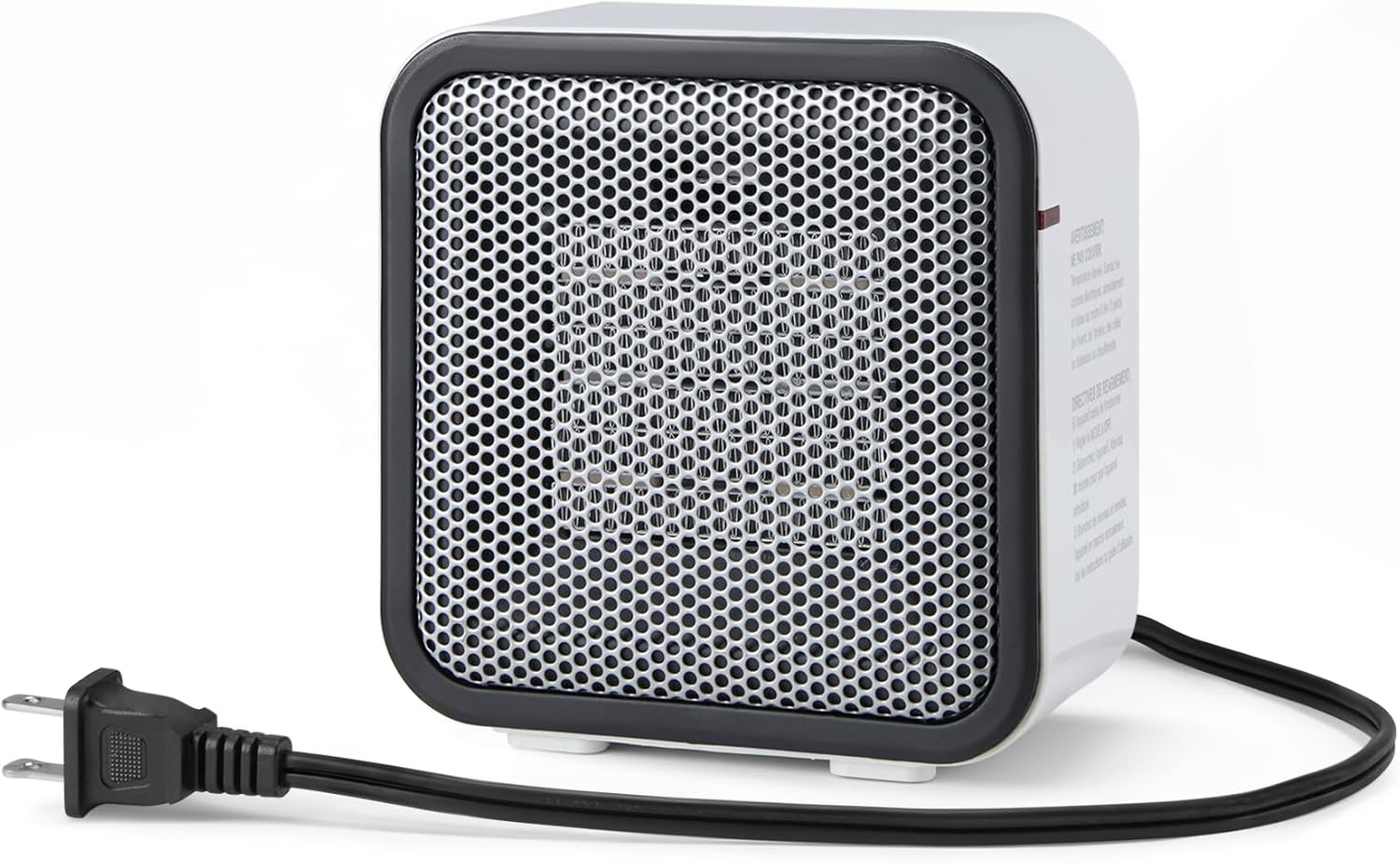
| Heat Output | 500 watts |
|---|---|
| Heating Method | Convection |
| Power Source | Corded Electric |
| Heating Coverage | 107.6 square feet |
| Special Features | Tip-Over Protection |
This compact Amazon Basics ceramic heater delivers focused warmth for small spaces like desks, bedside tables, or home offices. It uses a 500-watt ceramic element to produce heat quickly with a single heat setting and convection-style output, and its tiny footprint and 1.4 lb weight make it easy to move where you need it. Built-in tip-over protection automatically cuts power if the unit is knocked over, which improves safety for use around pets or in busy workspaces. Because it runs at low wattage it warms a limited area rather than an entire room, so expect noticeably faster comfort for one person sitting within a few feet of the unit but modest impact beyond that distance. The heater is simple to operate with no fan speed or temperature controls beyond its single output, which keeps operation straightforward but limits fine-tuning. For anyone needing a cheap, portable source of immediate warmth in close quarters, this is a practical, no-frills option.
Best for: Buyers who want an efficient, low-wattage heater to warm a single seating area or small workspace quickly and without fuss.
Less Ideal for: People looking to heat entire rooms, open-plan spaces, or multiple occupants should choose a higher-powered room heater instead.
- Very compact and lightweight for easy repositioning
- Low 500W power draws useful for saving energy or using on limited circuits
- Heats up quickly for localized, personal warmth
- Tip-over protection adds a straightforward safety cut-off
- Single heat setting limits temperature control and customization
- Not powerful enough to heat medium or large rooms effectively
Verdict: A tiny, energy-frugal ceramic heater that delivers fast personal warmth for desks and small spots where a low-wattage solution is the priority.
Lerat Mini Space Heater K40

| Heat Output | 500 watts |
|---|---|
| Heating Method | Convection |
| Power Source | ac |
| Special Features | Fast Heating, Noiseless, Overheat Protection, Portable, Tip-Over Protection |
| Room Type | Bedroom, Home Office |
The Lerat Mini Space Heater K40 is a tiny 500W PTC ceramic heater built for personal spaces like desks, dorm rooms, and nightstands. It produces near-instant warm air and is meant to heat a small zone around your hands and feet rather than an entire room, which makes it useful for focused comfort while working or sleeping. The unit runs quietly at about 30 dB, so it is unlikely to disturb concentration or rest, and a single-button control keeps operation simple. Safety is emphasized with tip-over and overheat automatic shutoff plus flame-retardant materials, and the low 500W draw helps avoid tripping circuits and keeps energy use down compared with typical 1500W heaters. The trade-offs are obvious: it cannot replace a full-room heater and will take longer or fail to raise temperature in larger or poorly insulated spaces. It is best as a personal, plug-in supplementary heater where compact size, low power draw, and safety matter more than raw output.
Best for: Buyers who want an inexpensive, energy-conscious personal heater for a desk, bedside, or small enclosed spot and prioritize compact size and quiet operation.
Less Ideal for: People who need to warm large rooms, open-plan living areas, or who expect rapid whole-room temperature changes should choose a higher-output heater.
- Low 500W power draw reduces electricity use and lowers chance of tripping circuits
- PTC ceramic element provides quick warm air in a small area
- Very quiet operation (~30 dB) suitable for offices and bedrooms
- Built-in tip-over and overheat automatic shutoff for safer unattended use
- Limited heating capacity not suited to warming full rooms or large open spaces
- Minimal controls with one-button operation limit temperature fine-tuning
Verdict: Choose the Lerat mini heater when you want a very compact, low-wattage personal heater that delivers quiet, energy-efficient spot warmth with strong safety features.
VOCRS PTC-903B Ceramic Heater
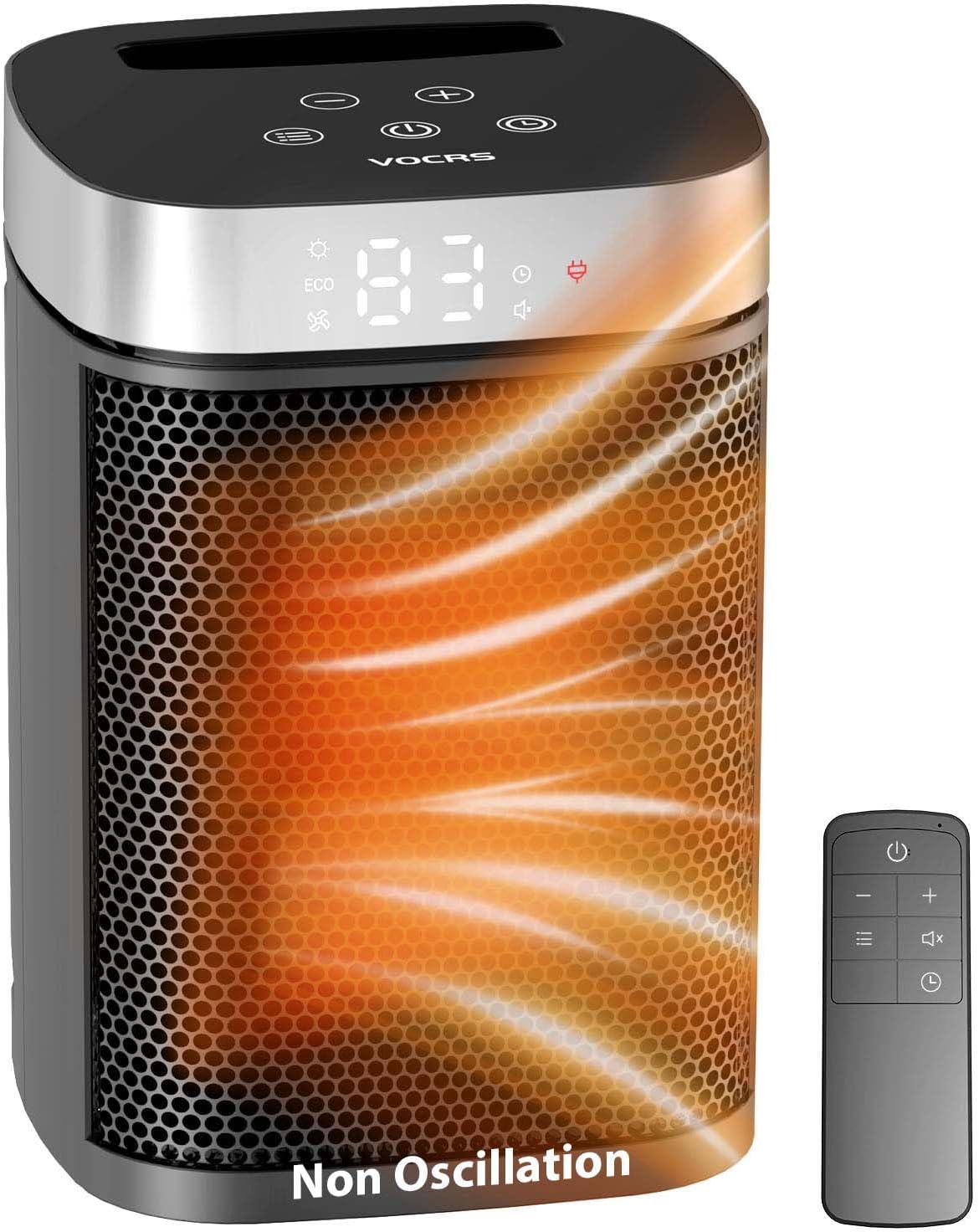
| Heat Output | 1500 watts |
|---|---|
| Heating Coverage | 200 sq.ft |
| Number of Speeds | 3 |
| Power Source | AC |
The VOCRS PTC-903B is a small ceramic tower heater designed to warm single rooms up to about 200 sq ft using selectable power levels (700W/1000W/1500W). It is typically used on bedroom or home office floors where you want targeted, quick warmth without a permanent installation. The unit includes a clear digital display, remote control, and a 1–12 hour timer so you can set run times and adjust heat from across the room. Practical features include overheat protection, tip-over shutoff, and a carry handle that make moving and operating the heater straightforward and safer. As a compact unit its strongest points are portability and simple controls, but at the highest setting it still consumes full-line power and is best for spot heating rather than warming large open areas. Expect effective short-term heating and basic safety features in a compact footprint.
Best for: Buyers who prioritize a reliable, easy-to-use portable heater for bedrooms or home offices and want clear controls plus basic safety features.
Less Ideal for: People needing to heat large, open living spaces or who require whisper-quiet operation for nearby sleeping infants.
- Three power modes (700W/1000W/1500W) for adjustable spot heating
- Remote control and digital display for convenient operation
- 1–12 hour timer to schedule run times and save energy
- Built-in safety features including overheat protection and tip-over shutoff
- Compact, lightweight tower form with carry handle for easy relocation
- 1500W maximum output is best for single-room spot heating, not whole-house warming
- Small footprint limits airflow compared with larger fan-forced heaters
Verdict: A compact, safety-minded ceramic tower that delivers dependable spot heating with simple controls and a timer.
GiveBest Portable Space Heater PTC-905

| Heat output | 1500 watts |
|---|---|
| Secondary heat | 750 watts |
| Heating coverage | 200 sq.ft |
| Number of speeds | 2 |
| Max temperature setting | 158 °F |
The GiveBest PTC-905 is a small PTC ceramic space heater designed to warm a single room or desk area quickly. It offers two heat modes (1500W and 750W) plus a cool-air fan, and an adjustable electronic thermostat that cycles the unit to hold a preset temperature. The unit is marketed for bedrooms, home offices, bathrooms and similar rooms up to about 200 sq ft and uses rapid PTC heating and a high-speed fan to deliver noticeable warmth fast. Safety features include V0 flame-retardant casing, automatic overheat shutoff and tip-over protection that beeps and cuts power if knocked over. It is lightweight and has a carry handle for moving between rooms, and the quieter-than-average operation makes it suitable for sleep or focused work. Limitations are its small coverage—best for single-room spot heating—and the basic two-speed control and lack of advanced scheduling or smart controls, so it is not a whole-house solution or a feature-rich smart heater.
Best for: Buyers who want a reliable, safety-focused portable heater to warm a single room quickly and prefer proven customer-backed designs over cutting-edge smart features.
Less Ideal for: People seeking whole-house heating or smart connected heaters with timers and remote control should look at larger or feature-rich models instead.
- Two heat settings (1500W/750W) plus cool fan for year-round use
- Adjustable electronic thermostat for automatic temperature control
- Multiple safety systems including overheat shutoff and tip-over protection
- Compact, lightweight design with carry handle for easy portability
- Quiet operation suitable for bedrooms or home offices
- Designed for single-room spot heating so it will not heat large open areas
- Controls are basic with no Wi-Fi, scheduling, or advanced modes
Verdict: A compact, safety-first ceramic heater that delivers quick spot warmth for one room, ideal if you prioritize reliable performance and social-proofed results.
DREO Space Heater HSH006

| Heat Output | 1500 watts |
|---|---|
| Heating Element | PTC Ceramic |
| Heating Coverage | 200 sq.ft |
| Min Temperature Setting | 41 °F |
| Max Temperature Setting | 95 °F |
This DREO tower heater delivers fast, forced-air warmth using a 1500W PTC ceramic element and an enhanced heat-funnel design that pushes heat farther than many compact heaters. It is intended for indoor rooms up to about 200 sq ft and offers multiple heat modes (including ECO and fan-only), a 12-hour timer, and a precise thermostat that can be set from 41 to 95°F in 1°F increments. Safety features include tip-over detection, overheat protection, flame-retardant materials, and an ETL listing, and the unit runs quietly thanks to a brushless DC motor rated around 34 dB which makes it suitable for bedrooms or offices. The included remote and memory function make day-to-day control convenient, while the handle and lightweight profile aid portability. Limitations are typical for a compact 1500W heater: it is designed for single-room spot heating and will not replace central heating for larger or open-plan spaces, and the 1500W power means it uses a standard circuit so prolonged use on older wiring should be considered.
Best for: Buyers who prioritize safe, quiet, and precise zone heating for bedrooms or home offices and want straightforward controls and reliable safety features.
Less Ideal for: Not a good fit for heating large, open-plan spaces or whole-home heating needs where a higher-capacity or central system is required.
- Quick PTC ceramic heating that warms a room up to roughly 200 sq ft
- Precise thermostat with 1°F increments for fine temperature control
- Multiple modes and a 12-hour timer for flexible, scheduled use
- ETL-listed safety features including tip-over and overheat protection
- 1500W output is suited to single-room use and will not heat large open areas
- No smart-home connectivity—control is via on-unit buttons or the included remote
Verdict: A safe, quiet, and precise 1500W tower heater ideal for risk-averse buyers needing dependable single-room warmth.
Choosing the Right Low-Wattage Portable Heater: Key Factors to Consider
Wattage and Actual Energy Use
Wattage determines how much electricity a heater draws and is the primary factor when selecting a low-wattage model. Lower wattage reduces operating cost and limits circuit load, but it also limits maximum heat output. Consider the balance between an appliance that fits your power constraints and one that actually produces enough warmth for the intended space.
Also think about how long you plan to run the unit. Continuous runtime multiplies the energy impact, so a lower-wattage heater with decent thermostat control can be more economical over time than a higher-wattage unit that cycles on and off frequently.
Room Size and Heat Coverage
A low-wattage portable heater works best in small, enclosed spaces where it can raise temperatures efficiently. Measure the room or estimate cubic footage to determine whether a compact heater will be adequate. Drafts, high ceilings, and poor insulation increase the heat demand and may make a low-wattage option feel underpowered.
Placement matters as well. Positioning the heater close to the primary sitting area or workspace improves perceived warmth while avoiding blocked airflow improves the unit's delivery of heat across the space.
Thermostat Accuracy and Control Options
Precise temperature control affects comfort and energy savings. Digital thermostats with clear readouts and programmable timers let you maintain a set temperature without manual intervention. Mechanical dials can work well but are often less accurate, which can lead to more on-off cycling and wasted energy.
Look for adjustable heat settings, an eco or low-power mode, and simple timers or scheduling features if you intend to run the heater while you sleep or are away for short periods.
Safety Features and Certifications
Because heaters operate at high temperatures, built-in safety protections are crucial. Reliable low-wattage portable heaters include tip-over shutoff, overheat protection, cool-touch housing, and certifications from recognized safety labs. These reduce the risk of fire and accidental burns.
Check that controls are easy to use and that vents remain unobstructed during operation. If you have children or pets, extra safety considerations like guarded grills and low external temperatures become more important.
Noise and Fan Operation
Noise level affects usability in bedrooms, offices, and shared living spaces. Some low-wattage heaters rely primarily on radiant or convection heating and are nearly silent, while units with fans can move heat faster but produce audible sound.
If you are sensitive to sound, prioritize models with quieter fans or those that operate effectively in fan-off modes. Also consider whether fan noise varies with heat setting and whether it produces frequency ranges that disrupt sleep or concentration.
Where Low-Wattage Heaters Work Best
Low-wattage portable heaters excel in localized heating scenarios: small bedrooms, home offices, dorm rooms, bathrooms with short use periods, and spot-warming near seating areas. They are not intended to replace whole-house systems but to supplement them where zoned comfort is needed.
- Small, enclosed rooms under 150 square feet are ideal.
- Place near the primary occupant for the most perceived warmth.
- Avoid using them as the primary heat source in poorly insulated spaces.
Placement and Ventilation Tips
Correct placement improves effectiveness and safety. Keep the heater on a stable, level surface away from curtains, bedding, or other combustibles. Allow at least a few feet of clearance on the front and sides to ensure unobstructed airflow and even heat distribution.
- Do not block intake or exhaust vents.
- Avoid using on soft surfaces that could tip the unit, such as beds or rugs.
- Position the heater so it directs warmth to where people sit rather than toward empty space.
Running Cost Expectations and Estimation
Understand how wattage translates to daily operating cost. Multiply the heater wattage by the number of hours used and divide by 1,000 to get kilowatt-hours. Then multiply by your electricity rate to estimate cost. Low-wattage units reduce per-hour consumption, but long runtimes still add up.
- Short bursts of heat for occupied zones are usually most economical.
- Use thermostat control to avoid unnecessary continuous operation.
- Set timers to ensure the heater runs only when needed.
Maintenance and Longevity
Regular maintenance keeps a portable heater working reliably and safely. Clean dust from grills and fan blades, check cords for wear, and ensure controls remain responsive. Simple maintenance can extend a heater's useful life and preserve quiet operation.
- Unplug before cleaning and allow the unit to cool.
- Vacuum intake vents periodically to remove dust buildup.
- Inspect the power cord and plug for fraying or damage. Replace the unit if safety components fail.
When a Low-Wattage Heater Is Not Enough
If the space is large, poorly insulated, or consistently exposed to drafts, a low-wattage heater may not provide satisfactory comfort. In those cases, consider supplemental measures such as adding insulation, weatherstripping, or using multiple small heaters on separate circuits with caution. Also be mindful of circuit capacity. Multiple electric heaters on one circuit can trip breakers, so assess your home wiring before deploying additional units.
- Assess insulation and draft sources before relying on a single small heater.
- Avoid running several heaters from the same outlet or circuit.
- Consider alternative heating strategies for larger or open-plan rooms.
How We Chose the Best Low-Wattage Portable Heater
To produce this shortlist we applied practical, buyer-focused filters and prioritized features that meaningfully affect the user experience of low-wattage portable heaters. First, we screened for nominal power ratings in the low-wattage range appropriate for small rooms and supplemental heat. We then evaluated heating effectiveness by looking at rated heat output relative to wattage and the presence of adjustable thermostats and multiple heat settings. Safety and built-in protections were nonnegotiable selection criteria, including tip-over shutoff, overheat protection, and safe surface temperatures. We also weighed controls and usability features such as digital or mechanical thermostats, timers, remote controls, and ease of portability. Noise level and fan operation were included to reflect real-world use in bedrooms and offices. Excluded from consideration were large standalone heaters intended for whole-house heating and any units that lacked essential safety certifications. The final list emphasizes efficient heat delivery, controllability, safety, and quiet operation, which align with the scoring criteria used for each product entry.
Our full evaluation process is outlined in our review methodology.
FAQ
How much area will a low-wattage portable heater warm?
Low-wattage heaters are best for small rooms or focused zones, usually up to about 100 to 150 square feet depending on insulation and ceiling height. The actual coverage depends on heater design and placement.
Are low-wattage heaters safe to leave on overnight?
Many low-wattage models include timers, thermostats, and safety shutoffs designed for overnight use, but you should only leave units on overnight if they have the appropriate safety features and are placed on a stable, clear surface.
Do low-wattage heaters consume much electricity?
They consume less per hour than high-wattage units, but total energy depends on runtime. Using thermostat control and timers reduces unnecessary usage and keeps operating costs down.
Will a fan-equipped low-wattage heater heat faster?
Fan-assisted models move warmed air faster across a room and can feel quicker, but they may be noisier. For quiet environments, a radiant or convection-only low-wattage model may be preferable.
Can I use a low-wattage heater in a bathroom?
Use only heaters rated for bathroom or damp-location use and keep them away from direct water exposure. Follow the manufacturer's safety guidelines for placement and distance from sinks or tubs.
Final Verdict
For small rooms and targeted warmth, prioritize a low-wattage portable heater that matches your room size, offers accurate thermostat control, and includes robust safety features. Expect tradeoffs between speed of heat and noise: fan-assisted units warm a space faster but can be louder, while convection or radiant designs are quieter but slower to change room temperature. Choose a model with the control features and protections you need, and plan placement to maximize perceived warmth. With proper sizing and sensible use, a low-wattage portable heater can deliver comfortable, energy-conscious supplemental heating.