
Note: This article contains affiliate links. If you click on these links and make a purchase, we may earn a small commission at no extra cost to you. This helps support our research and content. Read our full affiliate disclosure here.
When outside temperatures drop, a reliable portable heater for indoor use can make a living room, bedroom, or home office comfortable again without touching your central system. The right unit balances steady heat output, safety features, and running cost so you get effective warmth where and when you need it. This guide shortlists the top seven portable heaters for indoor use across common home settings and explains the practical tradeoffs buyers should expect. Read on for clear criteria on heating capacity, energy efficiency, safety, and usability before choosing the model that fits your space.
Top Picks at a Glance
| Best Overall The best all-around choice for most situations | Lasko Ceramic Tower Heater 751320 |  |
| Best Quality Built to a higher standard if you want something more solid | DR. Infrared Heater DR-968 |  |
| Best Value The sweet spot between price and what you get | DREO Space Heater DR-HSH004 |  |
| Best Budget The cheapest option that still gets the job done reliably | Amazon Basics 500W Ceramic Mini Heater |  |
| Top Rated A top-rated pick with lots of positive feedback | DREO Space Heater HSH006 |  |
| Most Popular A crowd favorite that many people choose with confidence | GiveBest Portable Space Heater PTC-905 |  |
| Best Seller A high-volume bestseller chosen again and again | Mr. Heater Portable Buddy F232000 |  |
Lasko Ceramic Tower Heater 751320

| Heat Output | 1500 watts |
|---|---|
| Heating Element | Ceramic |
| Indoor Outdoor Usage | Indoor |
| Power Source | Corded Electric |
| Special Features | Adjustable Thermostat, Timer, Widespread Oscillation, Remote Control |
The Lasko Ceramic Tower Heater is a slim, portable electric tower designed to deliver fast, even warmth in small to medium indoor rooms. It uses a 1500-watt ceramic heating element and widespread oscillation to circulate warm air across a room while offering two heat settings plus an adjustable thermostat and an auto-off timer for scheduled use. Controls are electronic and the included multi-function remote stores on-board for convenient adjustments from across the room. Built-in safety features such as overheat protection and cool-touch housing make it suitable for bedrooms and living areas, and the carry handle keeps it easy to move between rooms. Practical limits include only two heat settings rather than multiple fan speeds and no tip-over switch noted for this model, so placement should be careful; it is sized for localized room heating rather than whole-house use. For buyers who want a straightforward, quiet tower heater with programmable controls and oscillation, this model covers the essentials without extra complexity.
Best for: Buyers who want a portable, easy-to-use tower heater for bedrooms or living rooms that prioritizes simple programmable controls and even room circulation.
Less Ideal for: People who need very fine temperature control, multiple fan speeds, or a heater meant to warm very large open spaces should consider higher-capacity or feature-rich alternatives.
- 1500-watt ceramic element provides quick, effective heat for small to medium rooms
- Widespread oscillation helps distribute warmth more evenly through a room
- Electronic thermostat and 7-hour auto-off timer allow temperature control and scheduled shutoff
- Includes multi-function remote with on-board storage for convenient adjustments
- Built-in safety features include overheat protection and cool-touch housing
- Only two heat settings limits fine-grained power control compared with multi-speed models
- No tip-over switch is indicated for this specific model, so it requires careful placement
Verdict: A straightforward, portable 1500W ceramic tower heater that delivers quick, even room warmth with programmable controls and remote convenience.
DR. Infrared Heater DR-968

| Wattage | 1500 Watts |
|---|---|
| Heating Coverage | 576 square feet |
| Number of Speeds | 3 |
| Voltage | 120 |
| Thermostat Range | 50 °F to 85 °F |
The DR. Infrared Heater DR-968 is a freestanding 1500 W infrared space heater designed to heat large rooms quickly by combining a quartz infrared tube with a PTC element and a high-pressure low-noise blower. It is typically used as a supplemental heater in living rooms, bedrooms, home offices, and similar indoor spaces where faster, object-focused warmth is preferred to blasting hot air. Notable features include an electronic thermostat with a 50 to 85 F range, Auto energy-saving mode that cycles between high and low power, three power settings (auto, low 1000 W, high 1500 W), a 12-hour timer, caster wheels for room-to-room mobility, and an IR remote. Safety-minded buyers get tip-over and overheat protection and UL certification. In practice the hybrid heating and blower yield more noticeable warmth at a distance than many other 1500 W units, and the quiet fan makes continuous use tolerable. Trade-offs are the unit weight and footprint compared with smaller ceramic heaters and the fact that it heats objects and people more directly than uniformly warming large open-plan volumes.
Best for: Buyers who prioritize strong, performance-oriented heat delivery and safety for finished indoor rooms and want a portable unit that heats noticeably faster than typical 1500 W ceramic heaters.
Less Ideal for: People who need an ultra-compact, lightweight heater for occasional spot use or who want to quickly warm very large open-plan spaces with uniform air temperature.
- Dual heating system (quartz infrared + PTC) that increases delivered warmth compared with many single-element 1500 W heaters
- High-pressure low-noise blower spreads heat farther while remaining relatively quiet (~39 dB reported)
- Electronic thermostat with Auto energy-saving mode and timer for consistent temperature control and lower energy use
- Built-in safety features including tip-over and overheat protection and UL certification
- Remote control and caster wheels for convenient operation and repositioning
- Heavier and bulkier than compact ceramic heaters, making it less convenient for frequent transport
- Focuses on heating objects and people rather than rapidly raising air temperature in very large open areas
Verdict: Choose the DR-968 when you want a portable, safety-certified 1500 W heater that delivers stronger, farther-reaching infrared heat than most standard ceramic models.
DREO Space Heater DR-HSH004
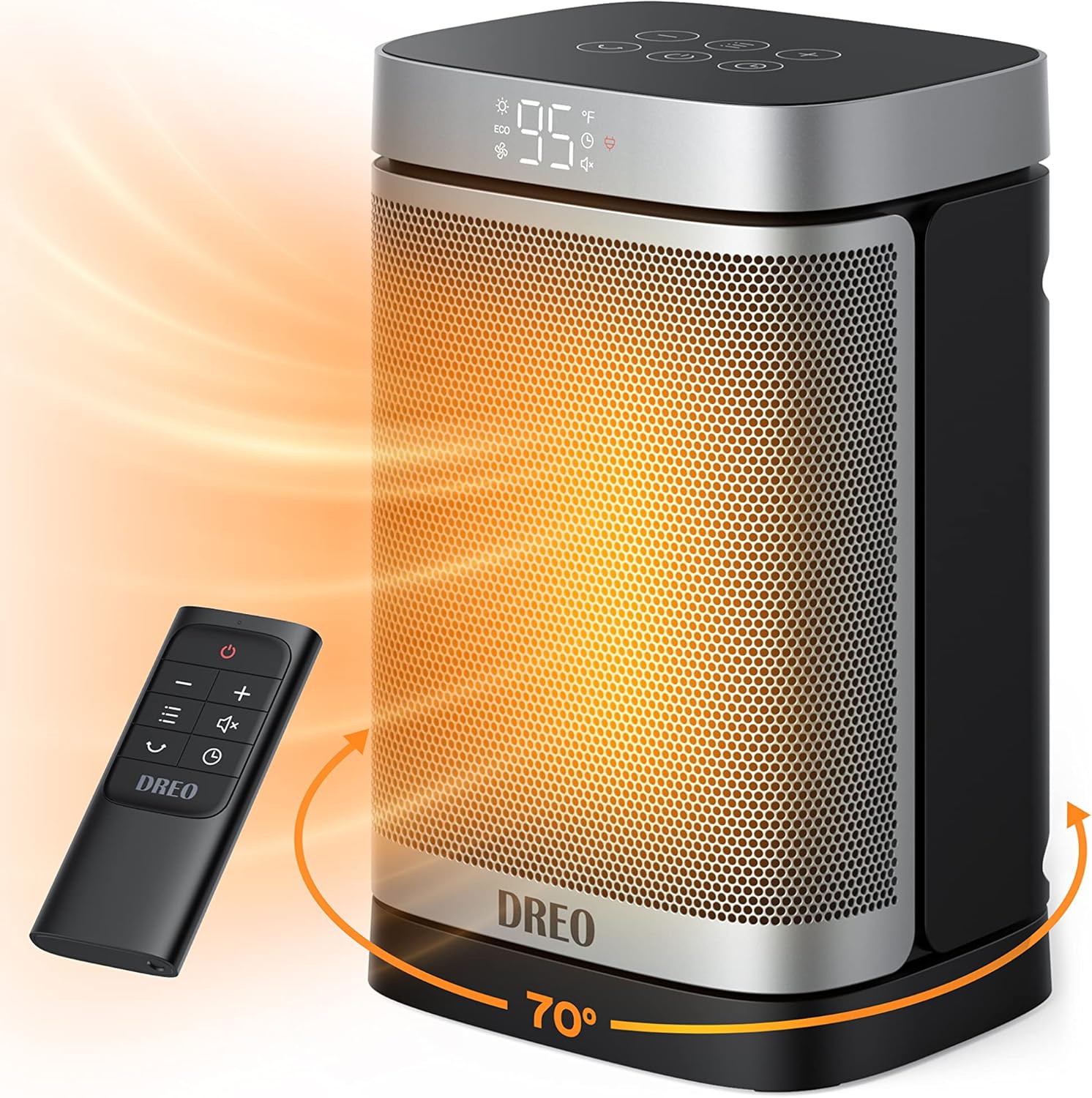
| Heat Output | 1500 watts |
|---|---|
| Heating Coverage | 200 sq.ft |
| Thermostat Range | 41-95 °F |
| Number of Speeds | 5 |
| Power Source | Alternating Current |
The DREO DR-HSH004 is a portable electric tower heater that delivers up to 1500W of PTC ceramic forced-air heat for spot heating in bedrooms, home offices, or small living spaces. It uses a programmable digital thermostat adjustable from 41 to 95 F in 1 F increments, plus ECO and multiple heat/speed modes to balance comfort and energy use. A 70 degree oscillation spreads warmth across a wider area and a detachable filter helps keep the air pathway cleaner. Safety features include ETL listing, tip-over and overheat protection, and a flame-retardant plug and housing. The unit is relatively quiet thanks to a brushless DC motor and aerodynamic fan design, so it is suitable for sleeping or working near. Limitations are its 200 sq ft coverage and 1500W ceiling, which means it is best for targeted heating rather than whole-house use, and the tower form and small footprint may produce less radiant warmth than larger radiators in very cold rooms.
Best for: Buyers who want a compact, efficient room heater that prioritizes precise temperature control and lower energy use for bedrooms, offices, or small living spaces.
Less Ideal for: People needing to heat large open-plan areas or whole apartments should consider higher-capacity or different heater types instead.
- Programmable digital thermostat with 1°F increments for precise temperature control
- 70° oscillation distributes warm air across a wider area
- ECO mode that adjusts output to save energy
- Detachable filter and quiet brushless DC motor for cleaner, low-noise operation
- Built-in safety features including tip-over and overheat protection and ETL listing
- Rated coverage around 200 sq ft and 1500W output limit it to small to medium rooms
- Provides forced-air warmth that may feel less steady than oil-filled radiators for long-term background heating
Verdict: A compact, safety-focused tower heater that gives precise temperature control and energy-saving ECO mode for targeted indoor heating.
Amazon Basics 500W Ceramic Mini Heater

| Heat Output | 500 watts |
|---|---|
| Heating Method | Convection |
| Heating Element | Ceramic |
| Power Source | Corded Electric |
| Voltage | 120 volts |
This Amazon Basics ceramic mini heater is a tiny, no-frills personal heater meant to warm small indoor spots quickly. It uses a 500-watt ceramic element and convection heating to produce fast, localized warmth for a desk, bedside table, or small home office; the low power draw makes it practical when you do not want to heat an entire room. The unit is lightweight and easy to move, and tabletop mounting means it sits neatly on narrow surfaces. Safety features include tip-over protection that cuts power if the heater is knocked over, which is helpful in busy spaces. Expect moderate noise around typical fan levels and limited reach — it is intended for close-range use rather than heating larger rooms. There are no advanced controls or thermostatic scheduling, so temperature control is basic and manual. For buyers who want an inexpensive, portable solution to take the chill off a small area, this delivers straightforward performance without extras.
Best for: Buyers looking for a low-cost, portable heater to warm a single workstation, bedside area, or small home office who prioritize affordability and simplicity.
Less Ideal for: Anyone needing to heat medium or large rooms or who wants programmable thermostatic control should choose a larger or feature-rich heater instead.
- Compact footprint fits on desks and small tables
- Lightweight and easy to move between rooms
- 500W ceramic element provides quick, localized heat
- Built-in tip-over protection for safer tabletop use
- Low wattage limits effective coverage to very small spaces
- No thermostat or advanced controls for precise temperature management
Verdict: A budget-friendly, portable personal heater that provides quick, close-range warmth for small indoor spaces.
DREO Space Heater HSH006

| Heat Output | 1500 watts |
|---|---|
| Heating Coverage | 200 sq.ft |
| Heating Element | PTC Ceramic |
| Number of Speeds | 4 |
| Timer | 1-12 H |
The DREO HSH006 is a portable tower heater designed to warm small to medium indoor rooms quickly using a 1500W PTC ceramic element and forced-air output. It offers multiple heat modes including power heat, ECO, and fan-only plus a precise thermostat that adjusts from 41 to 95°F in 1°F increments, so you can set and maintain a comfortable temperature rather than guessing. Practical extras include a 12-hour timer, remote control, child lock, and a memory function that restores previous settings. Safety is emphasized with ETL listing, tip-over detection, overheat protection, flame-retardant materials, and a grounded safety plug. The unit is lightweight and has a carry handle for moving between office, bedroom, and living spaces. Noise is low thanks to a brushless DC motor and winglet fan design, and DREO rates sound at about 34 dB, making it suitable for night use. Limitations are the 200 sq ft recommended coverage, which means it is not intended for large open rooms, and as a fan-forced heater it provides directional warm air rather than whole-room radiant warmth.
Best for: Buyers who prioritize a reliable, safety-focused indoor heater that delivers quick, controllable warmth for bedrooms, home offices, or similar rooms and value precise thermostat control and low noise.
Less Ideal for: Those needing to heat large open-plan areas or who prefer radiant/oil-filled heaters for slow, even heat distribution should consider other heater types.
- 1500W PTC ceramic with forced-air for fast, consistent heat
- Precise thermostat with 1°F increments for accurate temperature control
- Multiple convenience features: remote, 12-hour timer, memory, and child lock
- Comprehensive safety: tip-over sensor, overheat protection, ETL certification
- Recommended coverage limited to about 200 sq ft so not ideal for large spaces
- Directional forced-air heating may feel less even than radiator-style heaters
Verdict: A safety-first, quiet 1500W tower heater that reliably delivers precise, controllable warmth for small to medium indoor rooms.
GiveBest Portable Space Heater PTC-905

| Heat Output | 1500 watts |
|---|---|
| Heating Coverage | 200 sq.ft |
| Number of Speeds | 2 |
| Power Source | Corded Electric |
| Max Temperature Setting | 158 °F |
The GiveBest PTC-905 is a compact ceramic fan heater designed to warm small to medium indoor rooms quickly. It offers two heat settings (1500W and 750W) plus a cool-air fan mode, and an adjustable electronic thermostat that cycles the unit to maintain a set temperature without constant manual control. The PTC ceramic element and high-speed fan produce rapid, even heat for areas like bedrooms, home offices, and bathrooms, and the unit includes tip-over and overheat shutoff plus flame-resistant housing for added safety. Practical touches include a carry handle for moving the heater where you need it and a relatively quiet operation that is suitable for sleeping or working. Limitations are inherent to its size: it is intended for localized heating rather than whole-house use, and the simple two-speed control and lack of advanced programming or Wi-Fi mean it is best for straightforward on/off and thermostat operation rather than automated scheduling.
Best for: Buyers who prioritize a compact, safe heater with proven customer approval and straightforward thermostat control for warming a single room or workspace.
Less Ideal for: People who need to heat large open areas, want smart features like app control or scheduling, or expect multi-room heating from one unit.
- Dual heat modes plus cool fan for year-round use
- Adjustable electronic thermostat that maintains set temperature
- Multiple safety features including tip-over and overheat shutoff and flame-resistant housing
- Compact, lightweight design with carry handle for easy portability
- Quiet operation suitable for bedrooms or home offices
- Heats only a localized area and is not suitable for heating larger open-plan spaces
- Controls are basic with just two heat speeds and no advanced scheduling or connectivity
Verdict: A compact, safety-minded ceramic heater that reliably warms a single room with easy thermostat control and broad positive user feedback.
Mr. Heater Portable Buddy F232000

| Heat Output | 9000 BTU |
|---|---|
| Heating Coverage | 225 |
| Fuel Type | Propane |
| Number of Speeds | 2 |
| Power Source | gas_powered |
The Mr. Heater Portable Buddy is a small, pedestal-style radiant propane heater intended for quick spot heating in garages, patios, or similar indoor-safe spaces. It offers two heat settings (about 4,000 and 9,000 BTU) and runs on a 1 lb disposable propane cylinder with the option to connect to a larger tank using accessories, so it is useful for short sessions where electric heat is not available. The unit includes safety features such as an oxygen depletion sensor, thermal shutoff, and a tip-over switch, and its piezo igniter and easy-grip handle make it convenient to move and start. Practical benefits are fast radiant warmth for directional heating and a lightweight, portable design that stores easily. Important limitations are that it relies on propane so indoor use requires attention to ventilation and fuel availability, and run time on a 1 lb cylinder is limited to a few hours depending on the setting. For buyers seeking a simple, portable propane solution for spot heating, it is a reliable option; those wanting whole-room electric heating or continuous long-term indoor use should consider alternatives.
Best for: Buyers who want a dependable, easy-to-move spot heater for garages, covered patios, or other spaces where short-term propane heating and strong safety features are priorities.
Less Ideal for: People who need continuous whole-room electric heating or who cannot safely store or use propane indoors should choose an electric or hardwired heater instead.
- Portable pedestal design with easy-grip handle for quick relocation
- Two heat settings that produce up to 9,000 BTU for fast radiant warmth
- Built-in safety systems including oxygen depletion sensor, thermal shutoff, and tip-over switch
- Runs on common 1 lb propane cylinders and can attach to a larger tank with accessories
- Depends on propane fuel so requires ventilation and periodic cylinder changes
- Limited run time on a 1 lb cylinder, especially on the high setting
Verdict: A compact, safety-focused propane radiant heater that delivers fast spot heat for short-term indoor-safe use.
Choosing the Right Portable Heater for Indoor Use: Key Factors to Consider
Heating Capacity and Room Size
Match the heater's output to the size of the room you plan to warm. Heating capacity is usually expressed in watts or BTU; a higher rating means the unit can raise and maintain temperature in a larger space. For indoor use, consider both peak output and how well the heater can sustain comfortable temperatures over time. If the heater's listed capacity is borderline for your room, expect longer run times and higher energy use.
Room layout and insulation matter too. Open-plan areas and rooms with high ceilings will need more output than compact, well-insulated bedrooms. Choosing a unit rated slightly above your estimated need reduces runtime and helps maintain steady temperatures without constantly running at full power.
Energy Efficiency and Running Cost
Energy efficiency affects the ongoing cost of using a portable heater for indoor use. Look for models with adjustable power levels, eco modes, or thermostatic control so the device cycles on and off instead of running constantly at maximum. A thermostat that accurately holds a set temperature prevents wasted energy from overheating the space.
The type of heating element influences efficiency too. Some technologies convert most input power into immediate heat, while others offer fan-assisted distribution that warms a room faster. Consider how many hours per day you will use the heater and whether you need quick bursts of warmth or steady background heating when estimating operating cost.
Safety Features and Certifications
Safety is critical for indoor heating. Choose heaters with built-in protections such as tip-over shutoff, overheat cutoff, and cool-touch surfaces to reduce burn and fire risks. Certified units from recognized testing organizations provide a baseline assurance that the device meets safety standards for indoor use.
Also consider physical design factors that affect safe placement. Units with stable bases, guarded heating elements, and clear spacing guidelines lower the chance of accidental contact or nearby combustible materials catching fire. For households with children or pets, prioritize models with additional safeguards and clear operational indicators.
Noise Level and Daily Use
Noise matters when a portable heater will operate in bedrooms, home offices, or living areas. Fan-assisted units often produce measurable noise, which can be distracting during sleep or focused work. If you need quiet operation, prioritize heaters with lower decibel ratings or convection-only designs that distribute heat silently.
Consider when and how long you will use the unit. A slightly louder model that heats faster may be acceptable for short use, while a quiet, moderate-output option will be preferable for overnight or all-day use. Check whether the unit has multiple fan speeds and a sleep or quiet mode for flexible operation.
Controls, Programmability, and Placement
Usability affects how often you will actually use and benefit from a heater. Intuitive controls, clear displays, and programmable timers make it easier to set comfortable temperatures and avoid unnecessary runtime. Remote controls or mobile app integration add convenience when the heater is placed out of arm's reach.
Placement flexibility influences performance and safety. Look for compact designs with handles or wheels for moving between rooms and check electrical cord length versus outlet locations. Better cord management and straightforward mounting or positioning instructions reduce tripping hazards and ensure optimal airflow around the unit.
Durability and Maintenance
A portable heater for indoor use should be easy to maintain and built to handle repeated cycles. Durable materials and well-sealed components resist dust buildup and wear from fan motors. Easy-to-clean grills and accessible filters, where present, simplify upkeep and preserve airflow.
Consider warranty length and the availability of replacement parts for longer-term ownership. Regular maintenance, such as dusting intake grilles and checking for loose connections, helps keep the heater operating safely and efficiently over its lifespan.
Types of Portable Heaters and How They Work
Portable indoor heaters use a few common technologies, each with distinct tradeoffs. Convection heaters warm air and rely on natural circulation to spread heat; they are usually quiet and deliver steady background warmth. Fan-forced or ceramic-fan units use a heating element with a fan to push warm air into the room quickly, which is useful for rapid spot heating.
Radiant heaters produce heat that warms objects and people directly rather than heating all the air in a room; they are efficient for focused seating areas. Oil-filled radiators provide long-lasting, even heat with low noise but take longer to reach full temperature. Choosing the right type depends on whether you need fast, localized warmth or quiet, continuous background heating.
- Convection: Quiet, steady warmth for enclosed spaces.
- Fan-forced: Fast heating, higher noise.
- Radiant: Direct warmth for people or small areas.
- Oil-filled: Long-lasting, quiet, slow to heat.
Placement and Installation Tips for Indoor Use
Position the heater on a stable, level surface away from curtains, furniture, and high-traffic zones. Maintain recommended clearance around the unit to preserve airflow and reduce fire risk. Avoid placing heaters on rugs or soft surfaces unless the manufacturer explicitly allows it.
Keep the heater within easy reach of the intended area but not directly against walls or under shelves that trap heat. If you plan to move the heater between rooms, pick a model with a handle or casters and be mindful of cord length and outlet locations to prevent tripping hazards.
- Keep at least 3 feet of clearance from combustibles.
- Avoid running cords under rugs or through doorways.
- Place on a flat, non-flammable surface.
- Do not block air intakes or outlets.
Energy-Saving Habits and Settings
Small behavioral changes reduce running time and cost when using a portable heater indoors. Use timers to run the heater only when the room is occupied and lower the thermostat a few degrees once the space is warmed. Pair the heater with simple insulation tactics such as closing doors and using draft stoppers at night to retain heat longer.
Prefer models with programmable thermostats or eco modes that automatically cycle power to maintain a target temperature. Using a lower fan speed or radiator-style unit overnight typically uses less power than running a fan-forced model at full output, depending on room and usage patterns.
- Set timers to match occupancy patterns.
- Use doors and curtains to isolate heated zones.
- Run at reduced power once target temperature is reached.
Safety Best Practices and Child-Pet Considerations
In households with children or pets, take extra precautions. Choose units with guarded surfaces and tip-over shutdowns, and place heaters where curious hands or paws cannot reach heating elements. Use models with cool-to-touch exteriors and stable bases to minimize accidental contact.
Always unplug the heater when not in use and keep combustible materials well away. Regularly inspect cords for damage and avoid using extension cords unless a heavy-duty, properly rated unit is required. These practices reduce risk and ensure safer indoor heating.
- Use tip-over and overheat protection.
- Place out of reach of children and pets.
- Inspect cords and plug connections regularly.
When to Use Portable Heaters Versus Central Heat
Portable heaters are best for spot heating individual rooms or supplementing a central system when you only occupy part of the home. They provide quick warmth where you need it and can be more economical than heating the entire house to the same temperature. For extended whole-house heating, central systems are usually more efficient.
Consider using portable heaters to reduce thermostat setpoints in unused areas while maintaining comfort in active rooms. This approach can cut overall energy usage, but monitor total run time and energy draw to ensure portable heating remains cost-effective for your usage pattern.
- Ideal for single-room use or temporary comfort.
- Supplement central heat to avoid heating unused spaces.
- Not always cost-effective for continuous whole-house heating.
How We Chose the Best Portable Heater for Indoor Use
We screened widely available portable heaters for indoor use with an emphasis on safety, consistent heat delivery, and cost to operate. Primary filters included verified safety certifications and built-in protective features to reduce fire and tip-over risks. We prioritized machines with clear heating output ratings and adjustable thermostats so warmth can be matched to room size. Energy efficiency and control options were next: models with programmable settings, eco or low-power modes, and reliable temperature control ranked higher. We also evaluated build and usability factors such as noise level, ease of carry, control simplicity, and cleaning access. Exclusions included outdoor-only units, hardwired baseboards, or devices lacking essential indoor safety features. The final list favors units that strike a balanced tradeoff between heating performance, day-to-day operating cost, and safe, user-friendly operation.
Our full evaluation process is outlined in our review methodology.
FAQ
Are portable heaters safe to use indoors overnight?
Many portable heaters have safety features like tip-over and overheat shutoffs that make overnight use safer, but you should follow manufacturer guidelines, maintain clearances, and use units rated for continuous operation if planning extended use.
How do I choose the right heater size for my room?
Estimate the room square footage and match it to the heater's output rating. Choose a unit with slightly higher capacity if the room has poor insulation or high ceilings to ensure the heater can maintain temperature without running constantly.
Will a portable heater significantly raise my energy bill?
Running a portable heater will increase energy use, but the impact depends on run time, power level, and how well you isolate the heated area. Using timers, thermostats, and targeted heating can limit costs compared with raising whole-home heating.
Can I run a portable heater on any household outlet?
Most indoor portable heaters plug into standard household outlets, but high-power models may require dedicated circuits. Check the heater's power draw and ensure the outlet and circuit are rated for continuous use at that load.
How often should I maintain or clean my portable heater?
Regular maintenance is usually minimal: dust intake grills, check for lint or debris, and ensure fans run smoothly. Do this before the heating season and periodically during heavy use to maintain airflow and reduce fire risk.
Final Verdict
When choosing a portable heater for indoor use, prioritize safe operation, appropriate heating capacity, and features that match how you plan to use the unit. Decide whether you need fast, localized warmth or quiet, steady background heating, then pick a model with the safety protections and controls that fit your household. Balancing output, efficiency, and usability will help you get comfortable temperatures without unnecessary energy waste or risk.