
Note: This article contains affiliate links. If you click on these links and make a purchase, we may earn a small commission at no extra cost to you. This helps support our research and content. Read our full affiliate disclosure here.
If you need extra warmth in a small room, office, or dorm without overloading a circuit, a low-wattage space heater can be the practical solution. You want dependable heat that runs quietly and costs less to operate while fitting safely into the limited electrical capacity of compact spaces. This guide highlights the top shortlisted low-wattage space heaters selected for everyday household use and explains the real-world tradeoffs between heat output, energy use, and safety features. Below you will find brief product write-ups followed by the decision criteria we used. The guide emphasizes operating cost, heating effectiveness in small footprints, safety, and usability to help you pick the best low-wattage heater for your specific situation.
Top Picks at a Glance
| Best Overall The best all-around choice for most situations | Amazon Basics Ceramic Mini Heater |  |
| Best Quality Built to a higher standard if you want something more solid | Honeywell 360 Degree Surround Heater HHF360V |  |
| Best Value The sweet spot between price and what you get | Pereysi Ceramic Personal Space Heater |  |
| Best Budget The cheapest option that still gets the job done reliably | Gaiatop Mini Space Heater SH-02 |  |
| Top Rated A top-rated pick with lots of positive feedback | DREO Space Heater HSH006 |  |
| Most Popular A crowd favorite that many people choose with confidence | Amazon Basics Ceramic Mini Heater |  |
| Best Seller A high-volume bestseller chosen again and again | GiveBest Portable Space Heater PTC-905 |  |
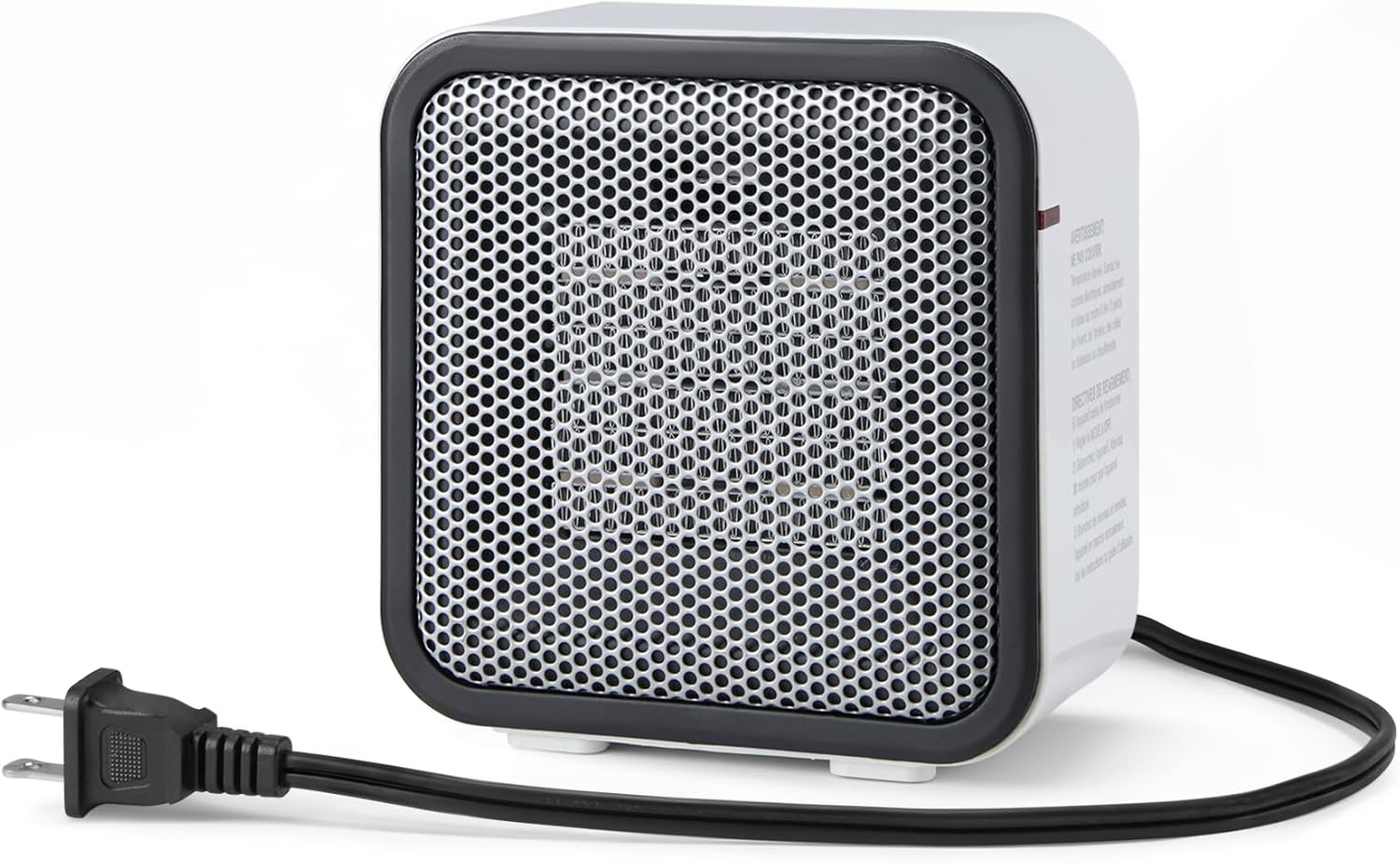
Amazon Basics Ceramic Mini Heater
| Heat Output | 500 watts |
|---|---|
| Heating Method | Convection |
| Power Source | Corded Electric |
| Heating Coverage | 107.6 square feet |
| Special Features | Tip-Over Protection |
This compact Amazon Basics ceramic heater is a 500-watt personal unit built for warming small areas like a desk, bedside table, or home office. It uses ceramic heating elements and convection to produce quick, focused heat while running relatively quietly at about 48 dB. The unit is very portable at roughly 1.4 pounds and small enough to tuck onto a tabletop without cluttering the workspace. Safety features include a tip-over shutoff that cuts power if the heater is knocked over, and the simple single-speed control keeps operation straightforward for occasional use. Because it is low wattage it warms only close proximity areas rather than whole rooms, so expect modest coverage suitable for one person. There are no thermostat cycles or multiple heat settings to fine-tune runtime or efficiency, and the fixed output means it is best used for short bursts of heat rather than continuous whole-room heating. For a low-cost, no-frills personal heater this model delivers predictable, portable warmth with basic safety features.
Best for: Buyers who want a low-wattage, portable heater to warm a single desk or bedside area quickly and safely without complexity.
Less Ideal for: Not suited for people needing whole-room heating, programmable thermostats, or multiple power settings for precise temperature control.
- Small footprint and very lightweight for easy placement and portability
- 500W ceramic element provides quick, localized heat
- Built-in tip-over protection enhances safety during desk or bedside use
- Quiet operation around 48 dB suitable for office or bedroom use
- Single fixed heat output with no adjustable thermostat or multiple heat settings
- Limited heating coverage intended for one-person zones rather than whole rooms
Verdict: A compact, low-wattage personal heater that delivers quick, quiet warmth and simple safety for single-person spaces.
Honeywell 360 Degree Surround Heater HHF360V

| Heat Output | 1500 watts |
|---|---|
| Power Source | Corded Electric |
| Number of Speeds | 2 |
| Indoor Outdoor Usage | Indoor |
| Form Factor | Tower |
The Honeywell 360 Degree Surround Heater (HHF360V) is a small, freestanding fan-forced tower heater that pushes heat in a wide pattern for rooms like bedrooms or home offices. It offers two heat settings plus an adjustable thermostat and a manual control layout, so you can run it on lower power for background warmth or boost it when you need faster heating. Safety features include a 360-degree tip-over switch, dual overheat protection, an auto-off timer option and a cool-touch handle for easy moving. In real use the unit is lightweight and easy to reposition, and its surround output helps avoid a single hot spot; on the lower setting it can maintain a comfortable microclimate without running at full power constantly. Limitations are its basic control set with no digital display or programmable schedule and the lack of multiple fan speeds beyond the two heat settings, so fine-grain temperature control is limited compared with higher-end models.
Best for: Buyers who prioritize straightforward, reliable low-wattage supplemental heating that is easy to move and safe for everyday room use.
Less Ideal for: People seeking precise digital controls, advanced programmability, or variable fan-speed options should consider more feature-rich models instead.
- 360-degree surround output helps distribute heat evenly in a small to mid-size room
- Adjustable thermostat with two heat settings for simple power control
- Multiple safety protections including tip-over switch and dual overheat shutoffs
- Lightweight, freestanding tower design with cool-touch carry handle for easy placement
- No digital controls or programmable scheduling limits precision and convenience
- Only two heat settings and limited fan control reduce fine temperature tuning
Verdict: A simple, safety-focused 1500W tower heater that delivers even, low-complexity warmth for small rooms.
Pereysi Ceramic Personal Space Heater

| Heat Output | 1000 watts |
|---|---|
| Number of Speeds | 3 |
| Voltage | 120 volts |
| Max Temperature Setting | 40 °C |
| Indoor Outdoor Usage | Indoor |
This compact Pereysi ceramic heater is built to warm a single person or small micro-space quickly and efficiently. It uses a PTC ceramic element and forced-air output to deliver heat in about three seconds and offers two power modes (700W and 1000W) so you can run it alongside office electronics or on limited RV/campground power. The unit is very small and lightweight, making it easy to tuck under a desk or move between rooms, and it operates quietly at roughly 45 dB for minimal distraction. Safety-minded features include ETL certification, tip-over shutoff, overheat protection, and flame-retardant materials, and controls are a single simple knob with three fan/speed settings. Expect focused, personal warmth rather than whole-room heating, and note the limited maximum temperature setting of 40 C which reflects its low-wattage design. For buyers who need a portable, energy-conscious heater for feet and hands, this model is straightforward and practical; it is not intended to replace a full-size 1500W heater for large spaces.
Best for: Buyers who want an efficient, portable heater to warm a small personal zone at a desk, in a dorm, or in an RV while minimizing energy use and breaker trips.
Less Ideal for: People who need to heat medium or large rooms or who expect high-temperature output should look at higher-wattage room heaters instead.
- Low-wattage 700W/1000W modes reduce risk of tripping breakers in offices and RVs
- Very compact and lightweight for easy placement under desks or portability
- Quiet operation (around 45 dB) suitable for work or sleep environments
- Built-in safety features including ETL certification, tip-over shutoff, and overheat protection
- Designed for personal spot heating only and will not warm larger rooms effectively
- Maximum temperature capped at 40 C, which limits peak heat output
Verdict: A compact, energy-conscious personal heater that delivers quick, quiet spot warmth on lower wattage settings ideal for offices and RVs.
Gaiatop Mini Space Heater SH-02

| Heat Output | 500 watts |
|---|---|
| Power Source | Corded Electric |
| Heating Method | Convection |
| Voltage | 120 volts |
| Max Temperature Setting | 100 °C |
The Gaiatop Mini Space Heater is a small, corded 500W PTC ceramic heater built for personal heating at a desk, in a dorm room, or a small office. It uses a ceramic heating element to deliver warm air quickly—the listing claims heat in about 2 seconds—and runs quietly with a simple LED indicator for status. Safety features include 45 degree tip-over protection, overheating protection, V0 fireproof materials, and an anti-slip base, which makes it reasonable for close-proximity use. Because it is low wattage and portable, it is energy efficient for short-term spot heating but will not warm large rooms or replace central heat. Controls are basic rather than programmable, so expect on/off and mode-style use rather than precise temperature scheduling. The unit is compact and lightweight, so it is easy to move and store, but its small footprint also limits sustained output. For someone who wants inexpensive, immediate warmth near their chair or workspace, this heater is practical and straightforward.
Best for: Buyers who want an inexpensive, low-energy personal heater for desks, small rooms, or temporary spot heating and prioritize safety and portability over room-wide output.
Less Ideal for: Those needing to heat larger rooms, maintain set temperatures for long periods, or replace a main heating system should choose a higher-wattage or multi-room solution.
- Low 500W power draw suitable for low-energy, personal use
- PTC ceramic element for fast warm-up and consistent heat
- Built-in safety features including tip-over and overheat protection and fireproof materials
- Compact, lightweight design that is easy to move and store
- Not powerful enough to heat medium or large rooms effectively
- Basic controls with no programmable thermostat or timer
Verdict: A compact, safety-minded 500W heater that delivers fast, energy-efficient personal warmth for budget-minded users.
DREO Space Heater HSH006

| Heat Output | 1500 watts |
|---|---|
| Heating Element | PTC Ceramic |
| Heating Coverage | 200 sq.ft |
| Number of Speeds | 4 |
| Min–Max Temperature | 41–95 °F |
This DREO tower heater delivers fast, forced-air warmth from a 1500W PTC ceramic element and is configured for everyday indoor use in bedrooms, offices, and living rooms. It heats up quickly, offers four fan/power modes including ECO and fan-only, and an adjustable thermostat that ranges 41 to 95°F in 1°F increments so you can dial in a precise setpoint. The unit includes a 12-hour timer, remote control, child lock, and a memory function that make hands-off operation simple, and DREO built in multiple safety measures such as tip-over detection, overheat protection, flame-retardant materials, and an ETL listing. The brushless DC motor and winglet fan design keep running noise low (about 34 dB) so it is comfortable for bedrooms. Trade-offs are typical for compact electric heaters: it is limited to room-level coverage (advertised up to 200 sq ft) and requires a standard 120V outlet at full 1500W output, so it is not a low-wattage option if you need strict power limits per circuit. For buyers who want reliable, feature-rich supplemental heat with strong safety and quiet operation, this model is a solid pick.
Best for: Buyers who prioritize dependable, safety-focused supplemental heating for single rooms and want precise temperature control with quiet operation.
Less Ideal for: People needing ultra-low power heaters for limited-circuit environments or heating very large, open spaces should look elsewhere.
- Fast PTC ceramic heating element for quick warm-up
- Precise thermostat control from 41 to 95°F in 1°F increments
- Multiple convenience features: remote, 12-hour timer, child lock, and memory function
- Solid safety package including tip-over sensor, overheat protection, flame-retardant materials, and ETL listing
- Quiet brushless DC motor design (~34 dB) suitable for bedrooms
- 1500W power means it is not suitable when you need strictly low-wattage operation
- Coverage limited to approximately 200 sq ft, so not for large open areas
Verdict: A reliable, safety-forward room heater that provides quick, quiet 1500W warmth with precise thermostat control.
Amazon Basics Ceramic Mini Heater

| Heat Output | 500 watts |
|---|---|
| Power Source | Corded Electric |
| Heating Element | Ceramic |
| Special Features | Tip-Over Protection |
| Voltage | 120 volts |
This Amazon Basics ceramic mini heater is a small, portable 500 W convection unit intended for personal heating at desks, bedside tables, or small rooms. It uses ceramic heating elements to warm air quickly and quietly, making it useful for taking the chill out of an office or study without powering a full-room heater. The heater is lightweight and compact so it is simple to move and tuck onto a tabletop, and tip-over protection automatically cuts power if it is knocked over for safer use. Noise is modest at about 48 dB, so it will not be disruptive during work or sleep. The low 500 W output keeps energy use down but also limits the effective coverage to a very small area rather than heating larger rooms. There are no advanced controls or multiple heat settings listed, so expect straightforward on/off operation and modest, localized warmth rather than precise temperature control or whole-room heating.
Best for: Buyers who want a low-wattage, portable heater to warm a single work or sleeping spot and who value quiet, simple operation with safety features.
Less Ideal for: People needing to heat larger rooms, shared living spaces, or those who want programmable thermostats and multiple power settings.
- Compact, lightweight design is easy to move and fits on small desks or bedside tables.
- Ceramic heating element provides quick warm-up and steady convection heat.
- Tip-over protection boosts safety for tabletop use.
- Low 500 W power draws less electricity than standard space heaters, suitable for low-wattage needs.
- Limited heat output restricts effectiveness to very small areas or one person.
- No listed advanced controls or multiple heat settings for fine temperature adjustment.
Verdict: A small, energy-sparing ceramic tabletop heater that reliably warms one personal spot while prioritizing portability and basic safety.
GiveBest Portable Space Heater PTC-905

| Heat output | 1500 watts |
|---|---|
| Heating coverage | 200 sq.ft |
| Number of speeds | 2 |
| Max temperature setting | 158 °F |
| Power source | Corded Electric |
The GiveBest PTC-905 is a small ceramic space heater intended to warm single rooms without heating an entire house. It offers two heat modes (1500W and 750W) plus a cool-fan setting, and an adjustable electronic thermostat that cycles the unit on and off to hold a chosen temperature. In practice the PTC element and high-speed fan deliver quick, quiet warmth for bedrooms, home offices, or small living rooms and the unit is rated to cover roughly 200 sq ft when positioned near the occupied area. Safety is emphasized with V0 flame-retardant housings, automatic overheat shutoff, and tip-over protection that beeps and cuts power if knocked over. The built-in carry handle and lightweight footprint make it easy to move to the spot you need heated, and the quieter operation is reasonable for night or desk use. Limitations are typical for compact heaters: it is best for spot heating rather than whole-home use and you should avoid relying on the maximum setting for extended periods in large open spaces.
Best for: Buyers who prioritize a safe, easy-to-use heater for spot warming small rooms or a personal workspace and who prefer a straightforward, low-maintenance appliance.
Less Ideal for: People seeking whole-house heating, smart app control, or a heavy-duty heater for very large spaces should look at higher-capacity or feature-rich alternatives.
- Two heat settings plus cool-fan for year-round use
- Adjustable electronic thermostat that maintains set temperature
- Multiple safety protections including overheat shutoff and tip-over sensor
- Compact, lightweight design with carry handle for easy portability
- Relatively quiet operation suitable for bedrooms and offices
- Designed for spot heating; not effective as a primary heater for large or open areas
- No advanced controls like Wi-Fi or programmable scheduling
Verdict: A compact, safety-focused ceramic heater that reliably provides quiet spot heating for small rooms and personal workspaces.
Choosing the Right Low-Wattage Space Heater: Key Factors to Consider
Wattage and Circuit Compatibility
Lower wattage matters because many small rooms, older homes, or dorm circuits cannot handle high-draw appliances. Choosing a heater with a maximum wattage that fits your room's circuit capacity reduces the risk of tripped breakers and makes it safer to run the heater for longer periods.
Consider whether the heater offers multiple power settings or an adjustable thermostat so you can dial in lower consumption when needed. A heater that runs at several reduced wattage levels gives flexibility to balance warmth and circuit load across different times of day.
Heat Delivery Efficiency
Not all low-wattage heaters produce useful warmth; design and element type determine how effectively the unit converts power into usable room heat. Look for models that spread heat steadily rather than producing short blasts of hot air that dissipate quickly.
Convection-style or ceramic elements are often better at maintaining a steady ambient temperature in a small room with lower power. The unit's shape, fan assistance, and placement guidance also influence how evenly the heat circulates.
Operating Cost and Runtime
Operating cost is a key reason to choose a low-wattage heater. Calculate expected energy use by comparing watts to your electricity rate and expected hours of operation. Lower wattage reduces hourly cost, but runtime matters; a more efficient heater that maintains temperature may run shorter cycles and cost less overall.
Also factor in thermostat accuracy and programmable timers because precise control can reduce wasted run time. Units that overshoot set temperature or lack timed options may run longer and increase total energy consumption, offsetting the benefit of lower wattage.
Safety Protections
Safety is especially important when using heaters for extended periods in occupied spaces. Look for tip-over shutoff, overheat protection, and thermal cutoff mechanisms. These features reduce fire and burn risks if the unit is knocked over or becomes obstructed.
Check that the heater's housing and elements remain cool enough to touch and that it has stable feet or a low center of gravity. Lower wattage does not eliminate risk, so safety certifications and clear placement instructions matter for everyday use.
Size, Placement, and Portability
A heater's physical size affects both how it distributes heat and where you can place it. Compact models are easy to move and position close to occupants or specific work areas, but too-small units may concentrate heat in a narrow zone and leave corners cold.
Consider cord length and whether the unit fits on floor or tabletop locations safely. Portability features like handles and light weight matter if you plan to move the heater between rooms. Also account for clearance recommendations to avoid placing the heater near curtains or furniture.
Control Options and Usability
Controls determine how easily you can manage comfort and energy use. Simple rotary switches may be reliable, but digital thermostats and timers allow finer temperature control and scheduled operation. Remote control or app integration can be convenient but are not necessary for everyone.
Evaluate the clarity of the display, the responsiveness of the thermostat, and whether the unit offers presets or eco modes. Usability influences how often you actually use energy-saving features, so choose controls that match your habits.
How Low-Wattage Heaters Save Energy
Low-wattage heaters reduce instantaneous electrical demand, which lowers hourly energy consumption and decreases the chance of tripping a circuit in small spaces. By running at reduced power, these heaters can be left on for longer stretches with a smaller impact on your electricity bill than higher-wattage alternatives.
Efficiency depends on how well the unit converts input power into sustained room heat. A well-designed low-wattage heater with good airflow and thermostat control can maintain comfort without constantly running at peak draw.
- Lower peak draw helps on limited circuits
- Better for prolonged use in small spaces
- Thermostat control reduces wasted runtime
Placement Tips for Best Results
Position the heater where air can circulate freely and away from walls, drapes, or bedding. For tabletop units, place them on a stable, heat-resistant surface at least the manufacturer-recommended clearance away from flammable materials. Floor models should sit on level, non-flammable flooring.
To heat efficiently in a small room, place the heater near the primary activity zone rather than tucked in a corner. If the room has a door or draft, orient the heater to counter the coldest airflow path to reduce heat loss.
- Allow recommended clearance on all sides
- Place near occupants for targeted warmth
- Avoid blocking vents or airflow paths
Quiet Operation for Bedrooms and Offices
Noise level is a practical consideration when you plan to use a heater in a bedroom, nursery, or shared office. Many low-wattage designs use ceramic elements and low-speed fans, or rely on convection, which keeps noise to a minimum compared with large fan-forced units.
Look for units with measured dB ratings when possible, and prefer models that offer a quiet mode or variable fan speeds to reduce distraction during work or sleep.
- Ceramic and convection units are typically quieter
- Variable fan speeds help balance warmth and noise
- Check for vibration-free housing for silent operation
Maintenance and Longevity
Routine maintenance extends the life of a heater and preserves efficiency. Keep air intakes and outlets free of dust and lint, and follow any cleaning instructions the manufacturer provides. For fan-assisted units, occasional dusting and ensuring the fan runs freely will prevent added load and noise.
Low-wattage heaters often have simpler internals, which can translate to fewer failure points. Still, periodic inspection for cord wear and housing damage helps maintain safe operation over time.
- Clean intakes and outlets regularly
- Inspect power cord and plug for damage
- Follow manufacturer guidelines for service
Using Timers and Thermostats Efficiently
Programmed timers and accurate thermostats are among the best ways to reduce wasted runtime. Set the heater to bring the space up to a comfortable temperature shortly before occupancy and reduce or turn off during sleep or when the room is unoccupied.
A responsive thermostat that maintains target temperature in small increments avoids frequent cycling and reduces overall energy use. If you need continuous low-level background warmth, look for units with precise low-end control.
- Preheat only when needed with timers
- Use accurate thermostats to avoid overshoot
- Combine with insulation and draft control for best results
How We Chose the Best Low-Wattage Space Heater
We focused on heaters designed to deliver useful warmth while drawing significantly less power than standard portable units. Selection prioritized consistent heat delivery on lower wattage settings, proven safety features, and practical controls for daily use in small rooms or rooms with limited electrical capacity. We examined documented heat output relative to wattage, thermostat and program controls, tip-over and overheat protection, and the unit's noise level or silent operation for bedrooms and offices. We excluded units that rely solely on fan-forced high-wattage elements or that lack basic safety certifications. We also filtered out specialty heaters intended for garage or outdoor use because their design and power assumptions do not translate to small indoor spaces. Final picks balance efficient heat distribution, measured operating cost, user-friendly controls, and safety protections that matter for low-wattage operation.
Our full evaluation process is outlined in our review methodology.
FAQ
Are low-wattage space heaters effective for heating a bedroom?
Often they are effective for single rooms, especially bedrooms, when the room is well insulated and the heater is sized appropriately. Low-wattage heaters are best for maintaining background warmth or providing targeted comfort near the bed rather than heating very large or poorly insulated spaces.
Will a low-wattage heater trip my circuit?
It depends on the circuit capacity and what else is plugged in. Low-wattage models reduce the chance of tripping compared with standard high-draw heaters, but you should avoid running multiple high-draw appliances on the same circuit to minimize risk.
How much does a low-wattage heater cost to run?
Operating cost varies with the heater's wattage, the thermostat settings, and local electricity rates. Generally, lower-wattage heaters cost less per hour to operate, but efficient heat distribution and shorter runtime due to accurate thermostats will have the biggest impact on your total cost.
Are ceramic heaters better for low-wattage use?
Ceramic heaters are often a good match because they convert heat efficiently and can maintain steady temperatures with modest power. However, convection designs without fans can also be quiet and effective in small rooms depending on room layout.
Can I leave a low-wattage space heater on overnight?
You can leave one running overnight if it has robust safety features like overheat protection and tip-over shutoff, and if you follow placement and clearance guidelines. Still, using timers or thermostat control to reduce power during sleep hours improves safety and saves energy.
Final Verdict
When choosing a low-wattage space heater, prioritize models that deliver steady heat relative to their wattage, include trusted safety protections, and offer precise controls or timers to minimize runtime. Consider where you will place the unit and whether noise level or portability matters for your daily use. Focus on the tradeoff between lower instantaneous draw and actual warmth produced in your room. By selecting a unit that balances efficient heat delivery, circuit compatibility, and usability, you can get comfortable warmth without excessive energy use or safety concerns.