
Note: This article contains affiliate links. If you click on these links and make a purchase, we may earn a small commission at no extra cost to you. This helps support our research and content. Read our full affiliate disclosure here.
If you are just starting to grind beans by hand, picking the right manual coffee grinder matters more than you might think. The right grinder makes it easier to dial in grind size, reduces frustration during brewing, and produces more consistent extraction for better-tasting coffee. This guide highlights seven shortlisted manual coffee grinders for beginners that balance simplicity with reliable performance. We evaluated each option on factors like grind consistency, build quality, and ease of use so you can choose a grinder that fits your preferred brew method and daily routine. Read on for practical buying guidance and what to expect from a user-friendly manual grinder.
Top Picks at a Glance
| Best Overall The best all-around choice for most situations | Hario Mini Mill Slim MSS-1B |  |
| Best Quality Built to a higher standard if you want something more solid | 1Zpresso K-Ultra Manual Coffee Grinder |  |
| Best Value The sweet spot between price and what you get | CEVING Mini Manual Coffee Grinder MCG-01 | 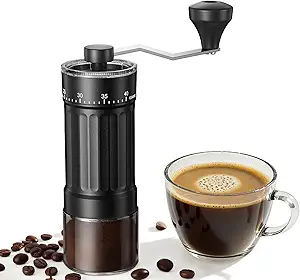 |
| Best Budget The cheapest option that still gets the job done reliably | PARACITY Manual Coffee Grinder |  |
| Top Rated A top-rated pick with lots of positive feedback | TIMEMORE Chestnut C3S Pro |  |
| Most Popular A crowd favorite that many people choose with confidence | JavaPresse Manual Coffee Grinder |  |
| Best Seller A high-volume bestseller chosen again and again | CEVING Manual Coffee Grinder MCG-02 | 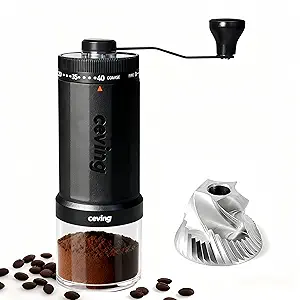 |
Hario Mini Mill Slim MSS-1B

| Capacity | 2 cups |
|---|---|
| Material Type | Ceramic |
| Power Source | Manual |
The Hario Mini Mill Slim is a hand coffee grinder built around a ceramic burr that delivers consistent, rust-free grinding in a compact package. You crank the stainless steel handle to grind beans into the clear collection jar, and an adjustable knob controls coarseness for everything from drip to medium-fine pours. Its slim profile and removable handle make it easy to store and to take on a trip, and the simple disassembly keeps cleaning straightforward. The ceramic burr resists wear and odor and produces a steady output for daily home brewing, though its two-cup capacity and manual operation limit how quickly you can grind large batches. This grinder is best for single-serve to small household use and for buyers who appreciate a durable, fuss-free manual grinder rather than an electric model.
Best for: Buyers seeking an easy-to-use, durable manual grinder for daily single-serve or small-batch home brewing who value compact storage and straightforward maintenance.
Less Ideal for: People who routinely grind large volumes, need electrically powered convenience, or want very fine espresso-level precision should consider other options.
- Ceramic burr that resists rust and odor for long-lasting, consistent grinds
- Slim, removable-handle design stores easily and is travel-friendly
- Adjustable grind knob allows tuning coarseness for different brew methods
- Simple disassembly and parts make cleaning straightforward
- Manual grinding is slower and less convenient for larger quantities
Verdict: A compact, reliable ceramic-burr manual grinder that is ideal for beginners wanting a durable, easy-to-store option for small-batch home coffee.
1Zpresso K-Ultra Manual Coffee Grinder

| Burr material | Stainless steel |
|---|---|
| Burr size | 48 mm |
| Adjustment | External dial, ~20 microns per click |
| Grounds capacity | 35–40 g |
| Power source | Manual |
The 1Zpresso K-Ultra is a performance-focused hand grinder that targets users who want café-level consistency without electricity. It uses a 48mm stainless steel conical K-burr and an external adjustment dial with over 100 clicks at roughly 20 microns each, so you can dial from coarse to espresso fine with predictable, repeatable steps. The magnetic catch cup holds 35–40 g of grounds and snaps on for a quicker workflow, while the foldable handle and included travel case make the unit easy to carry and store. Tool-free disassembly and the included brush and blower simplify cleaning and maintenance. Built aluminum construction and factory-calibrated burrs aim for long-term stability and a long operational life. The main limitations are price relative to simple entry grinders and the manual effort required for large batches; it is optimized for precision and small-to-medium doses rather than high-speed bulk grinding.
Best for: A buyer focused on performance who wants precise, repeatable grind control for espresso and specialty brews and is comfortable doing small to medium manual doses.
Less Ideal for: People who need fast, high-volume grinding or prefer an inexpensive, no-frills beginner grinder that sacrifices some precision for lower cost.
- Large 48mm stainless steel conical burrs for consistent particle size
- External micrometric adjustment with 100+ clicks for fine control
- Magnetic catch cup speeds up workflow and holds 35–40 g of grounds
- Foldable handle and travel case make it genuinely portable
- Tool-free disassembly and included cleaning tools simplify maintenance
- Manual grinding is slower for larger volumes compared with electric grinders
- Higher price point than basic manual grinders geared solely at beginners
Verdict: Choose the K-Ultra if you want a travel-ready, performance-oriented manual grinder that delivers precise, repeatable grind control for serious beginner to intermediate brewers.
CEVING Mini Manual Coffee Grinder MCG-01

| Capacity | 30 g |
|---|---|
| Material Type | Ceramic |
| Power Source | manual winding |
| Adjustable Settings | 40 |
The CEVING Mini Manual Coffee Grinder is a travel-friendly hand mill designed for users who want freshly ground coffee without electricity. It uses ceramic conical burrs and an external adjustment ring with 40 settings so you can tune grind size for espresso, pour-over, or French press. The 30 g bean chamber is sized for one or two cups, and the unit breaks down into a few simple parts for easy cleaning with the included brush. Because it is manual, grinding takes physical effort and is slower than electric models, but it is quiet, produces less heat from grinding, and is very portable for camping or commuting. The ceramic burrs help preserve flavor but can be more fragile than steel if dropped. Overall, this grinder is a practical choice for beginners who want precise control over grind size in a compact, low-tech package.
Best for: Buyers who prioritize control, portability, and low-tech reliability when learning coffee grinding and want a compact grinder for single-serve brewing or travel.
Less Ideal for: People who need large daily batch capacity, very fast grinding, or a fully hands-off electric solution should choose a different type of grinder.
- 40 external grind settings let you dial in a wide range of grind sizes without disassembly
- Ceramic conical burrs produce a uniform grind and reduce heat buildup
- Compact, lightweight design is easy to carry for travel, camping, or office use
- Simple disassembly and included brush make maintenance straightforward
- 30 g capacity only covers small batches, so multiple refills are needed for larger servings
- Manual operation requires noticeable effort and takes longer than electric grinders
Verdict: This compact manual grinder is ideal for beginners who want precise, portable grind control for single-cup brewing and travel.
PARACITY Manual Coffee Grinder

| Capacity | 1.4 pounds |
|---|---|
| Material Type | Stainless Steel |
| Power Source | Manual |
The PARACITY Manual Coffee Grinder is a simple, no-power hand mill aimed at small-batch brewing and travel use. It grinds beans with a ceramic burr and an adjustable control so you can dial in coarseness for French press, drip, espresso or Turkish styles, and the long stainless steel crank reduces effort during use. Two clear glass jars let you grind directly into a container and store beans or grounds, while a silicone lid and nonslip silicone base add convenience and stability. The unit disassembles for cleaning, and its manual operation means quiet mornings without electricity. Expect modest capacity and a glass construction that requires careful handling; it is not built for heavy daily commercial use. For beginners this grinder offers predictable, uniform grinds at a low cost, but those who need high throughput or rugged, drop-resistant gear should look elsewhere.
Best for: Buyers wanting an inexpensive, quiet manual grinder to learn brewing basics and experiment with grind size without investing in an electric machine.
Less Ideal for: Not a good choice for high-volume users, busy cafes, or anyone who needs a rugged, travel-proof grinder that can tolerate drops and heavy daily use.
- Ceramic burr delivers uniform grind size and reduces heat build-up
- Adjustable grind control supports multiple brew methods from coarse to fine
- Two glass jars allow grinding directly into storage and keep beans separate
- Long stainless steel crank reduces effort compared with short handles
- Removable construction makes parts washable for easier cleaning
- Glass jars and parts are fragile and can break if dropped
- Manual grinding is slower than electric grinders for larger batches
Verdict: A low-cost, easy-to-use manual grinder that gives beginners uniform, adjustable grinds and built-in storage for learning home brewing.
TIMEMORE Chestnut C3S Pro

| Capacity | 25 g |
|---|---|
| Power Source | manual |
| Item Weight | 430 g |
The TIMEMORE Chestnut C3S Pro is a manual coffee grinder built around a full metal aluminum-alloy body and patented S2C conical steel burrs, which together prioritize durability and consistent grind quality. You use it by loading up to about 25 g of beans, setting the stepless grind adjustment for your brew method, and turning the foldable crank; the double-bearing central axis and smooth gearing reduce effort and make longer turns easier. Notable features include the hardened S2C660 burrs for uniform particle size, a fold-flat handle for compact storage or travel, and about 36 levels of fineness so you can dial in grind size from coarse to espresso-adjacent. Practical benefits are steady, repeatable grinds, a robust metal shell that resists cracking, and easy cleanup thanks to its simple disassembly. The main limitations are its small capacity intended for single cups and the manual effort required for larger batches, which makes it less convenient for higher-volume brewing sessions.
Best for: Buyers who want a reliable, long-lasting manual grinder for single-cup brewing or travel and who value consistent grind quality over speed.
Less Ideal for: People who routinely grind large quantities at once or who prefer push-button electric convenience should consider a larger or electric grinder instead.
- Full aluminum-alloy metal body improves durability and resists cracking
- S2C hardened steel conical burrs deliver consistent, uniform grind particles
- Double-bearing central axis and smooth gearing lower hand effort during grinding
- Foldable crank handle makes the grinder compact for travel and storage
- Small 25 g capacity is best for single cups and requires repeated grinding for larger batches
- Manual operation is slower than electric grinders for high-volume use
Verdict: Choose the Chestnut C3S Pro if you want a compact, metal-bodied manual grinder that consistently delivers high-quality single-cup grinds and holds up to frequent use.
JavaPresse Manual Coffee Grinder

| Power Source | Manual |
|---|---|
| Material Type | Stainless Steel |
| Number of Settings | 18 |
| Included Components | Grinder |
The JavaPresse Manual Coffee Grinder is a hand-crank conical burr grinder aimed at home brewers and travelers who want precise, quiet grinding without electricity. It offers 18 adjustable grind settings that cover espresso through coarse pour-over, so you can dial in consistency for different brew methods. The ceramic burrs are marketed for durability and produce a relatively uniform grind while keeping heat and noise low, and the compact stainless steel body makes it easy to pack for camping or commuting. Using it is straightforward: set the grind size on the external adjuster, crank by hand, and collect grounds in the removable chamber. Trade-offs are typical for hand grinders: it requires physical effort and takes longer than an electric grinder for larger batches, and the small capacity suits single-serve or 1–2 cup routines rather than brewing for groups. Build quality and the long-tested burr design make it a reliable entry-level burr grinder if you value control and portability over speed.
Best for: Buyers who want a reliable, low-noise burr grinder to learn how grind size affects brew taste and who value portability and precise manual control.
Less Ideal for: People who routinely need large batches of grounds quickly or prefer one-touch electric convenience should consider an electric grinder instead.
- Wide range of 18 grind settings for espresso to coarse methods
- Quiet manual operation with no power required
- Durable ceramic conical burrs that resist heat and preserve flavor
- Compact stainless steel body is travel- and camping-friendly
- Manual cranking is slower and more tiring than electric grinders for larger volumes
- Small grind chamber limits batch size
Verdict: A compact, well-built manual burr grinder that gives beginners precise, quiet control over grind size while staying portable and reliable.
CEVING Manual Coffee Grinder MCG-02

| Capacity | 60 g |
|---|---|
| Adjustable settings | 40 |
| Burr material | Stainless steel conical burrs |
| Item weight | 0.5 kg |
The CEVING MCG-02 is a manual conical-burr grinder designed to give consistent, adjustable grinds for everything from espresso to French press. Its standout feature is a 60 g bean hopper that lets you grind larger single sessions without refilling, and the external click-ring offers 40 discrete settings so you can switch grind size quickly and visibly. CNC stainless steel burrs aim for uniform particle size and relatively fast grinding for a hand mill, making it useful for daily home brewing or travel. The unit is compact and light enough to pack for camping or commuting, and the external adjustment avoids fiddly internal spacers. Expect some arm work for larger batches and a short break-in period for burr smoothing, but build quality and the clear adjustment system make it approachable for beginners who want control without complexity. The grinder also includes guidance to reduce static and a one-year warranty for peace of mind.
Best for: Buyers who want a straightforward, low-risk way to learn manual grinding with a clear adjustment system and fewer refills per session.
Less Ideal for: People who want fully automatic or electric grinding for zero effort or those who need very large-volume commercial grinding.
- Generous 60 g capacity reduces refills for single-batch brewing.
- External 40-click adjustment ring lets you change grind size quickly and repeatably.
- CNC stainless steel conical burrs deliver consistent particle size and durable performance.
- Compact, lightweight design is travel and camping friendly.
- Manual operation requires physical effort for larger doses.
- May need a short break-in period for burrs to reach peak consistency.
Verdict: A beginner-friendly manual grinder that combines a large 60 g hopper with precise external adjustment for predictable, repeatable home and travel brewing.
Choosing the Right Manual Coffee Grinder for Beginners: Key Factors to Consider
Grind Consistency Across Brew Sizes
Consistent particle size is central to predictable extraction. For beginners, an uneven grind produces sour or bitter cups and makes it harder to learn how grind size affects flavor. A good manual grinder should deliver uniform grinds for at least two to three common brew ranges such as French press, pour-over, and espresso-adjacent settings.
Look for burr designs and tolerances that minimize fines and large particles. Even if you are only brewing pour-over at first, choosing a grinder that maintains consistency across settings gives room to experiment without replacing your grinder later.
Adjustment Precision And Repeatability
Simple, intuitive adjustment mechanisms help beginners reproduce settings from one session to the next. Click-style detents or clearly marked scales make it easier to return to a favorite grind size, while vague or friction-based adjustments can lead to guesswork.
Repeatability matters because learning to adjust grind size is a core brewing skill. A grinder with stable settings reduces the variables you need to manage and speeds up the learning curve.
Crank Effort And Ergonomics
Manual grinders rely on human power, so crank length, handle shape, and rotational smoothness affect your daily experience. Too much effort or a poorly shaped handle will make regular grinding unpleasant, which discourages consistent use.
Ergonomic handles and smooth bearings reduce fatigue and let you grind more quickly. Consider the grinder's size relative to your hand and whether the handle clears any lids or bean hoppers during rotation.
Burr Type And Material
Burrs determine both grind quality and long-term performance. Conical and flat burrs each have tradeoffs, but for beginners conical burrs often provide forgiving behavior across a range of grind sizes and are easier to maintain.
Material matters too. Hardened steel burrs resist wear and keep grinding predictable longer, while coated or softer materials may dull faster. Burr replacement options or modularity extend a grinder's useful life.
Capacity And Portability
Consider how many beans you typically grind in a session and whether you plan to travel with the grinder. Larger hoppers reduce the need to refill but add bulk and weight. Compact grinders are easier to store and carry but may require multiple rounds for larger servings.
If you want a travel-friendly option, prioritize a grinder with a small footprint, secure locking parts, and components that pack down without rattling.
Cleaning, Maintenance, And Accessibility
Regular cleaning preserves flavor and mechanical function. A grinder that disassembles with a few twists or screws will be cleaned more often, reducing stale-oil buildup and preventing flavor transfer between beans.
Look for accessible burrs and removable catch cups. Materials that tolerate simple wiping and occasional deeper cleaning without special tools make maintenance straightforward for someone new to manual grinding.
Why Choose A Manual Grinder As A Beginner
A manual grinder puts control of grind size and extraction into your hands without the cost or complexity of an electric grinder. For beginners, that tactile feedback helps you learn how grind size affects brew strength, clarity, and extraction speed.
Manual grinders also tend to be quieter, more compact, and easier to maintain than many electric models. That simplicity often translates to fewer variables while you develop brewing technique, making it easier to consistently produce better coffee.
- Lower noise and no electricity required
- Compact and travel-friendly options
- Often easier to clean and maintain
Setting Up Your Manual Grinder For Best Results
Start by reading the adjustment instructions and making a baseline grind setting for your preferred brew method. Grind a small test batch and note the time and feel—manual grinding speed gives clues about grind size and required adjustments.
Clean the grinder of any factory oils or loose particles before first use. After a few uses, adjust in small increments to observe extraction changes rather than large jumps that can obscure cause and effect.
- Calibrate with a known recipe to create a baseline
- Adjust gradually and record settings
- Wipe and brush out residual grounds between sessions
Common Mistakes New Manual Grinder Users Make
Beginners often over-adjust between brews when they see a flavor they do not like. Small changes in grind size can have a big effect, so avoid making multiple large changes at once. Instead, tweak gradually and give each setting a fair trial.
Another frequent issue is under-cleaning. Old grounds and oils change flavor quickly, so regular maintenance preserves the clarity of each brew. Also be mindful of using beans with different roast levels without cleaning, as oils from darker roasts can cling to burrs.
- Avoid large, frequent adjustments
- Clean after switching roast profiles
- Do not overload small bean hoppers
Tips For Brewing With A Manual Grinder
Use a scale to measure dose and a consistent grind time to help isolate variables as you refine recipes. A scale and timer let you focus on grind and extraction rather than estimating by sight or feel.
Match grind size to the brew method and aim for consistent particle distribution. For example, coarser settings suit full-immersion methods while finer settings are needed for filter and espresso-style devices. Minor adjustments to dose or brew time often produce better results than drastic grind changes.
- Weigh beans and brewed yield for repeatability
- Adjust grind in small increments
- Pair grind size with brewing time and method
Maintaining And Storing Your Manual Grinder
Disassemble the grinder periodically to brush away trapped fines and oil residue. Use a soft brush and a dry cloth; avoid soaking components unless the manufacturer indicates it is safe. Reassemble carefully and check for any looseness that can affect adjustment stability.
Store the grinder in a dry place away from direct sunlight. If you travel with it, ensure removable parts are secured to prevent damage or loss.
- Brush burrs and housing monthly with regular use
- Avoid water on metal bearings unless specified
- Keep parts tightened and stored dry
How We Chose the Best Manual Coffee Grinder for Beginners
We prioritized attributes that matter to new manual grinder users and that directly affect brewing outcomes. Our selection focused on grind consistency across brew ranges, ease of adjustment for beginners, and mechanical reliability for daily use. We also considered how comfortable and efficient each grinder feels during repeated cranking, including handle ergonomics and required effort. Durability of key components such as the burr material and the stability of the adjustment mechanism was another gatekeeper. We looked for grinders with straightforward maintenance and disassembly for cleaning. Portability and footprint were factored in for people who want a compact grinder for travel or tight kitchens. We excluded complex or specialty rotary grinders that demand advanced technique, and we did not include purely decorative or consumer-grade devices known for inconsistent output. Our final list emphasizes grinders that help new users make better coffee quickly while minimizing setup and upkeep friction.
Our full evaluation process is outlined in our review methodology.
FAQ
How finely can a beginner manual grinder grind?
Many beginner-focused manual grinders can reach fine settings suitable for pour-over and coarse espresso-adjacent grinds, though truly fine espresso may require more advanced machines. It often depends on the burr geometry and adjustment range.
How long does it take to grind enough beans for one cup?
Grinding time varies by grinder design and roast, but plan on one to three minutes for a single 12 to 20 gram dose. Longer crank times usually reflect a finer grind or smaller, less efficient burrs.
Do manual grinders require special maintenance?
Maintenance is simple: regular brushing and occasional disassembly to clear trapped fines. Most manual grinders do not require lubrication, and replacement burrs can extend service life if available.
Are manual grinders noisy or disruptive?
Manual grinders are significantly quieter than electric grinders. You will still hear mechanical scraping and the beans shifting, but the overall noise level is low and suitable for most home environments.
Can a manual grinder handle oily or dark roasted beans?
Yes, but darker, oilier beans can leave residue on burrs faster. Clean more frequently when using oily beans and avoid leaving them sitting in the hopper for extended periods to prevent buildup.
Final Verdict
Beginner manual grinders are a practical way to improve coffee quality while learning how grind size affects extraction. Prioritize grind consistency, an easy-to-use adjustment mechanism, and comfortable crank ergonomics to make daily grinding pleasant and repeatable. Keep maintenance simple and choose a capacity that fits your routine to avoid unnecessary refills. Balancing those tradeoffs will help you pick a grinder that supports steady improvement in brewing skills. Focus on the criteria above and you will be well placed to select a manual coffee grinder that grows with your technique.