
Note: This article contains affiliate links. If you click on these links and make a purchase, we may earn a small commission at no extra cost to you. This helps support our research and content. Read our full affiliate disclosure here.
Choosing the right manual grinder matters when you want consistent espresso shots and clean pour over cups from the same burr set. A good hand grinder makes it possible to dial in extraction by producing uniform particles, holding settings between uses, and resisting heat buildup while you grind. This guide covers seven shortlisted manual coffee grinders that are well suited to both espresso and pour over preparation, and explains the practical tradeoffs buyers face. Below we evaluate each option on grind consistency, adjustment range, build quality, and portability so you can pick the grinder that fits your brewing style. Read on for what to expect and how to match a grinder to your routine.
Top Picks at a Glance
| Best Overall The best all-around choice for most situations | TIMEMORE Chestnut C3S Manual Grinder | 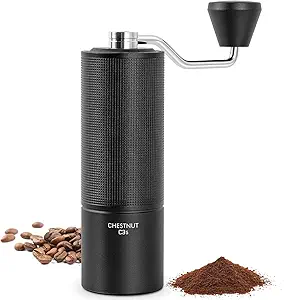 |
| Best Quality Built to a higher standard if you want something more solid | 1Zpresso K-Ultra Manual Coffee Grinder |  |
| Best Value The sweet spot between price and what you get | POPSWEETER C38 Manual Coffee Grinder |  |
| Best Budget The cheapest option that still gets the job done reliably | LHS Manual Coffee Grinder |  |
| Top Rated A top-rated pick with lots of positive feedback | Timemore C5 ESP PRO |  |
| Most Popular A crowd favorite that many people choose with confidence | JavaPresse Manual Coffee Grinder |  |
| Best Seller A high-volume bestseller chosen again and again | CEVING Manual Coffee Grinder MCG-02 | 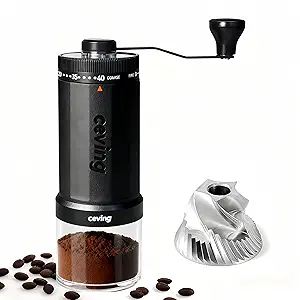 |
TIMEMORE Chestnut C3S Manual Grinder

| Capacity | 25 g |
|---|---|
| Material Type | Aluminum |
| Burr Type | S2C steel conical burr |
The TIMEMORE Chestnut C3S is a hand grinder built around a patented S2C steel conical burr and an all‑metal aluminum body, designed to deliver consistent, uniform grinds for espresso through pour over. You use it by adding up to the 25 g capacity of beans, turning the detachable handle and fine‑tuning the stepless adjustment to dial in the coarseness you need. The dual‑bearing setup and metal construction make the crank action stable and give a precise feel while grinding, and the compact footprint and lightweight build make it convenient to carry or keep on a countertop. Cleaning is straightforward with the included brush, though the manufacturer advises against washing with water. The practical limits are its 25 g capacity, which suits one to two cups but is small for batch grinding, and manual operation that requires effort for larger amounts. For buyers seeking a durable, precise manual grinder that covers espresso and pourover with tight grind control, the Chestnut C3S is a strong contender.
Best for: Buyers who want a durable, precise manual grinder that can reliably dial in both espresso and pour over grinds and value a compact, carryable design for daily single‑cup use.
Less Ideal for: People who routinely grind large batches or need a hands‑free electric grinder for high volume brewing should consider other options.
- Patented S2C steel conical burr for consistent, uniform particle size
- All‑metal aluminum body and dual bearings for durability and stable crank action
- Stepless grind adjustment for precise dialing across espresso to pour over
- Compact, portable design suitable for travel or small kitchens
- Includes brush and simple maintenance without disassembly for everyday use
- Small 25 g capacity limits batch or multi-cup grinding
- Not intended to be washed with water, requiring dry cleaning only
Verdict: A compact, all‑metal manual grinder that delivers precise, consistent grinds for espresso and pour over when you only need one or two cups.
1Zpresso K-Ultra Manual Coffee Grinder

| Burr size | 48mm stainless steel conical burr |
|---|---|
| Adjustment | External dial, ~20 microns per click, 100+ clicks |
| Capacity | 35-40 g catch cup |
| Power source | Manual |
The 1Zpresso K-Ultra is a premium hand grinder aimed at users who want tight control over espresso and pour-over grind sizes. It uses a 48mm stainless steel conical burr and an external adjustment dial with over 100 clicks at roughly 20 microns per click, so you can reliably dial in fine espresso settings or coarser pour-over grounds. The magnetic catch cup holds 35–40 g of grounds and snaps on for a fast workflow, while the foldable handle and included travel case make it convenient for use at home or on the road. The grinder disassembles tool-free for easy cleaning, and 1Zpresso rates the burrs for long-term stability. At this level you get noticeably better consistency than budget hand grinders, but expect a manual workflow that requires effort for multiple doses and a higher upfront cost than entry-level options. The K-Ultra rewards users who prioritize precision and build quality for espresso and specialty brews.
Best for: Buyers who prioritize precise, repeatable grind control for espresso and specialty brewing and who are willing to grind manually to get café-level consistency.
Less Ideal for: People who need quick, hands-free grinding for large daily batches or who prefer a lower-cost, basic grinder for occasional use.
- Large 48mm stainless steel conical burr for improved consistency across fine and medium grinds
- External micro-adjustment dial with 100+ clicks for precise, repeatable settings
- Magnetic catch cup that holds 35–40 g and speeds up the grinding workflow
- Tool-free disassembly for thorough cleaning and maintenance
- Foldable handle and travel case enhance portability and storage
- Manual operation requires physical effort for multiple doses and is slower than electric grinders
- Higher price point than many basic manual grinders
Verdict: Choose the K-Ultra if you want a highly precise, travel-ready manual grinder built to deliver consistent espresso and pour-over results.
POPSWEETER C38 Manual Coffee Grinder

| Burr size | 38mm stainless steel conical burr |
|---|---|
| Grind settings | 36+ precision settings |
| Power source | manual |
| Capacity | 24.95 g |
The POPSWEETER C38 is a hand-crank burr grinder designed for small-batch specialty brewing where grind control matters. It uses a 38mm CNC stainless steel conical burr and more than 36 grind settings to cover espresso through French press, and a removable burr makes deep cleaning and switching bean types straightforward. The all-metal construction and dual bearings give the grinder a solid, stable feel and smooth rotation during use, and its compact, portable shape works well for home use, travel, or campsite brewing. Because it is manual, grinding is quieter than electric mills and lets you pace extraction exactly, but it requires elbow grease for larger batches and is limited by a small 25g capacity — best for single cups or small doppio shots rather than high-volume prep. Included accessories like a brush, carry bag, and spare handle add practicality for maintenance and transport.
Best for: Practical home brewers who prioritize consistent grind control and easy maintenance for single-cup espresso and pour‑over routines and value a durable, portable tool.
Less Ideal for: People who need to grind large daily volumes or want fully automatic, hands-free operation should choose an electric grinder instead.
- Large 38mm CNC stainless steel conical burr for consistent particle size and faster grinding than tiny burrs
- 36+ grind settings for dialing in espresso and pour-over recipes
- Removable burr and included brush make deep cleaning and bean switching easier
- All-metal construction with dual bearings for stability and smooth operation
- Compact and portable for travel or small kitchens
- Small 24.95 g capacity limits batch size to single cups or small double shots
- Manual operation requires effort for frequent or larger-volume grinding
Verdict: Choose the C38 if you want a durable, portable manual grinder that delivers precise, consistent grinds for espresso and pour-over with easy cleaning.
LHS Manual Coffee Grinder

| Material Type | Stainless Steel |
|---|---|
| Power Source | manual |
| Specific Uses For Product | Coffee Grinder |
This compact manual grinder uses a ceramic conical burr and a stainless steel hand crank to grind coffee by hand for pour over, drip, French press and espresso-adjacent brewing. You fill the small hopper, turn the handle, and adjust the bottom rotor to set coarseness from fine to coarse; the ceramic burr reduces heat and preserves bean flavor during slow hand grinding. Its stainless steel body and removable parts make it reasonably durable and easy to rinse, and the size and weight make it portable for travel or office use. Expect modest capacity and a slower grind than electric grinders, so it is best for single-serve or small-batch use rather than brewing for groups. Assembly and adjustment are straightforward, but users seeking the fastest or most uniform espresso grind may prefer a dedicated electric burr grinder. For a low-cost, durable manual option that protects flavor, this does the job well.
Best for: Buyers looking for an affordable, durable manual grinder for single-serve or small-batch pour over and drip brewing who prioritize flavor preservation over speed.
Less Ideal for: People who need fast, high-capacity grinding for groups or the most consistent fine espresso grind should consider a dedicated electric burr grinder instead.
- Ceramic conical burr reduces heat and preserves coffee flavor
- Adjustable rotor for a range of grind sizes from fine to coarse
- Stainless steel construction offers durability and portability
- Compact, easy to disassemble and rinse for cleaning
- Small hopper and slower manual grinding limit throughput for larger batches
Verdict: A low-cost, durable manual burr grinder that preserves bean flavor and is well suited to single-cup pour over and small-batch brewing.
Timemore C5 ESP PRO

| Capacity | 30 g |
|---|---|
| Material Type | Aluminum |
The Timemore C5 ESP PRO is a sturdy, all-metal hand grinder built for precise dialing and daily use. It uses patented seven-angle 42mm S2C burrs that produce a consistent particle size suitable for espresso through pour-over, and a 10 macro / 50 micro-step adjustment system with 0.015mm clicks makes switching grind ranges repeatable. The wider 53mm body and diamond-pattern anti-slip grip give a secure hold and make grinding less fatiguing, while the full-metal construction and compact 30 g capacity keep it portable and durable for everyday single-cup routines. Practical benefits include quiet manual operation, fine control for dialing in espresso shots, and a solid feel that suggests long-term reliability. The small hopper means you will refill for multi-cup sessions, and as with any manual grinder it requires some hand effort compared with electric models, so it is best for routine single-dose use rather than large batch grinding.
Best for: Buyers who prioritize a reliable, durable grinder with precise, repeatable adjustment for daily single-dose espresso and pour-over brewing.
Less Ideal for: People who need to grind large batches frequently or prefer the speed and convenience of electric grinders.
- 42mm S2C burrs deliver consistent particle size for espresso and pour-over
- Fine 10-macro / 50-micro step adjustment with 0.015mm clicks for repeatable dialing
- All-metal construction and wide body improve durability and handling
- Diamond-pattern anti-slip grip reduces fatigue during use
- 30 g capacity requires frequent refills for multiple cups
- Manual operation requires more effort and time than electric grinders
Verdict: Choose the C5 ESP PRO if you want a rugged, metal manual grinder that gives precise, repeatable control for espresso and pour-over brewing.
JavaPresse Manual Coffee Grinder

| Power Source | Manual |
|---|---|
| Material Type | Stainless Steel |
| Adjustable Settings | 18 settings |
The JavaPresse Manual Coffee Grinder is a compact hand-crank burr grinder built for travel, camping, and home brewing where quiet operation and grind control matter. It uses a ceramic conical burr assembly with an adjustable dial offering 18 discrete grind settings so you can dial in textures from espresso-fine to coarse for French press and pour over. The manual crank removes most electric noise and requires no power, which makes it easy to use at campsites or in small kitchens. Stainless steel construction and a tested ceramic burr aim for durability and consistent particle size, though grinding by hand takes longer and more effort than an electric grinder for larger batches. The grinder is small and portable, so it is best for single-serve or small-batch grinding rather than entertaining. Overall this is a practical, low-noise option for anyone who prioritizes portability and precise manual control over speed.
Best for: Buyers who value quiet, portable grinding and want fine control over grind size for espresso and pour over in single-serve or travel situations with strong social proof backing the choice.
Less Ideal for: People who regularly need large quantities of ground coffee quickly or prefer fully automatic, hands-off electric grinders should consider an electric model instead.
- 18-step adjustable ceramic conical burr for precise grind control
- Manual crank eliminates most electric noise for quiet operation
- Compact, portable stainless steel design suitable for travel and camping
- Ceramic burrs are durable and claimed to outlast comparable steel burrs
- Hand grinding is slower and requires physical effort for larger quantities
- Small capacity is not ideal for grinding coffee for multiple people quickly
Verdict: Choose this grinder if you want a compact, low-noise manual burr grinder that gives precise control for espresso and pour over while traveling or brewing single cups.
CEVING Manual Coffee Grinder MCG-02

| Capacity | 60 g |
|---|---|
| Adjustable settings | 40 |
| Burr type | Stainless steel conical burr |
| Item weight | 0.5 kg |
The CEVING MCG-02 is a high-capacity manual grinder designed to sit between portable travel mills and full-size home grinders. It accepts up to 60 g of beans so you can grind a full batch for pour-over or French press in one session, and the 40-step external click dial makes switching from fine espresso-like settings to coarse pours simple and repeatable. Built with CNC stainless steel conical burrs, it delivers consistently sized grounds and relatively fast hand grinding for this category. Its larger capacity and robust burrs suit home use, camping, and travel where you want fewer refill interruptions. Expect the usual manual tradeoffs: it requires hand effort and time compared with electric grinders, and its larger body is less pocket-friendly than smaller travel mills. For a buyer seeking precise, repeatable grind adjustments with better throughput than typical mini grinders, the MCG-02 is a solid pick.
Best for: Buyers who prioritize consistent, repeatable grind adjustment and want to grind full batches for pour-over or French press without frequent refills, while accepting manual operation.
Less Ideal for: People who need fast, effortless grinding for multiple daily espressos or who prefer a compact, pocket-sized travel grinder should consider an electric or smaller model instead.
- Large 60 g bean capacity lets you grind a full pour-over or press batch in one session
- External 40-step adjustment ring provides quick, visible grind changes without disassembly
- CNC stainless steel conical burrs deliver uniform grounds and improved durability
- Portable design suitable for travel and camping while still offering higher throughput than mini grinders
- Requires manual effort and time compared with electric grinders
- Larger size reduces pocket portability compared with ultra-compact travel mills
Verdict: Choose this grinder if you want precise, repeatable grind control and the ability to grind larger single batches for pour-over and press while staying manual.
Choosing the Right Manual Coffee Grinder for Espresso and Pour Over: Key Factors to Consider
Burr Type and Material
The burr geometry and material determine how evenly the grinder cuts beans. Conical and flat burrs both appear in manual grinders, but material — typically steel or ceramic — influences longevity and heat conduction.
Steel burrs generally stay sharper longer and handle the fine settings needed for espresso more reliably, while ceramic burrs resist corrosion and are lightweight. For combined espresso and pour over use, choose a burr pair that produces a tight particle distribution at espresso fines and maintains clarity at coarser settings for pour over.
Adjustment System
How the grinder lets you change grind size has a big effect on dialing in espresso and switching to pour over. Stepped systems give repeatable, click-to-click settings that help you return to a preferred espresso setting quickly, while stepless systems allow micro-adjustments for precise dialing.
Consider whether the adjustment mechanism locks securely and whether markings or detents make it easy to reproduce settings. A mechanism that shifts under load or vibrates during grinding will frustrate repeatability and waste time when tuning shots or brews.
Grind Consistency and Particle Distribution
Grind consistency is the single most important functional factor because it governs extraction evenness and flavor clarity. Look for grinders that minimize fines when set for pour over and that can produce a uniform fine for espresso without excessive clumping or dust.
Consistency also affects dose yield and crema for espresso and clarity and body for pour over. While no manual grinder will match premium electric espresso machines in absolute throughput, a well-engineered manual model can get close on particle uniformity when ground correctly.
Ergonomics and Grind Speed
Manual grinding is physical work, so crank design, handle length, and overall leverage determine how comfortable and fast the process is. A long, well-positioned handle reduces wrist strain and shortens grind time, which matters when grinding a double espresso or a larger pour over dose.
Also consider the hopper capacity versus the portafilter or brew dose. If you frequently grind for two people, a larger hopper or easy emptying mechanism saves repeated loading. Faster, smoother rotation tends to produce more consistent output and less heat buildup during extended grinding.
Stability and Mounting
A grinder that shifts or wobbles while you turn the crank adds variability to grind and makes the process more tedious. Look for a stable base or a design that secures cleanly to counters or a mug when grinding.
Some manual grinders incorporate rubber feet, wide bases, or the ability to clamp to a table. For travel use, a compact, well-balanced unit is better; for home espresso work, a heavier, more stable grinder reduces movement and steady results.
Maintenance and Cleanability
Beans leave oils and fines that accumulate in burrs and the grind chamber, affecting flavor and operation over time. A grinder that disassembles easily for brushing and occasional deep cleaning will perform more consistently.
Check for removable burrs, simple access to the grind path, and parts that tolerate quick hand washing. Reduced friction points and sealed bearings help maintain calibration and minimize the need for frequent maintenance.
Why Use a Manual Grinder for Both Espresso and Pour Over
Manual grinders can deliver surprisingly consistent results while giving you direct control over dialing in extraction. They are ideal for people who value tactile control, quiet operation, and a compact footprint that fits small kitchens or travel bags.
When one grinder covers both espresso and pour over, you gain flexibility but must accept tradeoffs in throughput and sometimes absolute precision. A well-chosen manual grinder balances a fine enough setting for espresso with stable, repeatable coarser settings for pour over.
- Quiet operation suitable for early mornings
- Compact and portable for travel
- Direct feedback and control during dialing
Dialing In: Practical Tips for Switching Between Espresso and Pour Over
Start by establishing a reference setting for espresso: note the adjustment position, the dose weight, and shot time. Use that as the baseline when you return to espresso after a pour over session. Small, consistent increments are easier to track than large jumps.
For pour over, aim for a setting that reduces fines and produces an even flow through the brew bed. If you notice channeling or overextraction, back off a few clicks to a coarser setting and test again. Keep a simple log of settings and results to speed up repeatability.
- Record adjustment clicks or positions for both brew methods
- Adjust dose and grind together; changing one often requires re-tuning the other
- Clean the grind path regularly when switching between oily dark roasts and lighter beans
Packing and Travel Considerations
If you plan to travel with a manual grinder, prioritize compactness, low weight, and a secure lid to prevent spills. Many grinders are designed with travel in mind and include locking mechanisms or protective cases.
Consider how easy it is to load beans, grind into a small container, and reassemble after cleaning. A model with fewer loose parts reduces the risk of losing pieces on the road.
- Choose a grinder with a tight-sealing hopper for travel
- Prefer designs with integrated containers to minimize extra gear
- Evaluate how the grinder fits in your luggage and whether it adds significant weight
Common Maintenance Tasks and How to Do Them
Regular maintenance keeps grinding consistent. Brush out loose grounds after each use and perform a deeper clean monthly, depending on frequency of use. Removing the burrs for inspection and brushing prevents buildup that can alter particle size distribution.
If a grinder uses bearings or springs, check for play or looseness and tighten fasteners as needed. Avoid submerging non-washable parts in water; instead use a small dry brush, mild detergent on removable parts, and allow full drying before reassembly.
- Brush chamber and burrs after each session
- Disassemble and deep clean monthly or when switching roast types
- Inspect adjustment mechanism for debris and lubricate only if recommended
Matching Grinder Capacity to Your Brewing Habits
Think about the typical dose sizes you grind. If you regularly pull doubles or brew for two people, a larger capacity or faster grind speed reduces the number of cycles you need to run. For solo brewing or travel, a smaller, lighter grinder is often preferable.
Also consider how frequently you plan to change settings. If you switch often, a model with clear markings and stable detents will save time; if you mostly use one setting with occasional changes, a simpler mechanism may suffice.
- Balance hopper size with frequency of use
- Choose faster grinding for routine large doses
- Prefer stable adjustments if you switch settings daily
How We Chose the Best Manual Coffee Grinder for Espresso and Pour Over
We selected grinders based on functional attributes that matter for making espresso and pour over coffee with a hand-powered device. Key evaluation criteria included grind consistency across settings, the available adjustment range from fine to medium-coarse, and the burr design and material because these directly affect particle uniformity and flavor extraction. Build quality and materials were considered to ensure the grinder withstands daily use and maintains calibration over time. We also evaluated ease of use, covering crank ergonomics, grind speed, and efforts required per dose, plus portability and weight for people who travel or have limited counter space. Excluded items included blade-style or inconsistent grinders and units that do not offer a true stepped or stepless adjustment suitable for espresso. We focused on grinders that provide verifiable fine settings for espresso and stable, repeatable adjustments for pour over. Where relevant, attention was paid to cleaning and maintenance access because residue buildup affects long-term performance.
Our full evaluation process is outlined in our review methodology.
FAQ
Can a manual grinder produce fine enough grounds for espresso?
Yes, many manual grinders can achieve fine settings suitable for espresso, especially those with high-quality burrs and precise adjustment mechanisms. Expect a slower grind speed than an electric grinder and plan for a bit more effort and time to grind to espresso fines.
How often should I clean a manual coffee grinder?
Light cleaning after every use, such as brushing out loose grounds, keeps performance steady. Perform a deeper clean that removes the burrs and brushes the chamber about once a month, or more often if you switch roast types frequently.
Will manual grinding affect flavor because of heat from hand grinding?
Manual grinding generally produces less heat than high-speed electric grinders because rotation speed is lower, so heat transfer is minimal. Short, steady sessions and avoiding excessive force help keep temperatures low and preserve volatile coffee flavors.
Is a stepless adjustment better than a stepped system?
Stepless adjustment offers infinite micro-adjustments, which helps precise dialing for espresso. Stepped systems provide repeatable detents that make returning to a known setting easier. The choice depends on whether you prioritize micro-tuning or quick repeatability.
What grind changes should I make when switching from pour over to espresso?
You will need to move to a substantially finer setting for espresso, often several clicks or turns depending on the mechanism. Also adjust dose and tamping technique for espresso; small incremental changes to grind size combined with dose tuning yield the best results.
Final Verdict
A good manual grinder for espresso and pour over balances precise adjustment, durable burrs, and comfortable ergonomics. Prioritize grind consistency and a stable adjustment mechanism if you intend to use the same grinder for both brew methods. Expect tradeoffs in grind speed and convenience compared with electric machines, but benefit from portability, quiet operation, and direct control. Choose the grinder that aligns with how you brew most often: prioritize fine control and a wide adjustment range for regular espresso work, or favor speed and capacity if you mainly brew pour over for multiple people. With the right tradeoffs, a single manual grinder can serve both roles effectively.