
Note: This article contains affiliate links. If you click on these links and make a purchase, we may earn a small commission at no extra cost to you. This helps support our research and content. Read our full affiliate disclosure here.
If you pull espresso at home, a hand grinder tuned for espresso can make the difference between thin, underextracted shots and rich, balanced extraction. A manual coffee grinder for espresso machine focuses on compact footprint, fine and stable grind settings, and repeatable dosing so you can dial in grind size and yield for consistent crema and flavor. This guide covers seven shortlisted manual grinders that meet those goals. We evaluated each option on grind consistency, adjustment range, build quality, and ease of daily use to help you pick a grinder that suits your workflow. Read on for what matters and how each grinder type fits a typical home espresso routine.
Top Picks at a Glance
| Best Overall The best all-around choice for most situations | Hario Mini Mill Slim MSS-1B |  |
| Best Quality Built to a higher standard if you want something more solid | 1Zpresso K-Ultra Manual Grinder |  |
| Best Value The sweet spot between price and what you get | ALPACA VENTURES Manual Coffee Grinder | 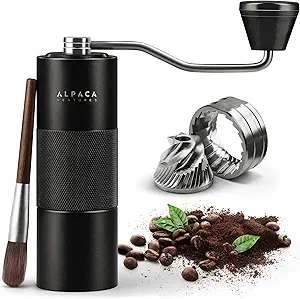 |
| Best Budget The cheapest option that still gets the job done reliably | Rsoilch Manual Coffee Grinder COGR001 |  |
| Top Rated A top-rated pick with lots of positive feedback | TIMEMORE Chestnut C3S Pro |  |
| Most Popular A crowd favorite that many people choose with confidence | JavaPresse Manual Coffee Grinder |  |
| Best Seller A high-volume bestseller chosen again and again | CEVING Manual Coffee Grinder MCG-02 | 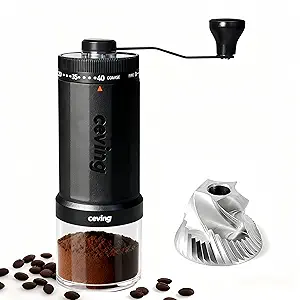 |
Hario Mini Mill Slim MSS-1B

| Capacity | 2 cups |
|---|---|
| Material Type | Ceramic |
| Power Source | Manual |
The Hario Mini Mill Slim is a hand-powered grinder built for simple, small-batch coffee preparation. It uses a ceramic conical mill that resists rust and delivers a consistent grind that you can adjust with the top knob, and the transparent collection chamber makes it easy to see how much ground coffee you have. Its slim profile and the removable handle let it store neatly in a kitchen drawer or travel bag, and the disassemblable parts are straightforward to clean. Practical use is focused on single-serve or two-cup batches rather than high-volume grinding, and because it is manual it requires a bit of effort to reach fine espressolike grinds compared with a powered burr machine. The grinder is best for home espresso users who prefer a quiet, low-tech tool and who value a compact footprint and ceramic burr durability.
Best for: Buyers who want a compact, low-noise manual grinder for small espresso-focused batches and value a durable ceramic burr and easy storage.
Less Ideal for: Those who need to grind large quantities quickly, want automated convenience, or require ultra-fine espressolike consistency with minimal effort should consider a powered grinder.
- Ceramic burr resists rust and provides consistent grinds
- Slim, removable-handle design stores easily and packs for travel
- Transparent grounds chamber lets you monitor quantity while grinding
- Easy to disassemble and clean
- Manual operation requires effort to achieve very fine espresso grinds
- Small 2-cup capacity limits batch size for multiple servings
Verdict: A compact, durable manual grinder that delivers consistent small-batch grounds and stores easily for espresso-focused home use.
1Zpresso K-Ultra Manual Grinder

| Burr material | Stainless steel |
|---|---|
| Burr size | 48 mm |
| Adjustment | External dial, 100+ clicks, 20 microns per click |
| Catch cup capacity | 35-40 g |
| Power source | Manual |
The 1Zpresso K-Ultra is a metal-bodied hand grinder built around a 48mm stainless steel conical burr and an external adjustment dial that delivers very fine, repeatable settings suitable for espresso and fine filter grinds. It uses an external stepless-like mechanism with over 100 clicks at roughly 20 microns per click, so you can dial in small grind changes without disassembling the unit. The magnetic catch cup and foldable handle speed up workflow and make the grinder stable on the counter or portable for travel, while tool-free disassembly and included cleaning tools simplify maintenance. Its catch cup holds about 35 to 40 g, enough for one to two espresso shots. The K-Ultra is purpose-built for performance: the fixed burr-to-shaft mounting improves stability and the aluminum body reduces wobble under heavy dosing. The main trade-offs are manual labor for high-volume use and a premium price point compared with entry-level hand grinders, but for someone chasing consistent, cafe-level espresso grinds by hand it delivers precise, durable performance.
Best for: Buyers seeking a precision manual grinder to dial espresso-level grinds and who prioritize grind consistency and build quality over automation.
Less Ideal for: People who need fast, hands-free grinding for multiple daily shots or those on a tight budget should consider an electric grinder instead.
- 48mm stainless steel conical burr for consistent, espresso-capable grind
- External adjustment dial with 100+ clicks for fine, repeatable settings
- Magnetic catch cup speeds workflow and holds 35–40 g of grounds
- Tool-free disassembly and included cleaning tools for easy maintenance
- Foldable handle and travel case improve portability and storage
- Manual operation is tiring for large daily volume
- Higher price than basic hand grinders
Verdict: If you want a durable, precision-focused handheld grinder that can reliably dial in espresso grinds, the K-Ultra is built for that purpose.
ALPACA VENTURES Manual Coffee Grinder

| Material Type | Aluminum, Stainless Steel |
|---|---|
| Power Source | Manual |
| Included Components | Brush |
| Number of Items | 3 |
This hand grinder is built around stainless steel conical burrs, a lengthened crank and a dual bearing design that make it easy to turn and reasonably quick for single-dose grinding. You adjust grind size with the numbered dial to move between fine settings for espresso and coarser settings for pour-over or French press, and the unit disassembles without tools for cleaning. Its manual operation means no electricity, so it is portable for travel or camping and avoids power or battery concerns. Practical touches include a cleaning brush in the kit and a sturdy aluminum body with a corrosion-resistant stainless-steel burr for longevity. Expect consistent, café-style finer grinds when dialed properly, but like most hand grinders it takes more effort and time than an electric grinder for large batches and requires some practice to hit exact espresso dialing repeatedly. For someone who values control, portability and a durable build, it performs very well as a daily single-dose grinder for espresso and other methods.
Best for: Buyers who prioritize precise control, portability and a durable manual grinder for single-dose espresso and occasional travel use.
Less Ideal for: Users who regularly grind large volumes or need quick, repeatable grind speed should prefer an electric grinder instead.
- Stainless steel conical burrs deliver consistent grind quality across settings
- Precision adjustable dial lets you dial in fine espresso and coarser brew sizes
- Dual bearing and extended crank reduce effort and improve turning smoothness
- Tool-free disassembly and included brush make cleaning straightforward
- Compact, lightweight design is easy to carry for travel or camping
- Manual grinding is slower and more labor intensive than electric grinders for multi-cup batches
- May require repeated adjustments and practice to reproduce exact espresso dose grind each time
Verdict: A durable, travel-friendly hand grinder that gives precise, café-style fine grinds for espresso without needing power.
Rsoilch Manual Coffee Grinder COGR001

| Material Type | Ceramic, Stainless Steel |
|---|---|
| Power Source | Manual |
| Number of Items | 1 |
This manual grinder uses a ceramic burr set inside a stainless-steel body to deliver consistent, adjustable grounds for everything from French press to espresso. It is operated by a removable hand crank and offers five grind settings so you can dial in finer or coarser textures depending on your brewing method. Its small, lightweight design makes it easy to carry for travel or camping, and the simple disassembly means routine cleaning is straightforward. Because it is manual, grinding larger amounts takes time and effort compared with electric grinders, and truly fine espresso-level results require patience and careful adjustment. Build quality is practical rather than premium, but the ceramic burrs resist wear and help preserve coffee flavor. For a budget-focused buyer who wants control over grind size without an electric unit, this grinder delivers a lot of value in a compact package.
Best for: Buyers wanting an inexpensive, portable way to control grind size for home espresso practice or travel who prioritize manual control over convenience.
Less Ideal for: People who need to grind large daily volumes quickly or who prefer push-button electric convenience should look elsewhere.
- Ceramic burrs for consistent grind and reduced heat transfer
- Five adjustable grind settings to cover espresso through French press
- Compact and lightweight for travel or small kitchens
- Stainless steel construction offers basic durability
- Manual operation is slower and more labor-intensive than electric grinders
- Small capacity makes it inefficient for grinding coffee for several people at once
Verdict: A low-cost, portable manual grinder that gives budget-minded espresso enthusiasts adjustable, wear-resistant ceramic grinding without electricity.
TIMEMORE Chestnut C3S Pro

| Capacity | 25 g |
|---|---|
| Item Weight | 430 g |
| Power Source | manual |
The TIMEMORE Chestnut C3S Pro is a solidly built manual coffee grinder aimed at delivering consistent grinds for home espresso and other brewing methods. Its all-aluminum integrated body and metal top cover reduce the chance of cracking and help dissipate heat during longer grinding, while the S2C660 steel conical burrs and double-bearing central axis produce a uniform particle distribution. The stepless adjustment offers about 36 levels of coarseness so you can micro-tune the grind for espresso, and the foldable crank handle makes the grinder portable and easier to store. In practice the bearing-assisted handle spins smoothly and lowers effort, so even fine espresso grinds are achievable without excessive wrist strain. Capacity is modest, so it is best for single-serve or small-batch grinding rather than large roasts, and manual operation is slower than electric grinders when you need multiple shots back to back. For someone prioritizing long-term reliability and precise, consistent manual grinding for espresso, the C3S Pro is a practical choice.
Best for: Buyers who want a durable, factory-quality manual grinder that produces consistent, espresso-capable grinds and value long-term reliability over speed.
Less Ideal for: Users who need to grind large quantities quickly or prefer the convenience and speed of an electric espresso grinder.
- All-metal aluminum body and metal top reduce cracking and improve durability
- S2C660 steel conical burrs provide consistent, even grind distribution
- Double-bearing central axis and bearing-assisted handle make grinding smoother and less tiring
- Stepless adjustment with ~36 levels allows fine tuning for espresso
- Foldable crank handle improves portability and compact storage
- Small 25 g capacity limits use to single-serve or small batches
- Manual grinding is slower than an electric grinder for multiple consecutive shots
Verdict: Choose the Chestnut C3S Pro if you want a robust, metal-bodied manual grinder that reliably produces espresso-ready grinds with precise adjustment.
JavaPresse Manual Coffee Grinder

| Power Source | Manual |
|---|---|
| Material Type | Stainless Steel |
| Included Components | Grinder |
The JavaPresse Manual Coffee Grinder is a compact hand-crank grinder that uses a ceramic conical burr and an adjustable internal mechanism to deliver 18 grind settings for everything from espresso to French press. It is typically used by travelers, campers, or home brewers who want control over grind size without an electric motor; the manual crank keeps operation quiet and removes the need for batteries or cords. The ceramic burr design aims for consistent particle size and improved durability compared with entry-level steel burrs, and the clear adjustment mechanism lets you dial in a finer grind for espresso or coarser for drip and pour-over. In everyday use it produces flavorful results for single-serve and small-batch brewing, though manually grinding for multiple shots takes more time and effort than an electric grinder. The stainless steel body feels sturdy and the unit is easily packed for trips, but users seeking very high-speed or hands-free grinding for heavy daily espresso workloads will want a motorized, espresso-specific grinder instead.
Best for: Buyers who prioritize proven performance and quiet, portable grinding for single-shot espresso or travel brewing and who prefer choices backed by strong customer feedback.
Less Ideal for: Someone who grinds frequently for multiple daily espressos or needs rapid, hands-free grinding should choose a dedicated electric espresso grinder instead.
- 18-step adjustable grind lets you tailor coarseness from espresso-fine to coarse brew
- Ceramic conical burrs provide consistent grind and resist corrosion
- Manual crank is very quiet and needs no power, good for travel or camping
- Compact stainless steel build is portable and durable for single-serve use
- Manual operation is slow for larger volume grinding needed for multiple espresso shots
Verdict: A reliable, travel-ready manual grinder that gives controlled, quiet grind adjustment ideal for single-shot espresso and on-the-go brewing.
CEVING Manual Coffee Grinder MCG-02

| Capacity | 60 g |
|---|---|
| Adjustable settings | 40 |
| Burr type | Stainless steel conical burr |
This CEVING manual grinder is built for people who want consistent, freshly ground coffee for espresso and other brew methods while traveling or at home. It holds up to 60 g of beans, so you can grind a full dose for espresso without repeated refills, and the external click-ring offers 40 discrete settings for quick adjustments between fine espresso and coarser brews. The CNC stainless steel conical burrs aim for uniform particle size and faster grinding than cheap blades, and the compact, lightweight body makes it easy to pack for trips or keep on a countertop. Practical limits include the manual effort required for fine espresso grinds and the absence of a motor for rapid back-to-back shots in a busy setting. For risk-averse buyers the visible external adjustment and metal burrs give predictable, repeatable changes rather than fiddly hidden mechanisms. Expect good precision for home espresso or pour-over use, but not the speed of an electric grinder when you need many consecutive doses.
Best for: Buyers who prioritize consistent, factory-quality grind control and portability for home espresso or travel and who prefer a simple, reliable manual tool over an electric grinder.
Less Ideal for: People who need fast, high-volume grinding for commercial use or those who prefer the convenience of a motorized grinder for frequent espresso pulls.
- 60 g capacity reduces the need for multiple fills when grinding for espresso or larger brews
- 40 external click-ring settings let you switch grind size quickly and predictably
- CNC stainless steel conical burrs produce uniform grinds and are more durable than blade options
- Compact and lightweight design is easy to carry for travel, camping, or daily commuting
- Manual operation requires significant effort for very fine espresso grinds compared with electric grinders
- Not suitable for high-volume or back-to-back grinding sessions due to speed limits
Verdict: Choose this grinder if you want portable, repeatable, laboratory-style grind adjustment and a larger-than-usual manual capacity for espresso and travel brewing.
Choosing the Right Manual Coffee Grinder for Espresso Machine: Key Factors to Consider
Burr Type and Material
Burr geometry and material directly affect particle uniformity and heat transfer. Typically, conical and flat burrs each have tradeoffs: conical burrs can be forgiving and maintain sharpness longer, while flat burrs often yield very uniform particle distribution at the expense of a slightly larger, heavier mechanism.
For espresso you need burrs that can hold a very fine setting without generating excessive heat during grinding. Hardened steel burrs are common and durable, while some premium options use ceramic for corrosion resistance. Consider how the burr material affects wear and whether replacement burrs are available for long-term maintenance.
Adjustment Precision
Espresso demands small, repeatable changes in grind size. Look for micro-adjustment mechanisms with clear detents, stepped rings, or calibrated markings so you can return to a known setting. Stepless systems give infinite granularity but require a stable locking mechanism to avoid drift between shots.
A coarse adjustment range is less important than fine control at the extreme fine end. Check how easy it is to make tiny adjustments while the grinder is assembled and whether the adjustment remains consistent as you grind multiple doses.
Dosing and Catch Capacity
Manual grinders vary from tiny single-dose hoppers to larger-capacity containers. For espresso, many users prefer single or small double-shot capacity to keep beans fresh and reduce wasted grounds.
Consider the catch cup design and whether it permits easy transfer into a portafilter or dosing cup. A clear, stable dosage helps with consistent tamping and reduces mess. If you plan to grind for multiple shots without stopping, ensure the grinder s handle and port can handle the volume without excessive strain.
Ergonomics and Crank Mechanics
Hand grinding should feel smooth and balanced. The crank length, handle grip, and bearings affect the effort required and the consistency of your rotation speed. A longer crank gives more leverage but increases travel and can be awkward on small counters.
Look for well-seated handles, sealed bearings, and a mechanism that does not wobble under load. Ergonomic designs reduce fatigue for frequent home espresso routines and make it easier to maintain steady grinding speed for consistent particle creation.
Stability and Footprint
A stable grinder that does not walk or tilt while you crank reduces missed shots and mess. Consider whether the grinder is intended for bench use or travel. Bench models can be heavier and more stable, while travel-friendly grinders trade stability for compactness.
If you have limited counter space near your machine, prioritize a vertical, narrow footprint or a clamp-compatible base. Stability also ties to the burr mounting and how tightly the parts fit together to avoid wobble that will degrade grind consistency.
Serviceability and Cleanability
Espresso-grade grinding produces fine particles and oils that accumulate in the burr chamber. Choose a grinder that is straightforward to disassemble for periodic cleaning. Easy access to the burrs, minimal small crevices, and clear instructions reduce the risk of rebuilding errors.
Consider whether parts can be replaced without specialized tools and whether the manufacturer or community supplies spare burrs or seals. Regular cleaning preserves flavor clarity and mechanical life.
Why Manual Grinders Work Well for Home Espresso
Manual grinders deliver tactile control and low retention, which are two advantages for home baristas dialing in espresso. The slower rotation speed reduces heat buildup compared with many electric grinders, helping preserve volatile oils and aromatics that contribute to crema and flavor clarity.
Because you control dose and speed, manual grinders often give a more predictable single-dose workflow. Many enthusiasts appreciate the quiet operation and compact footprint that fit well in small kitchens or travel bags without sacrificing the ability to reach fine espresso settings.
- Lower rpm reduces heat transfer during grinding
- Compact designs suit small counters and travel
- Single-dose control minimizes stale grounds and retention
How to Dial In Grind for Espresso with a Hand Grinder
Start with a baseline setting that has produced acceptable shots for your machine. Make very small adjustments, one click or notch at a time, and pull a short test extraction after each change. Note changes in shot time, flow speed, and sour or bitter notes to find the sweet spot.
Keep variables other than grind constant while testing: same dose, same tamp pressure, same water temperature and distribution. Because manual grinders can have slightly more variability, allow a few normalizing shots after each adjustment before judging results.
- Adjust one notch and pull a 20-30 second timed shot to gauge change
- Record setting and dose for reproducibility
- Flush or purge a small amount of grounds to avoid old particles affecting the test
Maintenance Tips to Keep Grind Consistent
Regular brushing and occasional deep cleaning keep the burrs free of oils and fines that can change extraction. Use a soft brush to clear grounds after each session and perform a full disassembly for deeper cleaning every few weeks depending on use.
Check adjustment mechanisms for wear or looseness and tighten fasteners to maintain repeatable settings. Replace burrs when you notice a decline in extraction quality, increased particle fines, or if grinding becomes noticeably harder.
- Brush out hopper and burr chamber after each use
- Deep clean bearings and burrs monthly with light disassembly
- Inspect seals and fasteners to prevent drift in settings
Travel and Portability Considerations
If you plan to use a manual grinder on trips with your espresso setup, prioritize compactness and low weight. Detachable cranks and collapsible designs save space in luggage. Consider models that include a travel pouch or that pack flat to avoid damage.
Balance portability against the need for a stable base during grinding. Some compact grinders require clamping or one-handed stabilization, which can be inconvenient when traveling. Decide whether you need true single-dose portability or a small bench grinder that stays at home.
- Removable crank and compact hopper reduce packed volume
- Durable materials resist dings from travel
- Consider a small silicone mat or clamp to stabilize on unfamiliar surfaces
Common Mistakes New Users Make
Expecting instant parity with high-end electric grinders leads to frustration. Manual grinders excel at control and low retention, but they require patience to dial in and a steady hand to maintain consistent crank speed. Avoid large, rapid adjustments that overshoot the sweet spot.
Neglecting cleaning and maintenance is another frequent error. Fine espresso grinding quickly shows the effects of clogged burrs and oily buildup. Keep a simple maintenance routine to preserve extraction quality.
- Avoid large incremental adjustments during dialing
- Do not skip routine cleaning
- Practice consistent dosing technique to isolate grind variables
How We Chose the Best Manual Coffee Grinder for Espresso Machine
We prioritized tools that deliver the specific performance espresso requires: very fine, stable particle distribution and repeatable settings that withstand frequent microadjustments. Our selection criteria emphasized the burr type and material, the range and fineness of the adjustment mechanism, and the grinder s ability to hold a tuned setting under repeated use. Mechanical factors such as burr alignment, stability of the adjustment ring, and anti-backlash features were considered because small changes matter a lot at espresso settings. We also assessed build durability and ergonomics for daily use. That included how easy the grinder is to crank consistently, hopper and catch-capacity relative to single- or double-shot routines, and how simple it is to disassemble for cleaning. Portability and footprint were weighed for users with small counter or travel needs. Finally, we considered dosing repeatability and static control since those affect tamping and puck prep. We excluded grinders that are optimized only for coarse brewing methods or that lack true micro-adjustment for espresso. The final picks balance grind precision, mechanical reliability, and real-world usability.
Our full evaluation process is outlined in our review methodology.
FAQ
Can a manual grinder reach fine enough settings for true espresso?
Often yes. Many manual grinders are designed specifically with the micro-adjustment and burr geometry needed for espresso. Performance depends on burr quality and the precision of the adjustment mechanism.
How much coffee should I grind per shot with a manual grinder?
It usually depends on your recipe but most home espresso doses range from single shots at 7 to 9 grams to double shots at 16 to 20 grams. Choose a grinder with a catch capacity and dosing method that fits your preferred routine.
Do manual grinders retain a lot of grounds?
Retention varies by design. Many manual grinders are single-dose oriented and have low retention, but some designs trap fines in the burr chamber. Low-retention models produce more consistent dosing between shots.
How often should I clean a manual espresso grinder?
Brush out loose grounds after each session and perform a deeper disassembly and cleaning every few weeks with regular use. Frequency increases with oily beans or heavy daily use.
Are manual grinders suitable for travel with an espresso setup?
Yes, many manual grinders are specifically built for travel and pack small and light. Consider whether you need a stable surface to grind on and whether the compact model still provides the fine adjustment range you require.
Final Verdict
Choosing a manual coffee grinder for espresso machine is about balancing precision, durability, and daily ergonomics. Prioritize a grinder with tight micro-adjustment, stable burr mounting, and a comfortable crank mechanism if you plan to grind every day. Tradeoffs between portability and stability are real, so pick the form factor that matches how and where you brew. Focus on grind consistency and dosing repeatability first, then consider serviceability and footprint. With the right manual grinder you can achieve excellent home espresso results while enjoying a quiet, controlled workflow.