
Note: This article contains affiliate links. If you click on these links and make a purchase, we may earn a small commission at no extra cost to you. This helps support our research and content. Read our full affiliate disclosure here.
If you brew with a moka pot, the grind you use has a big effect on flavor, extraction speed, and how often you clean the pot. A good manual coffee grinder for moka pot gives you the control to produce a slightly finer, uniform grind than a typical drip setting while staying coarser than espresso. That improves balance, reduces channeling, and helps prevent over-extraction that causes bitterness. This guide highlights seven shortlisted manual coffee grinders that suit moka pot brewing. We evaluated grind consistency, adjustment range, durability, and everyday handling to help you pick a grinder that matches how you brew and how often you make stovetop coffee. Read on to see the criteria we used and what matters when choosing a grinder for moka pot use.
Top Picks at a Glance
| Best Overall The best all-around choice for most situations | Hario Mini Mill Slim MSS-1B |  |
| Best Quality Built to a higher standard if you want something more solid | TIMEMORE S3 Manual Coffee Grinder |  |
| Best Value The sweet spot between price and what you get | Vivaant Manual Coffee Grinder |  |
| Best Budget The cheapest option that still gets the job done reliably | Rsoilch Manual Coffee Grinder COGR001 |  |
| Top Rated A top-rated pick with lots of positive feedback | TIMEMORE Chestnut C3S Pro |  |
| Most Popular A crowd favorite that many people choose with confidence | JavaPresse Manual Coffee Grinder |  |
| Best Seller A high-volume bestseller chosen again and again | CEVING Mini Manual Coffee Grinder MCG-01 | 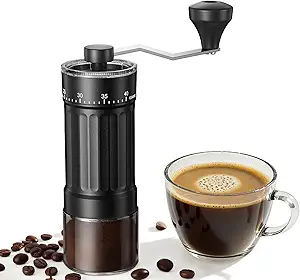 |
Hario Mini Mill Slim MSS-1B

| Material Type | Ceramic |
|---|---|
| Capacity | 2 cups |
| Power Source | Manual |
The Hario Mini Mill Slim is a hand grinder built for everyday home use and small-batch brewing with a Moka pot. It uses a ceramic milling burr that resists rust and produces reasonably consistent grounds adjustable via the top knob, while a transparent collection bottle makes it easy to see and measure output. Its slim profile and removable handle let you store it in a drawer or pack it for travel, and the disassemblable parts make cleaning straightforward. Because it is manual and sized for about two cups, grinding larger quantities takes more time and effort than an electric grinder, and the ceramic burr favors longevity over ultra-fine, high-speed grinding. For Moka pot users who value control, portability, and a factory-quality ceramic burr in a compact package, the Hario delivers reliable performance; for users who need high throughput or fingertip micro-adjustments at espresso fineness, an electric grinder will be faster and more precise.
Best for: Buyers who want a compact, durable manual grinder that delivers consistent, small-batch grinds for stovetop brewing and who appreciate portability and simple maintenance.
Less Ideal for: People who routinely grind large amounts of coffee or who require rapid, ultra-fine adjustment for espresso should choose a larger electric grinder instead.
- Ceramic mill resists rust and offers long-lasting grind consistency
- Slim, removable-handle design stores easily and is travel-friendly
- Visible collection bottle lets you monitor and measure grind output
- Simple disassembly makes cleaning and maintenance easy
- Manual operation is slow for larger batches
- Not optimized for extremely fine, dialed-in espresso-level grinds
Verdict: A compact, travel-friendly manual grinder with a durable ceramic burr that reliably produces small batches of Moka-pot-ready grounds.
TIMEMORE S3 Manual Coffee Grinder

| Capacity | 30 g |
|---|---|
| Material Type | Aluminum, Plastic, Stainless Steel |
| Power Source | Manual |
The TIMEMORE S3 is a full-metal manual grinder built for precision grinding across espresso to coarser brew methods, making it a strong choice for moka pot users who prioritize grind consistency. It uses TIMEMORE's patented S2C890 steel conical burrs and a point-to-point external adjustment system with 0.015mm/grid increments, so you can dial in a repeatable setting without counting clicks. The upgraded high-precision bearings reduce tolerance for smoother rotation and steadier output, and the foldable, spring-assisted handle helps keep the grinder compact and stable during storage or travel. In practice the S3 grinds quickly for a hand grinder and produces narrowly sized particles that improve extraction control for moka pot brewing. Limitations to expect are its 30 g capacity, which means multiple batches for larger servings, and the manual effort required for fine espresso-range settings, though the refined bearing and handle design lower fatigue. The all-metal construction also makes it heavier than plastic-bodied options, but it adds durability and tactile stability while grinding.
Best for: Coffee enthusiasts who want precise, repeatable grind control for moka pot brewing and value consistent particle size over ultra-light portability.
Less Ideal for: Casual users who need large single-batch capacity or those who prioritize the lightest possible travel grinder over rigidity and precision.
- Patented S2C890 steel burrs for improved grind uniformity
- External stepless adjustment with 0.015mm/grid precision for repeatable settings
- High-precision bearings for smoother, more consistent rotation
- Full metal unibody and foldable handle improve durability and portability
- Small 30 g capacity requires multiple fills for larger servings
- Heavier metal construction increases weight compared with plastic-bodied grinders
Verdict: Choose the TIMEMORE S3 when you need a durable, high-precision manual grinder that delivers consistent, fine-tunable grinds ideal for extracting richer moka pot coffee.
Vivaant Manual Coffee Grinder

| Capacity | 32 g |
|---|---|
| Included Components | grinder, handle, lid, measuring jar |
| Material Type | Glass, Metal, Plastic |
| Number of Grind Settings | 6 |
The Vivaant Manual Coffee Grinder is a handheld burr mill built for travel and small-batch brewing. It uses a stainless steel conical burr that the manufacturer says grinds faster and more consistently than ceramic, and an external dial offers six grind settings so you can move between fine and coarse without taking the unit apart. The grinder comes with a removable handle, a glass measuring jar with lid for storage, and a compact body that fits comfortably in one hand. In practice it grinds up to about 32 g of beans per fill, which is enough for a couple of Moka pot brews, and its metal burr produces fairly uniform grounds suitable for stovetop espresso-style extraction. The unit is quiet, easy to disassemble for cleaning, and durable thanks to metal components, though the small capacity means frequent refills for larger pots and heavier users. If you need a portable, precise manual grinder for concentrated brews, this performs well; if you want single-dose capacity or faster grinding for large batches, look elsewhere.
Best for: Buyers who prioritize precise, portable grinding for stovetop espresso-style brews and value durable metal burrs and easy dosing in a compact package.
Less Ideal for: People who regularly grind large quantities or want a hands-free, high-speed electric grinder should consider larger-capacity or powered alternatives.
- Stainless steel conical burr for consistent, fast grinding
- Six adjustable grind settings for dialing in Moka pot fineness
- Compact, portable design with removable handle and storage jar
- Glass measuring jar included for accurate dosing and storage
- Quiet operation suitable for travel or office use
- Small 32 g capacity requires multiple fills for larger servings or group brewing
- Manual operation is slower than electric grinders for high-volume use
Verdict: A small, durable manual burr grinder that delivers consistent, adjustable grounds ideal for single- or two-cup Moka pot brews.
Rsoilch Manual Coffee Grinder COGR001

| Material Type | Ceramic, Stainless Steel |
|---|---|
| Power Source | Manual |
| Number of Items | 1 |
This Rsoilch manual grinder uses ceramic burrs and a stainless steel body to produce a range of grind sizes for brewing methods from French press down toward espresso. You adjust grind coarseness with the stepped setting mechanism, then crank the hand handle to grind beans into the built-in collecting chamber. Its compact, lightweight form makes it easy to pack for travel or keep on a small counter, and the ceramic burrs resist heat and wear so grounds stay consistent across short sessions. Cleaning is straightforward because the unit disassembles, though the included parts list appears minimal so you should handle small components carefully. Because it is hand powered, grinding multiple cups takes more time and effort than an electric grinder, and very fine, espresso-level grinds require patience and careful adjustment. For moka pot use the grinder can deliver a suitable medium-fine setting when dialed in, making it a practical low-cost option for people who value portability and simplicity.
Best for: Buyers on a tight budget who need a portable, no-frills grinder for stovetop brewing and occasional moka pot use and who accept manual cranking to save money.
Less Ideal for: People who grind large volumes daily, need rapid electric operation, or require precise, repeatable espresso-level performance should consider an electric or higher-end hand grinder.
- Ceramic burrs for consistent grind and reduced heat transfer
- Adjustable grind settings to support multiple brew methods
- Compact, lightweight design suitable for travel and small kitchens
- Manual operation is slower and more tiring than electric grinders
- Minimal included components may require careful handling during disassembly
Verdict: A low-cost, portable manual grinder that can be dialed in for moka pot brewing when you want a simple, travel-ready solution.
TIMEMORE Chestnut C3S Pro

| Capacity | 25 g |
|---|---|
| Power Source | manual |
| Item Weight | 430 g |
The TIMEMORE Chestnut C3S Pro is a metal-bodied manual grinder built for consistent, travel-friendly grinding. It uses TIMEMORE's S2C conical steel burr set and a double-bearing central axis to deliver even particle size and low effort turning, which helps produce a stable extraction for stovetop brewers like the moka pot. The foldable crank and compact footprint make it easy to pack or store, while the stepless adjustment (about 36 levels) lets you dial in a medium-fine setting suitable for moka brewing. The full aluminum alloy construction and upgraded metal top improve durability and reduce the chance of cracking under regular use. Expect reasonably quick sessions for single-serve doses thanks to the 25 g capacity, and the built-in bearings give a smoother, less tiring crank when grinding denser roasts. Limitations are the small capacity if you brew for several people and the manual effort compared with electric grinders, which is a normal trade for portability and control.
Best for: Buyers who prioritize a durable, consistent manual grinder for reliable stovetop espresso-style extraction and who appreciate portability and precise grind control.
Less Ideal for: People who routinely brew multiple cups at once or who need one-touch convenience from an electric grinder should consider larger-capacity or motorized options.
- All-metal aluminum body for durability and better heat dissipation
- S2C conical steel burrs designed for uniform, consistent grind size
- Stepless grind adjustment with fine control across ~36 levels
- Foldable crank and compact design for travel and easy storage
- Double-bearing central axis reduces effort and smooths rotation
- 25 g hopper capacity is small for multi-cup brewing
- Manual grinding requires more time and physical effort than electric grinders
Verdict: Choose the C3S Pro when you want a rugged, travel-ready manual grinder that reliably delivers the consistent medium-fine grinds moka pot brewing needs.
JavaPresse Manual Coffee Grinder

| Material Type | Stainless Steel |
|---|---|
| Power Source | Manual |
| Adjustable Settings | 18 grind settings |
| Item Type Name | Coffee Grinder |
The JavaPresse Manual Coffee Grinder is a portable hand-crank grinder built around a ceramic conical burr and a stepped adjustment for 18 grind settings, making it suitable for a range of brew methods including moka pot. You use the external adjustment ring to select coarseness, then turn the detachable crank to grind; the manual operation keeps noise low and requires no power, so it is handy for travel or small kitchens. The ceramic burr is marketed for durability and consistent particle size, which helps extract more evenly from the moka pot basket compared with blade grinders. Its stainless steel body and compact footprint make it easy to pack and clean, though very fine espresso-level grinds take longer by hand and require more wrist effort. The grinder holds a modest amount of beans so plan for refills when making multiple cups. For buyers who value quiet, portable grinding with reliable settings, this is a practical, well-built option; power users seeking rapid, large-batch grinding may find it slow for heavy daily use.
Best for: Buyers who prioritize quiet, portable, and controllable grinding for moka pot brewing and value proven customer feedback when choosing a reliable manual grinder.
Less Ideal for: People who need to grind large volumes quickly, want hands-free electric operation, or routinely prepare many cups at once should consider an electric grinder instead.
- 18 stepped grind settings for tailored coarseness
- Ceramic conical burr for consistent grind and long wear
- Manual crank eliminates motor noise and power need
- Compact stainless steel design is travel-friendly and easy to clean
- Small bean hopper capacity requires frequent refills for multiple cups
- Manual grinding is slower and more effortful than an electric grinder
Verdict: A compact, travel-ready conical burr grinder that gives moka pot brewers quiet, adjustable, and consistent manual grinding.
CEVING Mini Manual Coffee Grinder MCG-01

| Capacity | 30 g |
|---|---|
| Material Type | Ceramic |
| Power Source | manual winding |
| Adjustable Settings | 40 |
The CEVING Mini Manual Coffee Grinder is a portable hand mill aimed at small-batch brewing and travel use. It uses ceramic conical burrs and an external adjustment ring that offers 40 distinct grind settings, which makes dialing in a medium-fine grind suitable for Moka pot brewing straightforward. The 30 g bean hopper is sized for one to two cups, and the disassemblable design simplifies cleaning and transport. Because it is manually operated, it produces minimal heat and is quiet compared with electric mills, but grinding larger amounts takes noticeably more time and effort. The ceramic burrs help keep flavor integrity but may wear differently than steel over many months of heavy use. For someone who values precise grind control in a compact, risk-free mechanical design, this grinder balances consistent results with easy maintenance; buyers who need larger daily capacity or the speed of an electric grinder should consider alternatives.
Best for: Buyers who want a reliable, low-risk manual grinder for precise single- or two-cup Moka pot brewing and who prioritize portability and easy maintenance.
Less Ideal for: Those who regularly grind larger daily volumes or who need fast, hands-free grinding should opt for a small electric grinder instead.
- 40 external grind settings let you fine-tune particle size for Moka pot brewing
- Ceramic conical burrs deliver uniform grind and produce less heat
- Compact, lightweight design is travel and camping friendly
- Detachable construction makes cleaning and packing simple
- 30 g capacity is small for multiple cups or shared use
- Manual operation requires physical effort and is slower than electric grinders
Verdict: A compact, portable manual grinder that offers precise grind control ideal for making Moka pot coffee while minimizing complexity and risk.
Choosing the Right Manual Coffee Grinder for Moka Pot: Key Factors to Consider
Grind Consistency
Uniform particle size is crucial for moka pot brewing because the small filter basket and short contact time exaggerate the effects of fines and large particles. A grinder that produces a narrow particle distribution helps achieve even extraction, reducing sour or bitter tastes caused by uneven brewing.
When assessing consistency, focus on burr type and how the grinder controls particle breakup. Conical or flat metal burrs typically deliver tighter distributions than low-quality steel blades or poorly machined burr sets. Consistent grinding will make it easier to dial in your preferred flavor without constant trial and error.
Adjustment Precision
Moka pots require a grind size between espresso and drip, and even small changes can alter extraction significantly. A grinder with clear, incremental adjustments or indexed steps lets you tune grind size precisely and return to a setting reliably.
Look for mechanisms that resist drift while grinding and that provide tactile feedback when changing settings. Micro-adjustment capability is useful if you like to tweak for roast level or bean origin, since different beans respond to slightly different sizes in a moka pot.
Burr Material and Construction
The burrs are the heart of a manual grinder. High-quality steel or ceramic burrs retain sharpness and resist wear, maintaining grind quality over months and years. Metal burrs are often preferred for durability and consistent performance, while ceramic can stay sharp but is more brittle.
Also consider how the burrs are mounted and whether tolerances and machining appear robust. Poorly aligned burrs increase fines and inconsistent grind size despite a nominal adjustment. Durable construction reduces the need for early replacement.
Ergonomics and Grind Speed
Because manual grinders rely on hand power, the crank design, handle comfort, and gearing directly affect usability. A well-designed crank reduces fatigue and makes daily grinding practical. Higher mechanical advantage can speed up grinding while requiring less force.
If you make coffee for more than one person, grind speed becomes more important. But speed should not come at the expense of control. Evaluate how the handle feels in your hand and whether the grinder remains comfortable during a full dose.
Capacity and Portability
Consider how much ground coffee you need at once. A moka pot typically uses small doses, so a compact hopper and grounds container may be fine, and smaller capacity can improve portability. If you brew multiple pots at once, choose a grinder with larger capacity or refill convenience.
Portability matters if you travel or camp with a moka pot. Look for grinders that are lightweight, packable, and have secure lids to prevent spillage. Balance capacity against convenience to match your routine.
Ease of Cleaning and Maintenance
Oils and fines build up over time and affect flavor consistency. A grinder that disassembles easily for periodic cleaning makes maintenance straightforward and preserves flavor. Removable hoppers and accessible burrs cut cleaning time and let you inspect wear.
Also consider whether replacement parts or serviceable components are available for long-term use. Simple designs with fewer trapped crevices are typically quicker to keep clean and less likely to harbor stale grounds.
Why Grind Size Matters for Moka Pot Brewing
Moka pot extraction sits between drip and espresso in terms of contact time and pressure. Because the metal filter and narrow pathways restrict flow, particle size strongly influences how fast water moves through the bed and how soluble compounds are extracted. Slightly finer grinds speed extraction but can produce more fines, which may clog the filter and increase bitterness.
Understanding the role of grind size helps you use a manual grinder to address common moka pot issues like sourness from under-extraction or harsh bitterness from over-extraction. The right grinder helps you hit the narrow window of particle size that produces balanced stovetop coffee.
- Finer grind increases extraction speed and can intensify bitterness if not tuned.
- Coarser grind slows flow and can leave coffee under-extracted and sour.
- Consistent particle size reduces channeling and uneven extraction in the small basket.
Setting and Tuning Your Grinder for Best Results
Start with a middle-ground setting recommended for moka pot grinding and make small adjustments after the first brew. Change one variable at a time such as grind size, dose, or heat source so you can identify what altered the cup.
Taste and timing are your guides. If the coffee tastes sour, move slightly finer. If it is bitter or over-extracted, move a touch coarser. Keep a note of settings that work for each bean and roast level to reproduce results consistently.
- Record the numbered setting plus dose and brew time for repeatability.
- Adjust in small increments; large jumps hide the true effect of a change.
- Allow a few brews for the grinder to settle after a setting change before judging.
Cleaning and Maintaining a Manual Grinder
Regular cleaning preserves both flavor and grinder performance. Empty grounds, brush the burrs, and wipe housings weekly or after oily beans. Deep clean by disassembling according to the manufacturer instructions every few months or when you notice buildup.
Avoid water on metal burrs unless the design supports it. Instead use a soft brush and, if needed, a dry food-safe cleaner. Inspect for wear and replace components if grind quality degrades noticeably.
- Brush out grounds after each use to prevent stale buildup.
- Deep disassemble periodically to access trapped fines and oils.
- Store disassembled parts dry and reassemble carefully to maintain alignment.
Portable Grinders Vs. Countertop Convenience
If you travel with a moka pot or make coffee outdoors, a small, lightweight manual grinder is a good match. These designs trade capacity and sometimes speed for compactness and ease of packing. For daily at-home use, a slightly larger manual grinder with more comfortable ergonomics and faster throughput may be preferable.
Decide which is more important: a compact footprint for travel or faster, more comfortable grinding for regular home use. The right choice depends on your routine and how often you brew multiple doses.
- Travel grinders are lightweight and often have fewer parts to lose.
- Home-oriented grinders may offer larger hoppers and better gearing for speed.
- Consider whether you want a dedicated moka pot grinder or a multi-use hand mill.
Common Mistakes New Moka Pot Brewers Make
A frequent error is using too coarse a grind which leads to under-extracted, thin coffee. Another is tamping or compressing grounds in the moka basket; this restricts flow and promotes bitter over-extraction. Rely on grind adjustment rather than tamping to control extraction.
Also avoid using a grinder setting that produces too many fines. Excess fines can clog the filter and change brew dynamics. Work methodically and adjust one parameter at a time to learn how grind adjustments affect flavor.
- Do not tamp grounds in the moka pot basket.
- Avoid excessive heat during brewing; use medium heat for stable extraction.
- Clean the filter and gasket regularly to prevent leaks and flavor contamination.
How We Chose the Best Manual Coffee Grinder for Moka Pot
We focused on attributes that directly affect moka pot brewing and everyday usability. First, grind consistency was a primary filter because a narrow particle distribution helps avoid under- or over-extraction in the small filter basket of a moka pot. Second, we prioritized adjustable, repeatable grind settings with clear detents or indexed steps so you can fine-tune grind size without guessing. Third, build quality and burr material were weighted heavily since metal burrs and sturdy housings hold settings and last through repeated use. Fourth, ergonomics and grind speed matter for daily use because hand fatigue or very slow grinding discourages regular use. Finally, capacity and ease of cleaning were considered to ensure the grinder fits how much coffee you make and stays hygienic. We excluded grinders that only offer coarse or single-setting outcomes unsuitable for moka pot extraction and designs with fragile parts that fail under normal hand use. The final shortlist balances consistent particle size, adjustment precision, durable burrs and housing, reasonable grind time, and cleaning access.
Our full evaluation process is outlined in our review methodology.
FAQ
How fine should I grind for a moka pot?
Grind size for a moka pot should be finer than drip but coarser than espresso. Start with a setting in the middle of the grinder's range and adjust slightly finer or coarser based on taste and brew time.
Can I use a manual grinder for other brew methods?
Often yes. Many manual grinders offer an adjustment range wide enough for pour-over, French press, and moka pot. Check the adjustment precision and burr quality to ensure they produce consistent results across different sizes.
How often should I clean my manual grinder?
Light cleaning such as brushing out grounds should be done after each use. A deeper disassembly and cleaning is recommended periodically, for example every few months or sooner if you use oily beans frequently.
Do ceramic burrs or steel burrs work better for moka pot?
Both can work well. Steel burrs are typically more durable and hold tight tolerances, while ceramic burrs stay sharp longer but can be brittle. Choose based on durability preferences and how often you plan to maintain the grinder.
Will a small-capacity grinder be enough for two people?
A small-capacity grinder can work for two if you do multiple short grinds or refill between brews. If you regularly brew multiple pots, a grinder with larger capacity and faster gearing will be more convenient.
Final Verdict
For moka pot brewing, prioritize a grinder that produces a narrow particle distribution and offers fine-grain adjustment so you can dial in the narrow extraction window that stovetop coffee requires. Balance burr quality and durable construction with ergonomics and grind speed so daily use is comfortable and repeatable. Finally, consider capacity and ease of maintenance to match how often you brew. With those priorities in mind, you can choose a manual grinder that consistently delivers balanced, flavorful moka pot coffee.