
Note: This article contains affiliate links. If you click on these links and make a purchase, we may earn a small commission at no extra cost to you. This helps support our research and content. Read our full affiliate disclosure here.
If you brew with a manual coffee grinder, the right tool shapes extraction, flavor clarity, and how much effort your morning routine requires. Picking a grinder under $100 can still get you precise burr geometry, consistent particle size, and a build that survives daily use. This guide lists the top shortlisted manual coffee grinders under $100, each chosen for controllable grind steps, portability, and durable materials. Below we summarize what matters for home brewing and note the evaluation criteria used to identify reliable grinders for different brewing methods. Next up are the individual picks tailored for common preferences and use cases.
Top Picks at a Glance
| Best Overall The best all-around choice for most situations | 1Zpresso Q Air Manual Grinder |  |
| Best Quality Built to a higher standard if you want something more solid | TIMEMORE C5 Pro Manual Grinder |  |
| Best Value The sweet spot between price and what you get | Hario Mini Mill Slim MSS-1B |  |
| Best Budget The cheapest option that still gets the job done reliably | Rsoilch Manual Coffee Grinder COGR001 |  |
| Top Rated A top-rated pick with lots of positive feedback | TIMEMORE Chestnut C3S Pro |  |
| Most Popular A crowd favorite that many people choose with confidence | JavaPresse Manual Coffee Grinder |  |
| Best Seller A high-volume bestseller chosen again and again | CEVING 60g Manual Coffee Grinder MCG-02 | 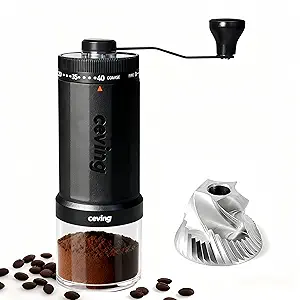 |
1Zpresso Q Air Manual Grinder

| Capacity | 15–20 g |
|---|---|
| Material Type | Stainless Steel Burr, Plastic Body |
| Recommended Uses | Pour-over, French press, cold brew |
| Item Weight | 12.8 ounces |
The 1Zpresso Q Air is a small, lightweight hand grinder aimed at pour-over lovers who want consistent, fresh grounds on the go. It uses stainless steel conical burrs and a numerical dial with 10 numbers and 30 clicks per rotation, which provides predictable, repeatable adjustments for medium-fine to medium brews. With a 15–20 g capacity it is tailored to single-cup prep and nests inside an AeroPress plunger for easy packing when traveling or camping. The grinder disassembles quickly without tools for cleaning and the magnetic catch cup speeds post-grind transfer. Because it is built for portability the hopper and capacity are limited, so it is not suited for grinding larger batches, and the compact plastic body means it is lighter but less hefty than all-metal models. For everyday single-cup use or as a travel grinder it delivers reliable, uniform grinds at a price point under $100.
Best for: Buyers who want a dependable, portable grinder that produces consistent grounds for pour-over and other single-cup methods and who prioritize compact size and precise adjustment over high capacity.
Less Ideal for: People who need to grind for multiple cups, larger batches, or who prefer a heavier, all-metal grinder for daily heavy use should consider larger models.
- Stainless steel conical burrs for durable, consistent grind quality
- Numerical dial with 30 clicks per revolution for precise adjustments
- Very compact and lightweight design that fits inside an AeroPress plunger for travel
- Quick disassembly without tools and magnetic catch cup for easy cleaning and transfer
- Small 15–20 g capacity limits it to single-cup or small-batch grinding
- Plastic body reduces perceived durability compared with full-metal alternatives
Verdict: A precise, travel-ready manual grinder that delivers consistent single-cup results for pour-over fans under $100.
TIMEMORE C5 Pro Manual Grinder

| Capacity | 30 g |
|---|---|
| Burr size | 42 mm |
| Material Type | Aluminum |
| Power Source | manual winding |
The TIMEMORE C5 Pro is a performance-focused hand grinder built around a 42 mm CNC stainless steel conical burr and a metal one-piece body. It grinds with a fine stepped adjustment (about 48 levels, ~0.031 mm per click) so you can dial in settings from espresso-fine to coarse for French press, and the double-bearing central axis helps keep particles uniform. The enlarged burr and smooth bearing-equipped handle make grinding efficient and less tiring than many compact manual grinders, and the folding handle plus 30 g hopper capacity keep it travel-friendly. Practical downsides are the relatively small bean capacity that means more refills for multiple cups and the manual operation which still requires effort for larger doses, but for single-serve precision and consistent particle size this grinder delivers strong results in a compact package.
Best for: Buyers who prioritize grind precision and consistent particle size for espresso and pour-over and want a compact, travel-capable grinder built for performance.
Less Ideal for: Those who need to grind large batches quickly, want a fully automatic solution, or prefer a larger-capacity grinder for frequent multi-cup brewing.
- CNC 42 mm stainless steel conical burrs for efficient, consistent grinding
- Fine stepped adjustment (~48 levels, ~0.031 mm per click) for precise grind control
- Double-bearing central axis and metal body improve stability and particle uniformity
- Smooth, labor-saving handle with folding design suitable for travel
- Compact, durable all-metal construction built for regular use
- 30 g bean capacity is small for brewing multiple cups without refilling
- Manual grinding still requires effort for larger doses
Verdict: Choose the C5 Pro if you want a compact, all-metal manual grinder that delivers precise, repeatable grind control for performance-minded single-cup brewing.
Hario Mini Mill Slim MSS-1B

| Capacity | 2 cups |
|---|---|
| Material Type | Ceramic |
| Power Source | Manual |
The Hario Mini Mill Slim is a hand-powered coffee mill that grinds beans using a ceramic burr assembly and a slim, easy-to-store body. It is used by adding beans to the top hopper, turning the removable handle, and adjusting grind size with a knob for coarser or finer grounds; the transparent catch lets you monitor the amount collected. The ceramic mill resists rust and preserves bean flavor, and the compact profile makes it convenient for small kitchens or travel; the handle can be removed for storage and the unit disassembles for cleaning. Its 2-cup capacity suits single-serve brewing or small French press batches but means frequent refills for larger pots. Because it is manual, grinding takes more time and effort than an electric model but gives precise control and quiet operation. The grinder is straightforward, durable in construction, and best for users who value consistent, small-batch grinding without electricity.
Best for: Buyers who want a compact, durable manual grinder for precise small-batch brewing and who prioritize flavor preservation and easy storage.
Less Ideal for: People who need to grind large volumes quickly, prefer electric convenience, or want hands-off operation for daily multi-cup brewing.
- Ceramic burrs resist rust and preserve coffee flavor.
- Slim, removable-handle design stores easily in small kitchens or luggage.
- Transparent grounds catcher lets you see yield and stop at the right amount.
- Disassembles for straightforward cleaning and maintenance.
- Small 2-cup capacity requires multiple batches for larger servings.
- Manual grinding is slower and requires physical effort compared with electric grinders.
Verdict: Choose this slim ceramic hand grinder if you want a compact, flavor-preserving tool for precise small-batch manual grinding.
Rsoilch Manual Coffee Grinder COGR001

| Material Type | Ceramic, Stainless Steel |
|---|---|
| Power Source | Manual |
| Number of Items | 1 |
This compact hand grinder uses ceramic burrs inside a stainless steel body to deliver adjustable grinds for espresso, French press, and other brew methods. You set grind size with a simple adjustment and turn the removable hand crank to process small batches of beans, making it suited to single-cup or travel use. The ceramic burrs offer consistent particle size and resist corrosion, while the manual operation means no power is required and cleanup is straightforward since the unit disassembles. Expect modest throughput because of the small size and hand operation, so it is best where portability and low cost matter more than speed. Build quality is reasonable for the price, but heavy daily use will highlight its manual nature compared with electric grinders. For buyers on a budget who want control over grind size and a durable, portable option, this grinder delivers solid value with a few practical compromises.
Best for: Buyers looking for an inexpensive, portable grinder that gives manual control over grind size for home brewing or travel and prioritizes value over speed.
Less Ideal for: People who regularly prepare large batches of coffee or want fast, hands-free grinding should choose an electric or higher-capacity grinder instead.
- Ceramic burrs provide consistent grind and resist corrosion
- Adjustable settings cover espresso to French press grind sizes
- Compact, lightweight design is easy to pack for travel
- Manual operation requires no power and is simple to maintain
- Small capacity and hand-crank operation make grinding slower for multiple cups
- Not as durable under heavy daily commercial use compared with pricier metal electric grinders
Verdict: A budget-friendly, portable manual grinder that delivers adjustable, corrosion-resistant ceramic burr performance for travelers and frugal home brewers.
TIMEMORE Chestnut C3S Pro

| Capacity | 25 g |
|---|---|
| Power Source | manual |
The TIMEMORE Chestnut C3S Pro is a sturdy manual coffee grinder built around CNC-machined S2C conical steel burrs and a full aluminum alloy body. You use it by loading up to a single-dose capacity, setting one of roughly 36 grind steps, and turning the foldable crank to produce grounds for pour-over, drip, or coarser methods. Key features include an integrated double-bearing central axis for smoother rotation and labor-saving operation, precision S2C660 burrs for uniform particle size, and a compact, foldable handle that makes it easy to pack for travel. In everyday use it grinds quickly for a hand mill and the metal construction resists cracking or wear better than plastic-bodied alternatives. Limits to consider are the small 25 g capacity, which makes it best for single-cup or small-batch grinding, and the manual effort still required for larger doses. Cleaning is straightforward and the stepless adjustment gives fine control, but those wanting electric convenience or larger batch throughput will need a different solution.
Best for: Buyers who prioritize a reliable, build-quality manual grinder for daily single-serve or travel use and want consistent, repeatable grind performance over flashy features.
Less Ideal for: People who need high-capacity or fast electric grinding for multiple cups or large batches should choose an electric grinder instead.
- All-metal aluminum alloy body for durable, long-lasting construction
- S2C conical steel burrs engineered for consistent, uniform grind size
- Double-bearing central axis and smooth rotation reduce hand effort
- Foldable handle improves portability and saves storage space
- Small 25 g capacity limits it to single-cup or small-batch use
- Manual grinding can be slow or tiring for larger quantities
Verdict: Choose the Chestnut C3S Pro if you want a well-built, dependable manual grinder that delivers consistent, precision grinds for single-cup and travel use.
JavaPresse Manual Coffee Grinder

| Power Source | Manual |
|---|---|
| Material Type | Stainless Steel |
| Adjustable Settings | 18 grind settings |
| Included Components | Grinder |
| Recommended Uses For Product | Camping |
The JavaPresse Manual Coffee Grinder is a compact hand-crank grinder built around a ceramic conical burr and an adjustable grind dial with 18 settings, so you can move from fine for espresso to coarse for French press. It is used by turning the removable crank to grind whole beans into the catch cup below, which makes it a good fit for travel, camping, or quiet at-home use where you do not want electric noise. The ceramic burr is marketed for longevity and consistent particle size, and the manual mechanism eliminates need for power and cuts grinding noise substantially. Practical benefits include easy portability, simple disassembly for refilling and cleaning, and precise grind control for multiple brew methods. Important limitations are that hand grinding takes more time and effort than electric models and the capacity is limited to single-cup or small-batch grinding, so it is less convenient for brewing for groups or high-volume use. Build quality is generally solid stainless steel but expect manual fatigue if you grind large daily volumes.
Best for: Buyers who prioritize quiet, portable grinding and want a proven, widely reviewed manual grinder for single-cup brewing or travel use.
Less Ideal for: People who routinely brew multiple cups at once or want fast, hands-free grinding should choose an electric grinder instead.
- 18 adjustable grind settings for fine to coarse control
- Ceramic conical burrs designed for consistent grind and long wear
- Portable, manual operation with no batteries or cords
- Quieter than electric grinders, suitable for travel and camping
- Small capacity suitable for single cups rather than brewing for groups
- Manual grinding is slower and requires physical effort
Verdict: A reliable, travel-friendly manual grinder with precise 18-step adjustment that suits quiet single-cup brewing under $100.
CEVING 60g Manual Coffee Grinder MCG-02

| Capacity | 60 g |
|---|---|
| Adjustable settings | 40 |
| Burr type | Stainless steel conical burrs |
| Item weight | 0.5 kg |
The CEVING MCG-02 is a travel-friendly manual grinder built around a large 60 g hopper and precision conical burrs. It is used by placing whole beans in the top, turning the hand crank, and collecting freshly ground coffee in the lower chamber; the 40-click external adjustment ring lets you switch between fine and coarse grinds quickly for espresso, pour-over, or French press. CNC stainless steel burrs aim for uniform particle size and faster grinding than budget blades, while the larger capacity reduces the need for multiple runs when brewing for two or more people. Its portable design and relatively light weight make it convenient for camping or daily commute use. Expect quieter operation than electric grinders and full manual control, but plan for the physical effort of hand-cranking and slightly slower throughput vs powered grinders. The external adjustment is simple and repeatable, which helps risk-averse buyers get consistent results without fiddling with hidden internals.
Best for: Buyers who want dependable, repeatable manual grinding with a larger hopper for brewing multiple cups and who value straightforward external grind adjustment over fiddly internal dials.
Less Ideal for: People who need fast, hands-free grinding for large daily volumes or who prefer the speed and convenience of an electric grinder.
- Generous 60 g capacity reduces the need for multiple grinding sessions
- 40 external click settings for quick, repeatable grind adjustments
- CNC stainless steel conical burrs for more uniform particle size than blade grinders
- Lightweight and portable design suitable for travel and camping
- Manual hand-crank requires physical effort and is slower than electric grinders
- May produce less throughput for large batches compared with motorized models
Verdict: Choose this grinder if you want a risk-free, larger-capacity manual mill that delivers repeatable, barista-style grinds with simple external adjustment.
Choosing the Right Manual Coffee Grinder: Key Factors to Consider
Grind Consistency
Consistent particle size is crucial because it directly affects extraction uniformity and flavor balance. A grinder that produces a tight distribution minimizes underextracted fines and overextracted large particles, helping espresso, pour-over, and immersion brews taste cleaner.
When assessing consistency, consider how the grinder behaves at both coarse and fine settings. Some hand grinders excel at coarse grinds for French press but scatter more fines at finer settings. Think about the brewing methods you use most frequently and prioritize a grinder that maintains a consistent distribution in those ranges.
Adjustment Precision
Clear, repeatable adjustment is essential if you dial in recipes. Stepped or detented systems let you return to a previous setting easily, while smooth continuous adjustments can offer micro-tuning but may be harder to reproduce precisely.
Look for visible markings, a stable adjustment mechanism that does not drift during use, and a range that covers the brew methods you prefer. The amount of grind change per click or turn matters more than having many clicks; usable, reliable increments are what make dialing in practical.
Burr Material and Design
Burrs are the heart of any grinder. Hardened steel burrs are common under $100 and provide durable, sharp cutting edges that retain geometry for a long time. Ceramic burrs can stay sharp but are more brittle and risk chipping if a stone enters the hopper.
Consider burr diameter and profile as well. Larger burrs grind faster and reduce heat buildup from friction. Conical designs are popular for hand grinders because they offer good flow and consistent results across a wide range of settings.
Ergonomics and Handling
Since manual grinders rely on hand power, ergonomics determine how comfortable and efficient grinding will be. A well-shaped handle, a secure knob, and a stable base make longer grinds less tiring and reduce wobble.
Think about crank length, handle grip material, and how the grinder locks or sits during use. Portability tradeoffs often mean smaller size and shorter cranks, so decide whether you prioritize compactness for travel or a larger, more comfortable setup for home grinding.
Build Durability and Maintenance
Durable construction ensures the grinder remains reliable over months and years of use. Metal housings, robust fastening of the adjustment mechanism, and replaceable parts all contribute to long-term value.
Also weigh how easy the grinder is to disassemble for cleaning. Coffee oils and fines accumulate over time, and grinders that allow straightforward access to burrs without special tools are easier to maintain and keep performing well.
Capacity and Portability
Capacity affects how many grams you can grind in a single session without refilling. For solo brews, a small hopper is fine; for multiple cups or shared brewing, larger capacity reduces interruptions. Portability encompasses folded size, weight, and whether the handle detaches for compact storage.
Decide whether you need a travel-ready grinder that fits a bag or a slightly larger unit optimized for quicker home grinding. Consider the tradeoff between capacity and size when making your choice.
Which Grind Settings Matter For Different Brew Methods
Different brewing methods require distinct particle ranges and consistency. Espresso demands very fine and uniform particles, pour-over benefits from a medium-fine setting with controlled flow, and French press uses a coarse, even grind to minimize slurry and overextraction.
Match the grinder's adjustment range and consistency to your primary brew method. If you switch between methods often, prioritize grinders that offer stable performance across a broad range rather than excelling at a single setting.
- Espresso: very fine, tight distribution
- Pour-over: medium-fine, controlled particle size
- French press: coarse, even particles for clean separation
Tips To Reduce Effort During Hand Grinding
Use a longer crank and maintain a steady, even stroke to reduce perceived effort. Grinding in short bursts with a pause can prevent muscle fatigue during larger batches.
Grip the grinder base or brace it against a stable surface to avoid wobble. Keeping your coffee beans at room temperature and dry helps ensure easy, predictable grinding without clogging.
- Consider grinding in smaller, repeatable batches for large quantities
- Apply steady, even pressure rather than jerky movements
- Keep the grinder clean to prevent buildup that increases resistance
How To Clean and Maintain a Manual Grinder
Regular cleaning preserves flavor and performance. Most manual grinders can be partially disassembled to access burrs; remove loose grounds and wipe components with a dry brush. Avoid soaking metal parts; a damp cloth for external surfaces is sufficient.
Every few weeks, perform a deeper clean depending on usage. Inspect burrs for chips or dulling and check the adjustment mechanism for play. Use only recommended replacement parts when available to maintain calibration and longevity.
- Brush out the chamber after each use
- Deep clean monthly or after espresso oils build up
- Reassemble carefully to preserve alignment and detents
Travel and Storage Considerations
If you plan to take your manual grinder on trips, prioritize compact dimensions, a detachable crank, and a secure locking mechanism so parts do not rattle in a bag. Lightweight materials help, but ensure the unit still feels sturdy enough for repeated use.
For home storage, choose a model with a stable base and a design that does not trap moisture or odors. Stowing in a dry place extends the life of bearings and reduces corrosion risk.
- Detachable handle for compact packing
- Protective case or pouch reduces dings in transit
- Metal housings resist crushing but add weight
How To Dial In a Consistent Setting
Start with a middle-range setting and adjust in small increments while tasting. Keep a simple log of settings for specific recipes so you can return to a proven setting later. Use brewing time and extraction cues as feedback rather than relying only on visual grind size.
If a grinder offers click stops, count clicks when making larger changes, and make micro-adjustments while noting extraction differences. Patience and small adjustments yield the most consistent improvements.
- Record settings and tasting notes for repeatability
- Change one variable at a time when testing
- Use extraction time and taste as the final judge
How We Chose the Best Manual Coffee Grinder
We focused on attributes that most affect brewing results and ownership experience for manual coffee grinders priced under $100. Primary evaluation criteria included grind consistency across common settings, burr type and material, adjustment range and repeatability, and build quality and ergonomics for comfortable daily use. We also measured portability aspects such as weight and folded size for users who travel or commute with a hand grinder. Hopper and catch capacity were considered to match typical home and travel batch sizes without frequent refilling. We excluded electric grinders and grinders with proprietary single-use designs. Very cheap grinders lacking replaceable burrs or clear adjustment mechanisms were also removed. The final list favors grinders that balance consistent particle distribution, precise adjustment steps, robust materials, and easy maintenance. Other practical filters included the presence of replaceable parts, clear markings or detents for repeatable settings, and low-friction turning for reasonable effort during longer grinds.
Our full evaluation process is outlined in our review methodology.
FAQ
Can a manual grinder produce consistent espresso grinds?
Often yes, but it depends on burr size, adjustment precision, and build stability. Many manual grinders under $100 can achieve fine settings suitable for pressed or light espresso; however, achieving true cafe-level consistency is more challenging and requires careful dialing and steady technique.
How often should I clean my manual coffee grinder?
Usually brush out loose grounds after each use and perform a deeper clean every few weeks depending on frequency. Heavy espresso use or oily beans may require more frequent disassembly and cleaning.
Are ceramic burrs better than steel for manual grinders?
It depends on priorities. Ceramic burrs can stay sharp a long time and resist corrosion, but they are more brittle. Steel burrs are durable and handle occasional grit better. Choose based on expected use and your willingness to avoid hard contaminants in the hopper.
Will a smaller grinder be noticeably slower?
Usually yes. Smaller burrs remove less coffee per rotation, increasing grind time. That is the tradeoff for compactness and portability. For daily home use, slightly larger burrs save time; for travel, smaller grinders are often acceptable.
What is the best way to carry a manual grinder while traveling?
Pack it in a padded pouch with the handle detached if possible and empty the hopper to avoid mess. Place it away from hard objects to prevent accidental impacts that can damage burrs.
Final Verdict
Prioritize consistent grind distribution, a stable and repeatable adjustment mechanism, and durable burrs when choosing a manual coffee grinder under $100. Balance ergonomics and capacity against portability based on whether you will mainly use the grinder at home or on the go. With these tradeoffs in mind, focus on grinders that make dialing in simple and that are easy to maintain for long-term flavor consistency.