
Note: This article contains affiliate links. If you click on these links and make a purchase, we may earn a small commission at no extra cost to you. This helps support our research and content. Read our full affiliate disclosure here.
If you brew coffee at home and value control over extraction, a solid manual coffee grinder can make a big difference. Manual grinders let you dial in grind size for pour-over, espresso-adjacent stovetop methods, or coarse grounds for immersion brews while keeping noise and power needs low. This guide covers the six best manual coffee grinders under $200 we shortlisted for home use, focusing on build quality, grind consistency, and ease of use. Below you will find the criteria we used, practical buying factors, and answers to common questions to help you pick the right hand grinder for your brewing routine.
Top Picks at a Glance
| Best Quality Built to a higher standard if you want something more solid | 1Zpresso J-Ultra Manual Grinder |  |
| Best Value The sweet spot between price and what you get | CEVING Mini Manual Coffee Grinder MCG-01 | 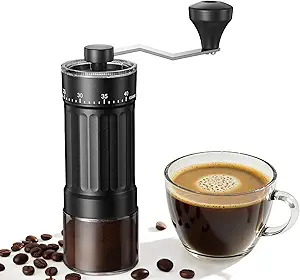 |
| Best Budget The cheapest option that still gets the job done reliably | Rsoilch Manual Coffee Grinder COGR001 |  |
| Top Rated A top-rated pick with lots of positive feedback | TIMEMORE Chestnut C3S Pro |  |
| Most Popular A crowd favorite that many people choose with confidence | JavaPresse Manual Coffee Grinder |  |
| Best Seller A high-volume bestseller chosen again and again | CEVING Manual Coffee Grinder MCG-02 | 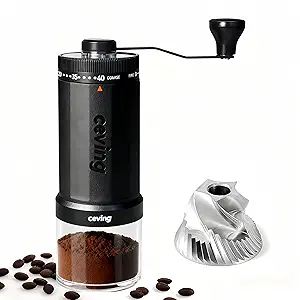 |
1Zpresso J-Ultra Manual Grinder

| Capacity | 35 g |
|---|---|
| Material Type | Aluminum |
| Power Source | manual |
The 1Zpresso J-Ultra is a performance-focused hand grinder built for espresso and other ultra-fine brews. Its 48mm coated conical burr and external adjustment ring with 100 clicks per rotation (approximately 8 microns per click) let you micro-tune grind size to find an espresso sweet spot, while the burr fixed to the shaft improves stability and reduces wobble. The magnetic catch cup holds about 35 to 40 g of grounds and snaps on for faster workflow, and the foldable crank and travel case make it easy to pack for trips or small kitchens. Tool-free disassembly simplifies cleaning and maintenance, and the manufacturer rates long-term durability for heavy use. The main compromises are its small capacity and manual effort required for larger batches, so it is best suited to single- or double-shot routines rather than brewing large automatic pots. For anyone prioritizing grind precision and build quality in an under-$200 grinder, the J-Ultra delivers on control and consistency.
Best for: Buyers who prioritize precise, repeatable espresso grinding and want a well-built manual grinder for single- or double-shot routines and travel.
Less Ideal for: People who need to grind large batches quickly or prefer an electric grinder for higher throughput and less physical effort.
- Very fine external adjustment with 100 clicks per rotation for precise espresso dialing
- 48mm coated conical burr fixed to shaft for stable, efficient grinding
- Magnetic catch cup that holds 35–40 g speeds workflow and prevents spills
- Foldable crank and included travel case improve portability and storage
- Tool-free disassembly and included cleaning tools make maintenance straightforward
- Small ground capacity and manual operation make it less convenient for brewing large volumes
Verdict: Choose the J-Ultra if you want a finely adjustable, travel-friendly manual grinder that delivers espresso-level precision under $200.
CEVING Mini Manual Coffee Grinder MCG-01

| Capacity | 30 g |
|---|---|
| Material Type | Ceramic |
| Power Source | manual winding |
| Adjustable Settings | 40 |
The CEVING Mini Manual Coffee Grinder is a portable hand mill built for small batches and on-the-go brewing. It uses ceramic conical burrs and an external adjustment ring that provides 40 distinct grind settings, so you can dial in particle size for espresso, pour-over, or French press without taking the unit apart. The 30 g bean hopper holds enough beans for one to two cups, and the grinder disassembles into three main parts for easy cleaning and packing. Because it is manually powered, it runs silently and requires no electricity, making it a good companion for travel, camping, or office use. The ceramic burrs reduce heat and help preserve flavor, though manual operation can be slower than an electric grinder and is less suited to grinding multiple servings quickly. The lightweight, compact design makes it easy to store, but users needing larger capacity or faster grinding will prefer a household electric grinder. For buyers who value portability and precise manual control, this grinder delivers consistent, adjustable results in a small package.
Best for: Buyers who prioritize portability, quiet manual control, and precise grind adjustment for single-cup or travel use and who prefer a compact, easy-to-pack grinder.
Less Ideal for: Those who regularly grind larger quantities, need rapid grinding for multiple servings, or want an electric, hands-free solution.
- 40 external grind settings for fine-to-coarse adjustments without disassembly
- Ceramic conical burrs that minimize heat and promote uniform grind
- Compact, lightweight design that is easy to pack for travel or camping
- Detachable construction for straightforward cleaning and maintenance
- 30 g capacity limits batch size to one or two cups
- Manual operation is slower and requires physical effort compared with electric grinders
Verdict: Choose this grinder if you want a lightweight, travel-ready manual mill with fine-grained adjustable settings and ceramic burrs for consistently better single-cup results.
Rsoilch Manual Coffee Grinder COGR001

| Material Type | Ceramic, Stainless Steel |
|---|---|
| Power Source | Manual |
| Included Components | Body |
| Number of Items | 1 |
This compact hand grinder uses a ceramic burr and stainless steel body to deliver freshly ground coffee on demand, whether you brew espresso, French press, or pour-over. Grind size is adjusted with five settings, making it simple to dial in coarseness for different methods, and the built-in burr and hand crank make it fully manual and portable for travel or camping. Its small footprint and removable parts mean it is easy to disassemble and clean, and the metal construction feels durable for everyday use. Because it is hand-powered, grinding larger quantities takes more time and effort than an electric grinder, and the five-step adjustment may be less precise than higher-end stepped or stepless systems. Still, for buyers focused on value and portability, it provides consistent, fresh grounds at a low cost and with minimal maintenance.
Best for: Buyers wanting a reliable, low-cost manual grinder for daily home use or travel who prioritize portability and simple, consistent grind settings.
Less Ideal for: If you need to grind large quantities quickly, want electric convenience, or require very fine, stepless tuning for advanced espresso technique, choose a different grinder.
- Ceramic burr for consistent grind quality and reduced heat transfer
- Stainless steel body feels durable and travel-ready
- Five adjustable grind settings for common brew methods
- Easy to disassemble and clean
- Compact, lightweight design suitable for camping or small kitchens
- Manual operation is slower and requires effort for larger batches
- Adjustment has only five fixed steps so micro-adjustments are limited
Verdict: A durable, budget-friendly manual grinder that delivers fresh, consistent grounds and is ideal for travelers and frugal home brewers.
TIMEMORE Chestnut C3S Pro

| Capacity | 25 g |
|---|---|
| Item Weight | 430 g |
| Power Source | manual |
The TIMEMORE Chestnut C3S Pro is a compact, all-metal manual grinder designed to deliver consistent grinds for a range of brewing methods. Its aluminum alloy body and full-metal top reduce flex and feel more durable than plastic-bodied hand grinders, while the upgraded S2C conical burrs are machined for hardness and even particle sizing. The foldable crank and compact profile make it convenient for travel or tight storage, and the double-bearing central axis plus built-in bearing reduce crank effort so grinding feels smoother and less fatiguing. Stepless adjustment with roughly 36 levels lets you fine-tune coarseness from espresso-adjacent to coarse filter grinds. Practical limits are the small 25 g capacity, which means repeated batches for multiple cups, and the manual operation that still requires physical effort compared with electric grinders. Cleaning is straightforward thanks to the metal body and included brush, but precise calibration takes a few tries for consistent results at very fine settings. For buyers wanting a reliable, durable manual grinder that emphasizes build quality and consistent burr performance, this is a strong choice under $200.
Best for: Buyers who prioritize long-term reliability and precision in a portable manual grinder and want a robust, well-built tool for daily specialty coffee brewing at home or on the road.
Less Ideal for: People who need to grind large quantities quickly, need hands-free electric operation, or prefer a higher-capacity grinder for entertaining.
- All-metal aluminum alloy body increases durability and resists cracking
- S2C stainless steel conical burrs engineered for even particle size and reduced fines
- Double-bearing central axis and built-in bearing reduce hand effort and improve smoothness
- Foldable crank and compact profile make it easy to pack for travel
- Stepless grind adjustment with about 36 levels for precise tuning
- Small 25 g bean capacity requires multiple cycles for larger servings
- Manual grinding still requires physical effort compared with electric grinders
Verdict: Choose the Chestnut C3S Pro when you want a travel-friendly manual grinder with a durable full-metal build and precise, consistent burr performance.
JavaPresse Manual Coffee Grinder

| Grind settings | 18 adjustable settings |
|---|---|
| Material type | Stainless Steel |
| Burr type | Ceramic conical burr |
| Power source | Manual |
The JavaPresse Manual Coffee Grinder uses a ceramic conical burr and an adjustable tension collar to offer 18 grind settings, letting you dial in grind size for espresso, pour-over, drip, or French press. It is hand-crank powered so it produces very little noise and needs no batteries or cords, which makes it convenient for travel, camping, or quiet morning routines. The stainless steel body and ceramic burrs are built for durability and the grinder disassembles for basic cleaning and packing. Practical benefits include consistent, low-heat grinding that preserves coffee aroma and a slim footprint that fits in most travel kits. Expect slower throughput compared with electric grinders and you will need a bit of elbow grease for larger batches, but for single-serve or small-batch brewing it is efficient and reliable. The product has strong user adoption in its category and a straightforward, easy-to-use adjustment mechanism that gives predictable results for everyday brewing needs.
Best for: Buyers who value quiet, portable grinding and want a proven, no-power solution for small-batch brewing backed by broad user adoption and clear, repeatable grind settings.
Less Ideal for: Anyone who routinely grinds large daily volumes or needs fast, hands-free grinding should choose an electric grinder instead.
- Ceramic conical burrs for consistent, low-heat grinds
- 18 adjustable settings for a wide range of brew methods
- Manual hand crank is quiet and requires no power
- Compact, travel-friendly stainless steel design
- Slower to grind than electric models, especially for larger amounts
- Requires manual effort and is best suited to single-serve or small batches
Verdict: Choose this grinder if you want a portable, quiet, and widely used manual burr grinder that reliably delivers adjustable, flavorful small-batch grinds.
CEVING Manual Coffee Grinder MCG-02

| Capacity | 60 g |
|---|---|
| Adjustable settings | 40 |
| Burr type | Stainless steel conical burr |
| Item weight | 0.5 kg |
This CEVING manual grinder aims to make consistent, on-the-go grinding easier by combining a rare 60 g capacity with 40 external click settings and CNC stainless steel conical burrs. You use it like a typical hand mill: load beans in the top, set the dial to the desired grind, then crank the handle to produce grounds in the catch cup. The large capacity means fewer refills for pour-over, French press, or batch cold brew, while the external adjustment ring provides fast, repeatable shifts between fine and coarse without disassembly. The stainless steel burrs are described as durable and produce uniform grinds quickly for a manual unit, and the portable, relatively light design suits travel and camping. Expect some manual effort for larger batches and the usual slower speed compared with electric grinders, but the grinder's build and click-style adjustment make it a reliable option for buyers who value precision and fewer interruptions during morning routines.
Best for: Buyers who want a reliable, precise manual grinder that minimizes refills and delivers consistent grinds for pour-over, French press, and travel without relying on electricity.
Less Ideal for: People who need fast, effortless grinding for daily large-volume brewing or those who prefer fully electric convenience should consider an electric grinder instead.
- Large 60 g bean capacity reduces the need for multiple grind sessions
- 40 external click settings let you switch grind size quickly and repeatably
- CNC stainless steel conical burrs claim durable, uniform grinding
- Portable, lightweight design suitable for travel and camping
- Manual operation requires physical effort and is slower than electric grinders
- May be bulky compared with very small travel hand grinders despite portability
Verdict: Pick this grinder if you want a travel-ready, high-capacity manual mill that delivers precise, repeatable grinds for small-batch brewing without electricity.
Choosing the Right Manual Coffee Grinder: Key Factors to Consider
Grind Consistency
Consistent particle size is the single most important factor for predictable extraction. A grinder that produces a narrow distribution reduces under- and over-extraction, which directly affects sweetness, clarity, and body in the cup.
When evaluating manual grinders, look for well-machined burrs and a stable adjustment mechanism that resists drift. Consistency matters across a range of grind settings if you plan to switch between brew methods frequently.
Build Quality and Materials
Durable materials and precise manufacturing keep burrs aligned and moving parts stable over time. Metal burrs and housings tend to offer better longevity and thermal stability than thin plastic components.
Consider the quality of the crank, axle, and locking mechanisms. Heavy or well-supported components reduce wobble and maintain alignment, which helps preserve consistent grinding performance after months or years of use.
Adjustment Precision
How fine and reliable the grind adjustment is determines how easily you can dial in a recipe. Some manual grinders use stepped clicks, while others offer continuous adjustment; both can work, but the usable resolution matters.
A clearly marked or tactile adjustment system helps repeatability. If you frequently shift from coarse to fine grinds, choose a grinder with predictable stops or micro-adjustment so you can return to a setting without guessing.
Ergonomics and Comfort
Grinding coffee by hand should be comfortable even for multiple daily doses. Crank length, handle grip, and overall resistance determine how tiring a grind session will be.
Ergonomic considerations also include how easy it is to mount the grinder for stability, whether the crank folds for storage, and how the grip shape fits your hand. Lightweight models help travel use, but extremely light designs can sacrifice steadiness.
Capacity and Portability
Think about how much coffee you usually grind in one go. If you prepare for two or more cups, a slightly larger hopper and catch container reduce the need for repeat cycles.
Portability matters if you plan to travel or camp. A compact grinder that disassembles easily is better for packing, while larger-diameter burrs may be preferable for home use where speed and throughput matter.
Ease of Cleaning and Maintenance
Manual grinders need periodic cleaning to remove oils and fines that alter flavor and clog adjustment systems. Simple disassembly, accessible burrs, and few small parts lower the barrier to regular maintenance.
Look for designs with tool-free access to the burrs, washable hoppers or catches, and clear manufacturer guidance on parts that require occasional replacement or lubrication.
How Grind Size Affects Different Brew Methods
Grind size dramatically influences extraction speed and flavor balance. Coarse grinds suit immersion methods like cold brew or French press because they expose less surface area and slow extraction. Medium-fine grinds work well for pour-over and drip where water contact time is moderate. Very fine grinds are needed for espresso-style extractions where pressure extracts quickly from tightly packed grounds.
A manual grinder that covers the range you need avoids needing multiple devices. Pay attention to whether the grinder can produce stable results at extreme settings as well as in the middle of its range.
- Coarse: immersion brews, larger particles, longer contact time
- Medium: pour-over and cone drippers, balanced extraction
- Fine: espresso-like methods, high surface area, short extraction time
Travel and Camp Use
If you plan to carry a grinder outside the kitchen, look for compact designs that disassemble and nest inside their own containers. Weight and footprint are critical for backpacking or airline travel, but so is robustness; a flimsy hopper or axle will fail in transit.
Some grinders include protective cases or foldable handles. Consider how easy it is to clean on the road and whether spare parts are available for long trips.
- Compact dimensions and low weight for packing
- Secure locking mechanisms to prevent accidental disassembly
- Easy-to-clean surfaces and minimal loose parts
Maintenance Routines That Keep Performance Steady
Regular cleaning preserves flavor and mechanical function. A monthly brush-out of burrs and a quarterly deeper clean that removes trapped oils and grounds will extend the useful life of the grinder and keep extraction consistent.
Replace or tighten parts showing wear and follow any lubrication guidance for bearings or bushings. Keeping the adjustment mechanism free of debris prevents drift and ensures repeatability.
- Brush burrs after each use to remove fines
- Deep clean quarterly depending on roast level and use
- Inspect crank and axle for play and tighten as needed
Choosing Between Stepped and Stepless Adjustment
Stepped adjustment provides repeatable clicks for common settings and is helpful if you move between a few fixed recipes. Stepless adjustment allows micro-tuning for exact particle distribution, which benefits skilled brewers seeking a narrow extraction window.
Consider how confident you are in dialing settings. Beginners may appreciate the simplicity of stepped systems, while experienced users often prefer stepless for finer control.
- Stepped: repeatable, user-friendly, fewer surprises
- Stepless: infinitely adjustable, allows micro-tuning
How We Chose the Best Manual Coffee Grinder
We evaluated candidates based on measurable, user-focused criteria that matter for manual coffee grinders. Grind consistency was a primary filter; we favored grinders that offer repeatable particle-size control and tight distributions suitable for multiple brew methods. Build quality and materials were assessed to ensure long-term durability, stable burr alignment, and reliable adjustment mechanisms. We also weighed user ergonomics including crank design, rotational smoothness, and how easy a grinder is to operate for daily use and travel. Hopper and catch capacity were considered for practical batch sizes, and we inspected how simple it is to disassemble and reassemble for cleaning. Noise and portability were secondary considerations for people who plan to grind in quiet spaces or take a grinder on the road. Excluded were devices that rely on cheap stamped steel burrs, grinders lacking adjustable grind steps, and models with fragile or poorly secured cranks. We prioritized options that balance precision and durability while staying within the under $200 constraint.
Our full evaluation process is outlined in our review methodology.
FAQ
Can manual grinders produce a fine enough grind for espresso-style brewing?
Many manual grinders can reach espresso-fine settings, but not all models do so consistently. Look for grinders with high-resolution adjustment and tightly machined burrs if you plan to pursue very fine extractions.
How long does it take to grind enough coffee for two cups by hand?
Grinding time depends on burr diameter, grind setting, and crank ergonomics. A well-designed manual grinder typically takes one to three minutes to produce grounds for two standard cups at medium settings.
Are metal burrs always better than ceramic?
Metal burrs generally offer greater durability and can be machined more precisely, while ceramic burrs resist corrosion and may stay sharper longer in some conditions. Both materials can perform well; prioritize machining quality and burr profile over material alone.
How often should I clean a manual coffee grinder?
Light cleaning, such as brushing out loose grounds, is recommended after each use. A more thorough disassembly and cleaning every one to three months keeps oils and fines from affecting flavor and the adjustment mechanism.
Will a manual grinder save me money compared with an electric grinder?
Manual grinders have lower power requirements and often lower upfront costs, but the primary benefits are control, portability, and quieter operation. Whether they save money depends on how you value those tradeoffs and how frequently you grind large batches.
Final Verdict
Prioritize grind consistency, durable construction, and an adjustment mechanism that matches how you like to brew. If you switch between methods often, favor a grinder with wide, stable range and precise adjustment. For travel or occasional use, compactness and ease of cleaning may be more important than throughput. Weigh the tradeoffs between portability and speed when choosing a manual grinder under $200. Focus on the factors discussed above to pick a model that will deliver consistent results and long-term value for your brewing routine.