
Note: This article contains affiliate links. If you click on these links and make a purchase, we may earn a small commission at no extra cost to you. This helps support our research and content. Read our full affiliate disclosure here.
If you brew coffee by hand, the right manual coffee grinder can make a measurable difference in taste and consistency. Manual grinders give you precise grind-size control and quiet operation, plus portability for travel or small kitchens. This guide covers seven carefully shortlisted models under $300 that balance grind uniformity, build quality, and daily usability. We evaluated each option for real-world home brewing needs including espresso, pour-over, and French press. Read on to see which grinders made the list and why they stand out based on grind consistency, adjustment range, and ease of use.
Top Picks at a Glance
| Best Overall The best all-around choice for most situations | 1Zpresso J-Ultra Manual Coffee Grinder |  |
| Best Quality Built to a higher standard if you want something more solid | Comandante C40 Hand Grinder |  |
| Best Value The sweet spot between price and what you get | ALPACA VENTURES Manual Coffee Grinder | 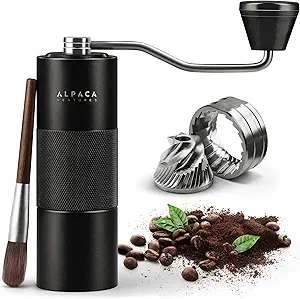 |
| Best Budget The cheapest option that still gets the job done reliably | CEVING Mini Manual Coffee Grinder | 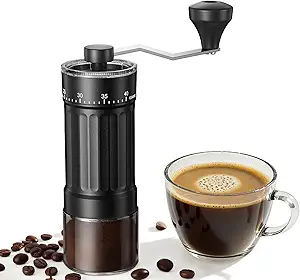 |
| Top Rated A top-rated pick with lots of positive feedback | Timemore C5 ESP PRO |  |
| Most Popular A crowd favorite that many people choose with confidence | JavaPresse Manual Coffee Grinder |  |
| Best Seller A high-volume bestseller chosen again and again | CEVING Manual Coffee Grinder MCG-02 | 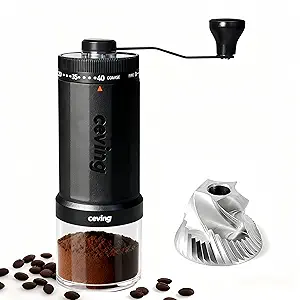 |
1Zpresso J-Ultra Manual Coffee Grinder

| Capacity | 35 g |
|---|---|
| Material Type | Aluminum |
| Power Source | manual |
| Burr Size | 48mm Coated Burr |
| Microns per Click | 8 |
The 1Zpresso J-Ultra is a compact, hand-crank coffee grinder built around a 48mm coated conical burr and an external micrometric adjustment system that clicks every 8 microns for very fine control. It is designed primarily for espresso and other ultra-fine grinds, with an external dial offering 100 clicks per rotation so you can dial in a consistent dose. The magnetic catch cup holds roughly 35 to 40 g of grounds and snaps on for a faster workflow, while the foldable crank and included travel case make it easy to pack for trips or small kitchens. Tool-free disassembly simplifies cleaning and maintenance, and the coated burr is fixed to the shaft for smoother, low-wobble performance over time. The grinder is manual, so it is quiet and requires some elbow grease, and its capacity is best suited to single-serve or small-batch brewing rather than large batches. For buyers who need factory-quality, precise espresso grinds in a portable package, the J-Ultra offers a focused, well-built solution under $300.
Best for: Buyers who want a compact, high-precision grinder focused on espresso-level control and portability while valuing build quality and repeatable results.
Less Ideal for: People who routinely grind large volumes or who prefer electric convenience and speed should consider a powered grinder instead.
- Very fine external adjustment with 8 microns per click for precise espresso dialing
- Large 48mm coated conical burr aimed at smoother, efficient grinding
- Magnetic catch cup speeds workflow and holds a 35–40 g dose
- Foldable handle and travel case make it genuinely portable
- Tool-free disassembly for easy cleaning and maintenance
- Manual operation requires physical effort and is slower for larger quantities
- Capacity is limited to roughly single to small-batch doses
Verdict: Choose the J-Ultra if you want a portable, factory-quality manual grinder that delivers precise, repeatable espresso grinds.
Comandante C40 Hand Grinder

| Capacity | 40 g |
|---|---|
| Material Type | Stainless Steel |
| Recommended Uses For Product | Turkish, Aeropress, Pour Over, Drip, French Press |
The Comandante C40 Hand Grinder is a precision manual grinder aimed at serious home brewers who want consistent particle distribution across brewing methods from Turkish to French press. It uses high-hardness martensitic stainless steel nitro blades with a refined cutting geometry and double-mounted axle for stable, even grinding at roughly one bean per crank turn. The MK4 includes oak handle details, a magnet-secured crank, and two 40 g jars (brown glass and clear polymer-glass) that are easy to fill and clean. In practice the C40 produces noticeably uniform grounds, which helps extraction and flavor clarity, and its ball-bearing axle reduces wobble during use. The trade-offs are typical for premium hand mills: it is a manual tool so grinding larger doses takes time, and its capacity is limited to about 40 g per jar, so it is best for single-serve or small-batch brewing rather than large batches. Build and materials are premium, and maintenance is straightforward but not as fast as an electric grinder for daily high-volume use.
Best for: Serious home brewers who prioritize grind consistency and flavor clarity for single-serve or small-batch methods and are willing to use a manual grinder for better control.
Less Ideal for: Users who routinely need to grind large quantities at once or want a fast electric solution for daily high-volume coffee preparation.
- High-hardness nitro steel burrs for excellent edge retention and uniform grind
- Double-mounted axle with stainless steel ball bearings for stable, low-wobble operation
- Includes two 40 g jars that are easy to fill and clean
- Removable oak handle knob and magnetic crank connection improve ergonomics and transport
- Limited 40 g capacity means multiple loads for larger servings
- Manual operation is slower than electric grinders for high-volume use
Verdict: Buy this if you want a precision, build-quality manual grinder that delivers exceptionally consistent grounds for small-batch specialty coffee.
ALPACA VENTURES Manual Coffee Grinder

| Material Type | Aluminum, Stainless Steel |
|---|---|
| Power Source | Manual |
| Included Components | Brush |
| Number of Items | 3 |
This hand grinder is built for daily use and travel, using stainless steel conical burrs and a long crank to make manual grinding easier and more consistent. You set grind size with the fine adjustment dial, then turn the lengthened handle; the dual bearing design and built-in bearing reduce wobble and effort so you can achieve everything from coarse French press to fine espresso prep. It disassembles quickly for cleaning and includes a small brush for clearing grounds, and the aluminum and stainless construction resists rust during outdoor use. Because it is manual there is no electricity or batteries, which keeps it lightweight and portable but means larger doses take more time and elbow power than an electric grinder. The parts are mostly metal which improves durability but can make it heavier than some plastic travel grinders. For someone who values control, consistency, and reliability without relying on power, this grinder delivers predictable results in a compact package.
Best for: Buyers who want reliable, repeatable grind control and a durable, portable grinder for home use or travel and who prioritize consistency over automatic convenience.
Less Ideal for: People who need fast, hands-free grinding for large daily volumes or who prefer plug‑in electric grinders for convenience should look elsewhere.
- Stainless steel conical burrs for consistent particle size
- Adjustable fine-tuning dial for a wide range of grind settings
- Dual bearing and built-in bearing design reduces wobble and effort
- Easy to disassemble and clean with included brush
- Durable aluminum and stainless construction suitable for travel
- Manual operation requires physical effort and is slower for large batches
- Mostly metal construction can feel heavier than minimalist travel models
Verdict: A durable, travel-ready manual grinder that delivers precise, repeatable grinds for coffee enthusiasts who want control without electricity.
CEVING Mini Manual Coffee Grinder

| Capacity | 30 g |
|---|---|
| Material Type | Ceramic |
| Power Source | manual winding |
This compact hand grinder is built for portable, small-batch coffee: its ceramic conical burrs and 40 external grind settings let you dial in textures from fine to coarse for espresso, pour-over, or French press. The external adjustment ring is easy to use and keeps grounds contained while changing grind size, and the unit breaks down into a few pieces for simple dry cleaning with the included brush. At about a 30 g capacity it handles one to two cups per grind, making it best for travel, camping, or a single-person kitchen rather than heavy daily use. Ceramic burrs run cooler and preserve flavor but are slightly slower than some metal options, and the manual winding means more effort than an electric grinder. For buyers prioritizing a low-cost, portable grinder that still gives consistent results, this is a practical choice under $300.
Best for: Buyers on a tight budget who want a portable, reliable manual grinder for travel, single-cup brewing, or occasional use and who value grind control over automation.
Less Ideal for: Those who routinely grind larger daily quantities, want hands-off electric operation, or need ultra-fast grinding for high-volume households should look elsewhere.
- 40 external grind settings for fine control across brewing methods
- Ceramic conical burrs that preserve flavor and limit heat buildup
- Compact, lightweight design suited for travel and camping
- Detachable construction for easy dry cleaning with included brush
- 30 g capacity only covers one to two cups per grind
- Manual winding requires physical effort and is slower than electric grinders
Verdict: A budget-friendly, travel-ready manual grinder that delivers precise grind control and preserved flavor for single-cup and small-batch brewing.
Timemore C5 ESP PRO

| Capacity | 30 g |
|---|---|
| Material Type | Aluminum |
The Timemore C5 ESP PRO is a robust hand grinder built for repeatable, small-batch brewing. Its 42mm S2C burrs and 10 macro plus 50 micro steps (0.015mm clicks) let you dial grind size precisely from espresso to French press, while the wider 53mm body and diamond-pattern anti-slip grip make grinding steadier and less tiring. The all-metal construction and foldable handle feel durable for daily use or travel, and the 30 g bean capacity is sized for single-serve routines without frequent refills. The sharper burr geometry promises cleaner extraction and more consistent particle size, which translates to clearer flavor in the cup. On the downside, the 30 g capacity limits batch grinding for multiple cups and the metal build makes it heavier than plastic alternatives, which may matter on long trips. Overall, it delivers reliably accurate grinds and solid build quality for home baristas who prioritize consistency and durability in a manual grinder.
Best for: Buyers who want a reliable, repeatable manual grinder for daily single-cup brewing and value durable, factory-quality construction and precise grind control.
Less Ideal for: People who regularly grind larger batches for multiple cups or prefer an ultra-light travel grinder should consider higher-capacity or lighter alternatives.
- 42mm S2C burrs designed for consistent particle size and clearer extraction
- Fine stepped adjustment with 10 macro and 50 micro steps for precise dialing
- All-metal construction and foldable handle for durable, solid feel
- Wider 53mm body and diamond-pattern grip improve stability and reduce fatigue
- 30 g capacity is small for brewing more than one or two cups at a time
- Full-metal build increases weight compared with lighter portable grinders
Verdict: Choose the Timemore C5 ESP PRO if you want a durable, precision-stepped manual grinder that consistently delivers espresso-to-pour-over results for single-cup use.
JavaPresse Manual Coffee Grinder

| Adjustable grind settings | 18 settings |
|---|---|
| Burr type | Ceramic conical burr |
| Power source | Manual |
| Material type | Stainless Steel |
The JavaPresse Manual Coffee Grinder is a hand-crank conical burr grinder built for travel, home, and camping use. You set grind size with an internal adjustable ceramic burr offering 18 settings that cover fine espresso to coarse French press, and the manual crank eliminates most electric noise for discreet grinding. Its stainless steel body and ceramic burrs are marketed as durable and produce a consistent grind that works across drip, pour-over, French press, and espresso prep. The grinder is compact and cordless, so it is easy to pack for trips or keep on a kitchen counter, and the simple assembly makes daily use straightforward. Expect slower grinding compared with electric models and a small capacity suited to single-serve or small-batch brewing, so it is best when you value control and portability over speed. The unit is a practical choice for someone who wants predictable grind adjustments and low noise without relying on power, but it is not the fastest option for large households or high-volume brewing sessions.
Best for: Buyers who prioritize quiet, portable grinding and precise manual control and who rely on social proof and established product reputation when choosing a reliable entry-level burr grinder.
Less Ideal for: If you need fast grinding for several cups at once or want a hands-off electric workflow, this manual grinder will feel too slow and effortful.
- Ceramic conical burr gives consistent grinds and resists wear longer than steel burrs.
- 18-step adjustable grind lets you dial in settings from fine to coarse.
- Manual crank is quiet and requires no power, ideal for travel and camping.
- Compact stainless steel build is durable and easy to pack.
- Small capacity and manual operation make it slow for multiple cups or large batches.
- Requires hand effort and regular maintenance to keep parts clean.
Verdict: A durable, quiet, and highly adjustable manual burr grinder for buyers wanting precise, portable grinding under $300.
CEVING Manual Coffee Grinder MCG-02

| Capacity | 60 g |
|---|---|
| Adjustable settings | 40 |
| Burr material | Stainless steel conical burr |
| Item weight | 0.5 kg |
This CEVING manual grinder is built for people who want consistent, adjustable grinds without relying on electricity. It holds up to 60 g of beans so you can grind enough for multiple cups in one session, and the external click-ring offers 40 distinct settings that let you switch quickly between espresso-fine and coarse French press. The CNC stainless steel conical burrs produce uniform grounds and are rated for faster grinding than cheaper blades, and the portable form factor makes it convenient for travel, camping, or small kitchens. Practical benefits include the large capacity that reduces the need for repeated refills and the user-friendly external adjustment that prevents guesswork. Be aware this is a manual hand crank grinder, so it requires physical effort and is slower than electric models for large volumes, and it does not include battery or motorized options. For buyers focused on reliability and control under $300, it delivers a balanced mix of capacity and precision.
Best for: Buyers who prioritize consistent, factory-quality grind control and want a portable, worry-free manual grinder that reduces refills and simplifies dialing in recipes.
Less Ideal for: People who need to grind large daily volumes quickly or who prefer hands-off electric grinders should consider a motorized model instead.
- Large 60 g bean capacity reduces the need for multiple batches
- 40-step external click-ring for easy, repeatable grind adjustments
- CNC stainless steel conical burrs for uniform, faster grinding
- Portable and lightweight for travel, camping, or small kitchens
- Manual operation requires physical effort and is slower than electric grinders
- No motorized or rechargeable option included
Verdict: Choose this grinder if you want a travel-ready, high-capacity manual mill with precise external grind control for reliable, repeatable brews under $300.
Choosing the Right Manual Coffee Grinder: Key Factors to Consider
Burr Type and Material
The burrs determine cutting geometry and long-term wear. Conical steel burrs are common in this price range and offer good durability and heat resistance. Ceramic burrs can stay sharper longer but are more brittle and may chip if handled roughly.
Choose a burr material and shape that suit your brewing goals. Conical burrs often produce a slightly broader particle distribution but are less prone to clogging with oily beans. Flat burrs tend to yield a narrower distribution but are less common in compact manual designs. For grinders under $300, focus on well-engineered steel burrs with reliable manufacturing tolerances to ensure consistent results over time.
Adjustment Mechanism
How you change grind size affects repeatability. Simple stepped adjustments can be fast but may lack the fine control needed for espresso. Micro-step or threaded dial systems give finer increments and let you return to a previous setting reliably.
Look for an adjustment system with clear indexing or tactile clicks when you change settings. If you plan to brew multiple styles—espresso, pour-over, and French press—prioritize a grinder that lets you make small, measurable changes without overhauling the whole setup.
Grinding Effort and Handle Design
Manual grinding requires physical effort, so handle length, crank shape, and bearing quality matter. A long crank reduces the force per stroke but increases rotations, while a shorter crank needs more force. The handle should fit comfortably in your hand and attach securely to avoid wobble.
Assess how much effort you can comfortably exert each morning. If you typically grind larger doses, a grinder with low internal friction and a smooth-bearing axle will make the process faster and less tiring. Consider whether the grinder allows for clamping or stable placement to keep it steady during use.
Capacity and Dosing
Capacity affects convenience. A small catch cup is fine for single cups or travel, but larger households may prefer a bigger hopper or catch to reduce repeated grinding sessions. Also consider whether the grinder supports single-dose preparation without wasted retention.
Check how the grinder stores ground coffee and whether it traps fines that can affect extraction. For espresso, low retention and predictable dosing are more important. For immersion or batch brewing, a bit more retention is usually acceptable if the overall workflow is faster.
Build Quality and Maintenance
Durability comes from materials, tolerances, and serviceability. Metal housings, stainless shafts, and robust fastening reduce wobble and extend lifespan. Ease of disassembly for cleaning is important because grounds and oils accumulate and can alter flavor over time.
Choose a design that offers access to the burr set without special tools, or with standard screws that can be handled at home. Consider warranty or manufacturer support when available, and prefer finishes and coatings that resist corrosion and staining in a kitchen environment.
Matching Grind Range to Brew Method
Different brewing methods need different particle ranges. Espresso demands very fine and consistent particles, pour-over requires a medium-fine setting with minimal fines, and French press works best with a coarse, even grind. Manual grinders vary in how fine they will go and how consistently they hold that setting.
When selecting a grinder, decide which brew method you use most often. If you switch between methods regularly, prioritize a grinder with a wide adjustment range and good repeatability so you can move between settings without losing calibration.
- Espresso: look for fine grind capability and low retention.
- Pour-over: prioritize uniform medium-fine settings and easy adjustments.
- French press: choose a grinder that produces large, even particles without excessive fines.
Portability and Travel Considerations
Manual grinders often double as travel grinders because they do not require power. Weight, packability, and disassembly for cleaning are key factors if you plan to use the grinder on trips. A compact profile and lightweight materials help keep luggage weight down.
Consider whether the grinder can be secured inside luggage to prevent accidental damage to burrs or adjustment dials. Removable handles and protective cases or sleeves make transport safer. Also think about whether you will be grinding single doses or multiple cups while traveling.
- Removable handle reduces packed length.
- Protective case or sleeve prevents scratches and knocks.
- Low-profile design fits better in backpacks or carry-ons.
Cleaning and Long-Term Care
Regular cleaning keeps oils and fines from building up and changing flavor over time. Ideally, the grinder allows access to the burrs for brushing and occasional deeper cleaning. Avoid grinders that trap large amounts of grounds in nooks that are hard to reach.
Some designs let you remove the burr carrier quickly for cleaning, while others require partial disassembly. Use a soft brush to remove grounds after each use and perform a more thorough cleaning periodically to maintain consistent performance.
- Brush out the catch and burr chamber after each use.
- Disassemble periodically to check for wear or buildup.
- Avoid water on metal burrs; use dry methods unless the manufacturer specifies otherwise.
Tuning Ergonomics for Daily Use
Small details like the crank shape, handle padding, and grip surface affect how pleasant the grinder is to use every morning. A comfortable crank reduces fatigue and helps you maintain steady speed, which can influence grind consistency across a dose.
If you have limited counter space, consider grinders that clamp to the edge or have a stable base. Ergonomic improvements pay off most when you grind frequently or for multiple cups.
- Look for smooth-bearing axles and stable handle attachment.
- Consider anti-slip base or clamp options for stability.
- Test how the handle feels in your hand for extended use.
How Adjustment Markings Affect Repeatability
Clear, repeatable markings let you return to a known setting quickly. Some grinders use numbered steps, while others employ unnumbered micro-adjustment dials. The best systems combine fine control with positive feedback when you change settings.
If you often tweak grind size to hone extraction, pick a grinder with a reliable indexing system. Keep a note of your favorite settings for different brew methods so you can reproduce them consistently.
- Numbered indexing saves time when switching methods.
- Micro-adjustment dials are better for precise dialing in.
- Consistency matters more than absolute markings; a repeatable system is key.
How We Chose the Best Manual Coffee Grinder
We focused on features that matter most to home baristas looking for a manual coffee grinder under $300. Primary evaluation criteria included grind consistency across settings, the adjustment mechanism and its precision, build materials and durability, and the effort required per dose. We also considered capacity and portability for users who want a grinder that works at home and on the go, plus ease of cleaning to minimize daily maintenance. Products were excluded if they lacked a reliable burr set, used predominantly plastic parts in high-wear areas, or did not offer a clear, repeatable adjustment range suitable for multiple brew methods. We prioritized burr geometry and material, the presence of a stable adjustment system with indexed settings or micrometric control, and ergonomics that reduce hand fatigue during typical doses. Final selections represent grinders that deliver consistent particle distribution, straightforward adjustments, and long-term durability for regular home use.
Our full evaluation process is outlined in our review methodology.
FAQ
Are manual coffee grinders good enough for espresso?
Often yes, but it depends on the grinder. Some manual grinders reach fine settings suitable for espresso and offer very consistent burr alignment. Successful espresso with a manual grinder usually requires patience and a grinder with precise adjustment and low retention.
How often should I clean a manual grinder?
Usually you should brush out grounds after each use and perform a deeper clean every few weeks, depending on usage and bean oiliness. Regular maintenance prevents flavor carryover and preserves burr performance.
Do manual grinders wear out faster than electric ones?
Not necessarily. Wear depends on burr material and build quality rather than power source. Well-made manual grinders with steel burrs and solid shafts can last many years with proper care.
Can a manual grinder handle oily or dark-roast beans?
Often, but oily beans can increase clogging and retention. Choose a design with good clearance and easy access to the burr chamber if you frequently use darker, oilier roasts.
Is grind retention a big problem with manual grinders?
It depends on the design. Some manual grinders have low retention and are optimized for single-dose use, while others trap more grounds in the chamber. Low-retention designs are preferable for espresso and precise dosing.
Final Verdict
Choosing the right manual coffee grinder under $300 comes down to prioritizing what matters most to your routine. If you value repeatable settings and fine control for espresso, focus on grinders with precise adjustment mechanisms and low retention. For travel or occasional batch brewing, prioritize portability, capacity, and ease of cleaning. Balance the tradeoffs between burr material, ergonomics, and grind range to match your preferred brew methods. With the right selection, a manual grinder can deliver excellent consistency and durability for daily home brewing, giving you control over extraction without relying on electricity.