
Note: This article contains affiliate links. If you click on these links and make a purchase, we may earn a small commission at no extra cost to you. This helps support our research and content. Read our full affiliate disclosure here.
If you brew coffee by hand or travel with a small setup, a dependable manual coffee grinder can make a big difference in flavor and consistency. Choosing the right grinder under $50 matters because inexpensive grinders vary widely in grind uniformity, durability, and how easy they are to dial in for different brew methods. This guide lists seven shortlisted manual coffee grinders that represent the best options in the budget segment and explains the tradeoffs to expect. We evaluate each pick on grind consistency, construction, and user experience to help you find a grinder that fits your brewing style and daily routine.
Top Picks at a Glance
| Best Overall The best all-around choice for most situations | KINGrinder P0 Manual Coffee Grinder |  |
| Best Quality Built to a higher standard if you want something more solid | Rsoilch Manual Coffee Grinder HS-023 |  |
| Best Value The sweet spot between price and what you get | Hario Mini Mill Slim MSS-1B |  |
| Best Budget The cheapest option that still gets the job done reliably | Rsoilch Manual Coffee Grinder COGR001 |  |
| Top Rated A top-rated pick with lots of positive feedback | YQE Mini Manual Coffee Grinder |  |
| Most Popular A crowd favorite that many people choose with confidence | JavaPresse Manual Coffee Grinder |  |
| Best Seller A high-volume bestseller chosen again and again | CEVING Manual Coffee Grinder MCG-02 | 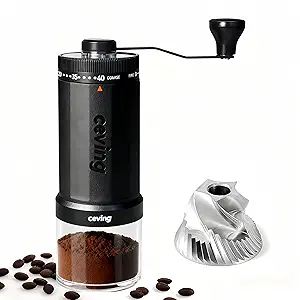 |
KINGrinder P0 Manual Coffee Grinder

| Burr design | 38mm 5-Burrs |
|---|---|
| Clicks per round | 30 |
| Hopper volume | 20 g |
| Material Type | Acrylonitrile Butadiene Styrene, Stainless Steel |
| Power Source | Manual |
The KINGrinder P0 is a compact hand grinder aimed at everyday drinkers who want a consistent grind without a heavy or complex device. It uses a 38mm 5-burr conical stainless steel set and an interior adjustment system with 30 clicks per rotation, letting you dial in settings for pour-over, Moka pot, AeroPress and French press ranges listed by click counts. The ABS body keeps weight down to about 330 g and the 20 g hopper is sized for single-cup or travel use. It disassembles without tools for basic cleaning and comes with a brush and integrated handle, though the manufacturer warns against washing with water and burrs are not user-replaceable. Expect good uniformity for drip and pour-over at the price, but limited capacity and less durability than heavier metal-bodied grinders if you grind frequently or for larger batches.
Best for: Buyers who want an affordable, easy-to-use grinder that delivers consistent results for pour-over and other common brews and value portability and simple maintenance.
Less Ideal for: People who need to grind large daily volumes, require replaceable burrs for long-term service, or prefer a heavy-duty metal body for maximum durability.
- 38mm stainless steel conical burrs for reasonably uniform grind
- 30-click adjustment gives measurable, repeatable grind steps
- Very lightweight ABS body makes it easy to carry for travel
- Tool-free disassembly and included brush simplify routine cleaning
- Small 20 g hopper requires frequent refills for multiple cups
- Burrs cannot be replaced individually which limits long-term serviceability
Verdict: A lightweight, travel-friendly manual grinder that gives reliable, adjustable grind control for pour-over and single-cup brewing under $50.
Rsoilch Manual Coffee Grinder HS-023

| Capacity | 20 g |
|---|---|
| Material Type | Aluminum, Stainless Steel |
| Included Components | Stainless Steel Burr |
| Model Number | HS-023-Silver |
This handheld manual grinder uses a stainless steel conical burr to produce consistent grinds across espresso to coarse pour‑over settings, and the adjustable mechanism makes it straightforward to dial in grind size. Its all‑metal, plastic‑free construction and quiet hand crank make it durable and pleasant to use at home or on the road, and the ergonomic handle helps maintain control during longer sessions. The unit is optimized for single‑serve brewing with a stated capacity around 20–32 g, so it is best when you prepare one cup at a time rather than batching for multiple drinks. It disassembles easily for cleaning and the compact footprint is travel and camping friendly. Buyers seeking the absolute fastest grind speed or bulk grinding will find a manual crank slower than electric options, but for precision, portability, and a near‑silent operation this grinder delivers solid, repeatable results for under $50.
Best for: Buyers who prioritize precise, consistent grinds and portability for single‑cup brewing or travel and value a durable, all‑metal manual grinder under $50.
Less Ideal for: People who need to grind large quantities quickly or who prefer the convenience and speed of an electric grinder for daily multi‑cup brewing.
- Stainless steel conical burr for consistent particle size
- Adjustable grind settings suitable from espresso to French press
- All‑metal, plastic‑free construction improves durability and feel
- Compact and light enough for travel and single‑serve brewing
- Quiet, smooth hand crank and ergonomic handle for controlled grinding
- Small capacity designed for single cups rather than batch grinding
- Manual operation is slower than electric grinders for larger volumes
Verdict: A durable, travel‑ready manual grinder that delivers consistent, adjustable grinds for single‑serve brewing at a budget price.
Hario Mini Mill Slim MSS-1B

| Capacity | 2 cups |
|---|---|
| Material Type | Ceramic |
| Power Source | Manual |
The Hario Mini Mill Slim is a hand-powered coffee grinder built around a ceramic burr and a slim, store-friendly body. You grind by turning the stainless steel handle over the ceramic mill, and the grind size is adjusted with an external knob so you can go from finer to coarser grounds for drip, pour-over, or immersion brewing. Its clear collection jar lets you see how much you have ground and the compact profile makes it easy to stash in a drawer or pack for trips. Ceramic burrs resist rust and produce consistent particle size for a clean cup, and the unit breaks down for straightforward cleaning. The main compromises are capacity and speed: the grinder holds roughly two cups worth of coffee and manual operation is slower than electric models, so it is best for one to two cups at a time rather than large batches. Build materials mix plastics with metal and ceramic, so it feels lighter than heavier all-metal grinders but remains serviceable for daily use.
Best for: Buyers who want a compact, reliable manual grinder for daily single-serve brewing and value consistent ceramic burr performance over speed.
Less Ideal for: If you routinely make coffee for several people at once or need fast, hands-off grinding, choose a larger or electric grinder instead.
- Ceramic burr resists rust and gives consistent grind size
- Slim footprint stores easily and is travel friendly
- Transparent collection jar lets you monitor grind amount
- Easy to disassemble and clean
- Small capacity and manual operation make large batches slow
- Mostly plastic body feels less durable than all-metal alternatives
Verdict: A space-saving, ceramic-burr manual grinder that delivers consistent small-batch results for daily single-cup brewing.
Rsoilch Manual Coffee Grinder COGR001

| Material Type | Ceramic, Stainless Steel |
|---|---|
| Power Source | Manual |
| Included Components | Body |
| Number of Items | 1 |
This handheld grinder is built around a ceramic burr set inside a stainless steel body and is meant for people who want freshly ground beans without electricity. You adjust grind size through five settings to suit French press, drip, or finer espresso-style grinds and turn the removable hand crank to grind single servings. Its compact footprint and durable metal construction make it convenient for travel or small kitchens, and the ceramic burr helps keep grounds consistent while resisting corrosion. The grinder is simple to disassemble for cleaning and stores together with the handle when not in use. Expect manual effort and modest capacity — it is best for one to two cups at a time, and very fine espresso requires extra cranking compared with larger, motorized grinders. The design favors portability and value rather than high-volume or pro-level tamp-ready output, but it does deliver better control and fresher flavor than preground coffee at a budget-friendly price.
Best for: Buyers wanting a low-cost, portable grinder to get fresher coffee one cup at a time and who prioritize simplicity and durability over speed.
Less Ideal for: People who need to grind large quantities quickly, want fully hands-off electric operation, or require pro-level espresso precision for frequent use.
- Ceramic burr for consistent grind and corrosion resistance
- Five adjustable grind settings for multiple brew methods
- Stainless steel body that feels durable and travel-ready
- Easy to disassemble and clean
- Small capacity suited to single-serve use rather than brewing for groups
- Manual operation requires physical effort and is slower than electric grinders
Verdict: A rugged, budget-friendly manual grinder that delivers fresher, adjustable grinds for solo brews and travel under $50.
YQE Mini Manual Coffee Grinder

| Capacity | 30 g |
|---|---|
| Material Type | Acrylonitrile Butadiene Styrene, Ceramic, Stainless Steel |
| Power Source | Manual |
The YQE Mini Manual Coffee Grinder is a portable hand mill aimed at making consistent single-serve coffee on the go. It uses ceramic conical burrs and a clearly marked external adjustment ring with 40 settings so you can dial in grind sizes from espresso-fine to coarse for French press without taking the grinder apart. The stainless steel body and long ergonomic handle give a solid, durable feel and help reduce wrist fatigue during longer grinds, while the transparent grounds container shows how much you have ground. With a 30 g capacity it is best for one to two cup servings, and the included brush makes basic upkeep straightforward. Because it is manual there is no heat or electricity involved, preserving bean aroma, but strong hands or extra crank time are needed for larger doses. If you want a compact, travel-ready grinder that prioritizes consistent grinds and simple maintenance, this model delivers good value under $50.
Best for: Buyers who want a reliable, travel-ready grinder that consistently produces good grinds for single-serve brewing and value a durable, low-maintenance tool.
Less Ideal for: People who regularly grind large quantities, prioritize speed, or prefer hands-free electric grinders.
- Ceramic conical burrs provide uniform grind and low heat buildup
- 40 external grind settings let you adjust grind size without disassembly
- Compact, portable design suitable for travel and small kitchens
- Stainless steel construction and ergonomic handle improve durability and comfort
- 30 g capacity limits it to one to two cups per grind, requiring multiple batches for larger servings
- Manual operation requires physical effort and takes longer than electric grinders
Verdict: A compact, well-built manual grinder that reliably delivers consistent grinds for travel and single-serve coffee under $50.
JavaPresse Manual Coffee Grinder

| Adjustable settings | 18 settings |
|---|---|
| Material Type | Stainless Steel |
| Power Source | Manual |
The JavaPresse Manual Coffee Grinder is a portable hand-crank burr grinder built for travel, camping, and everyday home use when you want fresh grounds without an electric motor. It uses a ceramic conical burr and an 18-setting adjustable mechanism to deliver a range of grinds from fine to coarse suitable for espresso, pour-over, drip, and French press. The manual drive drastically reduces noise and requires no power, making it convenient for mornings, small kitchens, or outdoor brewing. The stainless steel body feels solid and the ceramic burr is marketed as durable and resistant to heat, which helps preserve bean flavor. Because it is hand-powered, grinding larger quantities takes time and effort, and it lacks the speed and convenience of motorized grinders. The grind catch is small so it is best for single-serve or small-batch brewing rather than bulk grinding. For buyers prioritizing portability, quiet operation, and grind control under a modest budget, this grinder balances performance and durability in a simple package.
Best for: Buyers who want a quiet, portable grinder that delivers repeatable grind sizes for single-serve or small-batch brewing and value social proof from a well-reviewed, proven model.
Less Ideal for: People who regularly grind coffee for large households or who need fast, hands-free grinding should choose an electric grinder instead.
- 18-step adjustable ceramic conical burr for consistent, controllable grind sizes
- Manual hand crank eliminates electric noise and does not require power
- Compact, stainless steel body designed for portability and travel
- Durable ceramic burr claimed to outlast comparable steel burrs
- Small capacity is not suitable for grinding large batches quickly
- Manual operation requires physical effort and more time than electric grinders
Verdict: A dependable, compact manual burr grinder that delivers precise grind control and quiet, portable performance for single-serve and travel use.
CEVING Manual Coffee Grinder MCG-02

| Capacity | 60 g |
|---|---|
| Adjustable settings | 40 |
| Burr type | Stainless steel conical burrs |
| Item weight | 0.5 kg |
The CEVING MCG-02 is a hand-operated bean mill designed for people who want consistent, adjustable grinds while traveling or brewing at home. It holds up to 60 g of beans so you can grind a full batch in one session for pour-over, French press, or cold brew, and the external click-ring offers 40 indexed settings to move quickly between fine and coarse grinds without opening the unit. CNC stainless steel conical burrs are built for uniform particle size and faster grinding than cheaper blade-style mills, and the portable design keeps it easy to pack for camping or commuting. Expect a bit of arm work for larger batches and a learning curve dialing in the exact setting for your recipe, but the clear external adjustment and larger capacity reduce repeated batches and mess. For buyers focused on reliable, repeatable grind quality under $50, this grinder delivers a durable-feeling, travel-friendly package with practical benefits for everyday brewing.
Best for: Buyers who want a reliable, factory-quality manual grinder that produces consistent, repeatable grinds for multiple brew methods and who prefer a larger single-batch capacity for travel or household use.
Less Ideal for: People who need hands-free or electric grinding for very large daily volumes or those unwilling to hand-crank for each batch should consider an electric grinder instead.
- Generous 60 g bean capacity lets you grind a full batch at once
- 40 external, indexed grind settings for quick and repeatable adjustments
- CNC stainless steel conical burrs provide more uniform grinds than blade grinders
- Portable and relatively lightweight for travel, camping, or office use
- Manual operation requires effort for larger quantities
- No built-in motor so grinding speed depends on user cadence
Verdict: If you want a durable, travel-ready manual grinder that delivers consistent, adjustable grinds and a larger single-batch capacity under $50, the CEVING MCG-02 is a strong choice.
Choosing the Right Manual Coffee Grinder: Key Factors to Consider
Grind Consistency and Burr Quality
Uniform particle size affects extraction, crema, and overall cup balance. Burr geometry and material determine how evenly beans are crushed; ceramic and hardened steel burrs each have pros and cons. At this price point, expect tradeoffs between absolute fineness and uniformity, but prioritize a design that minimizes fines and large shards.
Good burrs preserve flavor and make recipes repeatable, so look for visible, well-machined burrs and a stable burr mount. Even small improvements in consistency translate to noticeably better espresso, pour-over, and French press results.
Adjustment Range and Repeatability
A usable grinder needs to reach the grind sizes for your preferred brew methods and return to the same setting reliably. Coarse settings for French press, medium for drip or Aeropress, and fine for espresso require a robust adjustment mechanism.
Markers, detents, or clearly numbered steps help you reproduce a setting day to day. Avoid grinders with vague friction-fit adjustments that slip under torque, since small changes in particle size will change extraction and taste.
Ergonomics and Effort
Manual grinding is physical work, so handle shape, leverage, and rotation resistance matter for comfort. A long handle or efficient crank reduces effort per grind, and a secure grip prevents slipping during longer sessions. Consider how many grams you typically grind at once and whether a given model's capacity and crank feel suit your routine.
For travel, lighter weight and a collapsible or compact handle make packing easier, but balance those gains against increased effort and possible sacrifices in durability.
Build Materials and Longevity
Materials influence how long a grinder will perform well. Metal housings and steel burrs resist wear; ceramic burrs can hold an edge but may chip if dropped. Check for corrosion-resistant finishes and tight tolerances in the body and shaft connection to avoid wobble that degrades grind quality.
For frequent users, pay attention to the quality of the handle interface and the fasteners. Parts that loosen or wear quickly are common failure points in budget grinders, so prefer sturdy joins and replaceable components when possible.
Cleaning, Maintenance, and Spare Parts
Coffee oils and fines build up inside grinders and affect flavor over time. A model that disassembles easily for brushing or wiping makes upkeep straightforward. Look for simple burr removal, minimal small trapped chambers, and components that can be rinsed if appropriate.
Availability of replacement burrs or accessible customer support can extend a grinder's life. Consider how often you will clean it and whether the design makes that chore quick and thorough.
Portability and Storage
If you plan to take a grinder on trips, weight, size, and protective cases matter. Compact grinders are easier to pack and can double as a travel accessory, but smaller units may require more strokes to grind the same amount and can be noisier in hand.
Assess whether you need an integrated grounds container for travel or a system that nests the crank for storage. A travel-friendly grinder should balance size with reasonable ergonomics and durability.
How Grind Size Changes Brewing
Grind size controls extraction rate. Finer grinds expose more surface area and speed up extraction, which suits espresso and some Aeropress recipes. Coarser grinds slow extraction and are better for immersion methods like French press. Knowing how grind size affects brew time lets you adjust to achieve balanced flavor.
With manual grinders under $50, achievable grind ranges vary. Expect competent performance across most drip and immersion methods, while ultra-fine settings for true espresso may be limited. Still, many budget hand grinders let you tune pour-over recipes and produce consistent cups.
- Finer grind increases extraction and can highlight acidity and sweetness when dialed in.
- Coarser grind reduces over-extraction and emphasizes body and lower-end flavors.
- Small adjustments often have noticeable effects, so incremental markings are helpful.
Daily Use Tips to Get the Best Results
Establish a routine: measure beans by weight, set a starting grind size, and time your brews. Consistency in dose and grind setting yields the most reliable improvements. Take brief notes when you change grind size to understand how it alters flavor.
Warm up the grinder or preheat metal components if you grind for espresso to reduce temperature-driven variability. Also, grind just before brewing to preserve volatile aromas and flavors.
- Weigh beans for each brew to reduce variability.
- Adjust grind in small increments and taste to evaluate changes.
- Clean the grinder regularly to avoid stale oil buildup.
Maintenance and Simple Repairs
Routine cleaning keeps flavor pure and operation smooth. Disassemble the grinder according to the included steps and brush out trapped grounds after every few uses. For deeper cleaning, remove the burrs and wipe or rinse nonmetal parts if the design allows, then dry completely.
Minor repairs like retightening the handle, re-seating the burr, or replacing a worn spring are common and often straightforward. Keep basic tools and a soft brush on hand, and consult the manual for torque or assembly notes.
- Brush out grounds after each use to prevent clogging.
- Inspect burr alignment periodically to maintain consistency.
- Replace worn parts when performance declines rather than forcing adjustments.
Travel and Packing Advice
Pack grinders with protective sleeves or wrap to prevent knocks that can misalign burrs. Empty the grounds container before stowing to avoid mess and stale residues. If the crank is removable, detach and pack it separately to reduce pressure on the shaft during transit.
Consider weight versus convenience: lighter units save luggage space but may require more effort to grind. For multi-day trips, choose a grinder with a good balance between compact size and comfortable crank leverage.
- Stow the handle to avoid bending or stripping the shaft.
- Carry a small brush for on-the-road cleaning.
- Secure lids and containers to prevent spills in luggage.
Common Misconceptions About Budget Grinders
Many assume budget manual grinders cannot deliver good espresso. While true high-pressure espresso requires specialized equipment, a well-made affordable hand grinder can still produce a finer grind suitable for strong immersion and some pressurized portafilter style methods. Expect limitations, but do not dismiss budget grinders for concentrated brews.
Another misconception is that heavier equals better. Weight can help stability, but thoughtful design and properly aligned burrs often matter more than raw mass for consistent performance.
- Good grind quality depends on burr design and assembly, not just price.
- Ergonomics and adjustment repeatability often matter more than extra features.
How We Chose the Best Manual Coffee Grinder
We focused on criteria that matter for manual coffee grinders under $50 and used those to narrow a wide market to practical, durable picks. First, grind consistency and range: a solid burr geometry and the ability to dial from fine to coarse were required because extraction depends on predictable particle size. Second, build materials and durability: grinders needed robust burrs and housings that tolerate repeated use without loosening or breaking. Third, ergonomics and portability: we prioritized compact designs with comfortable handles and stable bases that make hand grinding easy during daily use and travel. Fourth, ease of adjustment and repeatability: clear adjustment mechanisms and reliable detents or markings scored highly because they reduce guesswork between sessions. Finally, maintenance and cleaning: grinders that disassemble easily for cleaning and have replaceable parts were preferred. We excluded blade grinders and models that relied on low-quality plastic burrs. Budget electric grinders and large cafe equipment were outside this scope. Overall, selections favor grinders that deliver the best practical performance for home brewers and travelers shopping in the under $50 price range.
Our full evaluation process is outlined in our review methodology.
FAQ
Can a manual grinder under $50 produce a fine enough grind for espresso?
Often it depends. Many budget hand grinders reach a relatively fine setting useful for strong immersion or pressurized portafilter methods, but achieving true, consistent espresso-level fineness and uniformity can be challenging. Results vary by burr quality and adjustment precision.
How often should I clean a manual coffee grinder?
Usually clean the grinder by brushing out grounds every few uses and perform a deeper cleaning with burr removal every 2 to 4 weeks depending on use. Frequent cleaning prevents stale oils from affecting flavor and helps maintain consistent grinding.
Are ceramic burrs better than steel at this price point?
Ceramic burrs hold an edge and resist corrosion, but they can chip if dropped. Hardened steel burrs are more impact resistant and often deliver steadier performance under heavy use. The choice depends on how you handle and transport the grinder.
Will grinding manually change the taste compared with electric grinding?
Grinding method alone does not determine taste. Particle distribution and freshness matter most. Manual grinders can produce equally fresh and well-distributed grounds as many electric grinders if the burrs and adjustment are good.
How much coffee can I grind at once with a typical budget manual grinder?
Capacity varies, but many compact manual grinders hold between 20 and 40 grams of beans in a single chamber. Larger-capacity models exist but may increase size and effort required. Choose capacity based on your typical brew batch size.
Final Verdict
When shopping for a manual coffee grinder under $50, prioritize grind consistency, durable burrs, and an adjustment system that you can reproduce easily. Expect tradeoffs between compact portability and grinding effort, and choose a design that matches how you brew most often. Regular cleaning and simple maintenance will keep any budget grinder performing well for months or years. Focus on the metrics discussed here to pick a grinder that delivers the best balance of performance and convenience for your routine.