
Note: This article contains affiliate links. If you click on these links and make a purchase, we may earn a small commission at no extra cost to you. This helps support our research and content. Read our full affiliate disclosure here.
A sharp kitchen knife makes prep faster, safer, and more enjoyable. Choosing the right manual knife sharpener for kitchen knives matters because different sharpening tools affect edge angle, metal removal rate, and how often you need to touch up blades in regular home use. This guide gathers seven top manual knife sharpeners chosen for durability, consistent edge geometry, and straightforward operation. Below you'll find practical details about usability, sharpening results, and long-term maintenance so you can pick the right sharpener for your routine. The shortlist focuses on tools that work reliably on common kitchen steel and that are easy to use for cooks of varying skill levels.
Top Picks at a Glance
| Best Overall The best all-around choice for most situations | Sharp Pebble 1000/6000 Whetstone |  |
| Best Quality Built to a higher standard if you want something more solid | Chef'sChoice ProntoPro 4643 |  |
| Best Value The sweet spot between price and what you get | KitchenIQ Diamond Deluxe 2-Stage |  |
| Best Budget The cheapest option that still gets the job done reliably | Amazon Basics 4-in-1 Knife Sharpener |  |
| Top Rated A top-rated pick with lots of positive feedback | AccuSharp Knife Sharpener ACCU-001C |  |
| Most Popular A crowd favorite that many people choose with confidence | KitchenIQ Edge Grip 2-Stage Sharpener |  |
| Best Seller A high-volume bestseller chosen again and again | KITCHELLENCE 3-Stage Knife Sharpener |  |
Sharp Pebble 1000/6000 Whetstone

| Grit | 1000/6000 |
|---|---|
| Material Type | Corundum |
| No Oil Required | Yes |
The Sharp Pebble 1000/6000 whetstone is a user-friendly waterstone kit that brings professional sharpening capability into a home kitchen. It pairs a 1000-grit side for repairing and re-profiling edges with a 6000-grit side for polishing to a razor finish, and the included angle guide plus non-slip bamboo base makes it much easier for beginners to hold consistent angles. Because it is a waterstone made from corundum, no oil is required and the stone cuts efficiently while producing a fine, mirror-like edge that rivals service shop results. The kit also includes an instruction manual and online tips to shorten the learning curve. Practical limitations are typical of whetstones: you need a little practice to get speed and an even edge, and occasional flattening may be required over long-term use. The stone is compact and durable compared with cheap alternatives, but if you prefer instantaneous, automated sharpening you will miss the convenience of an electric sharpener.
Best for: Home cooks who want professional-quality edges and are willing to learn a manual sharpening technique to keep knives razor sharp over time.
Less Ideal for: People who want instant, maintenance-free sharpening or who prefer a purely mechanical, push-button solution should consider powered alternatives.
- Dual 1000/6000 grit covers edge repair and polishing without extra stones
- Included angle guide and bamboo base make consistent sharpening easier for beginners
- Waterstone construction cuts efficiently and does not require oil
- Compact, durable corundum composition resists chipping and stays flatter than cheaper stones
- Requires some practice and occasional flattening to maintain an even surface
- Slower than electric sharpeners and needs manual stropping time for some users
Verdict: This two-sided waterstone kit delivers pro-level edge repair and polishing in a compact, beginner-friendly package for cooks who want long-lasting razor edges.
Chef'sChoice ProntoPro 4643

| Angle options | 15° or 20° |
|---|---|
| Sharpening element | 100% diamond abrasives |
| Stages | 3-stage (sharpen, hone, polish) |
| Knife types | Straight-edge and serrated |
The Chef'sChoice ProntoPro 4643 is a compact, three-stage manual sharpener built around 100% diamond abrasive wheels and precise angle guides to deliver very sharp, durable edges. You pick a 15° or 20° setting for Asian-style or Western-style blades, draw the blade through the coarse and fine diamond stages, then finish in the polishing stage for a micro-serrated, highly biting edge. Its CrissCross sharpening method sharpens both sides simultaneously to reduce burrs and speed the process, and the soft-touch handle and compact footprint make it easy to use and store. It handles straight-edge, serrated, pocket and sports knives and is engineered and assembled in the U.S.A. The unit is strictly manual so sharpening speed depends on user technique, and it does not replace a full professional honing system for extremely damaged blades, but for routine maintenance and restoring keen performance it produces reliable, long-lasting results without electricity.
Best for: Buyers who prioritize sharpness and edge performance and want a compact manual tool to quickly restore a razor-like cutting edge on a variety of knives.
Less Ideal for: Users who need an electric, fully automated sharpener or those seeking a tool for heavy re-profiling of badly damaged blades.
- 100% diamond abrasive wheels for fast, effective material removal and long-lasting grit
- Selectable 15° and 20° angle guides for accurate, repeatable edges
- Three-stage system includes a polishing/honing stage for a refined, micro-serrated finished edge
- Compact, soft-touch design that is easy to grip and store
- Works on straight-edge, serrated, pocket and sports knives
- Manual operation requires proper technique and multiple passes for very dull or damaged blades
- Not intended as a replacement for professional re-profiling on severely chipped edges
Verdict: If you want a compact manual sharpener that produces professional-grade, long-lasting edges with precise 15° or 20° angle control, the ProntoPro 4643 delivers.
KitchenIQ Diamond Deluxe 2-Stage

| Material Type | Plastic |
|---|---|
| Grit Type | Coarse,Fine |
| Included Components | Sharpener |
| Model Number | 50825 |
The KitchenIQ Diamond Deluxe Edge Grip 2-Stage is a small, user-friendly manual sharpener for everyday kitchen knives. It offers a coarse diamond-coated stage to reset very dull or nicked edges and a fine ceramic stage to hone and polish the edge for slicing performance. The patented V-shaped edge grip lets you hook the tool on a countertop for added stability and the non-slip rubber feet and soft-grip handle make single-handed sharpening easier and safer. Because the sharpening angles are preset, you do not need technique knowledge to get a usable edge, which makes this convenient for quick touch-ups or restoring a neglected blade. The compact plastic body stores easily in a drawer but is not a substitute for professional stones when you need precise angle control or to reprofile an expensive blade. It also works on many serrated and straight blades, though repeated heavy use on very hard steels may require more aggressive sharpening methods.
Best for: Home cooks who want a fast, foolproof way to keep everyday kitchen knives sharp without learning whetstone technique and who prioritize convenience and compact storage.
Less Ideal for: Professional chefs or knife enthusiasts who need precise angle control, frequent heavy-duty reprofiling, or the best possible edge retention on high-end steels.
- Two-stage system (diamond coarse, ceramic fine) handles both edge setting and honing
- Patented V-shaped edge grip allows countertop use for added stability
- Non-slip rubber feet and soft-grip handle improve safety and control
- Compact, lightweight design stores easily in a drawer
- Preset angles limit precise control or re-profiling of specialty blades
- Plastic body and simple abrasives are less effective on very hard steels
Verdict: A compact, easy-to-use two-stage sharpener that quickly restores and hones everyday kitchen knives for cooks who value convenience over precision control.
Amazon Basics 4-in-1 Knife Sharpener
| Material Type | Metal, Plastic |
|---|---|
| Grit Type | Coarse, Medium, Fine |
| Included Components | Knife Sharpener |
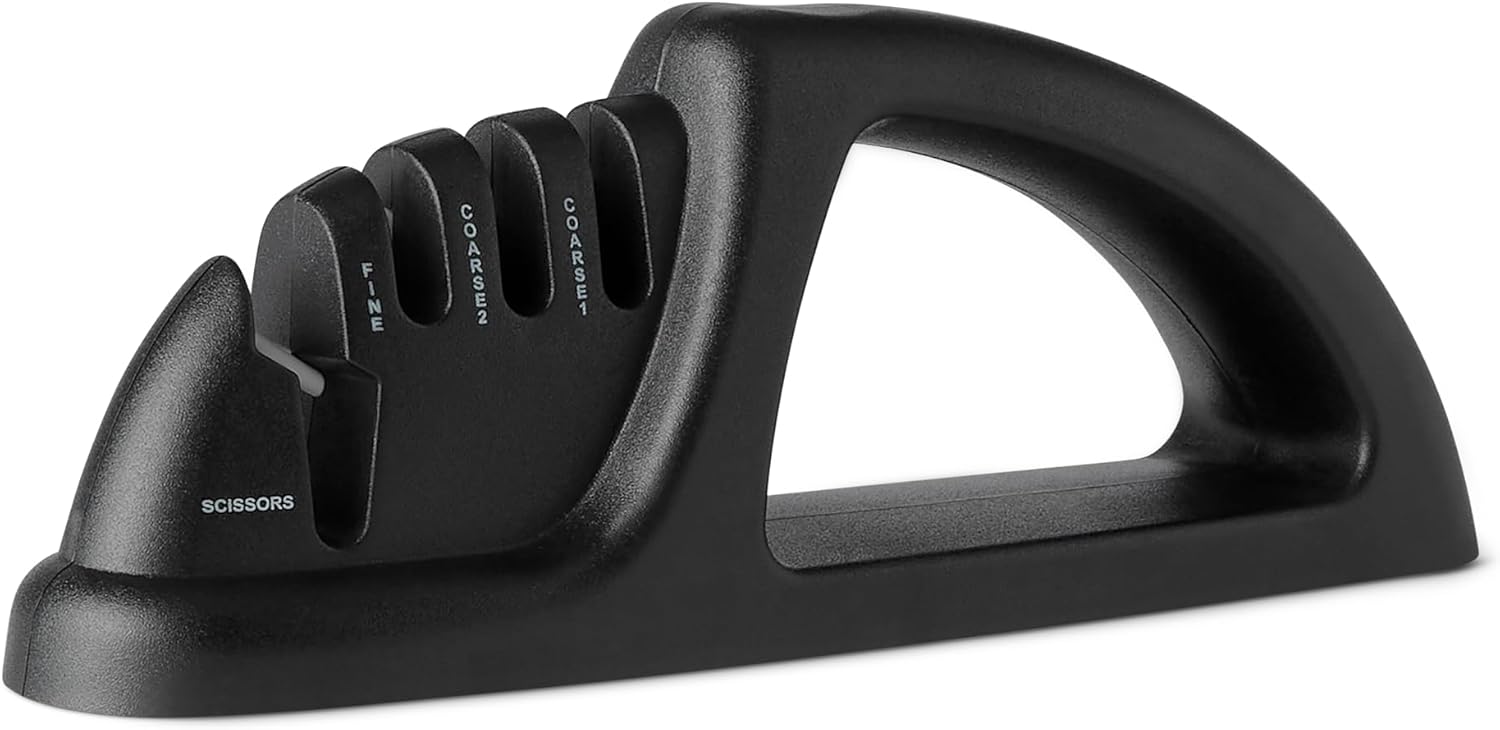
This Amazon Basics 4-in-1 Knife Sharpener is a straightforward, no-frills tool for restoring straight-edge blades. It offers three progressive sharpening slots (coarse, medium, fine) for rebuilding and refining edges plus a separate scissor slot, and the silicone non-slip base keeps the unit stable during use. The included cut-resistant glove is a helpful safety touch, and the unit is easy to rinse clean after sharpening. It works well on kitchen knives, pocket knives, and hunting knives but is not suitable for serrated blades. Because it is manual and compact, sharpening takes a few steady passes rather than machine-speed results, so you should plan a little time for very dull knives. For everyday home cooks who want an affordable, safe way to maintain sharp edges without replacing or sending out knives, this delivers solid value.
Best for: Buyers looking for an inexpensive, practical way to keep everyday kitchen knives sharp at home without power tools or professional servicing.
Less Ideal for: Users who need to sharpen serrated blades, want fast electric sharpening, or expect showroom-level razor edges with minimal effort.
- Three-stage sharpening (coarse, medium, fine) for progressive edge restoration
- Dedicated scissor sharpening slot expands usefulness beyond knives
- Non-slip silicone base provides stable, safer sharpening
- Includes cut-resistant glove for added user protection
- Compact and easy to rinse clean after use
- Not suitable for serrated knives
- Manual operation requires multiple passes and some technique for best results
Verdict: A budget-friendly, safe manual sharpener that restores straight-edge kitchen knives with a three-stage system and included safety glove.
AccuSharp Knife Sharpener ACCU-001C

| Material Type | Acrylonitrile Butadiene Styrene |
|---|---|
| Grit Type | Coarse |
| Included Components | Sharpener |
| Model Number | ACCU-001C |
The AccuSharp is a simple, pull-through manual sharpener designed to restore and hone straight and many serrated kitchen knives in seconds. You place the blade in the V-shaped tungsten carbide slot and pull through a few times; the reversible, diamond-honed carbide edges do the cutting work so sharpening is fast and repeatable. Its ergonomic handle and full-length finger guard make it comfortable and safe to use left- or right-handed, and the plastic body is easy to rinse or put in the dishwasher for cleanup. It is best for routine maintenance and quick edge repair rather than reshaping heavily damaged blades or achieving fine, polished edges that come from stones or stropping. The coarse grit gets blades cutting again very quickly, and the replaceable reversible blades extend service life, so you can expect dependable performance for years under normal use.
Best for: Buyers who prioritize a reliable, low-effort way to keep kitchen knives functional between professional sharpening sessions or stone honing will appreciate this tool.
Less Ideal for: Users seeking precision finishing, mirror-polished edges, or heavy re-profiling of damaged blades should choose whetstones or professional sharpening services instead.
- Very quick edge restoration in about 10 seconds
- Diamond-honed tungsten carbide blades provide hard, durable cutting surfaces
- Ergonomic handle and full-length finger guard improve safety and control
- Reversible, replaceable blades extend the sharpener's usable life
- Dishwasher-safe plastic body makes cleaning simple
- Coarse grit is not suited for refining a polished razor edge or fixing severely chipped blades
Verdict: A fast, durable, and easy-to-use manual sharpener that reliably restores knife edges for everyday kitchen use.
KitchenIQ Edge Grip 2-Stage Sharpener

| Stages | 2 (Carbide coarse, Ceramic fine) |
|---|---|
| Material Type | Plastic |
| Grit Type | Fine |
| Included Components | Complete |
The KitchenIQ Edge Grip 2-Stage Sharpener is a simple pull-through tool designed to restore and maintain kitchen knives. You start with the carbide coarse slot to set a new edge on dull or nicked blades, then finish in the ceramic fine slot to polish and hone the edge. Its preset angles make sharpening straightforward for beginners and the patented V-Grip lets you anchor the unit on a countertop edge to protect surfaces and control the blade tip while pulling. The soft rubber handle and non-slip feet add stability during use, and the unit is small enough to store in a drawer. Limitations are its manual pull-through design and plastic body, which make it best for routine household touch-ups rather than precision re-profiling of high-end knives or repeated heavy-duty use.
Best for: Buyers who want an inexpensive, low-effort way to keep everyday kitchen knives sharp and prefer a tool that is easy to use with visible user feedback.
Less Ideal for: Users seeking professional-level sharpening, precise angle control, or a durable metal-bodied tool for frequent heavy re-profiling should consider more advanced sharpeners.
- Two-stage sharpening with carbide (coarse) and ceramic (fine) stages for edge setting and polishing
- Preset V-shaped sharpening angle simplifies use and reduces skill needed
- Patented V-Grip base and non-slip feet provide stability on a countertop edge
- Compact, lightweight design stores easily in a drawer
- Plastic housing and manual pull-through design are not suited for restoring heavily damaged or premium blade steels
Verdict: A no-fuss, compact two-stage pull-through sharpener that keeps everyday kitchen knives serviceable with minimal skill.
KITCHELLENCE 3-Stage Knife Sharpener
| Material Type | Plastic |
|---|---|
| Number of Items | 1 |
| Model Number | KS37 P |
| Item Weight | 180 g |
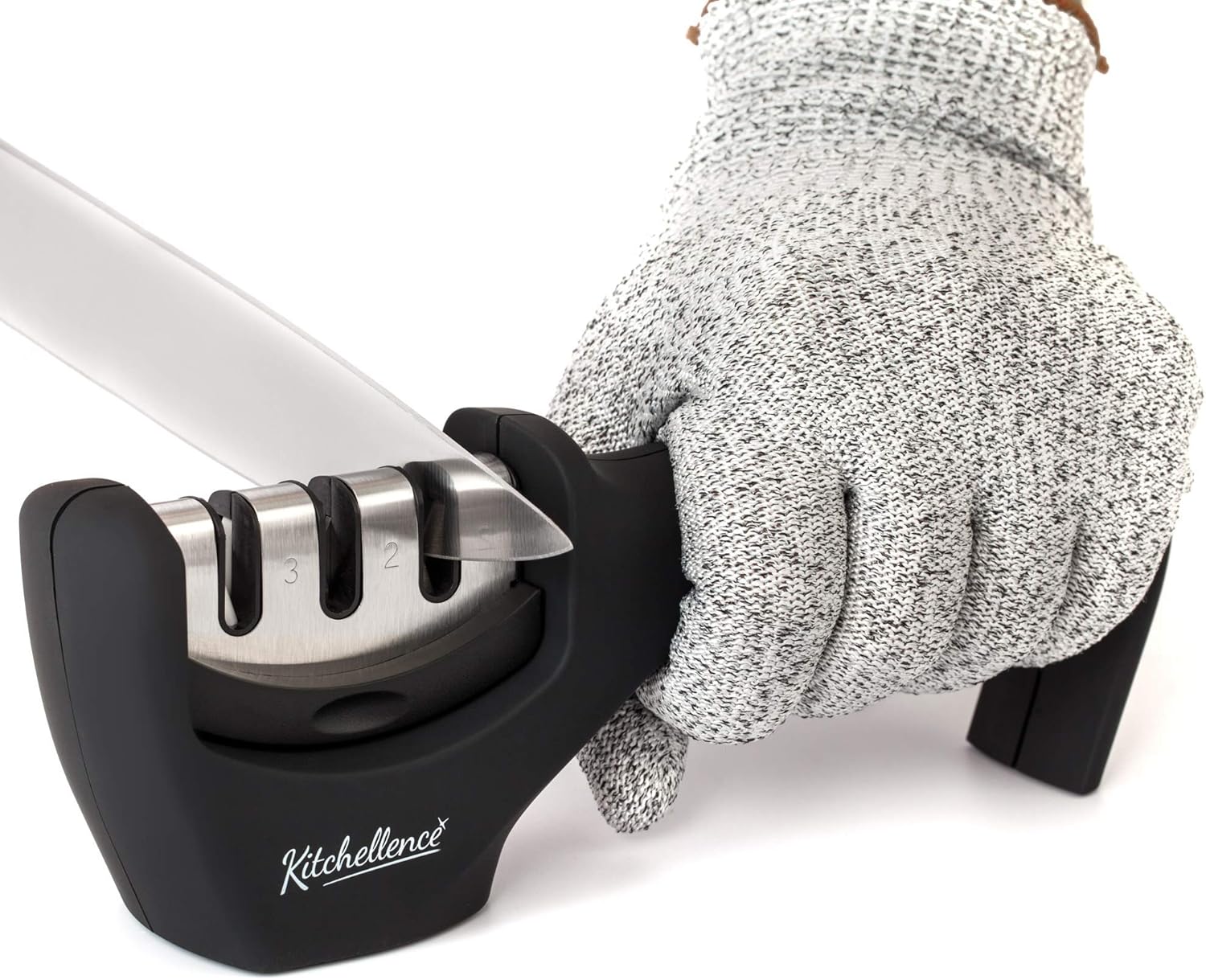
This KITCHELLENCE 3-stage sharpener is a compact manual tool for restoring kitchen knives without electricity. It uses a diamond rod first to repair and straighten damaged edges, a middle slot to re-establish the primary bevel, and a fine polishing slot to refine the edge. The ergonomic handle and nonslip base make it easy to hold steady while you pull the blade through the slots, and the included cut-resistant glove adds safety for less experienced users. It is made from ABS plastic so it is lightweight and portable for use at the counter or stored in a drawer. The system works well for routine maintenance and reviving slightly nicked blades, but like other pull-through sharpeners it is not appropriate for full re-profiling of heavily damaged or high-end specialty blades and it offers limited control over sharpening angle compared with whetstones. For risk-averse cooks who want a quick, repeatable way to keep everyday knives sharp, it is a sensible, easy-to-use option.
Best for: Home cooks who prioritize safety and simple, reliable maintenance and want a low-effort, repeatable way to keep everyday kitchen knives sharp.
Less Ideal for: Professional chefs or serious hobbyists who need precise angle control, custom bevels, or to re-profile damaged high-end knives.
- Three distinct sharpening stages for repair, sharpening, and polishing
- Diamond rod in the first stage helps restore damaged edges
- Ergonomic handle and nonslip base for stable, one-handed use
- Includes cut-resistant glove to reduce injury risk during sharpening
- Lightweight, portable ABS plastic construction for easy storage
- Not suitable for full re-profiling or restoring heavily damaged professional blades
- Limited angle control compared with stones or guided systems
Verdict: A safe, easy three-stage pull-through sharpener that gives risk-averse home cooks a fast, repeatable way to keep everyday knives sharp.
Choosing the Right Manual Knife Sharpener for Kitchen Knives: Key Factors to Consider
Edge Angle And Control
Edge angle determines cutting performance and durability. Sharper, lower-angle edges slice better but can chip or dull faster; higher-angle edges last longer but require more force. A good manual sharpener should either guide a consistent angle or allow you to set and repeat the desired bevel.
For home cooks, predictable angle control reduces the risk of overgrinding and keeps knives cutting smoothly between full resharpens. Consider whether the sharpener uses fixed guides, adjustable guides, or freehand stones and choose based on your comfort with technique and the knives you own.
Abrasive Type And Grit Progression
The abrasive material and available grits affect how much metal the tool removes and the final polish of the edge. Coarse abrasives reshape dull or damaged edges quickly, while medium and fine stages refine and polish the bevel for better cutting and edge life.
If you frequently restore very dull blades, pick a sharpener that includes a coarse stage or can accept coarse media. For routine maintenance, a medium-to-fine progression produces a keen edge with minimal material loss. Also consider whether the abrasive is replaceable or resurfaceable to extend the tool's useful life.
Safety And Ease Of Use
Manual sharpening can be hazardous without proper stability and guards. Look for non-slip bases, clear hand placements, and guides that keep fingers away from the blade. Simpler, guided systems reduce the learning curve and produce repeatable results for less experienced users.
Ease of use also covers setup and storage. Tools that require minimal assembly, have compact footprints, and store safely fit better into a busy kitchen. If technique-intensive sharpening is acceptable, freehand stones offer more control but require steady hands and skill development.
Compatibility With Knife Steels And Profiles
Kitchen knives come in a range of steels and edge profiles. Some abrasives cut faster on softer steels, while very hard or powdered-metallurgy steels need harder abrasives to reshape effectively. A suitable manual sharpener should handle the common steels found in household kitchen knives without glazing or ineffective cutting.
Also consider blade geometry. Wide chef knives, thin paring knives, and serrated edges each present different contact shapes. Verify the tool's ability to accommodate length, width, and slightly curved profiles so you do not create uneven bevels during sharpening.
Durability And Serviceability
A well-made sharpener stands up to repeated use without losing guide accuracy or abrasive effectiveness. Look for robust housings, replaceable abrasive modules, and clear cleaning procedures. Replaceable parts extend the product lifespan and protect your investment.
Consider whether spare abrasives or replacement components are available and how easy it is to perform routine cleaning. Tools that require infrequent maintenance but offer replacement parts provide the best long-term value for frequent cooks.
Types Of Manual Sharpeners And When To Use Them
Manual sharpeners fall into a few distinct categories: guided rod or V-guide systems, clamp-style guided sharpeners, and freehand whetstones or diamond plates. Guided systems provide repeatable angles, making them suitable for users who want quick, consistent results without much technique. Freehand stones and plates offer maximum control for experienced sharpeners who need to match specific edge geometries.
Choose a guided system if you want predictability and speed. Opt for whetstones or diamond plates if you plan to frequently refine high-end knives or enjoy the control of freehand sharpening.
- Guided V and rod systems: fast, repeatable angles
- Clamp-style sharpeners: secure blade positioning for consistent results
- Whetstones and diamond plates: best control and finish for experienced users
How To Maintain A Manual Sharpener
Regular maintenance keeps a manual sharpener performing well. Clean abrasive surfaces after use to remove metal particles and swarf. For stones, follow manufacturer recommendations for flattening and cleaning; for diamond plates, wipe with a damp cloth and mild detergent when necessary.
Check guides, clamps, and non-slip bases periodically for wear. Replace worn abrasive inserts as soon as sharpening becomes inconsistent to avoid damaging your knives.
- Remove metal debris after every use
- Flatten stones when they develop hollows
- Inspect and replace worn abrasive parts promptly
Sharpening Technique Tips For Home Cooks
Start with light, controlled strokes and focus on maintaining a consistent angle. If using a guided sharpener, let the tool set the angle and work evenly from heel to tip. For freehand stones, practice on inexpensive blades until you can hold the angle steady across the full blade length.
Use progressive grits: begin with a coarser abrasive only when necessary, then move to medium and fine grits to refine the edge. Finish with light stropping or a fine ceramic hone to remove burrs and polish the bevel for immediate cutting performance.
- Work heel-to-tip in smooth passes
- Use light pressure; let abrasives do the work
- Progress from coarse to fine to minimize metal removal
Caring For Different Kitchen Knife Types
Different kitchen knives benefit from slightly different approaches. Thinner blades perform best with lower-angle finishes and finer abrasives, while heavier or thicker blades tolerate steeper angles and more aggressive grits. Serrated knives require specialized tools or professional attention rather than standard flat abrasives.
For frequently used chef knives, regular light honing and occasional sharpening with a medium-to-fine abrasive maintain performance without removing excessive material. Reserve coarse reshaping only for very dull or damaged edges.
- Thin blades: finer grits and lower angles
- Thicker blades: steeper angles and more aggressive abrasives
- Serrated edges: use dedicated tools or professional service
Storage And Safety Advice
Store manual sharpeners where abrasives stay dry and protected from impacts. Keep any guide or clamp systems fully assembled and secure to prevent misalignment. If the tool has removable inserts, store spares in a labeled container to avoid mixing grit levels.
Always secure the sharpener on a stable surface before use and maintain a clear workspace. Treat sharpening as a focused task to reduce the risk of slips and accidental cuts.
- Keep abrasives dry and protected
- Label and separate replacement abrasive modules
- Use a stable work surface and attention-focused technique
How We Chose the Best Manual Knife Sharpener for Kitchen Knives
We evaluated manual knife sharpeners using criteria that matter in everyday kitchen use. First, we looked at edge geometry control and consistency, meaning how well a sharpener produces repeatable angles across a blade length. Second, abrasive quality and progression were assessed, including whether the tool provides coarse-to-fine grits or a single, effective abrasive stage. Third, we considered ease of use and safety features, such as stable bases, intuitive guides, and hand protection for non-expert users. Fourth, durability and materials were examined to ensure the sharpener holds up to repeated use without excessive wear. Fifth, maintenance and lifespan were factored in, including whether components are replaceable and how easy the tool is to clean. We excluded electric systems and guided belt machines to keep the focus strictly on handheld and manually guided sharpeners. We also excluded tools designed only for outdoor or field knives that use different steel and edge profiles. Final selections balanced sharpening effectiveness with approachable operation so home cooks can get predictable, long-lasting results.
Our full evaluation process is outlined in our review methodology.
FAQ
How often should I sharpen my kitchen knives with a manual sharpener?
It depends on use. Frequent home cooks may need light touch-ups every few weeks and a fuller manual sharpening a few times a year. Watch cutting performance and only use coarse grits when blades are noticeably dull.
Can manual sharpeners handle hard stainless or high-carbon kitchen steels?
Many manual sharpeners work well on common kitchen steels, but very hard or powder metallurgy steels need harder abrasives. Choose tools with diamond or high-quality ceramic abrasives for harder steels.
Will a guided manual sharpener damage thin or delicate blades?
Guided systems can be safe if you choose an appropriate angle and use light pressure. For very thin or specialty blades, freehand sharpening or gentler finishing grits may be preferable to avoid removing too much material.
Is stropping necessary after manual sharpening?
Stropping helps remove the burr and polish the edge, improving initial cutting performance. It is usually a short, beneficial final step but not strictly required if the final abrasive already produces a fine polish.
Can I sharpen serrated kitchen knives with these manual sharpeners?
Standard flat manual sharpeners are not ideal for serrations. Serrated blades typically need a tapered cone or specialized tool to reprofile each tooth. For deep or damaged serrations, consider professional servicing.
Final Verdict
Prioritize consistent angle control and the right abrasive progression when choosing a manual knife sharpener for kitchen knives. Think about how often you will touch up versus fully reshape edges, and select a tool that matches your skill level and knife steels. A practical choice balances repeatable results with easy maintenance and durable construction. Focus on tools that provide predictable edge geometry and replaceable abrasives so you can keep blades performing well for years.