
Note: This article contains affiliate links. If you click on these links and make a purchase, we may earn a small commission at no extra cost to you. This helps support our research and content. Read our full affiliate disclosure here.
If you plan to grind bones at home for pet food, stock, or specific recipes, choosing the right meat grinder matters for safety and consistent results. Bone grinding is tougher on equipment than regular mince work because it requires sustained torque, stronger cutting components, and housings that handle higher stresses. This guide covers seven shortlisted meat grinders built for bone processing and explains the evaluation criteria we used. Below you will find practical notes on power, durability, feeding systems, and maintenance so you can pick the right heavy-duty grinder for your needs. The products listed are the top picks in this category based on the factors described below.
Top Picks at a Glance
| Best Overall The best all-around choice for most situations | STX Turboforce II 4000 |  |
| Best Quality Built to a higher standard if you want something more solid | Weston Pro Series Meat Grinder 10-3201-W |  |
| Best Value The sweet spot between price and what you get | FOHERE Meat Grinder MG-2950R |  |
| Best Budget The cheapest option that still gets the job done reliably | Oaomi Meat Grinder S8 |  |
| Top Rated A top-rated pick with lots of positive feedback | LEM BigBite #32 Meat Grinder |  |
| Most Popular A crowd favorite that many people choose with confidence | AAOBOSI Meat Grinder MG7610C-400-SG |  |
| Best Seller A high-volume bestseller chosen again and again | Aiheal Meat Grinder MG-2430RB |  |
STX Turboforce II 4000
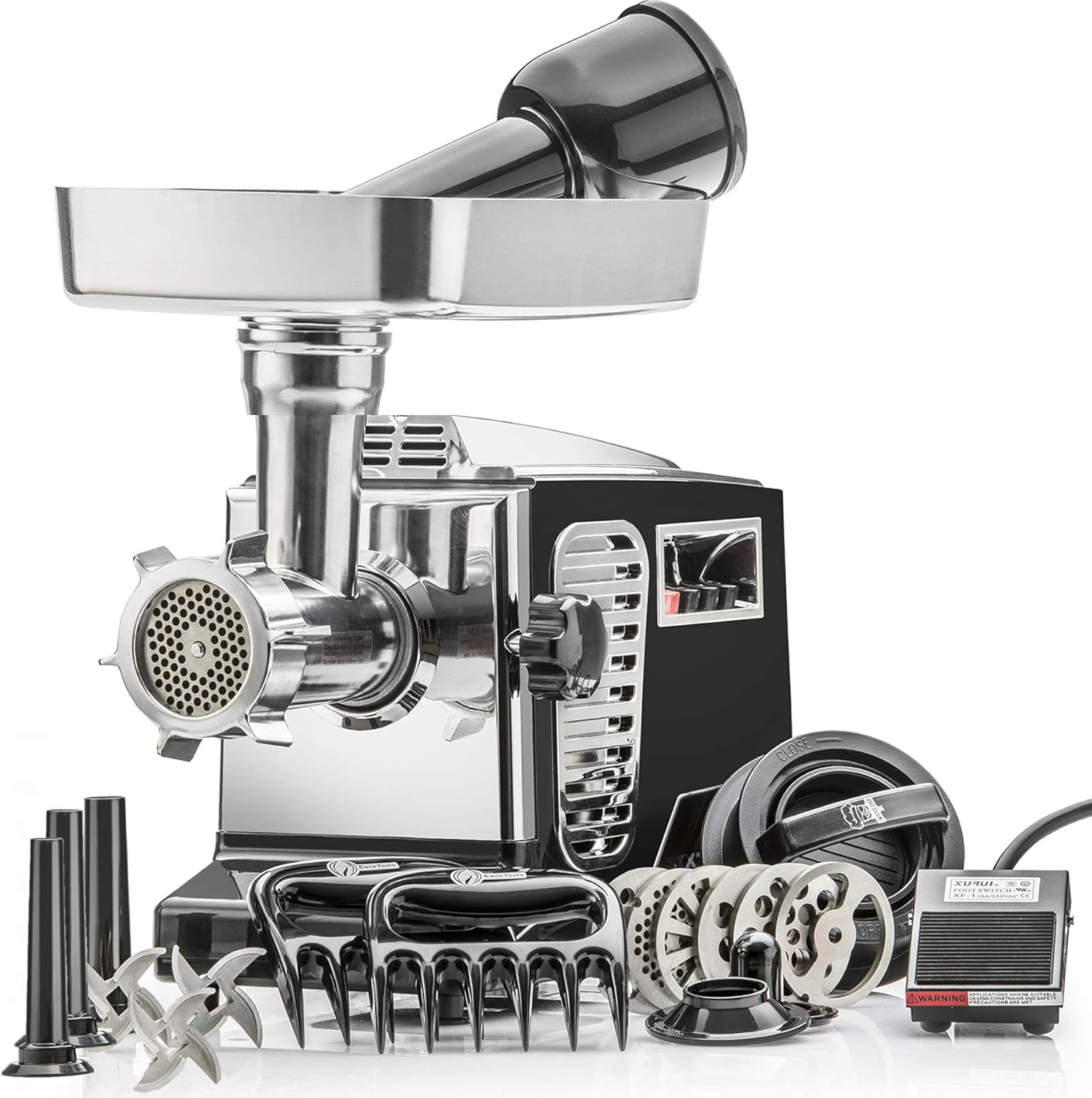
| Wattage | 2000 watts |
|---|---|
| Capacity | 3 pounds |
| Voltage | 120 volts |
The STX Turboforce II 4000 is a high-capacity electric meat grinder built for serious home use and small-batch commercial tasks. It uses a 2000 watt locked motor and a patented quad air induction cooling system to sustain heavy grinding runs, and the size 12 head with a 2.5-inch output and 2-inch feed tube moves large volumes quickly. The package includes multiple grinding plates, three stainless cutting blades, sausage tubes, a kubbe attachment, meat claws, a patty press and a foot pedal for safer, hands-free operation. Practical benefits include fast throughput (the manufacturer rates roughly 220–260 lb/hr depending on plate and meat), the ability to handle soft bones like chicken, and a roomy tray that holds about 3 lb for continuous feeding. Trade-offs are its weight and footprint compared with smaller home models and the expectation that regular cleaning and occasional maintenance will be needed after heavy use. The included safety features and cooling system make it a solid choice if you need a grinder that tolerates demanding grinding sessions and bone-capable jobs at home.
Best for: Buyers who want a durable, high‑throughput home grinder capable of handling soft bones and frequent heavy sessions and who prioritize power and versatility over compact size.
Less Ideal for: Casual users who only grind small amounts occasionally or who need a lightweight, compact countertop unit for limited storage space.
- Powerful 2000W motor and quad air cooling for sustained heavy use
- Size 12 grinder head with 2.5-inch output for higher throughput
- Includes multiple grinding plates, blades and sausage/kubbe attachments for versatility
- Foot pedal control improves safety and hands-free operation
- Can handle soft bones and high-volume batches (manufacturer throughput 220–260 lb/hr)
- Large and heavier than compact home grinders, taking more counter space
- 3 lb tray capacity may require frequent refilling during long runs
Verdict: If you need a rugged, high‑power home grinder that can handle soft bones and high volumes, the STX Turboforce II 4000 delivers the power and attachments to get the job done.
Weston Pro Series Meat Grinder 10-3201-W

| Wattage | 1500 watts |
|---|---|
| Capacity | 18 pounds |
| Voltage | 120 volts |
The Weston Pro Series is built for heavy-duty home grinding, using a permanently lubricated 1500 W (2 HP) air-cooled motor and an offset throat that pushes high feed speeds for 12–18 pounds per minute. It comes with coarse and fine stainless steel plates, a sharp grinder knife, an auger-grabbing stomper for quick disassembly, and a multi-size sausage kit so you can grind for burgers, loins, and stuffed sausages. Practical touches include a built-in knife sharpener, tray-nested accessory storage with dust cover, non-slip rubber feet and a reverse function to clear jams. Because it is mostly stainless steel with precision steel gears and a robust motor, it handles continuous runs better than typical consumer models. Limitations: the unit is large and loud compared with countertop mixers, and grinding bones or extremely dense frozen blocks will stress any consumer grinder so careful technique and short bursts are advisable. The included accessories and five-year limited warranty make it a strong choice for serious home cooks who need near-commercial throughput.
Best for: Buyers who prioritize performance and throughput for regular heavy home grinding and sausage making and want near-commercial capability without moving to a true commercial machine.
Less Ideal for: Those seeking a compact, very quiet countertop unit or buyers who plan to routinely pulverize large, weight-bearing bones without a dedicated bone-crushing commercial grinder.
- High-power 1500 W (2 HP) motor for sustained, faster grinding
- Stainless steel construction and precision steel gears for durability
- Includes coarse and fine plates plus a sausage-making kit for versatility
- Built-in knife sharpener and tray storage simplify prep and cleanup
- Reverse function and auger-stomper speed disassembly and jam clearing
- Can be loud and bulky compared with smaller home grinders
- Not specifically rated for large weight-bearing bone crushing; requires cautious technique when grinding bones
Verdict: Choose this Weston Pro Series grinder when you want a high-power, durable machine that delivers near-commercial grinding performance for heavy home use.
FOHERE Meat Grinder MG-2950R

| Power source | electric |
|---|---|
| Motor rated / max | 500W rated, 3000W Max |
| Grinding head size | #12 stainless steel |
| Grinding plates | 3mm, 5mm, 7mm |
The FOHERE MG-2950R is a robust electric meat grinder built around a 100% copper motor (500W rated, 3000W max) and a size #12 stainless steel grinding head, designed to handle large volumes of meat at home. It is typically used for grinding beef, pork, venison, stuffing sausages, making kubbe, and preparing tomato sauce or vegetable processing using the included attachments. Notable features include two speed settings for power-versus-control, an auto-reverse jam-clearing function, overload protection with ETL certification, and an extensive 5-in-1 accessory kit with three grinding plates (3mm, 5mm, 7mm), three sausage tubes, kubbe maker, vegetable cutters, and a tomato juicer. In practice the large hopper and #12 head let you process big batches quickly and the slower speed helps when stuffing sausages or handling softer ingredients; the reverse button reduces downtime from jams. Removable parts are simple to wash by hand, though they are not dishwasher safe. This model provides professional-style throughput for serious home butchers, but it is a substantial appliance that requires counter space and careful cleaning after heavy use.
Best for: Buyers who prioritize efficient home butchery and want a machine that can process large game or whole cuts quickly with factory-style output and practical jam control.
Less Ideal for: If you only grind small, occasional amounts or need a compact, lightweight unit for tiny kitchens, this heavy-duty model is more than you need.
- High-power copper motor (500W rated, 3000W max) for fast throughput
- Size #12 stainless steel grinding head and extra-large hopper for big batches
- Two-speed control plus auto-reverse to clear jams without disassembly
- Comprehensive accessory kit covering fine to coarse plates, sausage stuffing, kubbe, and vegetable/tomato attachments
- Not dishwasher safe — removable parts must be hand-washed
- Large, heavy unit that needs substantial counter or storage space
Verdict: Choose this FOHERE grinder when you need a high-throughput, factory-style machine that handles large cuts and game efficiently with built-in jam clearing.
Oaomi Meat Grinder S8

| Motor power | 3200W |
|---|---|
| Included plates | 3 grinding plates |
| Blades | 2 stainless steel blades |
| Material type | Stainless Steel |
The Oaomi S8 is a home electric meat grinder that combines a high-power motor with a full accessory set for basic grinding and sausage making. It includes two stainless steel blades, three grinding plates of varying thickness, three sausage stuffing tubes, and a Kubbe kit so you can grind for burgers, sausages, and shaped specialties. The unit claims a 3200W copper motor and features safety locks, overload protection, and a reverse function to clear jams, which helps when working with tougher cuts. Parts detach for cleaning and several components are dishwasher-safe while others should be hand-washed. For bone processing the powerful motor and overload protection are useful, but the listing does not specify explicit bone-grinding plates or manufacturer guidance on grinding large bones, so expect limitations with very hard or large bones. The S8 is best for home cooks who want a versatile grinder and sausage tools with helpful safety features, but users planning heavy bone grinding should verify capability or choose a model explicitly rated for bones.
Best for: Home cooks on a budget who want a feature-rich grinder that handles regular meat grinding, sausage making, and occasional tougher cuts while keeping upfront cost low.
Less Ideal for: Butchers or users who need a grinder rated for frequent large-bone processing or commercial heavy-duty use should choose a dedicated bone-grinding machine instead.
- High-power 3200W copper motor for demanding grinding tasks
- Comes with two blades, three grinding plates, three sausage tubes, and a Kubbe kit for versatile use
- Safety features including overload protection, thermostat control, and a reverse function to clear jams
- Many detachable parts and some dishwasher-safe components for easier cleaning
- No explicit manufacturer rating or plates listed for grinding large or hard bones
- Some parts must be hand-washed which adds cleanup steps
Verdict: If you want an affordable, well-equipped home grinder that handles tough cuts and sausage making, the Oaomi S8 delivers strong motor power and useful accessories for everyday kitchen use.
LEM BigBite #32 Meat Grinder

| Power Source | electric |
|---|---|
| Material Type | Stainless Steel |
| Capacity | 17 pounds |
| Horsepower | 1.5 HP |
The LEM BigBite #32 is a commercial-style electric meat grinder designed for processing large volumes and even raw chicken bones. With a 1.5 HP motor and a large-diameter throat, the auger pulls big portions through the rifled head so grinding is faster and less likely to jam; the listing claims up to 17 pounds per minute. The unit ships with stainless steel knife and plates, a stuffing plate with three tubes, a meat stomper, and a convenient storage drawer for accessories, and the mostly stainless construction makes it straightforward to disassemble and clean. Noise-dampening features and a permanently lubricated motor aim to reduce maintenance and operating upset. Important limitations are its weight and footprint, which make it less portable, and the power and throughput mean it is best used in a dedicated prep area rather than an occasional countertop appliance. For buyers who need a robust, bone-capable grinder for regular heavy use, this model brings near-professional performance and durable materials; casual users who grind small amounts occasionally may find it overbuilt for their needs.
Best for: Buyers who prioritize a reliable, heavy-duty grinder for regular processing of game, bulk meat, and bone-in cuts and who plan to use it in a dedicated prep area.
Less Ideal for: People who only grind small, infrequent batches or need a lightweight portable grinder for occasional kitchen use should consider smaller models.
- 1.5 HP motor and large-throat BigBite design for high throughput and better feeding of large pieces
- Stainless steel knife, head, auger, and plates included for durable, food-safe processing
- Can handle a wide range of proteins including raw chicken bones according to manufacturer, expanding processing options
- Includes stuffing plate and three tubes plus a storage drawer for convenient sausage making and accessory storage
- Noise-dampening design and permanently lubricated motor reduce maintenance and operating fuss
- Heavy and bulky, making it hard to move or store in small kitchens
- Designed for frequent, high-volume use so it may be more machine than needed for occasional home grinding
Verdict: If you need a dependable, bone-capable grinder for frequent heavy-duty use, the LEM #32 BigBite delivers near-professional throughput and durable stainless construction.
AAOBOSI Meat Grinder MG7610C-400-SG

| Capacity | 4.5 pounds |
|---|---|
| Peak Power | 3000W |
| Control | 3-Speed |
| Noise | 60 dB |
| Included Components | 3 plates, 2 blades, sausage tube, kibbe kit |
This AAOBOSI grinder is built around a copper DC motor and industrial-style metal gearbox that deliver high torque and steady power up to a claimed 3000W peak, so it handles continuous grinding without frequent stalling. It offers three speed settings and an auto-reverse function to clear jams, which makes working through tougher cuts and sinew much less fiddly. The unit includes three grinding plates, two blades, a sausage tube and a kibbe kit plus a storable food pusher, so you can make burgers, sausages and kibbe without buying extras. The manufacturer rates throughput at about 4.5 pounds per minute and highlights a quieter 60 dB operation, useful if you run the grinder in a home kitchen. Cleaning is typical for this category: removable metal plates and blades are hand-wash recommended. Important limits for bone work: the listing emphasizes meat, sausage and kibbe and does not state bone-crushing capability or dedicated bone plates, so expect to pre-trim or consult the manual before attempting any bone-in grinding to avoid damage.
Best for: Buyers who prioritize proven, high-torque hardware and want a grinder that handles continuous home butchery tasks with clear user feedback and included accessories.
Less Ideal for: If you need to regularly grind large bones or require certified bone-crushing performance for pet food, choose a commercial bone-specific grinder instead.
- High-torque copper DC motor with industrial metal gearbox for durable, steady grinding
- Auto-reverse and three speed settings help clear jams and match grind tasks
- Includes multiple accessories (3 plates, 2 blades, sausage tube, kibbe kit) so it is ready for common jobs
- Claims quiet operation (~60 dB) compared with louder consumer grinders
- Manufacturer does not specify bone-grinding plates or explicit bone-crushing capability
- Recommended cleaning is hand wash which adds post-use maintenance time
Verdict: Choose this model if you want a torque-first, accessory-ready home grinder that handles heavy muscle and sausage work with fewer jams.
Aiheal Meat Grinder MG-2430RB

| Power source | ELECTRIC |
|---|---|
| Material Type | Stainless Steel |
| Included Components | 2 Blades, 3 Plates, 3 Sausage Tubes, Pusher |
| Capacity | 44 pounds |
The Aiheal MG-2430RB is a heavy-duty home meat grinder built around a 300W motor with a 3200W peak power claim and a stainless steel feed system designed for routine mincing and sausage stuffing. It ships with three grinding plates (2mm, 5mm, 7mm), two cutting blades, three sausage tubes, and a pusher, making it straightforward to switch between fine grind, coarse grind, and stuffed sausages. Safety features include a lock knob and thermal overload protection that stops the motor if it overheats or is overloaded, and most removable components are stainless steel for easier cleaning by hand. For someone who wants dependable, everyday grinding for beef, pork, chicken, venison, and recipe work like burger patties or meatballs, the unit handles steady batches well. That said, the motor rating and parts are aimed at regular home use rather than continuous industrial bone-crushing; expect slower feeding or jams if you try to grind large bones or very dense frozen blocks. Use chilled, boneless chunks and follow the unclogging procedure to keep it running smoothly.
Best for: Buyers who want a reliable, safety-minded home grinder for regular mincing and sausage making and who prioritize dependable, easy-to-clean metal components.
Less Ideal for: People seeking a grinder specifically for crushing large or frequent bones or continuous industrial-scale grinding should choose a commercial-grade bone crusher instead.
- Comes with three grinding plates and three sausage tubes for versatile grind sizes and sausage making
- Stainless steel construction on feed components for food-safe contact and easier cleaning
- Thermal overload protection and locking knob add safety during heavy use
- Includes a dedicated unclogging button and a pusher for simpler operation
- Motor and parts are designed for home batches and are not rated for frequent bone grinding
- Manufacturer advises hand cleaning of parts and not using a dishwasher
Verdict: Choose the Aiheal MG-2430RB if you want a safe, versatile home meat grinder for regular boneless grinding and sausage making rather than heavy bone crushing.
Choosing the Right Meat Grinder for Grinding Bones: Key Factors to Consider
Motor Power and Torque
Higher continuous motor power and torque are essential when grinding bone because bones resist shearing and can stall under light loads.
Look for grinders rated for sustained duty rather than short bursts. Extra torque helps push large bone fragments through the feed and cutting system without overheating the motor. If you plan to run long batches, the motor's duty-cycle specification or rated continuous horsepower is more meaningful than peak or surge ratings. A well-matched motor reduces the chance of jams and reduces stress on gears and cutting parts.
Gearbox Construction and Drive Train
The gearbox and drive train take the brunt of the mechanical stress when grinding hard material. A robust metal gearbox with hardened gears or sealed bearings lasts longer and handles shock loads better than lightweight plastic assemblies.
Consider models with metal housings, replaceable gear sets, and accessible bearings. Low-quality gears will wear quickly and lead to wobble or uneven cutting. A reliable drive train also reduces vibration and improves alignment between the auger, cutter, and plate, which is critical when working with bone.
Cutting System and Plate Thickness
The cutter, plate thickness, and auger design determine how effectively bone is broken down. Thicker stainless plates and hardened cutting knives resist deformation and keep tolerances tight under load.
Screw/auger geometry that concentrates pressure at the cutter can help fracture small bone pieces without jamming. Also check for availability of multiple plate sizes and hardened cutting knives if you need different bone textures or coarseness levels. Durability here prevents frequent replacement and keeps grinding consistent.
Feeding Design and Safety Features
A controlled feeding system reduces the chance of sudden jams and keeps hands away from moving parts. A well-sized hopper, gravity feed or slow-feed pusher, and a roomy throat let you manage larger bone pieces safely.
Safety features such as reverse function for clearing blockages, sturdy feed pushers, and secure locking mechanisms for the head and tray matter for heavy-duty use. Avoid designs that require aggressive hand pressure or awkward feeding angles when processing hard material.
Cooling, Thermal Protection, and Duty Cycle
Grinding bone generates heat from prolonged motor work and friction. Thermal protection, adequate ventilation, or a design that supports intermittent work cycles reduce the risk of motor failure.
Look for built-in thermal cutouts, fan-cooled motors, or manufacturer duty-cycle guidance. If a grinder lacks cooling features, plan on shorter batches and longer cool-down periods to avoid overheating. Consistent cooling improves longevity under frequent bone-grinding tasks.
Serviceability and Ease of Cleaning
Bone grinding leaves behind tiny fragments and grease that can accelerate wear if not cleaned thoroughly. Easy disassembly, dishwasher-safe parts where applicable, and straightforward access to the auger and cutter make routine maintenance practical.
Also consider how simple it is to source replacement plates, knives, and gaskets. Models that allow quick access to bearings or gear housings simplify repairs and lengthen usable life when you process hard materials regularly.
How Bone Type Affects Grinder Choice
Not all bones are equal. Softer, marrow-rich bones such as poultry necks or small ribs process more easily than dense weight-bearing bones from large mammals. Match your grinder to the hardest bone you expect to process rather than the average.
If you only occasionally grind small bones, a lighter-duty heavy-duty consumer model may suffice. For frequent processing of dense bones, prioritize torque, hardened cutting parts, and a gearbox designed for shock loads.
- Small bones: less torque required, watch for plates that minimize clogging
- Large dense bones: need high torque, hardened cutters, and strong gearbox
- Frozen bones: avoid unless your grinder explicitly allows it; partial thaw reduces shock to components
Practical Feeding and Operation Tips
Pre-cut bones into manageable pieces before feeding to reduce stress on the auger and cutter. Consistent piece size helps maintain throughput and prevents sudden jams.
Use a slow, steady feed with the pusher rather than forcing oversized chunks. If a unit offers a reverse function, use it cautiously to clear blockages and then inspect the cutting elements for dents or deformation.
- Trim large, awkwardly shaped pieces to fit the throat
- Feed small batches and pause if the motor struggles
- Check for metal fatigue or deformation after heavy sessions
Maintenance Routines After Grinding Bone
Immediately disassemble the head and remove bone fragments to prevent drying and sticking. Rinse parts in warm water to remove grease and small particles, then hand-wash or use the dishwasher only if the manufacturer permits.
Regularly inspect cutting plates and knives for nicks or warping. Replace any components that show significant damage to maintain performance and avoid further stress on the drive train.
- Clean promptly to prevent buildup
- Dry and lightly oil exposed metal parts to resist corrosion
- Schedule periodic gearbox checks if the unit exposes service points
Home Safety and Food-Handling Considerations
Grinding bone involves handling raw animal material and sharp components. Always wear appropriate hand protection when disassembling and ensure the unit is unplugged before maintenance.
Sanitize contact surfaces and utensils after use to limit cross-contamination. If preparing pet food, follow safe food-handling guidelines to prevent bacterial growth during storage.
- Unplug unit before cleaning or servicing
- Use dedicated utensils and cutting boards for raw bone processing
- Store ground bone products cold or frozen to maintain safety
When to Consider Commercial or Dedicated Gear
If you routinely grind large quantities of dense bone, a commercial-grade grinder or a unit specifically rated for high-duty cycles may be more economical over time. These designs typically include heavy cast housings, industrial gearboxes, and serviceable components.
Commercial options often provide easier parts replacement and stronger cooling systems, which reduce downtime and long-term wear when processing tough material.
- Assess yearly volume before upgrading to commercial-grade equipment
- Factor in maintenance and replacement part availability when choosing
- Commercial units may need different electrical supply; verify compatibility
How We Chose the Best Meat Grinder for Grinding Bones
We focused on attributes that directly affect a grinder's ability to handle bone safely and reliably. Key evaluation criteria included continuous motor power and torque for consistent throughput; gearbox and drive durability to resist wear from hard material; cutting system robustness including plate thickness and screw design; hopper and feeding design for controlled, safe feeding; thermal protection and cooling to prevent burnout during heavy loads; and ease of disassembly for cleaning and maintenance after bone processing. We excluded models that are explicitly rated only for light domestic use or that specify a prohibition on grinding bone. We also filtered out units with poor user-serviceability or inadequate thermal protection. Our shortlist favored designs with proven heavy-duty components, thicker cutting plates and screws, and clear cooling or duty-cycle specifications. Where possible we emphasized grinders that offer straightforward replacement parts and accessible housings, since longevity matters when you routinely grind bone.
Our full evaluation process is outlined in our review methodology.
FAQ
Can I grind frozen bones?
Grinding fully frozen bone is generally not recommended because the added brittleness increases shock loads and can damage cutters and gears. Slightly thawing bones until they are firm but not rock-hard reduces stress on the machine and helps achieve smoother cuts.
How often should I replace cutting plates and knives when grinding bone?
Replacement frequency depends on usage and material hardness. For occasional bone grinding inspect parts after each heavy session and replace when you see nicks, warping, or decreased performance. Frequent heavy use may require replacement several times a year.
Is there a duty cycle I should follow?
Follow the manufacturer's duty-cycle guidance if provided. If not specified, operate in shorter batches with cool-down periods to avoid motor overheating. Monitoring motor temperature and stopping if performance drops helps prevent damage.
What safety steps reduce the risk of jams or damage?
Pre-cut large bones, feed slowly with the pusher, avoid forcing oversized pieces, and use the reverse function sparingly to clear blockages. Always unplug before clearing jams or disassembling the head for cleaning.
Can I use the same grinder for meat and bone together?
Many heavy-duty grinders are designed to handle mixed meat-and-bone loads, but operation requires more frequent cleaning and inspection. Expect higher wear on cutting parts and plan maintenance accordingly.
Final Verdict
When picking a meat grinder for grinding bones, prioritize sustained motor torque, a durable gearbox, and hardened cutting components. Balance these performance traits with practical features such as safe feeding design, cooling or duty-cycle protections, and ease of service. For occasional bone processing, a robust consumer unit with good plates and cooling may be sufficient. If you grind dense or large volumes of bone regularly, invest in equipment with industrial-grade drive components and accessible replacement parts to minimize downtime and long-term costs.