
Note: This article contains affiliate links. If you click on these links and make a purchase, we may earn a small commission at no extra cost to you. This helps support our research and content. Read our full affiliate disclosure here.
Picking the right meat grinder for home use changes how you prep meals and what you can make at home. The right unit gives you control over grind texture, fat content, and the cuts you use, which affects flavor, yield, and food safety. This guide shortlists seven top meat grinders for home use and explains the practical differences that matter when you grind at home. We evaluated power, build and feed design, ease of cleaning, and accessories to surface options that suit regular family cooking, occasional sausage making, or heavier weekly batches. Read on to see which features match the way you cook and prepare meat at home.
Top Picks at a Glance
| Best Overall The best all-around choice for most situations | LEM MightyBite #8 Meat Grinder |  |
| Best Quality Built to a higher standard if you want something more solid | Cuisinart Electric Meat Grinder MG-100 |  |
| Best Value The sweet spot between price and what you get | Aiheal Meat Grinder MG-2430RB |  |
| Best Budget The cheapest option that still gets the job done reliably | LHS Manual Meat Grinder JRJ-2 |  |
| Top Rated A top-rated pick with lots of positive feedback | LEM BigBite #8 Meat Grinder |  |
| Most Popular A crowd favorite that many people choose with confidence | STX Turboforce 3000 Meat Grinder |  |
| Best Seller A high-volume bestseller chosen again and again | KitchenAid Metal Food Grinder Attachment KSMMGA |  |
LEM MightyBite #8 Meat Grinder

| Wattage | 500 watts |
|---|---|
| Capacity | 3 pounds |
| Voltage | 120 volts |
| Power Source | AC adapter |
The LEM MightyBite #8 is a heavy-duty countertop electric grinder built for frequent home use and processing game. Its 500-watt motor and robust aluminum housing power through most meats at roughly 4–5 pounds per minute while long-lasting gears and a permanently lubricated motor keep operation smooth; the unit also has a built-in circuit breaker for protection. It comes with stainless steel plates, a knife, a stomper, and three stuffing tubes so you can grind for burgers, prepare sausage, or make pet food from scraps. Assembly, disassembly, and cleaning are straightforward since the main food-contact parts are stainless steel or aluminum and wash up with warm soapy water. The grinder is not intended for bones and the unit is fairly large and heavy compared with small domestic models, so it needs a dedicated counter area and some strength to move. For cooks, hunters, or anyone buying meat in bulk who wants a durable, capable home grinder, this model balances power and reliability without professional-level complexity.
Best for: Home cooks, hunters, or buyers who process larger quantities of meat and want a durable, no-nonsense grinder that handles regular use and sausage making.
Less Ideal for: Someone who needs a lightweight, compact grinder for occasional small batches or a model that can process bones should look elsewhere.
- 500-watt motor and durable aluminum construction for steady, reliable grinding
- Processes about 4–5 pounds per minute, suitable for bulk home prep
- Includes stainless steel plates, knife, stomper, and three stuffing tubes for sausage making
- Permanently lubricated motor and circuit breaker improve long-term reliability and safety
- Not designed to grind bones
- Relatively large and heavy for countertop storage and moving
Verdict: Choose the LEM MightyBite #8 if you want a sturdy, higher-capacity home meat grinder that reliably handles frequent bulk grinding and sausage stuffing.
Cuisinart Electric Meat Grinder MG-100

| Wattage | 300 watts |
|---|---|
| Capacity | 3 pounds |
| Voltage | 120 volts |
The Cuisinart MG-100 is a straightforward countertop electric grinder designed for home cooks who want reliable, hands-on meat processing. Its 300-watt motor delivers steady power for daily tasks and the manufacturer claims it can grind up to 3 pounds of meat per minute, which is useful when preparing larger batches for meatloaf, burgers, or sausage. The unit ships with two metal cutting plates for medium and coarse grinds plus two sausage attachments, giving practical flexibility for burgers, chilies, and link-style sausages. Operation is simple via a single on/off switch and a reverse function helps clear jams, reducing downtime during heavy use. Being mostly stainless steel, it feels durable and cleans up acceptably for a home appliance, though you will need to disassemble plates and feed tube for full cleaning. The MG-100 is not a commercial machine, so expect it to heat up with extended continuous runs; for intermittent home use it performs dependably and produces consistent coarse-to-medium grinds.
Best for: Home cooks who prioritize reliable, performance-oriented grinding for regular batch cooking and making sausages at home.
Less Ideal for: Users who need heavy-duty, continuous commercial grinding or very fine industrial-style grinds should choose a commercial-grade grinder.
- 300-watt motor provides steady grinding power for home batches
- Included medium and coarse metal plates plus sausage attachments increase versatility
- Reverse function helps clear clogs without manual disassembly
- Stainless steel construction for a durable, easy-to-wipe exterior
- Not intended for prolonged commercial use and can warm during long continuous runs
- Only two grind plate sizes; finer grinds require additional plates or passes
Verdict: A dependable, performance-focused home meat grinder that handles regular batch grinding and sausage making with simple, durable controls.
Aiheal Meat Grinder MG-2430RB

| Included components | 2 blades, 3 plates, 3 sausage tubes, 1 pusher |
|---|---|
| Material Type | Stainless Steel |
| Power Source | Electric |
| Capacity | 44 pounds |
The Aiheal MG-2430RB is a heavy-duty home electric meat grinder built around a copper-wound motor (300W rated, 3200W peak locked power) and a stainless steel feed and cutting assembly. It grinds beef, pork, chicken, venison, and fish using three plates (2mm, 5mm, 7mm) for fine to coarse textures and includes three sausage tubes and two cutting blades for making sausages or kebbeh. Safety features include a locking knob and overload protection that stops the unit if it overheats or is jammed, plus an R reverse/unclog button to clear blockages. The grinder disassembles for cleaning and the supplied pusher helps feed meat cleanly; the manufacturer advises hand drying rather than dishwasher use. Practical buyers will appreciate the capacity rating and sturdier stainless construction for batch grinding, while the unit's size and weight make it suited to countertop use rather than compact storage. Expect audible motor noise during heavy loads and follow the cleaning guidance to prevent corrosion of parts.
Best for: Buyers who want a durable, versatile countertop grinder to process whole cuts and make sausages at home and who prioritize build quality and batch capacity over compact storage.
Less Ideal for: Those seeking an ultra-quiet or very compact tabletop appliance for occasional light use should consider smaller or lower-powered models instead.
- Three grinding plates and multiple sausage tubes for versatile grind sizes and sausage making
- Stainless steel construction for food-contact parts
- Built-in overload protection and reverse function for safer, jam-resistant operation
- Copper motor with high locked power rating suitable for batch grinding
- Manufacturer recommends hand drying parts and not using a dishwasher, which adds cleanup time
- Motor produces noticeable noise under heavy load
Verdict: Aiheal MG-2430RB is a solid choice for home cooks who want a rugged, versatile grinder to handle batch grinding and homemade sausages with factory-quality components.
LHS Manual Meat Grinder JRJ-2

| Material Type | Stainless Steel |
|---|---|
| Power Source | Manual |
| Included Components | Lid |
This manual LHS meat grinder grinds meat by hand using stainless steel blades and a crank handle, so no electricity is required and it is useful for making meatballs, burgers, or small-batch baby food. It mounts to counters with a suction base that helps keep the unit steady while you turn the handle, and the enlarged hopper accepts larger pieces to reduce prep time. The body is plastic to keep weight and cost down while the cutting components are stainless steel for durability. Because it is manual it is quiet and portable, but you will be limited by hand power for large volumes or very tough cuts. Parts like blades, sausage tubes, and handles are listed as replaceable, which helps longevity if a part wears or is misplaced. Expect simple assembly and straightforward cleaning compared with electric grinders, and follow the suction-base instructions to get a reliable hold on smooth counters.
Best for: Home cooks who want an inexpensive, portable grinder for occasional batches of ground meat or homemade baby food and prefer a simple, non-electric tool.
Less Ideal for: People who need to grind large volumes regularly or want the speed and convenience of an electric grinder should consider a powered model instead.
- Manual operation requires no electricity and stays quiet
- Stainless steel blades for effective cutting and durability
- Suction base secures the grinder to smooth countertops
- Enlarged hopper accepts larger meat pieces to speed loading
- Plastic body may feel less heavy-duty than full-metal units
- Manual crank is slow for large quantities or frequent grinding
Verdict: A budget-friendly manual grinder that delivers durable cutting performance and countertop stability for occasional home use.
LEM BigBite #8 Meat Grinder

| Capacity | 7 pounds |
|---|---|
| Material Type | Stainless Steel |
| Power Source | electric |
| Horsepower | 0.50 HP |
The LEM BigBite #8 is a heavy-duty electric meat grinder built for frequent home use and small-batch commercial tasks. Its stainless-steel construction, permanently lubricated motor, and 0.5 HP drive let you grind roughly 7 pounds per minute for burgers, sausage, pet food, and bulk meal prep while staying relatively quiet. The unit ships with three grinding plates, a knife, a stomper, and sausage-stuffing tubes, and it disassembles for cleaning, which makes routine maintenance straightforward. Practical benefits include robust metal parts that resist wear, the capacity to process game or bulk cuts, and quieter operation compared with many consumer grinders. Limitations to note are that it is not intended for bones and its size and weight make it less portable or convenient for occasional users; it is a larger countertop machine that suits steady use rather than one-off tasks. The manufacturer backs the grinder with multi-year support and available replacement parts, which helps long-term reliability for owners who plan to grind regularly.
Best for: Buyers who prioritize a durable, long-lasting grinder for regular home use, hunting harvest processing, or bulk meal prep and who value factory support and replaceable parts.
Less Ideal for: People who need a lightweight, highly portable grinder for occasional use or who require bone-crushing capability should look elsewhere.
- Stainless-steel construction for durability and easy cleaning
- 0.5 HP motor capable of about 7 pounds per minute grinding speed
- Includes three plates, knife, stomper, and stuffing tubes for versatile use
- Permanently lubricated motor and available replacement parts support long service life
- Not suitable for grinding bones
- Relatively heavy and large compared with small consumer grinders
Verdict: A robust, factory-supported stainless-steel grinder built for reliable, regular home use and bulk processing.
STX Turboforce 3000 Meat Grinder

| Wattage | 1800 watts |
|---|---|
| Capacity | 3 pounds |
| Voltage | 110 volts |
The STX Turboforce 3000 is a powerful home meat grinder built around a size 12 grinding head and a large hopper that holds about 3 pounds of prepped meat. It is equipped with three stainless steel cutting blades, five grinding plates including a sausage plate, three stuffing tubes, a kubbe attachment, and several shaping accessories, so it handles everything from coarse grind to sausage and kubbe making. The motor is rated up to 3000W max but typically runs between 800 and 1200W under load, which lets the unit grind 180 to 240 pounds per hour when meat is properly cubed and chilled. Practical benefits include the large feed opening and variable intake auger for faster throughput and the useful accessory set for making burgers, sausage, and kibbe at home. Important limits are that it is intended for home use only and not for grinding bones, tendons, vegetables, or other non-meat items, and the physical footprint is fairly large so it needs counter space for setup and cleaning.
Best for: Buyers who want a heavy-duty, versatile home grinder with fast throughput and a full set of sausage and shaping accessories and who value proven customer feedback when choosing gear.
Less Ideal for: People needing a compact, travel-friendly grinder or a commercial-grade machine for continuous professional use should look elsewhere.
- High-capacity hopper and large 2-1/8" feed opening for faster, continuous grinding
- Includes multiple grinding plates, stuffing tubes, kubbe maker, and burger press for versatile home use
- Robust motor capable of high throughput when meat is properly prepped
- Mostly metal construction with stainless steel cutting blades for durability
- Not designed to grind bones, tendons, or non-meat items
- Large footprint that requires dedicated counter or storage space
- Intended for home use only and not rated for commercial workloads
Verdict: A feature-rich, heavy-duty home meat grinder that delivers fast, versatile grinding and comes with a full set of accessories for sausage, burgers, and kubbe.
KitchenAid Metal Food Grinder Attachment KSMMGA
| Material | Metal |
|---|---|
| Included components | Grinding plates, sausage tubes, tray, brush, pusher |
| Voltage | 110 volts |
| Capacity | 11 kg |
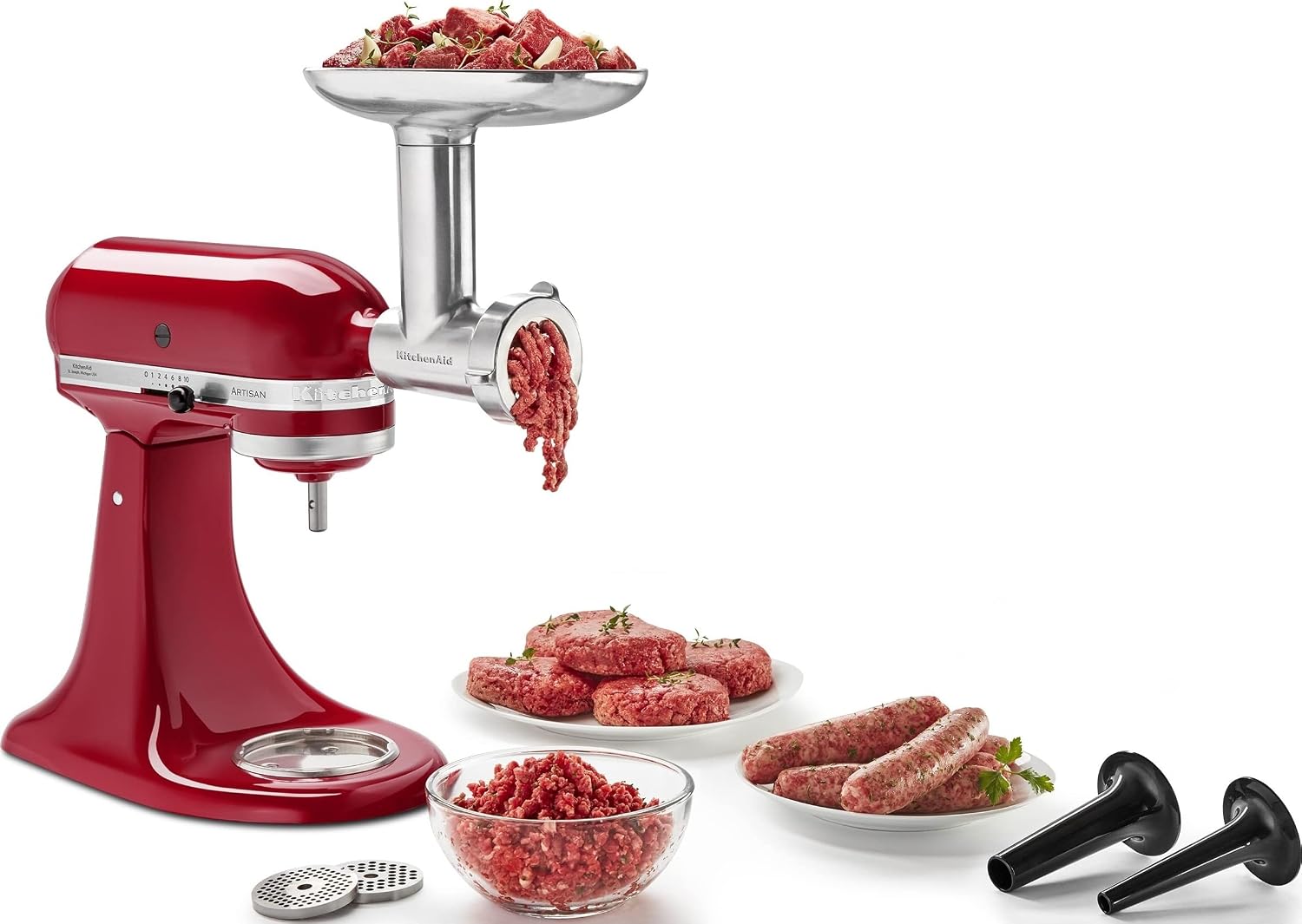
The KitchenAid Metal Food Grinder Attachment turns a KitchenAid stand mixer into a powered grinder for making burgers, sausages, hard cheese grating, and fresh breadcrumbs. You mount the unit on the mixer power hub, feed ingredients into the large tray, and the mixer drives the auger and interchangeable fine, medium, and coarse plates for different textures. The kit includes two sausage stuffer tubes, a sausage plate, a food pusher, and a storage case to keep everything organized. Because it is metal construction and designed to use the mixer's motor, it handles denser ingredients more reliably than plastic attachments and benefits from simple prep steps like pre-chilling meat to keep grinds clean. It is not a standalone appliance so you must already own a compatible KitchenAid stand mixer, and batch size is limited by the tray and mixer capacity rather than a dedicated grinder motor. For everyday home use it simplifies small-batch grinding and sausage making while storing compactly with the included case.
Best for: Home cooks who want a reliable, factory-quality grinder solution that leverages an existing KitchenAid mixer to make burgers, sausages, and fresh breadcrumbs without buying a separate motorized grinder.
Less Ideal for: People who need a dedicated, high-capacity standalone grinder for frequent large-volume processing or those without a KitchenAid stand mixer should look elsewhere.
- Uses the power of a KitchenAid stand mixer so no separate motor is needed
- Metal construction suited for tougher ingredients and regular use
- Includes fine, medium, and coarse plates plus sausage stuffer tubes for versatility
- Larger feed tray reduces repeated feeding and speeds prep
- Comes with a storage case to keep parts organized
- Requires a KitchenAid stand mixer to operate; not a standalone grinder
- Batch capacity constrained by the mixer and tray size for larger processing tasks
Verdict: If you already own a KitchenAid stand mixer and want a durable, versatile attachment for small-batch home grinding and sausage making, this metal grinder is a practical, factory-quality choice.
Choosing the Right Meat Grinder for Home Use: Key Factors to Consider
Motor Power and Torque
Motor power determines how easily a grinder processes different cuts and connective tissue. Higher wattage and robust torque reduce stalling when the feed contains sinew or higher fat content, which matters when you want consistent output without repeated re-feeds.
For home use, you do not always need commercial-grade horsepower, but choosing a model with a margin above your typical batches prevents overheating and reduces stress on gears. Consider whether the motor has thermal protection and whether the manufacturer rates continuous versus peak power.
Grind Plates and Blade Quality
The materials and finish of the cutting knife and grind plates dictate consistency and longevity. Hardened stainless components stay sharper longer and resist rust, which is important when you will be grinding frequently and rinsing parts.
Pay attention to plate hole sizes included with the unit and whether replacement or alternative plates are available. Different hole patterns and sizes allow you to move from coarse to fine grinds and adapt recipes without forcing meat through the wrong aperture.
Ease of Cleaning and Disassembly
Meat grinders need thorough cleaning after each use to prevent bacterial buildup. Units that disassemble without tools and have smooth, simple part shapes make washing and drying much faster and more reliable.
Also consider whether parts are dishwasher-safe, the number of small crevices where fat can accumulate, and how easy it is to remove the auger and cutting assembly. Faster cleaning reduces downtime between uses and lowers the chance of cross-contamination.
Feed System and Safety Features
A well-designed feed system speeds grinding and keeps hands safe. Look for large-capacity hoppers or trays if you frequently do big batches, and a robust pusher to avoid forcing meat with unsuitable tools.
Built-in safety features like overload cutoffs and secure locking mechanisms ensure the unit stops under strain and prevents accidental disassembly during operation. These features protect both the machine and the operator during typical home use.
Accessory Compatibility
Attachments expand what a grinder can do, turning it into a multi-use kitchen tool. Common accessories include sausage stuffing tubes, multiple plate sizes, kibbeh attachments, and reverse functions that help clear jams.
Consider whether the unit supports common accessory sizes or proprietary fittings. Accessory availability affects how versatile the machine will be for different recipes and preparations in a home kitchen.
Size, Weight, and Storage
Physical footprint matters when counter or cabinet space is limited. Heavier units tend to be more stable during operation, but they also require more storage planning and may be harder to move.
Think about where you will store the grinder, whether you need a folded or compact design, and how easily parts can be organized. A model that is more convenient to store is likelier to be used frequently rather than sitting idle.
How Grind Plate Size Affects Texture
Grind plate size is the primary tool for controlling texture. Larger holes yield coarse grinds suitable for chili or chunky sausages, while smaller holes create fine grinds good for burgers and pâtés. Choosing a grinder that includes a range of plate sizes or accepts industry-standard plates gives you flexibility across recipes.
When changing plates, make sure the blade and plate alignment is correct to avoid tearing meat or producing inconsistent cuts. Some home models include quick guides on which plate to use for specific outcomes, which can speed up experimentation.
- Coarse plates: stews, chili, rustic sausages
- Medium plates: classic burger texture
- Fine plates: smooth sausages, pâté, and kibbeh
Regular Maintenance Tips
Routine maintenance preserves performance and food safety. After each use, disassemble the feed parts, rinse with warm water and mild detergent, and dry parts thoroughly before storage. Lightly oiling non-food-contact shafts can prevent corrosion, but avoid oil on cutting surfaces that will touch meat.
Periodically inspect blades and plates for nicks or dullness. Replacing worn cutting edges restores grinding efficiency and reduces heat generated by the meat passing through the mechanism.
- Disassemble and dry all parts after washing
- Store plates and blades separately to avoid dulling
- Check seals and gaskets for wear periodically
Safer Sausage Stuffing at Home
If you plan to make sausages, look for units with dedicated stuffing tubes and a stable feed tray. A consistent, even feed helps achieve properly packed casings and reduces air pockets that can cause spoilage. Using the correct tube size for your casing type prevents overfilling and splitting.
Keep raw meat chilled until the moment you grind it, and work with cold equipment to minimize friction and fat smearing. These practical steps improve casing adhesion and final texture without requiring professional-level tools.
- Use cold meat and chilled parts for best results
- Select the correct stuffing tube for casing size
- Work in small batches to maintain control and consistency
Noise, Placement, and Countertop Impact
Grinders produce mechanical noise, so consider where you will use the unit. Heavier machines with rubber feet reduce vibration and noise transfer to the countertop. Placing a dampening mat under the unit can also limit movement during heavy loads.
Think about proximity to a grounded outlet and whether running the grinder will disrupt other appliances. For frequent use, choose a location where cleanup and storage are convenient to encourage regular operation.
- Use rubber feet or a dampening mat to reduce vibration
- Keep the grinder near a suitable outlet
- Avoid thin or unstable surfaces that amplify noise
When to Choose Electric Versus Manual
Electric grinders are faster and handle larger batches with less physical effort, which suits families or anyone who grinds regularly. They also offer more consistent output and better accessory support for sausages and other preparations.
Manual grinders can be fine for occasional use, small batches, or situations where electricity is unavailable. They tend to be quieter and simpler to store, but they require more effort and are less versatile for heavy-duty recipes.
- Electric: speed, consistency, and accessory options
- Manual: portability, simplicity, and lower upfront maintenance
How We Chose the Best Meat Grinder for Home Use
We focused on attributes that directly affect day-to-day use and long-term ownership for home cooks. Key evaluation criteria included motor power and torque to assess how well a grinder handles different cuts and fat levels; build quality and grinding components to evaluate durability and food-contact safety; ease of cleaning and disassembly because regular use needs fast, hygienic maintenance; and accessory and feed system versatility to support sausage stuffing, coarse and fine grinds, and other tasks. We excluded commercial-only gear and heavy industrial models that require a dedicated circuit or pro-only service. We also filtered out units with unclear materials on food-contact parts or models lacking basic safety features. Our short list emphasizes machines that balance realistic home-use capacities with sensible maintenance requirements and clear accessory support. Performance claims were weighed against typical home workloads rather than commercial throughput.
Our full evaluation process is outlined in our review methodology.
FAQ
How often should I sharpen or replace grinder blades?
Blade lifespan depends on frequency of use and what you grind. For regular home use, expect to sharpen or replace blades annually or when you notice tearing instead of clean cuts. Always inspect blades for nicks and replace sooner if you grind bone or very tough cuts.
Can I grind frozen meat?
Partially frozen meat is easier to grind because it stays firm and reduces smearing, but fully frozen blocks can damage the mechanism. Cut meat into small, cold chunks and chill the grinder parts before use for best results.
Are dishwasher-safe parts essential?
Dishwasher-safe parts can save time, but hand washing often provides better control to prevent corrosion and wear. If parts are dishwasher-safe, follow manufacturer guidance on rack placement and detergents to preserve finish and fit.
What cut of meat is best for burgers?
A balance of lean and fatty cuts creates juicy burgers. For many home cooks, blending a leaner chuck with a slightly fattier cut yields good flavor and moisture. Trim large silver skin or tough connective tissue before grinding for a better texture.
Is it safe to grind meat at home for sausages?
Yes, home grinding is safe when you follow hygienic practices: keep meat and equipment cold, clean parts thoroughly after use, and store or cook ground meat promptly. Proper casing handling and refrigeration are also important for safe sausage making.
Final Verdict
Choosing a meat grinder for home use comes down to matching capacity and features to how often and what you plan to grind. Prioritize motor power and torque if you will process tougher cuts or larger batches, and favor durable, easy-to-clean components for regular use. Accessory options and plate variety will determine how versatile the machine is for burgers, sausages, and other preparations. Decide whether speed and convenience or compact simplicity matter more to your kitchen routine, then pick a unit that balances grinding performance with straightforward maintenance. That approach will give you reliable results and make regular grinding a practical part of home cooking.