
Note: This article contains affiliate links. If you click on these links and make a purchase, we may earn a small commission at no extra cost to you. This helps support our research and content. Read our full affiliate disclosure here.
If you plan to grind large quantities of meat or work with tougher cuts, a Powerful Meat Grinder makes the job faster and more consistent than handheld methods. The right grinder reduces strain on your hands, speeds up batch prep, and produces a uniform texture that improves seasoning and cook times. This guide covers six shortlisted, top-rated Powerful Meat Grinders suited for heavy home use. We evaluated machines for motor output, build durability, throughput, and ease of cleaning to help you choose the model that matches your workload and kitchen setup. Read on for what mattered in our selection and practical tips to match a grinder to your needs.
Top Picks at a Glance
| Best Overall The best all-around choice for most situations | STX Turboforce II 4000 |  |
| Best Quality Built to a higher standard if you want something more solid | Weston Butcher Series #22 Grinder |  |
| Best Value The sweet spot between price and what you get | Aiheal Electric Meat Grinder MG-2430RB |  |
| Best Budget The cheapest option that still gets the job done reliably | ALTRA LIFE Meat Grinder MGAC13 |  |
| Top Rated A top-rated pick with lots of positive feedback | LEM BigBite #8 Meat Grinder |  |
| Most Popular A crowd favorite that many people choose with confidence | STX Turboforce 3000 Meat Grinder |  |
STX Turboforce II 4000
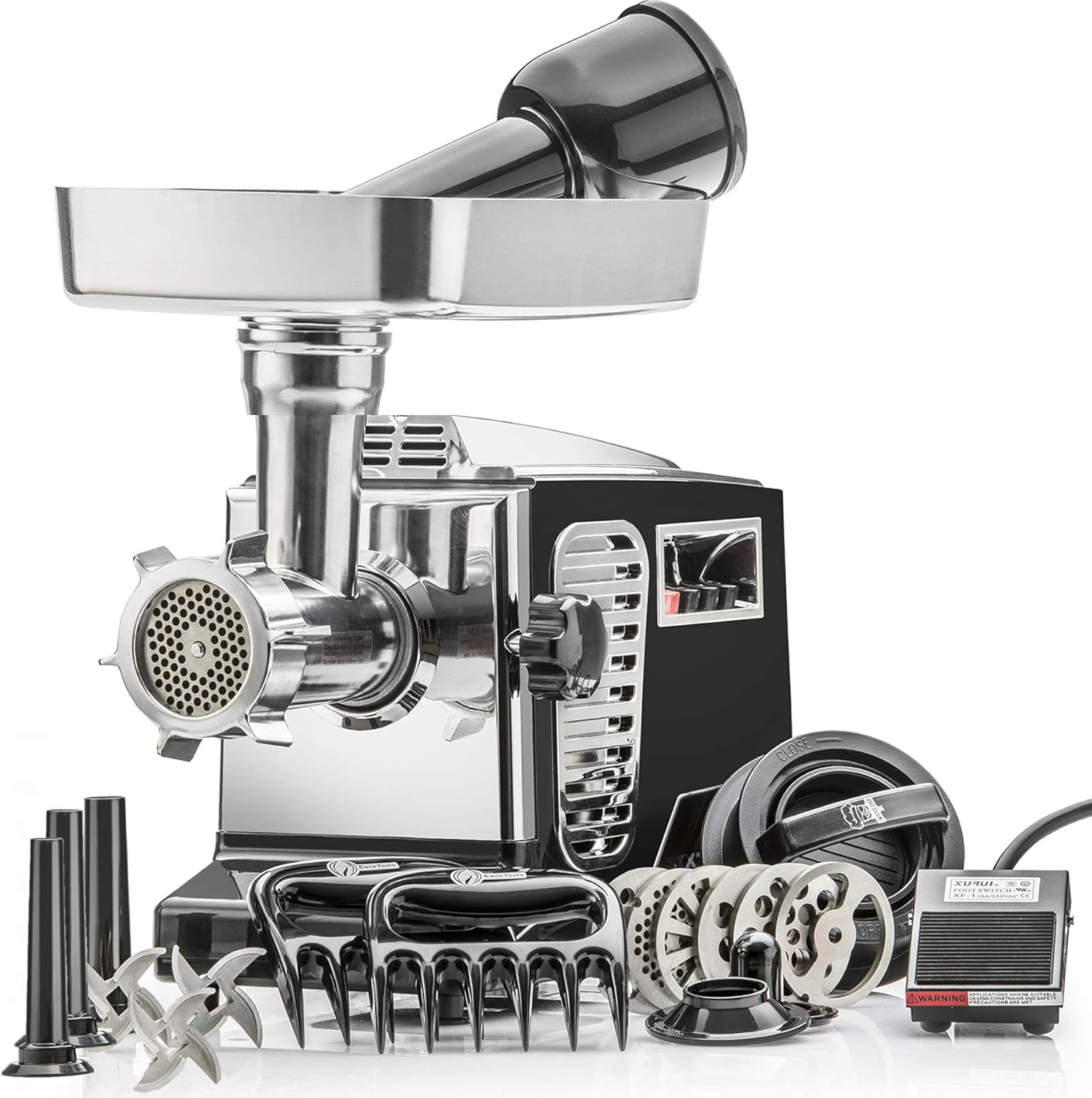
| Wattage | 2000 watts |
|---|---|
| Capacity | 3 pounds |
| Voltage | 120 volts |
| Included Components | Grinding head, meat pusher, 6 grinding plates, 3 cutting blades, sausage tubes, kubbe attachment, foot pedal |
| Power Source | Electric |
The STX Turboforce II 4000 is a high-capacity home meat grinder built for frequent use and larger batches. Its 2000-watt locked motor with a patented air-cooled induction system and circuit breaker keeps the unit running cooler during long grinding sessions while the large tray and size No.12 head let you feed more meat at once. Included accessories cover common tasks: multiple grinding plates and cutting blades, sausage tubes, a kubbe attachment, meat claws, and a patty press, and the foot pedal gives practical hands-free operation when stuffing or making large volumes. The grinder handles soft bones and claims throughput of roughly 220 to 260 pounds per hour depending on plate and meat, which makes it suitable for serious hobbyists and small-batch production. Trade-offs are its footprint and weight compared with compact home grinders and the need to follow the manufacturer cleaning and safety guidance for a powerful motorized unit. For buyers who want a robust, well-equipped grinder for frequent use, this model delivers strong performance and useful accessories.
Best for: Buyers who want a robust, high-capacity home grinder for regular large batches, sausage making, and other butchery tasks and who value included accessories and a powerful motor.
Less Ideal for: Casual users who only grind small quantities occasionally or need a compact, lightweight countertop unit better suited to limited space.
- Powerful 2000-watt motor with air-cooled system for sustained heavy use
- Size No.12 grinder head and large tray for higher throughput
- Comprehensive accessory kit including multiple plates, blades, sausage tubes, kubbe attachment, meat claws, and patty press
- Foot pedal control for hands-free operation during stuffing and continuous grinding
- Heavier and larger than smaller home grinders, requiring more counter or storage space
- Claims high throughput depend on plate selection and meat type, so real-world speed varies
Verdict: If you need a serious, well-equipped home grinder for large batches and sausage work, the STX Turboforce II 4000 delivers industrial-strength power and a full accessory kit.
Weston Butcher Series #22 Grinder

| Wattage | 750 watts |
|---|---|
| Capacity | 14 pounds per minute |
| Power Source | AC adapter |
| Material Type | Stainless Steel |
The Weston Butcher Series #22 is built for heavy-duty home or light commercial use, driven by a 1 HP (750 watt) air-cooled motor that grinds up to 14 pounds of meat per minute. It uses a rifled-head and tapered throat to feed meat efficiently without a tray guard, and the package includes coarse and fine stainless steel plates, a grinder knife, an auger-grabbing stomper, and a sausage stuffer kit with multiple funnels. A forward-reverse mode helps clear jams and handle tougher cuts with connective tissue. In practice this model shines when you need fast throughput for bulk grinding tasks like processing whole chickens, roasts, or large batches for sausage; the permanently lubricated motor and stainless construction aim for long runtime and durability. Downsides are its weight and size for casual users and the louder operation compared with small tabletop grinders, so it is better suited to users needing raw power and continuous grinding rather than occasional countertop use.
Best for: Buyers who prioritize raw grinding power and speed for processing large quantities of meat or making sausages frequently and want a durable, built-for-duty machine.
Less Ideal for: People who only grind small amounts occasionally or need a lightweight, quiet countertop unit should consider simpler, smaller grinders instead.
- Powerful 1 HP (750 W) motor for continuous, high-volume grinding.
- Grinds up to 14 pounds per minute for efficient bulk processing.
- Includes coarse and fine stainless steel plates, knife, stomper, and sausage stuffer kit for versatile use.
- Forward-reverse function helps clear jams and process tougher cuts.
- Stainless steel construction for durability and food-safe surfaces.
- Heavy and sizable compared with compact household grinders, limiting portability.
- Louder operation during heavy use compared with smaller consumer models.
Verdict: Pick this Weston Butcher Series #22 if you need a rugged, high‑throughput grinder that handles continuous, heavy-duty meat processing and sausage making.
Aiheal Electric Meat Grinder MG-2430RB

| Capacity | 44 pounds |
|---|---|
| Material Type | Stainless Steel |
| Power Source | Electric |
| Included Components | 2 Blades, 3 Plates, 3 Sausage Tubes, 1 Pusher |
This Aiheal electric meat grinder is built for home users who need higher throughput and basic commercial-style features without a pro price. The unit uses a 300W continuous motor with a 3200W peak rating and a pure copper motor core to process beef, pork, chicken, venison and fish; its metal feed tube, three cutting plates (2mm, 5mm, 7mm), two blades and three sausage stuffing tubes let you switch between fine grinding, coarser mince and sausage making. The machine includes an R reverse/unclogging button and overload protection that cuts power if the motor overheats. In practice it handles batch grinding quickly and the removable attachments make cleanup straightforward, though the manufacturer warns against dishwasher use. The stainless steel construction and included pusher give a durable, food-safe feel, while the locking knob and safety features add confidence for regular use. For users expecting continuous commercial duty, the motor rating and recommended home use suggest occasional cool-downs and moderate workloads are prudent.
Best for: Buyers who want a capable home grinder that can handle frequent batch grinding and sausage making and who prioritize durable construction and practical safety features.
Less Ideal for: This is not the best choice for small commercial shops or users needing nonstop industrial duty or fully dishwasher-safe parts.
- Three grinding plates and three sausage tubes for versatile grind sizes and sausage making
- Pure copper motor with overload protection for more durable operation
- Stainless steel construction and removable attachments for food-safe handling and easier cleaning
- Reverse/unclogging button helps clear jams without disassembly
- Not intended for continuous commercial heavy use despite high peak watt claim
- Attachments are removable but not dishwasher safe
Verdict: Aiheal’s grinder is a practical, higher-throughput home machine that combines durable stainless-steel parts and useful sausage-making accessories for serious home use.
ALTRA LIFE Meat Grinder MGAC13

| Power source | Corded Electric |
|---|---|
| Rated/Peak power | 350W rated, 2300W max peak |
| Capacity | 3 pounds |
| Grinding plates | 3 sizes (Fine/Medium/Coarse) |
This ALTRA LIFE grinder is built for home cooks who want a lot of power without a commercial price tag. The motor is rated 350W with a 2300W peak, which the brand says can handle about 3 pounds of meat per minute and helps push through tougher cuts or game. It ships with two cutting blades, three stainless steel grinding plates (fine, medium, coarse), a sausage stuffing tube, and a kibbe/kubbe attachment, so you can grind for burgers, sausages, and regional recipes without buying extras. Safety features include overload and overheat protection plus a reverse function to clear jams, and most food-contact parts are stainless steel or BPA-free plastic and removable for cleaning. Practical limitations are dishwasher cautions for some metal parts and the unit uses aluminum alloy components that the brand warns may discolor if washed in a dishwasher. For buyers prioritizing power and bundled accessories on a budget, this unit delivers strong performance, but those needing continuous commercial duty or fully dishwasher-safe metal parts should consider higher-end models.
Best for: Buyers seeking a budget-friendly, high-power grinder with useful accessories who plan to grind batches for burgers, sausages, or home-prepared pet food and value performance per dollar.
Less Ideal for: People who need continuous commercial-grade operation or who require every metal component to be dishwasher-safe should look at heavier-duty, professional units.
- High peak motor power for faster grinding and handling tougher cuts
- Includes two blades and three stainless steel plates for fine to coarse textures
- Comes with sausage stuffing tube and kubbe attachment, expanding recipe options
- Safety features: overload/overheat protection and reverse function to clear jams
- Most food-contact parts are removable and made from stainless steel or BPA-free plastic for cleaning
- Some aluminum alloy parts are not dishwasher safe and may oxidize
- Manufacturer recommends hand-washing and oiling plates to maintain longevity
Verdict: A powerful, well-equipped grinder that gives strong home-use performance and versatile sausage and kubbe accessories at a budget-friendly price.
LEM BigBite #8 Meat Grinder

| Capacity | 7 pounds |
|---|---|
| Material Type | Stainless Steel |
| Power Source | electric |
| Horsepower | 0.5 HP |
The LEM BigBite #8 is a sturdy, commercial-style electric grinder built for repeated home use. Its stainless steel construction and permanently lubricated 0.5 HP motor handle steady workloads and the unit processes roughly 7 pounds of meat per minute, making it useful for burgers, sausages, pet food, and bulk meal prep. It ships with three grinding plates, a knife, stomper, and sausage-stuffing tubes, and disassembles for cleaning, which keeps maintenance straightforward. Noise-dampening design makes operation quieter than many similar-capacity grinders, and the included parts and accessible replacement support mean you can keep it running long term. The grinder is not rated for bones, so users must trim meat first, and at over 30 pounds it is a heavy bench unit that needs a dedicated spot. Overall it delivers dependable, pro-style grinding for buyers who need a durable machine for frequent use rather than a lightweight occasional appliance.
Best for: Buyers who prioritize a long-lasting, workhorse grinder for regular batch processing and want a machine they can rely on for sausage making and bulk prep.
Less Ideal for: People who need a lightweight, highly portable grinder or want a model that can process bones should consider different options.
- Stainless steel construction for durability and easy cleaning
- 0.5 HP motor rated for regular use and continuous grinding
- Processes about 7 pounds per minute for efficient batch prep
- Includes three plates, knife, stomper, and stuffing tubes for versatile use
- Not designed to grind bones, requiring pre-trimming of meat
- Heavy, bench-style unit that is less portable for occasional users
Verdict: Choose the LEM BigBite #8 when you need a reliable, heavy-duty grinder built for frequent home use and sustained batch processing.
STX Turboforce 3000 Meat Grinder

| Wattage | 1800 watts |
|---|---|
| Capacity | 3 pounds |
| Voltage | 110 volts |
The STX Turboforce 3000 is a powerful home meat grinder built around a size 12 grinding head and a high-capacity hopper that holds roughly 3 pounds of prepped meat. It is typically used for grinding large batches of beef, pork, or poultry for burgers, sausages, and kibbe using the included five grinding plates, three sausage tubes, kubbe attachment, and burger press. The unit's heavy-duty construction and 304 stainless steel cutting blades let it process 180 to 240 pounds of meat per hour when meat is properly prepared, and the AVI auger design helps feed larger pieces. Practical benefits include the variety of included accessories and a design geared to sustained home use rather than light occasional tasks. Important limitations are that it is not suitable for grinding bones, tendons, vegetables, nuts, or fruit, and it is intended for home rather than commercial use; the claimed maximum wattage is higher than its typical operating draw, so buyers should expect heavy but not industrial performance. Noise and footprint are typical for high-capacity grinders and should be planned for in a home kitchen.
Best for: Buyers who want a robust home grinder that can handle large batches and multiple sausage or burger projects and who value included attachments and proven user feedback.
Less Ideal for: People needing a commercial-grade machine for nonstop restaurant use or those who need bone-crushing or multi-material grinding capabilities.
- Size 12 grinding head with a large hopper for continuous batch grinding
- Includes five grinding plates, three sausage tubes, kubbe attachment and burger press for versatile use
- 304 stainless steel cutting blades and aluminum head for durable food-contact parts
- High throughput capability of 180–240 pounds per hour when meat is properly prepped
- Not designed to grind bones, tendons, vegetables, nuts, or fruit
- Intended for home use only and not suitable for commercial, continuous industrial workloads
Verdict: Choose the STX Turboforce 3000 if you want a heavy-duty home grinder with high throughput and a broad set of attachments for sausages, burgers, and kibbe.
Choosing the Right Powerful Meat Grinder: Key Factors to Consider
Motor Power and Torque
Higher continuous motor power and sufficient torque directly affect a grinder's ability to process dense cuts or partially frozen meat without stalling. A grinder with a strong, well-cooled motor will maintain speed under load, reducing the need to feed small pieces or wait for the unit to recover. Consider how often you will grind and whether you plan to handle tougher tasks such as grinding bones for pet food or processing large batches for sausage making.
Motor cooling and duty cycle matter too. Some home-oriented heavy-duty grinders can run for longer continuous periods, while others require rest breaks to avoid overheating. If you expect to process multiple pounds in a session, prioritize power ratings and any manufacturer duty-cycle guidance.
Throughput and Feed System
Throughput, often expressed in pounds per hour, gives a practical sense of how quickly a machine will process meat under normal conditions. High theoretical numbers sometimes reflect optimal test conditions; look for realistic throughput tied to motor and auger design. A well-matched feed system and auger profile push meat efficiently toward the cutting plate and reduce the chance of clogging.
Also consider hopper size and feed-tube geometry. Larger hoppers and wide feed tubes reduce the need to stop and reload during big batches. If you plan to make large quantities of sausage or ground meat regularly, a grinder with higher real-world throughput will save time and reduce operator fatigue.
Construction and Component Durability
Grinders that use heavy-gauge metal housings, stainless-steel feed tubes, and hardened steel cutting components last longer when used heavily. Plastic components can be fine for light use but tend to wear or crack under higher loads. Look for metal gears or robust gearbox housings and easily serviceable parts such as removable augers and replaceable knives.
Durability also affects long-term maintenance costs. Machines designed for heavier use typically offer parts that resist warping and corrosion. When evaluating durability, consider how easily you can access wear items and whether replacement components are standard sizes.
Cut Quality and Versatility
The quality of the grind affects texture, binder absorption for sausages, and final cooking results. A grinder that accepts multiple plate sizes and a sharp, stable knife will produce consistent particle sizes and reduce heat buildup that can smear fat. Plate variety also expands use cases from coarse burger blends to fine pâté preps.
Check whether the grinder includes or supports interchangeable plates and specialized attachments for sausage stuffing or kibbeh. Versatility matters if you plan to experiment with different grinds or make processed products beyond simple ground meat.
Ease of Cleaning and Maintenance
Because meat grinders handle raw protein and fat, straightforward disassembly and cleaning are essential for food safety and longevity. Machines with tool-free disassembly, stainless or nonporous surfaces, and parts that fit in standard sinks streamline cleanup. Complex assemblies with hard-to-reach crevices increase the time to sanitize and can harbor residue.
Consider how easy it is to remove and sharpen knives, replace plates, and reassemble the unit. Regular lubrication points and simple access to the gearbox or motor plate for maintenance reduce downtime and preserve performance.
Sausage and Accessory Support
If you plan to make sausages or other processed products, accessory support will determine how practical the grinder is for those chores. Quality sausage funnels, stuffing tubes, and dedicated plates make stuffing consistent and reduce waste. Attachments that are sturdy and match the grinder's throughput avoid bottlenecks during stuffing.
Also consider whether the grinder accepts standard accessory sizes so you can expand functionality over time. Accessories that are easy to attach and clean contribute to smoother workflow during multi-step prep sessions.
How to Size a Grinder for Your Workload
Estimate your typical batch size and frequency before selecting a machine. A household that grinds a few pounds monthly can get by with a lighter-duty powerful grinder, while weekly or multiple-batch cooks benefit from a higher-capacity unit with a larger hopper and stronger motor.
Also think about future needs. If you anticipate scaling up sausage production or processing whole animals occasionally, choose a model with a higher nominal throughput and stronger construction to avoid buying twice.
- Match motor torque to expected cut toughness
- Choose larger hopper and feed tube for big batches
- Account for duty cycle to avoid overheating
Practical Tips for Grinding Tough or Partially Frozen Meat
Partially freezing meat firms up connective tissue and fat, which prevents smearing and produces a cleaner grind. Work in small, uniform chunks and chill feed pieces before grinding. Avoid fully thawed, warm meat when aiming for firm texture.
Feed slowly and keep an eye on the motor temperature. If the machine slows, stop and give it a brief rest. Using the correct plate size and a sharp knife also reduces resistance and improves texture.
- Cut meat into 1-inch cubes and chill before grinding
- Use a coarser plate for the first pass if meat is dense
- Monitor motor heat during long sessions
Maintaining Blades and Plates for Best Results
Sharpening and replacing knives and plates keeps grind quality consistent. Dull blades create heat and tear meat, leading to a mushy texture and uneven particle sizes. Inspect cutting edges regularly and replace or regrind when performance drops.
Store plates and knives dry and lightly oiled to prevent corrosion. During cleaning, avoid harsh impacts that could nick cutting edges, and reassemble components carefully to maintain alignment.
- Rotate plates periodically to even wear
- Lightly oil cutting components after drying
- Replace knives at the first sign of chipping or dullness
Setting Up a Safe and Efficient Grinding Station
Organize a dedicated area with space for a hopper, bowls for ground product, and a sanitized cutting board for feed pieces. Keep cleaning supplies and a brush nearby to address small clogs quickly without contaminating the workspace.
Use a stable surface and secure the grinder according to the manufacturer's assembly guidelines. Proper cord management and splash containment keep cleanup easier and reduce hazards when working with wet raw meat.
- Have chillers or ice packs for feed pieces
- Use food-safe brushes and sanitizers
- Keep a spare cutting plate and knife on hand
Noise, Vibration, and Installation Considerations
Heavy-duty grinders can be louder and produce more vibration than light-duty units. Consider placing the machine on a dense, vibration-damping mat or a sturdy countertop to reduce noise transmission. For frequent use, choose a location where sound and cleanup are manageable.
Also account for ventilation and motor cooling. Avoid enclosed cabinets during long runs and ensure the motor ventilation ports are clear of obstructions to prevent overheating.
- Use anti-vibration pads under the grinder
- Allow clearance for motor ventilation
- Locate near a sink for easier cleaning
How We Chose the Best Powerful Meat Grinder
We prioritized machines designed for frequent, heavy-duty home use rather than occasional countertop models. Our selection criteria focused on quantifiable, category-specific performance measures: continuous motor power and torque to handle dense or partially frozen cuts; throughput capacity measured as pounds per hour for realistic batch expectations; metal construction and component durability for long-term reliability under heavier loads; variety and quality of cutting plates and knives to achieve consistent grind textures; and ease of cleaning and maintenance because grease and meat residue affect performance and hygiene. We excluded lightweight hobby units and attachments intended only for occasional use. We also filtered out units with unclear motor ratings or minimal metal components. The final list emphasizes measurable capability and practical durability: sustained motor output, real-world throughput, robust metal feed systems, replaceable cutting components, and straightforward disassembly for cleaning. These dimensions informed our scoring and are the same criteria we used to surface grinders suitable for heavy home processing.
Our full evaluation process is outlined in our review methodology.
FAQ
How much horsepower do I need for home sausage making?
It depends on batch size and meat toughness. For occasional batches a modest high-torque motor is usually sufficient. If you process large volumes or denser cuts regularly, choose a higher continuous-power motor to avoid stalling.
Can I grind partially frozen meat with a powerful home grinder?
Often yes. Partially frozen meat grinds cleaner and helps prevent smearing, but verify that the grinder's motor and duty cycle support the extra resistance. Feed smaller pieces and monitor the motor for heat buildup.
How do I know when cutting plates or knives need replacement?
When you notice increased tearing, inconsistent particle size, or unusual motor strain, the cutting edges are likely dull. Regular inspection and a drop in grind quality are reliable signals to resharpen or replace components.
Are metal gears necessary for durability?
Metal gears are preferred for heavy use because they better resist wear under load. Plastic gears can suffice for occasional household grinding but tend to wear faster with frequent, heavy batches.
What maintenance keeps a grinder running reliably?
Regular cleaning after each use, drying and lightly oiling metal parts to prevent corrosion, inspecting and sharpening knives, and ensuring ventilation around the motor are key maintenance steps. Periodic checks of fasteners and seals also prevent surprises during heavy sessions.
Final Verdict
Choose a Powerful Meat Grinder by balancing motor power and torque with the throughput you expect to run. Prioritize durable metal components and easy disassembly if you plan frequent or large-batch grinding, and select plate and knife options that match the textures you want to produce. Remember that higher capacity and better cooling reduce downtime but may increase noise and footprint. Focus on the dimensions described here to match a grinder to your workflow and get consistent, safe results for years of heavy home use.