
Note: This article contains affiliate links. If you click on these links and make a purchase, we may earn a small commission at no extra cost to you. This helps support our research and content. Read our full affiliate disclosure here.
Choosing the right meat grinder for the money matters if you make ground meat at home regularly or want better control over texture and ingredients. The wrong grinder can slow prep, overheat on tough cuts, or create inconsistent grind sizes that affect recipes. This guide highlights six top options shortlisted for everyday home use, focusing on power, durability, and simple cleanup. We evaluated units based on motor performance, build quality, and user-centered features so you can match a grinder to how often and how much you plan to grind. Read on for a concise breakdown of what matters and which features deliver the best value.
Top Picks at a Glance
| Best Overall The best all-around choice for most situations | STX Turboforce 3000 Meat Grinder |  |
| Best Value The sweet spot between price and what you get | AAOBOSI Meat Grinder MGC04 |  |
| Best Budget The cheapest option that still gets the job done reliably | LHS Manual Meat Grinder 9303 |  |
| Top Rated A top-rated pick with lots of positive feedback | ALTRA LIFE Meat Grinder MG090 |  |
| Most Popular A crowd favorite that many people choose with confidence | AAOBOSI Meat Grinder KS-MGG100 |  |
| Best Seller A high-volume bestseller chosen again and again | Aiheal Electric Meat Grinder MG-2430RB |  |
STX Turboforce 3000 Meat Grinder

| Wattage | 1800 watts |
|---|---|
| Capacity | 3 pounds |
| Voltage | 110 volts |
The STX Turboforce 3000 is a roomier, higher-power home meat grinder designed to process family-sized batches at a steady clip. It uses a size #12 aluminum grinding head, a wide hopper that holds about 3 pounds of prepped meat, and an auger with variable intake to feed larger pieces; in practice that combination lets you grind coarse or fine textures using the included five plates and three stainless cutting blades. The unit comes with sausage tubes, a kubbe attachment, claws for handling meat, and a burger/slider press, so it covers common tasks beyond straight grinding. The motor is rated up to 3000W max though typical load draw runs lower, which translates to fast throughput when meat is properly cubed and chilled. Important limits: the head is not designed to grind bones, tendons, produce, or nuts, and the unit is intended for home rather than commercial use. Expect a relatively large footprint and basic controls rather than a compact countertop appliance.
Best for: Home cooks who make frequent batches of ground meat and want a durable, versatile grinder that handles large portions and multiple tasks without commercial-level complexity.
Less Ideal for: Those needing a compact countertop unit for occasional light use or buyers who require bone-crushing or heavy commercial throughput.
- Large 3 lb hopper for continuous batches reduces reloads during prep
- Size #12 head and multiple grinding plates allow coarse to fine textures
- Includes sausage stuffing tubes, kubbe attachment and burger press for versatile use
- Stainless steel cutting blades and aluminum grinding head are durable for home use
- Not designed to grind bones, tendons, vegetables, or non-meat items
- Bulky footprint that requires counter or storage space
Verdict: Choose the Turboforce 3000 when you want a powerful, full-featured home grinder that handles family-size batches and a range of sausage and burger tasks.
AAOBOSI Meat Grinder MGC04

| Wattage | 2800 watts |
|---|---|
| Capacity | 1.5 kg |
| Voltage | 120 volts |
| Power Source | electric |
The AAOBOSI MGC04 is a countertop electric meat grinder designed to handle everyday home grinding tasks with a robust motor and a set of practical attachments. It accepts whole cuts in the top hopper and pushes meat through interchangeable stainless steel plates to produce coarse to fine grinds, and includes sausage stuffing tubes, a kubbe maker, and slicing/shredding blades for extra versatility. The metal housing and included stainless blades and plates make it straightforward to clean and durable for repeated use, while built-in overload protection, a reverse function, and ventilation holes help prevent jams and overheating during longer runs. Its 1.5 kg per minute processing rate (with the 7 mm plate) and 120 V, 2800 W rating indicate it can move through batches quickly, though the unit is intended for boneless meat only to avoid clogging. For buyers who want a multifunction appliance that covers basic grinding, sausage making, and light shredding without professional cost, this model balances power and included accessories, but users should plan for regular cleaning and avoid heavy continuous commercial use.
Best for: Buyers who want a capable, multipurpose home meat grinder that speeds up batch prep and includes sausage and kubbe attachments for occasional charcuterie or meal-making projects.
Less Ideal for: People who need a commercial-grade grinder for continuous heavy-duty use or who plan to grind bones or very tough cuts regularly should choose a commercial unit instead.
- Comes with multiple stainless steel plates and blades plus sausage stuffer and kubbe kit for diverse tasks
- High-wattage motor and ventilation/overload protection support faster batch grinding
- Durable food-grade stainless steel exterior and removable parts for easier cleaning
- Reverse function helps clear clogs without disassembly
- Not designed to grind bones or very tough sinew which can cause jams
- Intended for home use rather than continuous commercial operation
Verdict: A feature-rich, high-power home meat grinder that delivers fast, versatile batch processing and includes useful sausage and kubbe attachments for the money.
LHS Manual Meat Grinder 9303

| Power Source | Manual |
|---|---|
| Material Type | Acrylonitrile Butadiene Styrene, Stainless Steel |
| Included Components | Lid; Sausage Tube; Cutting Plates |
| Number of Items | 1 |
This LHS manual meat grinder is a hand-crank unit designed for small-scale home grinding tasks like burgers, meatballs and homemade sausages. It mounts to a smooth counter or tabletop with a twist-down suction base so you can work without a clamp, and the transparent hopper makes it easy to monitor feed. The package includes two stainless steel blades for coarse and fine grinds, a sausage stuffing tube and dough/cookie shaper, which expand its uses beyond meat. Because it is manual, it needs no power and the long handle reduces effort on tougher cuts, but throughput is slower than electric grinders and very hard or frozen meat is not recommended. Assembly and cleaning are straightforward since most parts are removable and blades are stainless steel, though the body is mainly heavy-duty plastic rather than metal. For buyers prioritizing an inexpensive, compact grinder for occasional home use, this covers the essentials without electrical complexity.
Best for: Buyers who want an affordable, compact grinder for occasional home meals and DIY sausage or cookie projects and who prefer a simple, no-electricity tool.
Less Ideal for: People who need high-volume or commercial-level grinding, or who will regularly process very hard or partially frozen meat should look at electric or heavy-duty metal grinders instead.
- Suction base secures unit to smooth counters without clamps
- Includes coarse and fine stainless steel grinding plates and a sausage stuffing tube
- Transparent hopper lets you watch the grinding process
- Manual operation requires no electricity and has a long handle for leverage
- Plastic body rather than metal may feel less durable under heavy use
- Suction base requires a smooth, dry edge of counter to work reliably
Verdict: An inexpensive, no-power countertop grinder that delivers basic home grinding and sausage-making features for budget-minded cooks.
ALTRA LIFE Meat Grinder MG090

| Wattage | 350 watts |
|---|---|
| Voltage | 120 volts |
| Capacity | 180 pounds |
| Included Components | 3 grinding plates, 2 blades, sausage tubes, kubbe attachment, grater, burger press, meat claws |
The ALTRA LIFE MG090 is a full accessory electric meat grinder built for regular home use and batch processing. Its 350W rated motor (advertised 2800W max locked) runs through common meats and soft bones and the unit includes three stainless steel plates, two cutting blades, sausage tubes, kubbe attachment, burger press, grater and meat claws so you can grind, stuff sausages and shape burgers without buying extras. The machine has a removable head and stored accessory compartment for easier cleanup and organization, and safety features such as a lock knob, reverse to clear jams and overload/overheat protection. In practice it grinds quickly for household needs and handles steady workloads, but the listing warns against continuous runs longer than 10 minutes to avoid overheating, so very large commercial loads are not appropriate. Some alloy parts require hand drying to prevent darkening while the main plates and blades are stainless and dishwasher-safe. For cooks who want a well-equipped, dependable grinder for homemade sausages, burgers and pet food, this covers the bases without complicated controls.
Best for: Buyers who prioritize a reliable, fully equipped grinder for regular home sausage and burger making and who want safety protections and accessory storage built into the unit.
Less Ideal for: People who need a heavy commercial grinder for continuous large-volume processing or professional shop use should consider higher-duty, commercial-rated equipment instead.
- Comes with comprehensive accessories (plates, blades, stuffing tubes, kubbe maker, grater, burger press) so you can start grinding and stuffing right away.
- Stainless steel grinding plates and blades are dishwasher-safe for easier cleaning.
- Built-in storage compartment keeps accessories organized on the unit.
- Safety features include a locking knob, reverse function to clear jams and overload/overheat protection.
- Designed for steady home use with a copper motor that delivers quick grinding performance for routine batches.
- Not intended for long continuous commercial use—manufacturer advises against runs over 10 minutes to prevent overheating.
- Some alloy/alloy-coated parts require hand drying to avoid oxidation or darkening.
Verdict: A well-equipped, safety-minded home meat grinder that delivers dependable everyday performance for sausages, burgers and small batch processing.
AAOBOSI Meat Grinder KS-MGG100
| Wattage | 3000 watts (peak) / 800 watts rated |
|---|---|
| Capacity | 4.5 pounds per minute |
| Voltage | 120 volts |
| Material Type | Stainless Steel |
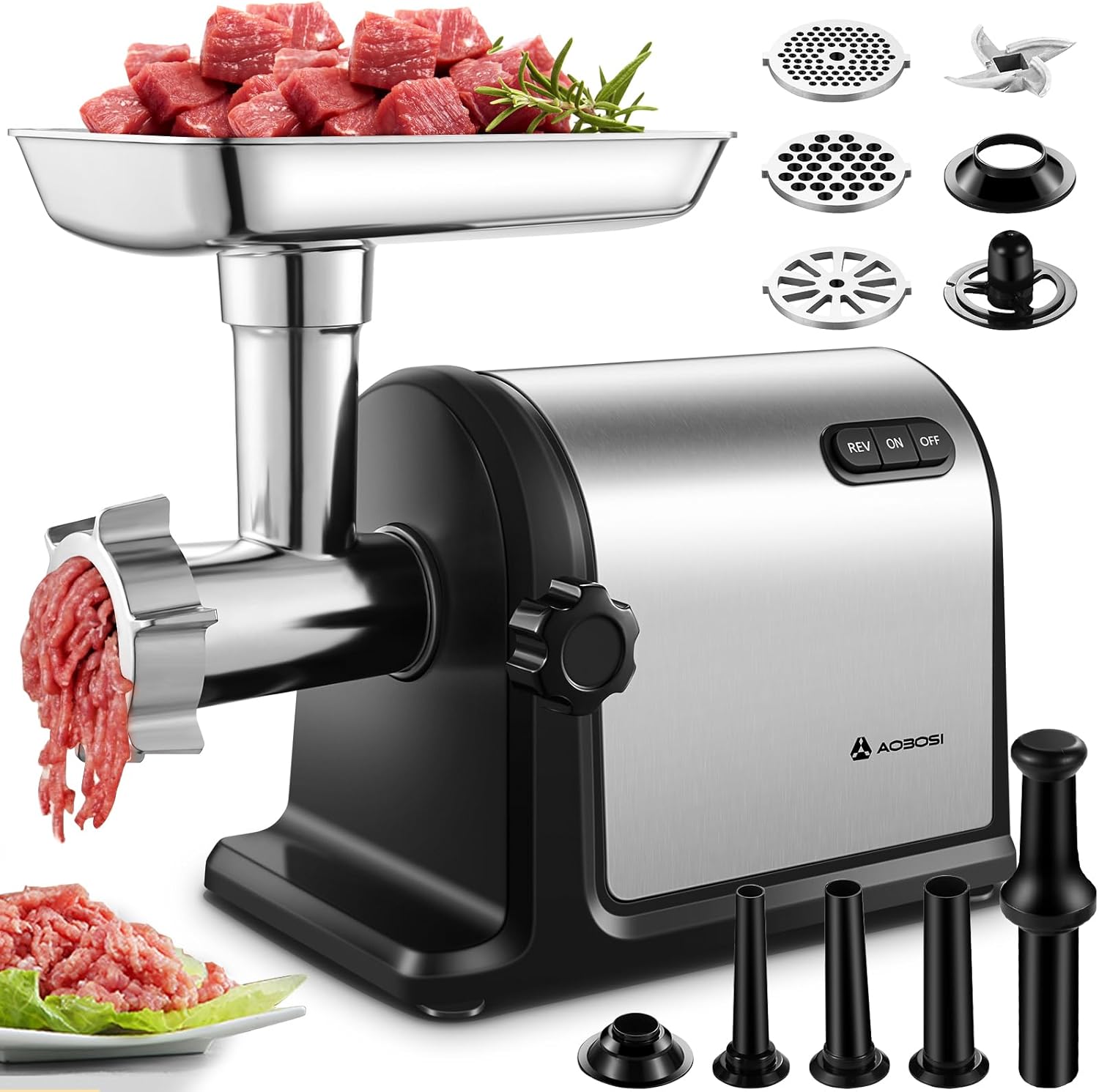
The AAOBOSI KS-MGG100 is a stainless-steel electric meat grinder built for high-throughput home use. Its peak 3000W (800W rated) motor and full-metal gearbox let it push up to 4.5 pounds per minute, and the included coarse, medium, and fine cutting plates plus three sausage tubes and a kubbe kit make it useful for burgers, meatballs, sausages, and other ground-meat recipes. Operation is simple with a single button that offers forward, off, and reverse to clear jams, and the detachable feeding tray and removable head make setup and hand-washing straightforward. Practical safety touches include a circuit breaker to help prevent motor burnout. Expect a substantial countertop footprint and that some components require immediate drying after washing to avoid oxidation; the listing advises hand washing rather than dishwasher use. For buyers who want a powerful, versatile grinder that can handle frequent batches and sausage making, this model delivers strong performance, but it is a heavier, more industrial-feeling unit compared with compact kitchen grinders.
Best for: Buyers who prioritize high throughput and versatile sausage or kubbe-making features and want a rugged, performance-focused grinder for regular home use backed by visible customer reviews.
Less Ideal for: If you need a compact, lightweight grinder for occasional small batches or want fully dishwasher-safe components, choose a simpler countertop model instead.
- High peak power and metal gearbox for heavy-duty grinding performance
- Includes three cutting plates plus three sausage tubes and a kubbe attachment for versatile recipes
- One-button forward/off/reverse control simplifies operation and jam clearing
- Detachable feeding tray and removable head for easier cleaning and part access
- Manufacturer recommends hand washing and immediate drying because some parts can oxidize, which adds cleaning care
- Large and heavy footprint may be overkill for occasional or very small-quantity use
Verdict: Choose this AAOBOSI grinder when you want a heavy-duty, versatile home unit that handles high-volume grinding and sausage making with professional-style power.
Aiheal Electric Meat Grinder MG-2430RB

| Motor power | 300W (3200W max locked power) |
|---|---|
| Plates included | 2mm / 5mm / 7mm |
| Included components | 2 blades, 3 plates, 3 sausage tubes, pusher |
| Material type | Stainless Steel |
| Capacity | 44 pounds |
This Aiheal electric meat grinder is built for at-home use when you want to grind whole cuts and make sausages without a lot of fuss. It uses a copper motor rated 300W (3200W peak locked power) and includes three stainless steel plates (2mm, 5mm, 7mm), two cutting blades, and three sausage tubes so you can make fine to coarse grinds and fill casings. The feeding tray, pusher, and removable cutting assembly make regular use and cleaning straightforward, and overload protection plus a reverse/unclog button improve safety and keep jams from halting a session. Its stainless construction and included accessories mean you can handle burgers, meatballs, and several sausage styles at home. Expect some noise and an emphasis on hand-cleaning parts rather than dishwasher convenience, and the product is sized for home batches rather than commercial throughput. For cautious buyers it offers familiar safety features and solid materials, but those needing industrial output or ultra-quiet operation should look elsewhere.
Best for: Home cooks who want a reliable, safety-minded grinder for batches of minced meat and homemade sausages and prefer durable, familiar materials.
Less Ideal for: Commercial users or households that need very high-volume, continuous grinding or ultra-quiet operation should consider stronger, purpose-built machines.
- Includes 3 grinding plates and 3 sausage tubes for versatile grind sizes and sausage making
- Stainless steel construction and removable cutting parts are easy to wipe clean and durable
- Reverse/unclog function and overload protection enhance safe, reliable operation
- Copper motor delivers steady power for home grinding tasks
- Not designed for commercial-scale throughput or continuous heavy-duty use
- Manufacturer advises hand-drying parts and not using a dishwasher for attachments
Verdict: Aiheal's grinder is a practical, safety-conscious choice for at-home sausage making and batch grinding that balances power and durable stainless construction for risk-averse buyers.
Choosing the Right Meat Grinder for the Money: Key Factors to Consider
Motor Power and Continuous Duty
Motor power determines how quickly and reliably a grinder moves meat through plates and cutting knives. Higher continuous-duty power and good torque help avoid stalling on tougher cuts and reduce the chance of overheating during multi-pound batches.
If you plan frequent or larger-volume grinding, choose a unit rated for continuous use rather than one designed only for intermittent home duty. Look for clear manufacturer guidance on duty cycle and features such as thermal protection or cooling vents, since these directly affect long-term performance.
Build Materials and Metal Components
The materials used for the feeding tube, auger, cutting blade, and plates impact longevity and cleanliness. Stainless steel parts resist rust and are easier to sanitize, while zinc or aluminum housings can reduce weight but may be less durable under heavy use.
Consider how easily metal components can be disassembled for inspection and replacement. Corrosion-resistant finishes and hardened cutting edges keep performance steady over time, which matters when you are buying based on long-term value.
Ease of Cleaning and Maintenance
A grinder that is awkward to clean will be used less and may harbor bacteria in crevices. Look for designs with simple disassembly, smooth surfaces, and parts that can be rinsed or soaked without trapping meat residue.
Maintenance also includes sharpening or replacing blades and plates. Units with commonly sized, replaceable parts are easier to service, and clear manufacturer instructions reduce the risk of damage during cleaning. Consider whether parts are dishwasher-safe if you need extra convenience, but remember that handwashing often extends component life.
Grinding Consistency and Plate Options
Different recipes require different grind sizes and textures. A grinder that accepts multiple plate sizes and produces a consistent feed will make it easier to achieve coarse, medium, or fine results without reprocessing the meat.
Uniformity affects not only texture but also cooking behavior. Consistent particle size improves seasoning distribution and helps avoid overworking proteins, which can make patties or sausage dense. Check how securely plates lock in place and how straightforward it is to switch between sizes.
Feeding Mechanism and Hopper Capacity
The size and shape of the feeding tray or hopper influence how efficiently you can prepare multiple pounds. A larger tray reduces the need to stop and reload for frequent batches, while a well-angled feedtube helps meat move toward the auger.
Safety features matter with the feeding mechanism. A sturdy pusher that keeps hands clear and a design that minimizes splatter both make grinding safer and cleaner. Think about the practical batch size you typically handle when assessing this factor.
Accessory Versatility and Multiuse Features
Useful accessories expand what a grinder can do beyond basic grinding. Common add-ons include sausage stuffing tubes, kebbe attachments, and different plate sizes. These accessories add value when they are well-made and easy to attach and remove.
Evaluate whether accessories meet your planned uses and whether the grinder accepts industry-standard attachments. Versatility matters if you want to experiment with sausage making, meat blends, or non-meat tasks like grinding vegetables or bread crumbs.
How Much Power Do You Really Need
Match grinder power to your typical batch sizes. Small households that grind a few pounds occasionally can get by with lower-wattage machines designed for intermittent use. Larger households or frequent grinders should prioritize units with higher continuous-duty ratings and greater torque to prevent stalls when processing tougher cuts.
Also consider motor protection features. Thermal cutouts and shorter duty cycles indicate a design intended for lighter home tasks, while continuous-duty motors and better cooling are signs the unit can handle longer sessions.
- Low-use: lighter motors and compact form factors
- Frequent use: continuous-duty motors with higher torque
- Look for thermal protection to prevent burnout
Sanitation Best Practices
Proper cleaning after each use is essential for food safety. Disassemble the grinder parts, rinse away solids under warm water, and scrub with a brush to remove trapped meat. Dry metal parts promptly to prevent rust.
If you plan to grind poultry or pork, sanitize contact parts more thoroughly. Consider keeping at least one spare set of plates and blades so you can continue working while other parts soak or dry.
- Handwash and dry metal parts immediately
- Use separate cleaning brushes for plates and tubes
- Consider spare components for continuous workflows
Sausage Making and Specialty Uses
If you want to make sausage, check whether the grinder offers compatible stuffing tubes and how securely they attach. Properly sized tubes and a consistent feed ensure even filling without excessive air pockets.
Some grinders handle non-meat tasks such as grinding bread, vegetables, or making pet food. Verify that the manufacturer recommends these uses and that the machine's plates and knives are suitable for the intended materials.
- Ensure secure attachment for stuffing tubes
- Choose appropriate plates for non-meat grinding
- Follow manufacturer guidance for specialty tasks
Noise, Vibration, and Placement
Grinders vary in how much noise and vibration they produce. Higher-power motors often run louder, so think about where you will operate the unit. Counter stability and rubber feet reduce vibration transfer and keep the grinder from walking during use.
If noise is a concern, look for reviews emphasizing smooth operation and balanced augers, which reduce coping with loud vibrations and rattling during heavy batches.
- Use on a stable counter to minimize movement
- Rubber feet or suction mounts help control vibration
- Consider operating times if noise is an issue in shared spaces
Storage and Countertop Footprint
Consider where you will store the grinder and how often you will move it. Some grinders are bulky and benefit from a dedicated storage space, while more compact models are easier to store in cabinets.
Easier-to-disassemble units often fit into smaller boxes for storage. If countertop space is limited, prioritize compact dimensions and folding or removable trays.
- Measure storage space before buying
- Modular parts reduce overall storage footprint
- Weigh portability if you plan to transport the unit
How We Chose the Best Meat Grinder for the Money
We focused on practical, measurable factors that matter for regular home grinding and for buyers seeking the best balance of performance and cost. Key criteria included motor power and torque to ensure consistent throughput with common cuts, build materials and durability for long-term reliability, and ease of cleaning and maintenance to keep daily use practical. We also weighed grind quality and accessory flexibility to support different recipes, and the safety and ergonomics of controls for comfortable, low-risk operation. We excluded hobbyist or industrial-grade models that are overbuilt for average home kitchens and ultra-budget options that compromise critical safety or durability. Our list favors machines that handle common home volumes without overheating, use serviceable parts, and simplify cleanup. In short, we prioritized usable motor performance, robust construction, practical accessories, and straightforward maintenance as the primary filters for inclusion.
Our full evaluation process is outlined in our review methodology.
FAQ
How often should I sharpen or replace the cutting blade?
Blade life depends on use and the types of meat you grind. Typically, blades need sharpening or replacement after months of regular use. Inspect blades for nicks or dullness and replace when grinding becomes inconsistent or takes longer.
Can I grind frozen meat safely?
Partially frozen meat is easier to grind than fully thawed meat because it feeds cleaner and reduces smearing. Freeze blocks should be firm but not rock-solid. Avoid grinding fully frozen blocks to prevent motor strain or blade damage.
Are metal parts dishwasher-safe?
Some metal parts are labeled dishwasher-safe, but handwashing and immediate drying usually extend part life and prevent corrosion. Check the manufacturer's care instructions for the specific components before using a dishwasher.
What maintenance keeps a grinder working long-term?
Regular cleaning, prompt drying, and periodic inspection of the auger, blade, and plates reduce wear. Lubricate moving parts only as the manufacturer recommends and replace worn components to maintain consistent performance.
Is a higher-wattage motor always better?
Higher wattage often means more power, but torque and continuous-duty ratings matter more for real-world grinding. A well-designed mid-watt motor with good torque and cooling can outperform a higher-watt model that overheats quickly.
Final Verdict
When choosing a meat grinder for the money, prioritize the combination of motor reliability, durable metal components, and ease of cleaning. Those factors have the biggest impact on long-term value and day-to-day usability. Balance the machine's power and duty rating with the volume you plan to process, and favor units with replaceable parts and sensible accessory options. Focusing on these tradeoffs will help you pick a grinder that delivers consistent results without unnecessary expense.