
Note: This article contains affiliate links. If you click on these links and make a purchase, we may earn a small commission at no extra cost to you. This helps support our research and content. Read our full affiliate disclosure here.
Picking the right heavy-duty meat grinder matters when you need consistent throughput, safe processing, and durable components for frequent use. Whether you grind whole cuts weekly or run small-batch production, the right grinder affects texture control, cleaning time, and machine longevity. This guide gathers the top shortlisted heavy-duty meat grinders built for sustained performance and ease of upkeep. We evaluate each pick for motor power, build quality, throughput, and sanitation to help you match a grinder to your workload and cleanup preferences. Read on for focused buying guidance and practical tradeoffs before you pick the best unit for your needs.
Top Picks at a Glance
| Best Overall The best all-around choice for most situations | STX Turboforce II 4000 |  |
| Best Quality Built to a higher standard if you want something more solid | LEM BigBite #8 Meat Grinder |  |
| Best Value The sweet spot between price and what you get | AAOBOSI Meat Grinder MG102A |  |
| Best Budget The cheapest option that still gets the job done reliably | ALTRA LIFE Meat Grinder MGAC13 |  |
| Top Rated A top-rated pick with lots of positive feedback | STX Turboforce 3000 Meat Grinder |  |
| Most Popular A crowd favorite that many people choose with confidence | Aiheal Meat Grinder MG-2430RB |  |
| Best Seller A high-volume bestseller chosen again and again | CHEFFANO Meat Grinder AZ-MG091DG |  |
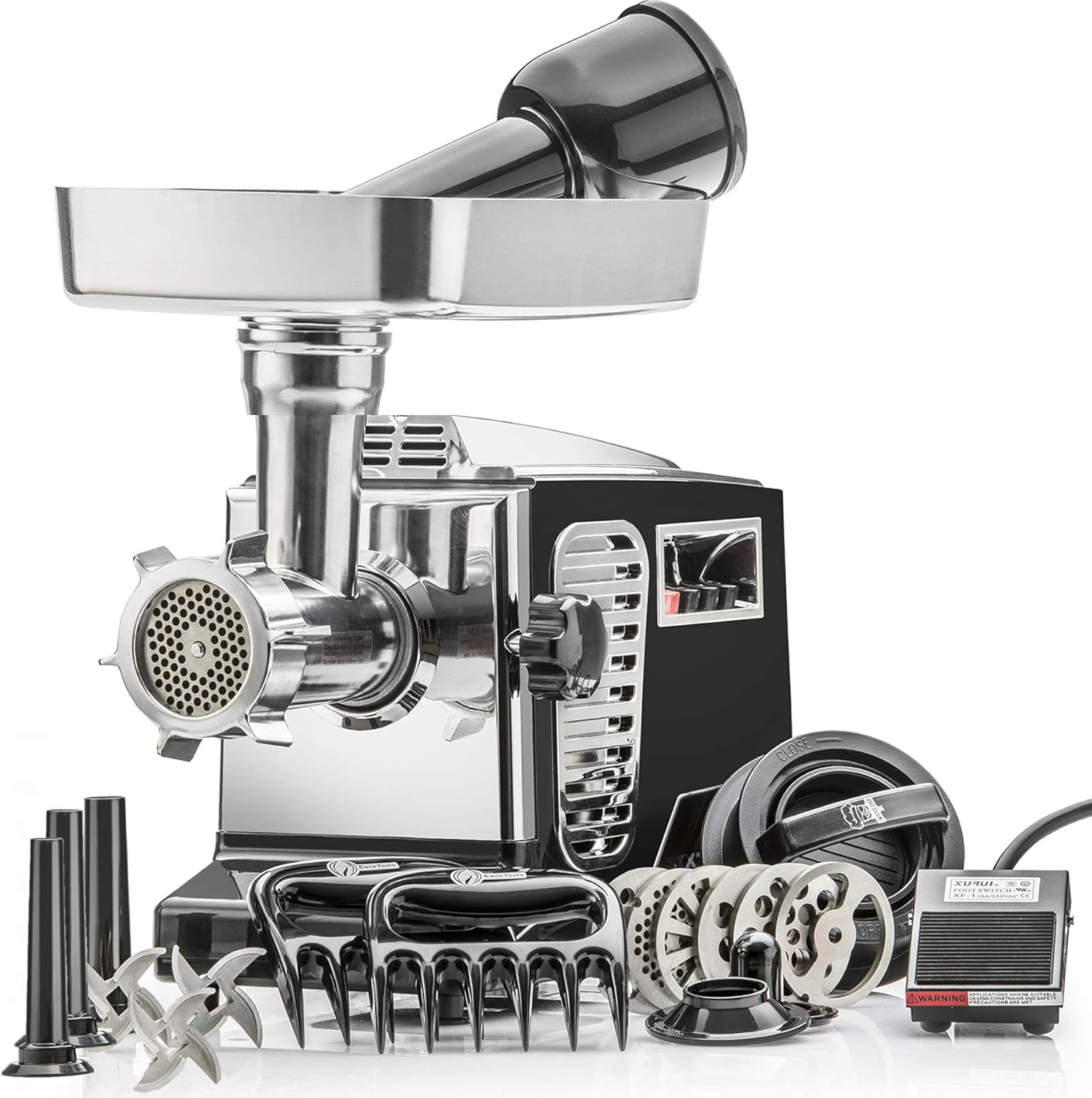
STX Turboforce II 4000
| Wattage | 2000 watts |
|---|---|
| Capacity | 3 pounds |
| Voltage | 120 volts |
| Included Components | Grinding head, meat pusher, 6 grinding plates, 3 cutting blades, sausage tubes, kubbe attachment, foot pedal |
The STX Turboforce II 4000 is a purpose-built home meat grinder designed for frequent, high-volume use. Its 2000-watt motor and patented quad air induction cooling system keep the unit running through long batches, while the large tray and size 12 head handle up to roughly 220–260 pounds of meat per hour depending on plate choice and meat type. The package includes multiple grinding plates, three cutting blades, sausage stuffing tubes, a kubbe attachment, meat claws, a patty press and a foot pedal for hands-free control. Practical benefits include the ability to grind soft bones for small game, efficient throughput for batch sausage or burger making, and a metal grinding head plus stainless cutting components that stand up to heavy use. Trade-offs are its bulk and weight compared with compact kitchen units, and the 3-pound stated tray capacity means very large jobs still require refill cycles; heavier users should expect to work in batches. The 3-year guarantee and included accessories make this a solid choice if you need a rugged, nearly commercial-capable grinder for home workshops and hobby butchery.
Best for: Buyers who want a durable, high-capacity home grinder for regular sausage making, batch burger prep, or small-game butchery and who prioritize throughput and heavy-duty components over compact size.
Less Ideal for: Those who need a lightweight, countertop-friendly unit for occasional small jobs or who lack storage space should consider smaller, simpler grinders instead.
- Powerful 2000-watt motor with air-cooled design for sustained grinding
- Size 12 head with large 2.5-inch output handles big batches and soft bones
- Comes with multiple plates, cutting blades and sausage/kubbe attachments for versatile use
- Foot pedal control frees hands for feeding and accessory use
- Stainless steel blades and polished metal grinding head for durability
- Relatively large and heavy compared with small home grinders
- High throughput still requires periodic refilling due to the tray capacity
Verdict: If you need rugged, high-throughput home grinding with versatile attachments and a powerful motor, the STX Turboforce II 4000 delivers.
LEM BigBite #8 Meat Grinder

| Horsepower | 0.5 HP |
|---|---|
| Capacity | 7 pounds per minute |
| Material Type | Stainless Steel |
| Power Source | electric |
The LEM BigBite #8 is a heavy-duty electric meat grinder built from stainless steel and driven by a 0.5 HP motor for steady, repeatable grinding. It is set up for routine batch work like burgers, sausage, pet food, and game processing and can handle about 7 pounds per minute when fed properly. The unit includes three cutting plates, a knife, a stomper, and sausage-stuffing tubes, and its permanently lubricated motor and straightforward disassembly make cleaning and maintenance manageable. Noise-dampening design keeps operation relatively quiet for its class, and the stainless construction feels rugged and serviceable. Important limitations are that it is not designed for bones and its physical footprint and weight make it a workshop or utility-kitchen appliance rather than a countertop everyday gadget. If you need consistent, pro-style grind performance for frequent large batches, this grinder brings the parts and power to match that use case.
Best for: Buyers who prioritize reliable, pro-style grinding performance for regular large-home or hobby sausage and game processing and want a rugged, serviceable machine that stands up to frequent use.
Less Ideal for: Casual cooks who need a lightweight, compact countertop grinder or users who require a grinder that can process bones or run continuously in an industrial setting.
- Stainless-steel construction built for durability and food-contact safety
- 0.5 HP motor capable of steady grinding around 7 pounds per minute
- Includes useful accessories: three plates, knife, stomper, and stuffing tubes for sausage making
- Permanently lubricated motor and parts that disassemble for cleaning and upkeep
- Noise-dampening design for comparatively quieter operation in its class
- Not designed to grind bones
- Heavy and bulky, so it is less convenient to move or store
- Capacity and motor size are oriented to small-to-medium batches rather than continuous industrial use
Verdict: If you need dependable, heavy-duty grinding for frequent batches of meat or game, the LEM BigBite #8 delivers rugged stainless construction and steady 0.5 HP performance.
AAOBOSI Meat Grinder MG102A

| Wattage | 3000 watts |
|---|---|
| Capacity | 3 pounds |
| Voltage | 120 volts |
The AAOBOSI MG102A is a home-focused heavy-duty meat grinder that pairs a high-power motor with simple digital controls to process large batches quickly. Its motor claims up to 3000W max (rated power 350W) and a reported output up to about 4 pounds per minute, making it useful for grinding meat for sausages, burgers, and raw pet food. Operation is handled via a smart touch color screen and three speed modes including reverse to clear jams, and the unit stores blades and attachments in a built-in compartment to keep the countertop tidy. The stainless steel construction and dishwasher-safe plates/blades simplify cleanup, though the manual suggests hand-washing attachments for best results and warns against continuous use over 10 minutes to avoid overheating. Practical buyers will appreciate the included sausage tubes, kibbe kit, and multiple plates, but expect a sizable countertop footprint and the need to manage heat during long sessions. For cooks who process whole joints or larger game frequently, this grinder offers strong throughput and helpful anti-jam features.
Best for: Home cooks and small-batch processors who need a high-throughput, feature-rich grinder that handles sausages and larger volumes while keeping accessories organized.
Less Ideal for: Users who need a compact, lightweight machine for infrequent light-duty grinding or those who require sustained continuous operation for commercial processing.
- High-power motor with claimed max 3000W for fast grinding and up to ~4 lb/min throughput
- Smart touch color screen with three speed modes and reverse to clear jams
- Built-in storage keeps plates, blades, and stuffing tubes organized
- Stainless steel blades and plates are dishwasher-safe for easier cleaning
- Includes useful accessories: three grinder plates, two blades, sausage tubes, and kibbe kit
- Manufacturer warns against continuous use over 10 minutes to prevent overheating
- Relatively heavy and large footprint may be cumbersome for small kitchens
Verdict: If you want a heavy-duty home grinder with strong throughput, anti-jam reverse, and onboard storage for accessories, the AAOBOSI MG102A is a practical pick.
ALTRA LIFE Meat Grinder MGAC13

| Rated power | 350W |
|---|---|
| Peak power | 2300W |
| Capacity | 3 pounds |
| Grinding plates | 3 sizes (Fine/Medium/Coarse) |
This ALTRA LIFE electric meat grinder packs a punch for the price, using a 350W rated motor with a 2300W peak to push through batches quickly and grind about 3 pounds per minute. It is used like a typical tabletop mincer: feed trimmed meat through the hopper with the provided pusher, choose one of three stainless steel plates (fine, medium, coarse) and the dual cutting blades to get the desired texture, or attach the sausage tube or kubbe kit for stuffed products. Notable features include overload/overheat protection, a reverse function to clear jams, and a generous accessory set that covers sausages, kubbe, and basic grinding tasks. Most food-contact parts are stainless steel or BPA-free plastic and detach for hand washing. Important limitations are that parts with aluminum alloy should not be dishwashed and the unit is positioned as an affordable heavy‑use option rather than a full commercial-grade grinder, so extremely heavy continuous operation may push it beyond consumer expectations.
Best for: Buyers who want a high‑powered, feature‑packed grinder on a budget for frequent home use or small-batch commercial tasks and who prioritize accessories and safety features over industrial continuous-duty performance.
Less Ideal for: Large-scale butcheries or kitchens that need nonstop commercial throughput should choose a purpose-built industrial grinder instead.
- High peak power (2300W) for faster grinding and clearing tougher cuts
- Comes with 3 stainless steel grinding plates and 2 cutting blades for versatile textures
- Includes sausage stuffing tubes and kubbe attachment for added functionality
- Safety features include overload/overheat protection and a reverse function to clear jams
- Most food-contact parts are stainless steel or BPA-free plastic and detach for cleaning
- Not intended as a continuous heavy commercial machine; aluminum alloy parts are sensitive to dishwashers
- Manufacturer advises hand washing and drying parts to prevent oxidation
Verdict: A budget-friendly, high‑peak electric grinder that delivers versatile home and light commercial performance with a full accessory set.
STX Turboforce 3000 Meat Grinder

| Wattage | 1800 watts |
|---|---|
| Capacity | 3 pounds |
| Voltage | 110 volts |
The STX Turboforce 3000 is a home-focused, high-capacity electric meat grinder that handles regular batch grinding and sausage making. It uses a size 12 grinding head, a large meat hopper and an AVI auger to feed larger portions, and comes with five cutting plates, three stainless cutting blades, sausage tubes, a kubbe attachment and burger press to cover most home processing tasks. The motor is rated up to 3000W peak but runs in the 800 to 1,200W range under load, which translates to steady performance when feeding properly prepped meat and avoids frequent overheating in normal use. Practical benefits include the ability to grind 180 to 240 pounds per hour when meat is cubed or stripped correctly and the range of accessories for sausage and specialty forms. Limitations are that it is intended for home use only, will not grind bones or dense tendon, and needs correctly prepped meat to reach claimed throughput, so it is not a substitute for commercial equipment.
Best for: Buyers who want a robust, home-focused grinder that reliably processes large batches and includes accessories for sausages and burgers.
Less Ideal for: People who need commercial-grade continuous use equipment or those who want to grind bones or very tough animal parts.
- Size #12 head and large hopper handle larger portion sizes and steady batches
- Includes five grinding plates, three stainless blades and multiple stuffing tubes for versatile processing
- High claimed throughput of 180–240 lbs per hour with properly prepped meat
- AVI auger design improves intake of larger pieces to reduce jamming
- Not designed to grind bones, tendons, or non-meat items
- Marketed peak wattage is higher than typical running wattage under load
Verdict: Choose the Turboforce 3000 when you want a dependable, high-capacity home meat grinder with a complete set of plates and stuffing accessories for regular batch processing.
Aiheal Meat Grinder MG-2430RB

| Included Components | 2 blades, 3 plates, 3 sausage tubes, pusher |
|---|---|
| Material Type | Stainless Steel |
| Power Source | Electric |
| Capacity | 44 pounds |
The Aiheal MG-2430RB is a heavy-duty home meat grinder built for large batches and multi-use kitchen tasks. It uses a 300W continuous motor with a claimed 3200W max locked power and a pure copper motor to push meat through removable stainless-steel plates and blades, and it comes with three plate sizes (2mm, 5mm, 7mm) plus three sausage tubes for making links. Typical use is seasonal bulk grinding, sausage making, or preparing burger and meatball mixes—meat is fed through with the pusher while the unit's reverse/unclog button helps clear jams. The stainless-steel construction and detachable parts make cleanup straightforward, though the manufacturer advises hand washing rather than a dishwasher. Safety features include a locking knob and overload protection that stops the unit if it overheats. Limitations to note are that the real continuous power is 300W so expect slower throughput on very dense cuts, and some buyers may find the motor louder under heavy load. For buyers focused on processing large quantities at home, this model balances capacity and useful accessories without professional-level pricing.
Best for: Buyers who want a capable, versatile home grinder for seasonal large batches, sausage making, and frequent mincing and who value included plates and safety features backed by many user reviews.
Less Ideal for: This is not the best choice for commercial kitchens or users who need industrial continuous-duty throughput and ultra-quiet operation.
- Multiple grinding plates (2mm, 5mm, 7mm) for coarse to fine grinds
- Includes three sausage stuffer tubes and two stainless-steel blades for sausage making and versatile recipes
- Stainless-steel construction with removable attachments for easier cleaning and durability
- Built-in overload protection and a reverse/unclog function to reduce jams and protect the motor
- Rated continuous power is 300W so real-world throughput on dense or frozen meat can be modest
- Manufacturer recommends hand washing attachments rather than using a dishwasher
Verdict: Aiheal MG-2430RB is a well-equipped heavy-duty home grinder that delivers versatile grinding and sausage-making capability with user-friendly safety features.
CHEFFANO Meat Grinder AZ-MG091DG

| Capacity | 180 pounds |
|---|---|
| Material Type | Stainless Steel |
| Power Source | Corded Electric |
| Included Components | Sausage maker, food pusher, 2 kubbe attachments, 2 blades, 3 cutting plates |
| Manufacturer Warranty Description | 2 Year Manufacturer |
The CHEFFANO meat grinder is a corded electric machine built around a stainless steel body and a copper motor that the listing rates at 350W normal power with 2800W peak, designed to handle regular home heavy-duty grinding tasks. It includes three cutting plates (2mm, 5mm, 7mm), two blades, sausage stuffer tubes and kubbe attachments so you can grind to different textures, make sausages and form kibbe without buying extras. The updated three-layer auger is meant to reduce heat buildup and preserve meat texture, and the unit offers a reverse function to clear jams. Most parts disassemble for hand washing, and the ETL listing and included replacement support and a two-year manufacturer warranty are reassuring for cautious buyers. Expect about 3 pounds per minute throughput with manual loading; the attachments are not dishwasher safe and the peak wattage claim is a short-term value rather than continuous output, so plan for intermittent use rather than nonstop commercial runs.
Best for: Buyers who want a robust home grinder that handles frequent, thicker jobs and includes sausage and kibbe accessories with safety certification and warranty backing.
Less Ideal for: Not the best choice for commercial kitchens or continuous heavy production where industrial duty cycles and dishwasher-safe parts are required.
- Includes three stainless steel cutting plates and two blades for multiple grind sizes
- Accessories for sausage stuffing and kibbe making expand functionality beyond basic grinding
- ETL safety certification and a two-year manufacturer warranty provide reassurance
- Reverse function and updated auger design help reduce jams and heat buildup during use
- Attachments are not dishwasher safe and require hand drying
- Rated peak wattage is for short bursts, so not suited for continuous commercial workloads
Verdict: A well-equipped, safety-certified home heavy-duty grinder that lets cautious buyers grind, stuff sausages, and make kibbe with confidence and warranty support.
Choosing the Right Heavy-Duty Meat Grinder: Key Factors to Consider
Motor Power and Continuous Duty Rating
Motor size and the continuous duty rating determine how long you can run the grinder without risk of overheating. For heavy-duty use you want a motor rated for sustained operation rather than short duty cycles. Higher torque helps push dense cuts and sinew through the plate without stalling, which reduces stress on gears and drive components.
Matching motor capability to expected workload prevents frequent interruptions and extends component life. Check whether the motor is ventilated well and whether the manufacturer specifies a continuous duty rating. Remember that listed wattage or horsepower alone does not guarantee long runtime if cooling and thermal protection are insufficient.
Gear Train and Housing Construction
Metal gears and a cast or stamped-steel housing typically outlast plastic components under heavy loads. Durable gears transfer torque more efficiently and resist stripping, which is crucial when grinding tougher cuts or working at higher volumes. A rigid housing keeps the alignment between motor, gears, and auger correct and reduces wear on bearings.
Sturdy construction also affects vibration and stability. Less vibration lowers the chance of fastener loosening and makes the machine safer to operate. Consider grinders with serviceable gearboxes or replaceable bearings to simplify repairs and extend the unit's useful life.
Throughput, Plate Selection, and Cooling
Throughput is the practical rate at which the grinder processes meat, usually measured in pounds per minute or hour depending on cut and plate size. Plate diameter, blade sharpness, and auger design influence throughput as much as motor strength. Larger plates and properly matched blades reduce rework and heat buildup.
Cooling matters because heat will degrade meat quality and stress the motor. Units with effective airflow paths, sufficient mass to absorb heat, or duty cycles designed for continuous use perform better in heavy workloads. Think through what throughput you need per hour and choose a grinder whose realistic rate matches that need.
Sanitation and Ease of Disassembly
Frequent heavy use means frequent cleaning. Parts that disassemble quickly without tools, have smooth surfaces, and are accessible reduce cleaning time and lower contamination risk. Stainless-steel feed trays, augers, and plates resist corrosion and are easier to sanitize.
Avoid designs with hidden crevices or permanently sealed housings that trap residues. Look for grinders that use standard-size plates and blades so you can replace or swap parts easily without special-order components.
Safety Features and Mounting Stability
A stable base and secure mounting prevent movement during operation, which improves cut consistency and operator safety. Non-slip feet, clamp-compatible bases, or integrated mounts are important for heavy workloads. Guarding around the feed throat and a well-designed pusher minimize the chance of accidental contact with the auger or blade.
Electrical safety is also crucial. Look for grounded plugs or equivalent protection and thermal cutouts that stop the motor if temperatures climb too high. Safe, repeatable operation reduces injury risk and machine downtime.
Serviceability and Parts Availability
Long-term value depends on whether worn parts can be replaced and how easy routine maintenance is. Grinders with replaceable blades, plates, bearings, and gear components let you restore performance without replacing the whole unit. Standardized part sizes and clear service documentation reduce repair time.
Consider how easy it is to access gears and bearings for lubrication or replacement, and whether common wear items are sold separately. Serviceable designs reduce total cost of ownership and keep production running with minimal interruption.
Matching Grinder Capacity to Your Workload
Estimate how much meat you need to process in a typical session and choose a grinder that meets that throughput with margin for tougher cuts. Small increases in capacity can save hours over weekly production runs.
Consider whether you will run long continuous batches or short intermittent jobs. Continuous batches demand higher-rated motors and better cooling; intermittent use allows for smaller units with lower duty cycles.
- Light hobby use: prioritize compact size and ease of cleaning.
- Frequent home use: choose mid-range continuous ratings and replaceable parts.
- Small-scale production: prioritize torque, cooling, and metal gear trains.
Plate Sizes, Blade Choices, and Grind Texture
Different plate hole sizes and blade geometries produce varied textures from coarse to fine. Larger holes and thicker blades speed throughput and are better for coarse grinds, while fine grinds require more passes or a grinder designed for higher shear.
Pick a grinder that accepts multiple plate sizes and lets you swap quickly to change texture without excessive downtime.
- Coarse grind: larger plate holes, single pass.
- Medium grind: medium plates, one pass for most cuts.
- Fine grind: smaller plates, possibly two-pass processing.
Cleaning Routines and Food-Safety Best Practices
Establish a cleaning routine that includes full disassembly, hot-water rinse, and sanitation after each use to prevent bacterial growth. Dry and re-lubricate moving parts as recommended to prevent corrosion.
Keep spare plates and blades so you can swap components during long sessions and clean parts without halting production.
- Disassemble immediately after use to avoid congealed residues.
- Use food-safe lubricants on bearings and threads where recommended.
- Inspect seals and gaskets regularly for wear.
Noise, Vibration, and Shop Ergonomics
Heavy-duty grinders can generate significant noise and vibration. Look for models with balanced augers and solid mounting options to reduce vibration transfer. Lower vibration improves operator comfort and reduces fastener loosening over time.
Plan your workspace with stable surfaces, adequate lighting, and easy access to cleaning supplies to speed changeovers and reduce strain during long sessions.
- Mount on a rigid bench or use a clamp mount when possible.
- Place a rubber mat under the unit to dampen vibration.
- Protect hearing when running grinders for extended periods.
Maintenance Tasks That Keep Grinders Running
Regular maintenance extends service life. Routine tasks include checking and replacing blades and plates, inspecting gears and bearings for wear, and ensuring the motor ventilation paths are clear. Tighten fasteners periodically and verify electrical connections.
Create a maintenance log to track part replacements and unusual noises or performance drops. Early intervention on minor issues prevents major failures during critical production runs.
- Sharpen or replace blades when cuts become ragged.
- Lubricate gears and bearings per manufacturer guidance.
- Replace worn gaskets and seals to maintain sanitation.
How We Chose the Best Heavy-Duty Meat Grinder
We shortlisted models that deliver dependable performance under repeated use and that are built from serviceable materials. Our selection criteria emphasized continuous-duty motor ratings and realistic throughput expectations, because buyers need units that can handle multiple pounds per minute without overheating. We prioritized grinders with robust metal gear trains and housings to minimize wear and allow repairability. Sanitation and ease of disassembly were key: components that come apart quickly and use standard-size plates and blades reduce downtime and cleaning complexity. Safety features, such as secure feed systems and stable mounting, were required for inclusion. We also considered accessory fitment and parts availability to ensure long-term serviceability. We excluded lightweight household hobby units and machines rated only for intermittent or occasional use. Low-torque or plastic-geared grinders were filtered out because they do not meet sustained heavy-duty expectations. The evaluation centered on motor power and torque, gear and housing durability, throughput and cooling performance, ease of cleaning and maintenance, and safety and mounting stability. These concrete dimensions guided our selection and align with the scoring metrics used in the reviews.
Our full evaluation process is outlined in our review methodology.
FAQ
How much meat can a heavy-duty grinder process per hour?
Throughput depends on motor torque, plate size, and meat condition, but heavy-duty units are designed for sustained higher rates. Expect a realistic rate that matches the grinder's continuous rating rather than peak or theoretical figures.
Can I grind frozen meat in a heavy-duty grinder?
Partially frozen meat can be ground more cleanly than fully frozen blocks, but extreme cold increases stress on gears and blades. Thaw to the point of firm, chilled meat for best results and to protect the drivetrain.
How often should I sharpen or replace blades and plates?
Frequency varies with use and meat type, but inspect cutting surfaces before each large session. Replace or resharpen when grinding requires extra force or produces inconsistent textures.
Is it safe to leave a heavy-duty grinder unattended during operation?
No. Continuous monitoring reduces the risk of jams, overheating, or safety incidents. An operator can respond quickly to feed issues, noise changes, or motor strain.
What cleaning products are safe for grinder components?
Use hot water, mild detergent, and food-grade sanitizers recommended for meat-contact surfaces. Avoid harsh abrasives or corrosive chemicals that can pit metal and harbor bacteria.
Final Verdict
Choose a heavy-duty meat grinder by matching motor torque and continuous duty capability to your expected throughput, and favor robust metal gears and housings for long-term durability. Prioritize designs that disassemble easily for cleaning and that offer replaceable wear parts to minimize downtime. Balance capacity, cooling, and serviceability against shop ergonomics and noise to pick the unit that fits your production rhythm. With those tradeoffs in mind, you can select a grinder that reliably handles heavy workloads while remaining maintainable and safe.