
Note: This article contains affiliate links. If you click on these links and make a purchase, we may earn a small commission at no extra cost to you. This helps support our research and content. Read our full affiliate disclosure here.
If you make burgers, sausages, or large batches of ground meat at home, the right meat grinder saves time and produces a better texture than preground packages. Choosing carefully matters because grinder capacity, motor strength, and ease of cleaning directly affect how often you will actually use the machine and how consistent the results are. This guide highlights the top shortlisted meat grinders for home cooks, focusing on power, durability, grind versatility, and cleanup. Below you will find concise buying guidance, the evaluation criteria we used, and practical sections on maintenance and recipe ideas to help you pick the right unit for your kitchen.
Top Picks at a Glance
| Best Overall The best all-around choice for most situations | STX Turboforce II 4000 Meat Grinder |  |
| Best Quality Built to a higher standard if you want something more solid | LEM BigBite #8 Meat Grinder |  |
| Best Value The sweet spot between price and what you get | AAOBOSI Meat Grinder MGC04 |  |
| Best Budget The cheapest option that still gets the job done reliably | Ganiza Food Processor GC10 |  |
| Top Rated A top-rated pick with lots of positive feedback | Cuisinart Electric Meat Grinder MG-100 |  |
STX Turboforce II 4000 Meat Grinder
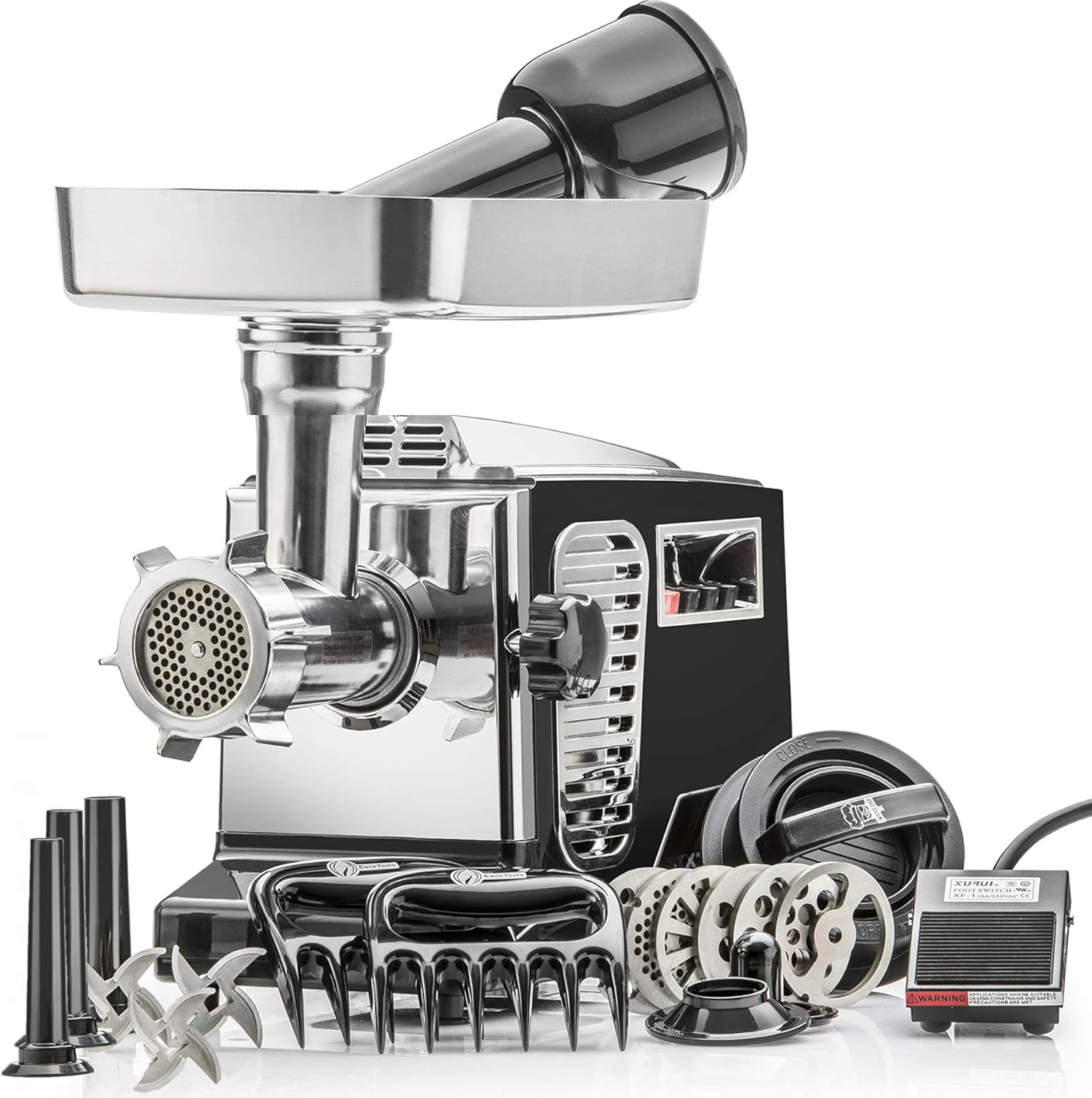
| Wattage | 2000 watts |
|---|---|
| Capacity | 3 pounds |
| Voltage | 120 volts |
| Included Components | Grinding head, meat pusher, 6 grinding plates, 3 cutting blades, sausage tubes, kubbe attachment, foot pedal control |
The STX Turboforce II 4000 is a powerful home meat grinder designed for high-volume kitchen work and home charcuterie projects. It uses a 2000-watt motor with a patented air-cooled system and circuit breaker to sustain long grinding runs and help prevent overheating, and the generous tray and size 12 head let you feed large batches without constant reloading. The unit comes with multiple grinding plates and stainless cutting blades, sausage tubes, a kubbe attachment, meat claws and a foot pedal for hands-free control, so it covers everything from coarse burger grind to fine sausage or kibbe. Practical benefits include the ability to handle soft bones, a high throughput rate when using larger plates, and a mostly metal construction where it matters. Trade-offs are its relatively large footprint and 13-pound weight, which make it less convenient for occasional users or cramped counters, and the learning curve for cleaning and assembly compared with simpler tabletop models.
Best for: Home cooks who regularly grind large quantities of meat or make sausages and want a durable, high-capacity machine that handles varied tasks.
Less Ideal for: Casual users who only grind small amounts occasionally or need a lightweight, space-saving countertop unit.
- Very powerful 2000W motor with air-cooled design for long runs
- Includes multiple grinding plates, 304 stainless cutting blades and sausage/kubbe attachments
- Foot pedal control for hands-free operation and better workflow
- Size No.12 grinding head and large tray let you process large batches quickly
- Large and heavy compared with compact home grinders
- Requires more cleaning and storage space due to many metal parts and accessories
Verdict: Buy this if you need a robust, high-capacity home grinder that handles large batches, sausage making and soft bones reliably.
LEM BigBite #8 Meat Grinder

| Capacity | 7 pounds |
|---|---|
| Material Type | Stainless Steel |
| Power Source | electric |
| Horsepower | 0.50 HP |
The LEM BigBite #8 is a commercial-style electric meat grinder built for steady, frequent use at home. Its stainless-steel construction and 0.5 HP motor process roughly 7 pounds per minute, making it suitable for burgers, sausages, pet food, and bulk meal prep without grinding bones. The unit ships with three grinding plates, knife, stomper, and sausage-stuffing tubes, and it disassembles for cleaning; permanently lubricated motor bearings simplify maintenance. Noise-dampening features help keep operation quieter than comparable shop machines, and the grinder's solid build feels durable for repeated batches. Limitations to note are the midrange horsepower—this is not a heavy industrial unit—so extremely large operations will be slower than higher-horsepower models, and the machine's weight and size mean it needs a dedicated prep area. For home cooks, hunters, and small-batch processors who want reliable, factory-quality grinding capability, the BigBite #8 delivers consistent results with useful sausage-making accessories.
Best for: Buyers who prioritize reliable, repeatable grinding performance for small-to-medium batches—home chefs, hunters, and anyone making sausage or bulk patties—who want a durable, factory-quality machine built for frequent use.
Less Ideal for: Large-scale processors or commercial kitchens that need higher throughput and more horsepower should choose a larger industrial model instead.
- Stainless-steel construction for durability and easy cleaning.
- 0.5 HP motor rated to grind about 7 pounds per minute for steady home use.
- Includes three plates, knife, stomper, and stuffing tubes for versatile grinding and sausage making.
- Permanently lubricated motor and straightforward disassembly reduce maintenance needs.
- Noise-dampening design for quieter operation compared with larger commercial grinders.
- Midrange power means slower throughput than 1 HP+ commercial grinders for very large batches.
- Heavy and sizable unit requires dedicated counter or workspace.
Verdict: Choose the LEM BigBite #8 when you want a durable, factory-quality grinder that reliably handles regular small-to-medium batch meat processing and sausage making.
AAOBOSI Meat Grinder MGC04

| Wattage | 2800 watts |
|---|---|
| Capacity | 1.5 kg |
| Voltage | 120 volts |
| Power Source | electric |
The AAOBOSI MGC04 is a countertop electric meat grinder aimed at home cooks who want a versatile, higher‑power unit for regular use. It ships with three grinding plates, two cutting blades, sausage stuffer tubes, a kubbe maker, and slicing/shredding attachments so you can grind meat, make sausages, form kubbe, and grate or slice softer foods. The stainless steel housing and removable stainless plates/blades make cleanup straightforward and the machine includes safety features like a locking knob, overload protection, and a reverse function to clear jams. With a listed 2800W peak and a claimed 1.5 kg per minute throughput the grinder handles batches quickly, though the vendor warns against grinding bones or large tendons. Practical touches such as built‑in ventilation holes and disassemblable parts improve durability and serviceability. Expect a solid home appliance for frequent meal prep, but plan to hand‑dry alloy parts to avoid oxidation and avoid heavy bone processing which can stall the motor.
Best for: Buyers who want a practical, multiuse home meat grinder that speeds routine batch prep and replaces manual processing with a durable, safety‑minded electric unit.
Less Ideal for: Users who need a commercial or bone‑crushing grinder for heavy butchery or those who want a fully dishwasher‑safe metal finish for every component.
- Comes with multiple stainless steel plates and blades for grinding, slicing, and shredding
- Includes sausage stuffer tubes and kubbe maker for versatile kitchen tasks
- Safety features like overload protection, locking knob, and reverse function reduce jams and motor stress
- Stainless steel casing and removable parts simplify cleaning and improve durability
- Not intended for grinding bones or very tough connective tissue which can jam the motor
- Some alloy parts require hand drying to prevent oxidation
Verdict: A versatile, safety‑focused home meat grinder that handles regular batch grinding, sausage making, and slicing with durable stainless components.
Ganiza Food Processor GC10

| Wattage | 450 watts |
|---|---|
| Capacity | 0.95 gallons |
| Voltage | 120 volts |
| Material Type | Stainless Steel, Glass |
The Ganiza GC10 is a compact 450W food processor designed for everyday sauce making, chopping, and light grinding. It comes with two 8-cup bowls—one glass and one stainless steel—so you can keep ingredients separate for savory sauces or meat-based blends, and it includes two sets of S-shaped stainless blades for different textures. The two-speed motor handles softer ingredients and tougher items like cooked meats or nuts, and built-in overheating protection helps prevent motor damage during repeated use. Setup and cleaning are straightforward thanks to removable blades and simple controls, and the glass bowl gives good visibility when puréeing sauces. Limitations to note are the modest 450W power and thermal cutoff, which mean it is best for small to medium batches rather than heavy-duty continuous grinding, and the unit's compact capacity may require multiple batches for larger sauce volumes. For cooks who want a safe, easy-to-use processor for everyday sauce prep and occasional meat grinding, the Ganiza GC10 is a practical choice.
Best for: Home cooks who prioritize reliable, safe operation and want a versatile small processor for daily sauce making and light grinding without professional-level power.
Less Ideal for: Users who need to process very large batches, run long continuous grinding sessions, or require industrial-strength motor performance.
- Two bowls (8-cup glass and 8-cup stainless steel) let you separate ingredients for different sauces and uses
- 450W full-copper motor with two speeds handles a range of textures from soft purées to light grinding
- Overheating protection and spring-loaded blade safety reduce risk during frequent kitchen use
- Removable blades and simple controls make cleanup and everyday operation easy
- Modest power and thermal cutoff limit continuous heavy-duty grinding
- Capacity may require multiple batches for large sauce volumes
Verdict: A safe, easy-to-use two-bowl processor that reliably handles everyday sauce prep and light grinding for risk-averse home cooks.
Cuisinart Electric Meat Grinder MG-100

| Capacity | 3 pounds |
|---|---|
| Wattage | 300 watts |
| Voltage | 120 volts |
The Cuisinart Electric Meat Grinder MG-100 is a compact, stainless steel countertop grinder built for routine home use. Its 300-watt motor claims to grind up to 3 pounds per minute and the unit includes two metal cutting plates for medium and coarse grinds plus two sausage attachments for links. Operation is straightforward with a single on/off switch and a reverse function to clear jams, and the included pusher and accessory storage keep small parts organized. In practice this grinder handles common proteins like beef, chicken, turkey, and game without fuss and produces consistent texture for meatloaf, burgers, or sausage. The mostly metal construction gives the impression of durability, though the 300-watt motor is modest compared with heavy-duty commercial machines so it is best for regular home batches rather than continuous large-scale grinding. Cleaning requires disassembly of the plate and auger, which is standard for models in this class. If you want a reliable, easy-to-use home grinder that covers basic grinding and sausage making, this is a sensible, well-built option.
Best for: Home cooks who prioritize a dependable, straightforward grinder for weekly or occasional batches and value durable metal construction over commercial power.
Less Ideal for: Those who regularly grind large volumes or need a commercial‑grade machine for continuous heavy use should consider higher‑power models.
- Stainless steel construction for durable, easy-to-clean surfaces
- 300-watt motor capable of up to 3 pounds per minute for quick home batches
- Includes medium and coarse cutting plates plus two sausage attachments for versatility
- Simple controls with reverse function to clear jams and integrated accessory storage
- Motor is modest compared with commercial grinders so not ideal for continuous heavy use
- Requires disassembly for cleaning which can be time-consuming after multiple batches
Verdict: A durable, easy-to-use home meat grinder that reliably handles everyday batches and basic sausage making.
Choosing the Right Meat Grinder: Key Factors to Consider
Motor Power and Duty Cycle
Motor power determines how quickly the grinder processes meat and how well it handles tougher cuts or small bones. Higher wattage or horsepower typically means faster throughput and less chance of jams when grinding cold or partially frozen meat.
Duty cycle explains how long the motor can run before it needs a cooldown. For home cooks who grind occasional batches, a shorter duty cycle may be acceptable, but if you plan to process large quantities in one session choose a grinder rated for longer continuous use. Overstressing a motor shortens its life and can lead to overheating during long jobs.
Throughput and Feed Size
Throughput is a practical measure of how much meat the grinder can handle in a given time and is influenced by both motor torque and feed-throat dimensions. A wider feed throat reduces prep time because you can push through larger chunks rather than finely cubing everything.
Consider throughput in relation to how you source meat. If you buy bulk roasts or break down whole cuts, higher throughput reduces processing time. For occasional use with small roasts, a lower throughput grinder may be adequate and more space-efficient.
Grind Versatility and Attachments
Grind versatility depends on available plate sizes and any included attachments, such as sausage stuffing tubes or kubbe tools. Multiple plate sizes let you produce coarse, medium, and fine grinds suitable for different recipes—from chili meat to pâté.
Attachments extend a grinder's utility beyond basic mincing. If you plan to make sausages, look for secure, easy-to-clean stuffing tubes and adapters that fit the machine. Versatility reduces the need for other specialized equipment.
Materials, Construction, and Food Safety
Materials in the meat path should be nonreactive and easy to sanitize; stainless steel components are preferred for durability and corrosion resistance. The housing material affects long-term wear and the unit's overall stability during operation.
Check for solid metal gears or durable gear housings rather than thin plastic internals if you expect frequent use. Design choices such as sealed motors and well-fitting gaskets also reduce contamination risk and make cleaning more reliable.
Ease of Cleaning and Maintenance
A grinder you can quickly disassemble, clean, and dry is more likely to be used regularly. Parts that are dishwasher-safe simplify cleaning, but even hand-washable components should be straightforward to remove and reassemble without tools.
Regular lubrication points, easily replaceable blades and plates, and accessible screws help extend the unit's life. Consider models with clear maintenance instructions and available spare parts if you plan to use the grinder for years.
Size, Storage, and Noise
Physical size determines where you will store the grinder and how easy it is to deploy for a batch job. Compact units save counter and cabinet space but may sacrifice throughput or motor size.
Noise level varies by motor and build quality. If you have an open-plan kitchen or prefer quieter appliances, look for models engineered with better vibration control and insulated housings. Balance footprint, storage needs, and acceptable noise when making your choice.
How to Size a Grinder for Your Needs
Match grinder capacity to the volume you expect to process. For occasional home use, a compact grinder with moderate motor power handles a few pounds at a time. If you plan monthly bulk processing or frequent sausage making, prioritize a larger feed throat and higher torque to avoid long grinding sessions and reduce stress on the motor.
Also consider practical throughput versus advertised power. Look at stated pounds per hour numbers and compare them to your intended batch sizes. A grinder that processes slightly more than your typical batch will finish faster and run cooler.
- Small households: choose compact units with easy storage and simple disassembly.
- Regular batch processing: prioritize torque, duty cycle, and a larger feed throat.
- Sausage making: ensure compatible stuffing tubes and at least two plate sizes.
Preparing Meat for Best Results
Proper preparation affects texture and reduces strain on the grinder. Chill meat and blades thoroughly; cold meat cuts cleaner and reduces smearing, which helps preserve texture and food safety. Trim large sinews and bones that are not intended to be ground, leaving small hard bits only if the unit is rated to handle them.
Cut meat into uniform pieces that fit the feed throat, and partially freeze fattier cuts to help the fat remain solid during grinding. For sausages, mix spices and cure agents evenly then refrigerate the mixture briefly before grinding to meld flavors and stabilize the meat.
- Chill meat and keep blades cold for cleaner cuts.
- Cut to consistent sizes to maintain steady throughput.
- Partially freeze high-fat cuts to reduce smearing.
Cleaning, Sanitizing, and Storage Tips
Disassemble and wash all food-contact parts immediately after use to prevent bacterial growth. Use hot water and a mild detergent, then sanitize with a food-safe sanitizer or a dilute bleach solution if recommended. Dry all parts thoroughly before storage to prevent rust on metal components.
Store small plates and blades wrapped or in a dedicated box to avoid nicks and contamination. Keep spare blades and gaskets on hand and replace wear items at the first sign of damage to maintain performance and food safety.
- Wash parts promptly, sanitize, and dry completely.
- Protect cutting surfaces from nicks by storing safely.
- Keep replacement blades, plates, and gaskets available.
Common Troubleshooting and Maintenance
Typical issues include jams, dull blades, and motor overheating. Jams are often caused by overly large pieces, sinew, or bone fragments. Stop the machine, clear the obstruction, and inspect the blade and plate for damage. Dull blades will reduce throughput and increase motor strain; sharpen or replace them as needed.
If the motor overheats, allow it to cool and avoid extended continuous runs beyond the duty cycle. Regularly check gear housings for wear, keep ventilation passages clear, and follow the manufacturer's lubrication schedule for moving parts if applicable.
- Clear jams by stopping power and removing obstructions safely.
- Replace dull blades to restore cutting efficiency.
- Respect duty cycle limits to prevent motor damage.
Recipe Ideas That Benefit From Fresh Grinding
Fresh grinding gives better texture and flavor control for burgers, meatballs, and sausages. You can blend different cuts of meat to control fat content and create custom seasoning profiles for regional recipes. Grinding at home also makes it easy to include special ingredients like roasted peppers or herbs without losing texture.
Try coarse grind for rustic burgers, a medium grind for meatloaf, and a fine grind for smooth sausages or pâtés. Experiment with fat trims and connective tissue percentages to dial in juiciness and binding without adding fillers.
- Coarse grind: chunky burgers and chili.
- Medium grind: meatloaf and stuffed vegetables.
- Fine grind: sausages, pâtés, and smooth spreads.
How We Chose the Best Meat Grinder
We evaluated meat grinders using criteria that matter for home use, focusing on power, capacity, versatility, durability, and upkeep. Primary filters were motor power and duty cycle to ensure the grinder can handle frequent household batches without overheating. Capacity and feed throat size were used to judge how efficiently the unit processes larger roasts or bulk purchases. Grind versatility and available plate sizes determined how many textures and recipes the grinder can support, from coarse chili meat to fine sausage blends. Materials and build quality were assessed for longevity and food-safety considerations, favoring stainless steel contact parts and robust housings. Ease of cleaning and disassembly were essential because a grinder that is hard to clean will see less use and may harbor bacteria. We excluded commercial-only equipment with excessive duty cycles and industrial voltages, as well as single-purpose mincers that do not accept different plate sizes or attachments. Final selections prioritized balanced performance for home cooks, straightforward maintenance, and clear specifications for power and throughput.
Our full evaluation process is outlined in our review methodology.
FAQ
How often should I sharpen or replace grinder blades?
Blades should be checked regularly and re-sharpened or replaced when cutting performance drops. For moderate home use, expect to service blades every several months; heavy use requires more frequent attention. Replace blades if you see chips, bending, or persistent dullness after sharpening.
Can I grind frozen meat?
Partially frozen meat grinds best because it reduces smearing and helps fat stay solid. Full freezing may damage components, so follow the grinder's guidance on acceptable temperature and cut meat into pieces that fit the feed throat before grinding.
Is stainless steel necessary for food-contact parts?
Stainless steel is preferred because it resists corrosion and is easy to sanitize. Other materials may be acceptable if they are food-safe, nonreactive, and easy to clean, but stainless parts typically last longer under frequent use.
How do I know if my grinder can make sausage?
Check whether the grinder accepts sausage-stuffing attachments and includes appropriate tubes or adapters. Also confirm the motor and throughput can handle the finer work of pushing seasoned meat through a stuffing tube without overheating.
What maintenance extends a grinder's lifespan?
Regular cleaning, drying, timely blade and plate replacement, and following lubrication or gear-care recommendations will extend service life. Avoid processing bones or overly sinewy cuts unless the unit is rated for them, and respect the duty cycle to prevent motor wear.
Final Verdict
Prioritize the few attributes that match how you plan to use a meat grinder: adequate motor power and duty cycle for batch size, feed-throat and throughput for prep speed, and easy disassembly for safe cleaning. Balance materials and build quality against your expected frequency of use, and prioritize models that offer multiple plate sizes and sausage accessories if you intend to expand recipes. A sensible purchase focuses on reliable performance and maintainability rather than maximum specs you will rarely use. Choose the grinder that fits your typical batch sizes and cleaning habits to get consistently better results at home.