
Note: This article contains affiliate links. If you click on these links and make a purchase, we may earn a small commission at no extra cost to you. This helps support our research and content. Read our full affiliate disclosure here.
If you make homemade beef jerky, slice consistency and safe handling matter more than raw speed. A dedicated meat slicer for beef jerky helps you turn whole cuts into uniform strips that dry evenly and reduce wasted trim. The right slicer also makes prep faster, reduces hand fatigue, and simplifies cleanup between batches. This guide covers seven shortlisted meat slicers chosen for home jerky makers and small-batch processors. We evaluate blade material and edge retention, thickness control, motor durability, and cleaning practicality to help you pick the tool that fits your volume and workspace. Read on to compare the features that matter most before you start slicing.
Top Picks at a Glance
| Best Overall The best all-around choice for most situations | Cuisinart Kitchen Pro FS-75 |  |
| Best Quality Built to a higher standard if you want something more solid | KWS MS-10NS 10" Meat Slicer |  |
| Best Value The sweet spot between price and what you get | CUSIMAX Meat Slicer 8.7" |  |
| Best Budget The cheapest option that still gets the job done reliably | Elite Gourmet EMT-625B Meat Slicer |  |
| Top Rated A top-rated pick with lots of positive feedback | BESWOOD 10" Meat Slicer BESWOOD250 |  |
| Most Popular A crowd favorite that many people choose with confidence | OSTBA Meat Slicer SL-518 |  |
| Best Seller A high-volume bestseller chosen again and again | OSTBA Meat Slicer SL-518 |  |
Cuisinart Kitchen Pro FS-75

| Blade length | 7.5 inches |
|---|---|
| Motor power | 130 watts |
| Slice thickness range | 1/32" to 1/2" |
| Operation mode | Automatic |
The Cuisinart Kitchen Pro FS-75 is a compact electric slicer built for home kitchens that need reliable, consistent slices without a commercial footprint. It uses a 7.5" stainless steel blade driven by a 130-watt motor and a slice-control knob that sets thickness from 1/32" up to 1/2", so you can produce paper-thin prosciutto or thicker cuts for sandwiches and jerky prep. The carriage, blade, and food guide are removable which makes cleanup easier and keeps maintenance straightforward. Its die-cast aluminum and coated-steel housing plus non-slip feet make operation stable on a countertop. For making beef jerky, the thin-slice capability and consistent feed help produce uniform strips that dry evenly, though the motor is sized for home use rather than continuous commercial workloads. Expect a bit of learning to steady your feed for very long cuts and to hand-wash components per care instructions.
Best for: Home cooks who want a reliable countertop slicer to produce consistent, adjustable slices for sandwiches, charcuterie, and small-batch jerky where precision matters more than nonstop commercial throughput.
Less Ideal for: People who need a commercial-grade slicer for long continuous runs or a fully dishwasher-safe machine for heavy daily use should consider more heavy-duty or professional models.
- Adjustable slice thickness from 1/32" to 1/2" for fine control over cut thickness
- 7.5" stainless steel blade suitable for clean, consistent slices
- Removable blade, carriage, and food guide for easier cleaning
- Stable die-cast aluminum and coated-steel housing with non-slip feet
- 130-watt motor is intended for home use and not for heavy continuous commercial slicing
- Components require hand washing rather than dishwasher-safe cleaning
Verdict: Choose the Cuisinart Kitchen Pro FS-75 if you want a compact, countertop slicer that delivers precise, adjustable slices ideal for home jerky batches and deli-style prep.
KWS MS-10NS 10" Meat Slicer
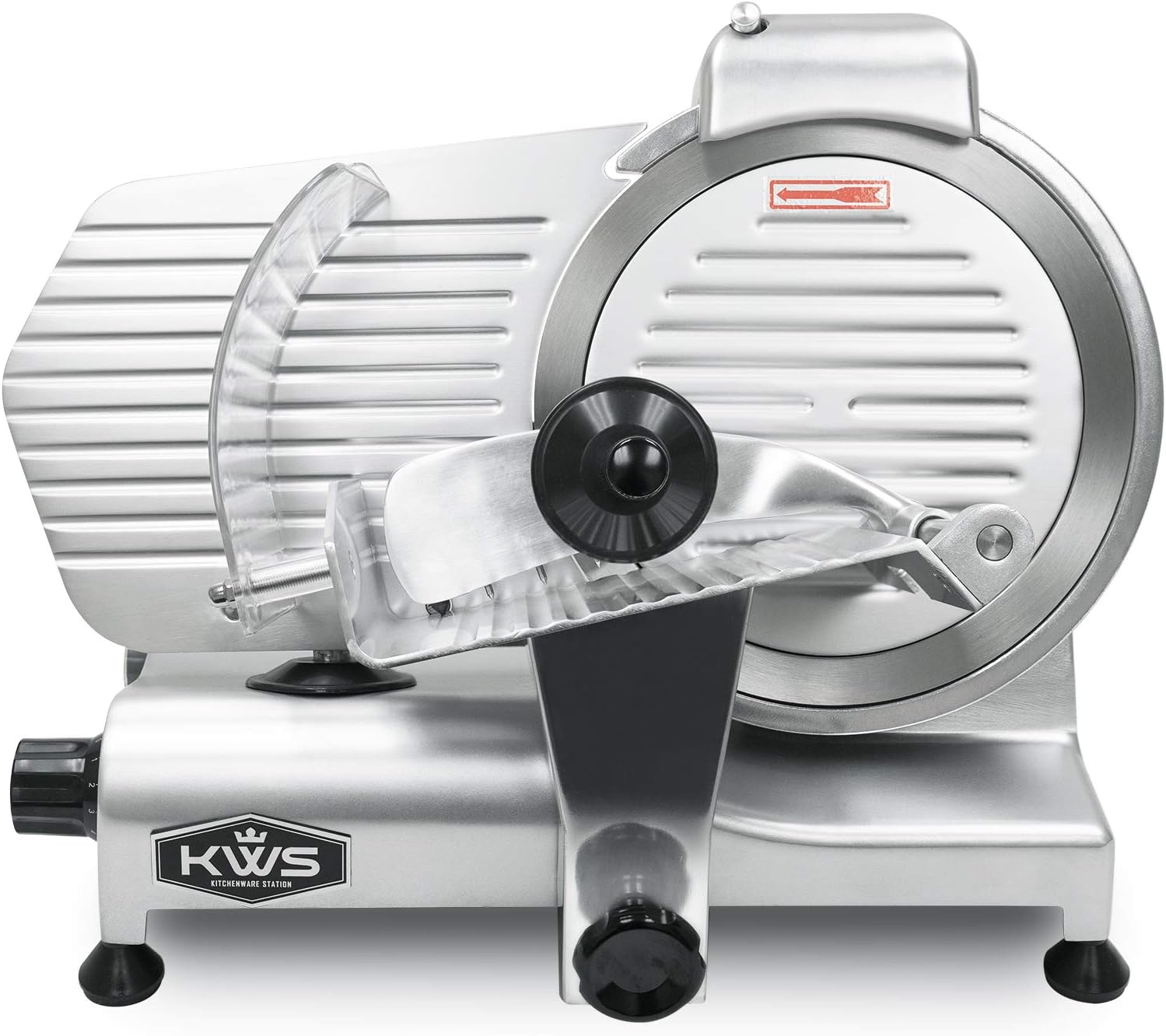
| BladeLength | 10 inches |
|---|---|
| Material Type | Stainless Steel |
| Operation Mode | Semi Automatic |
| Included Components | Complimentary Belt and Stone, Hand Guard, Sharpener, Slicer, User Manual |
| Motor Power | 320W |
The KWS MS-10NS is a compact but robust deli-style slicer built to handle frequent home and light-commercial use. It uses a 320W high-torque belt-driven motor and a 10" stainless steel blade to slice meats, cheese, and semi-frozen products with consistent results; the built-in dual whetstone sharpener keeps the edge between jobs. An adjustable thickness dial lets you go from paper-thin cuts up to 14 mm, which is useful when preparing beef jerky or thicker deli slices, and the removable carriage, hand guard, blade, and cover simplify cleanup after batch work. Cast aluminum construction and a balanced design reduce vibration for smoother, quieter operation while the tray size and spring-assisted carriage make feeding larger pieces easier. It is ETL listed and the blade is NSF certified for food contact. Expect a substantial, 37-pound unit that is best for users who need frequent, precise slicing rather than occasional countertop convenience, and note that hand washing is recommended for care.
Best for: Buyers who prioritize performance and repeatable, professional-style slicing for frequent jerky or bulk meat prep and want a durable, serviceable machine.
Less Ideal for: People who need a lightweight, highly portable slicer for occasional home use or who prefer fully dishwasher-safe components.
- Powerful 320W belt-driven motor designed for continuous slicing without slowing under load
- NSF certified 10" stainless steel blade with built-in dual whetstone sharpener for maintained edge
- Adjustable thickness dial for consistent slices from paper-thin to 14 mm useful for jerky or deli cuts
- Removable carriage, blade, and covers make cleaning and service easier after batch runs
- Cast aluminum body and balanced design reduce vibration and operate relatively quietly
- Relatively heavy and large for small kitchens at 37 pounds
- Recommended hand wash only increases post-use cleaning effort
Verdict: Choose the KWS MS-10NS when you need a durable, high-torque slicer that delivers consistent, professional-quality cuts for frequent beef jerky and bulk meat prep.
CUSIMAX Meat Slicer 8.7"

| Power | 200 watts |
|---|---|
| Blade Diameter | 8.7 inches |
| Thickness Adjustment Range | 1-20 mm |
| Material Type | Stainless Steel |
The CUSIMAX 8.7" meat slicer is a compact countertop deli slicer designed for home kitchens that need consistent, adjustable cuts. It uses a 200W motor to drive an 8.7-inch stainless steel blade and offers a 1–20mm thickness dial so you can slice ultra-thin to about 3/4-inch pieces for meats, cheese, bread and vegetables. The unit includes two removable blades, a removable food carriage and a food pusher for safer handling, and non-slip feet to keep the machine stable during operation. Parts that contact food are removable and dishwasher-safe, which makes cleanup and switching between ingredients straightforward. Practical users should note the manufacturer advises against slicing frozen meat or items with bones and recommends limiting continuous operation to short intervals, so it is best for batch slicing rather than industrial workloads. For jerky specifically, the slicer gives repeatable thin slices if the meat is properly chilled but you will need to prepare and dry the slices separately.
Best for: Buyers who want a compact, easy-to-clean countertop slicer that delivers consistent, adjustable slices for home cooking and small-batch jerky preparation.
Less Ideal for: People who need a heavy-duty commercial slicer or who plan to process large volumes of frozen or bone-in meat should choose a commercial-grade machine instead.
- Adjustable thickness from 1 to 20 mm for precise slice control
- 200W motor with an 8.7-inch stainless steel blade suitable for deli-style slicing
- Removable blade, food carriage and pusher for easier cleaning and ingredient switching
- Non-slip feet and blade safety guard improve stability and user safety
- Not intended for frozen meats or meats with bones, limiting heavy-duty jerky prep
- Recommended short continuous runtime means slower throughput for large batches
Verdict: A practical countertop slicer that delivers precise, repeatable thin-to-thick slices for home deli work and small-batch jerky when meat is prepped correctly.
Elite Gourmet EMT-625B Meat Slicer

| Blade length | 7.5 inches |
|---|---|
| Operation mode | Automatic |
| Material type | Stainless Steel |
The Elite Gourmet EMT-625B is a countertop electric meat slicer designed to handle cold cuts, hard cheeses, firm vegetables and bread for home kitchens. It uses a removable 7.5-inch stainless steel round blade and an adjustable thickness control that lets you slice from razor-thin to about 1/2-inch, which is handy when you need uniform slices for jerky prep or sandwich making. The die-cast aluminum housing and nonslip rubber feet give the unit a stable feel during use, and the blade is retractable and removable for safer handling and cleaning. Operation is automatic with a simple on/off control so it is straightforward for occasional users. Practical limits include its modest blade diameter and home-oriented build, so it will be slower and make narrower slices than commercial slicers and is best suited to small batches rather than heavy daily use. Hand washing is required for care, so expect some cleanup time after processing meat.
Best for: Home cooks who want an affordable, easy-to-use slicer for occasional meat, cheese, and jerky prep and who prioritize straightforward operation over commercial throughput.
Less Ideal for: Users who need a heavy-duty, high-volume slicer for frequent large batches or commercial use should choose a more powerful, professional model.
- Removable 7.5-inch stainless steel blade for easier cleaning and maintenance
- Adjustable thickness control from razor-thin up to 1/2-inch for versatile slicing
- Die-cast aluminum housing and rubber feet provide stability during use
- Simple automatic operation with an easy on/off switch for beginner-friendly use
- Blade and unit are sized for home use so not ideal for very large or continuous commercial batches
- Requires hand washing and some disassembly for cleaning
Verdict: A budget-minded, compact electric slicer that delivers consistent home-quality slices for small jerky and cold-cut batches.
BESWOOD 10" Meat Slicer BESWOOD250
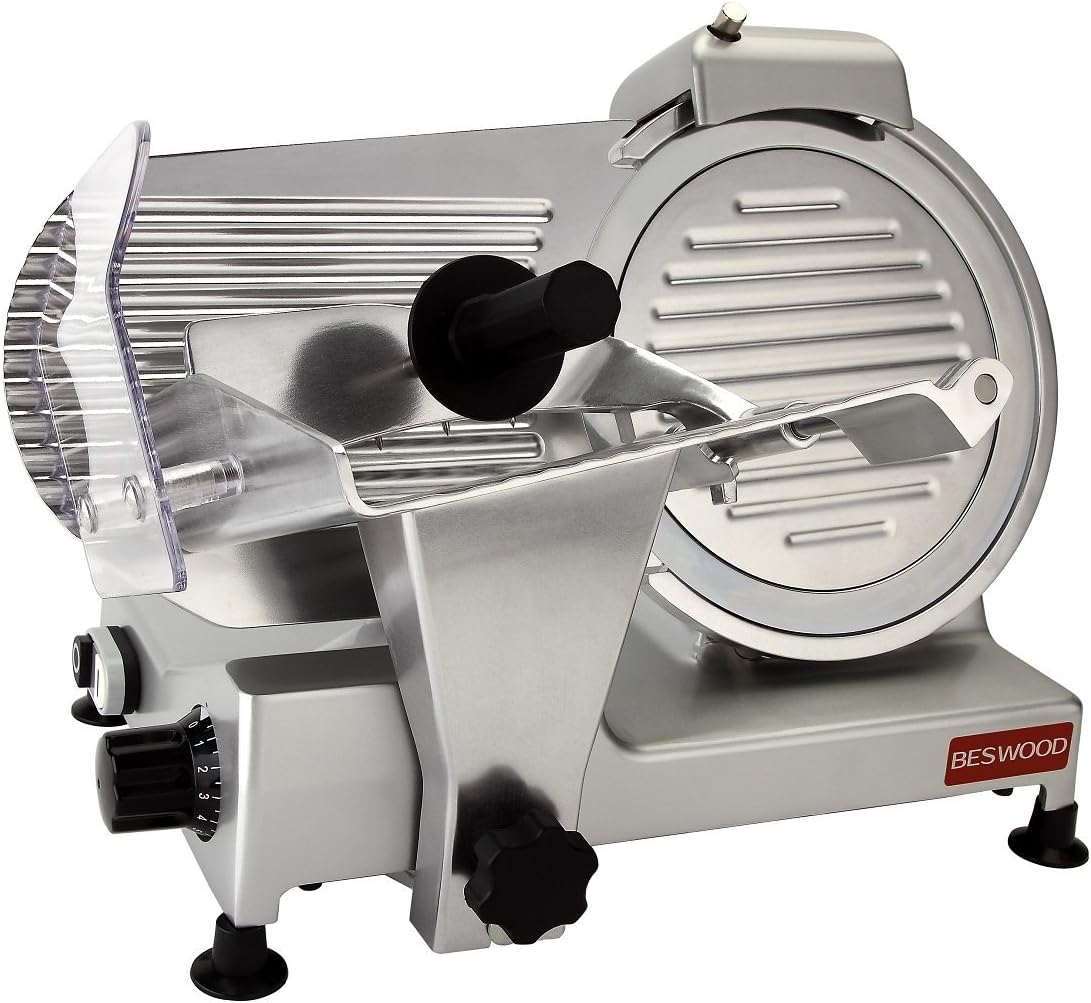
| Blade Diameter | 10" |
|---|---|
| Power | 240W (110-120V 60Hz) |
| Maximum cutting thickness | 12mm |
| Blade Material | High-carbon chromium-plated steel |
The BESWOOD 10" electric deli slicer is a heavy-duty countertop machine built to handle regular slicing of meats, cheeses, and vegetables. It uses a high-carbon, chromium-plated steel blade with a built-in two-stone sharpener, so the edge stays usable longer with minimal maintenance, and the 240W enclosed motor delivers steady power for continuous slicing. The gravity-feed, semi-automatic operation and removable product table make it straightforward to produce uniform cuts from very thin deli slices up to thicker pieces, and safety features such as a blade ring guard and skidproof rubber feet help stabilize the unit during use. Practical touches include a V-belt designed to reduce noise and vibration and a double-illuminated low-voltage on/off switch for safer control. Trade-offs are its substantial size and weight, which make it less suitable for casual counter-top storage, and it requires hand washing of parts rather than dishwasher convenience. In a jerky-focused kitchen this slicer handles repeat runs and varied thickness settings reliably but will occupy permanent countertop or storage space.
Best for: Buyers who prioritize a reliable, workhorse slicer for frequent batch slicing and value a long-lasting blade and built-in sharpening over portability.
Less Ideal for: If you need a lightweight, compact slicer for occasional use or countertop storage, this heavy commercial-style unit is a poor fit.
- Durable chromium-plated high-carbon steel blade resists corrosion and stays sharp longer.
- Built-in two-stone sharpener lets you maintain edge without removing the blade.
- 240W enclosed motor provides consistent power for frequent slicing.
- Semi-automatic gravity-feed and adjustable thickness let you produce uniform slices from very thin to thicker cuts.
- Rubber feet, blade guard, and low-voltage switch improve stability and operator safety.
- Heavy and bulky design makes it awkward to move or store in small kitchens.
- Key parts require hand washing rather than dishwasher-safe cleaning.
Verdict: Choose this slicer when you want a durable, maintenance-friendly machine that reliably produces consistent slices for heavy home or small commercial jerky prep.
OSTBA Meat Slicer SL-518

| Blade Length | 7.5 inches |
|---|---|
| Wattage | 150W |
| Adjustable Thickness | 0-15mm |
| Material Type | Stainless Steel |
The OSTBA SL-518 is a countertop electric slicer built for straightforward, consistent slicing of meats, cheese, bread, and vegetables. It uses a 7.5-inch stainless steel serrated blade driven by a 150W motor and lets you set slice thickness from paper-thin up to 15 mm, which is useful when preparing jerky pieces or uniformly thin deli cuts. The unit has removable components including the blade guard, food carriage, slide rod, and food pusher for easier cleaning, and non-slip suction feet plus a child-lock start that improve safety during use. In practice it handles small to medium batches well and produces even slices without a long learning curve, though the 150W motor and single blade design mean it is best suited to softer or partially frozen meats rather than heavy commercial loads. The compact footprint and dishwasher-safe parts make maintenance simple, but buyers wanting long continuous runs or thicker industrial cuts should consider higher-power models with larger trays and DC motors.
Best for: Buyers who want a reliable home deli slicer for occasional jerky prep and everyday thin slicing and who prioritize safety features and easy cleaning backed by strong customer feedback.
Less Ideal for: People who need a high-volume or commercial slicer for continuous heavy-duty use or those who need a large integrated tray for big roasts.
- Adjustable thickness from 0 to 15 mm for precise, repeatable slices
- Removable blade, carriage, and food pusher for easier cleaning and sanitation
- Safety lock plus non-slip suction feet reduce accidental starts and improve stability
- 7.5-inch stainless steel blade gives consistent cuts for deli-style slicing
- 150W motor and single blade limit heavy continuous slicing and very dense cuts
- No built-in large food tray, so larger roasts require more hands-on feeding
Verdict: A compact, safety-focused home slicer that delivers consistent thin cuts and easy cleanup, making it a sensible choice for small-batch jerky and deli slicing.
OSTBA Meat Slicer SL-518

| Wattage | 200W |
|---|---|
| Blade length | 7.5 inches |
| Adjustable thickness | 0-15mm |
| Included components | Food pusher; serrated and non-serrated blade; user instruction |
The OSTBA SL-518 is a compact electric deli slicer designed for home kitchens that need reliable, consistent slices for meats, cheeses, bread and vegetables. It uses a 200W motor and comes with two removable 7.5" stainless steel blades—one serrated for firmer or partially frozen items and one non-serrated for softer foods—so you can switch depending on the food. Thickness adjusts from nearly paper-thin to about 15mm to suit deli-style cuts or thicker pieces for jerky prep. The carriage, blade guard and food pusher are removable which makes cleanup and sanitation straightforward, and suction-cup feet plus a child-lock start reduce accidental movement and misuse. Because it is a semi-automatic, operator control matters for long runs and very thick or fully frozen blocks may require partial thawing or smaller pieces. The unit is sturdy for household use but is sized for home volumes rather than continuous commercial slicing, so expect occasional pauses during heavy tasks. For home cooks who prioritize safety and ease of cleaning while making consistent slices, this is a practical choice.
Best for: Home cooks who want a safe, easy-to-clean slicer that delivers consistent deli-style slices for household meal prep and occasional jerky batching.
Less Ideal for: Users needing a commercial-duty slicer for continuous high-volume production or those who slice large frozen primal cuts without pre-thawing.
- 200W motor with two removable 7.5" stainless steel blades for serrated and non-serrated slicing
- Adjustable slice thickness from 0–15mm for fine to thicker cuts
- Removable parts and seamless design simplify cleaning and sanitation
- Child-lock start and non-slip suction feet improve safety and stability during use
- Designed for home use so not intended for heavy continuous commercial slicing
- Very large frozen blocks may need partial thawing or pre-cutting for best results
Verdict: A safe, easy-to-clean 200W home deli slicer with dual blades and adjustable thickness that reliably produces consistent slices for home jerky and deli prep.
Choosing the Right Meat Slicer for Beef Jerky: Key Factors to Consider
Blade Material and Edge Retention
Blade composition directly influences how often you must sharpen or replace the blade. High-carbon stainless steel or hardened stainless blends hold an edge longer and resist corrosion from marinades or brines commonly used in jerky preparation. A blade that stays sharp produces clean cuts without tearing muscle fibers, which improves drying consistency and final texture.
Also consider blade diameter and whether the blade is removable for honing or replacement. Larger-diameter blades maintain momentum better and can slice through slightly thicker, chilled cuts with less effort. If you plan regular jerky batches, prioritize a slicer with proven blade metallurgy and straightforward maintenance.
Thickness Control and Adjustment Range
Consistent thickness is the single biggest factor in uniform jerky drying time. Look for slicers with precise, ratcheting thickness controls and a range that covers very thin (1–2 mm) up to thicker strips (4–6 mm). Stepless or micro-adjustment knobs are particularly useful when you need to dial in a specific chewiness or drying schedule.
Clear, repeatable thickness settings reduce waste and let you replicate successful batches. If you plan to experiment with different meat types or marinade soaking times, a finer adjustment mechanism gives you better control over how fast each strip dehydrates.
Motor Capacity and Continuous Duty
Motor power determines how well the slicer handles multiple pieces in sequence, especially if you are slicing chilled or partially frozen meat. A higher-wattage motor with reliable thermal protection will resist stalling and recover quickly during long sessions. Equally important is the motor's duty cycle and whether the manufacturer rates the unit for longer runs versus short intermittent use.
For small-batch home jerky production, a motor that balances torque and heat management reduces the risk of motor fatigue or automatic shutoffs mid-session. Consider also whether the drive system is belt-driven or direct drive, as that can affect noise, maintenance, and vibration.
Food Safety and Ease of Cleaning
Sanitary design shortens downtime between batches and lowers the risk of cross-contamination. Removable blade guards, detachable trays, and accessible nooks for fat and juice collection make cleaning faster and more thorough. Smooth surfaces and stainless-steel components resist staining from marinades and simplify wiping.
Dishwasher-safe parts are convenient but not strictly necessary if components are easy to disassemble and clean by hand. Also check for crevices where meat particles can lodge; simpler assemblies mean fewer hidden areas for bacteria to accumulate.
Stability, Weight, and Build Quality
A stable slicer produces more even cuts because vibration and movement can change blade contact and thickness as you feed meat through. Heavier, well-built units with rubber feet or clamps minimize shifting on countertops. Metal frames and quality fasteners increase longevity, especially if you will use the slicer frequently.
Portability is useful if you plan to store the unit between uses, but avoid ultra-light models that sacrifice rigidity. Evaluate the balance between weight and footprint so you get a stable machine that fits your prep area.
Safety Features and Operator Control
Safety matters whenever you run a high-speed blade. Look for features such as blade guards, a secure meat pusher or carriage, on/off locks, and non-slip feet. Some slicers include automatic shutoff when guards are removed or when the motor overheats, which reduces accident risk during maintenance.
Operator-friendly controls, like a clearly marked thickness dial and an accessible power switch, help you keep both hands on the meat pusher and maintain steady feed pressure. These design choices protect users and improve slicing consistency.
Preparing Meat for the Slicer
Trim large silver skin and excessive fat before slicing so strips dry uniformly and fat does not produce uneven slices. Partially freezing lean cuts for about 30 to 60 minutes firms the muscle, making it easier to get consistent, thin sections without slippage.
Slice against the grain when you want chewier jerky, and with the grain for a softer bite. Test a few trial slices to confirm your thickness setting and adjust marinades or drying time accordingly.
- Chill meat until firm but not rock-hard for best slicing.
- Pat meat dry before placing on the carriage to reduce slippage.
- Make uniform loins or flat strips before slicing to maintain steadiness.
Maintenance Tips to Keep Slices Consistent
Keep the blade sharp and follow a routine honing schedule. Even slight dulling increases tearing and inconsistent thickness. Wipe down the blade after each batch and perform a full cleaning at least weekly if you use the slicer regularly.
Check fasteners and the carriage alignment periodically. Loose screws or a misaligned carriage can shift slice thickness and increase wear on the motor and blade assembly.
- Inspect blade for nicks and replace when necessary.
- Lubricate sliding parts as recommended by the manual using food-safe lubricants.
- Store the unit covered to reduce dust and debris buildup.
Choosing Between Manual and Automatic Feed Options
Some slicers rely on a hand-guided carriage while others include a motorized feed. Manual feed gives you tactile control and can be preferable for hobbyists doing short runs. Motorized feed speeds up repetitive work and produces very consistent pressure over long batches, which is helpful for larger jerky projects.
Consider how much hands-on involvement you want. Automatic feed reduces operator fatigue but can add complexity to cleaning and maintenance. Evaluate whether the convenience is worth the additional moving parts for your typical batch size.
- Manual feed is simpler to maintain and often lighter.
- Motorized feed is better for long runs and production consistency.
- Confirm feed speed options to match your desired slice thickness and texture.
Workspace Setup and Safety Practices
Position the slicer on a stable, level surface with plenty of clearance for the meat carriage travel and a clean tray to catch slices. Keep a dedicated cutting board nearby to line up trimmed pieces and to stage slices for drying racks or dehydrators.
Always use the provided pusher or carriage guard, wear a cut-resistant glove on the hand that feeds meat, and follow lockout procedures before disassembly or cleaning. Good setup reduces accidents and improves slice repeatability.
- Allow airflow around the motor for cooling during longer sessions.
- Keep the power cord away from wet areas and marinade spills.
- Use a non-slip mat or secure the unit to the counter if the slicer shifts during use.
Adapting Thickness and Drying Time for Different Cuts
Lean rounds and eye-of-round slices dry faster than marbled cuts, so you may choose thinner slices for leaner muscles. Thicker strips require longer drying times and will retain more chewiness. Adjust thickness settings incrementally and track drying times to build repeatable recipes.
Record your slice thickness, drying temperature, and time for each cut and marinade combination. That log will help you reproduce successful batches and avoid under- or over-drying future runs.
- Start with a small test batch whenever trying a new cut or marinade.
- Label trays with thickness and drying time for consistent results.
- Use consistent airflow and temperature in your dehydrator or oven to match slice thickness choices.
How We Chose the Best Meat Slicer for Beef Jerky
We focused on attributes that directly affect jerky production and safe, repeatable slicing. Primary criteria included blade material and edge retention, because a sharp, durable blade yields cleaner cuts and more uniform drying. Thickness control and adjustment range were essential so users can choose thin strips for fast drying or thicker cuts for chewier results. Motor power and duty cycle were considered to ensure the machine handles longer runs without stalling or overheating. Ease of cleaning and food-safety design mattered for trimming fat and switching between batches. Build quality and stability were evaluated to limit vibration and produce steady slices from lean and slightly marbled cuts. We excluded machines intended only for deli counters or commercial continuous-use slicers whose size and ventilation needs exceed typical home or small-batch kitchens. Final selections reflect a balance of slicing precision, sanitary design, and durability for home jerky production.
Our full evaluation process is outlined in our review methodology.
FAQ
Can I slice partially frozen meat in a meat slicer for beef jerky?
Yes. Partially freezing meat firms it up and makes thin, clean slices easier. Do not freeze solid. Aim for a firm but still pliable texture so the carriage and blade cut without excessive force.
How thin should I slice meat for faster drying?
For faster drying, aim for 1 to 2 millimeters. Thinner slices dry quickly and produce chewier jerky. Thicker slices between 3 and 6 millimeters take longer and result in a meatier texture.
How often should I sharpen or replace the blade?
Frequency depends on use. For regular home jerky production, hone the blade weekly and sharpen or replace it when you notice tearing or drag. Inspect the edge before long sessions and address any nicks to maintain consistent slicing.
Are there special cleaning steps after slicing marinated meat?
Yes. Remove detachable parts and wash them promptly to prevent marinade residues from drying and hardening. Wipe the main body and blade guard, sanitize contact surfaces, and allow components to air-dry before reassembly.
Do heavier slicers perform better for jerky production?
Generally, heavier, well-built slicers offer more stability and produce steadier slices. However, overly large commercial units may be unnecessary for home use. Balance weight with your storage and countertop needs.
Final Verdict
Pick a slicer that matches your batch size and workflow. Prioritize blade quality and precise thickness control if you value consistent drying and repeatable texture. If you plan frequent, longer runs, favor stronger motors and robust cooling to avoid interruptions. Weigh tradeoffs between portability and build stability, and choose a model that is straightforward to clean and maintain. With the right combination of blade, adjustment range, and sanitary design, you can produce reliable, uniform beef jerky at home every time.