
Note: This article contains affiliate links. If you click on these links and make a purchase, we may earn a small commission at no extra cost to you. This helps support our research and content. Read our full affiliate disclosure here.
If you want uniformly thin deli cuts at home, the right meat slicer makes the difference between uneven, torn slices and smooth, consistent results. A slicer optimized for thin slices helps you handle everything from roast beef and ham to partially frozen pork or cooked poultry with predictable thickness and cleaner presentation. This guide covers the top shortlisted meat slicers for thin slices, focusing on the features that matter when precision is the priority. We evaluate blade quality, thickness control, safety, and ease of cleaning so you can pick a slicer suited to how often you will use it and the results you expect. Read on for the top picks and the buying considerations that will help you match a slicer to your kitchen and slicing habits.
Top Picks at a Glance
| Best Overall The best all-around choice for most situations | Borlebbi 200W Meat Slicer SL-518M |  |
| Best Quality Built to a higher standard if you want something more solid | KWS MS-10NS 10" Meat Slicer |  |
| Best Value The sweet spot between price and what you get | NutriChef Electric Meat Slicer NUGJ801 |  |
| Best Budget The cheapest option that still gets the job done reliably | SUPER DEAL Meat Slicer 7.5" |  |
| Top Rated A top-rated pick with lots of positive feedback | BESWOOD 10" Meat Slicer BESWOOD250 |  |
| Best Seller A high-volume bestseller chosen again and again | OSTBA Meat Slicer SL-518 |  |
Borlebbi 200W Meat Slicer SL-518M

| Power | 200 watts |
|---|---|
| Voltage | 120 volts |
| Hertz | 50/60 Hz |
| Blade Diameter | 7.5 inch |
| Max Slice Thickness | 0.6 inch (15 mm) |
This Borlebbi electric slicer is a countertop deli-style unit aimed at household cooks who want consistent, thin slices without effort. It uses a 200W motor and two removable 7.5-inch stainless steel blades to handle deli meats, cheeses, breads, and vegetables; the thickness knob adjusts from nearly paper-thin up to 0.6 inch (15 mm). The carriage, blade, slide rod extension, and food pusher are removable for easier cleaning, and the stainless steel tray keeps slices contained. Safety features include a recessed power switch and non-slip suction feet to stabilize the unit during use. The die-cast aluminum construction should resist rust and feel sturdy compared with plastic-only models. Expect good performance for sandwich prep and home charcuterie, but the 200W motor is not designed for prolonged commercial use and hand-wash-only parts add dishwashing effort. For buyers focused on very fine, delicate slicing, patience and careful feed speed will get the thinnest cuts rather than an automated ultrathin capability.
Best for: Buyers who want a capable, compact home deli slicer for regular sandwich making, charcuterie, and kitchen prep and who value durable construction and adjustable slice thickness.
Less Ideal for: Those who need a heavy-duty commercial slicer for continuous, high-volume use or users who require dishwasher-safe parts for fast cleanup.
- Adjustable thickness up to 15 mm for thin to thicker slices.
- Two removable 7.5" stainless steel blades for varied slicing tasks.
- Removable carriage, blade, and food pusher for more thorough cleaning.
- Non-slip suction feet and recessed power switch improve safety and stability.
- Die-cast aluminum body offers durability and rust resistance compared with plastic units.
- 200W motor is suitable for home use but may struggle with very dense or frozen items.
- Parts are hand-wash only which increases cleaning time compared with dishwasher-safe components.
Verdict: A sturdy, countertop home slicer that delivers precise thin-to-medium slices and durable construction ideal for everyday sandwich and charcuterie prep.
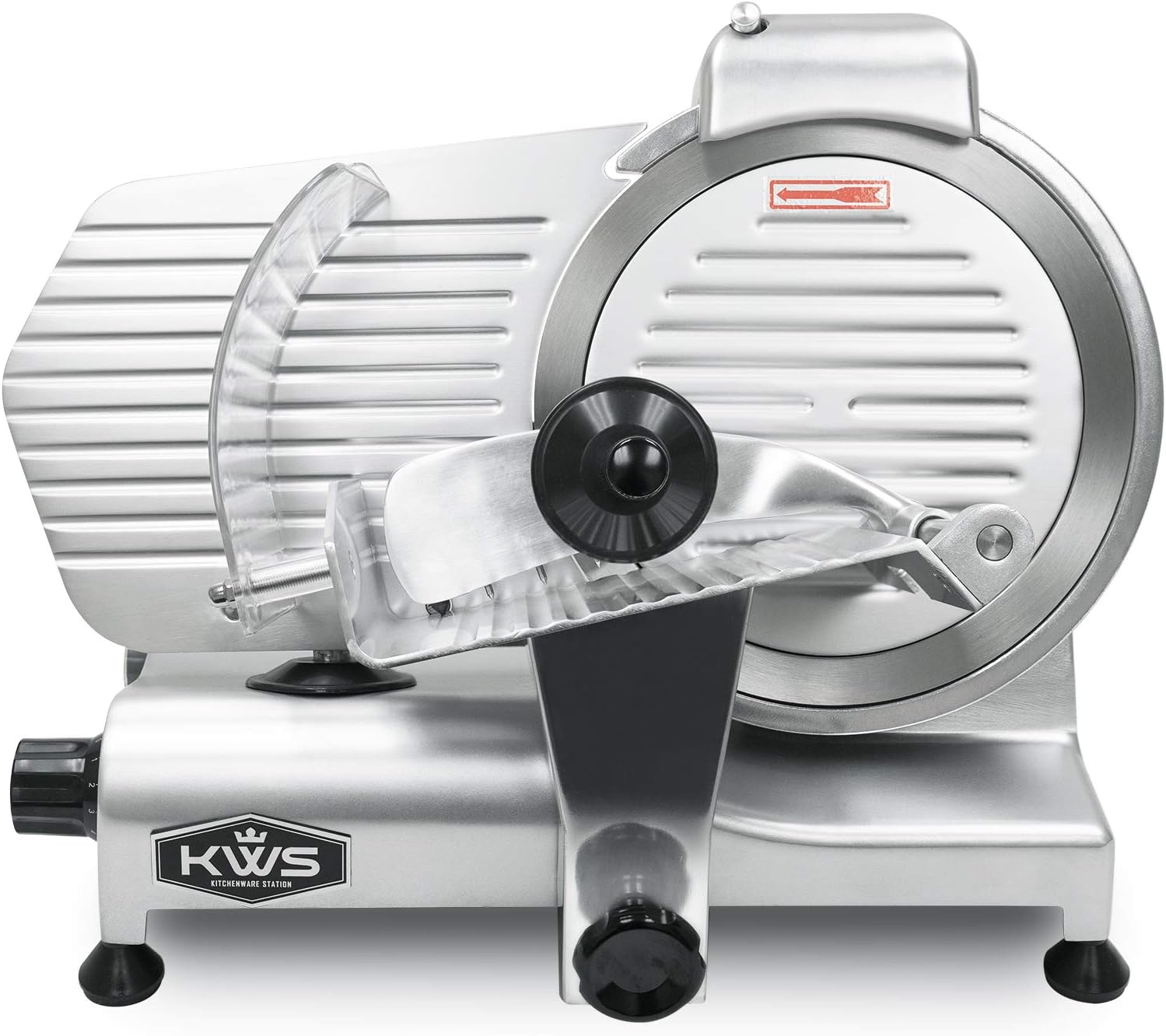
KWS MS-10NS 10" Meat Slicer
| BladeLength | 10 inches |
|---|---|
| Material Type | Stainless Steel |
| Operation Mode | Semi Automatic |
| Included Components | Complimentary Belt and Stone, Hand Guard, Sharpener, Slicer, User Manual |
| Manufacturer Warranty Description | 1-Year Factory Limited Warranty |
The KWS MS-10NS is a serious countertop slicer built to deliver deli-style thin slices at home or in light commercial use. Its 320W high-torque belt-driven motor keeps the 10" stainless steel blade spinning consistently under load, so you can slice meats, cheeses, and semi-frozen items without bogging down. An adjustable thickness dial provides precise control from paper-thin cuts up to 14 mm, and the built-in dual whetstone sharpener makes it easy to touch up the blade mid-run. The removable carriage, hand guard, blade, and cover simplify cleaning after batch prep, and the cast aluminum body and balanced design reduce vibration for smoother, quieter operation. It is heavier and more substantial than hobby slicers, so it feels stable while handling larger quantities, but that weight and commercial construction mean it needs a dedicated countertop spot and hand-washing for parts. For anyone who prioritizes consistent, very thin slices for charcuterie, jerky, or bulk prep, this slicer behaves like a compact deli machine rather than a light kitchen gadget.
Best for: Buyers who need deli-grade, repeatable thin slicing for charcuterie, jerky, or bulk meal prep and value continuous performance over occasional convenience.
Less Ideal for: Casual cooks who only need occasional single-loaf or small-quantity slicing and prefer lightweight, fully dishwasher-safe gadgets.
- Powerful 320W belt-driven motor maintains speed under continuous slicing
- Adjustable thickness dial delivers consistent paper-thin to 14 mm cuts
- 10" NSF-certified stainless steel blade resists corrosion and holds edge
- Built-in dual whetstone sharpener for quick touch-ups during use
- Removable carriage, hand guard, and blade simplify cleaning and service
- Heavy, substantial construction requires dedicated countertop space and manual cleaning
- Semi-automatic operation may have a learning curve for first-time slicer users
Verdict: Choose the MS-10NS when you want a compact, deli-style slicer that consistently produces paper-thin slices and holds up to heavy batch use.
NutriChef Electric Meat Slicer NUGJ801

| Power | 200W |
|---|---|
| Blade length | 7.5 inches |
| Adjustable thickness | 0-15 mm |
| Operation mode | Automatic |
The NutriChef NUGJ801 is a compact automatic meat slicer aimed at home cooks who want consistent deli-style cuts without a commercial machine. It uses a 7.5-inch stainless steel blade driven by a 200W motor and an adjustable dial that sets slice thickness from very thin up to 15 mm, so it can handle deli meats, cheeses, and breads. The removable blade and detachable carriage simplify cleaning compared with fixed commercial units, and safety features such as a food pusher and safety lock make it straightforward to operate. Its small footprint stores easily on a counter or in a cabinet, but because it is a home-grade 200W motor it is best for moderate, intermittent use rather than continuous heavy-duty slicing. The unit is mostly plastic and aluminum, so it feels lighter than professional all-metal slicers, which helps portability but may limit long-term durability under heavy use. For everyday home slicing of thin deli cuts, it delivers precise results and easy cleanup, with the expected compromises of a compact consumer machine.
Best for: Buyers who want a compact, easy-to-clean home slicer that produces consistent thin deli-style slices and prioritizes safety and convenience over commercial power.
Less Ideal for: People who need a heavy-duty, continuous-use slicer for large volumes or professional deli work should choose a commercial-grade all-metal machine instead.
- Adjustable thickness dial for precise thin to thicker slices
- 7.5-inch removable stainless steel blade for easier cleaning and maintenance
- Compact footprint that stores easily in small kitchens
- Safety features including a food pusher and safety lock for secure operation
- 200W motor is suited for light to moderate home use rather than continuous commercial slicing
- Construction includes plastic components which may be less durable than all-metal professional slicers
Verdict: Pick this NutriChef if you want an affordable, compact home slicer that reliably makes thin deli-style cuts with easy cleanup and safe operation.
SUPER DEAL Meat Slicer 7.5"

| Blade length | 7.5 inches |
|---|---|
| Motor power | 150 watts |
| Operation mode | Automatic |
| Material type | Alloy Steel, Aluminum, Plastic, Stainless Steel |
The SUPER DEAL Meat Slicer is a budget-friendly countertop slicer built for deli-style slicing at home. It uses a 7.5-inch stainless steel blade driven by a 150-watt motor to cut everything from paper-thin prosciutto to thicker sandwich slices, and the thickness control adjusts from very thin to about 3/5 inch for versatile prep. The sliding carriage, removable ring-guard cover, and detachable meat grip are designed for easier cleaning and safer handling, while suction feet and a blade guard help keep the unit stable during use. It is housed in die-cast aluminum which gives it a sturdier feel than many low-cost alternatives, but the unit is still aimed at light-to-moderate household use rather than heavy commercial workloads. Expect hand-wash cleaning for the components and occasional sharpening if you slice often. For buyers focused on getting thin, consistent slices without spending much, this delivers solid performance with a few compromises in industrial durability and continuous heavy-duty duty cycle.
Best for: Shoppers who want an affordable countertop slicer to produce thin deli-style slices at home for sandwiches, charcuterie, and meal prep without paying for commercial grade equipment.
Less Ideal for: Those needing a heavy-duty, continuous-use slicer for catering or commercial kitchens should choose a commercial-grade machine instead.
- 150-watt motor with 7.5-inch stainless steel blade capable of thin, consistent slicing
- Adjustable thickness from very thin to about 3/5 inch for versatile cuts
- Removable carriage, ring-guard cover, and meat-grip arm for easier cleaning and sanitation
- Suction feet and blade guard improve stability and safety during operation
- Die-cast aluminum housing offers a more solid build than many entry-level slicers
- Designed for light-to-moderate home use and not for continuous commercial slicing
- Requires hand washing of removable parts rather than dishwasher-safe cleaning
Verdict: If you want consistent paper-thin deli slices on a tight budget, this compact 7.5-inch electric slicer delivers reliable home use performance.
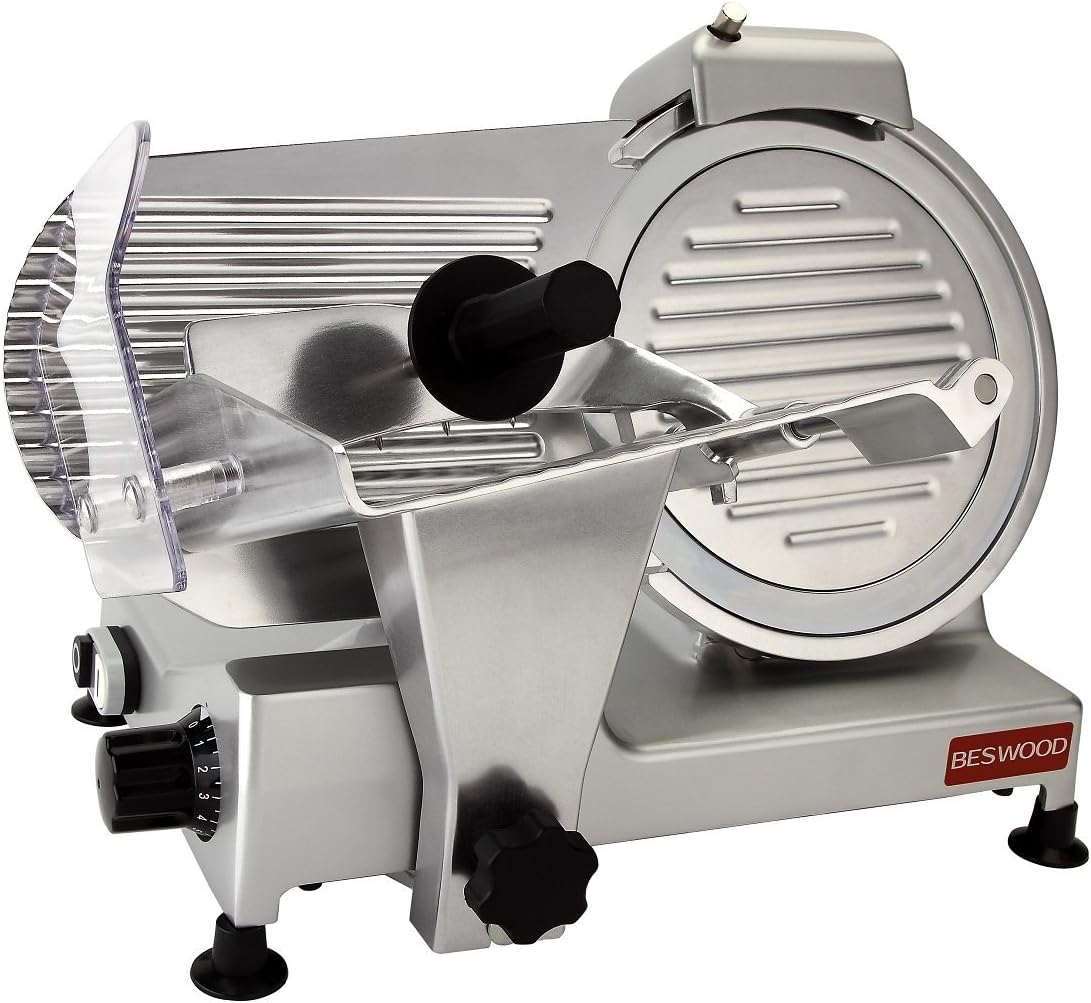
BESWOOD 10" Meat Slicer BESWOOD250
| Blade Diameter | 10 inches |
|---|---|
| Power | 240W 110-120V 60Hz |
| Maximum cutting thickness | 12mm |
| Blade Material | High-carbon and Chromium-plated Steel |
The BESWOOD 10" electric deli slicer is built to deliver consistent thin-to-thicker slices of meat, cheese, and vegetables for home kitchens or light commercial use. It uses a high-carbon, chromium-plated steel blade and a 240W enclosed motor to handle regular slicing tasks while resisting corrosion and reducing the need for frequent sharpening. The unit includes an easy adjustment system for controlling slice thickness up to the stated maximum and a top-mounted two-stone sharpener so you can maintain a sharp edge without removing the blade. Practical touches include a removable product table for cleaning, skidproof rubber feet, a blade ring guard, and a double illuminated on/off switch for safer operation. At about 33 pounds and with an aluminum body, it feels stable during use but is large compared with compact kitchen slicers and requires hand washing and routine maintenance. Noise and vibration are reduced by a V-belt, yet users should expect some typical slicer noise and need to follow the manual for safe operation.
Best for: Buyers who prioritize reliable, repeatable thin slicing for deli-style cuts and want a robust machine that stays sharp with routine upkeep.
Less Ideal for: Those who need a lightweight, ultra-compact slicer for occasional use or who want a tool that is fully dishwasher-safe should consider smaller, easier-to-store alternatives.
- Durable chromium-plated high-carbon steel blade resists corrosion and holds an edge longer.
- Built-in two-stone sharpener and easy thickness adjustment for consistently thin deli slices.
- 240W enclosed motor with V-belt reduces vibration for steady slicing during regular use.
- Removable product table and safety features like blade guard and skidproof feet simplify cleaning and operation.
- Relatively heavy and bulky compared with compact home slicers, taking more counter space.
- Requires hand washing and periodic maintenance; not a dishwasher-safe design.
Verdict: Choose this slicer if you want a sturdy, corrosion-resistant machine that consistently produces deli-thin slices with onboard sharpening for long-term reliability.
OSTBA Meat Slicer SL-518

| Blade Length | 7.5 inches |
|---|---|
| Wattage | 150W |
| Adjustable Thickness | 0-15mm |
| Operation Mode | Automatic |
The OSTBA SL-518 is a compact electric deli slicer designed for home use that delivers consistent thin cuts for meats, cheese, bread and produce. It uses a removable 7.5" stainless steel blade driven by a 150W motor and an adjustable thickness dial that ranges from nearly paper-thin up to 15mm, so you can slice delicate prosciutto or thicker sandwich cuts. The unit has a removable food carriage, slide rod and food pusher for easier cleaning and a ring-guard that reduces debris buildup. Safety features include a child-lock style two-button start and non-slip suction feet to keep the unit steady during use. For everyday kitchen use it is straightforward to operate and stores on a counter without much fuss, and replacement blades and pushers are available from the brand. Limitations are its modest 150W motor and home-oriented build, so it is not intended for heavy commercial throughput or continual high-volume slicing sessions.
Best for: Buyers who prioritize safe, consistent thin slicing for home deli tasks and want an easy-to-clean machine that handles occasional household volumes.
Less Ideal for: People who need a commercial-grade slicer for high-volume or continuous use should look at more powerful, professional units instead.
- Adjustable thickness control from near paper-thin up to 15mm for versatile slicing.
- 7.5" removable stainless steel blade that is easy to clean and replace.
- Removable carriage, slide rod and food pusher simplify sanitation.
- Safety two-button start and non-slip suction feet improve user safety and stability.
- Compact countertop footprint suitable for home kitchens.
- 150W motor is adequate for home use but can struggle with long continuous runs or very dense meats.
- No built-in food tray on this model which may require an external catch for slices.
Verdict: Choose the OSTBA SL-518 if you want a safe, easy-to-clean home slicer that consistently produces thin deli-style slices.
Choosing the Right Meat Slicer for Thin Slices: Key Factors to Consider
Blade Material and Grind
The blade determines how well a slicer can cut paper-thin slices without tearing. Look for blades made from high-carbon stainless steel or equivalent alloys that take and hold a fine edge. A quality grind and heat treatment reduce the frequency of sharpening and preserve slicing performance over time.
Thinner slices demand a blade that resists chipping and burr formation. Consider whether the blade is removable for sharpening or replacement and whether sharpening tools are user-accessible. Blade diameter also affects cutting geometry; larger blades maintain momentum better during long slicing tasks, which can help keep slices uniform.
Thickness Adjustment and Repeatability
Accurate, repeatable thickness control is essential when aiming for consistently thin slices. A fine-stepped or micrometer-style adjustment lets you set and re-create the same thickness across multiple sessions. Coarse or poorly indexed dials make it difficult to dial in paper-thin settings and often result in variable results.
Also consider how the adjustment mechanism is accessed and whether it stays locked under load. A mechanism that drifts while slicing will ruin delicate cuts. Clear markings and a positive detent or locking feature increase confidence that the setting you choose will be the setting you get while slicing.
Carriage Design and Feed Stability
The carriage that holds and feeds the meat must move smoothly and stay square to the blade. Any wobble, tilt, or binding amplifies variations in slice thickness and can cause tearing. Materials and bearings used in the sliding mechanism affect how vibration-free and consistent each pass is.
A well-designed food grip and pusher keep the meat aligned and reduce the need to re-seat or reposition the product between passes. For very thin slices, secure, low-profile holders help present the meat evenly against the blade without crushing or compressing the product.
Motor Power, Duty Cycle, and Cooling
Motor capacity matters when you are pushing for thin slices, especially if you will process larger volumes or denser cuts. A motor with adequate torque keeps the blade speed steady under load, which promotes uniform slices. Home-use motors vary in rated power and duty cycle, so consider whether the unit is rated for intermittent household use or heavier continuous loads.
Also check cooling features and thermal protection. Motors that overheat will slow or stop, interrupting work and possibly affecting blade sharpness. For occasional household slicing, a modestly powered motor with good cooling is preferable to an oversized, commercial motor that adds unnecessary complexity.
Cleaning and Maintenance Access
Regular cleaning prevents buildup that dulls blades and creates hygiene issues. A slicer that disassembles easily, with removable blade guards and food-contact parts, shortens cleaning time and improves sanitary maintenance. Seams and crevices in the housing should be minimal to avoid trapped food particles.
Consider whether parts are dishwasher-safe or require handwashing, and whether the design permits safe blade handling during maintenance. Units that include a safe sharpening accessory or clear guidance on blade care reduce long-term upkeep hassles.
Safety Features and User Ergonomics
When slicing thin cuts, users often make many passes close to the blade, so safety features are crucial. Look for robust finger guards, non-slip feet, and secure on/off switches or safety interlocks. A well-positioned power switch and a blade cover that locks during cleaning are helpful for preventing accidents.
Ergonomics also affect how comfortable you are during extended slicing. A carriage handle with a comfortable grip, balanced weight distribution, and a stable base reduce fatigue and improve control when working toward very thin slices.
Preparing Meat for Best Thin Slices
The condition of the meat before slicing strongly influences how thin and neat each slice will be. For many cuts, chilling the meat until it is firm but not frozen makes it easier to slice thinly without slippage or tearing. Slightly firm texture helps the blade engage cleanly and reduces compression of the product under the food pusher.
Trim large fat caps and remove bones where possible to provide a flat, even surface for the carriage to feed. When slicing cooked products, let them cool to a safe, firm temperature; very hot or very soft items are more likely to deform and produce uneven slices.
- Chill meat to firm consistency for best thin slicing.
- Remove bones and large irregularities that can catch on the blade.
- Slice in consistent-sized portions to maintain even carriage feed.
Sharpening and Blade Care Tips
Maintaining a sharp edge keeps thin slices clean and reduces the force needed during cutting. Follow the manufacturer instructions for sharpening frequency and technique. If the blade is removable, use the recommended sharpening stone or device and ensure the blade is thoroughly cleaned and dried before reinstalling.
Avoid over-sharpening which can remove excessive material and alter blade geometry. Inspect blades for nicks and burrs and dress minor defects promptly. Proper storage and regular sanitizing will preserve blade life and performance.
- Use recommended sharpening tools and follow angle guides.
- Clean and dry blades fully before storage.
- Inspect for burrs and address them immediately to prevent tearing slices.
Safe Operation Practices
Always use the food pusher and keep fingers behind the guard while the blade is exposed. Engage any blade covers or safety locks before cleaning or when the unit is idle. Place the slicer on a stable, level surface and confirm non-slip feet or suction bases are secure before use.
Power down and unplug the unit before adjusting blade settings or performing maintenance. If the slicer stalls or vibrates excessively, stop immediately and inspect for jammed food or misalignment before continuing.
- Use a firm food grip; do not attempt one-handed feeding when slicing thin cuts.
- Unplug before disassembly or blade access.
- Stop and inspect if carriage binds or motor struggles.
Matching Slicer Size to Your Kitchen and Volume
Slicers range from compact, counter-friendly units to larger platforms better suited for frequent or party-sized jobs. Consider countertop space and storage when selecting a unit. A heavy, stable base reduces vibration but may be harder to store.
If you slice occasionally for household meals, a compact slicer with solid thickness control may be ideal. For regular entertaining or high-volume use, prioritize a unit with a larger carriage and a motor built for longer duty cycles.
- Measure storage and counter space before choosing a size.
- Balance portability with stability for vibration-free thin slicing.
- Plan for ventilation and cleaning access in your storage location.
Common Troubleshooting for Uneven Thin Slices
Uneven slices usually come from carriage wobble, dull blades, or inconsistent feed pressure. Check the carriage rails for debris and verify that the food pusher holds the meat flat and square against the carriage plate. Replace or sharpen blades that show wear.
If the slicer vibrates, confirm the unit sits level and that feet are secure. Motor strain under load might indicate the meat is too warm or the motor is undersized for that task. Addressing these mechanical and preparation issues typically restores thin-slice performance.
- Inspect carriage rails and clean any buildup.
- Sharpen or replace blades showing burrs.
- Ensure the slicer is level and feet are secure to reduce vibration.
How We Chose the Best Meat Slicer for Thin Slices
We prioritized criteria that directly affect how thin and consistent slices can be produced, and which make routine use and maintenance realistic for home kitchens. Blade construction and sharpness were primary filters because a hardened, well-ground blade sustains fine edges and resists burr formation that ruins thin cuts. Thickness control and carriage stability were required selection factors; models with precise, repeatable adjustments and a low-vibration sliding carriage are better at producing paper-thin slices. We also screened for safety and ergonomics, including secure food holders, finger guards, and on-off controls that are easy to reach. Ease of cleaning and disassembly mattered because residue and trapped bits quickly degrade performance and hygiene. Motor capacity and cooling were evaluated to ensure consistent cutting without overheating during repeated thin passes. Finally, we excluded commercial-only units whose size, power, or installation needs make them impractical for home use. The remaining picks balanced blade quality, slicing precision, user safety, and manageable upkeep.
Our full evaluation process is outlined in our review methodology.
FAQ
Can I get paper-thin slices at home with a consumer meat slicer?
Yes, many home-use slicers can achieve very thin, deli-style slices when the blade is sharp, the meat is properly chilled, and the thickness adjustment is precise. Expect better results with a stable carriage and a fine-stepped adjustment mechanism.
How cold should meat be before slicing thinly?
Chill meat until it is firm but not frozen solid. Slight firmness helps the blade cut cleanly without crushing. Avoid slicing fully frozen meat unless the slicer is explicitly rated for it.
How often do I need to sharpen the blade for thin slices?
Frequency depends on use intensity and meat types. For occasional home use, sharpening a few times per season may suffice. If you slice frequently or work with tough, fibrous cuts, sharpen more often. Inspect cuts for tearing as a sign it is time to sharpen.
Is a larger blade better for thin slices?
Larger blades tend to hold momentum and can produce steadier slices during long jobs, which helps consistency. However, blade material, sharpness, and carriage stability matter as much or more for producing very thin slices.
Are removable blades safer to clean and maintain?
Removable blades make cleaning and sharpening easier because you can access both sides safely. They require careful handling during removal and reinstallation, and you should always follow safety steps such as unplugging the unit and using protective gloves.
Final Verdict
Prioritize blade quality, a precise thickness adjustment, and a stable carriage when choosing a meat slicer for consistently thin slices. Evaluate motor capability and cleaning access based on how often you will slice and how much volume you expect to handle. Balance safety features and ergonomics with size and storage needs to find a slicer that fits your kitchen routine. Focus on the tradeoffs between convenience and heavy-duty capacity: choose a compact, well-engineered home unit for occasional delicate slicing, or a sturdier model with better cooling and carriage stability if you need to produce thin slices regularly.