
Note: This article contains affiliate links. If you click on these links and make a purchase, we may earn a small commission at no extra cost to you. This helps support our research and content. Read our full affiliate disclosure here.
Picking the right oscillating fan matters when you want reliable airflow without constant adjustment. The right model can improve comfort, lower perceived temperature, and move air efficiently across rooms while staying quiet enough for sleep or work. This guide covers seven carefully shortlisted oscillating fans that suit common home uses, from bedroom breeze to living-room circulation. Below we evaluate practical factors like airflow distribution, noise output, controls, and build quality to help you pick an option that fits your space and routine. Read on for focused buying guidance and answers to common owner questions before the product list.
Top Picks at a Glance
| Best Overall The best all-around choice for most situations | Levoit Classic 36-inch Tower Fan |  |
| Best Quality Built to a higher standard if you want something more solid | DREO TurboPoly Pedestal Fan DR-HPF008S |  |
| Best Value The sweet spot between price and what you get | BLACK+DECKER 16" Pedestal Fan BFSR16B |  |
| Best Budget The cheapest option that still gets the job done reliably | Honeywell TurboForce HT-900 |  |
| Top Rated A top-rated pick with lots of positive feedback | DREO DR-HPF013 Pedestal Fan |  |
| Most Popular A crowd favorite that many people choose with confidence | Amazon Basics 16" Pedestal Fan FS40-10BR |  |
| Best Seller A high-volume bestseller chosen again and again | Lasko 2520 Oscillating Pedestal Fan | 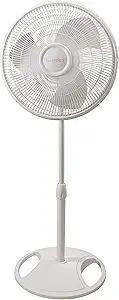 |
Levoit Classic 36-inch Tower Fan

| Number of Speeds | 5 |
|---|---|
| Noise Level | 28 db |
| Wattage | 39 watts |
| Air Flow Capacity | 1044 cfm |
| Control Method | Remote |
The Levoit Classic 36-inch tower fan is a bedroom-focused oscillating tower that delivers versatile air circulation from a slim footprint. It offers five speeds and four modes including Normal, Turbo, Sleep and Auto, and the built-in temperature sensor adjusts fan speed automatically to respond to room temperature. Typical use is standing on the floor by a bed or in a living room corner where the 90 degree oscillation and up to 28 ft/s airflow move air across a whole room. Notable features include a near-silent low speed rated at 28 dB, a 12-hour timer, LED display with advanced sleep behavior, and a small remote for adjusting settings from across the room. The fan runs on an AC motor with a standard wall outlet and the removable rear grille makes cleaning straightforward. Trade-offs are typical of slim tower designs: it prioritizes quiet, whole-room airflow rather than raw industrial power, and the plastic construction keeps weight and cost down but feels less premium than metal consoles.
Best for: Buyers who want a quiet, bedroom-friendly oscillating fan that adapts speed automatically and is easy to operate from a distance.
Less Ideal for: People who need an industrial-strength fan for workshops or very large open spaces should choose a higher-power, heavy-duty model instead.
- Quiet operation on low speed (around 28 dB) suitable for bedrooms and light sleepers
- Auto mode with built-in temperature sensor adjusts airflow to room conditions
- Five speeds, turbo and sleep modes plus 90° oscillation cover whole-room circulation
- Includes remote control and 12-hour timer for convenient, out-of-reach adjustments
- Removable rear grille allows easy cleaning
- Plastic construction may feel less durable compared with metal fans
- Slim tower design focuses on airflow distribution rather than extreme high-power output
Verdict: Choose this fan when you want a quiet, easy-to-control oscillating tower that adapts airflow automatically for bedroom comfort.
DREO TurboPoly Pedestal Fan DR-HPF008S

| Power Source | dc |
|---|---|
| Number of Speeds | 9 |
| Air Flow Capacity | 1000 cfm |
| Noise Level | 28.2 db |
| Control Method | App, Remote, Touch |
The DREO TurboPoly pedestal fan is built to move a lot of air quietly and give flexible control for different rooms. Its DC motor and Turbo mode deliver up to 1000 CFM and a reported reach of roughly 100 ft, making it useful for circulating air across medium rooms or boosting HVAC performance. The head supports simultaneous horizontal and vertical oscillation with wide angles and an adjustable-height pedestal so you can aim flow precisely. Nine speed settings, six modes including an Auto mode that reacts to temperature, and an 8-hour timer let you tailor comfort, while app, remote, touch and Alexa support make hands‑free operation easy. The unit includes an RGB LED ring for night lighting and a removable front for cleaning. Expect low noise thanks to the DC design but note the fan is plastic-bodied and weighs about 11.5 lb, so it is not the heftiest build. Also, advanced smart features require the app and a Wi‑Fi setup. For buyers who prioritize strong, adjustable airflow with smart controls, this fan balances power and quiet operation effectively.
Best for: Buyers who want a performance-focused standing fan that delivers strong, directional airflow and smart control for cooling and air circulation in medium-size rooms.
Less Ideal for: People seeking a minimalist, no-tech fan or those who need a heavy-duty metal fan for workshop or outdoor abuse should look elsewhere.
- High airflow capacity up to 1000 CFM for whole-room circulation
- Wide 3D oscillation (horizontal and vertical) and adjustable height for targeted coverage
- Quiet, energy-efficient DC motor with multiple speeds and Auto mode
- Comprehensive controls: app, remote, touch, and voice compatibility
- Removable front grille for easier cleaning
- Plastic construction may feel less durable than metal alternatives
- Smart features require Wi‑Fi and app setup to access full functionality
Verdict: Choose this fan when you need a powerful, quiet pedestal unit with wide 3D oscillation and full smart controls for serious whole-room airflow.
BLACK+DECKER 16" Pedestal Fan BFSR16B

| Number of Speeds | 3 |
|---|---|
| Oscillation | 90° |
| Tilt Angle | 30° |
| Wattage | 48 watts |
| Noise Level | 55 db |
The BLACK+DECKER 16" pedestal fan is a straightforward floor fan designed to move air in bedrooms, living rooms, and similar indoor spaces. It offers three speed settings and a 16-inch three-blade propeller for adjustable airflow, plus 90-degree oscillation and 30-degree tilt to spread breeze across a room. Height adjusts up to about 49 inches so you can aim airflow where it is needed, and the included remote and front-panel buttons make changes convenient from across the room. A 7.5-hour timer and LED indicator add basic programmability, and the brushless motor with an ETL safety mark suggests reliable, energy-efficient operation at about 48 watts. The fan is plastic-bodied and light enough to move between rooms, but that also means it lacks the heft and premium materials of higher-end metal fans, which can influence longevity and vibration at higher speeds. Noise is listed around 55 dB at operating levels, so it is audible on higher settings but suitable for daytime use. Overall, it is a practical, easy-to-use oscillating pedestal fan that covers common cooling needs without extra complexity.
Best for: Buyers who want a no-frills, programmable pedestal fan that delivers adjustable airflow across a room and values easy operation and portability.
Less Ideal for: If you need a premium, heavy-duty fan built from metal for long-term commercial use or near-silent operation for bedrooms, consider more robust or specialty models instead.
- Three speed settings plus 90-degree oscillation and 30-degree tilt for flexible airflow coverage
- Adjustable height up to 49 inches to target air where needed
- Remote control and front-panel buttons for convenient adjustments from a distance
- Brushless motor with ETL listing for efficient, reliable operation
- Lightweight, portable design makes it easy to move between rooms
- Plastic construction may feel less durable than metal alternatives
- Noise around 55 dB on higher speeds may be noticeable in quiet rooms
Verdict: A simple, easy-to-use oscillating pedestal fan that delivers flexible room circulation and remote convenience for everyday home cooling.
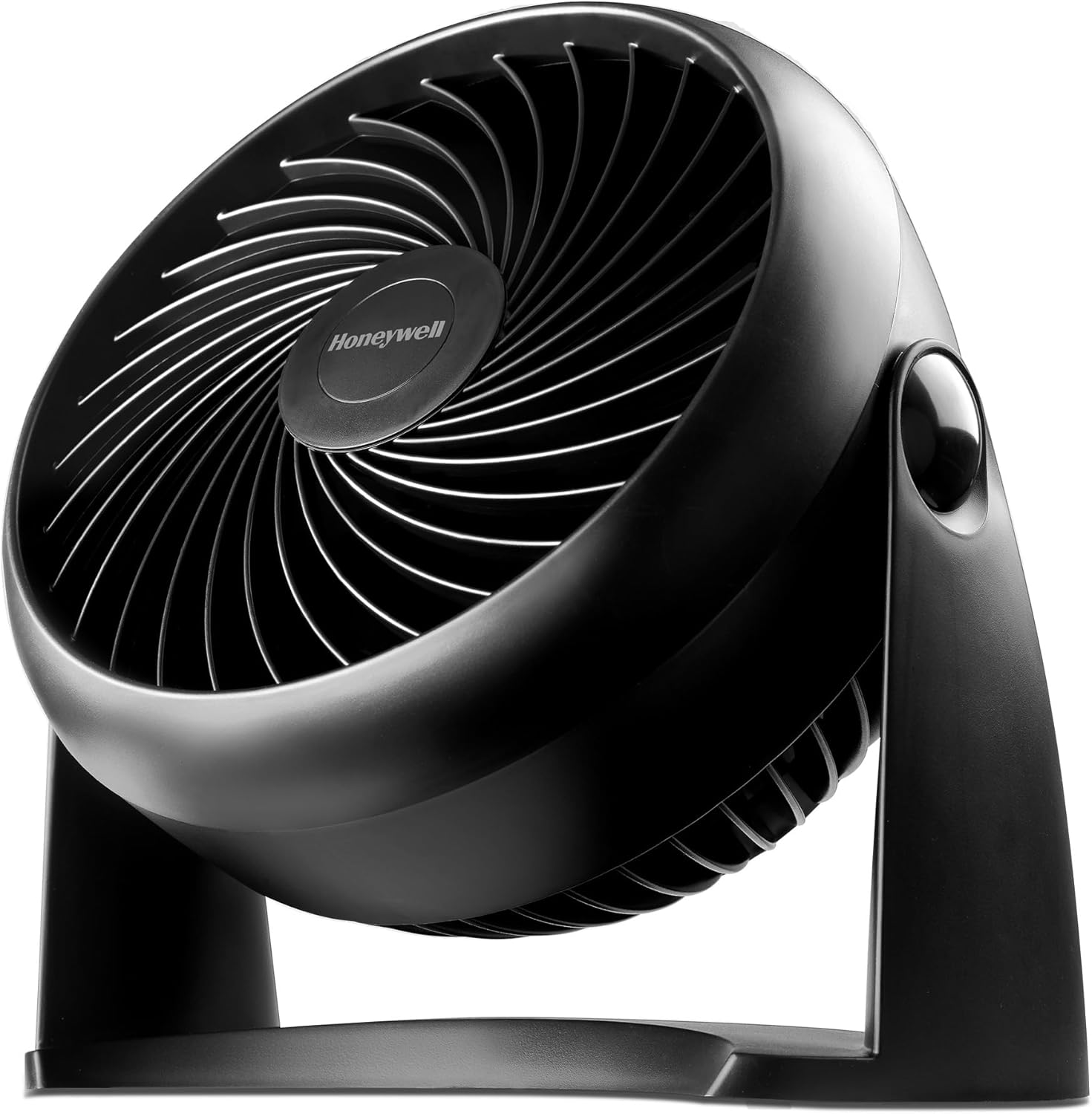
Honeywell TurboForce HT-900
| Power Source | Corded Electric |
|---|---|
| Number of Speeds | 3 |
| Air Flow Capacity | 185 cfm |
| Wattage | 35 watts |
| Motor Type | brushless |
The Honeywell TurboForce HT-900 is a compact tabletop air circulator meant to boost airflow in small to medium rooms. It runs from a standard corded outlet and uses an aerodynamic turbo design with three speeds to push air efficiently; the manufacturer claims the breeze can be felt up to 25 feet away. The head pivots 90 degrees so you can direct airflow toward a workspace, bed, or a seating area, and its brushless motor and Honeywell sound tuning make it noticeably quiet for continuous use. The fan can be wall-mounted or used on a desk and its plastic construction keeps it lightweight and easy to move between rooms. Limitations are its basic control scheme with only push-button speed selection and no timer or remote, and the small size means it is best for targeted circulation rather than cooling large open spaces. For buyers seeking simple, reliable spot cooling on a budget, this model offers a lot of performance for the size.
Best for: Buyers who want an inexpensive, portable fan to provide targeted cooling or improve airflow in a bedroom, home office, or small living area without fuss or advanced controls.
Less Ideal for: People who need whole-room oscillation, programmable schedules, or remote/voice control should consider larger or more feature-rich fans instead.
- Compact and lightweight for easy placement and transport
- Aerodynamic TurboForce design delivers strong airflow for its size
- Three speeds and 90-degree pivot allow directed, customizable airflow
- Brushless motor and design tuned for relatively quiet operation
- No oscillation feature for full-room coverage
- Controls are basic push-button only with no timer or remote
Verdict: A compact, budget-friendly desk or tabletop circulator that delivers strong, quiet spot cooling with simple controls.
DREO DR-HPF013 Pedestal Fan

| Power Source | Corded Electric |
|---|---|
| Number of Speeds | 8 |
| Noise Level | 28.2 db |
| Air Flow Capacity | 1000 cfm |
| Motor Type | Brushless |
The DREO DR-HPF013 is a tall pedestal air circulator built around a brushless DC motor that aims to move air across a whole room quietly and reliably. It offers up to 1000 CFM and a claimed 90 ft throw, with eight distinct speed settings, an auto mode that adjusts output with temperature, 90° horizontal oscillation and a 105° manual tilt for directional control. Controls are available on a top touch panel and via the included remote, and an 8-hour timer plus a mute function make it easy to run overnight. The unit is largely plastic but uses a detachable grill and blade for easier cleaning and includes a small aroma pad for fragrance. Practical benefits are strong airflow with low noise and flexible placement thanks to height adjustment. Limitations include plastic construction that may not feel premium and a manual vertical pivot rather than a motorized tilt; the 8-hour timer is useful but shorter than some competitors that offer 12-hour schedules.
Best for: Buyers who prioritize a quiet, dependable fan that delivers strong whole-room airflow and simple, fuss-free controls for daily use and overnight operation.
Less Ideal for: Anyone seeking a heavy-duty metal build, fully motorized multi-axis oscillation, or longer programmable timers should consider other models.
- Brushless DC motor for efficient, quiet operation
- High airflow (1000 CFM) with up to 90 ft throw for whole-room circulation
- Eight speed levels plus auto mode for fine control
- Remote and touch controls with an 8-hour timer and mute function
- Detachable grill and blade for easier cleaning
- Plastic construction can feel less durable than metal alternatives
- Vertical tilt is manual rather than motorized
- Timer max is 8 hours which is shorter than some rivals
Verdict: A reliable, quiet pedestal circulator that delivers strong whole-room airflow with straightforward controls and maintenance.
Amazon Basics 16" Pedestal Fan FS40-10BR

| Power Source | Corded Electric |
|---|---|
| Number of Speeds | 3 |
| Wattage | 60 watts |
| Motor Type | AC |
| Control Method | Remote |
This 16-inch Amazon Basics pedestal fan is designed to move air through medium to large rooms using a 60W AC motor, three speed settings and an oscillation function. Typical use is as a stand-alone room circulator in a living room, bedroom or home office where you want directed airflow without running a central system. The fan includes adjustable height and tilt so you can aim airflow, and a remote that controls speed, mode (normal, nature, sleep) and timer from across the room. Dual-layered blades and the oscillation help spread air more evenly, while the AC motor favors continuous reliable operation and relatively quiet performance for its class. The unit is simple to assemble and constructed from metal and plastic with a powder-coated finish for a neutral look. Limitations are its basic three-speed control without smart or app features and the reliance on an AC motor which is heavier than some brushless options, but those trade-offs keep the design straightforward and durable.
Best for: Buyers who prioritize reliable, no-frills air circulation for medium to large rooms and want remote convenience backed by many user reviews.
Less Ideal for: People who want app control, very fine-grained speed options, or the lightest brushless motor designs should look elsewhere.
- Adjustable height and tilt let you aim airflow where needed
- Remote control with speed, mode and timer adds convenience
- Oscillating function and dual-layered blades improve room-wide circulation
- Energy-efficient 60W AC motor provides steady airflow with relatively low noise
- Only three speed settings and no smart connectivity
- Plastic blades and parts may feel less premium than higher-end models
Verdict: A straightforward, reliable pedestal fan that delivers broad room circulation and easy remote control for buyers who want proven performance without extra smart features.
Lasko 2520 Oscillating Pedestal Fan

| Blade Length | 16 inches |
|---|---|
| Number of Speeds | 3 |
| Power Source | Corded Electric |
| Motor Type | AC |
| Wattage | 91 watts |
The Lasko 2520 is a basic, reliable pedestal fan that brings adjustable airflow to bedrooms, living rooms, and home offices. It uses a four-blade 16-inch head with widespread oscillation and a tilt-back fan to direct air where you need it, while a fully adjustable stand extends up to 47 inches for targeted circulation. Three quiet speed settings cover gentle nighttime breezes to stronger cooling during hot afternoons, and simple rotary controls and pull chain or push-button switching keep operation straightforward. Assembly requires no tools and the fan includes built-in safety features like Blue Plug technology to cut power if an electrical fault is detected. Expect solid, no-frills performance from an AC motor and plastic construction that keeps weight low and makes the unit portable. The trade-offs are the limited number of speeds and basic manual controls compared with fans that offer remote control, timers, or more advanced speed ranges, but for everyday spot cooling this model is practical and dependable.
Best for: Buyers who prioritize a simple, dependable fan with proven safety features and easy setup for everyday room cooling.
Less Ideal for: Someone who wants smart features, remote control, precise speed steps, or a heavy-duty metal high-velocity fan for large industrial spaces.
- Widespread oscillation and tilt-back head let you direct airflow effectively
- Three quiet speed settings suitable for nighttime and daytime use
- Adjustable height up to 47 inches for flexible placement
- Tool-free assembly and lightweight portability make it easy to move between rooms
- Built-in Blue Plug safety feature provides electrical fault protection
- Manual-only controls with no remote, timer, or digital features
- Basic plastic construction limits premium feel and long-term durability compared with metal high-velocity models
Verdict: Choose the Lasko 2520 when you want an affordable, easy-to-use pedestal fan that delivers reliable, directed airflow with built-in safety.
Choosing the Right Oscillating Fan: Key Factors to Consider
Airflow Distribution
How air is moved and spread across a room matters more than peak speed. Fans with better blade design and a wider oscillation angle provide a more even breeze, reducing hot spots and the need to reposition the unit. Look for descriptions or specs that note cubic feet per minute (CFM) or measured distance of airflow when available.
Even distribution affects comfort and energy use because a fan that effectively mixes room air can allow you to use higher thermostat setpoints or lower the HVAC runtime. For bedrooms and small living spaces, prioritize consistent coverage over raw blast power.
Noise Levels
Noise is often the limiting factor for where a fan can be used. Models with noisier motors and poorly damped housings become distracting at close range, especially on higher speeds. Check for low-noise modes or specific dB ratings when available, and favor options with smoother motor operation and vibration isolation.
Consider your use case: sleeping and home-office scenarios need whisper-quiet performance, while a kitchen or garage might tolerate louder operation. A slightly lower top speed that runs quietly is often more usable than a louder high-speed unit.
Oscillation Range and Coverage
Oscillation angle and the ability to adjust the oscillation pattern determine how much horizontal area the fan can serve. Some fans offer variable oscillation widths or an off-center pivot to direct air along walls or around furniture. Others combine vertical tilt with horizontal sweep to increase effective coverage.
Think about room layout and placement options. A fan with limited sweep may still work well if it sits centrally, but a wider oscillation is better for long rooms or when you need airflow to pass over multiple seating areas.
Controls and Usability
Easy-to-use controls matter because you will adjust the fan frequently. Intuitive buttons, clear speed steps, remotes, and timers extend usefulness. Digital displays or tactile knobs each have tradeoffs: displays can show precise settings and timers while knobs are simple and fail-resistant.
Remote control and timer functions help integrate the fan into daily routines, while memory settings or gradual speed ramps improve comfort when waking or going to sleep.
Build Quality and Maintenance
A well-built fan minimizes rattles, wobble, and premature motor wear. Look for robust stands or weighted bases for stability, metal or reinforced plastic grills for safety, and accessible housings for cleaning. Easy disassembly for blade and grill cleaning extends life and maintains airflow performance.
Consider warranties and serviceability if you plan to use the fan daily or in a high-use space. Durable components reduce the likelihood of replacing the unit frequently, which is both more convenient and more sustainable.
Energy Use and Efficiency
Running a fan continuously can add to electricity use, so efficiency matters. Fans with efficient motor designs and multiple speeds let you run lower settings for longer. Some models include eco or sleep modes that automatically reduce power consumption overnight.
Evaluate typical power draw at the speeds you expect to use. A modestly efficient fan that runs quietly on medium can be more energy-friendly in practice than a high-power unit cycled between off and full speed.
Where to Place an Oscillating Fan in Your Home
Placement determines how effectively a fan moves air through a space. In bedrooms, position the fan to create a gentle cross-breeze with the window or doorway to draw cooler air in and push warmer air out. For living rooms, aim the fan to circulate air along the longest axis of the room so it reaches multiple seating areas.
Avoid placing fans too close to walls or large furniture that can block airflow and create turbulence. For apartments or small rooms, a corner placement with a wide oscillation can sweep air across the room without taking up central floor space.
- Bedrooms: place near a doorway or window for cross-ventilation
- Living rooms: orient along the longest wall to reach more seating
- Small rooms: use a pedestal or compact oscillating fan with a wide sweep
- Avoid blocking grills with curtains or furniture
Setting Up for Quiet Sleep and Home Work
To use an oscillating fan for sleep or focused work, choose a low-noise setting and position the unit so it does not blow directly into your face. A gentle ambient flow is usually more comfortable and less disruptive than a high-speed gust.
Use timer functions or gradual speed decrease features where available to avoid sudden changes that can disturb sleep. If noise is a major concern, look for fans with proven low-end decibel ratings or models with brushless DC motors, which typically run smoother and quieter.
- Use low speeds and wider oscillation for background cooling
- Timers help turn the fan off after you fall asleep
- Position the fan to avoid direct blasts while still circulating air
Maintenance Tips to Keep Performance High
Regular cleaning preserves airflow and reduces motor strain. Dust buildup on blades and grills decreases effective airflow and can increase noise and power draw. Most fans allow the grill to be removed for cleaning; follow the manufacturer instructions for safe disassembly.
Check for loose screws and wobble periodically and tighten mounts or bases as needed. Replace or repair damaged grills promptly to maintain safety, and keep the motor vents clear of obstructions to avoid overheating.
- Clean blades and grills every few weeks in dusty environments
- Tighten fasteners to prevent vibration noise
- Keep vents clear and inspect for wear annually
Using Oscillating Fans With Smart Home Setups
Many modern oscillating fans offer remote control, timers, and sometimes smart-home integration. If you plan to include a fan in automated schedules, confirm compatibility with your hub or voice assistant before buying. Remote or app control can simplify multi-room setups and allow for timed or scene-based operation.
When integrating with smart systems, consider how the fan responds to power cycles and whether it remembers previous speed and oscillation settings. Fans that return to a default on power-up can behave unexpectedly in automation scenarios unless accounted for in routines.
- Use remotes or apps to manage multiple fans from one spot
- Confirm power-up behavior for automation reliability
- Prefer models with simple, documented command sets for integration
When a Fan Is Not Enough: Complementary Cooling Strategies
Fans move air but do not lower ambient temperature. Pair oscillating fans with passive cooling strategies such as shading, cross-ventilation, and ceiling fans to improve perceived comfort. Using a fan to direct air across a cooler surface or open window is more effective than running multiple fans that circulate only warm indoor air.
In humid conditions, fans can make you feel cooler by increasing evaporation from skin but will not remove moisture from the room. Combine dehumidification strategies with fans for better comfort in sticky climates.
- Use fans to enhance ventilation rather than as standalone cooling in high heat
- Coordinate with ceiling fans or natural ventilation for best results
- Address humidity separately when moisture is the primary discomfort
How We Chose the Best Oscillating Fan
We focused on features and performance that actually affect daily use rather than marketing claims. Our selection required measurable airflow behavior, multiple speed settings, and either an adjustable oscillation range or a physically tilting head to ensure effective room coverage. Durability signals such as sturdier grills, reliable motor housings, and serviceable controls were prioritized to reduce the chance of early failure under regular use. Noise performance was a gate: candidates had to offer usable low-noise settings for sleeping or home-office use. Energy efficiency and average power draw under typical settings were considered to reflect ongoing operating cost. We also looked for useful control options such as timers, remote or app control, and clear, reliable speed increments. Excluded from the list were units with unverified airflow claims, flimsy construction, or minimal oscillation that limits coverage. Extremely specialized industrial fans or units intended solely for outdoor or workshop use were not considered. The final picks represent practical home-ready oscillating fans that balance airflow, quiet operation, adjustability, and build quality.
Our full evaluation process is outlined in our review methodology.
FAQ
How wide of a room can an oscillating fan cool effectively?
Effective coverage depends on blade design, oscillation angle, and placement. A well-placed oscillating fan can circulate air across a medium-sized room, while larger or long rooms may need a higher airflow rating or multiple units for consistent circulation.
Are oscillating fans good for sleeping?
Often yes. Many oscillating fans have low-noise settings that provide gentle, indirect airflow suitable for sleep. Prioritize models with low decibel output and stable bases to avoid disturbances from vibration or sudden noise.
Can an oscillating fan reduce my energy bills?
Typically a fan itself uses modest power, and using one to improve perceived comfort can allow you to raise thermostat settings slightly. The net energy effect depends on how you use the fan and whether it reduces HVAC runtime in your situation.
How often should I clean my oscillating fan?
Cleaning frequency depends on dust levels, but a monthly wipe of blades and grills in moderately dusty environments is a good baseline. More frequent cleaning may be needed in homes with pets or heavy dust to maintain airflow and minimize noise.
Is a pedestal fan better than a compact oscillating unit?
It depends on your needs. Pedestal fans usually offer higher elevation and wider sweep for larger rooms, while compact oscillating units are better for small spaces or tabletop use. Choose based on room size, desired height, and portability.
Final Verdict
Focus on the combination of airflow distribution, noise performance, and oscillation coverage when choosing an oscillating fan. Decide where you will place the fan and whether quiet operation or high sweep range is the priority, then use control and maintenance features to keep the unit useful over time. Balance tradeoffs between raw airflow and usable quiet settings to match your typical daily use. Prioritize durability and practical controls to ensure the fan remains effective and convenient month after month.