
Note: This article contains affiliate links. If you click on these links and make a purchase, we may earn a small commission at no extra cost to you. This helps support our research and content. Read our full affiliate disclosure here.
If you need hot water for an outdoor kitchen, remote workshop, or seasonal cabin, picking the right outdoor propane tankless water heater matters. These units must deliver consistent flow, withstand weather exposure, and protect against freezing while keeping installation and fuel access practical. This guide shortlists the seven best outdoor propane tankless water heaters for common outdoor setups and evaluates them on the features that matter most to homeowners and installers. Read on for our practical look at flow capacity, cold-weather protection, venting and installation requirements, and maintenance needs before you choose a unit for your property.
Top Picks at a Glance
| Best Overall The best all-around choice for most situations | Ranein Propane Tankless Water Heater RHO13K-LPG |  |
| Best Quality Built to a higher standard if you want something more solid | Westinghouse HS180A0G-LP 8.1 GPM |  |
| Best Value The sweet spot between price and what you get | GASLAND BE528 Tankless Propane Heater | 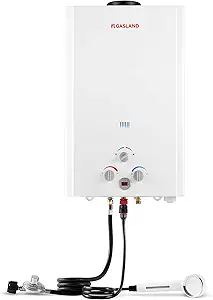 |
| Best Budget The cheapest option that still gets the job done reliably | Kohree Tankless Propane Water Heater 6L |  |
| Top Rated A top-rated pick with lots of positive feedback | Rinnai RX180iN 10 GPM Tankless Heater |  |
| Most Popular A crowd favorite that many people choose with confidence | CAMPLUX AY132 Portable Tankless Heater |  |
| Best Seller A high-volume bestseller chosen again and again | Orbek RV Tankless Water Heater |  |
Ranein Propane Tankless Water Heater RHO13K-LPG

| Power Source | Propane Gas |
|---|---|
| Flow Rate | 5.3 gpm |
| Heat Output | 130000 BTU |
| Maximum Temperature | 155 °F |
| Maximum Pressure | 116 psi |
The Ranein RHO13K-LPG is an outdoor propane tankless water heater designed to supply continuous hot water to a small house or multi-fixture setup. It heats on demand with a 130,000 BTU burner and a rated flow up to 5.3 gallons per minute, which the manufacturer positions for roughly 3 to 5 water points such as bathrooms and a kitchen. The unit is built for outdoor wall mounting, uses standard 3/4" NPT fittings for gas and water, and runs on 120V power for its LED display and controls. Notable practical features include a bottom-mounted blower for stable combustion in windy conditions, a closed combustion chamber, oxygen-free copper heat exchanger for heat transfer, and anti-freeze protection for cold climates. Installation is straightforward for someone comfortable with gas plumbing, though proper venting clearances and altitude limits should be observed because the product is not recommended above 2,000 feet. Expect steady hot-water performance for daily shower and sink use, but plan professional gas hookup and follow the drain/pressure-relief advice for winterizing in freezing conditions.
Best for: Buyers who want a compact outdoor propane tankless heater that reliably supplies continuous hot water to a small to medium household and value robust combustion and simple controls.
Less Ideal for: People living at high elevations, those who cannot accommodate professional gas installation, or buyers needing very high flow rates for large homes.
- High heat output (130,000 BTU) supports simultaneous use at multiple fixtures
- Rated up to 5.3 GPM for sustained on-demand hot water
- Outdoor-rated, wall-mount design with bottom-mounted blower for wind-resistant combustion
- LED display and wired controller allow straightforward temperature control and monitoring
- Built-in anti-freeze protection helps prevent internal freeze damage in cold weather
- Not recommended for high-altitude installations above 2,000 feet
- Requires professional gas plumbing hookup and winter drain procedures to avoid freeze risk
Verdict: A solid outdoor propane tankless heater for small to medium homes that need reliable, on-demand hot water with strong combustion performance.
Westinghouse HS180A0G-LP 8.1 GPM

| Flow Rate | 8.1 gpm |
|---|---|
| Heat Output | 180000 BTU |
| Power Source | Propane (gas) / requires 120V AC |
| Installation Type | Outdoor |
| Temp Range | 95°F – 158°F |
This Westinghouse outdoor propane tankless heater is built for strong, whole-house performance: it produces up to 8.1 gallons per minute and 180,000 BTU, which the manufacturer says supports three to five fixtures at once. It uses self-modulating controls and a variable-speed combustion fan to adjust gas and water flow for a steady output and claims ±1°F temperature stability to minimize cold shots during showers. The unit mounts to an exterior wall, runs on 120V for its electronics, and includes an indoor wired remote panel for convenient temperature adjustment and status readout. Because it is non-condensing and rated with high energy efficiency (UEF>0.81), it avoids the added complexity of condensate management while still reducing standby losses compared with tanks. Important practical limits are that it is an outdoor, propane-specific installation and requires proper vent-free clearances and plumbing hookups, so professional installation and periodic maintenance are recommended for reliable long-term performance.
Best for: Buyers who prioritize high output and steady temperature control for whole-house, performance-oriented hot water delivery and who plan an outdoor propane installation.
Less Ideal for: Those wanting an indoor unit, dual-fuel flexibility, or the highest possible condensing efficiency should consider other options.
- High heating capacity at 180,000 BTU suitable for multiple simultaneous fixtures
- Strong flow rate up to 8.1 GPM for consistent hot-water delivery
- Self-modulating control and variable-speed fan for tighter temperature regulation
- Includes indoor wired remote control for easy temperature adjustments
- Built-in freeze protection and CSA certification for outdoor reliability
- Outdoor propane-only model limits installation locations and fuel choice
- Non-condensing design may be less efficient than condensing units in some climates
Verdict: Choose this Westinghouse if you need a robust outdoor propane tankless heater that supplies strong, stable hot water for multiple fixtures simultaneously.
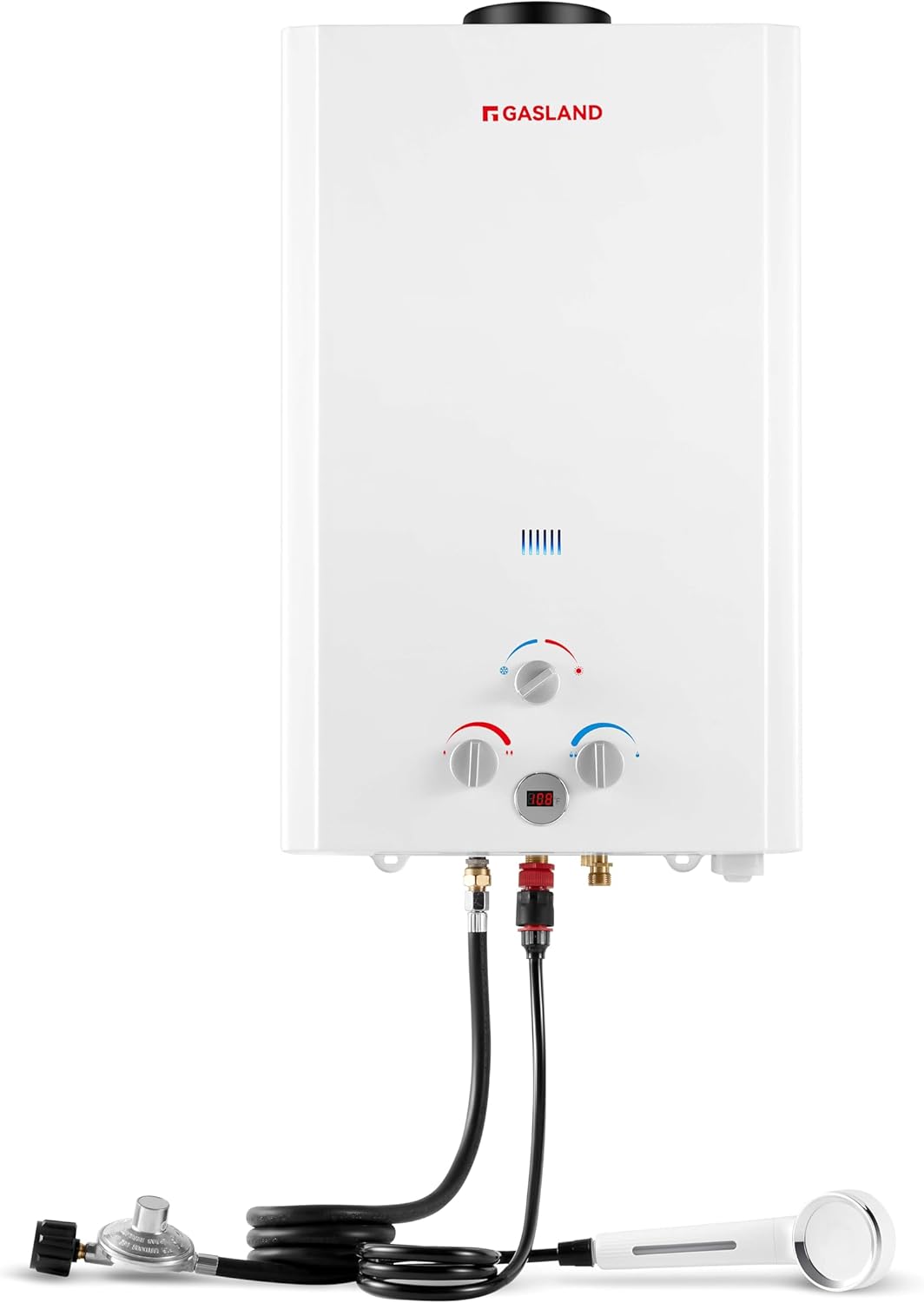
GASLAND BE528 Tankless Propane Heater
| Flow Rate | 5.28 gpm |
|---|---|
| Maximum Temperature | 176 °F |
| Heat Output | 136,000 BTU/hr |
| Maximum Pressure | 110 psi |
| Power Source | Propane (electronic ignition via D‑cell batteries) |
The GASLAND BE528 is a portable outdoor propane tankless water heater designed to give on‑demand hot water from a standard 20 lb LPG tank. It is typically mounted outdoors for uses like camping, RV hookups, outdoor kitchens, pet washing, and emergency backup where mains power or natural gas is not available. The unit produces up to 5.28 gallons per minute and a high heat output (136,000 BTU/hr), so it can raise water temperature substantially at moderate flow rates; a bright LED display and temperature lock make set up and control straightforward. Safety features include overheating protection, low‑flow and dry combustion protection, and a flame failure device. It runs ignition off two D‑cell batteries so no external power is required, and the package includes a regulator, hose, shower head, and adapters for quick installation. Limitations to consider are that it is meant for outdoor use only and is not rated for horizontal installation or sustained exposure to heavy rain, and it is not suitable for high altitude above 3300 feet or very windy locations.
Best for: Buyers who need a no‑power, high‑output outdoor hot water source for camping, RVs, outdoor kitchens, or emergency backup and value easy setup and built‑in safety.
Less Ideal for: People seeking an indoor or permanently installed natural gas water heater, or users who need a unit certified for high‑altitude or fully weatherproof indoor/outdoor use.
- High maximum output (136,000 BTU/hr) supports hot water at up to 5.28 GPM for multiple outdoor tasks
- LED digital display with temperature lock for easy monitoring and consistent set temperature
- Runs on standard 20 lb propane and uses two D‑cell batteries for ignition, so no external electricity is required
- Multiple built‑in safety protections including overheat, low‑flow, dry combustion, and flame failure device
- Includes practical accessories: CSA regulator and hose, 5 ft shower head, mounting hardware, and garden hose adapter
- Designed only for outdoor vertical wall mounting and not rated for extended exposure to heavy rain
- Performance and installation are limited at elevations above 3300 feet and in strong wind conditions
Verdict: Choose the GASLAND BE528 if you need a powerful, battery‑ignited outdoor propane tankless heater that delivers strong on‑demand hot water and includes practical accessories for quick setup.
Kohree Tankless Propane Water Heater 6L

| Power Source | Liquid Propane |
|---|---|
| Flow Rate | 1.58 gpm |
| Heat Output | 41000 BTU/HR |
| Capacity | 6 liters |
| Maximum Pressure | 110 psi |
This Kohree portable tankless propane heater supplies instant hot water for outdoor use, camping, RVs, pet washing, and light off-grid tasks. It ignites with two D batteries and produces up to 41,000 BTU/hour, giving a maximum flow of 1.58 gallons per minute and a temperature rise up to about 120°F. Installation is straightforward: the unit ships with a shower head, gas regulator, brass fittings, and Teflon tape and can be hung by its handle or mounted vertically. Safety is emphasized with CSA-approval and protection features including anti-freeze, dry combustion, flame-failure, overheating cutoff, and low/high pressure safeguards. The heater starts at very low water pressure (3 PSI) and is described as windproof for outdoor use. Practical limits are the modest flow rate, which is fine for showers or washing but not for multiple simultaneous fixtures, and the reliance on disposable batteries for ignition. The brass connections and included accessories make it usable right away, but expect basic build and performance consistent with an affordable portable unit rather than a full-size RV or home system.
Best for: Buyers wanting an affordable, portable propane tankless heater for camping, RVs, pet washing, and occasional outdoor showers who prioritize immediate hot water and safety features over high flow.
Less Ideal for: People who need high-flow continuous hot water for whole-RV plumbing or multiple simultaneous fixtures should consider larger or permanent RV/home models instead.
- Delivers on-demand hot water up to 1.58 GPM for showers and outdoor tasks
- Multiple safety features including overheating, flame-failure, dry combustion, and anti-freeze protection
- Includes shower head, gas regulator and brass fittings so it is ready to install
- Starts at very low water pressure (3 PSI) and designed to be wind resistant
- Brass connectors improve durability compared with plastic fittings
- Flow rate and output are modest and not suitable for running multiple fixtures at once
- Ignition depends on two D batteries rather than an integrated electric starter
Verdict: A budget-friendly portable propane tankless heater that gives dependable on-demand hot water with strong safety features for camping and outdoor use.
Rinnai RX180iN 10 GPM Tankless Heater

| Power Source | Dual-Fuel (Natural Gas or Propane) |
|---|---|
| Flow Rate | 10 gpm |
| Maximum Temperature | 140 °F |
| Heat Output | 180000 british thermal units |
| Efficiency | 0.98 UEF |
The Rinnai RX180iN is a convertible condensing tankless water heater designed for indoor or outdoor installation and capable of running on natural gas or propane. It delivers up to 10 gallons per minute, enough to support multiple fixtures, and its high 0.98 UEF efficiency helps reduce fuel use compared with conventional tanks. The unit is compact—about the size of a small suitcase—so it frees up space and mounts on a wall, and features a Quick Flush routine to simplify routine maintenance. Smart Sense gas control makes switching fuel types straightforward and the Versa Vent option allows outdoor placement with the correct vent cap. The heater supports app-based assistance via a separate Control-R WiFi module and includes user-friendly controls for setup and troubleshooting. Important considerations for reliability-focused buyers are that professional installation is recommended and that advanced electronics and condensing components can require periodic servicing, but the long heat-exchanger warranty and built-in maintenance features help keep long-term performance predictable.
Best for: Buyers who prioritize a reliable, fuel-efficient hot-water source for multiple fixtures and want a compact, convertible unit that supports outdoor installation when properly vented.
Less Ideal for: People looking for a DIY install or a maintenance-free simple tank heater should consider alternatives, and those who need bare-minimum electronics to avoid periodic servicing may prefer non-condensing models.
- High energy efficiency (UEF 0.98) for lower fuel consumption
- Convertible design supports natural gas or propane
- Compact wall-mount form saves space compared with tank heaters
- Versa Vent option enables indoor or outdoor installation
- Quick Flush feature simplifies preventive maintenance
- Requires professional installation and correct venting for outdoor use
- Advanced condensing components and electronics may need periodic servicing
Verdict: Choose the RX180iN when you want a compact, high-efficiency propane-capable tankless heater built for reliable multi-fixture performance and install flexibility.
CAMPLUX AY132 Portable Tankless Heater

| Flow Rate | 1.32 gpm |
|---|---|
| Power Source | Battery Powered (2 D batteries) and Propane |
| Heat Output | 34,000 BTU/hr |
| Water Pressure Range | 3-130 PSI |
| Capacity | 5 liters |
The CAMPLUX AY132 is a lightweight, portable tankless propane water heater designed for outdoor use where electricity is unavailable. It runs on a standard LP tank and uses two D batteries for ignition, delivering up to 1.32 gallons per minute and a maximum temperature around 114°F. Typical uses are campsite showers, rinsing gear or pets, and supplying a small cabin or RV with instant hot water; the unit includes a folding handle, mounting options, a CSA-certified regulator and a shower hose for quick setup. Built-in safety features include anti-freeze protection, flame-failure and overheat protection, and low-flow and low-pressure startup so it will run with as little as 3 PSI of inlet pressure. Practical limits are its modest flow rate and temperature ceiling, which make it best for single-person showers and light-duty washing rather than simultaneous multi-fixture use, and it relies on batteries for ignition and a propane supply so you must manage fuel and cells for extended trips.
Best for: Buyers who need reliable on-demand hot water away from mains power and who prioritize safety and social-proofed performance for camping, RVing, or remote cabins.
Less Ideal for: People who need high flow or to serve multiple fixtures at once or those who want an electric or permanent indoor tankless solution.
- Portable and lightweight with a folding carry handle for easy transport and mounting
- Runs without mains electricity using propane and two D batteries for ignition
- CSA-certified with multiple safety protections including overheat and flame-failure cutoffs
- Starts at low inlet pressures (as low as 3 PSI) so it works with small pumps or gravity feed systems
- Includes regulator, shower head and hoses for simple out-of-the-box setup
- Maximum flow and temperature are limited, so not suitable for full household usage
- Requires propane and batteries to operate, adding ongoing fuel and battery management
Verdict: A compact, CSA-certified propane tankless heater that reliably delivers instant hot water off-grid for solo outdoor showers and light-duty campsite tasks.
Orbek RV Tankless Water Heater

| Power Source | Liquid Propane |
|---|---|
| Voltage | 12 volts DC |
| Flow Rate | 3.5 gpm |
| Maximum Temperature | 123 °F |
| Maximum Pressure | 150 psi |
The Orbek RV Tankless Water Heater is a 12V DC, propane-fired on-demand unit designed for RV and camper use, supplying continuous hot water for showers, dishwashing, and general onboard needs. It heats water instantly with a 60,000 BTU burner and a copper heat exchanger while brushless DC fans and staged combustion help stabilize output at higher altitudes. The unit mounts in a standard RV door opening and pairs with an optional exterior door panel for a finished look. A smart remote lets you set temperatures from 95°F to 123°F and view error codes for troubleshooting. Built-in safety features include flame failure protection, dry-combustion protection, frost protection, and a factory-installed pressure-reducing valve. Practical strengths are reliable continuous hot water without a tank, high-altitude compatibility, and straightforward 12V wiring for RV systems, but owners should ensure correct 12V supply and proper propane plumbing during installation and confirm the RV cutout fits the unit and optional doors.
Best for: Buyers who prioritize a reliable, factory-featured propane tankless heater for RVs and want a plug-in 12V solution that works at higher elevations and includes remote control and safety protections.
Less Ideal for: Those who lack a stable 12V power setup or prefer integrated tank-style heaters with stored hot water should consider other options.
- Provides continuous on-demand hot water with a 60,000 BTU burner
- High-altitude capable with oxygen-free copper heat exchanger and brushless DC fan
- Smart remote control for temperature adjustment and error code display
- Multiple built-in safety features including flame failure and frost protection
- Includes a 150 PSI factory-installed pressure-reducing valve
- Requires a proper 12V DC power supply and correct polarity to avoid fuse damage
- Door panels are sold separately so matching exterior trim may add cost
Verdict: A robust, altitude-capable propane tankless heater built for RV use that delivers continuous hot water with factory safety and remote control features.
Choosing the Right Outdoor Propane Tankless Water Heater: Key Factors to Consider
Flow Rate And Temperature Rise
Flow rate determines how many fixtures you can run simultaneously and how quickly a unit can maintain your desired hot-water temperature. Outdoor tankless heaters list flow capacity in gallons per minute at specified inlet temperatures; since incoming ground or source water is often colder outdoors, pay attention to performance at realistic seasonal inlet temperatures.
If you plan to run multiple outlets at once, choose a unit whose rated GPM at the expected temperature rise covers the combined demand of showers, faucets, and any outdoor appliances. Undersizing leads to lukewarm water or reduced flow when two or more fixtures are in use.
Freeze Protection And Cold-Start Behavior
Outdoor units face the risk of freezing pipes and internal components. Reliable freeze protection can be active, such as built-in electric heaters or automatic recirculation, or passive, like frost-resistant construction and drain-back designs. Confirm the unit's lowest operating temperature and what measures are required to prevent freeze damage in your climate.
Consider how the heater behaves on cold starts. Some systems take longer to reach set temperature or require minimum flow to engage. If you have intermittent use in subfreezing conditions, choose a unit with explicit freeze safeguards or an installation plan that allows safe winterization.
Weatherproofing And Corrosion Resistance
Outdoor units should be designed to keep rain, snow, dust, and insects away from sensitive components. Look for durable enclosures, effective gaskets, and protective coatings on heat exchangers and fittings. Corrosion resistance is important if you are in a coastal or high-humidity area where salt and moisture accelerate metal degradation.
Proper mounting location and additional sheltering can extend service life, but starting with a unit built for exterior exposure reduces the need for aftermarket protections and lowers long-term repair risk.
Venting, Installation, And Gas Supply
Outdoor propane tankless water heaters simplify venting because they are often direct-vented to the exterior or rely on ambient outdoor air. Still, check clearance requirements, mounting options, and recommended piping runs. Propane supply needs to be sized correctly; undersized gas lines cause poor performance and burner instability.
Plan for safe gas shutoff access and consider whether you need a licensed installer. Some installations require permits and inspections, so factor installation complexity and required trades into your choice.
Maintenance And Serviceability
Tankless water heaters require periodic maintenance, such as flushing to remove mineral scale and checking burners and filters. For outdoor units, inspect seals, sacrificial anodes if present, and any freeze-protection heaters before cold months. Ease of access to serviceable components reduces service costs and downtime.
Choose units with accessible panels, clear maintenance instructions, and readily available replacement parts. A design that supports simple descaling or filter replacement will simplify ownership, especially for seasonal properties.
Sizing For Your Outdoor Use Case
Estimate simultaneous demand by listing every fixture you expect to run at once outdoors or in the adjacent indoor circuit. Typical flow estimates: a shower uses about 1.5 to 2.5 GPM, an outdoor sink 0.5 to 1.5 GPM, and small appliances vary. Add those numbers and select a unit with a slightly higher rated GPM at your expected inlet water temperature.
Account for temperature rise rather than relying on the maximum GPM alone. If your source water is 40 degrees and you want 110-degree outlet water, your unit must supply the GPM required at a 70-degree rise. Check spec charts that show GPM versus temperature rise.
- Measure typical inlet water temperature in the coldest months for accurate sizing.
- Prioritize higher GPM at realistic temperature rises over headline peak GPM.
- Factor in future needs such as added fixtures or outdoor laundry hookups.
Placement, Mounting, And Shelter Options
Mount the unit where it is protected from direct water spray and where gas and water lines can be run safely. Wall mounting on a sheltered exterior wall is common. Consider mounting height so controls and service panels remain accessible year-round.
Even outdoor-rated units benefit from partial shelter that prevents direct wind-driven rain and reduces freeze exposure. Building a vented enclosure or installing the unit under an overhang can extend component life while still meeting clearance requirements.
- Avoid installing in fully exposed locations where ice buildup is likely.
- Ensure clearances around the unit meet local code and manufacturer recommendations.
- Provide a drip loop on water lines and insulating wrap for short exposed runs.
Propane Supply And Gas Line Considerations
Propane delivery must be steady and sized to meet the maximum BTU demand of the tankless unit. Long runs and small-diameter piping reduce pressure and can cause burner cycling or insufficient heat output. Calculate pipe sizing and regulator settings before installation.
If you rely on an existing propane system, confirm available BTU capacity and whether additional regulators or a larger supply line are necessary. For remote installations powered by a small tank, plan for refill logistics and safe shutoff placement.
- Use approved pipe sizing charts to avoid gas starvation at high demand.
- Locate manual shutoffs in an accessible place for maintenance and emergencies.
- Install gas detectors if local code recommends them for outdoor appliance locations.
Protecting The Unit From Freezing
Beyond built-in protections, use insulating wraps on short water runs, heat tape where permitted, and ensure proper drainage for stray condensate or standing water. If your unit supports it, enable internal freeze heaters and verify their power requirements.
For seasonal properties, plan a winterization process that may include draining the unit and external plumbing or maintaining a minimum powered state to keep freeze protection active. Clear written procedures reduce the risk of winter damage.
- Test freeze-protection features before the first winter.
- Label shutoff valves and drains to simplify winterization.
- Consider a small shelter with ventilation for extreme climates.
Routine Service And Troubleshooting Basics
Regular maintenance keeps outdoor tankless heaters operating efficiently. Flushing to remove scale, checking filters, and inspecting seals should be performed per manufacturer intervals or more frequently in hard-water areas. Record maintenance actions so you can spot recurring issues early.
If you experience fluctuating temperatures or burner lockouts, inspect gas pressure, inlet water filters, and scale buildup first. Many common issues have straightforward fixes that a qualified technician can perform quickly.
- Plan an annual inspection before the cold season.
- Flush heat exchangers regularly if you have hard water.
- Keep a simple toolkit and replacement filters near the installation for quick service.
How We Chose the Best Outdoor Propane Tankless Water Heater
We focused on features that directly affect real-world outdoor performance and long-term reliability. Key evaluation criteria included measured flow rate at different temperature rises, cold-weather or freeze protection systems, outdoor-rated weatherproofing and corrosion resistance, installation and venting flexibility for typical outdoor setups, and ease of maintenance for owners who may not have regular HVAC support. We prioritized units that offer clear flow specifications across inlet water temperatures and that include freeze-prevention features or straightforward ways to add them. We excluded indoor-only units and any product lacking explicit outdoor ratings or basic freeze protection guidance. We also filtered out models with unclear installation requirements or unavailable technical documentation. The final list contains units that balance dependable hot-water delivery, outdoor durability, and practical installation considerations for most yards, cabins, and exterior-service applications.
Our full evaluation process is outlined in our review methodology.
FAQ
Can an outdoor propane tankless water heater freeze in winter?
Yes, without proper protections outdoor units can freeze. Many models include built-in freeze protection or require supplemental measures like insulated piping, heat tape, or a small powered enclosure. Seasonal winterization is recommended for seldom-used installations.
How do I know what GPM I need for my outdoor setup?
Estimate the combined flow of fixtures you might use at once and match that to a unit's rated GPM at the expected inlet temperature. Use conservative estimates for showers and any appliance draws to avoid undersizing.
Do outdoor-rated units still need a shelter or cover?
Often yes. While outdoor-rated units tolerate exposure, a ventilated cover or overhang reduces weather stress and improves longevity. Ensure any shelter meets clearance and ventilation requirements to avoid overheating or combustion issues.
What maintenance do outdoor tankless heaters need?
Typical maintenance includes periodic flushing to remove scale, cleaning or replacing inlet filters, inspecting seals and fittings, and testing freeze-protection systems. Frequency depends on water quality and how often the unit is used.
Is professional installation required for safety or code compliance?
Professional installation is often required or strongly recommended because proper gas line sizing, regulator setup, and compliance with local codes are critical for safe operation. A qualified installer can also verify clearances and venting as needed.
Final Verdict
When choosing an outdoor propane tankless water heater, prioritize the unit's flow capacity at realistic inlet temperatures and reliable freeze protection for your climate. Balance weatherproofing, ease of installation, and serviceability so the heater delivers consistent on-demand hot water with manageable upkeep. Focus on the tradeoffs between higher GPM capacity and installation complexity, and pick a unit that meets your peak demand while offering clear maintenance access and documented cold-weather safeguards.