
Note: This article contains affiliate links. If you click on these links and make a purchase, we may earn a small commission at no extra cost to you. This helps support our research and content. Read our full affiliate disclosure here.
A good panini press turns basic bread, cheese, and fillings into hot, crisp sandwiches in minutes. When you are shopping on a budget, you still want reliable heat, a durable cooking surface, and an appliance that is easy to clean and store. This guide collects the top panini presses under $50 that meet those expectations and explains the practical tradeoffs you should expect from budget models. We shortlisted products that aim for consistent grilling, simple controls, and manageable maintenance. Read on to see which features and setups match how you plan to use a panini press.
Top Picks at a Glance
| Best Overall The best all-around choice for most situations | Chefman Panini Press Grill |  |
| Best Quality Built to a higher standard if you want something more solid | Proctor Silex Panini Press Grill |  |
| Best Value The sweet spot between price and what you get | OVENTE Electric Sandwich Maker GPS401B |  |
| Best Budget The cheapest option that still gets the job done reliably | OSTBA Sandwich Maker ABS07-G |  |
| Top Rated A top-rated pick with lots of positive feedback | Hamilton Beach Panini Press 25462 |  |
| Most Popular A crowd favorite that many people choose with confidence | Chefman Panini Press RJ02-180 |  |
| Best Seller A high-volume bestseller chosen again and again | George Foreman 4-Serving Grill GRP1060B |  |
Chefman Panini Press Grill
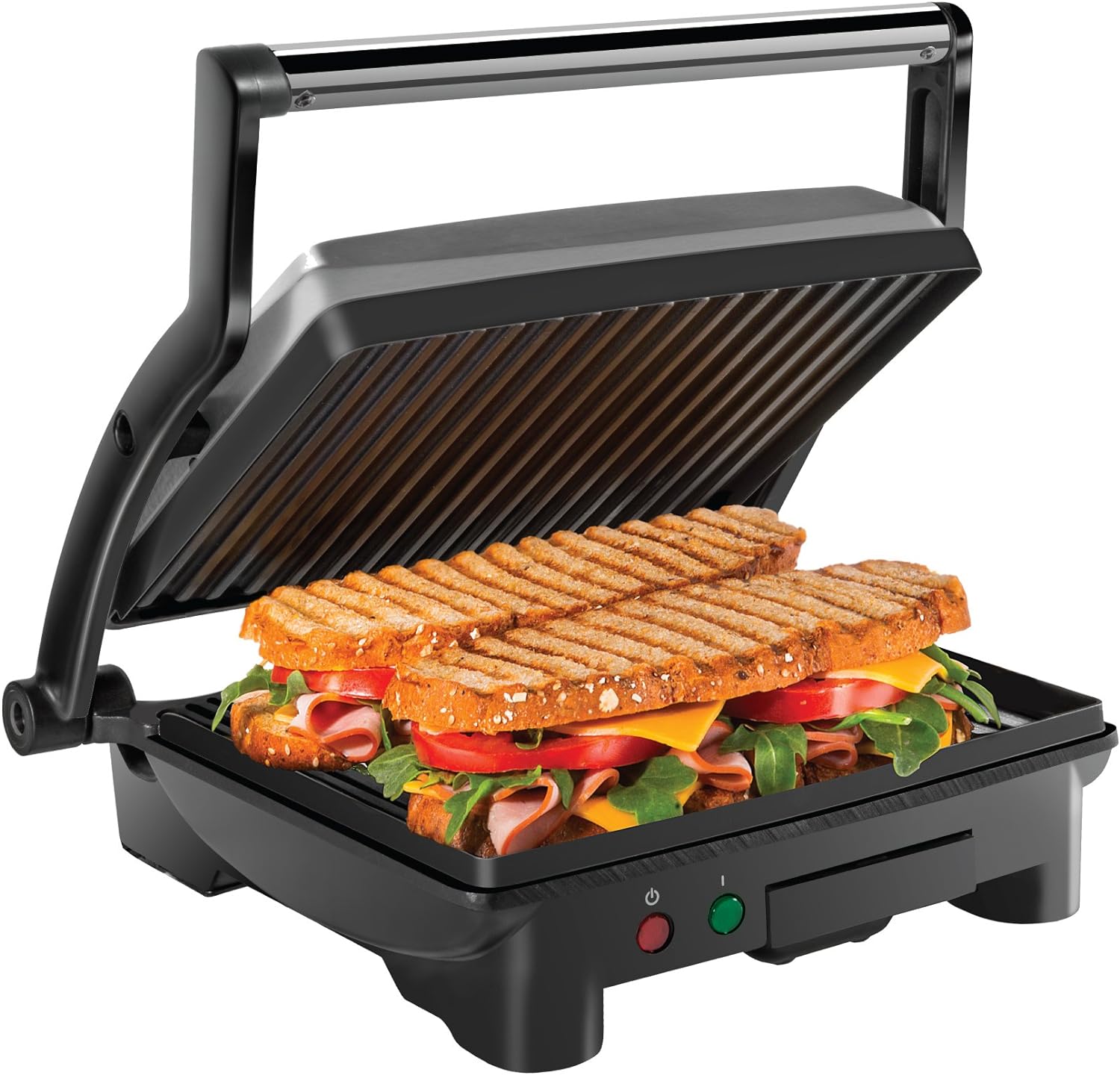
| Wattage | 1000 watts |
|---|---|
| Voltage | 120 |
| Number of settings | 4 |
| Material | Stainless Steel |
The Chefman Panini Press Grill is a versatile countertop contact grill that works as both a closed panini press and a lay-flat grill for burgers, fish, vegetables and more. It uses a floating hinge to accommodate thick or thin sandwiches and the closed surface fits four sandwiches or two large paninis, while the 180 degree open position provides a flat griddle for larger items. The nonstick coated plates, sloped design and removable drip tray make cleanup straightforward, and the compact footprint suits small kitchens, dorms or offices. At 1000 watts the grill reaches cooking temperatures quickly and four manual settings let you control browning without complicated controls. Trade-offs are a basic manual control layout with no temperature display and a relatively small individual cooking area, so it is better for small families or singles than large batches. Overall it delivers simple, reliable pressing and grilling for everyday use without extra bells and whistles.
Best for: Buyers who want an affordable, no-frills appliance that can do both pressed sandwiches and simple grilling in a compact package for everyday meals.
Less Ideal for: Those who need precise temperature control, large-capacity batch cooking, or a premium commercial-grade press should consider higher-end models.
- Floating hinge lets the top plate adjust to different thicknesses for stuffed sandwiches
- Opens flat to 180 degrees to double as a griddle for burgers and vegetables
- Nonstick plates and removable drip tray simplify cleanup
- Compact footprint fits small kitchens, dorms, and offices
- No digital temperature readout or precise temperature control
- Cooking surface per sandwich is relatively small for very large paninis
Verdict: A practical, budget-friendly panini press that doubles as a compact griddle, ideal for everyday sandwiches and small-batch grilling under $50.
Proctor Silex Panini Press Grill

| Wattage | 1000 watts |
|---|---|
| Voltage | 120 |
| Material | Ceramic |
| Special Features | PFAS Free, Manual |
The Proctor Silex Panini Press Grill is a straightforward, budget-friendly sandwich press that also doubles as a small indoor grill. It heats with 1000 watts to quickly reach cooking temperature and its 70 square-inch ceramic nonstick plates are easy to wipe clean after use. The floating lid accommodates thicker sandwiches and helps press evenly so stacked fillings cook through without squashing the bread too flat. Use it for pressed sandwiches, grilled chicken breasts, burgers, vegetables, and other quick stovetop-style items when you want a compact appliance that stores upright. A removable drip tray keeps counters cleaner and is dishwasher safe for convenience. Limitations are its basic manual controls with no temperature dial and a modest cooking area that fits two thick sandwiches or one long sandwich but not larger batches, and the unit is best for single-person or small household cooking rather than heavy daily commercial use.
Best for: Buyers who want a dependable, no-frills sandwich press that heats quickly and handles thick paninis or quick indoor grilling for one to two people.
Less Ideal for: Those who need precise temperature control, large batch capacity, or a heavy-duty commercial unit should consider higher-end models or larger grills.
- Ceramic PFAS-free nonstick plates for easier cleaning and food release
- Floating lid that accommodates thick sandwiches and presses evenly
- 70 sq. in. cooking surface fits two thick sandwiches or one long sandwich
- Removable drip tray for catching grease and dishwasher-safe cleaning
- No adjustable temperature control or preset settings
- Cooking surface size limits batch cooking for larger households
Verdict: A capable, compact panini press that delivers quick, even pressing and easy cleanup for budget-minded home cooks looking for performance under $50.
OVENTE Electric Sandwich Maker GPS401B

| Wattage | 750 watts |
|---|---|
| Voltage | 120 |
| Number of settings | 3 |
| Material | Stainless Steel |
The OVENTE GPS401B is a small, no-frills sandwich maker designed to toast two sandwiches quickly. It uses a 750W fast-heating element and three thermostat settings to deliver evenly browned, sealed-edge sandwiches, and the power and preheat indicator lights make it easy to know when the unit is ready. Nonstick cooking plates speed food release and wipe-downs, and the stainless steel exterior feels durable while the cool-touch locking handle and anti-skid feet improve safety during use. Its lightweight, compact footprint stores upright to save cabinet space, which is handy in dorms or small kitchens. Limitations include modest power that slows thicker or very dense fillings and the fixed plate design that only fits two sandwiches at a time, so it is not suited for large households or batch cooking. There is no removable drip tray or digital timer, so you need to watch cook time manually. For everyday grilled cheese, omelets, and quick breakfasts this model is straightforward and reliable for its price point.
Best for: Buyers looking for an affordable, compact sandwich maker for quick single-meal breakfasts, dorms, or small kitchens who prioritize simplicity and easy cleanup.
Less Ideal for: Families or users who need to toast multiple sandwiches at once, want advanced controls like timers, or require higher power for very thick or filled sandwiches.
- Fast-heating 750W element for quick toasting
- Nonstick plates for easy food release and simple cleaning
- Compact, lightweight design that stores upright to save space
- Stainless steel body with cool-touch handle and indicator lights for safer operation
- Fixed two-sandwich plate limits capacity for larger households
- No removable drip tray or digital timer for hands-off cooking
Verdict: A budget-friendly, compact sandwich maker that reliably produces quick, easy toasted sandwiches for one or two people.
OSTBA Sandwich Maker ABS07-G

| Wattage | 750 watts |
|---|---|
| Voltage | 120 volts |
| Material | Aluminum |
This OSTBA sandwich maker is a straightforward, space-conscious panini press designed for quick sandwiches, paninis, and small grilled items. Its 750W heating element warms up fast and the raised nonstick plates create sear marks while letting excess fat drain away, which helps produce crisp results without extra oil. Indicator lights make operation simple and the cool-touch handle plus cord-wrap storage suit tight kitchens and quick put-away. The plate area is sized for two slices or a single panini rather than large artisan bread, so it is best for single-serve meals and weekday breakfasts. Cleanup is easier thanks to the nonstick surface, but the plates are not removable so scraping or careful wiping is needed after use. Build is lightweight aluminum that keeps the unit affordable but feels less heavy-duty than thicker cast models. For buyers who want a reliable, no-frills sandwich toaster that saves counter space and heats consistently, this is a practical option; those needing larger capacity or removable plates should consider heavier-duty alternatives.
Best for: Buyers who prioritize a compact, efficient sandwich maker for daily breakfasts and quick meals and want a simple appliance that stores easily and heats reliably.
Less Ideal for: People who need to grill larger sandwiches, cook for several people at once, or prefer removable plates for dishwasher cleaning should look elsewhere.
- Fast, consistent heating from a 750W element for quick toasting
- Raised nonstick grill plates produce sear marks and allow fat to drain
- Cool-touch handle and indicator lights improve safety and ease of use
- Compact footprint with cord-wrap storage saves counter space
- Durable nonstick surface simplifies cleanup
- Plates are not removable, which makes deep cleaning harder
- Lightweight aluminum construction feels less rugged than heavy-duty models
Verdict: A compact, no-frills sandwich press that delivers quick, consistent toasting and saves counter space for practical everyday use.
Hamilton Beach Panini Press 25462

| Wattage | 1400 watts |
|---|---|
| Voltage | 120 |
| Number of settings | 1 |
| Included Components | Panini Press |
The Hamilton Beach Panini Press is a simple, no-frills sandwich maker that heats top and bottom nonstick grids to toast and press sandwiches without flipping. Its cafe-style floating lid accommodates different sandwich thicknesses and the locking top lets you use the bottom plate alone for open-face breads or personal pizzas. The 1400-watt unit has an indicator light for power and a ready/preheat signal to help time cooking, and the 8" x 10" grids fit two standard sandwiches or a few smaller items at once. Cleanup is straightforward thanks to the nonstick surfaces, and the press stores upright to save counter space. This model focuses on reliable, everyday performance rather than adjustable settings or digital controls, so you get consistent browning but limited temperature control. For buyers who want a straightforward, durable sandwich press that works right out of the box, it delivers; power users who need multiple heat settings or removable dishwasher-safe plates may want a different model.
Best for: Buyers who want a dependable, easy-to-use sandwich press for daily grilled sandwiches and simple hot snacks without fussing over settings.
Less Ideal for: Users who need precise temperature control, programmable cycles, or dishwasher-safe removable plates for heavy multi-use cooking.
- Floating lid adapts to sandwiches of varying thickness for even pressing
- Nonstick top and bottom grids simplify cooking and cleanup
- 1400-watt power gives quick preheat and consistent browning
- Locks shut and stores upright to save counter and cabinet space
- Single setting only with no temperature or time controls
- Grids are fixed and not removable for dishwasher cleaning
Verdict: A reliable, straightforward panini press that consistently toasts and presses sandwiches for everyday home use under $50.
Chefman Panini Press RJ02-180

| Wattage | 1000 watts |
|---|---|
| Voltage | 120 volts |
| Number of settings | 1 |
| Material | Stainless Steel |
The Chefman Panini Press is a lightweight, space-saving contact grill that presses sandwiches and converts to a flat grill for burgers, fish, vegetables, and other quick meals. It uses nonstick coated plates and a floating hinge so you can press thin grilled cheeses or thicker stuffed sandwiches, and the unit opens fully to provide a flat 10" x 8.75" cooking surface. Cleanup is straightforward thanks to the removable drip tray and tilt-up feet that direct grease to the rear, and the plates plus tray are designed for easy wiping or dishwasher-safe cleaning. The single manual setting keeps operation simple but limits temperature control for precise searing. With a 1000 W/120 V rating it reaches cooking temps quickly for short prep times, but the compact cooking area is best suited to two sandwiches or small portions rather than feeding a crowd. For buyers wanting a no-frills, easy-to-clean press that doubles as a compact tabletop grill, this model is a practical choice within a tight budget.
Best for: Buyers who want an inexpensive, easy-to-use sandwich press that also works as a small flat grill and value proven performance and simple cleanup over advanced controls.
Less Ideal for: Those who need high-capacity cooking for larger households or precise temperature control for restaurant-style searing should consider larger or adjustable models.
- Floating hinge adapts to thin or thick sandwiches for consistent contact
- Opens 180 degrees to serve as a flat grill for burgers, veggies, and more
- Removable drip tray and nonstick plates make cleanup quick and dishwasher-friendly
- Compact footprint is easy to store and fits small kitchens, dorms, or offices
- Single manual setting offers no temperature control for precise cooking
- Compact cooking area limits batch size to about two sandwiches or small portions
Verdict: A straightforward, compact panini press that reliably makes two sandwiches or small grilled dishes with easy cleanup at a budget-friendly value.
George Foreman 4-Serving Grill GRP1060B
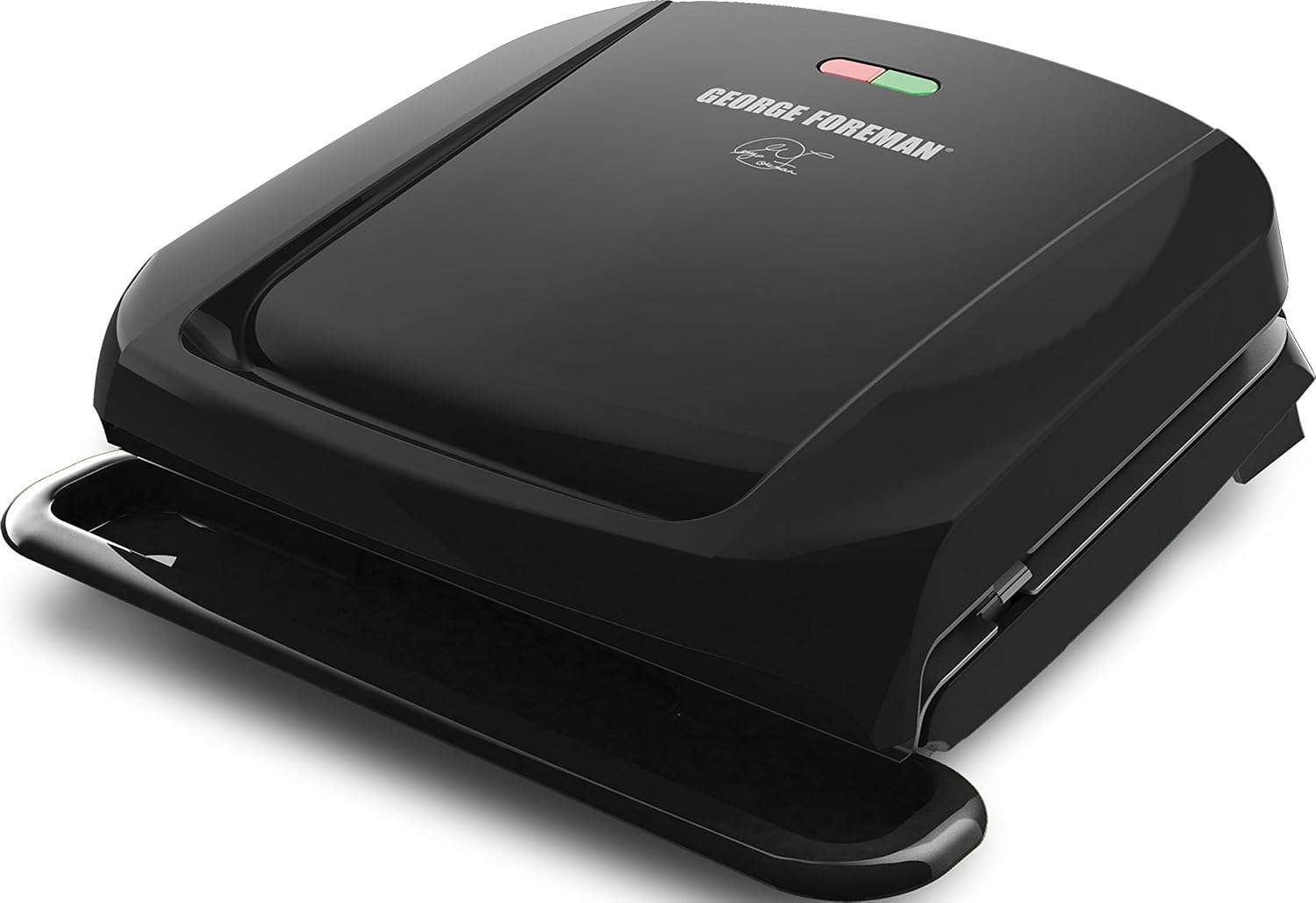
| Wattage | 1800 watts |
|---|---|
| Voltage | 110 |
| Material | Ceramic |
| Number of settings | 1 |
The George Foreman 4-Serving Indoor Grill is a simple contact grill and panini press aimed at everyday kitchen use. It heats quickly with 1800 watts and a claimed 35% faster preheat, so sandwiches, burgers, and vegetables reach serving temperature fast. The removable dishwasher-safe plates and durable George Tough nonstick surface make cleanup straightforward, and the sloped cooking surface channels fat away while grilling. With a single heat setting it is easy to operate for routine toasting and pressing tasks, though it lacks precise temperature controls for delicate items. Its 4-serving footprint fits small families or couples and the ceramic, PTFE-free coating reduces reliance on added oil. The main limitations are the single setting and basic controls, which mean less flexibility for browning levels or specialty cooking, but for reliable, low-effort sandwich toasting and panini pressing this grill delivers consistent, easy results.
Best for: Buyers who want a straightforward, low-fuss sandwich toaster and panini press that works reliably for everyday meals and prioritizes fast heat-up and easy cleanup.
Less Ideal for: Users who need precise temperature control or multiple cooking modes for specialty recipes should consider more advanced grills or countertop ovens instead.
- Removable dishwasher-safe grill plates for easy cleanup
- Durable nonstick George Tough coating that reduces need for added oil
- Heats quickly with 1800W power for fast sandwich toasting
- Sloped surface drains fat for leaner cooking
- Single heat setting limits control over browning and cooking intensity
- No temperature display or adjustable thermostat for precise cooking
Verdict: A dependable, easy-to-use sandwich toaster and panini press that delivers fast heating and dishwasher-safe plates for minimal-maintenance everyday use.
Choosing the Right Panini Press: Key Factors to Consider
Heat Distribution and Controls
Even heat distribution is essential for crisp, evenly browned paninis. On budget presses, internal heating elements and plate contact determine whether sandwiches come out soggy in the middle or nicely toasted throughout. Look for models that report consistent surface temperatures or include adjustable settings; variable controls help when you cook both thin and thick sandwiches.
Temperature feedback and indicator lights matter because they tell you when the press is ready. A stable heating profile reduces the need to flip or press multiple times, saving time and preserving fillings.
Cooking Surface Material
The plate material and nonstick coating affect both cooking results and longevity. Cast plates, coated aluminum, or hard-anodized surfaces each offer different heat transfer and durability characteristics. A high-quality nonstick finish makes it easier to release sandwiches without tearing bread or leaving residue behind.
Consider whether plates are ridged or flat; ridged plates create grill marks and channel away grease, while flat plates are better for paninis with lots of fillings. Nonstick durability is especially important on lower-cost units because cheaper coatings can wear faster under repeated use.
Cleanup and Grease Management
Ease of cleaning directly impacts how often you will use the press. Removable plates or a drip tray simplify cleanup, while fixed plates require more careful wiping and may trap crumbs. Look for models with accessible drip channels that collect grease rather than letting it pool on the counter or inside the housing.
Dishwasher-safe components are handy, but check whether the manufacturer specifies which parts are safe. If plates are fixed, a generous nonstick finish and a well-designed hinge that opens flat for cleaning make a big difference.
Size, Storage, and Hinge Function
Counter space and storage options influence which panini press fits your kitchen. Compact presses are easier to store but may limit sandwich size. Adjustable or floating hinges let you press thicker sandwiches without crushing fillings, while fixed hinges restrict sandwich height.
Vertical storage or a built-in locking latch can keep the unit tidy in a cabinet. Consider the footprint when open for cleaning and when closed for storage, especially if you cook on crowded countertops.
Safety and Ergonomics
Handle design, cool-touch surfaces, and indicator lights affect safe operation. A well-insulated handle keeps fingers safe while pressing thick sandwiches, and visible ready/temperature indicators reduce guesswork and the risk of burning.
Cord length and a place to wrap or tuck the cord can make daily use tidier. Buttons or dials should be easy to reach and intuitive, since complicated controls add little value for straightforward sandwich making.
Durability and Warranty Expectations
Durability expectations should be tempered for budget appliances, but construction choices still matter. Thicker housing, a solid hinge, and corrosion-resistant plates indicate a longer-lived product. Even under $50, some units use better materials that resist warping and wear.
Check warranty terms and return policies when available to understand how the maker supports defects. A longer warranty or clear support pathway signals confidence in the product and can be worth prioritizing over small upfront savings.
How Plate Design Changes Results
Plate texture and pattern directly affect how sandwiches cook. Ridged plates create charcoal-style grill marks and channel grease away from bread, which can help produce a crisper exterior. Flat plates give more even contact across the entire surface and are preferable when you want to press a lot of fillings without imprinting ridges.
Plate depth and spacing also influence how much the press compresses the sandwich. A deeper ridged profile will press more aggressively, flattening softer fillings, while shallow patterns preserve a loftier interior.
- Ridged plates: Better for grill marks and fat drainage
- Flat plates: Better for thick, heavily filled sandwiches
- Shallow patterns: Preserve sandwich height
- Deeper patterns: Create more pronounced texture
Maximizing Crispness with Limited Power
Budget panini presses often have modest wattage, so technique matters. Preheating fully before placing the sandwich ensures quicker searing. Pressing firmly but not overly long helps avoid overcooking the exterior while underheating the center.
Use a light brush of oil or butter on the outer bread for better browning without needing extra power. For thick sandwiches, consider toasting one side briefly in the press, then flipping to finish both sides evenly if the unit lacks a floating hinge.
- Preheat until indicator shows ready
- Press evenly and avoid prolonged single-side cooking
- Use slight oiling to encourage browning
Cleaning Tips to Extend Lifespan
Wipe crumb and grease buildup soon after the unit cools but is still warm; this makes residue easier to remove. If plates are removable, soak them briefly before washing to loosen stuck-on cheese or caramelized sauces. For fixed plates, use a nylon brush and warm soapy water rather than metal tools that can scratch the coating.
Empty and wipe drip trays after each use and avoid submerging the base housing. Regular light maintenance prevents buildup that can degrade nonstick surfaces and impede hinge movement.
- Wipe while warm, not hot
- Soak removable plates for tougher residue
- Avoid abrasive cleaners on nonstick surfaces
- Keep drip trays emptied and dry
Best Practices for Different Bread Types
Sourdough and crusty loaves benefit from higher heat and a short press to get a crisp exterior without crushing the interior. For soft sandwich breads, reduce pressing pressure and heat slightly to avoid flattening the sandwich too much. Wraps and flatbreads cook quickly; watch them closely to prevent burning.
When using very dense or frozen bread, allow a brief thaw or warm in the press at a lower setting before applying full pressure to ensure the center reaches the right temperature without overbrowning the outside.
- Crusty loaves: Higher heat, shorter presses
- Soft breads: Lower pressure, gentler heat
- Wraps: Quick press, watch closely
- Frozen bread: Thaw slightly first
Storage and Counter Considerations
If countertop space is limited, look for presses that lock closed for vertical storage. A compact footprint when closed makes it easier to tuck the unit into a pantry or cabinet. Consider whether the unit needs to sit flat when cooling or can be stored upright to save room.
Measure appliance dimensions, including the width when open for cleaning, to ensure it fits in your intended storage spot. Cord storage or a wrap reduces clutter and keeps the unit ready for daily use.
- Vertical storage reduces footprint
- Locking latch keeps halves aligned
- Check open width before buying
- Cord management reduces clutter
How We Chose the Best Panini Press
We focused on practical performance measures that matter for everyday sandwich making and small-kitchen convenience. First, heat distribution and temperature control were prioritized because even browning and the ability to handle thicker sandwiches determine final texture. Second, cooking surface quality and nonstick durability were evaluated to estimate how long a unit will stay easy to use. Third, cleanup and maintenance were considered, including drip management and removable versus fixed plates. Fourth, build quality and hinge/lock design were reviewed to assess long-term reliability and storage friendliness. Fifth, user ergonomics such as handle safety, indicator lights, and cord storage were factored in. We excluded specialty griddles, multi-cookers that do not include a dedicated panini plate, and units intended solely for commercial use. Our shortlisting favored units that balance consistent heating, practical cooking surface design, straightforward cleaning, and compact storage—dimensions that shoppers on a sub-$50 budget will find most consequential.
Our full evaluation process is outlined in our review methodology.
FAQ
Can I use a panini press to cook other foods besides sandwiches?
Yes. Many presses work well for grilling vegetables, thin cuts of meat, quesadillas, and even warming tortillas. Cooking times and heat settings may differ from sandwich preparation, so monitor closely to avoid overcooking.
How do I prevent my sandwich from sticking to the plates?
Lightly oiling the bread or preheating the plates fully helps release sandwiches more easily. Use a non-abrasive utensil to lift food and avoid metal tools that can damage nonstick coatings.
Is a removable plate necessary?
Removable plates simplify cleanup and are helpful if you plan frequent use or messy fillings. Fixed plates can still work well if they have an effective nonstick finish and accessible drip management, but cleaning will require more care.
Will a low-wattage press make soggy sandwiches?
Not necessarily. Technique matters: preheat properly, press with steady pressure, and avoid overfilling. Low-wattage units may take longer to reach temperature and may require slightly longer cook times for the same level of crispness.
How do I care for a nonstick coating on a budget press?
Avoid metal utensils and abrasive cleaners. Clean with warm soapy water, use silicone or nylon tools, and avoid high-heat cycles that could accelerate coating wear. Regular gentle care extends the useful life of the finish.
Final Verdict
When choosing a panini press under $50, prioritize consistent heat distribution, a durable cooking surface, and easy cleanup. Expect some tradeoffs on materials and advanced controls, but solid hinge construction and effective grease management will deliver reliable sandwiches day after day. Focus on the features that match how you cook—whether that is quick weekday toasts or thicker gourmet sandwiches—and choose the unit that balances plate design, cleaning convenience, and storage for your kitchen.