
Note: This article contains affiliate links. If you click on these links and make a purchase, we may earn a small commission at no extra cost to you. This helps support our research and content. Read our full affiliate disclosure here.
Picking the right pedestal fan on a budget matters because a low-cost fan can still deliver reliable airflow, quiet operation, and reasonable energy use for daily cooling. You want a model that moves air where you need it, runs quietly enough for living areas or bedrooms, and does not spike your electricity bill. This guide shortlists seven pedestal fans that meet those goals. We focus on practical performance metrics like airflow, noise, build stability, and power draw so you can pick a fan that fits your space and routine. Read on for key factors we used to evaluate these budget picks, then see the top options that match different room sizes and noise preferences.
Top Picks at a Glance
| Best Overall The best all-around choice for most situations | PELONIS 16" Pedestal Fan PSFS40R4ABB |  |
| Best Quality Built to a higher standard if you want something more solid | Lasko 1820 Pedestal Fan |  |
| Best Value The sweet spot between price and what you get | Hurricane Supreme 16" Pedestal Fan |  |
| Best Budget The cheapest option that still gets the job done reliably | Comfort Zone 16" Pedestal Fan CZST161BTEBK |  |
| Top Rated A top-rated pick with lots of positive feedback | Amazon Basics 16-Inch Pedestal Fan |  |
| Most Popular A crowd favorite that many people choose with confidence | Lasko 2520 Oscillating Pedestal Fan | 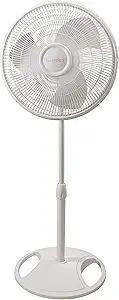 |
| Best Seller A high-volume bestseller chosen again and again | DREO DR-HPF013 Pedestal Fan |  |
PELONIS 16" Pedestal Fan PSFS40R4ABB

| Power Source | Corded Electric |
|---|---|
| Number of Speeds | 3 |
| Air Flow Capacity | 1765 cfm |
| Noise Level | 50 db |
| Motor Type | AC |
The Pelonis 16" pedestal fan is a straightforward, budget-friendly floor fan that moves a lot of air for its size thanks to an efficient AC motor and aerodynamic blades rated at 1765 CFM. It is used as a room circulator for bedrooms, home offices, and living areas where whole-room airflow is needed; the head tilts and the stand adjusts in height so you can aim the breeze at a desk, bed, or couch. Controls are simple: a push-button panel plus a remote that operates power, the three speed levels, 90° oscillation, and the 7-hour auto-off timer. Practical benefits include a stable weighted base, built-in overheat protection, and relatively quiet operation for overnight use. Trade-offs are the basic three-speed control rather than variable fan speeds and a plastic construction that keeps weight down but feels less premium than metal alternatives. For buyers prioritizing strong airflow and easy remote control on a modest budget, this model delivers sensible performance without extra frills.
Best for: Buyers who want powerful, no-nonsense room cooling on a budget and value remote convenience and simple controls for everyday home use.
Less Ideal for: Shoppers seeking premium materials, variable speed control, or a designer look should consider higher-end models with metal construction or DC motors.
- High airflow for size (1765 CFM) for effective room circulation
- Remote control plus intuitive touch/push-button panel for convenient operation
- 90° oscillation and adjustable tilt/height let you direct airflow where needed
- 7-hour timer and quiet motor suitable for overnight or home office use
- Only three fixed speed settings instead of a variable dial
- Plastic build may feel less durable or premium than metal designs
Verdict: A cost-conscious choice that delivers strong, whole-room airflow with easy remote control and practical features for everyday home cooling.
Lasko 1820 Pedestal Fan

| Number of Speeds | 3 |
|---|---|
| Air Flow Capacity | 1840 cfm |
| Wattage | 85 watts |
| Power Source | Corded Electric |
| Special Features | Adjustable Height, Oscillating, Remote Controlled |
The Lasko 1820 is a straightforward pedestal fan built for strong airflow in medium to larger rooms. Its five 18-inch blades and 1840 CFM rating produce noticeable circulation, and the 60-degree oscillation plus tilt-back head and adjustable stand (up to 54 inches) make it easy to aim air where you need it. Use the three quiet speed settings and included remote to move between a gentle nighttime breeze and higher output for hot afternoons. Assembly is tool-free and the plastic blades and alloy-steel body keep weight down for easy portability. Safety features include ETL listing and Lasko Blue Plug fault protection. The fan is simple to operate with rotary controls and touch functions, but it lacks finer speed control or advanced quieting compared with higher-end DC models and it does not include a timer or sleep mode. For budget-focused buyers who need reliable, no-frills performance and wide coverage, this model delivers solid airflow and convenient remote operation.
Best for: Buyers who prioritize strong, no-frills airflow on a budget and want a portable pedestal fan that covers medium to large rooms with simple controls and remote convenience.
Less Ideal for: Users seeking whisper-quiet operation, precise speed control, smart/home integration, or advanced features like timers and sleep modes should consider other models.
- High airflow from five 18-inch blades with 1840 CFM for effective room circulation
- Adjustable height, 60-degree oscillation, and tilt-back head let you direct airflow accurately
- Included remote control for convenient speed changes from across the room
- ETL listing and Blue Plug fault protection for added electrical safety
- Only three speed settings limit fine-tuning compared with multi-speed or DC fans
- Higher noise level on top setting compared with quieter DC models
Verdict: A budget-friendly pedestal fan that delivers strong, far-reaching airflow and convenient remote control for cooling medium to large rooms.
Hurricane Supreme 16" Pedestal Fan

| Number of Speeds | 3 |
|---|---|
| Air Flow Capacity | 1201 cfm |
| Wattage | 35 watts |
| Speed | 1350 rpm |
| Power Source | Corded Electric |
The Hurricane Supreme 16" Pedestal Fan is a basic, no-frills standing fan designed to move a lot of air for the price. It adjusts between roughly 41 and 55 inches, offers 90 degree oscillation that can be locked off, and includes a small remote to change power, speed, and oscillation from across the room. The motor is a brushed type driving three polypropylene blades that deliver up to 1201 CFM at 1350 RPM while drawing about 35 watts, so it produces strong airflow with modest energy use. The steel grill, powder-coated finish, and plastic blades keep the unit lightweight and easy to assemble or move between rooms. Downsides are the basic brushed motor and plastic construction, which mean it will not be as quiet or as long-lived as higher-end metal-blade or commercial fans, and the control set is simple with only three speeds. For budget-minded shoppers who want a tall, powerful oscillating fan with remote convenience, this is a practical choice; buyers seeking ultra-quiet operation or premium longevity should consider heavier-duty models.
Best for: Buyers who want the most cooling performance per dollar and value simple conveniences like adjustable height and a remote for everyday room circulation.
Less Ideal for: If you need whisper-quiet operation for bedrooms or a heavy-duty commercial fan built for continuous industrial use, look at quieter or more robust alternatives.
- High airflow rated at 1201 CFM for strong room circulation
- Adjustable height and 90° oscillation for wider coverage
- Includes remote control for convenient speed and oscillation changes
- Low power draw around 35 watts for energy-efficient operation
- Brushed motor and plastic blades are less durable and can be noisier than higher-end designs
- Only three speed settings limit fine-tuning of airflow
Verdict: A budget-friendly pedestal fan that delivers powerful, adjustable airflow and remote convenience for buyers prioritizing practical cooling value.
Comfort Zone 16" Pedestal Fan CZST161BTEBK

| Number of Speeds | 3 |
|---|---|
| Wattage | 47 watts |
| Noise Level | 56.7 db |
| Power Source | Corded Electric |
| Blade Length | 16 inches |
The Comfort Zone 16" pedestal fan is a straightforward freestanding fan for adding targeted cooling and circulation to bedrooms, offices, or dorms. It offers three push-button speeds and a 90-degree oscillation to move air across a wider area, while the head tilts and the pole height adjusts for directing airflow where you need it. The quad-pod folding base makes setup and storage simple, and the metal safety grill and plastic blades are typical for a value fan. At 47 watts and a quoted noise level around 56.7 dB it provides usable airflow without being excessively power hungry, though the motor is a basic brushed type so you should expect standard longevity and maintenance. Practical benefits are easy controls, a compact collapsible base for portability, and ETL/UL safety listings. Limitations include a 3-speed control rather than variable dial or remote, modest airflow compared with higher-end models, and a simple brushed motor that may be noisier or less durable than brushless designs.
Best for: Buyers needing an inexpensive, no-frills pedestal fan for everyday rooms who prioritize easy setup, portability, and basic adjustable airflow.
Less Ideal for: Anyone who wants whisper-quiet operation, variable-speed precision, or the strongest possible airflow for very large rooms should look at higher-end models.
- Adjustable height and tilt let you aim airflow precisely.
- 90-degree oscillation spreads air across a larger area.
- Foldable quad-pod base for easy storage and transport.
- ETL and UL listed safety compliance.
- Only three fixed speeds and push-button controls limit fine tuning of airflow.
- Uses a brushed motor which is less durable and potentially louder than brushless motors.
Verdict: A practical, budget-friendly 16-inch pedestal fan that delivers adjustable, room-wide airflow and easy storage for buyers who want straightforward cooling without extras.
Amazon Basics 16-Inch Pedestal Fan

| Power Source | Corded Electric |
|---|---|
| Wattage | 60 watts |
| Number of Speeds | 3 |
| Motor Type | AC |
| Included Components | Remote |
This Amazon Basics 16-inch pedestal fan is a straightforward indoor air circulator built for everyday use in living rooms, bedrooms, and home offices. It uses a 60W AC motor and six dual-layered blades to move air efficiently while keeping noise low, and the oscillation plus adjustable tilt and height let you direct airflow where it is needed. Controls are simple: three speed settings, three preset breeze modes (normal, nature, sleep), and a timer that you can operate from across the room using the included remote. Assembly and operation are typical for a pedestal fan and the metal/plastic construction feels utilitarian rather than premium. The fan is energy efficient for continuous use, but it lacks advanced features like app control, variable-speed precision, or brushless motor quietness found on higher-end models. For buyers prioritizing basic, reliable cooling on a budget, this model delivers consistent airflow and handy remote convenience without extras that raise the price.
Best for: Buyers who want a dependable, no-frills pedestal fan that reliably moves air in medium to large rooms and values straightforward controls and remote convenience.
Less Ideal for: Shoppers seeking smart-home integration, whisper-quiet brushless motors, or precise variable-speed control should look at higher-end options instead.
- Effective airflow from a 60W AC motor and six blades for medium to large rooms
- Remote control lets you change speed, mode, and timer from across the room
- Adjustable height, tilt, and oscillation for targeted air circulation
- Energy-efficient operation suitable for extended use
- Basic three-speed control lacks fine-grained speed adjustment
- Construction is utilitarian metal and plastic rather than premium materials
- No smart connectivity or advanced noise-reduction features
Verdict: A practical, reliable pedestal fan that delivers solid airflow and remote convenience at a budget-friendly level.
Lasko 2520 Oscillating Pedestal Fan

| Number of Speeds | 3 |
|---|---|
| Blade Length | 16 inches |
| Motor Type | AC |
| Wattage | 91 watts |
The Lasko 2520 is a straightforward pedestal fan that delivers usable airflow for bedrooms, living rooms, or small workspaces. It offers three quiet speed settings and widespread oscillation so you can choose a gentle breeze for sleeping or stronger circulation for hot afternoons, while the tilt-back head and height adjustment up to 47 inches help aim air where you need it. The fan uses an AC motor and simple manual controls, which keeps operation intuitive and durable, and the unit includes safety features such as Blue Plug fault protection and ETL listing. Assembly is tool-free and the plastic construction makes it lightweight and easy to move, though that same construction feels less premium than metal alternatives. The 16-inch blade gives solid room circulation but won't match high-velocity utility fans for workshop or garage use. For budget-focused shoppers who want reliable, no-frills cooling with basic safety features, this fan is a practical choice.
Best for: Buyers seeking an affordable, reliable bedroom or living-room fan who prioritize simple controls, safety features, and easy setup backed by many user reviews.
Less Ideal for: People who need heavy-duty, high-velocity airflow for garages, workshops, or large open-plan rooms should look at higher-performance utility or metal fans instead.
- Three quiet speed settings for adjustable airflow
- Fully adjustable height and tilt-back head for directed cooling
- Widespread oscillation to circulate air across a room
- Tool-free assembly and lightweight for easy portability
- Plastic construction feels less durable and premium than metal fans
- Not designed for high-velocity utility tasks or large open spaces
Verdict: A budget-friendly, easy-to-use pedestal fan that delivers reliable room cooling with basic safety features and simple controls.
DREO DR-HPF013 Pedestal Fan

| Power Source | Corded Electric |
|---|---|
| Number of Speeds | 8 |
| Noise Level | 28.2 db |
| Air Flow Capacity | 1000 cfm |
| Motor Type | Brushless |
The DREO DR-HPF013 is a budget-friendly pedestal air circulator aimed at moving a lot of air quietly. It uses a brushless DC motor and a three-blade turbo-style design to deliver up to 1000 CFM and a claimed reach of about 90 feet, which makes it useful for circulating air across living rooms, bedrooms, or kitchens. Controls are straightforward: a top touch panel and an included remote let you pick among eight speeds, three modes and an auto mode that adjusts speed with temperature changes, and an 8-hour timer is handy for overnight use. The fan tilts 105 degrees and oscillates 90 degrees horizontally while the height is adjustable from about 38 to 42 inches, so you can point airflow where you need it. It is mostly plastic but disassembles for cleaning and even includes an aroma pad for scent if desired. Expect good airflow for the price and very quiet operation, though the build is typical of economical fans and lacks premium metal construction or app/voice controls.
Best for: Buyers who prioritize dependable, quiet whole-room airflow on a budget and want simple, risk-free controls and easy cleaning.
Less Ideal for: Those seeking a heavy-duty metal build, advanced smart-home integration, or specialty commercial airflow should consider more premium models.
- High claimed airflow (1000 CFM) suitable for whole-room circulation
- Quiet brushless DC motor operation with low noise level
- Simple controls with remote, touch panel, auto mode and 8-hour timer
- Adjustable height, wide vertical tilt and 90° oscillation for directed airflow
- Disassemblable design for easier cleaning
- Mostly plastic construction may feel less durable than metal alternatives
- No smart app or voice control for remote scheduling or integration
Verdict: A quiet, high-airflow pedestal fan that delivers whole-room circulation and simple remote control at a budget-friendly price.
Choosing the Right Pedestal Fan on a Budget: Key Factors to Consider
Airflow and Coverage
How much air a pedestal fan moves at different speed settings directly affects whether it can cool a small desk area, a medium living room, or an open-plan space. Look for fans with clear speed steps and spec sheets that list airflow in CFM or provide realistic descriptions of coverage area.
Consider the fan's head diameter and whether it offers wide oscillation. Larger blades and wider oscillation patterns increase coverage, while adjustable tilt helps direct airflow to where you need it most. For bedrooms, a focused breeze may be enough; for living areas you may want broader sweep.
Noise and Suitability for Sleeping Areas
Noise matters when a fan is used in a bedroom or for background white noise. Budget fans vary widely in how they balance airflow and sound. Evaluate reported decibel levels at common distances if available, and prefer models with multiple speed steps that let you run a lower, quieter setting overnight.
Motor type and blade design influence humming or whistling tones. Fans that offer a 'sleep' or low-noise mode are useful. Also check for mechanical rattles or loose parts in reviews since these can create irritating noises even if the motor is quiet.
Energy Use and Running Cost
Even on a budget, running cost adds up over months of use. Look for fans that draw less power at effective speeds and offer efficient motors or DC options when available. Energy-efficient fans provide comparable airflow at lower wattage, reducing monthly energy consumption.
Also consider features that reduce runtime, such as timers and thermostatic controls. A fan that lets you set an automatic shutoff or that integrates with a thermostat will cut constant operation and save energy.
Build Quality and Stability
A solid base, rugged adjustment mechanisms, and secure guard assembly increase safety and longevity. Budget fans sometimes skimp on materials, leading to wobble, loose tilt joints, or guards that rattle. Prioritize models with heavier bases or weighted feet, and check that height and tilt adjustments lock firmly.
Stability is especially important if you have children, pets, or place the fan on uneven floors. A safe, durable fan reduces the chance of tipping and requires fewer repairs or replacements.
Ease of Use and Controls
Simple, intuitive controls make a fan easy to operate day to day. Look for clearly labeled speed settings, straightforward oscillation on/off, and accessible height or tilt adjustment. Remote controls and timers add convenience, but only if they are reliable and use standard batteries.
Consider the visibility of control knobs or buttons in low light and whether the fan has indicator LEDs. Easy assembly and clear instructions also improve the ownership experience for budget buys.
Maintenance and Safety Features
Routine maintenance for pedestal fans usually means occasional dusting of blades and guard cleaning. Models that allow tool-free guard removal or simple blade access save time and reduce the chance of damage during cleaning. Check if the design minimizes trapped dust around the motor housing.
Safety features such as tightly spaced grill bars, auto-shutoff on tip-over, and thermal overload protection for the motor are valuable. Even budget fans should meet basic safety standards to reduce fire risk and accidental contact with moving blades.
Best Fan Sizes for Different Rooms
Choosing the right fan diameter and motor strength depends on room size and how you use the fan. Small bedrooms and offices do well with compact heads that deliver a focused breeze, while larger living rooms benefit from bigger blades and wider oscillation to move air across more area.
If you mostly need targeted cooling, a medium head with adjustable tilt gives precise airflow without excess noise. For faster whole-room circulation, choose a larger head and a design that offers consistent airflow at mid to high speed settings.
- Small rooms: 12 to 16-inch head for targeted airflow
- Medium rooms: 16 to 18-inch head for balanced coverage and noise
- Large rooms: 18+ inch head or higher airflow rating with wide oscillation
Tips to Reduce Fan Noise
Start by placing the fan on a stable surface and tightening height and tilt mechanisms. Even a slight wobble amplifies noise. Use lower speed settings at night and aim the fan so air moves across the room rather than directly at a wall, which can create reflections and perceived volume.
Regular cleaning prevents dust buildup on blades and guards, which can cause imbalance and additional vibration. If a fan has a remote, check for a sleep or eco mode that reduces motor RPM without eliminating airflow.
- Stabilize the base to cut resonance
- Use lower speeds and indirect aiming for bedrooms
- Keep blades and guards clean to avoid imbalance noise
Placement and Airflow Strategies
Placement affects how effectively a pedestal fan circulates cool air. Near windows, fans can push cooler night air into a room. Placed in a doorway, a fan can help move conditioned air between rooms. Position the fan at a height that aligns with the area you want to cool—higher placement for whole-room circulation, lower for seated occupants.
Combine fan placement with other cooling strategies. For example, use blinds to block daytime solar gain while running a fan to create a comfortable indoor feel. Multiple fans can be arranged to create cross-breezes in larger rooms, but be mindful of cumulative noise and power draw.
- Window placement helps bring in night air
- Doorway placement improves cross-room circulation
- Adjust height to match seated or standing occupants
Maintenance Checklist for Longevity
Regular upkeep keeps a budget pedestal fan performing well. Monthly dusting of blades and the grill prevents buildup that causes imbalance and extra motor strain. Every few months, remove the guard (if tool-free) and wipe blades with a damp cloth, then fully dry before reassembly.
Check the base and adjustment knobs for looseness and tighten as needed. Inspect the power cord for fraying and ensure vents around the motor stay clear. If a fan develops unusual noise or reduced airflow, stop using it until you inspect for loose parts or accumulated debris.
- Dust blades and grill monthly
- Tighten screws and adjustment knobs quarterly
- Inspect power cord and motor vents regularly
When to Consider a Higher-End Model
If you need exceptionally quiet operation for a recording space, want integrated smart controls, or expect heavy daily use, spending more can be worthwhile. Higher-end fans often have smoother motors, finer balance of blades, and extras like timers, app control, or DC motors that run more efficiently.
However, for many typical home uses a budget pedestal fan that scores well on airflow, noise, and stability will be the smarter purchase. Evaluate whether advanced features justify extra cost based on how frequently the fan will run and where it will be used.
- Higher-end benefits: quieter motors, smart controls, better efficiency
- Budget picks offer most everyday value for intermittent or moderate use
How We Chose the Best Pedestal Fan on a Budget
We prioritized measurable performance and everyday usability when choosing budget pedestal fans. Primary evaluation criteria included steady airflow at multiple speed settings, measured noise output at typical operating distances, and electrical efficiency so running costs stay low. We also assessed build and stability, looking for robust base design, adjustable-height mechanisms, and secure oscillation systems that reduce wobble over time. Controls and convenience were another focus because easy-to-use speed dials, remote control options, and tilt/height adjustments matter in daily use. Durability and serviceability were considered by checking typical materials and straightforward assembly features. We excluded specialty fans with nonstandard power requirements, purely decorative units with limited airflow, and ceiling or wall-mounted designs that do not match the pedestal form factor. In short, products made the list when real-world airflow, acceptable noise levels, safe and stable design, and efficient power consumption aligned with budget pricing and common user needs.
Our full evaluation process is outlined in our review methodology.
FAQ
How loud are budget pedestal fans typically?
Budget pedestal fans vary, but many operate in a range that is acceptable for living areas and light bedroom use. Expect higher speeds to be noticeably louder. Look for models that publish decibel levels or offer a low-speed or sleep mode for quieter operation.
Can a pedestal fan cool an entire room by itself?
A single pedestal fan can provide perceived cooling by increasing air movement, particularly in small to medium rooms. For larger spaces, you may need higher airflow or multiple fans oriented to create cross-breezes for effective whole-room circulation.
Are pedestal fans energy efficient compared with other cooling options?
Pedestal fans use much less power than air conditioners, making them an energy-efficient way to improve comfort when humidity and temperature allow. Efficiency varies by motor design and settings, so choose models that provide good airflow at lower wattage and offer timers to reduce runtime.
How often should I clean a pedestal fan?
Basic cleaning every month helps maintain performance. Remove dust from the guard and blades, and do a more thorough wipe-down every few months. Regular cleaning prevents imbalance and keeps airflow strong without adding strain to the motor.
Is assembly difficult for budget pedestal fans?
Most budget pedestal fans are straightforward to assemble with simple tools or tool-free parts. Clear instructions and few components are common, but check for reviews that mention assembly ease if this is important to you.
Final Verdict
When choosing a pedestal fan on a budget, prioritize the balance between airflow effectiveness and acceptable noise levels, then confirm the fan's build and stability. Energy efficiency and convenient controls like timers or simple remotes are useful secondary considerations that reduce running costs and increase daily usability. Tradeoffs are typical: very cheap units may save upfront money but can be noisier or less stable, while slightly higher-cost budget models often deliver longer service life and quieter operation. Focus on the factors that matter most for your room size and usage pattern to pick a dependable, cost-effective pedestal fan.