
Note: This article contains affiliate links. If you click on these links and make a purchase, we may earn a small commission at no extra cost to you. This helps support our research and content. Read our full affiliate disclosure here.
Flying exposes you to recycled cabin air, close quarters, and allergens that can make travel uncomfortable or aggravate sensitivities. Choosing a compact, aircraft-ready personal air purifier matters because it can reduce particulates and some airborne irritants right around your breathing zone without taking up carry-on space or creating cabin disruption. This guide shortlists seven top personal air purifiers for airplane use, focusing on filtration effectiveness, noise and battery behavior, and practical mounting or placement options for travel. Below we outline what we evaluated and provide guidance to help you pick the unit that fits your flight habits and health priorities.
Top Picks at a Glance
| Best Overall The best all-around choice for most situations | Blueair Mini Max Auto |  |
| Best Quality Built to a higher standard if you want something more solid | AirTamer A320W Personal Air Purifier |  |
| Best Value The sweet spot between price and what you get | Pure Enrichment PureZone Mini |  |
| Best Budget The cheapest option that still gets the job done reliably | Arint U-13 Mini Air Purifier | 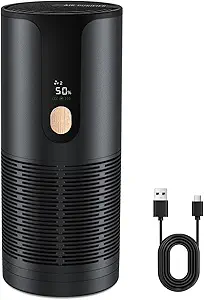 |
| Top Rated A top-rated pick with lots of positive feedback | Levoit Core Mini-P |  |
| Most Popular A crowd favorite that many people choose with confidence | FULMINARE H13 Air Purifier |  |
| Best Seller A high-volume bestseller chosen again and again | GoveeLife Smart Mini Air Purifier H7126 |  |
Blueair Mini Max Auto

| Clean Air Delivery Rate (sq ft/hr) | Up to 510 sq ft in one hour |
|---|---|
| Filtration | HEPASilent with activated carbon |
| Noise level | As low as 19 dB |
| Controls | Auto Mode, Night Mode, 3 fan speeds |
The Blueair Mini Max Auto is a small, lightweight air purifier designed for personal spaces such as bedrooms, nurseries, dorms, and home offices. It combines HEPASilent filtration with an activated carbon layer to capture particles down to 0.1 microns and reduce light household odors, and a built-in particle sensor that automatically adjusts fan speed via Auto Mode. Its 360° intake and compact cylindrical shape make placement flexible on a nightstand or desk, and noise can drop to about 19 dB in Night Mode for undisturbed sleep. Controls are simple with a two-button interface and a five-color LED air quality indicator, and maintenance is straightforward thanks to a washable pre-filter and a filter replacement indicator. Because it is optimized for small rooms and prioritizes quiet, it is excellent for continuous, low-profile use but will take longer to clean larger or smoke-filled spaces at high rates. Its portability and low noise make it especially useful for personal use where space and sleep comfort matter most.
Best for: Buyers who want a quiet, easy-to-use purifier for a personal space or travel-ready setup that prioritizes sleep comfort and low-profile operation.
Less Ideal for: People who need fast purification for large rooms or heavy smoke and odor removal should consider larger, higher-capacity units instead.
- HEPASilent filtration captures particles down to 0.1 microns for effective allergen and particle removal.
- Auto Mode with particle sensor adjusts fan speed based on real-time air quality.
- Very quiet operation with Night Mode down to ~19 dB for bedrooms and sleep.
- Compact, lightweight cylindrical design with 360° intake for flexible placement.
- Washable pre-filter and filter life tracking make maintenance simple.
- Designed for small rooms so it is less effective at rapidly cleaning large or heavily polluted spaces.
- Activated carbon layer reduces light odors but is not a heavy-duty odor eliminator.
Verdict: A compact, whisper-quiet purifier with automatic sensing that is ideal for personal spaces and bedside use.
AirTamer A320W Personal Air Purifier

| Item model number | A320W |
|---|---|
| Batteries | 1 Lithium Polymer (included) |
| Manufacturer | AirTamer |
The AirTamer A320W is a small, wearable personal air purifier designed to create a local sphere of cleaner air using electrostatic negative-ion technology rather than a fan and filter. You wear it on the included conductive lanyard or place it nearby to push particles and tested viruses away from your breathing zone, and a single charge provides exceptionally long runtime of 150+ hours. Its filter-free design eliminates replacement parts and keeps maintenance minimal, and the unit is silent and unobtrusive for travel and airplane use. Independent lab testing cited a 99% reduction in specific test viruses within 20 minutes, and the device is CARB approved with zero ozone emission. Practical limitations are that it does not actively capture particles in a room the way HEPA-based purifiers do and its effective sphere is limited to the immediate breathing area, so it is a personal supplement rather than a full-room solution. For frequent flyers who want a lightweight, long-running purifier to wear in crowded cabins, it delivers clear real-world benefits.
Best for: Frequent travelers and commuters who prioritize compact, low-maintenance personal protection in crowded or enclosed spaces and value long battery life for extended trips.
Less Ideal for: People seeking a full-room air purification solution or those who prefer HEPA filtration that actively captures particles should consider other appliance types.
- Very long single-charge runtime of 150+ hours for extended travel use
- Filter-free operation eliminates replacement costs and maintenance
- Silent, fanless design suitable for wear on planes and in quiet environments
- Independent lab testing reported rapid reduction of specific test viruses
- Cleans only the immediate breathing zone and does not replace a HEPA room purifier
- Relies on ion emission rather than particle capture, which may be less familiar to some buyers
Verdict: If you need a lightweight, silent personal purifier with industry-leading runtime for airplane travel, the AirTamer A320W is a top practical choice.
Pure Enrichment PureZone Mini

| Filtration | 2-stage (Activated Carbon + True HEPA) |
|---|---|
| Battery | Rechargeable lithium-ion |
| Run time | Up to 12 hours (low) |
| Fan speeds | 3 |
The Pure Enrichment PureZone Mini is a compact, battery-powered personal air purifier intended to clean the air immediately around you. It uses a two-stage system with an activated carbon pre-filter for odors and a True HEPA filter to capture fine particles, and the company rates it to clean about 6 ft² in roughly 12 minutes. The unit is lightweight, includes a removable adjustable handle, and runs up to 12 hours on low on its rechargeable lithium-ion battery, so it works unplugged in cars, hotel rooms, or on a plane tray table. Three fan speeds let you balance noise and airflow; on high it also provides a modest personal cooling effect. Practical limitations are its very small coverage area and modest CADR, so it is designed for one-person, close-range use rather than whole-cabin cleaning, and filter replacements are required over time. For travelers who want a cordless, easy-to-pack purifier to reduce exposure to allergens and odors in immediate personal space, this is a straightforward option.
Best for: Travelers and commuters who prioritize a compact, rechargeable purifier to reduce allergens and odors right around their seat or workspace.
Less Ideal for: People seeking whole-room or cabin-level purification or higher CADR performance should choose a larger, higher-output purifier instead.
- Rechargeable battery runs up to 12 hours on low for cordless, on-the-go use
- True HEPA plus activated carbon pre-filter captures particles and reduces odors
- Lightweight, compact design with adjustable/removable handle for flexible placement
- Three fan speeds let you trade noise for faster local purification
- Very small coverage area (personal space only) so it will not purify larger areas
- Modest airflow/CADR limits how quickly it cleans even a personal bubble
Verdict: If you want a lightweight, cordless purifier to improve the air immediately around your seat while traveling, this mini unit is an easy, travel-ready choice.
Arint U-13 Mini Air Purifier
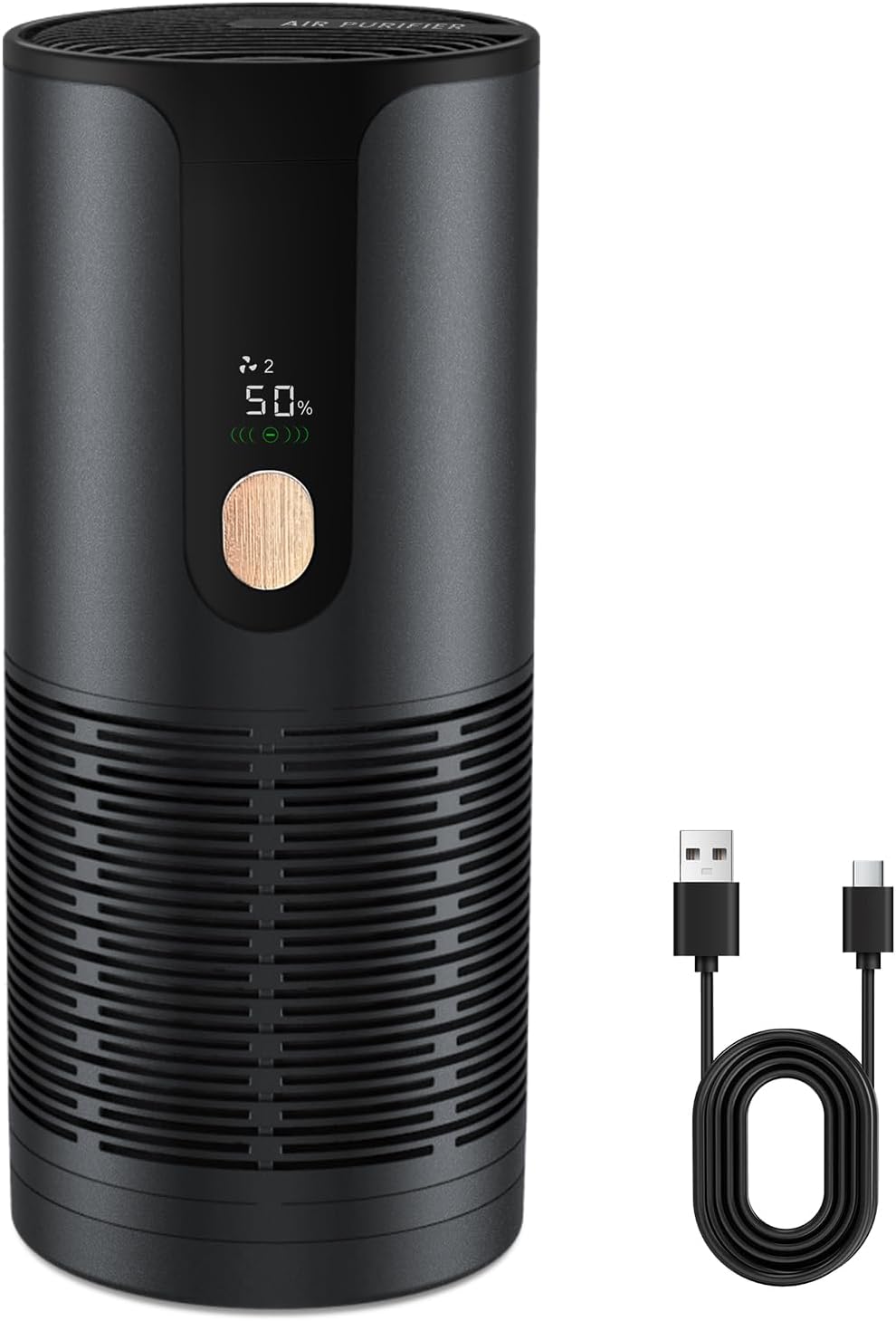
| Filtration | 4-layer (Pre-filter, H13 True HEPA, Activated Carbon, Alkali + Negative Ions) |
|---|---|
| Coverage | ~20 sq ft (5 minutes refresh claim) |
| Noise level | 15 dB (low) |
| Charging | USB-C fast charge (≈1.5 hours) / D battery option |
| Run time | 8+ hours at low speed |
The Arint U-13 is a travel-focused personal air purifier designed to scrub the air in very small spaces such as a car cup holder, airplane tray area, or bedside desk. It uses a four-layer system including a pre-filter, H13 True HEPA element, activated carbon, and a final alkali/negative-ion stage to tackle dust, pollen, smoke and odors, and the maker claims it refreshes about 20 sq ft in five minutes. It is compact and cordless with USB-C fast charging and a battery option using an included D cell, so it can run on the go for hours at low speed and fits easily in bags or cup holders. Controls are simple with three fan speeds and colored LED indicators, and the unit is very quiet at its lowest setting. Important limits are its coverage — it is built for personal bubble use, not whole cabins — and replacement filters are required for sustained performance. Buyers should also note manufacturer claims like long filter life and noise levels reflect typical conditions rather than laboratory certification.
Best for: Travelers and commuters who prioritize a compact, battery-capable purifier to reduce smoke, pet dander, and odors in a personal space during flights or transit.
Less Ideal for: People seeking to clean the air of an entire room, full airplane cabin, or multiple seats should choose a larger, higher-output purifier instead.
- True H13 HEPA filtration for particles down to 0.3 μm
- Activated carbon layer to reduce odors and some VOCs
- Cordless design with USB-C fast charge and optional D-cell battery for travel use
- Very compact form factor that fits cup holders and airplane trays
- Three fan speeds and low 15 dB noise for quiet operation
- Designed for very small personal zones only, not effective for full cabins or larger rooms
- Some performance claims (coverage area and filter life) are manufacturer estimates and may vary in real use
Verdict: If you need a truly portable, quiet purifier for your personal space while flying or commuting, this compact Arint unit delivers HEPA-grade filtration and battery-powered convenience.
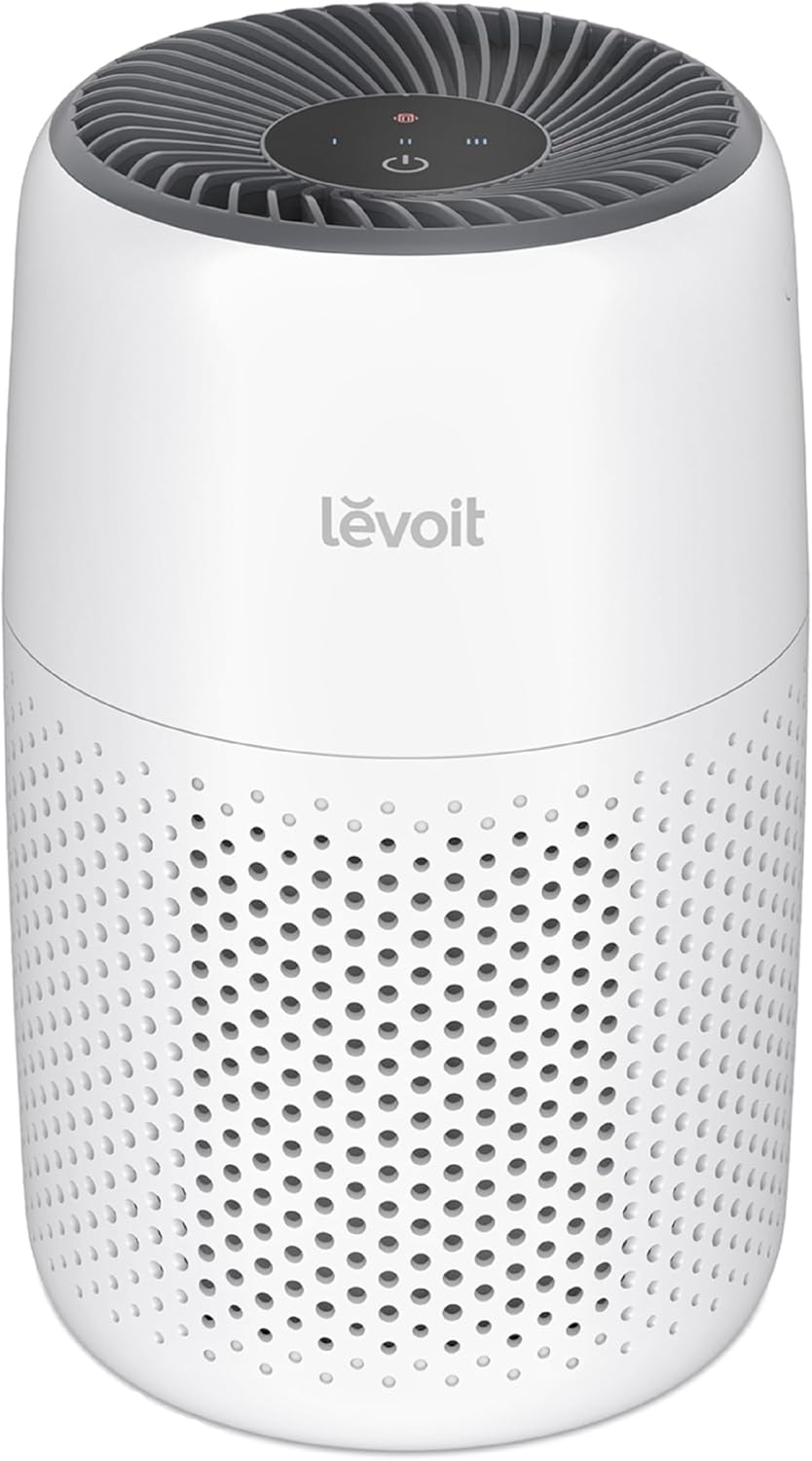
Levoit Core Mini-P
| Rated Power | 7W |
|---|---|
| Noise Level | 27-45 dB |
| Adapter Input | 100-240V, 50/60 Hz |
The Levoit Core Mini-P is a small, plug-in air purifier built for near-field use where space and noise matter. It combines a pre-filter and a main HEPA-style filter to capture lint, hair, pet dander, smoke particles, and other fine pollutants, and it includes a fragrance sponge for light aromatherapy. With rated power around 7W and a quoted noise range of roughly 27–45 dB, it runs quietly enough for sleeping or working without being intrusive. The unit has a sleep mode and an auto-off display to reduce disturbances, and its internal adapter design keeps the footprint tidy on a desk or tray surface. Practical limits are its small coverage area and modest CADR implied by the mini size, so it is best for single-person zones rather than whole cabins or large rooms, and the aromatherapy sponge needs careful dosing to avoid overflowing plastic parts. For travel or airplane use you will appreciate the low power draw and quiet operation, but expect only localized improvement in air quality rather than whole-cabin purification.
Best for: Buyers who prioritize a reliable, quiet unit to improve the air immediately around one person—ideal for frequent travelers or anyone who wants a low-maintenance purifier for a personal space.
Less Ideal for: People seeking whole-room or whole-cabin purification or high CADR performance should choose a larger, higher-capacity purifier instead.
- Very compact footprint suitable for tight spaces or a tray table
- Low power consumption (around 7W) for use on low-power USB adapters or chargers
- Quiet operation with sleep mode for minimal disturbance
- Includes pre-filter and main filter to capture common household particles and odors
- Designed for very small coverage areas so it provides only localized air cleaning
- Aromatherapy sponge requires careful dosing to avoid damaging plastic components
Verdict: A quiet, low-power personal purifier that reliably cleans the air immediately around one person, making it a sensible choice for travel and airplane use.
FULMINARE H13 Air Purifier

| Filter type | H13 HEPA |
|---|---|
| Recommended coverage | Up to 215 ft² / 20 m² |
| Noise level | Around 24 dB (low) |
| Timer options | 2/4/8/10/12 hours |
The FULMINARE H13 is a compact HEPA air cleaner designed to refresh air in small spaces up to about 215 sq ft using a 360 degree outlet and dual-channel airflow. It pulls air through an H13-rated filter to capture fine particles and is intended for everyday use in bedrooms, small offices, or near a travel seat where space is limited. Controls include a near-silent sleep mode that can drop noise to roughly 24 dB, an independent night light, and five timer settings (2, 4, 8, 10, 12 hours) for scheduled runs. The unit is plug-in powered with a removable bottom cover for the adapter and uses replaceable filters that the listing recommends changing roughly every three months under normal use. Practical benefits include quiet overnight operation and a small footprint that is easy to move, while limitations are that its clean-air delivery is sized for modest rooms and it requires regular filter replacement and access to power rather than battery operation.
Best for: Buyers who want a small, quiet HEPA purifier to reduce particles and odors in a compact, personal space and who prioritize proven filtration over maximum coverage.
Less Ideal for: People who need a cordless purifier for travel without access to power or those seeking rapid air cleaning for large or open areas.
- H13 HEPA filtration captures fine particles for cleaner air
- 360 degree outlet with dual-channel airflow refreshes air in small rooms
- Very low noise in sleep mode (around 24 dB) suitable for overnight use
- Multiple timer settings and independent night light for flexible placement
- Designed for rooms up to about 215 sq ft so not suitable for larger spaces
- Requires plug-in power and has no internal battery for true portable use
- Filters need replacement roughly every three months under normal use
Verdict: A quiet, compact H13 HEPA purifier that is a sensible choice for cleaning the air around a single seat or small room when you need reliable filtration and low noise.
GoveeLife Smart Mini Air Purifier H7126

| Model | H7126 |
|---|---|
| Coverage | 376 sqft per hour |
| Noise level | 24 dB (sleep mode) |
| Filter | 3-in-1 HEPA filter |
The GoveeLife Smart Mini Air Purifier H7126 is a compact HEPA air cleaner aimed at small spaces and bedside use. It pulls air through a 3-in-1 filter via a 360° dual-channel intake and offers three fan speeds, a sleep mode that can drop noise to about 24 dB, and an automatic mode when paired with GoveeLife's air quality monitor. Setup uses the GoveeLife app and supports voice control through Alexa and IFTTT, and the unit includes an aroma pad for light scenting. In practical use it is easy to place on a nightstand or travel bag for short trips and provides steady removal of pet hair, pollen, and household odors in small cabins or airplane seats where space is limited. The purifier is Energy Star and ETL certified, and filter change reminders are handled through the app. The main compromises are its small coverage—best for personal zones rather than full cabins—and lack of 5 GHz Wi-Fi support, which may limit connectivity on some modern networks. Replacement filters and aroma pads are available separately.
Best for: Buyers who prioritize a compact, quiet, and easy-to-control purifier for personal spaces or travel and who want simple smart features and aroma functionality.
Less Ideal for: People needing high CADR whole-cabin or whole-room purification or users who require 5 GHz Wi-Fi connectivity for their network setup.
- Compact footprint suitable for bedside or tight spaces
- App and Alexa control for remote operation and scheduling
- Quiet sleep mode rated around 24 dB for undisturbed rest
- 3-in-1 HEPA filter and 360° dual-channel intake for effective small-room purification
- Built-in aromatherapy pad for optional scenting
- Small room coverage not designed for large cabins or whole-room purification
- Does not support 5 GHz Wi-Fi networks which may limit connectivity options
Verdict: A quiet, app-controlled mini HEPA purifier that delivers reliable personal-zone air cleaning and added aromatherapy in a travel-friendly package.
Choosing the Right Personal Air Purifier for Airplane: Key Factors to Consider
Filtration Type and Rated Efficiency
The filtration media determines what the purifier actually removes. True HEPA filters capture 99.97 percent of particles down to 0.3 microns and are the baseline for particulate removal. Some travel purifiers use high-efficiency electrostatic or multilayer filters with equivalent performance; check manufacturer test data or certifications.
For airplane use you want a filter that handles fine particles and common cabin allergens because pathogens and ultrafine aerosols can be present in recirculated air. Also consider whether the unit includes activated carbon for reducing odors and volatile organic compounds, especially if you are sensitive to smells or chemical fumes during a flight.
Airflow Pattern and Placement
How the purifier moves cleaned air matters more in a plane than in a room. A unit that produces a focused upward or forward flow toward your breathing zone is more effective than one designed to circulate air in a larger space. Look for devices with directional outlets or adjustable vents that let you aim purified air where you sit.
Placement options affect performance. Devices that clip to a tray table edge, strap to a headrest, or sit comfortably on your lap provide different spread of clean air. Consider how the purifier performs when placed close to the user versus when placed on a seatback tray or armrest.
Battery Life and Charging Options
Flights can range from short hops to long hauls, so battery runtime is a key practical factor. Check how long the purifier runs at low and medium speeds and whether it supports pass-through charging or recharging from in-seat USB power. A long-lasting battery or the ability to top up from a power bank keeps the device usable throughout the flight.
Also look at charging convenience: USB-C is preferable for faster, standardized charging and compatibility with common power banks and inflight outlets. Some units allow operation while plugged in, which can be helpful on flights with working power.
Noise Level and User Comfort
Noise is a significant comfort factor when flying. Even a compact purifier that filters well can be disruptive if fan noise is constant or creates unpleasant tonal frequencies. Manufacturers often list dBA figures at different speeds; compare those numbers but also check how subjective noise feels during rest or conversation.
Fan speed options and a quiet mode help balance performance and comfort. If you plan to use the purifier while sleeping, prioritize units with a whisper-quiet low setting and minimal vibration when placed on a tray or lap.
Size, Weight, and Portability
Travel purifiers must fit into carry-on luggage or a personal bag and be light enough to handle during transit. Weight and dimensions determine whether you can comfortably store the unit in an overhead bin or under the seat. Compact designs with protective covers or travel cases reduce the risk of damage while moving through airports.
Consider also how quickly filters can be swapped or replaced and whether spare filters are readily available. A unit with a simple, tool-free replacement process is easier to maintain between trips.
Safety Features and Airline Compatibility
Air travel has specific safety expectations. Choose purifiers with reliable electrical protections, such as regulated charging circuits and overheat safeguards, to avoid issues during flights. Battery chemistry and certification for air transport are important if you plan to carry spare batteries or power banks to recharge the unit.
Also be mindful of in-cabin rules: some features like high-voltage ionizers or certain UV modules can be problematic or restricted. Prefer devices with clear safety documentation and no components that could be misconstrued by cabin crew.
How Personal Purifiers Help on Planes
Personal purifiers create a small microclimate of cleaner air around your head and upper chest. They are not designed to replace cabin filtration but can reduce your immediate exposure to particulates, allergens, and some odors when placed close to you.
Because airplane cabins recycle air, a localized purifier that directs cleaned air toward your breathing zone can reduce nuisance symptoms such as sneezing, eye irritation, and discomfort from odors. They are also useful during boarding and deplaning when airflow is limited.
- Reduce particulate exposure in the immediate breathing zone
- Lower concentration of allergens and some airborne irritants
- Provide odor reduction when activated carbon is included
Placement Tips for Best Performance
Aim to position the purifier so the outlet points toward your face without creating draft discomfort. If the unit sits on a tray table, angle it upward. If it clips to a seatback or headrest, ensure the airflow clears any obstruction.
Keep the device stable and avoid blocking intake vents with clothing or bags. For lap use, steady the unit with a small cushion or cloth to reduce vibration and noise transfer. Small adjustments in distance and angle often yield noticeable differences in perceived air quality.
- Place 6 to 18 inches from your face for the best benefit
- Avoid placing the purifier directly under an overhead vent
- Stabilize on soft surfaces to minimize vibration
Maintenance and Filter Replacement While Traveling
Check filter service life before a trip and carry a spare if you travel often. Filters loaded with dust or hair will lose efficiency and increase fan noise. Know the replacement interval specified by the manufacturer and how to access the filter compartment quickly.
When replacing filters on the go, follow the unit's instructions to avoid contaminating the clean side. Store spare filters in a resealable bag or clean case to prevent them from picking up debris in luggage.
- Inspect pre-filters and cleanable components regularly
- Pack spare filters in protective packaging
- Follow manufacturer guidance for filter disposal
Travel Considerations and Airline Etiquette
Be considerate of fellow passengers. Use lower fan settings during quiet hours or when people around you are sleeping. Avoid directing airflows that blow directly into neighboring seats.
Inform cabin crew if you plan to use a device that requires plugging into an outlet, and avoid using functions that produce strong odors or visible emissions. Keep documentation of the device specifications handy if an attendant asks about safety features.
- Prefer silent or low modes when others are nearby
- Avoid using functions that create visible output
- Have safety documentation available if requested
Power Solutions for Long Flights
For extended travel, pair the purifier with a compact power bank that meets airline battery rules. Confirm whether the purifier supports operation while charging and whether it uses a standard connector like USB-C for easier compatibility.
If relying on in-seat power, test the unit at home with similar USB outputs to ensure it charges and runs as expected. Some low-power settings extend runtime significantly and are adequate for most travel situations.
- Use USB-C power banks with sufficient capacity
- Verify operation while plugged in before flying
- Choose power banks compliant with airline carriage limits
How We Chose the Best Personal Air Purifier for Airplane
We focused on attributes that determine real-world usefulness on airplanes rather than broad home-focused features. First, filtration capability: we prioritized units with certified true HEPA or equivalent particulate filtration and effective capture rates for typical cabin contaminants such as ultrafine particles and pollen. Second, airflow and output design: compact devices that direct cleaned air toward the user with measurable clean air delivery or focused flow scored higher. Third, battery performance and charging: we judged run time at common fan speeds and the convenience of USB-C or mobile charging for inflight use. Fourth, noise and comfort: units had to maintain usable noise levels at useful fan speeds so they do not interfere with rest or conversations. Fifth, mounting and portability: form factor, weight, and attachment options for tray tables, headrests, or lap placement were considered. We excluded large room purifiers, products lacking verifiable filtration specs, and units intended solely for scent or ionization without particulate filtration. Our selections balance measurable filtration performance with travel-focused usability.
Our full evaluation process is outlined in our review methodology.
FAQ
Will a personal purifier stop viruses on a plane?
Personal purifiers with true HEPA or equivalent filters remove a high percentage of airborne particles down to 0.3 microns, which helps reduce exposure to some droplets and aerosols. They do not guarantee protection from infection and should be used alongside other precautions such as vaccination and good hygiene.
Can I use a personal air purifier during takeoff and landing?
Most compact purifiers are safe to use during takeoff and landing, but follow crew instructions and airline policies. If the device needs to be plugged in, confirm it can operate on battery or that an outlet is available and permitted.
How close should the purifier be to my face to be effective?
Placing the unit approximately 6 to 18 inches from your face usually provides the best localized benefit. Too close can cause draft discomfort, while too far diminishes the effect of the cleaned air stream.
Are ionizers or UV-only units good for airplane use?
Ionizers and UV-only products typically do not provide the particulate filtration that true HEPA-based units offer. Some ionizers can produce small amounts of ozone or require higher power, so prioritize units with verified particulate filtration for cabin use.
Do I need a replacement filter for every flight?
No. Replacement frequency depends on usage and air conditions. Inspect pre-filters and change or clean them per the manufacturer's schedule. Heavy use in dusty or polluted environments will shorten filter life.
Final Verdict
When choosing a personal air purifier for airplane travel, prioritize filtration efficiency, battery performance, and how the unit directs cleaned air toward your breathing zone. Tradeoffs are common: the most powerful airflow may reduce battery life or increase noise, while ultra-quiet units may have lower throughput. Decide which factors matter most for your flights—long-haul runtime, quiet sleep modes, or a focused airflow for allergy relief—and select a compact unit that balances those needs with reliable filter performance and safe charging behavior. That approach will give you the best chance of more comfortable, cleaner-feeling air on board.