
Note: This article contains affiliate links. If you click on these links and make a purchase, we may earn a small commission at no extra cost to you. This helps support our research and content. Read our full affiliate disclosure here.
If you struggle with sneezing, congestion, or itchy eyes at home, picking the right portable air purifier for allergies can make a tangible difference day to day. Small units positioned near sleeping or living areas can remove airborne pollen, pet dander, and fine dust that trigger symptoms, and choosing the wrong size or filter type limits effectiveness. This guide shortlists the top portable air purifiers for allergy relief and explains the practical tradeoffs buyers face. We evaluated filtration performance, room coverage, noise, and ongoing maintenance so you can find a unit that fits your bedroom, office, or living room. Read on to see how we assessed each option and which features matter most for allergy control.
Top Picks at a Glance
| Best Overall The best all-around choice for most situations | Winix 5510 Air Purifier |  |
| Best Quality Built to a higher standard if you want something more solid | Coway Mighty AP-1512HH |  |
| Best Value The sweet spot between price and what you get | VOOPNU Air Purifier DH-JH12 |  |
| Best Budget The cheapest option that still gets the job done reliably | FULMINARE H13 Air Purifier |  |
| Top Rated A top-rated pick with lots of positive feedback | Jafanda JF260 Air Purifier |  |
| Most Popular A crowd favorite that many people choose with confidence | Levoit Core Mini-P |  |
| Best Seller A high-volume bestseller chosen again and again | Levoit Core 200S-P Air Purifier |  |
Winix 5510 Air Purifier

| Coverage | Up to 1,882 sq ft in 1 hour |
|---|---|
| Filtration stages | 4-Stage |
| Noise (low) | 23.5 dB |
| Smart features | WiFi / Alexa / Google Home |
| AHAM Verified | Yes |
The Winix 5510 is a four-stage air purifier built to tackle allergens and household odors in large spaces. It uses a washable pre-filter, True HEPA filtration that captures particles down to 0.01 microns, and an advanced carbon filter to cut VOCs and smells from cooking, pets, and smoke. Built-in smart sensors continuously monitor air quality and the unit shifts fan speeds in Auto Mode for efficient cleaning, while an LED AQI indicator gives a quick visual of room conditions. App support plus Wi‑Fi and voice assistant compatibility let you check status and control the unit remotely, and Sleep Mode makes operation nearly silent in darkened rooms. Practical benefits include strong CADR-rated coverage for large rooms and an easy-to-clean pre-filter to extend HEPA life. Important limitations are the need for periodic HEPA and carbon filter replacements and that its larger coverage and smart features may be more than required for small bedrooms or single-person spaces.
Best for: Buyers who want a reliable, smart air purifier that cleans large living spaces and prioritizes allergen and odor removal with automated sensing and remote control.
Less Ideal for: People who only need a compact purifier for a small bedroom or who prefer a completely manual, no-app device should consider simpler, smaller units.
- True HEPA filtration captures microscopic allergens down to 0.01 microns
- Advanced activated carbon filter reduces VOCs and common household odors
- Smart sensors with Auto Mode adjust fan speed based on real-time air quality
- Wi‑Fi and Winix Smart App support plus voice assistant compatibility for remote control
- Washable pre-filter helps trap large particles and prolong HEPA life
- Requires replacement HEPA and carbon filters on a regular schedule
- Larger coverage and features may be unnecessary for small rooms
Verdict: Choose the Winix 5510 if you need a smart, high‑capacity purifier that reliably removes allergens and household odors from large rooms.
Coway Mighty AP-1512HH

| Coverage | Up to 1,748 sq. ft. in 60 minutes |
|---|---|
| Filtration | Washable pre-filter, deodorization filter, bipolar device, HEPA |
| HEPA efficiency | 99.97% of 0.3μm particles |
| Modes | Auto, Eco, Timer, Filter indicator |
The Coway Mighty AP-1512HH is a compact portable air purifier built around a four-stage filtration system: washable pre-filter, deodorization filter, bipolar ionizer, and a true HEPA filter that captures 99.97% of 0.3 micron particles. It is intended for regular room use where allergies, pet dander, smoke, and household odors are concerns and runs in Auto mode to adjust fan speed based on real-time air quality readings. The unit covers a large area quickly and includes practical features such as an air quality LED, timer, eco mode to reduce power when air is clean, and a filter indicator that tracks when the pre-filter needs cleaning and when filters should be replaced. Its washable pre-filter lowers maintenance costs and the availability of specialty custom filters (pet, smoke, VOCs) makes it flexible for specific problems. Expect some fan noise at higher speeds and ongoing replacement costs for HEPA and deodorization filters, but for allergy control the purifier's HEPA performance and continuous monitoring make it an effective everyday device for breathing cleaner indoor air.
Best for: Buyers who prioritize measurable particle removal and continuous air-quality control for allergy relief in living rooms, bedrooms, or open-plan spaces.
Less Ideal for: People seeking an ultra-quiet bedroom-only nightstand unit or those who want a permanently maintenance-free filter solution.
- True HEPA filtration captures 99.97% of 0.3 micron particles for allergy relief
- Auto mode with air quality sensor adjusts fan speed in real time
- Washable pre-filter reduces debris and lowers replacement frequency
- Multiple filtration stages (deodorization filter and bipolar ionizer) target odors and gases
- Replacement HEPA and deodorization filters are required periodically
- Fan can be audible on higher speed settings
Verdict: Choose the Coway Mighty AP-1512HH when you want a proven HEPA purifier with real-time sensing and multi-stage filtration to cut allergens and odors effectively in medium to large rooms.
VOOPNU Air Purifier DH-JH12

| Filtration | H13 True HEPA triple-layer |
|---|---|
| Coverage | Up to 1,076 ft² (manufacturer claim) |
| Noise level | 22 dB (low) |
| Speeds | 3 fan speeds |
The VOOPNU DH-JH12 is a small, user-friendly air purifier built around an H13 True HEPA multi-layer filter and 360° intake that the brand says captures 99.97% of airborne particles. It is intended for everyday use in bedrooms, living rooms, or small open-plan areas and offers three fan speeds, a timer, and an essential oil tray for scenting. The unit is quiet enough for night use with noise reported as low as 22 dB on its lowest setting, and the simplified control panel makes it easy to run continuously as recommended for best results. Practical benefits include strong particle filtration for allergens and pet hair, a compact footprint for flexible placement, and multiple safety and regulatory certifications. Limitations are the small physical size relative to the large coverage claim so expect best performance when placed centrally in a single room, and replacement filters are required on a regular schedule to maintain efficiency. The aroma tray is convenient but can complicate filter longevity if oils contact filter surfaces.
Best for: Buyers who prioritize steady, low-noise allergen removal in bedrooms or small living areas and want a compact, easy-to-use purifier they can run continuously.
Less Ideal for: People needing whole-house purification or highest-speed cleaning for very large, open spaces should choose a larger unit with higher CADR.
- H13 True HEPA triple-layer filtration captures most airborne allergens and fine particles
- 360° surround intake for more even air drawing from all directions
- Very quiet operation down to 22 dB suitable for bedroom or sleep use
- Simple controls and timer make continuous use easy
- Compact footprint that fits on a desk or bedside table
- Manufacturer lists a large coverage area that may be optimistic for closed or cluttered rooms
- Requires periodic filter replacements to preserve H13 performance
Verdict: A compact, quiet HEPA purifier that fits small rooms and households focused on low-noise, continuous allergen reduction.
FULMINARE H13 Air Purifier

| Filter type | H13 HEPA |
|---|---|
| Recommended room size | Up to 215 sq ft / 20 m² |
| Noise level (low) | Around 24 dB |
| Timers | 2-4-8-10-12 hours |
The FULMINARE H13 is a small portable air purifier aimed at improving air quality in bedrooms and similar-size rooms up to about 215 sq ft (20 m²). It uses an H13 true HEPA filter and a 360° outlet with dual-channel airflow to capture fine particles, pet hair, smoke, and common airborne allergens. Controls include sleep mode with very low noise around 24 dB, an independent night light, and five timer settings (2, 4, 8, 10, 12 hours) for hands-off operation. In everyday use it is easy to place on a bedside table or desk and run continuously on low for quiet background filtration; higher fan speeds will circulate air faster but increase sound. Filters need periodic replacement (manufacturer notes about roughly three months in typical use) and the unit is powered via a plug-in adapter stored under the base, so it is not battery-operated. For the price point this purifier offers solid HEPA-level filtration and useful bedroom-friendly features, though its coverage is best limited to single rooms rather than open-plan areas.
Best for: Buyers looking for an affordable bedroom-friendly purifier that reduces allergens and runs quietly overnight without complicated setup.
Less Ideal for: People needing whole-home coverage, battery-powered portability, or higher CADR for large living spaces should consider larger units.
- H13 true HEPA filtration captures fine particles and common allergens
- 360° air outlet with dual-channel airflow refreshes room air efficiently
- Very quiet sleep mode around 24 dB suitable for light sleepers
- Independent night light and multiple timer options for bedroom use
- Designed for rooms up to about 215 sq ft so not suited for large or open-plan areas
- Requires regular filter replacements and replacement cost over time
Verdict: A budget-friendly bedroom purifier that delivers true HEPA filtration and whisper-quiet operation for allergy relief in single rooms.
Jafanda JF260 Air Purifier

| CADR | 153 CFM |
|---|---|
| Filtration System | True HEPA & Activated Carbon |
| Coverage | Up to 1190 ft² (single air change rates vary by room size) |
| Noise Level | As low as 23 dB (Sleep Mode) |
The Jafanda JF260 is a compact tower-style air purifier aimed at cleaning large rooms by cycling room air multiple times per hour. It uses a 3-in-1 system—pre-filter, True HEPA, and a heavy activated carbon layer—to capture particles including dust, pollen, pet dander, smoke, and many odors, and the manufacturer rates CADR at 153 CFM. A built-in PM2.5 sensor and an Auto mode adjust fan speed to match air quality, and a Sleep mode drops noise to about 23 dB for overnight use. Practical benefits include straightforward operation, a visible air-quality readout for real-time feedback, and reportedly energy-efficient performance for continuous use. Filter life is indicated at several months depending on model usage, so routine replacement is needed. Limitations are typical for this class: performance depends on room layout and placement, filters add ongoing cost, and while the CADR suits many large rooms, the unit will require longer run times to fully refresh very large or unusually shaped spaces.
Best for: Buyers who prioritize reliable, continuous allergy relief in living rooms or bedrooms and want an easy-to-read air-quality display and low-noise operation.
Less Ideal for: People seeking a whole-home HVAC solution or instant purification for very large open-plan spaces should consider larger-capacity systems instead.
- True HEPA plus 300g activated carbon for particle and odor removal
- PM2.5 sensor with display enables automatic fan adjustment
- Very quiet Sleep mode around 23 dB suitable for bedrooms
- Rated CADR of 153 CFM for faster air changes in medium to large rooms
- Replacement filters require periodic buying and maintenance
- Effectiveness depends on correct placement and room layout, not a guaranteed instant whole-home solution
Verdict: Choose the Jafanda JF260 if you want a quiet, sensor-driven HEPA purifier that reliably reduces allergens in bedrooms and large rooms.
Levoit Core Mini-P
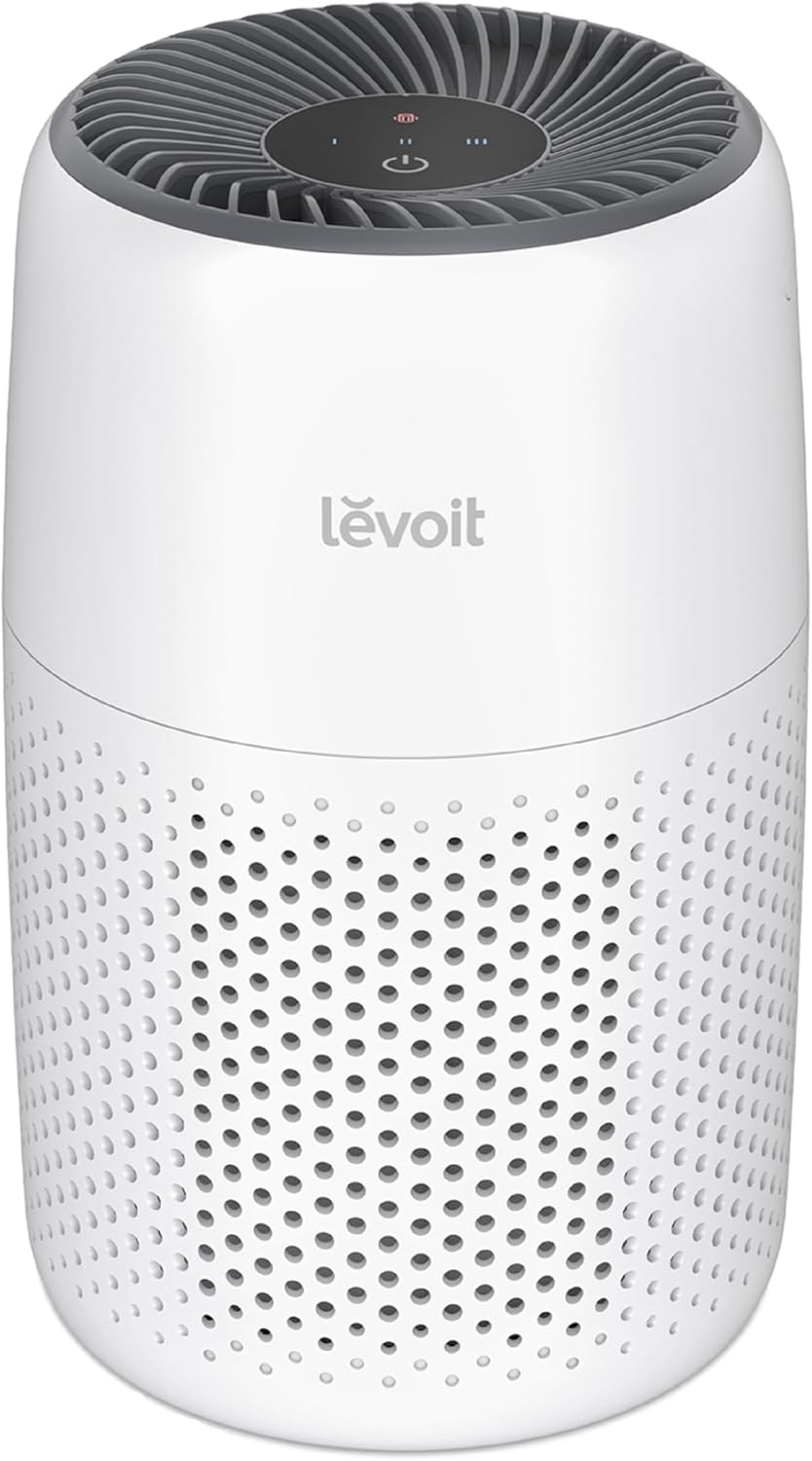
| Rated Power | 7W |
|---|---|
| Noise Level | 27-45dB |
| Adapter | Stored inside unit |
| Particle Retention Size | 0.3 micron |
The Levoit Core Mini-P is a small, plug-in air purifier built for desks, bedrooms, and other compact rooms where space is limited. It uses a pre-filter and main HEPA-grade filter to capture lint, pet dander, smoke, and fine airborne pollutants while an integrated fragrance sponge lets you add a light scent. The unit runs quietly—manufacturer noise figures list a low range around 27 dB—so it can be left on during sleep or focused work, and features a sleep mode and auto-off display to reduce distractions. At roughly 7 watts rated power it is energy efficient for continuous use, and the internal adapter stores inside the unit for neat placement. Limitations are its small coverage area and modest airflow: this is aimed at single-person zones rather than whole rooms, and overusing the aromatherapy pad can damage components so only a few drops are recommended. Replacement filters are required periodically to maintain performance.
Best for: Buyers who prioritize proven performance and social validation and need a discreet, energy-efficient purifier for a small bedroom, office, or dorm where quiet operation and verified filtration matter.
Less Ideal for: Homes needing whole-room or apartment-level air cleaning should choose a larger purifier with higher CADR and greater airflow capacity.
- True HEPA-grade main filter for fine particle capture
- Very quiet operation suitable for night use
- Compact footprint with internal adapter storage for desktop placement
- Low power draw for continuous operation
- Small unit with limited coverage not suitable for large rooms
- Aromatherapy pad must be used sparingly to avoid damage
Verdict: Choose the Levoit Core Mini-P when you want a compact, quiet, AHAM-verified purifier that reliably cleans air in small personal spaces.
Levoit Core 200S-P Air Purifier
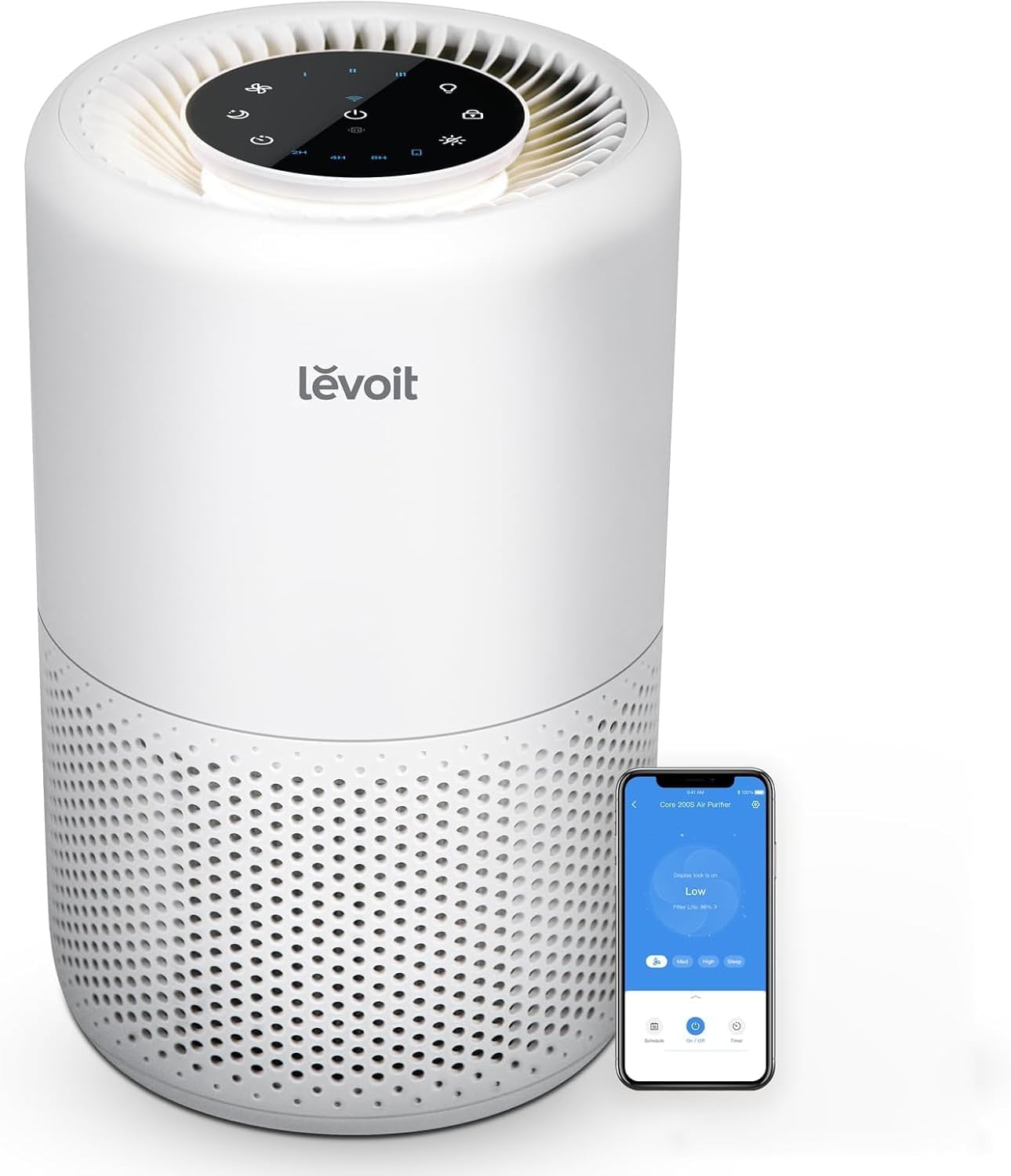
| Model | Core 200S |
|---|---|
| Room coverage | 140 ft² (refreshes air 4.8×/hr) |
| Noise level | As low as 27 dB |
| Filter type | 3-in-1 (Pre-filter, Activated Carbon, HEPA-grade) |
The Levoit Core 200S-P is a compact room air purifier that uses a three-stage filter (pre-filter, activated carbon, and HEPA-grade main filter) and 360 degree intake to clean air in small spaces such as bedrooms or offices. It is typically placed on a bedside table or shelf and runs continuously or on a schedule via the Levoit app, with voice control available through smart assistants. Notable features include AHAM-verified performance for room coverage and a quiet Sleep Mode that drops noise to around 27 dB, plus an in-app filter life monitor to know when to replace cartridges. The unit refreshes air in a 140 ft² room multiple times per hour and the activated carbon layer helps reduce common odors and VOCs while the HEPA-grade element captures fine particles down to 0.1–0.3 microns. Trade-offs are its small coverage area—it is not intended for large open-plan rooms—and replacement filters are needed to maintain performance, which adds operating cost over time. The Core 200S-P balances quiet operation, verified cleaning performance, and smart controls for everyday allergy relief in small rooms.
Best for: Buyers who prioritize reliable, verifiable air cleaning and quiet overnight operation for bedrooms or small living spaces and want app or voice control to simplify monitoring and scheduling.
Less Ideal for: People needing to purify large open-plan areas or whole-house coverage should choose a higher-capacity unit instead.
- Three-stage filtration including HEPA-grade main filter that captures 0.1–0.3 micron particles
- AHAM-verified cleaning performance for predictable small-room coverage
- Quiet Sleep Mode with noise as low as 27 dB suitable for bedrooms
- Smart app and voice control with filter life monitoring for convenience
- Designed for small rooms only and does not cover large open spaces
- Requires periodic replacement filters which increase ongoing costs
Verdict: A quiet, AHAM-verified compact purifier with smart controls that reliably reduces allergens and odors in bedrooms and small rooms.
Choosing the Right Portable Air Purifier for Allergies: Key Factors to Consider
Filter Type and Particle Capture
Filter media determines how effectively a portable air purifier removes the allergens you care about. True HEPA or HEPA-equivalent filters are the industry standard for capturing particles down to 0.3 microns, which covers most pollen, dust mite debris, and pet dander.
Some units add a pre-filter to catch larger particles and extend the life of the HEPA element, while others include activated carbon layers to reduce odors and volatile organic compounds. For allergy-focused buying, prioritize particulate capture first, then assess whether odor control is also important for your space.
Room Size and Airflow Capacity
A portable purifier must move enough clean air to meaningfully reduce airborne allergen concentrations in the intended room. Look for units with CADR ratings or manufacturer guidance that match or exceed the square footage of your bedroom, office, or living area.
Underpowered purifiers will run continuously without noticeably improving symptoms. Conversely, choosing a unit rated for a larger area than you need can deliver faster clearing and allow quieter, lower-speed operation during sleep.
Noise Performance During Use
Many allergy sufferers run purifiers overnight, so noise matters. Fan speed, motor design, and airflow path all contribute to audible noise at different settings. Low fan speeds usually provide the best balance of sound and removal rate for sleeping, but a unit must still have adequate CADR at that lower speed.
Check manufacturer decibel ratings for multiple fan speeds and consider units with dedicated sleep or night modes that reduce illumination and motor noise. Remember that subjective perception of noise varies, so lower published dBA at similar airflow is typically better.
Maintenance Frequency and Filter Cost
Routine filter replacement affects both ongoing cost and how well the purifier performs over time. HEPA filters gradually clog with captured particles and lose effectiveness, so replacement intervals and the price of OEM filters are important budgeting considerations.
Also factor in the ease of accessing and changing filters, whether pre-filters are washable, and whether units provide filter-change indicators. A model with higher upfront cost can be cheaper to own if it uses long-life or washable pre-filters that reduce disposable-filter purchases.
Energy Consumption and Runtime Practicality
Portable air purifiers often run for many hours each day, so energy use affects household electricity bills. Compare wattage at typical operating speeds and look for units with efficient brushless motors or low-power sleep modes.
Energy-efficient units also produce less heat and can safely run in bedrooms and small spaces. If you plan to run a purifier 24/7 during allergy season, prioritize efficiency alongside filtration performance.
Placement Flexibility and Portability
The portability of the unit determines how easily you can move it between rooms or position it near the source of allergens. Smaller, lighter units are convenient for shifting from bedroom to living room, but very compact purifiers sometimes sacrifice airflow or filter size.
Consider footprint, handle design, and whether the unit has multiple intake directions. Proper placement—away from walls and elevated off the floor when possible—improves circulation and real-world effectiveness.
How Much Clean Air Do You Need?
Estimate the square footage of the room where you will use the portable air purifier and match that to the unit's rated coverage or CADR figure. For bedrooms, a unit rated for the room size plus a margin is preferable so you can operate at lower, quieter fan speeds while maintaining effective air changes.
If you sleep with windows open seasonally, note that outdoor pollen infiltration increases the required clean-air throughput. In those cases, either a higher CADR or running the purifier continuously becomes more important.
- Measure room length and width to get square footage.
- Prioritize CADR or airflow figures over marketing room-size claims when available.
- Choose a unit with headroom so you can run quieter settings while preserving effectiveness.
Placement Tips for Best Allergens Reduction
Place portable air purifiers in the room's breathing zone, such as near the bed or seating area, rather than tucked into a corner. Elevating a compact unit on a bedside table or shelf helps distribute cleaned air more evenly through the occupied space.
Avoid blocking intakes or outlets with furniture or curtains. In open-plan spaces, a single portable purifier may help a localized area but will not substitute for whole-home ventilation or central filtration.
- Keep at least a few inches of clearance on all sides.
- Position units where occupants spend the most time.
- Do not place purifiers directly on carpet if possible; slightly elevated placement improves airflow.
Understanding Filter Lifespan and Replacement
Filter life depends on airborne particle load and runtime. In high-allergen seasons or homes with pets, expect more frequent replacement than in low-load environments. Many manufacturers publish estimated replacement intervals in months assuming typical daily use, but real-world conditions vary.
Plan for the recurring expense and check how easy it is to buy replacement filters. Consider models with washable pre-filters to reduce costs and extend the life of the HEPA element.
- Track run hours and change filters when indicators recommend it.
- Keep a spare filter on hand before peak allergy season to avoid downtime.
- Confirm whether replacement filters are proprietary or standardized sizes.
Features That Improve Everyday Use
Look for practical features that affect daily comfort, such as night mode, programmable timers, air-quality indicators, and reliable controls. An accurate particulate sensor and an auto mode that adjusts fan speed in response to detected particles can simplify operation.
Connectivity features like air-quality apps are convenient but not necessary for effective allergen control. Simpler units with dependable sensors and manual speed steps often provide the best value for straightforward allergy-focused use.
- Auto modes help maintain clean air without constant adjustment.
- Night modes reduce light and noise for bedroom use.
- Consider the clarity and ease of control panels and indicators.
When to Combine a Purifier with Other Measures
A portable air purifier is one part of an allergy-reduction strategy. In many homes, combining a purifier with frequent vacuuming using a HEPA-filter vacuum, washing bedding in hot water, and controlling indoor humidity produces significantly better symptom control than any single measure.
If household members have severe allergies, consider improving source control—like keeping pets out of sleeping areas—and reducing outdoor pollen entry by using entry mats and changing clothes after outdoor exposure.
- Use purifiers alongside cleaning routines for best results.
- Manage humidity to discourage dust mites; aim for moderate indoor humidity.
- Limit indoor smoking and aerosol pollutants to reduce overall particle burden.
How We Chose the Best Portable Air Purifier for Allergies
We applied a practical set of filters that reflect how people actually use portable air purifiers for allergy relief. First, we prioritized certified HEPA or true HEPA-equivalent filtration as the baseline requirement because particle capture is the principal driver of allergy reduction. Second, we considered Clean Air Delivery Rate or equivalent published CADR estimates to ensure a unit can cycle the air fast enough for typical bedroom and living areas. Third, noise levels at common fan settings were evaluated since many allergy sufferers use purifiers while sleeping. Fourth, we assessed energy consumption and fan efficiency to reflect daily operating cost and suitability for continuous use. Fifth, filter availability and replacement cost were reviewed to estimate ongoing maintenance burden and lifecycle cost. We excluded units that rely only on ionization or ozone generation without adequate particulate filtration, as those do not reliably remove allergens and can present air quality tradeoffs. We also filtered out products whose stated room coverage was inconsistent with published or manufacturer-rated airflow. The resulting shortlist balances measured particulate capture, practical room coverage, quiet operation, and manageable maintenance demands.
Our full evaluation process is outlined in our review methodology.
FAQ
Will a portable air purifier remove pollen effectively?
Yes, units with true HEPA or equivalent filtration typically capture pollen particles efficiently. Effectiveness depends on correct room sizing and sufficient runtime to cycle the air multiple times per hour.
How often should I replace the purifier's filter during allergy season?
Replacement intervals vary with usage and airborne load, but expect more frequent changes during heavy pollen seasons or in homes with pets. Monitor runtime indicators and visual filter condition to decide when to replace.
Can I run a portable purifier all night?
Running continuously is common and often recommended during high-allergen periods. Choose a unit with quiet night mode and low energy draw to keep noise and power consumption manageable for overnight use.
Do carbon filters help with allergies?
Activated carbon filters reduce odors and some gaseous irritants but do not remove particulate allergens. They can complement HEPA filtration if smells or VOCs are a concern, but they are not a substitute for particulate capture.
Is CADR important for allergy control?
Yes, CADR or equivalent airflow metrics indicate how quickly a purifier can clean a room. Higher CADR supports faster reduction of airborne allergens and allows quieter operation at lower fan speeds while maintaining effectiveness.
Where should I place a portable purifier in a bedroom?
Place it near the bed and slightly elevated if possible, with adequate clearance around intake and outlet paths. This positioning maximizes the concentration of cleaned air where you breathe while sleeping.
Final Verdict
When choosing a portable air purifier for allergies, prioritize proven particulate filtration, adequate room coverage, and quiet operation for the settings you use most. Balance filtration efficiency with maintenance costs and energy use so the unit remains practical for regular or overnight operation. Focus on matching CADR or coverage to your room size, pick a unit with true HEPA-level capture, and plan for filter replacements. That approach will give you the best chance of reducing symptoms reliably without unnecessary noise or upkeep.