
Note: This article contains affiliate links. If you click on these links and make a purchase, we may earn a small commission at no extra cost to you. This helps support our research and content. Read our full affiliate disclosure here.
If you care about indoor air health, a reliable PM2.5 air quality monitor is one of the most useful tools you can add to your home. These devices measure fine particulate matter that can affect allergies, respiratory health, and overall comfort. Picking the right monitor matters because sensor accuracy, response time, and reporting format determine how quickly you can detect problems and take action. This guide covers six shortlisted PM2.5 monitors that represent the top options in this category. We evaluated devices for sensor accuracy, ease of use, reporting detail, and long-term reliability so you can find a monitor that fits your space and habits. Read on for the buying factors we weighed and practical guidance to help you choose the best unit for your needs.
Top Picks at a Glance
| Best Overall The best all-around choice for most situations | BREATHE Airmonitor Plus |  |
| Best Quality Built to a higher standard if you want something more solid | IQAir AirVisual Pro |  |
| Best Value The sweet spot between price and what you get | SONOFF SAWF-07P Air Quality Monitor |  |
| Best Budget The cheapest option that still gets the job done reliably | Temtop S1 Air Quality Monitor | 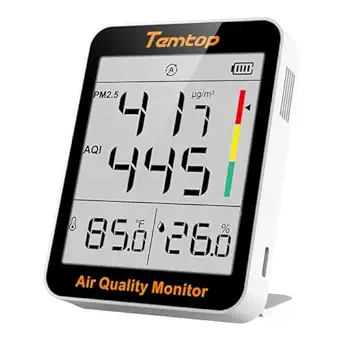 |
| Most Popular A crowd favorite that many people choose with confidence | Amazon Smart Air Quality Monitor |  |
| Best Seller A high-volume bestseller chosen again and again | GoveeLife Smart Air Quality Monitor H5106 |  |
BREATHE Airmonitor Plus

| Measures | CO2, PM1, PM2.5, PM10, TVOC, HCHO, Temperature, Humidity |
|---|---|
| CO2 sensor | NDIR module ±50 ppm |
| Data history | Up to 90 days (app) |
| Power source | Corded Electric, rechargeable battery |
| Compatible devices | Android 6.0+; iOS 13.0+ |
The BREATHE Airmonitor Plus is a multi-sensor indoor air quality monitor designed for home, office, or classroom use. It continuously reports CO2 (via an NDIR module), PM1/PM2.5/PM10 by laser particle sensing, TVOC and formaldehyde, plus temperature and humidity, and displays readings on a color screen while syncing to the Breathe Tech app. Setup is straightforward over 2.4 GHz Wi‑Fi and the app stores up to 90 days of data with CSV export for trend analysis. The Gen 2 adds a rechargeable battery that supports several hours of portable use and lets you run it plugged in for continuous monitoring. Practical benefits include precise CO2 checks for ventilation assessment, particle detection useful during cooking or smoke events, and VOC/HCHO alerts for chemical exposures. Limitations to note are that long-term continuous use depends on leaving it connected to power for best battery life and truly professional calibration beyond the built-in quick CO2 calibration may require external references for laboratory-grade validation.
Best for: Buyers who want a well-rounded home air quality monitor that tracks particles, CO2, and VOCs and provides app history and exportable data for investigating indoor events and ventilation.
Less Ideal for: Users seeking a simple single-parameter CO2 breathalyzer or those who require laboratory-grade, certified instruments for regulatory testing should look elsewhere.
- Measures CO2 with a professional-grade NDIR sensor with ±50 ppm accuracy
- Laser particle sensor reports PM1, PM2.5, and PM10 for detailed particulate tracking
- Dedicated TVOC and formaldehyde detection for chemical pollutant monitoring
- App connectivity with configurable alerts, 90-day history, and CSV export
- Rechargeable Gen 2 battery for up to several hours of portable use plus USB-C continuous operation
- Short built-in battery life for extended standalone use, requiring plug‑in for continuous monitoring
- Higher-end laboratory calibration is not included, which may limit absolute accuracy for professional testing
Verdict: Airmonitor Plus is the best-balanced PM2.5-capable home monitor here if you want combined particle, CO2, and VOC tracking with app history and export features.
IQAir AirVisual Pro

| Measures | PM2.5, CO2, AQI, temperature, humidity |
|---|---|
| Connectivity | Wi‑Fi |
| Power | Rechargeable via AC or USB |
| Manufacturer | IQAir |
The IQAir AirVisual Pro is a compact, performance-focused indoor air quality monitor built around high-precision laser sensors for PM2.5 and CO2 along with temperature and humidity measurement. In daily use it provides continuous real-time readings, configurable alerts when values cross your safety thresholds, and stores historical data so you can spot trends from cooking, smoking, or outdoor pollution events. The device connects to Wi-Fi and pairs with IQAir's app and desktop dashboard for remote viewing and forecasting, and it is rechargeable via AC or USB. Notable strengths are its professional-grade sensor suite and clear health-oriented guidance based on measured AQI, which make it useful for homeowners and small offices prioritizing accuracy. The main limitations are that it is a single-room monitor without integrated air cleaning and that advanced features require the companion app for full access, so users seeking a fully standalone, multi-room solution will need additional units or a different approach.
Best for: Buyers who want accurate, validation-style PM2.5 and CO2 readings to track indoor air performance and act on real data for health or benchmarking purposes.
Less Ideal for: People who need a whole-home monitoring system or an air purifier/monitor combo in a single device should look elsewhere or plan to deploy multiple units.
- Professional-grade laser sensor for PM2.5 for high-precision particulate readings.
- Measures CO2, temperature, and humidity alongside AQI for a fuller indoor air picture.
- Wi-Fi connectivity and companion app for remote monitoring, historical graphs, and forecasts.
- Configurable alerts let you set safety thresholds and receive notifications when conditions worsen.
- Designed as a single-room monitor and not a multi-room or whole-house solution.
- Relies on the companion app for advanced data access and long-term analysis.
Verdict: Choose the AirVisual Pro when you need a compact, professional-grade monitor that delivers accurate PM2.5 and CO2 data for performance-focused indoor air tracking.
SONOFF SAWF-07P Air Quality Monitor

| Output Type | Digital |
|---|---|
| Response Time | 2 seconds |
| Measurement Accuracy | +/-0.5 °C |
| Specific Uses For Product | bedroom, office, nursery, smart home |
The SONOFF SAWF-07P is an all‑in‑one indoor air quality monitor that continuously reports PM2.5, PM10, temperature, and humidity on a 3.73‑inch screen and pushes alerts to your phone. It pairs to 2.4GHz Wi‑Fi and supports Matter so it can join common smart home platforms and trigger automations. The sensor updates every two seconds and supplies year‑long data history viewable as graphs in the app, plus exportable logs for deeper analysis. Notifications use a threefold system: sound, multicolor LED, and app push with customizable thresholds, which is helpful in bedrooms and nurseries. Practical buyers will appreciate the relatively fast response, historical trend tracking, and easy integration into existing smart-home routines. Accuracy and response specs are reasonable for household use, but advanced users seeking lab‑grade precision or standalone battery operation may want a different class of meter.
Best for: Buyers who want a practical, networked indoor monitor to track particulate and environmental trends over time and integrate readings into smart‑home automations.
Less Ideal for: Users who need portable, battery‑powered monitors or highly precise scientific instruments for professional testing.
- Displays PM2.5, PM10, temperature, and humidity together on a 3.73‑inch screen
- Matter and 2.4GHz Wi‑Fi compatibility for integration with major smart home platforms
- Updates every 2 seconds with a fast response time for timely readings
- Year‑long historical data with in‑app charts and exportable logs
- Not designed for battery operation and requires continuous power
- Accuracy is suitable for home monitoring but not lab‑grade precision
Verdict: A practical, smart‑home friendly air quality monitor that gives fast, continuous PM and environmental readings plus year‑long trend tracking for everyday indoor monitoring.
Temtop S1 Air Quality Monitor

| PM2.5 Measuring range | 0-999 µg/m³ |
|---|---|
| Temperature Measuring range | 14-140°F |
| Temperature Accuracy | ±0.9°F |
| Humidity Measuring range | 0-99.9% RH |
| Battery Life | ≥20 days (Smart) ≥60 days (Eco) |
The Temtop S1 is a compact, battery-powered air quality monitor that combines a laser particle sensor for PM2.5/AQI readings with a temperature and humidity sensor for basic comfort monitoring. It is typically used on a tabletop, magnetically attached to surfaces, or carried between rooms to check air quality in nurseries, bedrooms, home offices, and classrooms. Notable features include a simple two-button interface, a three-color alert indicator for quick status checks, and two operating modes that prioritize either continuous real-time readings or extended battery life. Practical benefits are easy portability, a clear segment display, and very long run times—up to 60 days in Eco mode—so you can leave it operating without frequent recharging. Limitations are the basic display and controls that offer fewer data-logging or connectivity options than higher-end models, and the S1 does not report gases like CO2 or VOCs, so it is focused on particulate and basic comfort metrics rather than full-spectrum indoor air diagnostics.
Best for: Buyers who want an affordable, portable way to monitor particulate pollution and basic indoor comfort across rooms without fuss or frequent charging.
Less Ideal for: People who need connected monitoring, historical data logging, or multi-gas detection should consider more advanced monitors with Wi‑Fi and CO2/VOC sensors.
- Accurate PM2.5 readings using a laser particle sensor
- Long battery life up to 60 days in Eco mode
- Simple two-button operation and three-color alert for fast status checks
- Portable and includes options to stand, place, or magnetically attach
- No CO2 or VOC sensing — limited to particulates, temperature, and humidity
- Basic display and no built-in Wi‑Fi or app for logging or remote monitoring
Verdict: A budget-friendly, highly portable PM2.5 and comfort monitor that delivers accurate particulate readings and exceptional battery life for everyday room-to-room use.
Amazon Smart Air Quality Monitor

| Monitors | PM2.5, VOCs, CO, humidity, temperature |
|---|
The Amazon Smart Air Quality Monitor is a compact plug-in sensor that continuously measures five indoor air metrics—PM2.5, VOCs, carbon monoxide, humidity, and temperature—and reports a simple air quality score in the Alexa app. It is primarily used as a real-time indicator of changing indoor conditions, with a color-coded LED for glanceable status and detailed readings and trends available in the app. The monitor can send push notifications and make announcements on Echo devices when air quality worsens, and it supports Alexa Routines so you can automate compatible purifiers, fans, or dehumidifiers when thresholds are crossed. Setup is straightforward: plug it in, open the Alexa app, and follow the guided steps. The practical benefits are hands-off monitoring combined with smart-home automation, which makes it useful for households that already use Alexa devices. Limitations include dependence on the Alexa ecosystem for full functionality and the lack of an onboard display for detailed readouts, so users who want standalone dashboarding or non-Alexa integrations may find it constrained.
Best for: Buyers who want a simple, voice-integrated monitor that ties air quality alerts and automations into an existing Alexa smart-home setup and prefer easy, hands-off monitoring backed by mainstream device support.
Less Ideal for: People who need a standalone monitor with a local display, advanced third-party integrations, or professional-grade logging and exportable data should consider other devices.
- Monitors five key indoor metrics including PM2.5, VOCs, and carbon monoxide
- Integrates with Alexa for voice alerts, app notifications, and automation
- Color-coded LED provides at-a-glance air quality status
- Easy plug-in setup and app-guided configuration
- Relies on the Alexa ecosystem for alerts and automation
- No built-in display for detailed local readings
Verdict: Choose this monitor if you want straightforward PM2.5 and indoor pollutant tracking that works seamlessly with Alexa for alerts and automation.
GoveeLife Smart Air Quality Monitor H5106

| PM2.5 accuracy | ±15 µg/m³ (0–100 µg/m³), ±15% (100–1000 µg/m³) |
|---|---|
| Temperature accuracy | ±0.54°F |
| Humidity accuracy | ±3% |
| Response time | 2 seconds |
| Included components | Air quality monitor, Type‑C cable |
The GoveeLife H5106 is a countertop/plug-in air quality monitor that continuously reports PM2.5, temperature, and humidity with a two‑second refresh rate. It shows readings on an LED display with selectable clock, bright and night modes, and a four‑level air quality indicator for quick visual checks. The monitor connects over 2.4 GHz Wi‑Fi or Bluetooth to the Govee app for remote viewing, 13‑day online graphs, and up to two years of exportable data, which is helpful for tracking trends and sharing results. It integrates with other GoveeLife smart appliances so you can automate purifiers, humidifiers, or fans based on set thresholds. Accuracy specs are provided for PM2.5, temperature, and humidity, and the listing notes the sensor needs to stay unobstructed and requires a Type‑C power connection. There is no internal battery, so it is best used where continuous power is available. The H5106 is a practical choice if you want a fast, connected monitor with long-term data logging rather than a simple one-off detector.
Best for: Buyers who want a reliable, connected monitor for continuous indoor air tracking and prefer clear readings plus cloud data for peace of mind and record keeping.
Less Ideal for: People who need a truly portable, battery‑powered monitor for spot checks or for use away from mains power should look elsewhere.
- Fast 2‑second response time for near real‑time monitoring
- Measures PM2.5 plus temperature and humidity in one compact unit
- Wi‑Fi and Bluetooth connectivity with remote viewing and 2‑year data export
- LED display with selectable clock, bright/night modes, and simple air quality levels
- Can automate other GoveeLife smart appliances based on air quality thresholds
- Requires constant power via Type‑C cable because there is no internal battery
- PM2.5 accuracy has a fairly wide tolerance at higher concentrations (±15 µg/m³ or ±15%)
Verdict: Choose the H5106 when you want a fast, networked PM2.5 monitor that logs long‑term data and controls other smart home devices for automated air quality management.
Choosing the Right Pm2 5 Air Quality Monitor: Key Factors to Consider
Sensor Accuracy
Sensor accuracy determines how closely the monitor's PM2.5 readout matches true particle concentrations. A more accurate sensor reduces false alarms and gives you confidence when making decisions about ventilation, air purifiers, or occupancy. Look for units that use recognized optical particle sensors and that publish detection ranges and typical error margins.
Accuracy also affects long-term trend reliability. If a sensor drifts over time or lacks calibration guidance, its historical data becomes harder to trust. Consider whether the manufacturer offers calibration options, whether the device supports replacement sensor modules, and how the monitor reports uncertainty or confidence in its readings.
Response Time and Consistency
How quickly a monitor responds to changes matters for detecting sudden indoor events like cooking, smoking, or outdoor pollution entering via an open window. Fast response time gives a real-time picture of transient spikes, while consistent readings avoid jitter that masks true trends.
Consistency also includes stability across temperature and humidity ranges typical of homes. Some sensors can be influenced by humidity or high air speeds, causing variability. Check product documentation for stated response times and operating environment ranges to ensure the unit will behave predictably in your space.
Data Reporting and Alerts
A useful monitor does more than show a number. Clear real-time displays, readable trend charts, and customizable alert thresholds let you translate measurements into action. Built-in color coding or AQI-style categories make it easier to interpret levels at a glance.
Alerting options — push notifications, sound alarms, or visual indicators — affect how promptly you can react. Historical logs and export options are important if you want to correlate air quality with activities or evaluate long-term improvements after adding filtration or changing habits.
Connectivity and App Experience
Connectivity determines how convenient it is to access readings remotely and how data is stored. Wi-Fi-connected monitors typically offer cloud logging and remote alerts, while Bluetooth-only units may require proximity to fetch logs. Consider whether the app provides intuitive dashboards, reliable notifications, and options to integrate with other smart-home tools if you plan to automate ventilation or filtration.
Also evaluate firmware update policies and how the manufacturer handles privacy and data retention. A well-designed app with regular updates increases the long-term value of the monitor.
Placement, Power, and Build Quality
Practical aspects like physical size, mounting options, and power source influence where and how you can use a monitor. Small tabletop units are fine for single-room monitoring, while wall-mounted or compact designs suit narrow spaces. Battery-powered monitors offer portability but require recharge or replacement, which can interrupt continuous logging.
Build quality affects durability, especially for units you intend to run 24/7. Consider ventilation around the sensor, filterless designs versus those with protective screens, and clearance for air flow. These physical design choices influence measurement accuracy and device longevity.
Where To Place Your PM2.5 Monitor
Placement affects the relevance of readings. For general living areas, position the monitor at breathing height away from direct airflow sources like vents or fans. Avoid placing the device directly next to cooking surfaces or windows where short-lived spikes may overrepresent typical room conditions.
- Place on a stable surface about 3 to 5 feet above the floor for living spaces.
- Keep at least 1 foot of clearance around intake areas to avoid obstructed airflow.
- For bedroom monitoring, place the unit on a nightstand or shelf near the head of the bed without blocking vents.
Interpreting PM2.5 Readings
PM2.5 values are most useful when viewed as part of a trend rather than single isolated numbers. Look for sustained changes that correlate with activities like cooking, cleaning, or outdoor smoke intrusion. Many monitors translate particle counts into qualitative bands to help you decide when to ventilate or run filtration.
- Short spikes can indicate momentary events and may not require action if levels return to baseline.
- Sustained elevations over 24 hours suggest a persistent source or insufficient filtration.
- Cross-reference with humidity and CO2 readings if available to pinpoint causes.
Using Monitors to Guide Filtration and Ventilation
Monitors are especially useful when paired with an air purifier or ventilation strategy. Use real-time readings to decide when to increase filtration speed or when to open windows if outdoor levels are lower. Over time, the monitor's logs reveal whether changes you make reduce average PM2.5 exposure.
- Set alerts for threshold crossings to trigger purifier boosts or manual ventilation.
- Use historical charts to evaluate the effectiveness of different filtration settings.
- Consider timed automation if your monitor and purifier support smart integrations.
Maintenance and Longevity Tips
Regular cleaning of external grilles and ensuring unobstructed airflow help maintain consistent readings. Some devices require occasional sensor checks or recalibration; follow the manufacturer's maintenance recommendations to avoid drift. Battery-powered monitors should be scheduled for charging to prevent gaps in data capture.
- Inspect and gently clean intakes monthly to remove dust buildup.
- Keep firmware updated to benefit from accuracy and stability improvements.
- If the device offers sensor replacement, plan for end-of-life maintenance costs.
Privacy and Data Management
Understand how an internet-connected monitor stores and shares data before enabling cloud features. Local logging options reduce reliance on third-party servers, while cloud services can provide convenient remote access and long-term archives. Review app permissions and choose retention settings that match your privacy comfort level.
- Prefer models that allow local data export for independent analysis.
- Check whether the app anonymizes location and usage data if cloud sync is enabled.
- Disable unnecessary permissions and review account security options.
How We Chose the Best Pm2 5 Air Quality Monitor
We focused on evaluation criteria that directly affect how well a PM2.5 air quality monitor serves everyday indoor monitoring needs. First, sensor accuracy and calibration history were primary filters because reliable particle counts are the core function. We prioritized units using recognized sensor technologies and those with documented performance characteristics. Second, reporting and data clarity were key. We looked for devices that provide clear real-time readouts, historical trends, and configurable alerts so users can interpret results and respond appropriately. Third, connectivity and app ecosystem mattered: Wi-Fi or Bluetooth connections, cloud logging, and local data export options improve usefulness for ongoing monitoring. Fourth, build quality and power options were considered to ensure practical placement and consistent operation across different rooms. We excluded novelty gadgets and units without transparent sensor specifications or consistent connectivity. Devices with poor user feedback on firmware updates or unclear data presentation were not considered. The included products represent monitors that balance measurement fidelity, ease of use, and long-term reliability for indoor PM2.5 tracking.
Our full evaluation process is outlined in our review methodology.
FAQ
How often should I check the monitor to catch harmful PM2.5 events?
You can rely on continuous monitoring for automatic detection, but glance at real-time readouts during activities that raise particles, such as cooking. Configure alerts to notify you immediately when thresholds are crossed so you do not need to check manually.
Can a PM2.5 monitor tell me the pollution source?
Monitors measure particle concentrations but do not identify specific sources. Correlating spikes with activities, time of day, or outdoor conditions helps infer likely causes. Using additional sensors like CO2 and VOC monitors can improve source identification.
Do high humidity levels affect PM2.5 readings?
High humidity can influence certain optical sensors and sometimes lead to elevated readings if particles absorb moisture. Select a monitor with documented performance across humidity ranges or data compensation features for more consistent results.
Is a battery-powered monitor as good as a plug-in unit?
Battery-powered monitors offer portability and convenience but may sacrifice continuous logging unless frequently recharged. Plug-in units are preferable for 24/7 monitoring to avoid gaps and ensure consistent data collection.
How should I interpret brief spikes versus sustained high readings?
Brief spikes often reflect transient events and may not indicate a persistent problem. Sustained high readings indicate a continuous source or inadequate mitigation and typically warrant action such as increased filtration or ventilation.
Final Verdict
Prioritize sensor accuracy, reliable data reporting, and a connectivity model that fits how you plan to use the device. Faster response times and clear alerting make a monitor more actionable during transient events, while good build quality and sensible power options support continuous use. Balance portability against the need for uninterrupted logging, and use the monitor's historical data to validate any changes you make to filtration or ventilation. With these priorities in mind, you can select a PM2.5 monitor that provides meaningful, trustworthy insight into your indoor air quality.