
Note: This article contains affiliate links. If you click on these links and make a purchase, we may earn a small commission at no extra cost to you. This helps support our research and content. Read our full affiliate disclosure here.
A Smart Thermostat can make your home more comfortable while cutting energy waste, but not every model works the same in every home. You want a unit that connects reliably to your heating and cooling system, reports accurate temperature and humidity, and offers scheduling or learning features that actually reduce runtime without constant fiddling. This guide covers six shortlisted Smart Thermostats that meet common homeowner needs. We evaluated connectivity, sensor and control accuracy, ease of setup, and ongoing usability to narrow the list. Read on to see which features matter most and which options suit different household setups.
Top Picks at a Glance
| Best Overall The best all-around choice for most situations | Honeywell T10 Pro Smart Thermostat |  |
| Best Quality Built to a higher standard if you want something more solid | ecobee Smart Thermostat Premium |  |
| Best Budget The cheapest option that still gets the job done reliably | meross Matter Smart Thermostat MTS300 |  |
| Top Rated A top-rated pick with lots of positive feedback | Sensi Smart Thermostat ST55 |  |
| Most Popular A crowd favorite that many people choose with confidence | Google Nest Thermostat |  |
| Best Seller A high-volume bestseller chosen again and again | Amazon Smart Thermostat |  |
Honeywell T10 Pro Smart Thermostat

| Connectivity Technology | Wi-Fi |
|---|---|
| Controller Type | Amazon Alexa |
| Specific Uses For Product | Heat Pump |
| Voltage | 24 volts |
| Additional Features | can add up to 20 remote sensors |
The Honeywell T10 Pro is a smart wall thermostat that provides programmable temperature control for heat pump and conventional systems and adds Wi‑Fi connectivity plus RedLINK compatibility for Honeywell remote sensors. It is typically installed in a central living area and used to manage heating and cooling schedules, run the fan, and let voice assistants adjust temperature remotely. Notable features include support for up to 20 remote sensors, multi‑stage heating and cooling control, automatic changeover between heat and cool, and Alexa voice control via its controller type. In practice the large backlit LCD and button controls make local adjustments straightforward while Wi‑Fi and sensor support let you focus conditioning where you need it. Setup requires 24V power and a common C wire or the provided power options, and integration with advanced HVAC configurations may need an installer familiar with multi‑stage systems. The T10 Pro delivers flexible zoning and smart controls for homeowners who want precise comfort management without relying solely on learning algorithms.
Best for: Homeowners who want a flexible, sensor‑based smart thermostat that supports multi‑stage HVAC systems and remote control without relying solely on auto‑learning algorithms.
Less Ideal for: Buyers seeking a plug‑and‑play, self‑learning thermostat with minimal setup or those without a C wire and who cannot install required wiring.
- Supports up to 20 remote sensors for room‑by‑room temperature control
- Wi‑Fi connectivity and Alexa integration for remote and voice control
- Handles multi‑stage heating and cooling systems including heat pumps
- Large backlit LCD and tactile buttons make local control simple
- Requires 24V power and may need professional installation for complex systems
Verdict: Choose the T10 Pro if you want a sensor‑centric smart thermostat that gives precise, multi‑stage HVAC control and remote access for balanced, whole‑home comfort.
ecobee Smart Thermostat Premium

| Connectivity Protocol | Wi‑Fi |
|---|---|
| Controller Type | Amazon Alexa, Apple HomeKit, Google Assistant, Android, iOS |
| Power Source | Battery Powered (24 volts support) |
| Number of Batteries | 1 Lithium Ion battery (included) |
The ecobee Smart Thermostat Premium is a high‑end smart thermostat that manages heating and cooling while adding air quality monitoring and built‑in voice control. You mount it on the wall, connect to your 24VAC HVAC system (or use the included Power Extender Kit if you lack a C‑wire), and control it via the ecobee app, voice (Alexa or Siri with HomeKit), or the touchscreen. Notable features include a bundled SmartSensor to reduce hot and cold spots, radar occupancy sensing for presence detection, and an integrated air quality monitor that issues alerts and filter reminders. The metal chassis and large display give it a premium feel, and it supports Dual‑Band Wi‑Fi and wide smart home integrations. On the downside, full Siri functionality needs an Apple home hub, and some advanced features require time in the app to tune for best savings; installation on unusual or high‑voltage systems is not supported. For buyers who prioritize energy savings, home health features, and a built‑in smart speaker, this thermostat delivers a capable, polished experience.
Best for: Buyers who want a performance‑focused smart thermostat that combines energy savings, room‑level comfort control, and built‑in voice/audio capabilities for an integrated smart‑home experience.
Less Ideal for: People with line‑voltage heating systems, millivolt systems, or those who need a very minimal, no‑app thermostat should consider simpler or specialty controllers instead.
- Includes SmartSensor for room‑level temperature control to reduce hot and cold spots
- Built‑in voice assistant and speaker for hands‑free control and audio playback
- Integrated air quality monitor with alerts and filter reminders
- Radar occupancy sensing improves presence detection versus motion‑only sensors
- Power Extender Kit and trim kit included for easier DIY installation on homes without a C‑wire
- Siri voice control requires a separate Apple home hub to enable
- Not compatible with line voltage or millivolt HVAC systems
Verdict: Choose the ecobee Smart Thermostat Premium if you want a performance‑oriented smart thermostat that pairs energy savings and room‑level comfort with built‑in voice and air quality monitoring.
meross Matter Smart Thermostat MTS300

| Connectivity Technology | Wi‑Fi |
|---|---|
| Connectivity Protocol | Matter, Wi‑Fi |
| Voltage | 24 volts |
| Display Type | LED |
The meross MTS300 is a compact smart thermostat for 24V HVAC systems that adds Matter, Wi‑Fi, and voice control to basic heating and cooling setups. You install it on a wall like a conventional thermostat and connect required low‑voltage wires; some older wiring arrangements will need a separate C‑wire adapter. Once powered it pairs with the meross app and Matter‑compatible platforms so you can set 24/7 schedules, adjust temperature remotely, and use Alexa, Siri or Google Assistant voice commands. The LED display and adjustable brightness keep the interface simple, while smart alerts report filter life and system issues. Practical benefits include routine scheduling for energy savings, remote control for on‑the‑go adjustments, and broad smart home integration to avoid juggling multiple apps. The main limitations are the C‑wire requirement for certain setups and lack of a bundled adapter, which adds installation cost for some homes, and minimal on‑device controls compared with higher‑end touch displays.
Best for: Buyers who want an affordable, smart HVAC controller that integrates with Matter and major voice assistants and are comfortable handling basic thermostat wiring or hiring a simple install.
Less Ideal for: Homes without a C‑wire and no willingness to add an adapter or hire installation help, or buyers who want a large color touchscreen or advanced zoning features.
- Matter and Wi‑Fi connectivity for local smart home integration
- Works with Alexa, Apple HomeKit, Google Assistant and SmartThings for voice control
- 24/7 programmable scheduling to automate comfort and reduce energy use
- LED display with adjustable brightness and compact wall‑mounted design
- Smart alerts for filter life and system malfunction notifications
- Does not include a C‑wire adapter and some wiring configurations require one
- Limited on‑device control compared with larger touchscreen thermostats
Verdict: A budget‑minded smart thermostat that brings Matter integration and voice control to standard 24V HVAC systems without premium display frills.
Sensi Smart Thermostat ST55

| Connectivity Technology | Wi-Fi |
|---|---|
| Controller Type | Amazon Alexa, Apple HomeKit, Google Assistant, SmartThings, Vera |
| Power Source | Corded Electric |
| Display Type | LED |
| Number of Batteries | 2 AA batteries required. (included) |
The Sensi Smart Thermostat ST55 is a wall‑mounted, Wi‑Fi programmable thermostat that replaces a traditional stat to give remote control, scheduling, and energy reports via the Sensi app. It supports major voice assistants and smart home platforms and is Energy Star certified to help reduce HVAC energy use. Installation is aimed at DIYers with built‑in level, wiring labels, and app step‑through guidance, and the thermostat works in most common HVAC systems without a common wire in many installations. The interface mixes physical buttons with app and voice control, plus a simple LED display and backlight for local adjustments. Practical benefits include usage reports, smart alerts, filter reminders, and straightforward factory‑style fitment so you usually do not need to patch the wall. Limits to consider are a modest 5‑inch display and basic LED readout rather than a color touchscreen, and advanced thermostat power setups may still require a C‑wire or pro help for some systems.
Best for: Buyers who prioritize a reliable, factory‑quality smart thermostat that integrates with major smart home ecosystems and delivers straightforward installation and energy reporting.
Less Ideal for: Those who want a large color touchscreen or advanced on‑device controls and customizations should look at higher‑end models with richer local displays.
- Works with Alexa, Apple HomeKit, Google Assistant, SmartThings and other platforms for flexible smart control
- Energy Star certification with remote scheduling and usage reports to help lower HVAC energy use
- Designed for DIY install with built‑in level, wire stickers, and step‑by‑step app guidance
- Includes smart alerts and filter reminders to help maintain system performance
- LED display is basic rather than a full color touchscreen
- Some HVAC configurations may still require a C‑wire or professional installation
Verdict: Choose the Sensi ST55 when you want a dependable, Energy Star certified smart thermostat that is simple to install and integrates with major smart home platforms.
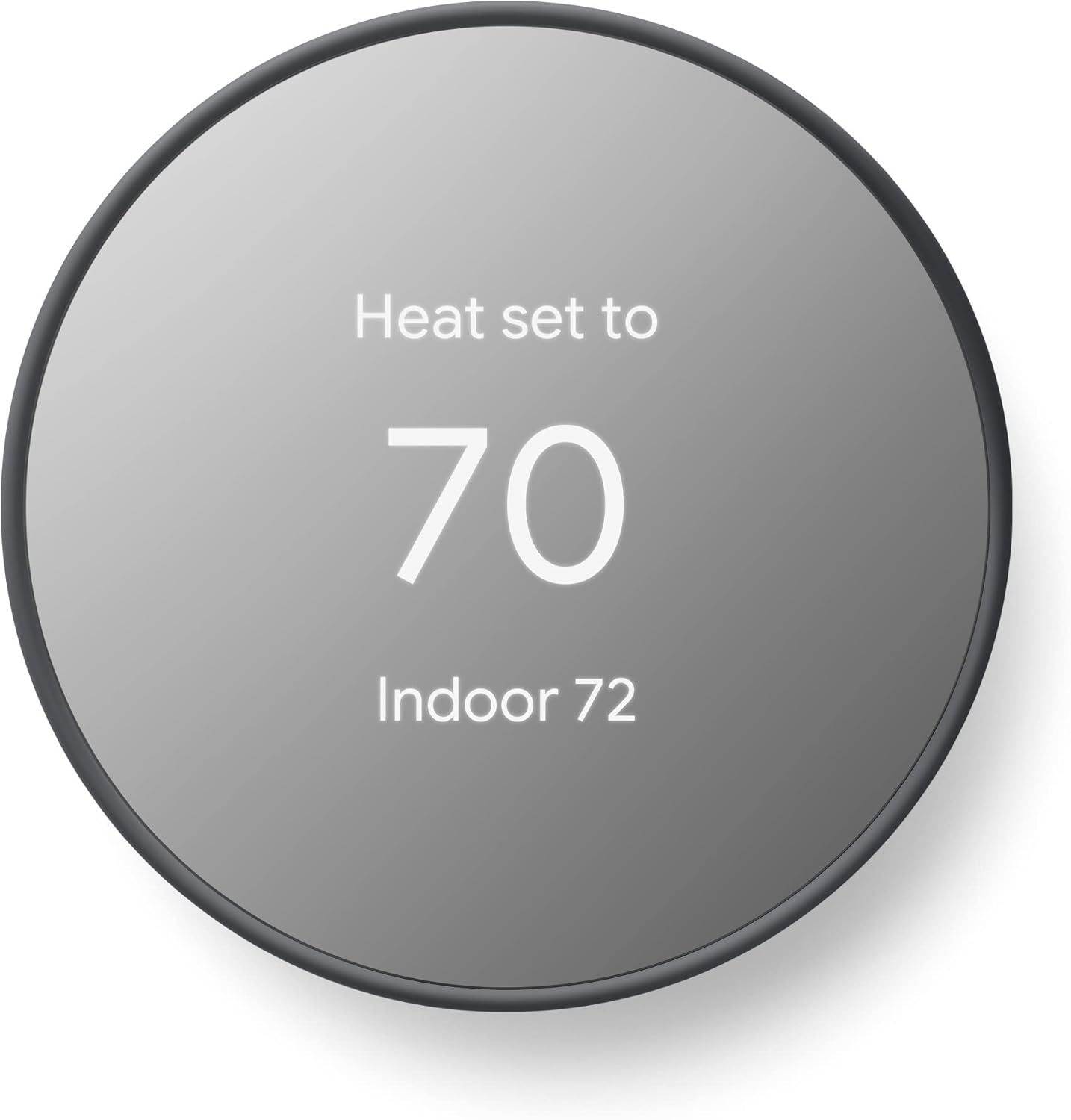
Google Nest Thermostat
| Connectivity Technology | Bluetooth, Wi-Fi |
|---|---|
| Control Type | Remote Control, Voice Control |
| Power Source | Battery Powered |
| Display Type | LCD |
| Number of Batteries | 2 A batteries (included) |
The Google Nest Thermostat is a compact smart thermostat designed for straightforward installation and everyday remote control via the Google Home app. It connects over Wi‑Fi and Bluetooth, supports voice control through compatible assistants, and can create or learn schedules to reduce energy use by automatically lowering temperature when you leave. The thermostat includes HVAC monitoring that sends alerts for potential system issues and a Savings Finder tool that suggests schedule tweaks to improve efficiency. It runs on two included A batteries and is intended to work without a C wire in most homes, though some systems may still require a common wire or power accessory. The touchscreen side bar and app controls make basic adjustments quick, and the unit integrates with other Nest devices for a unified smart home experience. Limitations to consider are dependence on Wi‑Fi for remote features and voice control, potential need for a C wire on less common HVAC setups, and modest on-unit display size which keeps advanced settings primarily in the app.
Best for: Buyers who prioritize verified performance and community feedback and want an easy-to-install smart thermostat that reliably integrates with Google Home for daily energy savings.
Less Ideal for: Users who lack stable Wi‑Fi, prefer full control from a large on-device interface, or need a thermostat guaranteed to work without adding a C wire in specialized HVAC setups.
- Remote control and scheduling via Google Home app for on-the-go temperature changes
- Energy-saving features like automatic Eco Temperatures and Savings Finder
- HVAC monitoring that can alert you to potential system issues
- Works without a C wire in most homes and includes required batteries and mounting hardware
- Supports voice control and integrates with other Nest/Google smart home devices
- Some HVAC systems may still require a C wire or power accessory to function
- Advanced settings and diagnostics are primarily accessed through the app rather than the small on-device display
- Remote and voice features require working Wi‑Fi and a compatible voice device
Verdict: A well-reviewed, easy-to-install smart thermostat for buyers who want Google Home integration and practical energy-saving features backed by community feedback.
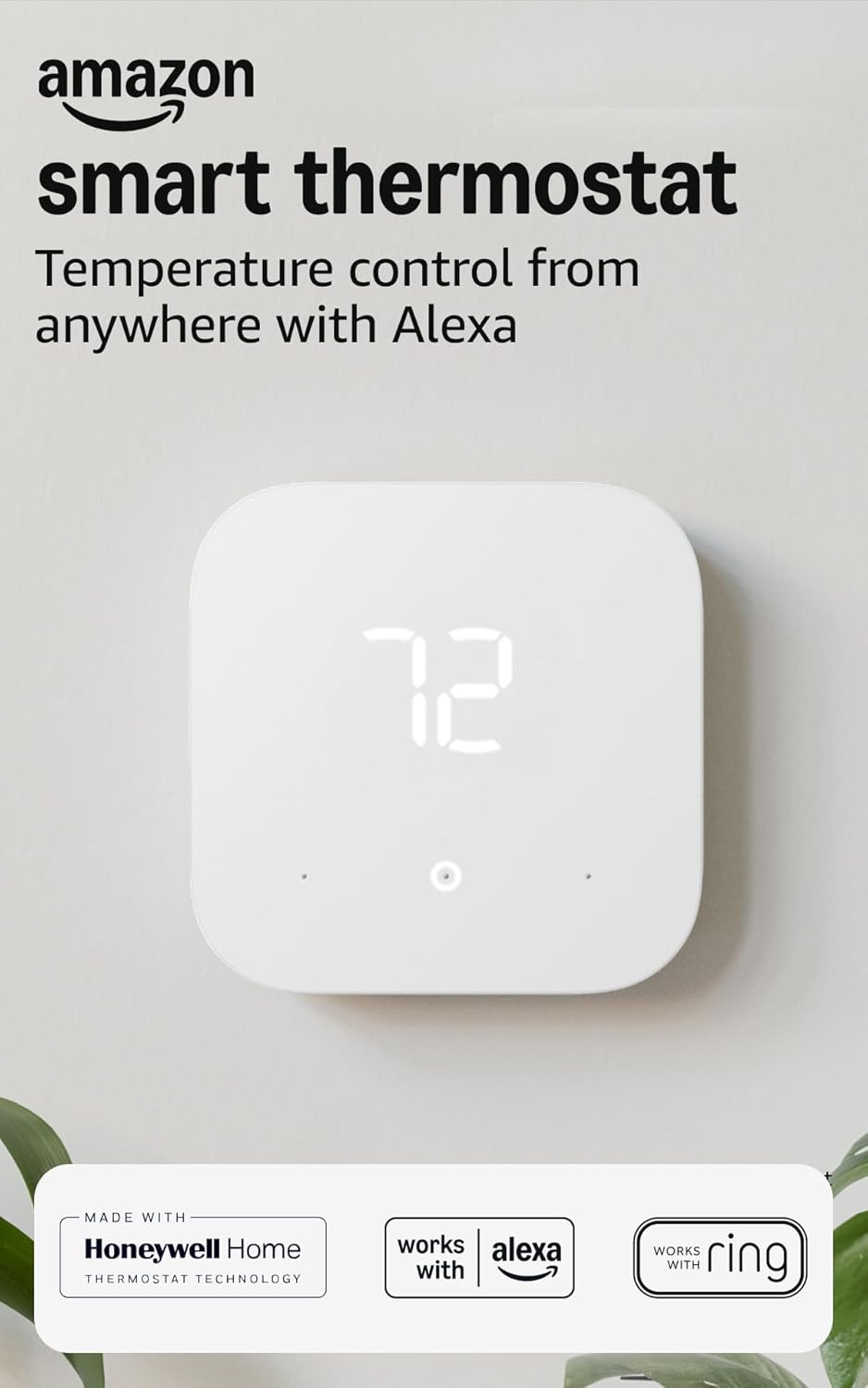
Amazon Smart Thermostat
| ASIN | B08J4C8871 |
|---|---|
| Brand | Amazon |
| Works with | Alexa and Ring |
| Requires | C-wire |
The Amazon Smart Thermostat is a simple entry point to smart heating and cooling control that leans on Alexa for setup and automation. It replaces a traditional thermostat and is typically installed by homeowners who want app and voice control, scheduling, and the ability to change temperature remotely. The unit supports creating home, away, and sleep schedules, and can use presence detection from compatible Alexa devices to adjust heating and cooling automatically. Setup is guided through the Alexa app and the hardware is built on Honeywell Home thermostat technology for reliable baseline performance. The product is positioned to save energy through smarter scheduling and by qualifying buyers for local thermostat rebates, and it exposes basic energy reporting and remote control in the Alexa app. Important limitations are that it requires a C‑wire for power and that deeper HVAC diagnostics or advanced multi-stage system controls are not highlighted, so buyers with complex systems should verify compatibility before purchase.
Best for: Homeowners who want a straightforward, voice-first smart thermostat that prioritizes easy setup, Alexa integration, and reliable basic automation without a steep learning curve.
Less Ideal for: Homes without an available C‑wire or owners who need advanced HVAC diagnostics, multi-stage control, or professional-grade commercial features.
- Works with Alexa for voice control, routines, and remote operation through the Alexa app
- Guided DIY installation via the Alexa app simplifies setup for typical homes
- Uses Honeywell Home thermostat technology for established, reliable control
- Supports scheduling and presence-based adjustments to reduce energy use
- Requires a C‑wire, which may need adapter or professional wiring in some homes
- Not clearly aimed at advanced HVAC setups or multi-stage systems
Verdict: Choose this thermostat if you want an easy, Alexa-centric smart thermostat that delivers reliable basic automation and remote control with guided DIY setup.
Choosing the Right Smart Thermostat: Key Factors to Consider
System Compatibility
A Smart Thermostat must be compatible with your specific HVAC wiring and control scheme. Single-stage systems, multi-stage heat pumps, conventional heat/cool split systems, and systems that rely on a common wire each impose different electrical and control requirements.
Confirm compatibility before buying because an incompatible unit can fail to control heating or cooling correctly or may require extra parts and professional installation. Systems with a dedicated common conductor are generally easier to support for advanced features like continuous Wi-Fi and remote diagnostics. If you have an older or unusual control setup, check wiring needs and whether an adapter or technician is required.
Sensor Accuracy And Placement
Thermostat temperature and humidity sensors determine how well the system maintains comfort. A highly accurate sensor reduces short cycling and helps the thermostat make better decisions about when to run heating or cooling.
Sensor placement matters because wall-mounted units read ambient air in a single location. If a thermostat sits in a drafty hallway or near a heat source, readings will be skewed. Some smart thermostats support remote sensors; these can improve whole-house comfort by averaging temperatures or prioritizing the room you use most.
Connectivity And App Reliability
Remote control and automation rely on stable connectivity and a well-designed app. A thermostat with flaky Wi-Fi or a confusing app can make scheduling and remote adjustments frustrating, negating the convenience of smart control.
Look for thermostats that offer clear status reporting in the app, local control fallback if the cloud is unavailable, and straightforward setup with common home Wi-Fi networks. Native integrations with voice assistants or smart home platforms can be useful, but they should not be required for basic remote operation.
Automation And Scheduling Flexibility
Automation features determine how much hands-off control you get. Some thermostats offer simple time-based schedules, while others learn your patterns or use geofencing and occupancy detection to adapt automatically.
Consider whether you prefer a learning thermostat that adapts with minimal setup or a manually configurable schedule that gives precise control. The best choice balances convenience with predictability: learning features are useful in stable routines, while detailed schedules suit households with regular but manually defined occupancy patterns.
Energy Reporting And Savings Verification
One of the main promises of smart thermostats is energy savings, but the ability to verify savings depends on reporting features. Good energy reports break down runtime, compare usage to previous periods, and show how temperature setbacks affect consumption.
Reports should be easy to find and understand in the app. Some devices offer cost estimates or integrate with utility programs, which can help you validate real savings over time. If proving reduced energy use is important, prioritize models with clear, exportable usage data.
Installation Complexity And Maintenance
Installation difficulty affects total cost and the time to benefit. Some smart thermostats are straightforward DIY installs with clear wiring diagrams, while others require a common wire or professional setup for complex systems.
Also consider ongoing maintenance needs such as battery changes, firmware updates, and periodic recalibration. Units that update automatically and provide clear firmware versioning reduce long-term hassles, whereas devices requiring manual updates or frequent troubleshooting will add upkeep time.
How Smart Thermostats Save Energy
Smart Thermostats reduce energy use by optimizing setpoints, minimizing runtime when the house is unoccupied, and matching temperature control to actual occupancy patterns. They can automate setbacks during sleep or away periods and restore comfort before you return, reducing wasted conditioning.
Effective savings depend on the thermostat making sensible decisions for your home. Features like adaptive recovery, which times when to start heating so the home reaches the desired temperature at a set time, cut unnecessary runtime compared with fixed schedules that run HVAC longer than needed.
- Setback scheduling reduces runtime during predictable absences
- Adaptive recovery avoids long preheating or precooling cycles
- Occupancy and geofencing minimize conditioning when no one is home
Remote Sensors And Multi-Zone Considerations
Many smart thermostats support auxiliary wireless sensors to get temperature readings from multiple rooms. Using remote sensors can reduce hotspots and cold areas by letting the system average readings or prioritize the room you care about most.
For homes with multiple heating zones, ensure your chosen thermostat supports the number of zones or can integrate with zone control panels. A single thermostat cannot manage independently controlled zones without the proper interface, so match the device capability to the home's control architecture.
- Remote sensors improve accuracy for high-use rooms
- Zone-capable systems require compatible control panels or multi-thermostat setups
- Averaging sensors helps maintain stable whole-house temperatures
Privacy And Data Considerations
Smart Thermostats collect data about temperature, occupancy patterns, and device usage. Review the privacy policy to understand what is stored, how long it is retained, and whether data is shared with third parties.
Local control options and clear user controls for data collection reduce privacy concerns. Look for devices that offer on-device data retention or allow you to opt out of nonessential telemetry while still keeping core remote control features.
- Check data retention policies in the device documentation
- Prefer devices that allow opt-out of noncritical telemetry
- Local control fallback reduces exposure during cloud outages
Power Options And Wiring Needs
Smart Thermostats may be powered by existing wiring or by batteries. Units that require a common wire can offer more reliable connectivity and fewer battery-related interruptions, but older homes may not have a common conductor available.
If your system lacks a common wire, verify that the thermostat supports battery operation or whether an adapter or professional wiring change is necessary. Consider the long-term convenience of continuous power for features like Wi-Fi and frequent data uploads.
- Common wire improves continuous connectivity
- Battery operation can simplify installation but may require periodic replacement
- Adapters can bridge compatibility but add installation steps
Integrations With Smart Home Systems
Integration options vary from simple voice control to deep automation within a smart home platform. Decide whether voice control, routines, or tight integration with other sensors and switches matters for your setup.
Avoid choosing a thermostat whose core functionality depends on fragile third-party integrations. Integrations should enhance convenience without becoming a requirement for basic scheduling and remote access.
- Voice assistants provide hands-free control for common tasks
- Native automations reduce the need for external hub devices
- Check for supported protocols like Wi-Fi and common smart home platforms
How We Chose the Best Smart Thermostat
We shortlisted products that meet core Smart Thermostat expectations for modern homes and then applied specific, measurable filters. Primary evaluation criteria included system compatibility with common HVAC setups, thermostat sensor accuracy and calibration stability, connectivity and remote control reliability, and user interface ease for both initial setup and daily adjustments. We also measured automation intelligence and scheduling flexibility, plus the availability of useful energy reports and data that help owners confirm real savings. We excluded units that lack basic multi-stage heating and cooling support or that depend on obscure third-party integrations for essential functions. Units with persistent connectivity failures, minimal temperature readouts, or no clear energy reporting were not considered. The focus stayed on devices that combine dependable control, clear feedback, and practical automation rather than gimmicky features. These criteria align with the scoring metrics used for each product to help readers compare like features across different models.
Our full evaluation process is outlined in our review methodology.
FAQ
Will a Smart Thermostat work with my existing heating and cooling system?
It often depends on the system type and wiring. Many modern smart thermostats support single-stage, multi-stage, and heat pump systems, but you should confirm wiring compatibility and whether a common wire or adapter is required.
Do Smart Thermostats actually save energy in every home?
Savings depend on behavior and setup. Homes that use scheduling, setbacks, or occupancy-based automation usually see measurable reductions, while homes that keep thermostat setpoints constant see smaller gains.
Can I install a Smart Thermostat myself?
Many units are designed for DIY installation with clear wiring guides, but complexity rises for multi-stage systems or when a common wire is absent. If you are unsure about wiring, getting professional help avoids control issues.
How reliable are remote controls and apps?
Reliability varies by device and network. Models with robust local fallback and consistent firmware updates tend to offer more dependable apps. Good Wi-Fi coverage in the area where the thermostat mounts also matters.
Are remote sensors worth it?
Remote sensors are useful if you have uneven temperature distribution or want the thermostat to prioritize a specific room. They help reduce hot and cold spots but add devices to manage.
Final Verdict
Pick a Smart Thermostat that matches your HVAC wiring and control needs first, then prioritize sensor accuracy and reliable connectivity. Decide whether you want learning automation or manual schedules, and choose units with clear energy reporting if proving savings matters. Balancing compatibility, ease of installation, and automation flexibility will lead to the best long-term result. Focus on the criteria most important for your household and the HVAC system to make a confident selection.