
Note: This article contains affiliate links. If you click on these links and make a purchase, we may earn a small commission at no extra cost to you. This helps support our research and content. Read our full affiliate disclosure here.
When summer travel heats up, a well-chosen portable air conditioner for RVs makes long drives and overnight stays far more comfortable. You want something that cools quickly, runs quietly, and fits the limited space and electrical constraints of an RV. This guide highlights seven shortlisted options that perform well in mobile cabins and emphasizes practical tradeoffs like cooling capacity, power use, and ease of installation. Below we summarize each top pick and how it performs on the features that matter most for RV use, then walk through the buying factors to help you choose the best unit for your rig.
Top Picks at a Glance
| Best Overall The best all-around choice for most situations | COSTWAY RV Window Air Conditioner |  |
| Best Quality Built to a higher standard if you want something more solid | Ivation Caravan 6500 BTU AC |  |
| Best Value The sweet spot between price and what you get | SereneLife 8,000 BTU Portable AC |  |
| Best Budget The cheapest option that still gets the job done reliably | PeakPursuit 8,000 BTU Portable AC |  |
| Top Rated A top-rated pick with lots of positive feedback | KoolSiln Portable Air Conditioner HAC-902WF |  |
| Most Popular A crowd favorite that many people choose with confidence | BLACK+DECKER Portable Air Conditioner BPACT08WT |  |
| Best Seller A high-volume bestseller chosen again and again | ZAFRO Portable Air Conditioner A9047L-8K |  |
COSTWAY RV Window Air Conditioner

| Cooling Power | 6500 BTU |
|---|---|
| Air Flow | 118 CFM |
| Wattage | 650 |
| Voltage | 115 volts |
| Noise | 50 db |
This COSTWAY RV window air conditioner delivers 6,500 BTU cooling and about 118 CFM airflow to cool spaces up to roughly 120 sq ft, making it suited to caravans, truck sleepers, and small kiosks. It installs in windows 1–5.7 inches thick and ships with a full accessory kit for stable mounting and drainage. Daily use centers on the LED control panel, app-based WiFi control, or voice commands through Alexa and Google Home, and you can pick cooling, fan, dehumidify, or sleep modes plus a 24-hour timer and two fan speeds. The unit runs at about 50 dB, which is relatively quiet for overnight comfort, and includes a washable filter and removable drain plug for maintenance. Trade-offs to expect are modest cooling capacity versus full-size room ACs and a reported power draw consistent with its 650 W rating, so it needs appropriate RV electrical capacity. In short, it balances smart controls, compact installation, and practical features for occupied RVs that need reliable localized cooling.
Best for: Buyers who want a balanced, feature-rich RV air conditioner that combines smart controls, quiet operation, and straightforward window installation for everyday road use.
Less Ideal for: People needing to cool very large RVs or whole-camper floorplans should look at higher-capacity or rooftop systems instead.
- 6,500 BTU cooling with 118 CFM airflow suitable for spaces up to about 120 sq ft
- WiFi app control plus voice compatibility with Alexa and Google Home for remote operation
- Multiple modes (cooling, fan, dehumidify, sleep) and 24-hour timer for flexible comfort
- Relatively quiet operation around 50 dB and washable filter for easier upkeep
- Cooling power is limited compared with full-size residential units and best suited to small RV interiors
- Requires a 115V supply and has a 650 W draw that may stress small or weak RV electrical systems
Verdict: A compact, smart-controlled 6,500 BTU window AC that offers balanced cooling and quiet operation for typical RV and small camper needs.
Ivation Caravan 6500 BTU AC

| Cooling Power | 6500 british thermal units |
|---|---|
| Wattage | 650 watts |
| Installation Type | Window |
| SEER | 14.5 |
| Application | RV, Camper, Motorhome |
This Ivation Caravan unit is a split-style, over-the-sill portable air conditioner built for RVs, campers, and other confined mobile spaces. It pairs a compact indoor unit with an external compressor connected by a hose so the noisy compressor sits outside, which helps reduce in-cabin sound and vibration during operation. Controls are simple push-button with a backlit digital display, a built-in thermostat with a 60°F to 86°F range, multi-speed fan, swing/oscillate, timer and sleep mode for quieter night operation. The unit also offers a dehumidify mode and a removable washable filter for basic maintenance. At 6,500 BTU and a 14.5 SEER rating it provides solid cooling for small to medium RV interiors while consuming about 650 watts. Important limits are its window-installation style that requires a suitably sized sill and the absence of inverter technology, so it does not offer the same variable-speed efficiency or very low sound levels of inverter-driven models. For buyers wanting straightforward, powerful cooling with easy setup and quieter cabin performance thanks to the outside compressor, this is a practical choice.
Best for: Buyers who prioritize strong, reliable cooling performance in an RV and want a unit that reduces cabin noise by locating the compressor outside while keeping controls simple.
Less Ideal for: Those seeking the highest energy efficiency, the lowest possible operating noise, or a universal fit for unconventional window profiles should consider other options.
- Split over-the-sill design keeps the compressor outside to reduce interior noise and vibration
- Multiple modes including cooling, dehumidifying, fan, timer and sleep for flexible control
- Backlit digital display with built-in thermostat and temperature control from 60°F to 86°F
- Removable washable filter and included mounting hardware for simple installation and upkeep
- No inverter compressor, so efficiency and variable-speed operation are limited compared with inverter models
- Requires a compatible windowsill opening and stable mounting which may not fit all RV window types
Verdict: A practical split-style portable AC that delivers strong 6,500 BTU cooling for RVs while keeping interior noise down by placing the compressor outside.
SereneLife 8,000 BTU Portable AC

| Cooling Power | 8000 BTU (ASHRAE) |
|---|---|
| Operating Mode | Cool / Fan / Dry |
| Wattage | 1050 watts |
| Control | App Control, Remote Control, Touch Control |
| Noise | 52 db |
The SereneLife 8,000 BTU portable air conditioner combines cooling, dehumidifying, and fan modes in a single freestanding unit intended for easy room-to-room use. It cools with 8,000 BTU (ASHRAE) capacity, includes a window installation kit and exhaust hose, and offers app control plus a physical remote for adjusting fan speeds, timer, and operating mode. Practical touches include rolling wheels for mobility, a removable washable filter for maintenance, and a built-in dehumidifier to cut humidity in muggy conditions. Noise is moderate at about 49–52 dB, so it is noticeable but not overly intrusive in small living spaces. Power is supplied by a corded 115V connection and the unit uses roughly 1050 watts when running, so it needs a standard RV shore power hookup or inverter capable of that draw. The unit is not an inverter model and is designed for indoor residential use, so performance in very large or poorly insulated spaces will be limited and continuous drain management may be necessary when heavy dehumidification is used. For someone who needs a moveable, easy-to-install cooling solution with smart controls, this model is a practical choice.
Best for: Buyers who want a single, movable unit to cool and control humidity in compact living spaces and prioritize easy installation, smart control, and portability.
Less Ideal for: Those needing an ultra-quiet, inverter-style AC or a solution for very large or poorly insulated spaces should consider higher-capacity or inverter units instead.
- Three-in-one functionality: cooling, fan, and dehumidifier modes in one unit
- Wi‑Fi and remote/app control make temperature and schedule adjustments convenient
- Includes window vent kit and rolling wheels for straightforward setup and mobility
- Removable washable filter simplifies routine maintenance
- Requires 115V corded power and draws about 1050W which may strain small RV electrical systems
- Not an inverter model, so efficiency and variable-speed performance are limited
Verdict: A practical, easy-to-install portable AC with smart controls and dehumidification that suits compact RV or small-room cooling needs when shore power is available.
PeakPursuit 8,000 BTU Portable AC

| Cooling Power | 8000 british thermal units |
|---|---|
| Noise | 50 db |
| Voltage | 115 |
| Wattage | 860 |
| Capacity | 45 pints |
This PeakPursuit 8,000 BTU portable air conditioner is a compact 4-in-1 unit aimed at cooling small spaces while also dehumidifying and circulating air. It is typically used in bedrooms, apartments and similar enclosed spaces where quick, localized cooling is needed; for RV use it can cool a modest cabin if the vehicle is reasonably insulated. Key features include remote control operation, a sleep mode that reduces noise and power draw overnight, a built-in dehumidifier, and a window installation kit for venting. Practical benefits are its portability and rolling casters for moving between rooms or positioning inside an RV, plus the quieter 50 dB operation that helps preserve sleep. Limitations include the modest 8,000 BTU capacity and the listed 150 sq ft coverage, so it may struggle on very hot days or in large RVs, and power draw requires a stable 115 V supply that many RV electrical setups must accommodate. The unit also lists annual energy consumption and weight that buyers should check against their vehicle power and space constraints before installing.
Best for: RVers on a tight budget who need a portable, easy-to-install unit to cool a small, well-insulated camper or a single cabin space and who prioritize quiet overnight operation.
Less Ideal for: Owners of large motorhomes, poorly insulated rigs, or those who need whole-vehicle cooling on extremely hot days should consider higher-capacity or purpose-built RV air conditioners instead.
- Compact 4-in-1 design combines cooling, fan, dehumidifier and sleep modes
- Quiet operation around 50 dB suitable for overnight use
- Includes remote control and a window installation kit for quick setup
- Rolling casters make it easy to move and position inside an RV
- 8,000 BTU rating limits effective cooling to small cabins or very well insulated RVs
- Requires standard 115 V power and has notable annual energy consumption
Verdict: A budget-friendly, portable cooling option for RVs with small, well-insulated cabins that need quiet overnight comfort.
KoolSiln Portable Air Conditioner HAC-902WF
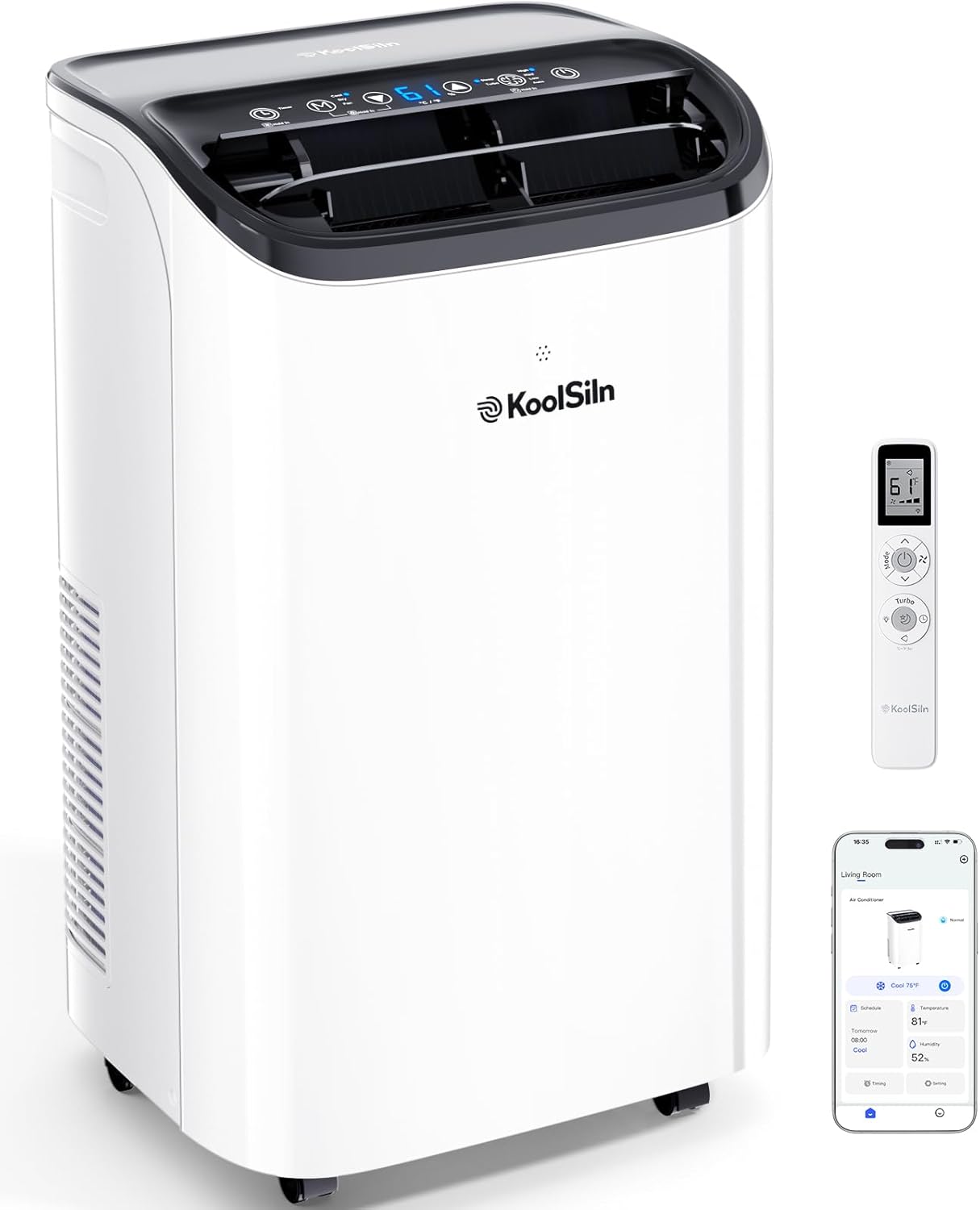
| Cooling Power | 14000 british thermal units |
|---|---|
| Additional Features | Dehumidifier, Fast Cooling, WiFi Enabled |
| Voltage | 115 volts |
| Wattage | 1200 watts |
| Capacity | 76 pints |
This KoolSiln HAC-902WF is a high-capacity portable air conditioner that delivers 14,000 BTU cooling and includes WiFi, remote control, and dehumidifier modes. It is typically used to cool large rooms, garages, or RV interiors where a strong, movable cooling source is needed; setup is tool-free with an included window kit and exhaust hose. Notable features are smart controls for app and voice operation, a sleep mode that mutes fans and dims the display for quieter nights, and an auto-evaporation system that reduces the need to manually drain condensate. Practical benefits include fast cooling for larger spaces and the flexibility to run as a dehumidifier or fan when full cooling is not required. Important limitations are its weight and physical footprint which make it less convenient for very small RV spaces, and the 115V power and 1,200W draw which require adequate electrical capacity or shore power; noise is modest but not silent. For buyers prioritizing dependable, strong portable cooling with smart controls, this unit is a capable option.
Best for: Owners who need a robust, reliable portable cooling solution for larger RVs or when running on shore power and prioritize consistent performance and smart controls.
Less Ideal for: People with very small RVs, limited storage, or only battery/low-wattage power sources should choose a smaller, lower-power unit instead.
- High 14,000 BTU cooling capacity suitable for large interior spaces
- WiFi and remote control with app and voice support for convenient operation
- Auto-evaporation system reduces manual draining during extended use
- Includes installation kit for tool-free window setup
- Relatively heavy and bulky for tight RV interiors
- Consumes 1,200 watts and requires appropriate electrical supply
Verdict: Choose this unit if you need dependable, high-capacity portable cooling with smart controls for larger RVs that can accommodate its power and size.
BLACK+DECKER Portable Air Conditioner BPACT08WT

| Cooling Power | 9000 BTU |
|---|---|
| SACC Cooling | 5,300 BTU SACC |
| Wattage | 935 watts |
| Refrigerant | R-32 |
| Control Method | Remote |
The BLACK+DECKER BPACT08WT is a compact 3-in-1 portable air conditioner that cools, dehumidifies, and circulates air for small rooms. It is typically set up using the included window kit and vent hose and moved on casters between spaces; the unit offers a full-function remote with a Follow Me thermostat for localized temperature control. Key practical features include self-evaporating operation to reduce draining, a reusable washable filter, and three fan speeds for basic airflow control. With a rated 9,000 BTU (5,300 BTU SACC) cooling capacity and roughly 935 watts power draw, it can cool spaces up to about 300 to 400 sq ft in home settings. For RV use the plug-in power and compact footprint make it a workable option in larger coach slide-outs or parked rigs with adequate ventilation and a suitable window or wall vent opening. Limitations to consider are the single power level control scheme and modest energy efficiency compared with inverter-based units, plus the need to route and seal the exhaust hose when used in a mobile space, which can be more involved than dedicated RV AC installations.
Best for: Buyers who want a trusted, full-featured portable AC they can set up in a parked RV or large towable where running a cord and vent hose to a window or wall opening is practical and who value straightforward installation and proven brand presence.
Less Ideal for: People who need a hard-mounted, shore-power-efficient RV rooftop or built-in air conditioner, or those who frequently run a unit while driving or boondocking without reliable external venting options.
- 3-in-1 functionality: cools, dehumidifies, and acts as a fan in one compact unit
- Included window kit and exhaust hose make venting and installation straightforward for standard openings
- Follow Me remote lets the remote act as a localized thermostat for more precise comfort
- Self-evaporating operation reduces the need to empty water during normal cooling
- Washable reusable filter is easy to remove and clean
- Not inverter driven so it uses more steady power compared with inverter RV-specific units
- Requires a vent path and a sealed opening which can be awkward to implement cleanly in many RV layouts
Verdict: A compact, brand-name portable AC that gives reliable cooling and dehumidification for parked RVs that can accommodate a vented hose and standard window or wall opening.
ZAFRO Portable Air Conditioner A9047L-8K
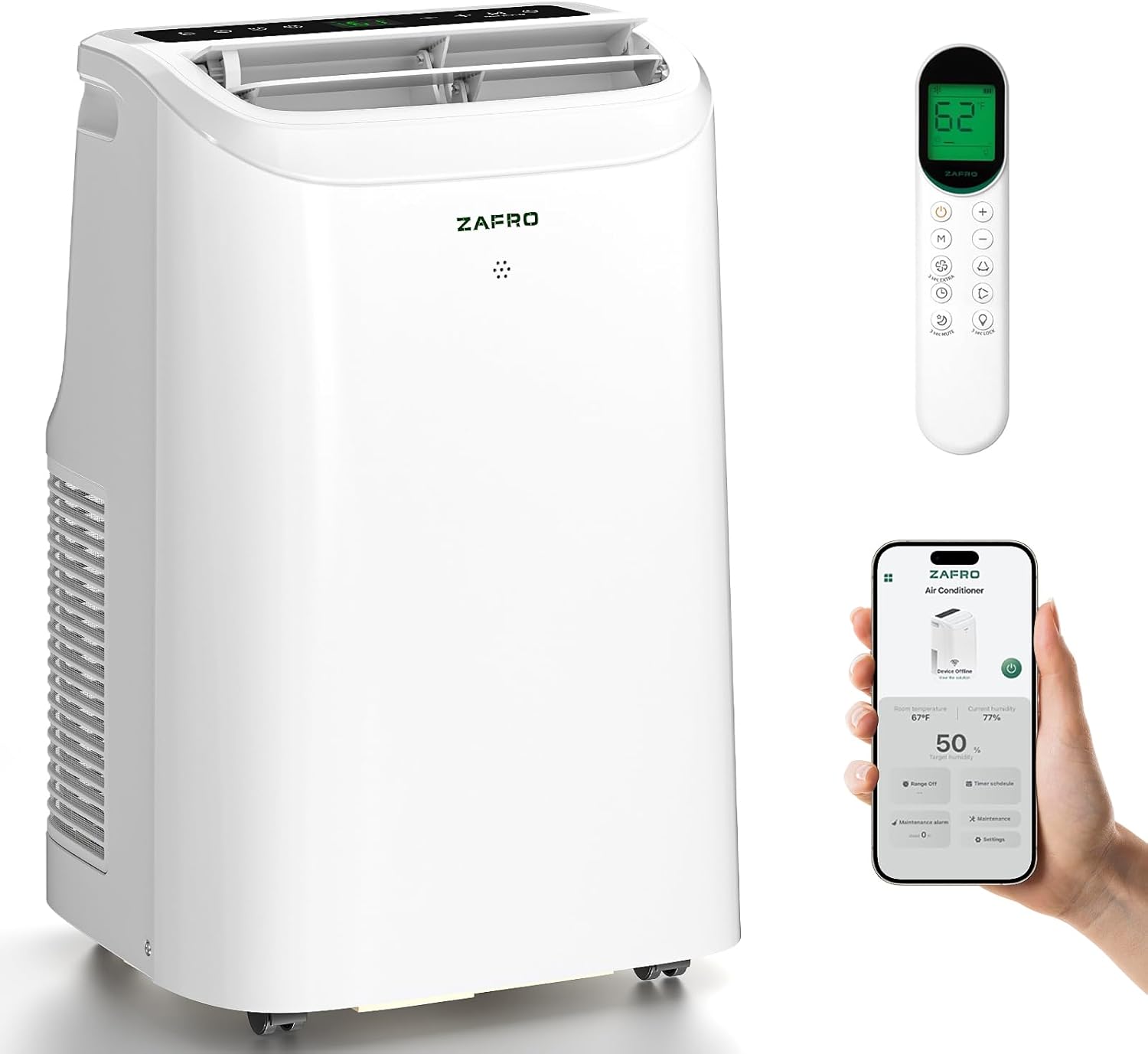
| Cooling Power | 12000 BTU (8000 BTU SACC) |
|---|---|
| Noise | 47 db |
| Wattage | 1070 watts |
| Control | App, Remote, Touch |
| Capacity | 500 cubic feet |
This ZAFRO portable air conditioner packs 12,000 BTU (8,000 SACC) cooling into a compact, rollable cabinet that works as a cooler, dehumidifier, and fan. It is typically used to cool single rooms like an RV living area or bedroom, with four fan speeds, an automatic mode, and a 24-hour timer for scheduled operation. Notable features include app, Alexa/Google Home and remote control, a self-evaporating condensate system that claims up to 72 hours drainage-free operation, and a sleep mode that reduces noise to about 47 dB. The included universal window kit and exhaust hose make short work of a through-window or vent installation without tools. Practical benefits for an RV include relatively compact footprint, casters and handles for repositioning, and the ability to dehumidify damp interiors while running. Important limitations are its 8,000 SACC effective cooling rating, which may struggle in very hot, poorly insulated RVs, and its power draw around 1070 watts that requires attention to campsite power limits or inverter capacity.
Best for: Buyers who prioritize a compact, easy-to-install portable AC with smart controls and low-maintenance drainage for occasional RV use or short stays where reliable, simple cooling and dehumidifying matter more than maximum capacity.
Less Ideal for: People who need strong cooling for large or poorly insulated RVs, continuous full-time cooling, or those limited to very small inverter capacity at campsites.
- Smart controls with app, Alexa and Google Home support plus a long-range remote for convenient adjustments
- Self-evaporating condensate system reduces the need to empty a water tank for up to 72 hours
- Compact, wheeled design with handles and an included universal window kit for quick, tool-free installation
- Multiple modes (cool, dehumidify, fan) and a 24-hour timer for scheduled operation
- 8,000 BTU SACC cooling is modest and may be marginal in hot or poorly insulated RVs
- Around 1070 watts power draw can be high for limited RV/inverter electrical systems
Verdict: A compact, smart-controlled portable AC with self-evaporation that fits occasional RV cooling needs where ease of installation and low maintenance are top priorities.
Choosing the Right Portable Air Conditioner for RVs: Key Factors to Consider
Cooling Capacity Relative to RV Size
Cooling capacity determines how quickly a unit can reduce cabin temperature. For RVs, use the unit's BTU rating in the context of your vehicle's square footage and ceiling height. A unit sized too small will run constantly and struggle on very hot days, while an oversized unit may short-cycle, reducing efficiency.
Consider how many occupants and heat sources you typically have, such as sunlight through windows or running appliances. Account for insulation quality, which varies widely between rigs and affects required capacity. In practice, choose a unit that offers enough headroom for peak afternoons but can be throttled back or used intermittently to avoid overuse.
Electrical Compatibility and Power Draw
RVs often operate on limited electrical systems: 12V battery power, shore power, or an inverter with defined continuous output. Confirm the portable air conditioner's starting and running wattage against your rig's available capacity. High starting current can trip inverters or shore power breakers.
Look for models with lower power draw or ECO modes that reduce compressor cycles. Also plan for simultaneous loads like microwaves or battery chargers. If you rely on an onboard generator or inverter, match the AC's power profile to sustainable output rather than short-term peaks.
Ventilation and Condensate Management
Portable units require a way to vent warm air and handle condensate. In an RV, venting may use a window kit, roof vent adapter, or flexible ducting. Check that the unit offers compatible venting options that work with your existing openings or that can be installed without permanent modifications.
Condensate handling options vary: some units self-evaporate water using the exhaust stream, others need periodic emptying, and a few provide continuous drain ports. For RV use, low-maintenance or self-evaporating designs reduce the need for attention and prevent unwanted water in the cabin.
Physical Size, Weight, and Portability
Space in an RV is at a premium, so the unit's dimensions and weight affect install location and storage when not in use. Measure potential placement areas including floor footprint and clearance for vents or exhaust hoses. Consider whether the unit can be easily moved between the RV and storage or carried by one person.
Also assess build features like recessed handles, caster wheels, and protective bumpers that make moving on uneven campground surfaces easier. Lightweight units are easier to stow but may sacrifice some durability or cooling capacity.
Noise and Comfort
Noise level matters in a small RV where the AC is near sleeping and living areas. Check manufacturer noise ratings and available fan speed steps. Quiet operation at night modes or sleep settings improves rest and reduces fatigue on long trips.
Keep in mind that lower fan speeds may reduce perceived airflow even if the compressor is still running. If you camp in quiet locations, prioritize models with proven low-dB operation at typical settings.
Installation Flexibility and User-Friendliness
Different RVs have different vent openings and interior layouts. Units that provide multiple installation accessories, adjustable vent hoses, or adaptors are easier to fit without cutting or modifying the rig. User-friendly controls, clear drain access, and simple filter removal matter for routine maintenance on the road.
Also consider whether the unit can operate in different modes such as fan-only, dehumidify, or thermostat-controlled cycles. Versatile controls let you tailor operation to conditions and reduce unnecessary compressor use, which benefits both comfort and energy consumption.
Placement Options Inside an RV
Choosing where to put a portable air conditioner in an RV affects effectiveness and comfort. Common spots include near the center of the living area for even distribution, adjacent to a window or door for shortest vent hose runs, or in a bedroom area when sleeping comfort is the priority.
Aim for a location with stable floor space and easy access to a venting opening. Avoid blocking walkways or appliance vents. Shorter, straighter exhaust runs preserve cooling performance and reduce noise from air turbulence.
- Center placement for balanced airflow
- Near a window or vent to minimize hose length
- Avoid confined cabinetry or blocking entryways
Managing Condensate on the Road
Condensate management becomes more important on humid nights and during long run cycles. Self-evaporating designs use heat from the exhaust to vaporize collected water, reducing the need for manual emptying. Models with continuous drain ports let you route water outside when parked for long periods.
If you frequently boondock or move between sites, plan how you will access and empty water reservoirs safely. Securely route any drainage away from the rig and campsite to avoid puddles or damage to campsite surfaces.
- Self-evaporating units minimize maintenance
- Continuous drain options are best for long stays
- Secure routing prevents water accumulation near the rig
Using an AC With Limited Shore Power or Inverters
When shore power is limited or you depend on an inverter, run-time planning helps avoid drawing down batteries. Use ECO or low-power modes when available, and prefer units with staged cooling to keep compressor cycles efficient. Pre-cooling the RV when shore power is available reduces peak loads during critical periods.
If you rely on an onboard generator, check the generator's continuous wattage rating versus the air conditioner's starting watt requirement. Where possible, supplement with fans or ventilation to reduce compressor workload and conserve fuel or battery capacity.
- Pre-cool while connected to shore power
- Use fan-only mode to circulate cool air
- Match unit starting watts to inverter/generator capacity
Maintenance Tasks to Keep Units Running
Routine maintenance keeps a portable RV AC efficient and extends service life. Regularly clean or replace filters to maintain airflow and reduce strain on the compressor. Inspect vents and hose connections for leaks and ensure exhaust paths are unobstructed.
Periodically check for water buildup in drain trays and clean access panels to prevent mildew. If the unit has a washable filter, allow it to dry completely before reinstalling to avoid mold growth.
- Clean or replace filters monthly in heavy use
- Inspect hoses and vents for kinks or blockages
- Empty and sanitize condensate trays as needed
How We Chose the Best Portable Air Conditioner for RVs
We prioritized features that directly affect real-world RV use. Cooling capacity and placement flexibility were primary filters because RV interiors have limited cubic footage and unusual airflow. We also evaluated power draw and electrical compatibility since many RV electrical systems are limited to shore power or inverter capacity. Portability, size, and installation options were used to ensure units fit small compartments and existing venting or window openings. Noise level and ventilation requirements were measured because quiet operation and reliable condensate management are especially important in confined mobile spaces. We excluded units that require extensive permanent modification, commercial or industrial models not designed for residential mobile use, and products without clear RV-style installation options. We favored units with adjustable fan speeds, multiple operating modes, and straightforward condensate handling, because those features materially affect comfort and convenience in daily RV life. Durability and serviceability were considered when available in product specifications and user documentation.
Our full evaluation process is outlined in our review methodology.
FAQ
Can a portable air conditioner cool an entire RV?
It depends on the unit's cooling capacity relative to the RV's interior volume and insulation. Smaller rigs can often be cooled by a single appropriately rated unit, while larger or poorly insulated RVs may need supplemental fans or staged cooling strategies.
Will a portable AC work on my RV's inverter?
Some portable units can operate on an inverter if the inverter's continuous and surge ratings meet the air conditioner's starting and running wattage. Verify the inverter specifications and consider starting-current demands to avoid tripping breakers or overloading the system.
How do portable units handle condensate in an RV?
Condensate approaches vary. Many units self-evaporate moisture using the exhaust airflow, some have internal tanks that need periodic emptying, and others include drain ports for continuous drainage. Choose the management style that fits your travel habits and ease-of-access in the rig.
Are portable air conditioners noisy inside an RV?
Noise varies by model and fan setting. In a compact RV interior, even modest noise can be noticeable, so look for models with lower decibel ratings and dedicated night or sleep modes that reduce fan speed and compressor cycles.
Do portable ACs need permanent installation in an RV?
Most portable units are designed for temporary placement and vented through a window or vent adaptor, avoiding permanent modifications. However, some owners choose semi-permanent setups for improved sealing and efficiency. Avoid modifications that could damage the rig without planning for reversibility.
Final Verdict
Selecting the right portable air conditioner for an RV comes down to matching cooling capacity to interior volume, ensuring electrical compatibility, and choosing a condensate and venting approach that fits your rig. Prioritize models that meet your power constraints, have manageable noise levels, and offer installation options that do not require irreversible modifications. Balance cooling power against power draw and physical fit, and plan for routine maintenance and secure placement. With those tradeoffs in mind, you can confidently pick a portable AC that keeps your RV comfortable on hot travel days.