
Note: This article contains affiliate links. If you click on these links and make a purchase, we may earn a small commission at no extra cost to you. This helps support our research and content. Read our full affiliate disclosure here.
If you need reliable cooling in a compact space, choosing the right portable air conditioner for small rooms matters. The wrong unit can run continuously without keeping the room comfortable, or it can be too loud for bedrooms and home offices. This guide shortlists the top portable air conditioners for small rooms and explains the key differences that affect daily use, like cooling capacity, noise output, and ease of installation. Below you will find our top picks and a close look at the criteria we used to evaluate them, so you can match a unit to your space and lifestyle.
Top Picks at a Glance
| Best Overall The best all-around choice for most situations | Frigidaire Portable Air Conditioner FHPC082AC1 |  |
| Best Quality Built to a higher standard if you want something more solid | BLACK+DECKER Portable Air Conditioner 9,000 BTU |  |
| Best Value The sweet spot between price and what you get | Electactic 8000 BTU Portable Air Conditioner | 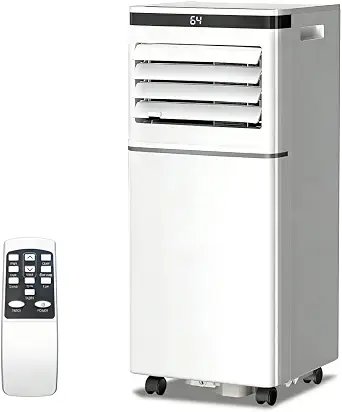 |
| Best Budget The cheapest option that still gets the job done reliably | PeakPursuit 8,000 BTU Portable Air Conditioner |  |
| Top Rated A top-rated pick with lots of positive feedback | EUHOMY Portable Air Conditioner 8,000 BTU |  |
| Most Popular A crowd favorite that many people choose with confidence | SereneLife Portable Air Conditioner SLPAC8 |  |
| Best Seller A high-volume bestseller chosen again and again | DREO Portable Air Conditioner 318S |  |
Frigidaire Portable Air Conditioner FHPC082AC1

| Cooling Power | 5,500 BTU (DOE) |
|---|---|
| Noise | 50 db |
| Refrigerant | R-32 |
| Power Source | Corded Electric |
| Wattage | 970 |
The Frigidaire FHPC082AC1 is a compact portable air conditioner intended to cool single rooms and small open spaces. It provides ASHRAE 8,000 BTU (DOE 5,500 BTU) cooling and is typically moved around on caster wheels to target bedrooms, home offices, or living rooms up to about 350 square feet. Controls include a remote and simple two-speed fan with modes for cooling and dehumidifying, plus a 24-hour timer, sleep mode, and auto-restart after power returns. Practical benefits include an easy-to-clean washable filter and a clean filter alert that helps maintain airflow and efficiency. The unit runs at roughly 50 dBA, so it is reasonably quiet for overnight use, though it is not whisper-quiet. Energy numbers reflect modest efficiency, and the compressor uses R-32 refrigerant with a rotary scroll design. Limitations are its basic two power levels and modest DOE cooling capacity, which means it can struggle in very hot or poorly insulated rooms and will draw near 970 watts during operation.
Best for: Buyers who want a straightforward, easy-to-move portable AC for a small bedroom or home office and prioritize simple controls and basic dehumidifying capability.
Less Ideal for: People who need strong cooling for large or very hot rooms, precise multi-speed airflow, or the most energy-efficient long-term operation should consider larger or higher-efficiency alternatives.
- Compact, mobile design with caster wheels for easy room-to-room placement
- Remote control and 24-hour timer for convenient operation
- Dry mode that reduces humidity as well as cooling
- Washable filter with a clean-filter alert for straightforward maintenance
- Relatively quiet operation around 50 dBA suitable for bedrooms
- Only two fan/power levels limits fine-grained temperature control
- Modest DOE cooling capacity may be insufficient for very hot or poorly insulated rooms
- Seasonal efficiency rating is average, so operating costs can be higher than more efficient units
Verdict: A practical, mobile choice for cooling and dehumidifying single small rooms when you want simple controls and easy maintenance.
BLACK+DECKER Portable Air Conditioner 9,000 BTU

| Cooling Power | 9000 BTU |
|---|---|
| SACC | 5,300 BTU |
| Power Source | Corded Electric |
| Wattage | 935 watts |
| Refrigerant | R-32 |
The BLACK+DECKER 9,000 BTU portable air conditioner is a compact, mobile unit designed to cool single rooms while also serving as a dehumidifier and fan. It installs with the included window kit and vents through sliding or double-hung windows, and mobility is aided by casters and side handles so you can move it between bedroom, office, or basement. Key features include a full-function remote with a Follow Me thermostat function, washable filter, self-evaporating operation to reduce the need to drain water in normal use, and three fan speeds plus a 24-hour timer and sleep mode for overnight comfort. In practice it offers strong spot cooling for rooms in the specified range and is relatively quiet for a portable unit, though the manufacturer SACC rating (5,300 BTU) is lower than the maximum rating and limits absolute cooling in very hot conditions. Energy efficiency and an R32 refrigerant are positives, but expect typical portable AC limits such as single-hose venting and modest dehumidification capacity compared with dedicated dehumidifiers.
Best for: Buyers who prioritize strong, portable room cooling and want a compact unit they can move between small rooms and use year-round for cooling plus occasional dehumidifying.
Less Ideal for: Homes needing sustained cooling for large open areas or very hot climates should consider higher-capacity or permanently installed systems instead.
- 3-in-1 functionality: cooling, dehumidifying, and fan modes for flexible use
- Included window kit and casters make installation and room-to-room mobility straightforward
- Full-function remote with Follow Me provides localized thermostat control
- Washable filter and self-evaporating design reduce maintenance and emptying
- Rated SACC cooling (5,300 BTU) is lower than the 9,000 BTU nominal rating, limiting performance in very hot or large spaces
- Single-hose portable design can be less efficient than through-the-wall or split systems
Verdict: Choose this unit if you need a portable, easy-to-install air conditioner that delivers effective spot cooling and useful dehumidifier and fan functions for small rooms.
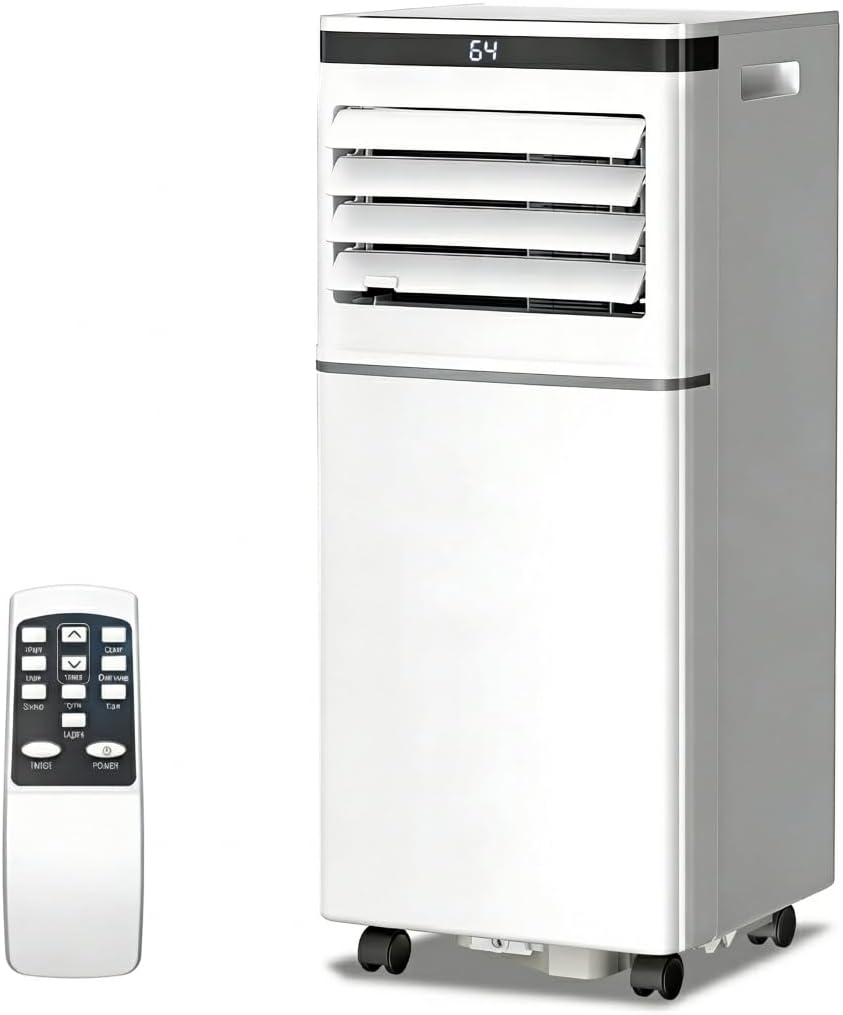
Electactic 8000 BTU Portable Air Conditioner
| Cooling Power | 8000 british thermal units |
|---|---|
| Operating Mode | Cooling, Dehumidifying, Air Circulation |
| Power Source | Corded Electric |
| Voltage | 115 |
This Electactic 8000 BTU portable air conditioner is designed to cool small rooms quickly while staying easy to move and operate. It provides four modes—cooling, dehumidifying, fan, and sleep—controlled via push buttons on the LED panel or the included remote, and a 24-hour timer for scheduled operation. The unit uses a self-evaporating system to reduce manual drainage and includes an exhaust hose plus a window kit for straightforward installation. Built-in casters and side handles make it simple to relocate between a bedroom, home office, or apartment living area. Noise is listed around 50 dB, and there is a sleep mode tuned for quieter nighttime use, though it is not as quiet as high-end split systems. Energy consumption is indicated (900 kWh/year), so running it continuously can add to electricity use. Practical buyers will appreciate the fast cooling for rooms up to roughly 350 sq ft and the convenience features, while those needing very large-room cooling or ultra-low operating noise should consider other formats.
Best for: Buyers who want a practical, easy-to-install portable AC that cools small rooms quickly and prioritizes straightforward controls, mobility, and low-maintenance operation.
Less Ideal for: People needing ultra-quiet performance for strict noise-sensitive sleeping environments or those who require cooling for large open-plan spaces.
- 8000 BTU cooling suitable for small rooms and rapid temperature drops
- Four operating modes including dehumidifier and sleep for versatile year-round use
- Self-evaporating design reduces the need for frequent manual drainage
- Remote control and 24-hour timer simplify daily operation and scheduling
- Built-in casters and included window kit make installation and relocation easy
- Listed annual energy consumption is relatively high, so long runtimes increase electricity use
- Noise around 50 dB may be noticeable in very quiet bedrooms
Verdict: A practical, mobile 8000 BTU unit that delivers fast cooling and low-maintenance dehumidifying for small rooms.
PeakPursuit 8,000 BTU Portable Air Conditioner

| Cooling Power | 8000 british thermal units |
|---|---|
| Noise | 50 db |
| Wattage | 860 |
| Floor Area | 150 square_feet |
The PeakPursuit 8,000 BTU portable air conditioner is built for cooling small rooms and apartments where space and budget matter. It provides cooling, a fan, and a dehumidifier in one packaged unit, plus a sleep mode for quieter nighttime operation. Setup uses the included window installation kit and the unit rolls on casters so you can move it between bedroom, living room, or home office. Controls are convenient via the remote and the 24-hour timer helps schedule runtime. Practical benefits include targeted cooling for a single room, reduced humidity from the dehumidifier function, and relatively low reported noise that fits bedroom use. Trade-offs are its modest 8,000 BTU capacity, which is best for rooms under the manufacturer guidance rather than larger open areas, and the unit consumes typical power for this class. Buyers should also expect basic controls and features rather than advanced smart integrations. For cost-sensitive shoppers who need straightforward portable cooling for a small room, this unit delivers the essentials without extra complexity.
Best for: Buyers on a tight budget looking for an affordable, easy-to-install portable AC that reliably cools and dehumidifies a single bedroom or small living area.
Less Ideal for: People who need to cool large rooms, open-plan spaces, or want smart home integration and higher-capacity performance.
- 4-in-1 functionality: cooling, fan, dehumidifier, and sleep mode in one unit
- Compact, portable design with casters and included window installation kit for easy room-to-room use
- Remote control and 24-hour timer for convenient operation
- Relatively quiet operation suitable for bedroom use
- 8,000 BTU capacity is intended for small rooms and will struggle to cool larger open spaces effectively
- No advanced smart features or app connectivity
Verdict: A no-frills, budget-friendly portable AC that delivers effective cooling and dehumidifying for a single small room.
EUHOMY Portable Air Conditioner 8,000 BTU

| Cooling Power | 8000 BTU |
|---|---|
| Floor Area | 350 square_feet |
| Noise | 50 db |
| Wattage | 760 watts |
| Refrigerant | R-32 |
This EUHOMY portable air conditioner is a compact, standing unit that delivers 8,000 BTU of cooling power and 350 CFM airflow for small rooms such as bedrooms, dorms, and offices. It operates in four modes—cooling, dry (dehumidifier), fan, and sleep—and includes an LED remote and touch-panel controls plus a 24-hour timer for scheduled operation. Installation is intended to be quick using the included 20–50 inch window kit and exhaust hose so you can start cooling without special tools. The unit uses R-32 refrigerant, a removable washable filter for routine maintenance, and reports noise around 50 dB in normal operation. On the downside, it is not inverter-driven and its listed seasonal efficiency ratio and annual energy use indicate moderate energy consumption, so it may run more often in hot conditions. The small internal capacity means occasional manual drainage or attention to the moisture removal will be needed in very humid climates. For reliable, straightforward cooling in a single small room this unit delivers practical features without complexity.
Best for: Buyers who prioritize a dependable, no-frills portable AC for a single small room and want easy installation and simple controls rather than advanced smart features.
Less Ideal for: People seeking the most energy-efficient or variable-speed inverter models, or those who need whole-home cooling or multi-room coverage.
- Adequate 8,000 BTU cooling and 350 CFM airflow for rooms up to 350 sq. ft.
- Four operation modes (cool, dry, fan, sleep) for flexible comfort control.
- Includes full window installation kit and exhaust hose for tool-free setup.
- Remote plus touch-panel controls and a 24-hour timer for easy, scheduled use.
- Removable washable filter simplifies routine maintenance
- Not equipped with an inverter compressor, so it uses steady power rather than variable-speed efficiency.
- Annual energy consumption is relatively high compared with more efficient models.
Verdict: A straightforward, reliable 8,000 BTU portable AC that gives practical cooling and easy setup for single small rooms.
SereneLife Portable Air Conditioner SLPAC8

| Cooling Power | 8000 british thermal units |
|---|---|
| Wattage | 1000 watts |
| Noise | 55 db |
| Control Method | Remote |
| Floor Area | 350 square_feet |
The SereneLife SLPAC8 is a compact 8,000 BTU portable air conditioner designed for small rooms and living spaces, offering cooling, dehumidifier, and fan modes in a single unit. It plugs into a standard 120V outlet, rolls on casters for repositioning, and comes with a window exhaust kit and remote control for simple setup and daily use. Notable features include an 8000 BTU cooling capacity, a built-in dehumidifier that removes about 1.2 liters per hour, and three fan speeds with a digital touch panel. Practical benefits are straightforward operation, portability for moving between rooms, and the combined dehumidifier mode that helps reduce indoor humidity and related allergens. Expect typical portable AC compromises: it runs with audible fan/compressor noise around 55 dB, has modest energy efficiency relative to larger systems, and works best in rooms up to roughly 215–350 square feet rather than open-plan areas. For buyers who need a self-contained temporary cooling solution that also controls humidity, this unit delivers usable performance with minimal installation fuss.
Best for: Buyers who prioritize a simple, self-contained cooling solution for a single small room and want the added benefit of humidity control without installing permanent equipment.
Less Ideal for: People who need near-silent operation, whole-house cooling, or the highest energy efficiency for continuous long-term use should consider other options.
- 3-in-1 functionality: cooling, dehumidifier, and fan modes in one unit
- Comes with window exhaust kit and remote for easy setup and control
- Portable design with casters for moving between rooms
- Effective for small rooms up to roughly 215–350 sq ft
- Operates at about 55 dB which may be noticeable in quiet bedrooms
- SEER and efficiency numbers are modest compared with more efficient models
Verdict: A portable, easy-to-install 3-in-1 air conditioner that reliably cools and reduces humidity in a single small room.
DREO Portable Air Conditioner 318S

| Cooling Power (ASHRAE) | 8000 BTU |
|---|---|
| Cooling Power (SACC/DOE) | 5000 BTU |
| Noise | 45 db |
| Power Source | Corded Electric |
| Controls | App, Remote, Touch, Voice |
The DREO 318S is a compact portable AC built to cool bedrooms and small living spaces up to about 100 sq ft. It offers three operating modes—cool, dry, and fan—and four fan speeds, so you can dial in targeted cooling or run it as a dehumidifier. The unit supports app, remote, touch, and voice control, and integrates with Alexa and Google Assistant for hands-free adjustments. A notable feature is the claimed drainage-free operation under 90% humidity using internal evaporation and a pump, which reduces the need to empty a tank during normal use; a drain hose is included for very humid conditions. At 45 dB on low it is reasonably quiet for overnight use, and the LED display/sleep curve lets you customize comfort while minimizing disturbance. Expect typical portable-AC limits: the SACC/DOE cooling rating is 5,000 BTU (8000 BTU ASHRAE), so it is best for small rooms rather than whole apartments, and energy efficiency is modest. Installation requires the included window mount kit and an accessible window for the exhaust hose.
Best for: Practical buyers who want a low-hassle, smart-controlled AC for a single bedroom or small living room and prioritize straightforward installation and quiet nighttime use.
Less Ideal for: People who need to cool large open-plan spaces, whole apartments, or who prioritize the highest energy efficiency and variable-speed inverter performance.
- 3-in-1 modes (cool, dry, fan) for flexible use in different conditions
- Multiple control options including app, remote, touch, and voice assistants for convenience
- Self-evaporating drainage system reduces manual draining in typical humidity levels
- Compact footprint and window mount kit make it straightforward to install in small rooms
- Relatively quiet operation at 45 dB suitable for bedrooms or home offices
- DOE/SACC cooling capacity is 5,000 BTU which limits effective cooling to small rooms
- No inverter compressor so energy use and cycling may be less efficient than inverter models
Verdict: A compact, smart-controlled portable AC that reliably cools small rooms while minimizing draining and noise, ideal for risk-averse buyers seeking plug-and-play comfort.
Choosing the Right Portable Air Conditioner for Small Rooms: Key Factors to Consider
Cooling Capacity and Room Size
A unit's rated cooling capacity should match the square footage and typical heat load of the room. For small rooms, oversizing is unnecessary and can cause short cycling, which reduces dehumidification and increases wear. Undersized units will run continuously without reaching comfortable temperatures. Consider factors like ceiling height, sun exposure, and the number of occupants, since these increase the effective cooling requirement.
Check the manufacturer's suggested room size range rather than BTU alone when possible. For small rooms, look for units explicitly rated for compact spaces and verify they support continuous operation without frequent short cycles.
Noise Output
Noise matters a lot in bedrooms, nurseries, and home offices where a constant hum can be disruptive. Look for published decibel ratings at low and high fan speeds and read user feedback about perceived noise quality, such as the presence of high-pitched whines or mechanical rattles. A few decibels can make a noticeable difference in perceived quietness.
Portable units often trade off fan speed for noise. If quiet operation is essential, prioritize models with lower low-speed dB ratings and multiple fan-speed settings so you can balance comfort and quiet.
Energy Efficiency and Operating Cost
Higher efficiency reduces running costs, which matters even for small rooms because continuous or nightly use can add up. Compare official efficiency metrics like EER or CEER where available, and note that lower power draw at a given cooling output is a sign of better design. Also consider variable-speed or inverter-driven compressors that modulate output, as these typically maintain temperature more efficiently than single-speed compressors.
Estimate typical daily run time and use that to compare likely energy consumption across similar-capacity models. Efficiency matters more when you plan to run the unit for long stretches or in regions with high cooling demand.
Installation and Venting Requirements
Most portable air conditioners require a window or wall venting kit for the exhaust hose. For small rooms, check the compatibility of the included window bracket with your window type and whether the hose length is sufficient for common room layouts. Units that come with adjustable or universal window kits reduce installation headaches and are quicker to move between rooms.
Also consider whether the unit requires condensate draining or if it has a self-evaporative design. Frequent manual draining can be burdensome in small-bedroom scenarios, while a self-evaporating design or internal reservoir with auto-evaporation is more convenient.
Portability, Footprint, and Placement
A portable unit should be easy to move and not dominate a small room. Look at overall dimensions and caster quality to ensure the unit fits your intended placement without blocking doors or pathways. Narrow, taller units can save floor space, while wider models may be more stable but take up more usable area.
Also consider placement options near a window and the routing of the exhaust hose. A unit with a flexible hose and a shorter overall profile is often easier to position in tight spaces.
Maintenance and Filter Access
Regular filter cleaning keeps airflow optimal and reduces noise and energy use. For small-room buyers who value low upkeep, choose units with tool-free filter access and washable filters. Also examine how condensate is handled: easy-to-empty reservoirs or a continuous-drain option minimize interruptions.
Maintenance requirements affect long-term convenience. A unit that is simple to service will remain effective and quiet longer than one that is difficult to keep clean.
Sizing a Portable Unit for Specific Small Rooms
Estimate the effective cooling load rather than relying on square footage alone. Consider ceiling height, sun exposure, the number of windows, and typical occupancy. For instance, a south-facing bedroom with high ceilings needs more cooling power than a small internal office with standard height.
Use conservative sizing to avoid extreme short cycling. If you are between capacity recommendations, choose the higher-rated unit only when the room has higher heat loads or poor insulation.
- Measure the room floor area and note ceiling height
- Factor in direct sunlight and appliance heat sources
- Account for usual occupancy and equipment use
Placement and Venting Best Practices
Place the unit near the window you will use for venting to minimize hose bends and length. Keep the intake and exhaust clear of curtains, furniture, and doorways to maintain airflow efficiency. If the room layout forces an angled hose, choose a model with a flexible hose and good sealing kits to prevent warm air recirculation.
Seal gaps around the window bracket to prevent warm outdoor air from entering and to reduce energy waste. Simple foam inserts or adjustable braces that come with most kits work well for common sash and slider windows.
- Keep exhaust hose as straight and short as possible
- Avoid routing exhaust to shared hallways
- Ensure the window kit seals tightly to reduce infiltration
Managing Noise Without Sacrificing Comfort
If the unit will run while you sleep or work, prioritize lower dB ratings at the lowest fan speed. Many users accept slightly lower cooling in exchange for a much quieter bedroom environment. Use programmable timers or thermostats so the unit runs at higher output only when the room needs rapid temperature correction.
Consider adding soft furnishings to the room to absorb sound and reduce perceived noise. Small changes, such as thicker curtains or an area rug, can cut reverberation and make the unit seem quieter.
- Use low or sleep mode overnight
- Close doors to isolate noise
- Combine with passive sound-dampening measures
Dehumidification and Comfort in Small Spaces
Cooling and dehumidification go hand in hand. In humid regions, a unit that dehumidifies effectively will feel cooler at higher thermostat settings, reducing runtime. Check whether the portable unit explicitly lists dehumidification capacity or has dedicated dehumidify modes.
In very small rooms, continuous condensate management matters. Units that can self-evaporate condensate into the exhaust or route condensate to a drain reduce the need for frequent emptying and help maintain consistent comfort.
- Prefer units with a dehumidify or dry mode for humid climates
- Look for self-evaporative designs to minimize manual draining
- Monitor humidity during prolonged use to avoid mold risk
Energy Use Habits to Keep Running Costs Low
Adjust thermostat setpoints by a few degrees and use fan-only modes when full cooling is not required. Using a programmable or smart plug schedule reduces runtime during unoccupied hours. For small rooms, small adjustments to behavior can yield noticeable energy savings without sacrificing comfort.
Regular filter cleaning and keeping the outdoor end of the exhaust free of obstructions maintains efficiency. Also consider using secondary measures such as ceiling fans or window coverings to reduce the cooling load on the portable unit.
- Raise setpoint by 1 to 2 degrees to save energy
- Use a timer to avoid unnecessary run time
- Clean filters monthly during heavy use seasons
How We Chose the Best Portable Air Conditioner for Small Rooms
We prioritized specifications and real-world use factors that most directly affect comfort in small rooms. Primary evaluation criteria included cooling capacity relative to small-room floor area, measured as BTU-per-square-foot effectiveness; noise output measured in decibels at typical fan speeds; and energy efficiency as indicated by EER or comparable ratings. We also evaluated installation simplicity, including window venting hardware and hose length, because many small-room buyers need quick, tool-free setup. Portability and form factor were considered, focusing on footprint, caster quality, and whether the unit can be moved easily between rooms. Finally, maintenance needs such as filter access and condensate handling were assessed for long-term convenience. We excluded units intended for larger open-plan spaces or those that require permanent ducting. We also filtered out devices that lacked clear published specs for cooling or noise, and any units whose installation requirements would make them impractical for typical small-room setups. The resulting shortlist balances measured performance with real-world usability for compact spaces.
Our full evaluation process is outlined in our review methodology.
FAQ
What size portable air conditioner do I need for a small bedroom?
Match the unit's recommended square-footage range to your room, accounting for ceiling height and sun exposure. For tight, poorly insulated rooms choose the higher end of the recommended range.
Can a portable air conditioner cool a small room quietly enough for sleep?
Yes, many models have sleep or low-noise settings designed for overnight use. Look at low-speed decibel ratings and user feedback about noise quality to find a unit suitable for bedrooms.
How do portable units handle condensate in small rooms?
Some models self-evaporate condensate into the exhaust so no emptying is needed, while others collect condensate in a tank that requires periodic draining. Continuous-drain options are available for setups with a nearby drain or window.
Will a portable air conditioner fit my window type?
Most units include universal window kits that adapt to sliding and single/double-hung windows. Confirm the included bracket and hose length match your window's dimensions and whether additional sealing is required.
Are inverter-style compressors common in portable units for small rooms?
Inverter-style compressors are becoming more common because they modulate output and run more efficiently. However, availability varies across models, so check specifications if modulation and energy savings are priorities.
How often should I clean the filter in a small-room portable unit?
Seasonal heavy use usually means cleaning the washable filter monthly. If the room has pets or higher dust levels, check and clean the filter more frequently to maintain airflow and efficiency.
Final Verdict
For small rooms, prioritize matching cooling capacity to the actual room load, choosing a unit with low noise at typical settings, and verifying easy installation and condensate handling. Energy efficiency and portability matter for long-term satisfaction in compact spaces. Balance these factors based on whether quiet operation, minimal maintenance, or maximum cooling is most important to you. Choose a unit that aligns with your primary need—quiet overnight use, effective dehumidification, or the simplest installation—and you will get dependable comfort without unnecessary complexity.