
Note: This article contains affiliate links. If you click on these links and make a purchase, we may earn a small commission at no extra cost to you. This helps support our research and content. Read our full affiliate disclosure here.
Picking the right split air conditioner changes how comfortable your home feels during heat waves and shoulder seasons. The correct system delivers steady cooling, lower energy bills, and quieter operation than many alternative formats. This guide presents a shortlist of the top split air conditioners across common room sizes and installation needs. We evaluated each option for measurable performance factors like cooling capacity, seasonal energy efficiency, noise, and serviceability. Read on to match a split system to your space and installation constraints.
Top Picks at a Glance
| Best Overall The best all-around choice for most situations | Albott 12,000 BTU Mini Split SAC001 |  |
| Best Quality Built to a higher standard if you want something more solid | Daikin Entra 12,000 BTU Mini Split |  |
| Best Value The sweet spot between price and what you get | Rellytech Mini Split 9000 BTU |  |
| Best Budget The cheapest option that still gets the job done reliably | CAAIR 12,000 BTU Mini Split |  |
| Top Rated A top-rated pick with lots of positive feedback | GrowthWing AuraCore HP12N |  |
| Most Popular A crowd favorite that many people choose with confidence | SereneLife 12,000 BTU Mini Split |  |
| Best Seller A high-volume bestseller chosen again and again | Senville LETO 12000 BTU Mini Split |  |
Albott 12,000 BTU Mini Split SAC001

| Cooling Power | 12000 british thermal units |
|---|---|
| SEER | 18 |
| Voltage | 115 volts |
| Annual Energy Consumption | 700 kilowatt hours per year |
| Refrigerant | R32, GWP: 675 |
The Albott 12,000 BTU mini split is a wall-mounted ductless AC and heat pump that cools, heats, dehumidifies, and circulates air for rooms up to about 750 square feet. It uses an inverter compressor for steadier temperature control and improved efficiency, and the unit supports app and remote control for convenient scheduling and setpoint changes. Notable features include built-in WiFi, a self-cleaning mode, removable mesh filters for easy maintenance, and a 24-hour timer with sleep mode for quieter overnight operation. The system is rated SEER2 18 and lists modest annual consumption, which should lower runtime costs versus non-inverter window units. It requires a matching outdoor unit and professional HVAC installation is recommended, though the package includes filters and a hose and the outdoor unit comes pre-charged. Trade-offs are the need for installation and outdoor space for the condenser, and buyers should expect standard mini-split commissioning steps like vacuuming lines and having a qualified installer add refrigerant if line lengths exceed specs.
Best for: Buyers who want a balanced, energy-conscious ductless AC/heat pump that provides year-round comfort, smart control, and quieter operation for medium-sized rooms without prioritizing lowest upfront cost.
Less Ideal for: People seeking a plug-and-play window unit or those unable to accommodate an outdoor condenser or arrange professional installation should consider other options.
- Inverter compressor for stable temperature control and improved efficiency
- Built-in WiFi plus remote control for app-based scheduling and monitoring
- Self-cleaning function and removable mesh filters for easier maintenance
- Quiet operation reported below 29 dB suitable for bedrooms
- SEER2 18 rating offering better seasonal efficiency than basic units
- Requires a new outdoor condenser and professional installation
- Power cord not included which may complicate DIY setup
- Line-set and installation details may require extra refrigerant or adjustments
Verdict: A well-rounded, energy-efficient 12,000 BTU mini split that combines inverter performance, quiet operation, and smart controls for reliable year-round comfort in medium rooms.
Daikin Entra 12,000 BTU Mini Split

| Cooling Power | 12000 british thermal units |
|---|---|
| Seasonal Energy Efficiency Ratio (SEER) | 18 |
| Refrigerant | R-32 |
| Voltage | 230 volts |
| Heating Capacity | 11,300 BTU |
This Daikin Entra mini-split is a performance-oriented single-zone heat pump that delivers efficient year-round climate control for spaces up to about 550 sq ft. The system pairs a wall-mounted indoor unit with a compact outdoor condenser pre-charged with R32 refrigerant and uses a smart DC inverter to provide modulating cooling (4,400–13,300 BTU) and heating (4,400–16,400 BTU). Notable features include an 18 SEER2 rating, ECO+ and Powerful Operation modes, adjustable air direction, a remote control, and a washable photocatalytic air filter for improved air quality. Practical benefits are quieter operation (reported 31 dB noise at indoor unit), better part-load efficiency from the inverter, and a bundled 15 ft Maxwell line set and wall bracket that simplify installation for retrofit or addition projects. Limitations to consider are that it is a single-zone solution so whole-house coverage will require additional units, and professional electrical and refrigerant handling are needed for safe, code-compliant installation.
Best for: Buyers focused on high-efficiency performance and precise temperature control for a single room, addition, or retrofit who want quieter operation and strong part-load efficiency.
Less Ideal for: People seeking a single system to cool or heat an entire home or those who need a DIY plug-and-play window solution.
- High 18 SEER2 efficiency for lower seasonal energy use
- Variable-speed DC inverter for precise temperature control and improved part-load performance
- Covers up to about 550 sq ft with both cooling and heat pump heating modes
- Includes a 15 ft pre-charged Maxwell refrigerant line and wall-mount bracket for easier installation
- Low indoor noise level (around 31 dB) suitable for bedrooms and living areas
- Single-zone unit only, so multiple units are required for whole-house coverage
- Requires professional electrical and refrigerant hookup for installation
Verdict: Choose this Daikin Entra 12,000 BTU mini-split when you want a quiet, high-efficiency single-zone system that delivers precise inverter-driven cooling and heating for a room or addition.
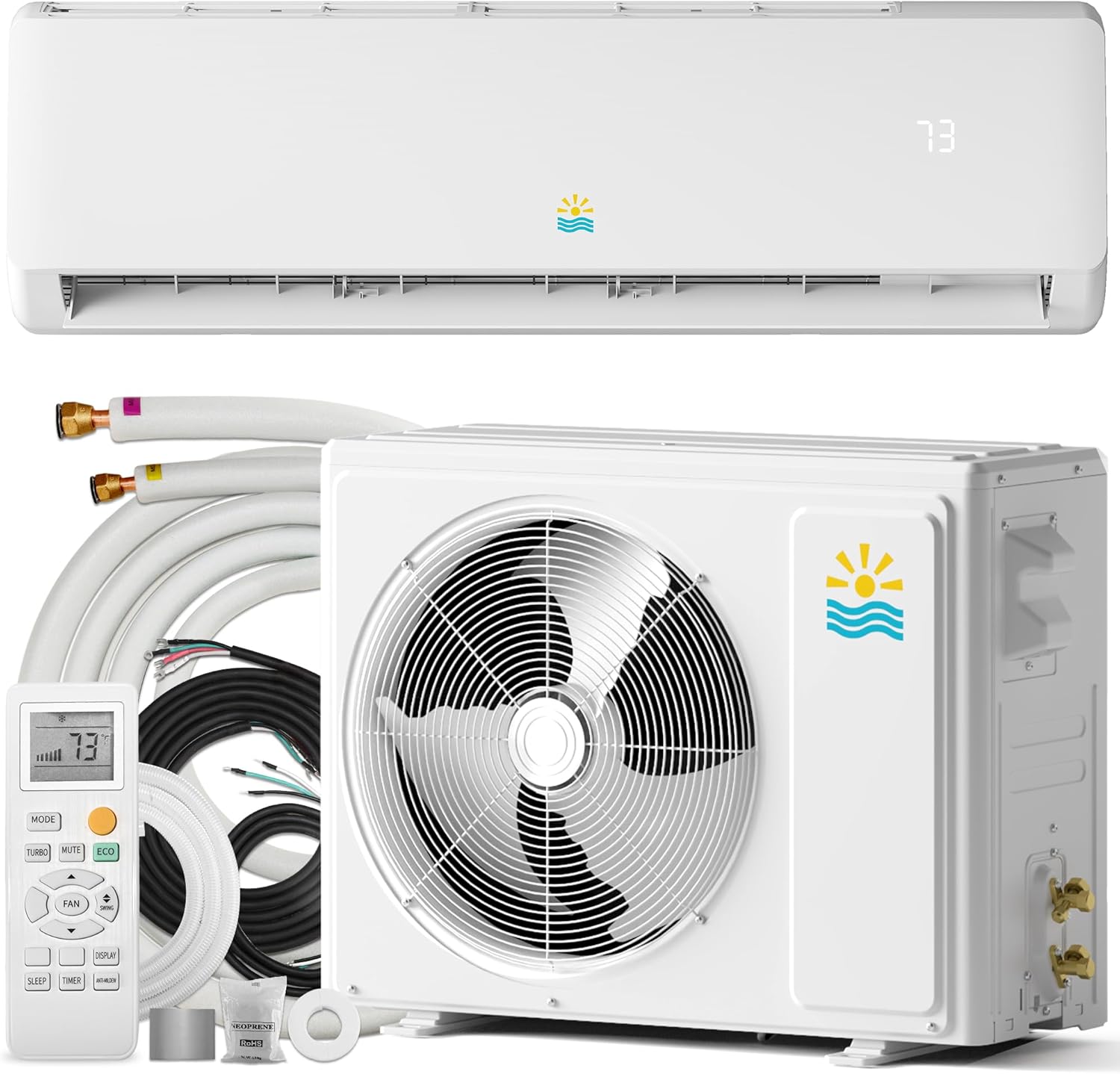
Rellytech Mini Split 9000 BTU
| Cooling Power | 9000 BTU |
|---|---|
| SEER | 19 |
| Refrigerant | R-32 |
| Voltage | 115 volts |
| Floor Area | 450 square_feet |
The Rellytech 9000 BTU mini split is a ductless inverter heat pump designed to cool or heat a single room efficiently. It includes indoor and outdoor units plus an installation kit and a remote for everyday control, offering modes for cooling, heating, fan and dehumidify along with a 24-hour timer and sleep setting for quieter overnight use. The inverter compressor and R32 refrigerant deliver a 19 SEER2 efficiency and lower annual energy consumption compared with non-inverter units, while 42 dB operating noise keeps the indoor unit unobtrusive. Coverage is targeted at bedrooms, living rooms, or offices up to roughly 450–550 sq ft, and the system runs on 115 V power. Expect professional installation because refrigerant handling and wall mounting are required even though the kit includes pipes, cables and mounting hardware. The main limitations are the single-zone capacity—it only serves one room—and the need to budget for installation labor; also the outdoor operating range and heating performance can be affected at very low ambient temperatures.
Best for: Buyers who want an energy-efficient, single-room heating and cooling solution and prioritize lower operating costs and quiet operation over DIY installation.
Less Ideal for: Those who need multi-room or whole-house cooling, or who want a strictly DIY plug-and-play option without professional HVAC installation.
- Inverter compressor and 19 SEER2 rating for better energy efficiency
- Includes indoor and outdoor units plus an installation kit with pipes and mounting hardware
- Multiple operating modes (cooling, heating, fan, dry) and 4 fan speeds for flexible comfort
- Low indoor noise level around 42 dB for quiet operation
- Requires professional installation for safe refrigerant handling and optimal performance
- Single-zone design only cools or heats one room
Verdict: A quiet, energy-efficient single-zone mini split that delivers reliable cooling and heating for a bedroom or living room when you plan for professional installation.
CAAIR 12,000 BTU Mini Split

| Cooling Power | 12000 BTU |
|---|---|
| SEER | 17 SEER2 |
| Floor Area | 750 square_feet |
| Voltage | 230 volts |
This CAAIR 12,000 BTU mini split is a year‑round ductless heat pump designed to cool and heat spaces up to roughly 750 square feet. It uses a DC inverter compressor with a 17 SEER2 rating for steady temperature control and improved energy efficiency compared with non‑inverter units, and it offers four operating modes (cool, heat, fan, dry) plus sleep and turbo settings. Practical touches include 4D auto‑swing airflow, a self‑cleaning cycle and washable filters to reduce odor and mold buildup, a quiet indoor unit rated at 25 dB, and Wi‑Fi with remote and app control for scheduling or voice integration. The system ships as separate indoor and outdoor packages and requires professional installation and a vacuuming procedure for the refrigerant lines; the outdoor unit is pre‑charged and a 13 ft line set and drain hose are included. For buyers on a budget this model balances efficiency and features, though installation costs and the need to add a compatible outdoor unit or ensure correct hookup can raise the total project price beyond the unit cost.
Best for: Buyers seeking an energy‑efficient, feature‑rich mini split for a single room who prioritize lower running costs and smart controls while limiting upfront purchase price.
Less Ideal for: People who need a DIY or plug‑and‑play cooling solution or who want to avoid paying for professional HVAC installation and outdoor unit setup.
- 17 SEER2 inverter compressor for steady, energy‑efficient operation
- Wi‑Fi, app and remote control with ZoneSense remote temperature sensing
- Self‑cleaning cycle and washable filters reduce mold and odors
- Very quiet indoor operation around 25 dB suitable for bedrooms
- Requires professional installation and vacuuming of refrigerant lines
- Outdoor unit compatibility requires a new outdoor unit which can increase total cost
Verdict: A cost‑minded choice for a single‑room mini split that pairs inverter efficiency and smart controls with practical self‑cleaning features, provided you budget for professional installation.
GrowthWing AuraCore HP12N

| Cooling Power | 12000 BTU |
|---|---|
| SEER | 20 |
| Voltage | 115 volts |
| Wattage | 1240 watts |
| Refrigerant | R-32 |
The GrowthWing AuraCore HP12N is a 12,000 BTU inverter mini-split that provides both cooling and heating for rooms up to about 750 square feet. It uses a variable-speed compressor and large-diameter fan to deliver steady temperature control with faster turbo cooling when you need it, while claiming quiet operation around 28 dB for low-noise bedrooms or living areas. Controls include a remote, app, and Alexa voice commands, and features like AutoClean and a washable filter reduce maintenance. The unit ships pre-charged with R-32 refrigerant and includes an installation kit, but factory guidance recommends professional HVAC installation to avoid warranty issues. Its 20 SEER2 efficiency rating and reported annual energy use make it a reasonable choice if you want lower operating costs compared with non-inverter systems. Expect straightforward everyday use and smart scheduling, but plan on professional hookup and space for a separate outdoor condenser assembly since this is a split system.
Best for: Buyers who prioritize dependable, efficient year-round comfort and want a smart-controlled mini-split that runs quietly in living spaces.
Less Ideal for: People seeking a DIY plug-and-play room-only unit or those who cannot accommodate a separate outdoor condenser should consider other options.
- Inverter-driven compressor for stable, energy-efficient temperature control
- 20 SEER2 rating for relatively low annual energy consumption
- App, remote, and Alexa voice control with smart scheduling
- Quiet operation around 28 dB suitable for bedrooms
- Pre-charged with R-32 refrigerant and includes an installation kit
- Requires professional HVAC installation for best performance and warranty protection
- Warranty excludes labor and installation costs
Verdict: Choose the GrowthWing AuraCore HP12N if you want a quiet, energy-efficient inverter mini-split with smart controls for reliable year-round comfort.
SereneLife 12,000 BTU Mini Split

| Cooling Power | 12000 british thermal units |
|---|---|
| SEER | 20 |
| Voltage | 115 volts |
| Annual Energy Consumption | 1260 kwh |
| Control Method | App, Remote |
The SereneLife 12,000 BTU mini split is a wall-mounted heat pump designed to cool or heat medium to large rooms. It offers smart controls via app and included remote, multiple operating modes (auto, cool, dry, fan, heat), and a programmable timer for tailored comfort. The unit claims a SEER of 20 and lists annual consumption consistent with moderate efficiency, while built-in WiFi lets you start or stop the system remotely. Installation is supported by a comprehensive kit that includes piping and power cord, which can simplify setup for a professional installer. Noise is marketed as low with quieter operation modes, though the product sheet also lists a higher 55 dB value for some conditions, so expect variation by fan speed. Practical benefits include year-round heating and cooling, app convenience, and an energy-efficient compressor for steady performance. Limitations are typical of packaged mini splits: you will need professional installation for best performance and the 1-year warranty is shorter than some competing models.
Best for: A buyer who values social proof and wants a feature-rich mini split that offers smart controls and energy efficiency for whole-room comfort backed by many user reviews.
Less Ideal for: Anyone seeking a long factory-backed warranty or a completely plug-and-play portable solution should consider other options.
- Both cooling and heating with a heat pump for year-round use
- App and remote control for convenient remote operation
- Included installation kit with pipe and power cord reduces accessory hunting
- Relatively high SEER rating (20) for better energy efficiency
- 1-year warranty is shorter than many competitors
- Noise specs vary in the listing, so real-world sound levels depend on mode and installation
Verdict: Choose this mini split if you want a WiFi-enabled 12,000 BTU heat pump with solid efficiency and broad real-world user adoption for year-round room comfort.
Senville LETO 12000 BTU Mini Split

| Cooling Power | 12000 british thermal units |
|---|---|
| Voltage | 110 volts |
| Wattage | 1020 watts |
| SEER | 20.8 |
| Capacity | 1 tons |
The Senville LETO 12000 BTU mini split is a ductless wall-mounted heat pump designed to cool, heat, dehumidify, and circulate air in spaces up to roughly 700 sq ft. It uses a DC inverter compressor for steady temperature control and higher seasonal efficiency, and it includes both the indoor air handler and outdoor condenser plus a 16 ft precharged line set for professional installation. The system supports app and voice control for remote scheduling and geofencing, and the included remote makes daily operation straightforward. Practical benefits include quiet indoor operation, strong energy efficiency (SEER around 20.8), and multi-mode operation that handles mild heating down to about 5 F. Important limitations are that it requires professional installation and the quoted refrigerant charge only covers line runs up to 25 ft, so longer installs add cost and complexity. The unit is corded for standard 110/120V power and carries a manufacturer parts and compressor warranty for added peace of mind.
Best for: Buyers who prioritize dependable, energy-efficient climate control and want a factory-backed mini split with smart controls and a clear warranty.
Less Ideal for: People seeking a DIY plug-and-play solution or installs that need long line runs without paying for additional refrigerant and labor.
- High seasonal efficiency (SEER ~20.8) for lower run-time energy use
- DC inverter compressor provides stable temperature and quieter cycling
- Works with Alexa and app control for remote scheduling and geofencing
- Includes indoor unit, outdoor condenser, and 16 ft precharged line set
- Requires professional installation and potential extra cost for longer line runs
- Precharged refrigerant covers only up to 25 ft of line set
- Listed noise spec is a single value and real-world sound depends on installation
Verdict: A quiet, energy-efficient mini split with smart controls and a solid warranty that suits buyers who want reliable, professionally installed heating and cooling.
Choosing the Right Split Air Conditioner: Key Factors to Consider
Energy Efficiency and Seasonal Ratings
Energy efficiency directly impacts long-term operating cost. Look at seasonal efficiency ratings rather than just peak numbers because they reflect how the system performs across typical ambient temperatures. Higher seasonal ratings usually translate to lower electricity use for the same cooling load.
Also consider inverter-driven compressors versus fixed-speed units. Inverter systems adjust capacity to match demand and tend to run longer at lower power, which reduces cycling losses and improves comfort. For homeowners concerned about bills, prioritize systems with strong seasonal efficiency and good part-load performance.
Proper Cooling Capacity
Matching capacity to room size prevents short cycling or underperformance. Capacity is typically expressed in tons or BTU per hour; selecting the right size requires accounting for room area, ceiling height, insulation, window exposure, and typical occupancy.
Oversized systems cool quickly but cycle on and off more, which can increase wear and reduce dehumidification. Undersized systems run continuously and may never reach the desired temperature. Use a room-by-room load estimate or consult an installer to find the correct capacity for the specific spaces you intend to cool.
Noise Levels Inside and Out
Split systems separate the noisy compressor outside from the indoor blower, but indoor unit noise still matters for bedrooms and living spaces. Check decibel ratings at common fan speeds and consider whether low-speed background noise will be noticeable during quiet hours.
Outdoor unit noise matters for patios, neighbors, and local ordinances. A quieter outdoor unit can allow more flexible placement. If noise is a priority, look for systems with low-SPL indoor units and well-damped outdoor compressors.
Installation Needs and Line-Set Length
Installation flexibility affects both initial cost and placement options. Line-set length limits how far the indoor and outdoor units can be separated, and certain systems have maximum vertical or horizontal separation distances. Consider mounting options for the indoor unit, outdoor unit footprint, and whether the building permits convenient refrigerant routing.
Some systems require specific clearance for airflow or service access. If your installation includes tight spaces, attics, or multiple stories, verify the recommended line-set and clearances before choosing a unit.
Controls and Thermostat Compatibility
Modern split units offer a range of controls, from basic remotes to Wi-Fi-enabled thermostats and app integration. Decide whether you need simple on/off and temperature control or more advanced scheduling and remote monitoring.
Compatibility with standard thermostats or home automation platforms can make the system easier to manage. If you plan to integrate with other smart home devices, confirm control protocols and whether a separate bridge or gateway is required.
Maintenance Requirements and Serviceability
Regular maintenance keeps a split air conditioner efficient and extends lifespan. Consider ease of accessing filters, fan coils, and electrical panels for routine checks and cleaning. Systems that use common, widely available service parts are typically easier and less costly to maintain.
Also check recommended maintenance intervals for filter changes, coil cleaning, and refrigerant checks. If you prefer lower upkeep, favor units with washable filters and simple service access.
Sizing a Split System for Different Rooms
Accurate sizing ensures efficient performance and comfortable conditions. Use square footage and heat-gain factors like window orientation, ceiling height, and insulation quality to estimate required capacity. For multi-room areas or open-plan layouts, calculate a combined load rather than treating the space as separate small rooms.
When in doubt, consult a qualified technician for a manual J load calculation. That process accounts for localized heat sources and gives a reliable capacity target, preventing the common errors of oversizing or undersizing.
- Small bedroom: prioritize low indoor noise and effective dehumidification
- Large living area: ensure higher capacity and even airflow distribution
- Rooms with many windows: increase capacity allowance for solar gain
Installation Considerations and Placement Tips
Position the indoor head where airflow can reach the room without blowing directly onto sleepers. Avoid placing the indoor unit above heat sources or behind large obstructions. The outdoor unit should sit on a stable, level pad with adequate clearance for airflow and service access.
Consider future maintenance when choosing placement. Allow space for removal of panels and for technicians to access electrical connections and refrigerant lines without major disassembly.
- Keep outdoor unit at least a few inches off the ground and away from heavy vegetation
- Run refrigerant lines with gradual bends and secure them to minimize vibration
- Locate indoor units away from direct sunlight to prevent false temperature readings
Dehumidification and Indoor Comfort Beyond Temperature
Cooling is not just about temperature. Effective dehumidification improves perceived comfort and can reduce the need for lower setpoints. Systems that run longer at lower speeds typically remove more moisture because air spends more time across the coil.
If indoor humidity is a chronic problem, focus on systems with good low-speed performance or consider pairing the split system with a dedicated dehumidifier in particularly humid regions.
- Long run times at low speeds increase moisture removal
- Proper drain installation prevents water issues and odor
- Ventilation and source control also reduce indoor humidity loads
Energy-Saving Installation Practices
Small installation decisions can materially affect seasonal efficiency. Insulate refrigerant lines to prevent heat gain or loss, seal wall penetrations to avoid air leaks, and ensure outdoor units are shaded without restricting airflow. Properly charged refrigerant and accurate airflow settings maximize efficiency.
Ask installers to verify system refrigerant charge and measure airflow during commissioning. A well-tuned system performs closer to its rated efficiency and uses less energy over its life.
- Insulate and protect line-sets from sun exposure
- Seal gaps around wall sleeves and service openings
- Confirm refrigerant charge and fan speeds during startup
Control Strategies to Save Energy
Use schedules and setback strategies to reduce runtime when rooms are unoccupied. If available, eco modes and adaptive algorithms can reduce compressor output during mild conditions while maintaining comfort. Remote control features also let you pre-cool spaces only when needed.
Avoid continuously lowering the thermostat to very low settings to speed cooling. Instead, set reasonable targets and use fans or zoning strategies to maintain comfort with lower energy use.
- Setback by a few degrees when rooms are empty
- Use timers or geofencing to avoid unnecessary runtime
- Combine with ceiling fans to raise thermostat setpoints without losing comfort
How We Chose the Best Split Air Conditioner
We focused on practical, measurable criteria that matter when selecting a split air conditioner for a home environment. Key evaluation dimensions included seasonal energy efficiency, measured by widely used ratings and projected running costs for typical use patterns; cooling capacity and how well that capacity matches room sizes; noise levels for both indoor and outdoor units during normal operation; and installation flexibility, covering mounting needs and typical line-set lengths. Additional editorial filters included the reliability of common components, availability of standard service parts, and typical maintenance needs over the first several years of operation. We also considered control options such as thermostat compatibility and basic smart features that affect daily usability. We excluded products limited to commercial-only specifications, obsolete refrigerant types, or systems requiring complex ducting or structural modification outside normal residential installations. The resulting picks focus on systems that balance efficiency, quiet operation, and straightforward home installation and upkeep.
Our full evaluation process is outlined in our review methodology.
FAQ
How do I know what capacity split air conditioner I need for a room?
Capacity depends on room size, ceiling height, insulation, window area, and sun exposure. A simple estimate uses square footage as a starting point, but the most reliable method is a load calculation that accounts for local heat gains.
Are inverter split systems worth the extra cost?
Inverter systems typically use less energy over the year and provide quieter, more consistent comfort because they vary compressor speed. Whether the upfront cost is justified depends on expected runtime, electricity rates, and how often you need precise temperature control.
How noisy are split air conditioners indoors?
Indoor noise varies by fan design and speed setting. Many split indoor units operate at low background levels suitable for bedrooms. Check published decibel ratings at low and high fan speeds to compare expected noise in quiet environments.
Can I install a split system myself?
DIY installation is possible for experienced HVAC installers, but most homeowners should rely on a licensed technician. Proper refrigerant charging, electrical connections, and leak checks require specialized tools and expertise.
What maintenance does a split air conditioner need?
Routine tasks include cleaning or replacing filters, inspecting and cleaning coils, ensuring condensate drains are clear, and checking outdoor unit clearances. Periodic professional service for refrigerant level checks and electrical inspections helps maintain efficiency.
Final Verdict
Choosing a split air conditioner comes down to matching cooling capacity to your space, prioritizing seasonal energy efficiency, and confirming installation feasibility. Balance quieter indoor operation and good low-speed dehumidification against installation constraints like line-set length and outdoor unit placement. If you value lower operating costs, favor systems with strong seasonal efficiency and inverter compressors. If quiet performance or tight placement is the priority, prioritize low indoor SPL ratings and flexible installation specs. With those tradeoffs in mind, you can select a split system that delivers reliable comfort for your home.