
Note: This article contains affiliate links. If you click on these links and make a purchase, we may earn a small commission at no extra cost to you. This helps support our research and content. Read our full affiliate disclosure here.
When indoor heat and sticky humidity pile up, a portable air conditioner with a dehumidifier can make a room noticeably more comfortable without permanent installation. You want a unit that cools a defined space efficiently while also removing excess moisture to reduce clamminess, odors, and the risk of mold. This guide shortlists seven top portable air conditioners with dehumidifier functions and explains the practical factors that matter for home use, from cooling capacity and dehumidification rate to noise, venting needs, and maintenance. Read on to see which types of units suit different rooms and operational priorities, and why these picks earned a spot on the list.
Top Picks at a Glance
| Best Overall The best all-around choice for most situations | DREO Portable Air Conditioner 318S |  |
| Best Quality Built to a higher standard if you want something more solid | Whynter ARC-14S 14,000 BTU Portable AC |  |
| Best Value The sweet spot between price and what you get | Line Blaster Portable Air Conditioner 8500 BTU |  |
| Best Budget The cheapest option that still gets the job done reliably | GarveeLife 8,000 BTU Portable Air Conditioner |  |
| Top Rated A top-rated pick with lots of positive feedback | KINDOJIA 16000 BTU Portable AC |  |
| Most Popular A crowd favorite that many people choose with confidence | SereneLife 8000 BTU Portable AC |  |
| Best Seller A high-volume bestseller chosen again and again | BLACK+DECKER Portable Air Conditioner BPACT10WT |  |
DREO Portable Air Conditioner 318S

| Cooling Power | 8000 BTU ASHRAE (5000 BTU DOE) |
|---|---|
| Noise | 45 db |
| Refrigerant | R-32 |
| Power Source | Corded Electric |
| Controls | App, Remote, Touch, Voice |
The DREO Portable Air Conditioner 318S is a compact unit designed for bedroom or small living spaces that combines cooling, dehumidifying, and fan modes. It uses an 8000 BTU ASHRAE (5000 BTU DOE) rating and a self-evaporating drainage system so you can run it without manually emptying a tank in most conditions; a drain hose is included for very humid environments. Controls are flexible: built-in touchpad, remote, smartphone app with sleep curve scheduling, and voice control via Alexa, Google, or Siri. The unit is relatively quiet at about 45 dB on low settings and includes a large LED display and multiple fan speeds for tailoring comfort. Practical benefits include easy installation with the supplied window mount kit and automatic moisture handling that reduces maintenance. Limitations are typical for this class: cooling coverage is aimed at single rooms up to about 100 sq ft, energy efficiency is modest, and it is a heavier, boxed portable unit that needs a window vent and 115V power. If you want a smart, low-maintenance portable AC with dehumidifying built in, this model delivers solid all-around performance for small spaces.
Best for: Buyers who want a smart, low-maintenance portable AC that also controls humidity in a bedroom or small living area and value multiple convenient control options.
Less Ideal for: Do not choose this if you need to cool large or multiple connected rooms or if maximum energy efficiency is your top priority.
- 3-in-1 modes: cooling, dehumidify, and fan for flexible seasonal use
- Self-evaporating drainage system reduces need to empty water during typical humidity levels
- Multiple control options including app, touchpad, remote, and voice assistants for convenient operation
- Relatively quiet operation at 45 dB on low plus a large LED display for easy monitoring
- Includes window mount kit and drain hose for straightforward setup
- Rated cooling capacity is modest for small rooms only, not suited for large open areas
- Annual energy consumption and SEER indicate average energy efficiency compared with higher-SEER models
Verdict: A smart, easy-to-use portable air conditioner with built-in dehumidifying and self-evaporation that makes it a practical choice for keeping a single bedroom or small living room comfortable.
Whynter ARC-14S 14,000 BTU Portable AC

| Cooling Power | 14000 BTU |
|---|---|
| Wattage | 1300 watts |
| Noise | 51 db |
| Floor Area | 500 square_feet |
| Capacity | 71 pints |
The Whynter ARC-14S is a heavy-duty dual-hose portable air conditioner designed for large rooms up to about 500 square feet. Its 14,000 BTU cooling (SACC lower) and dual-hose design deliver stronger, more consistent cooling than single-hose units, while the built-in dehumidifier and patented auto-drain help manage moisture without frequent emptying. It offers three modes—cool, dehumidify, and fan—with full thermostat control and a remote for convenient operation. The unit includes an activated carbon filter and washable pre-filter to improve indoor air quality. Practical benefits include a high dehumidifying capacity and relatively quiet low-speed operation at around 51 dB, plus a solid accessory kit for window installation and storage. Expect a large, heavy unit that needs a proper window vent and a dedicated circuit given its 1300 W draw, and its energy efficiency is moderate rather than top-tier. Setup and mobility are straightforward for a freestanding unit of this size, but it is bulkier than compact portable ACs and consumes notable power under sustained use.
Best for: Buyers who prioritize a dependable, high-capacity portable AC for cooling and moisture control in large rooms and want a unit built for continuous, low-maintenance operation.
Less Ideal for: People who need a lightweight, highly energy-efficient, or purely budget portable AC for small rooms or occasional spot cooling should consider smaller or inverter-based alternatives.
- Dual-hose design for more consistent cooling in large rooms
- Built-in dehumidifier with auto-drain reduces maintenance
- High cooling capacity suitable for ~500 sq ft spaces
- Includes activated carbon and washable pre-filter for better air quality
- Remote and panel controls with three fan speeds for easy operation
- Relatively high power consumption compared with smaller units
- Large and heavy, requires adequate space and a proper window vent
- Not ENERGY STAR rated, so long-term operating costs may be higher
Verdict: A robust, reliability-focused portable AC that pairs strong dual-hose cooling with a high-capacity dehumidifier, making it a sensible choice for cooling and moisture control in large rooms.
Line Blaster Portable Air Conditioner 8500 BTU
| Cooling Power | 8500 BTU |
|---|---|
| Floor Area | 450 square_feet |
| Wattage | 840 watts |
| Capacity | 1.2 gallons |
| Noise | 52 db |
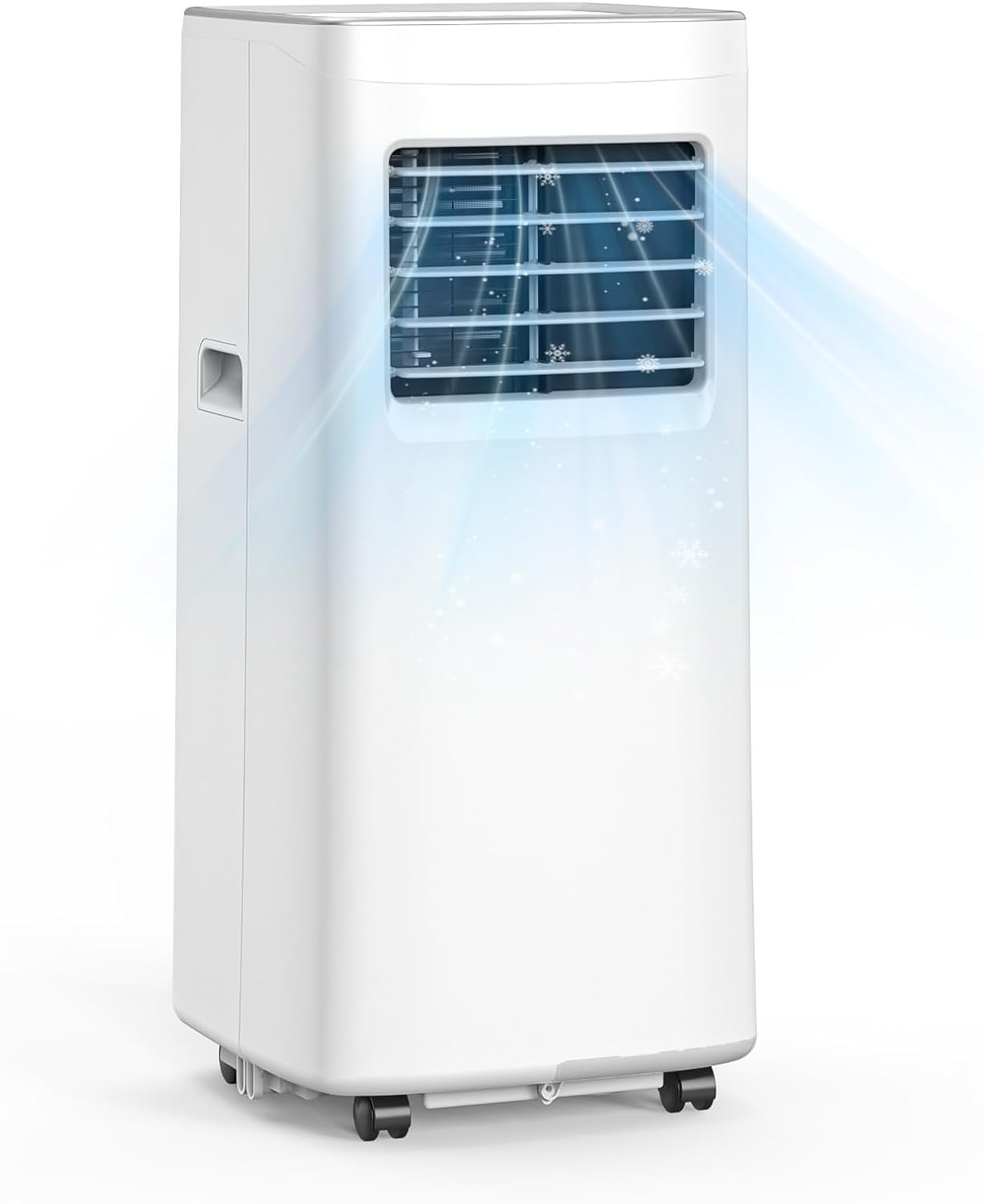
The Line Blaster 8500 BTU portable air conditioner is a compact, window-installation unit that cools, circulates air, and removes moisture from rooms up to about 450 sq ft. It ships with an exhaust hose, window slide bar and adaptor and is controlled by touch panel or remote for basic scheduling and sleep mode. The unit uses a rotary compressor and a mesh filter, offers an internal 1.2 gallon collection capacity for condensate, and lists a noise level around 52 dB which is typical for portable A/Cs. Practical features include easy mobility, a 24-hour timer, and separate dehumidify and fan-only modes so you can run it for humidity control without full cooling. Expect straightforward installation into a standard window opening and moderate energy use given the listed 840 W power draw and a SEER of 6.5. Important limitations are the midrange efficiency and typical portable-unit noise and weight, so it suits targeted room cooling rather than whole-house use.
Best for: Buyers who want a practical, all-in-one room solution to both cooling and humidity control for single rooms and prioritize straightforward installation and day-to-day convenience.
Less Ideal for: Those seeking the highest energy efficiency, ultra-quiet operation, or a solution to cool multiple large rooms should consider alternative systems or higher-capacity models.
- Three-in-one operation: cooling, dehumidifying, and fan modes for flexible use.
- Includes full window installation kit and exhaust hose for quick setup.
- Remote and touch controls plus 24-hour timer and sleep mode for easy scheduling.
- 1.2 gallon condensate capacity reduces the need for frequent emptying during normal use.
- SEER of 6.5 and 840 W power draw indicate only midlevel energy efficiency.
- Noise around 52 dB may be noticeable in very quiet rooms.
- Unit weight and dimensions make it less convenient to move frequently between rooms.
Verdict: A compact, no-frills room A/C that combines cooling and dehumidifying functions with easy window installation for buyers who prioritize practical single-room climate control.
GarveeLife 8,000 BTU Portable Air Conditioner

| Cooling Power | 8000 british thermal units |
|---|---|
| Floor Area | 350 square_feet |
| Control Method | App, Remote |
| Annual Energy Consumption | 538 kwh |
| Power Source | Corded Electric |
The GarveeLife 8,000 BTU portable air conditioner is a 3-in-1 unit designed to cool, remove humidity, or circulate air in bedrooms and similar mid-sized spaces. It uses an inverter-style compressor and a threaded exhaust hose kit for quick installation, and can be controlled with the included remote or smartphone app. Notable features include a 24-hour timer, reusable filters that rinse clean, and an energy-focused design with a reported annual consumption figure. The unit is relatively quiet for this class and includes a dehumidify mode useful for sticky conditions. Practical benefits are straightforward setup, the convenience of remote and app controls, and lower running complexity compared with window units. Limitations are typical for compact portables: cooling capacity is geared to rooms around 350 sq ft so it will struggle in large open-plan areas, and the published wattage is low which suggests modest performance at peak heat compared with higher-BTU models. The package weight and dimensions also make it less convenient to move frequently than small single-room fans.
Best for: Buyers seeking an affordable, low-complexity climate solution for a bedroom or similar mid-sized room who prioritize easy setup, simple maintenance, and combined dehumidifying and cooling functions.
Less Ideal for: Homes that need to cool large open areas, whole apartments, or rooms with poor insulation where higher BTU or multiple units would be necessary.
- Combines cooling, dehumidifying, and fan modes in one compact unit
- Remote and app control for convenient adjustments from across the room
- Reusable, tool-free filters that rinse clean for low-maintenance operation
- 24-hour timer and quiet operation suitable for bedrooms
- Best suited to mid-sized rooms and may underperform in larger or poorly insulated spaces
- Portable units require an exhaust hose and nearby window for venting, limiting placement options
Verdict: A budget-friendly 3-in-1 portable AC that reliably cools and dehumidifies single mid-sized rooms with straightforward controls and low-maintenance filters.
KINDOJIA 16000 BTU Portable AC

| Cooling Power | 16000 british thermal units |
|---|---|
| Additional Features | WiFi Enabled |
| Wattage | 850 watts |
| Noise | 50 db |
| Capacity | 650 ml |
This KINDOJIA portable air conditioner delivers strong cooling and built-in dehumidification for larger rooms where a window unit or central HVAC is not practical. It is used like a standalone room AC: set it up near a window panel, choose cooling or dehumidifier mode, and control temperature, fan speed, timer and swing from the LED panel, included remote, or Smart Life app. Notable features include WiFi connectivity for app control, a 24-hour timer, sleep mode for quieter nighttime operation, and an auto-swing louvers function to help distribute air. Its 16,000 BTU rating targets spaces up to about 700 sq ft and the 650 ml capacity supports continuous dehumidifying between drains or empty cycles. Practical benefits are quick room cooling, remote scheduling, and reduced humidity without a separate dehumidifier. Important limitations are the unit weight and footprint that make it less portable than smaller models, and a reported noise level around 50 dB which may still be noticeable in very quiet bedrooms.
Best for: Buyers who prioritize reliable, single-unit cooling plus moisture control for larger rooms and want app or remote control for scheduled comfort.
Less Ideal for: People who need an ultra-lightweight, highly portable cooler for frequent room-to-room moves or those who need near-silent operation for very sensitive sleeping environments.
- High 16,000 BTU cooling capacity suitable for large rooms
- Integrated dehumidifier mode reduces indoor humidity without extra equipment
- WiFi and remote control let you adjust settings from the app or included remote
- Sleep mode and 50 dB noise rating aim to keep nighttime operation quieter
- Auto swing and adjustable fan speeds help distribute cooled air more evenly
- Relatively heavy and bulky compared with compact portable ACs
- 50 dB noise can still be intrusive for light sleepers
- 650 ml capacity requires periodic emptying or hose hookup for long continuous dehumidifying
Verdict: Choose this unit if you need dependable high-capacity cooling with built-in dehumidification and smart app control for large-room comfort.
SereneLife 8000 BTU Portable AC

| Cooling Power | 8000 british thermal units |
|---|---|
| Wattage | 1000 watts |
| Noise | 55 db |
| Filter Type | Physical Mesh |
| Operating Modes | Cooling, Dehumidifier, Fan |
The SereneLife 8000 BTU portable air conditioner combines cooling, dehumidifying, and fan modes in a single freestanding unit designed for easy room-to-room use. It plugs into standard 120V power, rolls on casters, and includes a window exhaust kit and remote control for basic temperature, fan speed, and timer adjustments. In practice the unit cools spaces up to roughly 215 to 350 sq ft depending on layout, while its built-in dehumidifier removes moisture at about 1.2 liters per hour, which helps manage humidity in damp rooms. Notable points are its 8,000 BTU cooling capacity, 1000W power draw, and a physical mesh filter that is washable. The unit runs around 55 dB on cooling mode, so it is audible but not overly loud for living areas. Limitations include modest efficiency compared with inverter systems and a relatively small dehumidification rate for very humid climates, and it lacks advanced connectivity or smart controls. For buyers looking for a straightforward portable AC with a functional dehumidifier, this is a practical option with clear, simple controls.
Best for: Buyers who prioritize a proven, no-frills portable AC that also reduces indoor humidity and prefer clear user feedback from many other owners before purchasing.
Less Ideal for: People seeking the quietest, most energy-efficient inverter models or those who need heavy-duty dehumidification for very humid spaces should look elsewhere.
- Three operating modes: cooling, dehumidifier, and fan in one unit.
- Includes window exhaust kit and remote control for easy setup and operation.
- Portable design with casters for moving between rooms.
- Washable physical mesh filter for simple maintenance.
- Reasonable cooling for small to medium rooms (8,000 BTU).
- Consumes around 1000 watts and uses a non-inverter compressor, so it is less energy-efficient than inverter models.
- Noise level (~55 dB) may be noticeable in quiet bedrooms.
- Dehumidification rate (1.2 L/hr) is modest for very humid conditions.
Verdict: A straightforward, easy-to-use portable air conditioner with an integrated dehumidifier that reliably cools and reduces humidity in small to medium rooms.
BLACK+DECKER Portable Air Conditioner BPACT10WT

| Cooling Power | 10000 BTU |
|---|---|
| Floor Area | 450 square_feet |
| Refrigerant | R-32 |
| Control Method | Remote |
| Filter Type | Washable |
The BLACK+DECKER BPACT10WT is a mobile 3-in-1 unit that cools, dehumidifies, and circulates air in medium-size rooms. It ships with a window installation kit, exhaust hose, and a full-function remote with a Follow Me thermostat, making setup and temperature control straightforward. The unit rides on casters and has side handles for moving between bedrooms, offices, or basements, and a reusable washable filter keeps maintenance simple. In practice the unit delivers the advertised cooling class for spaces up to about 450 square feet and gives sensible dehumidifier performance with a small internal water collection tank plus a drain option. Noise and power draw are typical for this class, and it uses R-32 refrigerant. The trade-offs are its bulk and weight compared with smaller portable units and modest seasonal efficiency numbers, so it is not the quietest or lowest-cost-to-run option, but it is a practical, easy-to-install choice if you want combined cooling and dehumidifying without permanent installation.
Best for: Buyers who prioritize a simple, factory-quality portable cooling solution with built-in dehumidifying and easy installation will appreciate this unit for cooling bedrooms, living rooms, or offices without permanent installation.
Less Ideal for: People seeking the quietest, lightest, or most energy-efficient portable AC should consider alternative specialty models or window units.
- 3-in-1 functionality: air conditioner, dehumidifier, and fan in one unit
- Includes window installation kit and exhaust hose for straightforward setup
- Full-function remote with Follow Me thermostat for convenient control
- Reusable washable air filter simplifies maintenance
- Casters and side handles make the unit portable between rooms
- Relatively heavy and bulky compared with smaller portable models
- Seasonal efficiency is modest, so running costs may be higher than high-efficiency units
Verdict: A straightforward, easy-to-install portable AC that also dehumidifies, making it a dependable all-in-one choice for risk-averse buyers who want hassle-free cooling.
Choosing the Right Portable Air Conditioner with a Dehumidifier: Key Factors to Consider
Cooling Capacity and Room Size
Cooling capacity is the single biggest determinant of whether a portable air conditioner will keep a room comfortable. Capacity is usually expressed in BTU or a manufacturer-equivalent rating; larger rooms require higher output. Consider the square footage and typical ceiling height of the room, plus heat-generating factors like direct sun, many occupants, or electronics.
Undersizing a unit leads to constant running, higher energy use, and insufficient dehumidification because the compressor never reaches steady cycles. Oversizing can create short cycling that reduces dehumidification efficiency and increases wear. Match capacity to the room and, when in doubt, choose the next size up only if the unit has efficient humidity control.
Dehumidification Performance
A portable air conditioner that lists a dehumidification rate gives a sense of how much water it can extract from the air per day. Higher rates reduce relative humidity faster, which is important in very humid climates or rooms prone to moisture buildup, like basements. Look for clear specs and realistic expectations about how long it takes to lower humidity by 10 to 20 percent in a given room.
Also consider how the unit handles collected water: automatic evaporation into the exhaust, a removable bucket, or continuous drainage options. Continuous drainage is convenient for long runtimes, while automatic evaporation reduces maintenance in typical living spaces. Drain access and overflow protection are practical details that affect day-to-day use.
Venting and Installation Needs
Portable air conditioners require an exhaust path to the outdoors. Window vent kits are common, but the physical window type, available clearance, and how discreet you want the setup to be will influence the best choice. Some units offer more flexible venting or smaller-profile kits suited to narrow sliders or casement windows.
Also check how the unit handles return air and placement relative to walls and furniture. Units need a few inches of clearance for intake and exhaust airflow. If you cannot vent to the outdoors, cooling performance and dehumidification will be severely limited, so plan the exhaust routing before purchasing.
Noise and Daily Use Comfort
Noise matters when a portable air conditioner will operate in living rooms, bedrooms, or home offices. Look for published noise levels at different fan speeds and consider how disruptive the unit is during sleep or phone calls. Some units have quieter low-speed modes intended for nighttime use, while others are louder but provide stronger cooling or moisture removal.
Also assess control options like timers, sleep modes, remote controls, and app connectivity if you want automated schedules. Ease of use and intuitive controls reduce the friction of daily operation and help ensure you actually use the dehumidifier function when needed.
Energy Efficiency and Operating Cost
Energy efficiency affects long-term operating cost and environmental impact. Check energy efficiency ratios or listed wattage at typical operating modes to estimate daily power draw. Higher efficiency units use less electricity for the same cooling and dehumidification output, which matters for units used many hours per day.
Consider programmable features such as timers and eco modes that reduce runtime, and remember that dehumidifying while cooling can sometimes extend run time but improve perceived comfort. Balance upfront features with expected energy use for your typical local climate and usage patterns.
Maintenance and Filter Accessibility
Regular maintenance keeps a portable air conditioner with dehumidifier functioning properly. Filters trap dust and airborne particles and should be easy to remove and clean. The design of the condensate management system—whether it uses auto-evaporation, a removable bucket, or a continuous drain—affects how often you interact with the unit.
Also consider how easy it is to access the compressor area or service ports for occasional professional maintenance. Units that make routine tasks simple will be less of a chore and more likely to provide consistent dehumidification and cooling over several seasons.
Sizing a Unit for Different Rooms
Estimate the square footage of the room and account for high ceilings or sustained sun exposure when choosing cooling capacity. A modest bedroom and a sunny living room of the same floor area may need different-capacity units because of heat load differences.
For multiroom coverage or open-plan areas, portable units perform best when focused on a single zone. Consider supplemental fans to distribute cooled, dehumidified air more evenly rather than relying on one unit to cool several enclosed rooms.
- Measure room area and note ceiling height.
- Add capacity for sun-facing windows or many occupants.
- Use fans to help distribute air for open spaces.
Vent Kits and Placement Tips
Choose a vent kit that fits your window type and allows a short, straight exhaust run for best efficiency. Avoid long, convoluted exhaust hoses that can reduce cooling performance and raise noise levels.
Position the unit so the intake is unobstructed and the exhaust hose has a gentle curve. Keep it away from direct wall obstructions and allow manufacturer-recommended clearance to improve airflow and prolong compressor life.
- Prefer short, straight exhaust runs.
- Avoid kinks and sharp bends in the hose.
- Maintain manufacturer clearance around the unit.
Managing Drainage During Long Runtimes
If you plan to run a portable air conditioner with a dehumidifier for long periods, continuous drainage is the most convenient option. Verify whether the unit supports gravity-fed drainage or needs a condensate pump and plan routing to a nearby drain.
For units that rely on a removable bucket, check the bucket capacity and whether the unit has an overflow shutoff. Large-capacity buckets reduce emptying frequency but add weight when removed for disposal.
- Use continuous drain for unattended long runs.
- Confirm whether a condensate pump is required.
- Check bucket capacity and overflow protection.
Noise Control Strategies
If noise is a concern, compare published decibel levels and use the unit on lower fan speeds when possible. Placing the unit on a carpet pad or using a vibration-absorbing mat can reduce transmitted noise to floors.
Night modes and programmable schedules help avoid noisy periods. If the room is used for calls or sleep, prioritize quiet operation over maximum instantaneous cooling.
- Use sleep or low-noise modes at night.
- Place on vibration-absorbing surface.
- Schedule runtime to avoid peak noise periods.
Seasonal Use and Storage
Before storing a portable air conditioner for the off-season, run it on fan mode to dry internal components and empty any water collection containers. Clean or replace filters and pack the hose and venting accessories to protect them from damage.
When bringing the unit back into service, inspect seals and the exhaust hose for cracks or brittleness. Proper off-season care preserves performance and reduces the likelihood of moisture issues in the first weeks of reuse.
- Run dry cycle and empty tanks before storage.
- Clean filters and pack accessories safely.
- Inspect seals and hoses before the next season.
How We Chose the Best Portable Air Conditioner with a Dehumidifier
We focused on real-world performance and usability when selecting portable air conditioners with dehumidifiers. Primary evaluation criteria included cooling capacity matched to room size, measured as cooling output in BTU or an equivalent rating and how effectively a unit maintains a target temperature under normal household loads. We also prioritized moisture removal, using published dehumidification rates to judge how quickly a unit reduces relative humidity over time. Practical installation and operation mattered: venting requirements, flexibility of exhaust setups, drainage options, and the clarity of setup instructions were part of the filter. Noise levels under typical settings and energy efficiency metrics were assessed because these affect daily comfort and operating cost. Durability and ease of upkeep were considered by checking accessibility of filters, drain access, and suggested maintenance intervals. We excluded units that lacked documented dehumidification specs, required complex professional installation, or advertised only minimal moisture control as an ancillary feature. The final shortlist balances cooling power, moisture removal, user experience, and reasonable serviceability for typical home environments.
Our full evaluation process is outlined in our review methodology.
FAQ
Will a portable air conditioner with a dehumidifier remove enough moisture in very humid climates?
It often depends on the unit's dehumidification rate and room size. High-humidity climates may require a higher-capacity unit or supplementary dehumidification. Continuous drainage and proper sizing improve effectiveness.
Can I use the dehumidifier function without running the cooling mode?
Some models allow independent dehumidifier operation, while others run the compressor as part of both functions. Check the unit's feature set to confirm whether standalone dehumidification is supported.
How noisy are portable units compared with central air or window units?
Portable units are typically louder than central systems but comparable to window units. Noise varies by fan speed and compressor cycling. Look for published decibel ratings and consider lower fan settings for quieter operation.
Do I need to vent the unit when only using the dehumidifier?
Some units require venting even in dehumidifier mode because they rely on the exhaust path to remove heat and evaporated condensate. Others can operate unvented for short durations but will perform better with proper venting.
How often should I clean the filter and empty the water tank?
Filters should be checked monthly and cleaned as needed; frequency depends on dust levels and runtime. Water tanks need emptying based on how much moisture the unit collects, which varies with humidity and runtime. Continuous drain reduces the need to empty tanks manually.
Can a portable unit run all day without supervision?
Yes, if it has a continuous drain option and stable venting, a portable unit can run for extended periods. Without continuous drainage, manual emptying is necessary, and overflow protections become important for unattended use.
Final Verdict
Choosing a portable air conditioner with a dehumidifier means balancing cooling capacity, moisture removal, and practical installation. Prioritize units sized for your room and with a dehumidification rate that matches local humidity levels. Consider venting options and drainage convenience if you plan long run times, and factor in noise and maintenance needs for everyday use. The right pick will reliably cool and reduce humidity without excessive noise or upkeep. Focus on capacity, dehumidification rate, and ease of installation to choose a unit that fits your space and lifestyle with confidence.