
Note: This article contains affiliate links. If you click on these links and make a purchase, we may earn a small commission at no extra cost to you. This helps support our research and content. Read our full affiliate disclosure here.
When you need cleaner air in specific rooms or on the go, a portable air purifier is a practical solution. The right unit reduces airborne particles, allergens, and odors where you live and work, without the footprint of a whole-house system. This guide collects the top portable air purifiers shortlisted for performance, noise, and ease of use so you can pick the best fit for bedrooms, home offices, and small living spaces. We evaluate units across filtration effectiveness, airflow coverage, and usability to help you narrow options quickly. Below are the best portable air purifiers we vetted for everyday home use, followed by the criteria and practical buying advice to match a model to your space and priorities.
Top Picks at a Glance
| Best Overall The best all-around choice for most situations | WINIX 5510 Air Purifier |  |
| Best Quality Built to a higher standard if you want something more solid | WINIX AT40 Air Purifier |  |
| Best Value The sweet spot between price and what you get | GoveeLife Smart Mini Air Purifier H7126 |  |
| Best Budget The cheapest option that still gets the job done reliably | FULMINARE H13 HEPA Air Purifier |  |
| Top Rated A top-rated pick with lots of positive feedback | Levoit Core Mini‑P |  |
| Most Popular A crowd favorite that many people choose with confidence | Levoit Core 300-P Air Purifier |  |
| Best Seller A high-volume bestseller chosen again and again | VOOPNU H13 HEPA Air Purifier DH-JH12 |  |
WINIX 5510 Air Purifier

| Model | 5510 |
|---|---|
| Coverage | Up to 1,882 sq ft in 1 hour (AHAM verified at 392 sq ft) |
| Filtration stages | 4-Stage |
| Noise (low) | 23.5 dB |
| Smart features | Wi‑Fi, Alexa, Google Home, Winix Smart App |
The WINIX 5510 is a four-stage air purifier built to clean large rooms quickly while giving you smart controls and quiet operation. It combines a washable pre-filter, True HEPA that captures particles down to 0.01 microns, and an advanced carbon deodorization layer to reduce household odors and VOCs, while Winix's PlasmaWave technology provides an additional active air-cleaning step. Built-in air quality sensors drive an Auto Mode that adjusts fan speed in real time and an LED AQI indicator that shows conditions at a glance, and the unit pairs with the Winix Smart App for remote monitoring. Sleep Mode lowers noise automatically in the dark, making overnight use practical. Practical benefits include robust coverage for open living spaces and easy upkeep thanks to a washable pre-filter and filter replacement indicator. Limitations are typical for high-CADR machines: replacement HEPA/carbon filters are an ongoing cost and the unit is larger and heavier than compact bedroom purifiers, so it is less portable for frequent moving between very small rooms.
Best for: Buyers who want a single, high-capacity purifier for living rooms or open-plan spaces and value automated air-quality sensing plus app control.
Less Ideal for: People who need an ultra-lightweight or pocketable unit for frequent room-to-room moves or very small bedrooms should consider smaller models instead.
- True HEPA filtration capturing particles as small as 0.01 microns
- Advanced carbon filter for odor and VOC reduction
- Smart sensors with Auto Mode and LED air quality indicator
- Winix Smart App compatibility for remote control and monitoring
- Quiet Sleep Mode that reduces noise automatically in the dark
- Larger and heavier than compact portable purifiers, limiting hand-carry portability
- Replacement HEPA and carbon filters add recurring maintenance cost
Verdict: Choose the WINIX 5510 when you need a high-capacity, smart-enabled purifier that handles large living spaces while staying quiet for overnight use.
WINIX AT40 Air Purifier

| Coverage (AHAM) | Up to 1,968 sq ft in 1 hour |
|---|---|
| Filter type | 360° All-in-One True HEPA + Carbon |
| Air quality feedback | Built-in Smart Sensor with color display |
| Connectivity | Wi‑Fi / Winix Smart App |
The WINIX AT40 is a tower-style air purifier built for high-performance whole-room cleaning. It uses a 360° four-stage filtration stack with True HEPA and activated carbon to capture fine particles, smoke, pet dander, and odors, and Winix claims capture down to 0.01 microns. A built-in smart sensor and color-coded display report real-time air quality while Auto Mode adjusts fan speed to maintain target cleanliness, and Sleep Mode cuts noise for overnight use. The unit includes Wi‑Fi and works with the Winix Smart App so you can monitor air quality and check filter life remotely, and the package ships with two sets of 360° filters for extended initial use. Practical strengths are the large AHAM-verified coverage that can cycle very large rooms quickly and the automatic responsiveness to changing air conditions, but the tower size and higher-capacity design mean it is better suited to dedicated room installation rather than frequent moving between spaces. Users should also expect typical filter replacement costs over time since high filtration performance relies on fresh filter sets.
Best for: Buyers who prioritize raw cleaning power and automated air quality control for large living areas and want remote monitoring to keep tabs on performance.
Less Ideal for: People seeking an ultra-compact, travel-friendly purifier or those needing a unit for many small rooms where a lighter, portable model would be easier to reposition.
- 360° four-stage filtration with True HEPA for very fine particle capture
- AHAM-verified coverage rated to clean very large rooms quickly
- Integrated air quality sensor and color-coded real-time display for immediate feedback
- Wi‑Fi and Winix Smart App support for remote monitoring and filter tracking
- Includes two sets of 360° All-in-One filter sets for up to two years of initial filtration
- Larger footprint and capacity make it less convenient to move between rooms
- High-performance filtration requires periodic filter replacements that add ongoing cost
Verdict: Choose the WINIX AT40 when you need a high-capacity, smart air purifier that can rapidly clean very large rooms and be monitored remotely.
GoveeLife Smart Mini Air Purifier H7126

| Model number | H7126 |
|---|---|
| Coverage | Purifies 376 sqft once per hour |
| Noise level | 24 dB (sleep mode) |
| Connectivity | Wi-Fi (2.4 GHz) & Bluetooth |
The GoveeLife Smart Mini Air Purifier H7126 is a compact HEPA-equipped purifier designed for bedrooms and small to medium rooms. It pulls air through a 360° dual-channel intake and a 3-in-1 filter to capture pet hair, pollen, and basic particulates, and it is certified by Energy Star and ETL. Use it on a nightstand or shelf and control fan speed, timer, and modes via the GoveeLife app or with Alexa and IFTTT; auto mode works when paired with Govee's air quality monitor. The unit runs quietly down to about 24 dB in sleep mode, making it suitable for overnight use, and includes an aroma pad so you can add essential oils. Practical features include preset custom schedules and filter change reminders. Limitations are the reliance on 2.4 GHz Wi-Fi only and that the purifier is sized for smaller spaces (rated to refresh about 376 sq ft once per hour), so it is not intended as a whole-house solution. Replacement filters and aroma pads are sold separately.
Best for: Buyers who want a compact, app-controlled purifier for bedrooms or small living spaces and prioritize quiet overnight operation and simple scheduling.
Less Ideal for: Homes needing whole-house or large-room purification or users who require 5 GHz Wi-Fi compatibility and advanced sensor suites out of the box.
- App and voice control for remote operation and scheduling
- Certified 360° intake with 3-in-1 HEPA filtration for common allergens and particulates
- Very quiet sleep mode around 24 dB suitable for bedrooms
- Built-in aromatherapy pad adds fragrance without extra devices
- Custom presets and filter change reminders simplify regular use
- Only supports 2.4 GHz Wi-Fi, no 5 GHz support
- Intended coverage limited to smaller rooms; not for large open areas
Verdict: A quiet, app-controlled mini HEPA purifier that’s ideal for optimizing air quality in bedrooms and small rooms.
FULMINARE H13 HEPA Air Purifier

| Filter type | H13 HEPA |
|---|---|
| Recommended coverage | 215 ft² / 20 m² |
| Noise level (low) | Around 24 dB |
| Power | Plug-in (no battery) |
The FULMINARE H13 is a small, portable air purifier designed for single rooms and bedrooms. It uses an H13 HEPA filter and a 360 degree outlet with dual-channel airflow to refresh air in spaces up to about 215 sq ft (20 m²), making it suitable for bedside, office, or nursery placement. Controls include a near-silent sleep mode that reportedly runs around 24 dB, a selectable night light, and five preset timers from 2 to 12 hours for hands-off operation. The unit is plug-in powered and the filter is user-replaceable; the manufacturer suggests replacing the filter roughly every three months under typical use. Practical benefits are straightforward: effective particle capture for pet hair, smoke, and odors in small rooms, simple controls, and a low-noise profile for overnight use. Limitations are its room-size ceiling and the need to buy replacement filters periodically, so it is not intended for whole-home cleaning or very large rooms where higher CADR and larger filters are required.
Best for: Buyers who need an affordable, easy-to-use purifier for a bedroom, nursery, or small office and prioritize quiet overnight operation and simple controls.
Less Ideal for: Those looking to clean air in large living rooms, open-concept spaces, or whole-house setups should choose a higher-capacity unit instead.
- H13 HEPA filtration for capturing fine particles
- 360° air outlet with dual-channel design to circulate air across a small room
- Very quiet sleep mode suitable for bedrooms
- Integrated night light and multiple timer settings for convenience
- Compact, portable form factor easy to move between rooms
- Rated coverage limited to about 215 sq ft, not suitable for large open areas
- Requires periodic filter replacement (recommended about every three months)
Verdict: A budget-friendly, quiet portable purifier that effectively cleans air in single rooms like bedrooms and nurseries.
Levoit Core Mini‑P
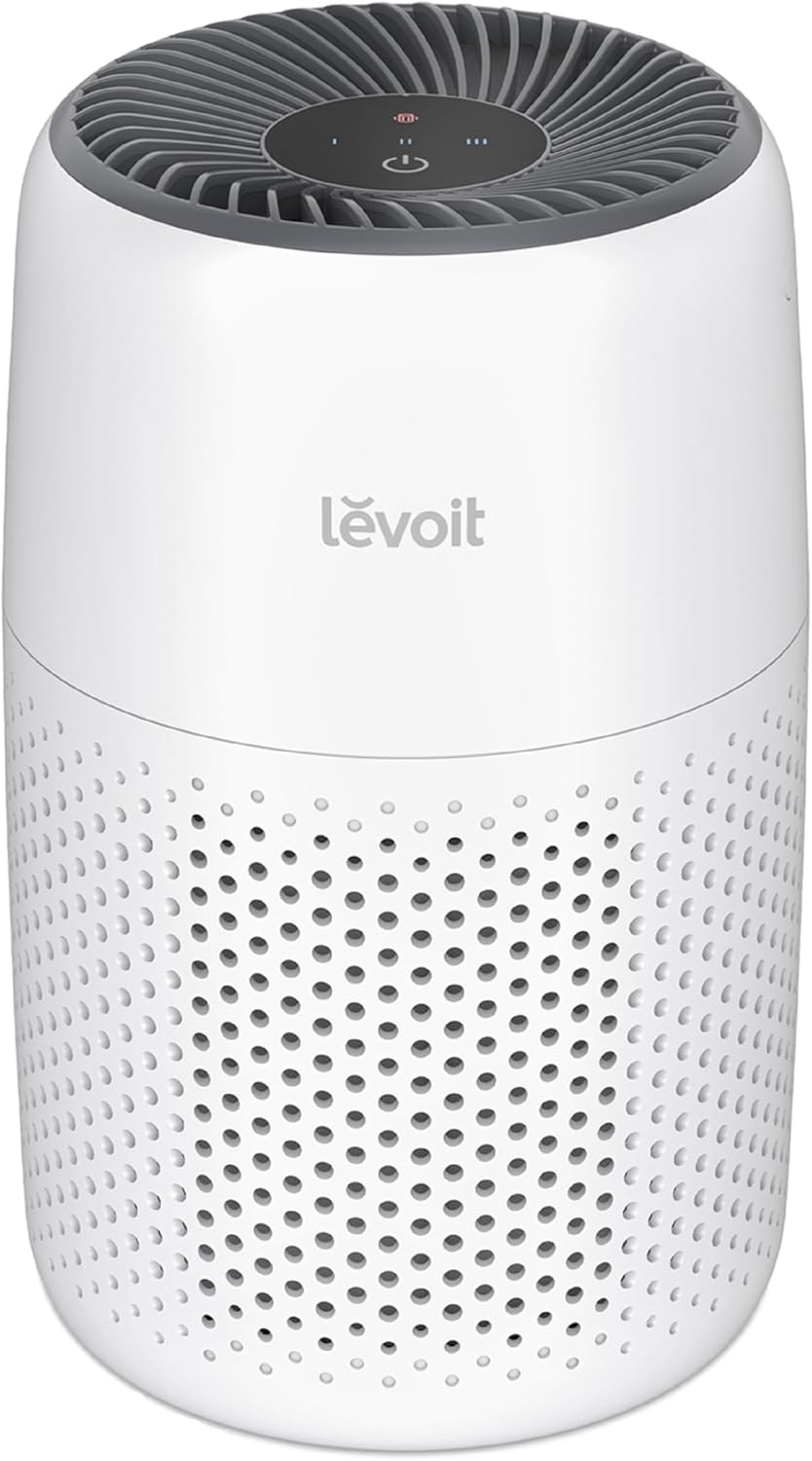
| Rated Power | 7W |
|---|---|
| Noise Level | 27–45dB |
| Adapter Input | 100–240V, 50/60Hz |
The Levoit Core Mini-P is a small, plug-in air purifier built for tabletop, desktop, or bedside use in small rooms. It draws air through a pre-filter and main HEPA-grade filter to remove lint, hair, pet dander, fine particles and smoke, and it includes a fragrance sponge for light aromatherapy. Controls include a sleep mode and an auto-off display to reduce disturbance overnight, and the unit is rated to run at very low noise levels (27–45 dB) while consuming only 7 watts. Practical benefits include easy placement thanks to its compact footprint and an internal adapter for simple setup, plus the ability to neutralize odors in confined spaces. Limitations are inherent to the size: it is intended for small areas rather than whole rooms, replacement filters and fragrance use require occasional attention, and overfilling the oil pad can damage plastic parts if not limited to the recommended 2–3 drops.
Best for: Buyers who want a dependable, low-noise purifier for a bedroom, office, or dorm that runs continuously without high energy use and handles common household particles and odors.
Less Ideal for: Those needing fast purification for large living rooms or whole-home coverage should choose a larger-capacity purifier instead.
- Compact, portable design fits on desks and nightstands
- Low power draw (7W) for continuous use
- Very quiet operation (27–45 dB) suitable for sleep mode
- Pre-filter plus main filter captures pet dander, dust, smoke and odors
- Sized for small spaces only and not suitable for whole-room purification
- Aromatherapy sponge requires careful dosing to avoid plastic damage
Verdict: Choose the Core Mini-P when you need a reliable, energy-efficient, ultra-quiet purifier for small personal spaces.
Levoit Core 300-P Air Purifier

| Power Source | Corded Electric |
|---|---|
| Filter Type | 3 in 1 Filtration |
| Floor Area | 1073 square_feet |
| Noise Level | 24 db |
| Wattage | 56 watts |
The Levoit Core 300-P is a small, portable air purifier built for bedrooms, home offices, and other everyday rooms where low noise and effective particle removal matter. It uses a 3-in-1 original filter (preinstalled) with HEPA-grade performance that captures 99.97% of particles down to 0.1–0.3 microns and targets dust, pollen, pet dander, smoke, odors, and VOCs. A 56W motor yields a CADR that refreshes a 222 ft² room multiple times per hour and can cover larger open areas up to the quoted 1,073 ft² at a slower exchange rate. Controls are touch-based with a Sleep Mode that cuts noise to about 24 dB and allows the display to be turned off for undisturbed nighttime use. The unit is AHAM verified and meets CARB and ETL safety standards. Limitations include manual fan-speed control only on this model (no Auto Mode) and reliance on Levoit replacement filters to maintain the published CADR and efficiency; filter replacements every 6–8 months are recommended. Its compact footprint and quiet operation make it practical for continuous daily use but users should plan for ongoing filter costs.
Best for: Buyers who prioritize quiet, proven particle filtration and want a compact purifier for bedrooms or small-to-medium rooms backed by high review counts and independent certifications.
Less Ideal for: If you need automatic air-quality sensing or a fully hands-off smart purifier, choose a model with Auto Mode or smart connectivity instead.
- HEPA-grade 3-in-1 filter captures 99.97% of 0.1–0.3 micron particles
- Quiet Sleep Mode reduces noise to about 24 dB for night use
- AHAM verified and CARB/ETL certified for tested performance and safety
- Compact, portable design fits bedrooms and small living spaces easily
- This model lacks an Auto Mode so fan speed must be adjusted manually
- Best performance depends on using official Levoit replacement filters
Verdict: A quiet, AHAM-verified portable purifier that delivers proven HEPA-grade particle removal for bedrooms and everyday rooms.
VOOPNU H13 HEPA Air Purifier DH-JH12

| Model number | DH-JH12 |
|---|---|
| Filter type | H13 True HEPA triple-layer |
| Max coverage (stated) | 1,076 ft² per hour |
| Noise level | 22 dB (low) |
The VOOPNU DH-JH12 is a small, user-friendly air purifier that uses an H13 true HEPA triple-layer filter and 360 degree intake to capture fine particles and common household pollutants. It is aimed at tabletop or corner placement and is rated in lab testing to clean about 250 sq ft every 15 minutes, giving a stated coverage up to 1,076 sq ft per hour. Controls are simple — three speeds, a timer, and an aroma tray for essential oils — and the unit claims very quiet operation down to 22 dB for bedroom use. Practical benefits include low noise for overnight running, a compact footprint that fits on desks or nightstands, and multiple certifications (ETL, CARB, FCC, DOE) that reflect basic safety and emissions compliance. Limitations are its small physical size which implies lower total airflow compared with larger tower purifiers and the need for regular filter replacements per the recommended 3 to 6 month cycle; continuous long-term operation is suggested for best results. For buyers who prefer straightforward setup and quiet, continuous filtration in personal spaces, this model is a sensible choice.
Best for: Buyers who want a low-noise, easy-to-use purifier for a bedroom, office, or other personal space and prioritize certified, reliable filtration over high-capacity airflow.
Less Ideal for: People seeking whole-house or very large room purification or the highest CADR output should consider larger, higher-flow models instead.
- H13 true HEPA triple-layer filtration captures 99.97% of airborne particles
- 360° surround intake for more even room circulation
- Very quiet operation down to 22 dB suitable for bedrooms
- Simple, one-touch controls with three speeds and a timer
- Built-in essential oil tray for light scenting while running
- Compact size limits maximum airflow compared with larger room purifiers
- Requires filter replacements on a 3–6 month schedule to maintain performance
Verdict: A compact, quietly running HEPA purifier that gives risk-averse buyers certified, easy-to-use filtration for bedrooms and small personal spaces.
Choosing the Right Portable Air Purifier: Key Factors to Consider
Filtration Technology
The core purpose of a portable air purifier is to remove particles and contaminants from the air. Units that use a true HEPA filter or an equivalent high-efficiency particulate filter will remove the vast majority of fine particles such as dust, pollen, and many respiratory aerosols. Some models add activated carbon or specialized media to reduce odors and volatile organic compounds, which is important if you want smell control in addition to particle removal.
Understanding the filter types helps set expectations for what a unit will remove and how often filters need replacing. If someone in the home has allergies or asthma, prioritize verified particle filtration over features that do not capture fine particulates.
Room Size and Airflow
A portable purifier's effectiveness depends on matching its airflow capability to the room where it will be used. Look for the Clean Air Delivery Rate or manufacturer-stated room coverage as a baseline for how many air changes per hour you can expect. A unit that is underpowered for the intended space will struggle to reduce particulate concentrations quickly.
Consider placement as well: portable purifiers work best when placed centrally or where airflow is not obstructed by furniture. For larger open-plan rooms, multiple smaller units or a single higher-capacity unit is preferable to relying on one compact purifier.
Noise and Daily Use
Noise performance matters because portable purifiers often run for many hours and are used in bedrooms and offices. Check decibel output at different fan speeds and prioritize models that remain quiet on their lower settings while still providing meaningful airflow. A very noisy unit is likely to be turned down or off, negating its benefit.
Also consider fan speed steps and an available sleep or quiet mode. Practical controls that let you run a low, continuous cleaning speed reduce the need for manual adjustments and help keep the unit active without disrupting sleep or concentration.
Maintenance and Operating Costs
All portable purifiers require periodic maintenance, primarily filter replacement. Understand the expected lifetime of initial and replacement filters, how easy filters are to access, and whether replacements are standard sizes or proprietary. Frequent, difficult, or costly filter changes can add up and affect long-term satisfaction.
Also check for washable pre-filters that extend primary filter life and straightforward indicators or reminders for filter changes. Units with clear maintenance procedures reduce the risk of users running devices with exhausted filters, which lowers effectiveness.
Controls, Automation, and Sensors
User convenience is important for consistent use. Units with simple, intuitive controls, clear displays, and basic automation are easier to adopt in daily routines. An automatic mode that adjusts fan speed based on an onboard particle sensor keeps the purifier responsive without manual input.
Air quality indicators give immediate feedback on indoor conditions and encourage continued use. Connectivity and app controls can be helpful but are not necessary for basic performance; if you value remote monitoring, prioritize models with reliable, privacy-respecting software.
Portability and Placement Flexibility
Since these units are meant to be portable, weight, handle design, and footprint matter for moving between rooms. A compact, lightweight unit is easier to reposition for targeted cleaning or seasonal use. Also consider vertical height and intake/exhaust orientations so the device fits comfortably on tables or nightstands without blocking airflow.
Keep in mind that portability should not force a compromise on critical performance metrics. A very small unit may be convenient to move but may not deliver sufficient airflow in larger rooms.
Where to Use a Portable Air Purifier
Portable air purifiers are best used in defined spaces where occupants spend significant time, such as bedrooms, nurseries, home offices, or a small living room. Position the unit where airflow is unobstructed and close to the breathing zone when possible. For bedroom use, place the purifier on a nightstand or dresser and choose a model with a quiet night mode.
In multiroom homes, consider which spaces need the most frequent cleaning and move the unit between rooms as needed. For continuous whole-home improvement, portable units can supplement central ventilation but are not a replacement for proper HVAC filtration and fresh-air exchange.
- Bedrooms and nurseries: prioritize low noise and reliable particle removal.
- Home offices: favor units with good airflow at moderate noise levels.
- Kitchens and pet areas: look for activated carbon options for odor control.
Understanding Clean Air Delivery and Runtime
Clean Air Delivery Rate, or CADR, is a practical indicator of how quickly a purifier can reduce particle concentrations in a space. Higher CADR or stated room coverage means faster clearing of airborne particulates, especially on higher fan speeds. Use the manufacturer's room size guidance as a starting point and aim for a unit that can provide multiple air changes per hour in the target room.
Runtime expectations are shaped by fan speed and energy use. Many portable models are designed for continuous use on low settings, with occasional higher-speed bursts when air quality worsens. If you need 24/7 operation, choose a model designed for continuous duty and check power consumption figures if energy use is a concern.
- Match CADR/coverage to room square footage for effective cleaning.
- Look for continuous-duty designs if you plan constant use.
- Use timers or scheduling to balance performance and energy use.
Placement Tips to Maximize Performance
Avoid placing the purifier behind furniture or in corners where intake or exhaust is blocked. Give the unit several inches of clearance on all sides for unobstructed airflow. Raising the unit slightly off the floor can improve circulation in some rooms but follow manufacturer guidance on safe placement.
For multi-occupant rooms, position the purifier centrally or near the area where people spend most time. In homes with pets, place the unit where shedding is heaviest to intercept particles before they spread across the room.
- Keep several inches of clearance around intakes and exhausts.
- Place near the breathing zone for targeted improvement.
- Avoid enclosed cabinets or tight shelves.
Common Misconceptions About Portable Purifiers
A common belief is that any air cleaner will eliminate all contaminants instantly. In reality, effectiveness depends on filter type, airflow, and room size. Portable purifiers reduce airborne particles over time but cannot instantly sterilize or remove every pollutant, especially on low fan settings.
Another misconception is that more features always mean better performance. Extras like lighting, aromatherapy pads, or Wi-Fi connectivity are useful to some users but do not substitute for core filtration capability. Focus first on the purifier's proven ability to capture particles and then evaluate add-on features.
- No single small unit can instantly purify a large open-plan room.
- Extra features do not replace filtration efficiency.
- Run time and fan speed choices strongly influence real-world results.
Maintenance Best Practices
Regular maintenance keeps a portable purifier working at its rated performance. Follow the manufacturer's replacement interval for primary filters and clean or replace washable pre-filters as recommended. Regularly inspect the unit for dust buildup around intake grills and vacuum or wipe as needed with a dry cloth.
Keep a simple schedule or set reminders for filter replacement to avoid running the unit with exhausted filters. If the unit includes indicators for filter life or air quality, use them as prompts but verify visually when possible.
- Check and replace filters on the recommended schedule.
- Clean pre-filters or grills to maintain airflow.
- Use filter-life indicators as a helpful guide, not an absolute substitute for inspection.
How We Chose the Best Portable Air Purifier
We applied practical, measurable filters to identify portable air purifiers that are genuinely useful for everyday home environments. First, we prioritized filtration performance by looking for units with recognized multi-stage filtration or true HEPA-level particle capture and verified clean air delivery potential. Second, airflow and room coverage were assessed to ensure each pick can handle typical bedroom or office footprints at useful fan speeds. Third, noise output across operating modes was included because quiet performance matters for nighttime and workspace use. Fourth, we evaluated user experience factors such as filter access, control simplicity, and available automation (timers, auto modes, and air quality indicators). Finally, reliability and maintenance demands informed selection; models with straightforward filter replacement and clear service intervals scored better. We excluded units that relied solely on gimmick technologies without verified particulate filtration, products designed only for industrial use, and any items that lacked basic safety certifications. The resulting shortlist balances measurable indoor air cleaning ability, practical coverage, low disturbance, and ease of upkeep.
Our full evaluation process is outlined in our review methodology.
FAQ
How large a room can a portable air purifier handle?
This depends on the unit's stated coverage or CADR. Choose a purifier sized for the room so it can provide multiple air changes per hour. For larger rooms, either pick a higher-capacity unit or use more than one portable purifier.
Do portable air purifiers remove odors and VOCs?
Some models include activated carbon or other adsorption media that reduce odors and certain VOCs. Particle filters alone do not remove gases, so check for dedicated odor-control media if smell reduction is a priority.
How often should I replace filters in a portable unit?
Replacement frequency varies by usage, air quality, and filter type. Typical primary filter lifespans range from several months to a year. Using washable pre-filters and following the manufacturer's guidance helps optimize replacement intervals.
Are quiet modes effective at cleaning air?
Quiet or sleep modes usually run at reduced fan speeds, so they provide slower air turnover. They are effective for ongoing background cleaning but may take longer to lower particle concentrations after a pollution event. Consider periodic boosts to a higher speed when needed.
Can I run a portable purifier all day?
Yes. Many portable models are intended for continuous operation. Running at a low continuous setting balances cleanliness and energy use. Ensure the unit is rated for continuous duty and maintain filters as recommended.
Final Verdict
When choosing a portable air purifier, prioritize proven filtration capability and appropriate room coverage before considering extras. Balance noise and runtime needs for the rooms where the unit will run most often, and factor in maintenance requirements like filter replacement frequency. If you need quiet overnight cleaning, choose a model with an effective low-noise mode and decent airflow at that setting. Ultimately, match the purifier to the space and your daily habits. Focusing on filtration efficiency, realistic coverage, and ease of upkeep will yield the most practical and long-lasting results for cleaner indoor air.