
Note: This article contains affiliate links. If you click on these links and make a purchase, we may earn a small commission at no extra cost to you. This helps support our research and content. Read our full affiliate disclosure here.
A basement that stays too damp invites musty smells, mold, and damaged belongings. Picking the right portable dehumidifier for basements matters because capacity, drainage options, and energy use determine whether the unit can actually maintain a safe humidity level in your space. This guide presents seven shortlisted portable dehumidifiers that suit common basement sizes and conditions. We evaluated each option against the key performance and usability factors buyers care about so you can pick a machine that controls humidity, minimizes maintenance, and fits your basement layout. Read on for what to expect from these picks and the criteria we used to choose them.
Top Picks at a Glance
| Best Overall The best all-around choice for most situations | Waykar 80-Pint Dehumidifier JD025CE-80 |  |
| Best Quality Built to a higher standard if you want something more solid | MOUNTO DH155W Dehumidifier |  |
| Best Value The sweet spot between price and what you get | AEOCKY BOREAS-001 Dehumidifier |  |
| Best Budget The cheapest option that still gets the job done reliably | ToLife Dehumidifier TZ-C2 |  |
| Top Rated A top-rated pick with lots of positive feedback | hOmeLabs 32-Pint Dehumidifier |  |
| Most Popular A crowd favorite that many people choose with confidence | BEDRED CT11 Dehumidifier |  |
| Best Seller A high-volume bestseller chosen again and again | ToLife Dehumidifier TZ-C2 |  |
Waykar 80-Pint Dehumidifier JD025CE-80

| Dehumidification Capacity | 80 pints_per_day |
|---|---|
| Tank Volume | 2.5 gallons |
| Wattage | 270 watts |
| Air Flow Capacity | 165 cfm |
| Operation Mode | Continuous |
The Waykar 80-Pint Dehumidifier is built to handle large, damp areas such as basements by extracting up to 80 pints per day and offering both tank and continuous drain options. It is commonly used running continuously or on a timed schedule to bring basement humidity down to a selected setpoint between 30% and 80% relative humidity, and the 90° auto-swing helps spread airflow for more even drying. Practical features include an included drain hose and connector for gravity drainage, a washable removable filter, automatic defrost and overload protection for low-temperature reliability, and an Energy Star rating to keep running costs lower than noncertified units. At roughly 42 dB it is quieter than many similarly sized machines, making it reasonable for finished basements or nearby living areas. The unit is relatively heavy and targeted at larger spaces, so it is less convenient to move frequently, and the 1.14 gallon tank means emptying is still needed if you do not use continuous drainage. For buyers focused on dependable basement performance and energy efficiency, this model delivers strong moisture removal with sensible protections for extended operation.
Best for: Homeowners who need a reliable, high-capacity dehumidifier to control moisture in large basements and prefer proven features and energy efficiency over portability.
Less Ideal for: People looking for a lightweight, highly portable unit for small rooms or occasional use should consider smaller, easier-to-move models instead.
- High dehumidification capacity rated at 80 pints per day for large basements
- ENERGY STAR certification for better energy efficiency during extended use
- Multiple drainage options with included drain hose for continuous gravity drain
- Auto-defrost and overload protection improve reliability in cool basement conditions
- 90° auto-swing airflow and washable filter help distribute air and simplify maintenance
- Relatively heavy and sized for large spaces, so not ideal for frequent transport
- Water tank is modest at 1.14 gallons if continuous drainage is not used
Verdict: A powerful, Energy Star certified 80‑pint unit that reliably handles large basement humidity with continuous drain and protective auto-defrost features.
MOUNTO DH155W Dehumidifier

| Capacity | 268 pints (saturation) / 155 pints (AHAM) |
|---|---|
| Air Flow Capacity | 350 cfm |
| Wattage | 470 watts |
| Operation Mode | Continuous |
| Voltage | 120 volts |
The MOUNTO DH155W is a high-capacity LGR dehumidifier built for demanding basement and water-damage jobs where fast, continuous moisture removal is required. It delivers industrial-grade extraction (rated 268 pints at saturation and 155 pints AHAM), moves a lot of air with a 350 CFM fan, and runs on 120V power while drawing about 11A. Practical touches include a built-in condensate pump with long lift capability and a 25 ft drain hose for continuous unattended operation, plus wheels, a rigid handle, and an LED display with humidity and temperature readouts and memory restart after power loss. The unit is clearly aimed at restoration pros and heavy-duty basement use so it is robust but large and heavy; it will occupy floor space and needs appropriate handling for transport and storage. It runs continuously rather than offering multiple fan speeds and its 470W power draw means it is best on a dedicated circuit in long runs. For anyone needing fast, reliable dehumidification in damp basements or after flooding, this model focuses on performance and uptime.
Best for: Buyers who prioritize fast, professional-grade moisture removal for basements, restorations, and flood-drying projects and who need a durable, continuously draining unit.
Less Ideal for: People seeking a lightweight, quiet dehumidifier for everyday household use or small rooms should consider consumer-grade models instead.
- Very high moisture removal capacity suitable for large basements and water-damage jobs.
- Built-in condensate pump with long lift and included 25 ft drain hose enables continuous unattended drainage.
- Robust airflow (350 CFM) and LGR technology improve drying speed and efficiency in cooler conditions.
- Digital display with humidity and temperature readouts plus automatic restart simplifies monitoring and jobsite use.
- Wheels and a rigid handle make moving the unit across work sites easier than stationary commercial units.
- Heavy and bulky, requiring effort or equipment to move and store.
- Single fan speed limits airflow control for lower-demand situations.
- Relatively high power draw that may need a dedicated circuit for extended use.
Verdict: If you need professional-speed drying for basements or water-damage jobs, the MOUNTO DH155W delivers high-capacity continuous dehumidification with built-in pumping for unattended operation.
AEOCKY BOREAS-001 Dehumidifier

| Dehumidification Capacity | 50 pints_per_day |
|---|---|
| Floor Area | 3500 square_feet |
| Tank Volume | 0.8 gallons |
| Wattage | 380 watts |
| Operating Noise (Min-Max) | 40-43 dB |
The BOREAS-001 packs strong compressor-level moisture removal into a compact cabinet intended for basements and other residential spaces. It extracts up to 50 pints/day under hot, humid test conditions and uses a 0.8 gallon collection tank with a supplied 2 m drain hose and garden-hose adapter for continuous gravity drainage. Controls include adjustable humidity (40%–80%), fan speeds, a 24-hour timer, child lock, and an ambient humidity light that offers a quick visual cue. Notable practical benefits are its small footprint and caster handle design for easy placement, an auto-defrost routine for cool basements, and claimed low-noise operation in the 40–43 dB range so it can run near living areas without being intrusive. The unit favors continuous drainage in very damp spaces since the tank fills quickly at high output, and buyers should plan plumbing or a nearby floor drain when heavy, long-term dehumidification is needed. If you need a larger tank or a pump for uphill discharge, larger models in the brand lineup are available.
Best for: Buyers who want an efficient, space-saving compressor dehumidifier for basements or damp rooms and value quiet operation and continuous drainage capability over a large onboard tank.
Less Ideal for: Users who need very large water storage or who require uphill automatic drainage without a pump should consider larger models with bigger tanks or an integrated pump.
- High dehumidification capacity up to 50 pints/day for a compact compressor unit
- Includes 2 m drain hose and garden-hose adapter for continuous gravity drainage
- Auto-defrost and humidity-compensation smart control keep it working in cool basements
- Quiet operation claimed at roughly 40–43 dB, suitable for near-living-space use
- Built-in casters and reinforced handle for easy repositioning
- Small 0.8 gallon tank fills quickly at high output, making continuous drainage preferable
- No built-in pump for uphill drainage without purchasing a different model
- Manufacturer noise and efficiency claims are higher-level marketing points and may vary with real-world conditions
Verdict: If you need powerful, quiet basement dehumidification in a compact, portable package and can use continuous drainage, the BOREAS-001 is a practical, space-saving choice.
ToLife Dehumidifier TZ-C2
| Floor Area | 1000 |
|---|---|
| Tank Volume | 95 fluid ounces |
| Number of Speeds | 2 |
| Wattage | 93 watts |
| Voltage | 220 volts |
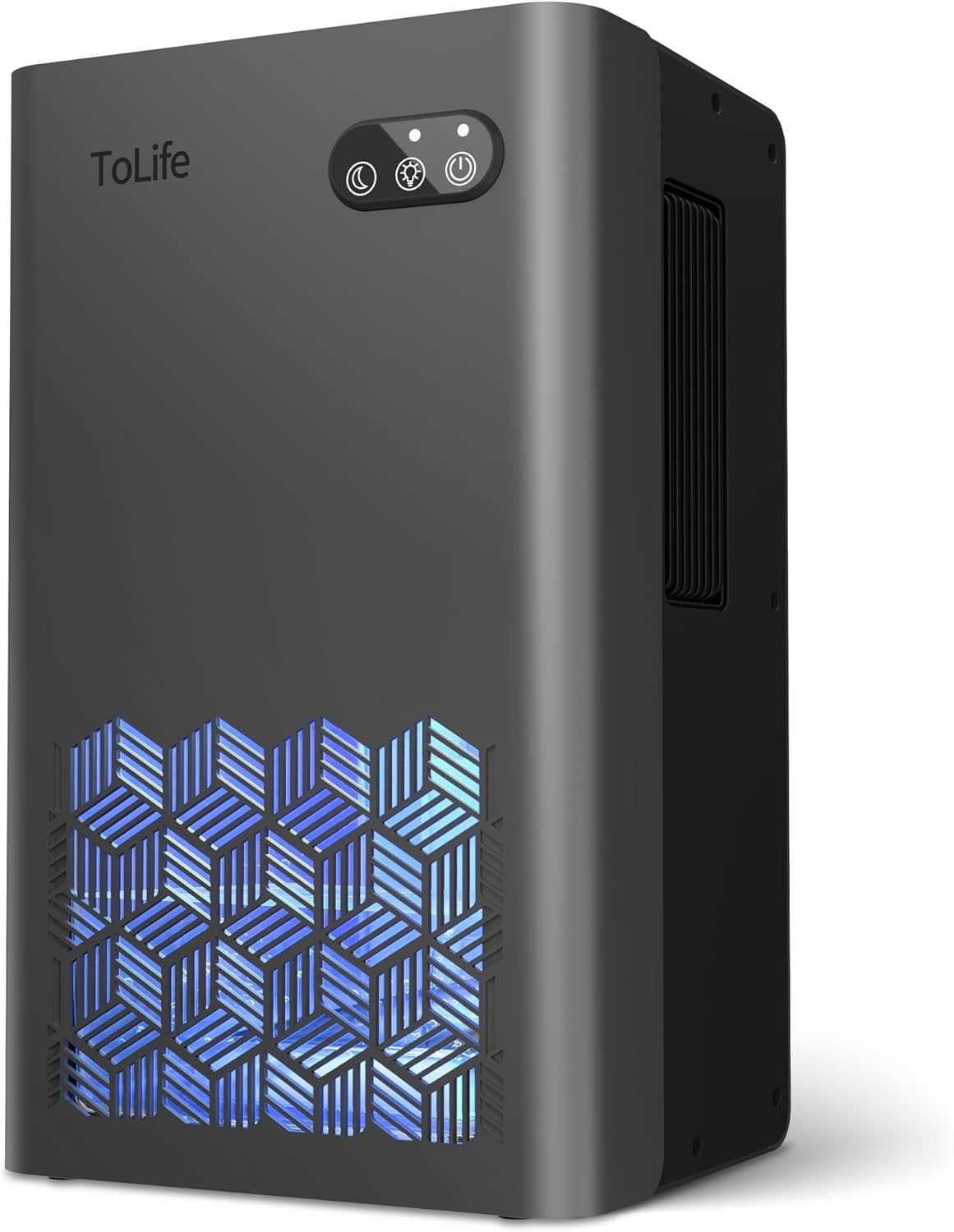
The ToLife TZ-C2 uses semiconductor condensation technology to quietly pull moisture from the air and deposit it into a removable 95 oz tank, making it a straightforward option for damp rooms. It offers two operating modes: a higher-power setting for faster moisture removal and a low-speed sleep mode that runs under 30 dB for overnight use. A seven-color LED can act as a night light and the unit includes automatic shutoff when the tank is full or removed, plus handles for easy moving between rooms. Practical benefits include simple setup, low noise, and a compact footprint that fits in basements, bathrooms, or bedrooms. Limitations are its modest rated dehumidification capacity and stated coverage, which means it will be most effective in smaller basement zones or for spot treatments rather than drying a large, very damp basement quickly. Also this model runs on 220 volts, so electrical compatibility should be confirmed for your location.
Best for: Buyers who need an affordable, portable dehumidifier for spot dehumidifying small basement areas, bathrooms, or bedrooms and who prioritize low noise and easy portability.
Less Ideal for: People looking to dry large, very damp basements or whole-house coverage should consider a higher-capacity compressor dehumidifier instead.
- Large removable 95 oz water tank reduces how often you need to empty it
- Quiet sleep mode under 30 dB suitable for nighttime operation
- Portable design with handles for moving between rooms
- Automatic shutoff prevents overflow when the tank is full
- Dehumidification capacity is modest and may be slow in very damp or large basements
- Requires 220 volt power which may not match all household outlets
Verdict: A compact, budget-friendly portable dehumidifier that is best for quiet, small-area moisture control and occasional basement spot treatments.
hOmeLabs 32-Pint Dehumidifier

| Dehumidification Capacity | 35 pints_per_day |
|---|---|
| Capacity | 1.8 gallons |
| Tank Volume | 1.6 gallons |
| Number of Speeds | 2 |
| Floor Area | 4500 square_feet |
This hOmeLabs unit is a straightforward, room‑scale dehumidifier built for large spaces like basements and open living areas. It removes up to 32 pints per day under typical conditions (and higher at very warm, humid extremes), and offers both a removable 1.6 gallon water tank with auto shutoff and a continuous drain outlet for hands‑free operation. The machine includes washable filter media, two fan speeds plus a TURBO mode for faster moisture removal, and smart features such as Wi‑Fi control and voice assistant compatibility so you can monitor and change humidity from your phone. Mobility is simple thanks to built‑in casters and a handle, and safety conveniences include automatic defrost and auto restart after power interruptions. Expect practical, reliable performance for basement humidity control, though it is a single‑hose portable unit so performance will vary with room layout and extreme cold conditions can reduce extraction rates. For buyers who want easy setup, remote control, and reliable daily dehumidification, this model covers the essentials without complex installation.
Best for: Buyers who want a reliable, easy‑to‑use dehumidifier for a basement or large room and value remote control, straightforward maintenance, and portability.
Less Ideal for: People seeking a hard‑plumbed or whole‑house solution or those who need maximum extraction in consistently cold spaces should consider other types of systems.
- Removes up to 32 pints per day with higher capacity at very high temperature and humidity
- Wi‑Fi control and compatibility with Alexa and Google Assistant for remote monitoring and adjustments
- Continuous drain option plus a removable tank with auto shutoff reduces manual emptying
- Washable air filter and caster wheels make maintenance and relocation simple
- Performance drops in cold environments since rated capacity is specified at warmer test conditions
- Only two fan speeds may limit fine control of noise versus extraction rate
Verdict: A portable, Wi‑Fi enabled dehumidifier that delivers dependable moisture removal and easy maintenance for large basements and open rooms.
BEDRED CT11 Dehumidifier

| Floor Area | 1000 square_feet |
|---|---|
| Tank Volume | 95 fluid ounces |
| Capacity | 5.9 pounds |
| Operation Mode | Intermittent |
| Other Special Features of the Product | 7 Color Ambient Light, Automatic Shutoff, Sleep Mode |
The BEDRED CT11 is a compact thermoelectric dehumidifier intended to reduce humidity in small spaces such as bedrooms, bathrooms, and modest basements up to about 1000 sq ft. It uses semiconductor cooling rather than a compressor, so it runs quietly and is simple to operate with an intermittent operation mode and an automatic shutoff when the 95 oz tank fills. Sleep Mode turns off the lights and lowers noise for overnight use, and the seven-color ambient light gives an optional mood-lighting feature. Practical benefits include easy emptying from the included tank, portability thanks to a lightweight design, and low sound levels that suit living spaces. Important limitations are inherent to semiconductor units: lower capacity compared with compressor dehumidifiers, reduced performance in very cold or very damp basements, and a smaller tank that requires more frequent emptying in high-humidity conditions.
Best for: Buyers who prioritize quiet, low-maintenance dehumidification and want a compact unit that is easy to move and run in living spaces or small basements without frequent intervention.
Less Ideal for: People needing heavy-duty moisture control for large, cold, or very damp basements should choose a higher-capacity compressor dehumidifier instead.
- Quiet thermoelectric operation suitable for bedrooms and living rooms
- Automatic shutoff protects against overfill and simplifies unattended use
- 95 oz removable tank for straightforward water removal
- Sleep Mode and ambient light options for low‑noise nighttime use
- Compact and lightweight for easy placement or moving between rooms
- Semiconductor cooling gives lower moisture removal capacity than compressor models
- Performance drops in cold basement conditions and very high humidity areas
Verdict: Choose the BEDRED CT11 if you want a quiet, portable dehumidifier with auto‑shutoff and sleep‑friendly operation for small basements or living spaces.
ToLife Dehumidifier TZ-C2

| Floor Area | 1000 square_feet |
|---|---|
| Tank Volume | 95 fluid ounces |
| Number of Speeds | 2 |
| Wattage | 93 watts |
| Operation Mode | Comfort |
The ToLife TZ-C2 is a small, portable dehumidifier that uses semiconductor condensation to pull moisture from the air and collect it in a removable 95 oz tank. It is meant for spot use in bedrooms, bathrooms, closets, RVs and small basements up to roughly 1000 sq ft, offering a choice of a higher-power mode for faster moisture reduction and a low-noise sleep mode for nighttime use. Practical features include auto shutoff when the tank is full or not seated properly, a carry handle for moving between rooms, and a seven-color LED ambient light you can lock as a night light. The unit runs at about 93 watts and lists quiet operation under 30 dB in sleep mode, but its listed daily dehumidification capacity is low, so it will be slow in very damp basements or large open spaces. It also uses semiconductor technology rather than a compressor, which keeps it quiet and portable but limits heavy-duty moisture removal. For routine humidity control in small basement zones or for supplemental use, it is convenient and easy to maintain, but not a replacement for a higher-capacity compressor dehumidifier in persistently wet basements.
Best for: Buyers who want a low-noise, easy-to-move unit to manage humidity in a small basement zone or other confined spaces and who prioritize safety features and simple operation.
Less Ideal for: Those needing fast, high-capacity moisture removal for large or continuously damp basements should choose a compressor-style dehumidifier instead.
- Portable, lightweight design with a built-in handle for easy room-to-room placement
- Large removable 95 oz water tank with automatic shutoff to prevent overflow
- Two-speed operation plus a quiet sleep mode for low-noise nighttime use
- Seven-color LED ambient light that can be locked and used as a night light
- Semiconductor condensation design delivers limited daily extraction compared with compressor units
- Not suited for large or very damp basements where heavy dehumidification is required
Verdict: A quiet, portable option for managing humidity in small basement zones when you need an easy, low-maintenance unit rather than heavy-duty extraction.
Choosing the Right Portable Dehumidifier for Basements: Key Factors to Consider
Extraction Capacity
Extraction capacity is the rate at which a dehumidifier removes water from the air, usually measured in pints per day. For basements, which are often larger and more humid than typical rooms, capacity determines how quickly humidity falls to a safe range and how well the unit handles prolonged damp conditions.
Choosing a unit with too low a capacity means it may run continuously without making meaningful progress, which increases wear and energy use. Conversely, oversizing can waste energy and cost more up front. Match capacity to your basement square footage and ceiling height, and consider higher capacity if the space includes laundry, exposed earth, or known water intrusion.
Low-Temperature Performance
Basements tend to run cooler than living spaces, and dehumidifier efficiency drops as air temperature falls. Some units stall or freeze up at low temperatures, while others include frost or low-temp modes that allow continuous operation.
Evaluate specifications for rated extraction at lower temperatures and look for explicit frost-protection features. A model that maintains meaningful extraction at cooler basement conditions will reduce the chance of shutdowns and the need for manual intervention during colder months.
Drainage Options and Continuous Run
Emptying a water tank in a basement can be inconvenient, especially if the unit runs frequently. Continuous drain capability, through gravity or a pump, lets a dehumidifier run unattended into a floor drain or a nearby sink.
Consider whether your basement has a convenient drain point and whether gravity feed will work with the dehumidifier's hose outlet height. If no floor drain is available or the unit must sit below the drain, a built-in pump or an external condensate pump is a practical choice to avoid frequent trips to empty the reservoir.
Energy Efficiency and Operating Cost
Basement dehumidifiers can run for long stretches during humid seasons, so energy consumption quickly becomes a major factor. Look for models with efficient compressors, adjustable humidity setpoints, and an Energy Factor or consumption data that align with lower operating costs.
Timers and humidity-controlled operation reduce unnecessary runtime. While initial purchase cost matters, calculating likely monthly energy use based on local electricity rates and expected run hours gives a clearer picture of long-term ownership costs.
Noise Level and Fan Speed Control
Noise matters if the basement is a home office, media room, or living area. Loud fans and compressors can be disruptive. Models with multiple fan speeds, quiet modes, or lower decibel ratings give you flexibility between performance and comfort.
Check noise specifications and consider where the unit will sit relative to occupied spaces. A slightly larger, quieter unit may be preferable to a smaller, louder one if the basement is frequently used for activities sensitive to noise.
Durability, Build, and Mobility
Basements present physical challenges: concrete floors, potential splashes, and the occasional need to move equipment. A robust housing, stable base, and corrosion-resistant components extend service life in these conditions.
Mobility features such as casters, handles, or a compact footprint make it simpler to reposition the unit for seasonal use or to treat different areas. Also evaluate filter access and ease of cleaning, since basement dust and debris can clog filters faster than cleaner living spaces.
Sizing Your Basement and Matching Capacity
Start by measuring the finished square footage and ceiling height of the basement. Multiply floor area by ceiling height to get a volume estimate if your basement has unusually high ceilings. Use that measurement and typical humidity levels to select a dehumidifier capacity that will achieve and maintain a relative humidity around 45 percent.
If the space is unfinished, contains exposed earth, or has a history of water intrusion, add a safety margin to the required capacity. For larger basements, consider more powerful units or using two smaller units placed in different zones to promote even dehumidification.
- Finished basements usually need less extraction than unfinished, high-moisture spaces.
- High ceilings increase volume and may require higher-capacity units.
- Divide very large basements into zones rather than relying on one distant unit.
Placement and Venting Best Practices
Position the dehumidifier where airflow is least obstructed, typically several feet from walls and large objects. Keep the intake and exhaust clear so the appliance can cycle air efficiently. Placing the unit centrally in an open area or near the main source of moisture yields the best results.
Avoid placing the unit directly against concrete that is actively leaking or where pooling occurs. If the basement has a sump or floor drain, plan hose routing so the continuous drain can reach the drain with minimal kinks and elevation change.
- Maintain clearance on all sides to avoid restricted airflow.
- Keep the unit on a level surface and elevate slightly if brief water exposure is possible.
- Route drain hoses along walls and use clips or straps to secure them.
Maintenance Routines for Long-Term Performance
Regular maintenance keeps a dehumidifier operating efficiently. Clean or replace filters according to the manufacturer schedule, and vacuum intake grilles to prevent dust buildup. In basements with heavy dust or pet hair, check filters more frequently.
Inspect condensate hoses for blockages and check seals for leaks. If the unit has a pump, test it periodically to verify it can lift condensate as expected. Keep the reservoir and collection areas clean to prevent odors and microbial growth.
- Wipe coils and accessible components during seasonal deep cleaning.
- Store the unit properly during off-season months in a dry area.
- Record periodic maintenance dates to stay on schedule.
Dehumidifier Noise: Managing Sound Without Sacrificing Performance
Understand that fan speed and compressor cycles drive most noise. If the basement is frequently used for activities that require quiet, choose a unit with lower-decibel operation or adjustable fan speeds to switch to a quieter mode when needed.
Placement can reduce perceived noise. Position the unit on vibration-absorbing feet or a thin rubber mat, and avoid placing it directly under living spaces where sound transmits upward.
- Lower fan speeds reduce noise but also reduce extraction rate.
- Rubber pads and vibration mounts can cut transmitted noise.
- Balance noise settings with the humidity setpoint to avoid prolonged runtime.
Safety Features and Operating in Cooler Conditions
Basement temperatures often dip into ranges that can challenge standard dehumidifiers. Look for frost protection, auto-defrost cycles, or specific low-temperature ratings to ensure reliable operation without ice buildup on coils.
Automatic shutoff on full tanks, thermal overload protection, and well-sealed electrical components reduce risk in damp environments. Confirm that any continuous drain connections are secure to avoid unexpected spills.
- Auto-defrost prevents performance loss and reduces maintenance.
- Full-tank shutoff protects internal components from overflow.
- Verify cord length and outlet placement to avoid extension cord use.
How We Chose the Best Portable Dehumidifier for Basements
We focused on attributes that directly affect a dehumidifier's performance in basement environments. Primary considerations included extraction capacity at typical basement temperatures, continual drainage options suitable for long-term unattended operation, and energy efficiency to limit running costs during heavy seasonal use. We also prioritized build features that matter in basements: durable housings, stable operation on concrete floors, and controls that work in lower light or damp conditions. Practical usability factors shaped selections as well. We looked for units with clear water-level indicators, easy-to-empty reservoirs, and caster or lift features to move the unit between spaces. Noise levels were considered because many basements serve as work or living spaces. Safety features, such as automatic shutoff and frost protection, were required for machines intended for cooler basement temperatures. We excluded units sized only for small closets or single rooms, and any models lacking either a drainage or robust condensate management option. Models with vague performance ratings or insufficient documentation on capacity at lower temperatures were also filtered out. The final list balances realistic extraction at basement conditions, energy use, and practical durability.
Our full evaluation process is outlined in our review methodology.
FAQ
How large a dehumidifier do I need for a 1,000-square-foot basement?
It depends on ceiling height and humidity level, but basements that size typically need a unit with higher daily extraction capacity than a bedroom model. Factor in whether the space is finished or has moisture sources and choose capacity with a safety margin for wetter conditions.
Can I run a portable dehumidifier in a cold basement during winter?
Many modern portable units support low-temperature operation, but performance drops as air temperature falls. Look for frost-protection or low-temp ratings if you expect sustained cool conditions to avoid freeze-ups and shutdowns.
Is continuous gravity drainage enough for basement use?
Gravity drainage works when the dehumidifier sits at or above the level of a floor drain. If the unit must sit lower than the drain, or the layout prevents a downhill route, a model with a built-in condensate pump or an external pump is a better choice for unattended operation.
How often should I clean the dehumidifier filter in a basement?
In basements, check filters every month and clean or replace them as needed. Dust, pet hair, and airborne debris can clog filters faster than in living spaces, which reduces airflow and extraction efficiency if not addressed.
Do dehumidifiers prevent mold entirely?
They reduce relative humidity and lower the risk of mold growth, but they do not remove mold already present or address structural water intrusion. Use dehumidification alongside proper ventilation, moisture repairs, and cleaning to control mold.
Final Verdict
When choosing a portable dehumidifier for basements prioritize realistic extraction capacity for your space, reliable low-temperature performance, and drainage options that match your layout. Balance energy efficiency against required runtime to keep operating costs manageable, and factor noise and durability into the decision if the basement is used as living or work space. A well-matched dehumidifier protects belongings, cuts mold risk, and reduces musty odors. Focus on the core tradeoffs—capacity versus efficiency, continuous-drain convenience, and quiet operation—to select a unit that meets your basement's specific needs with minimal fuss.