
Note: This article contains affiliate links. If you click on these links and make a purchase, we may earn a small commission at no extra cost to you. This helps support our research and content. Read our full affiliate disclosure here.
If you run a busy bakery, pizzeria, or foodservice operation, a Powerful Commercial Dough Mixer is one of the core pieces of equipment that affects product consistency and kitchen throughput. Choosing the right mixer matters because it determines how quickly you can scale batch sizes, how consistent dough development will be, and how much maintenance the machine will need over time. This guide covers seven shortlisted heavy-duty mixers that suit professional use and compares them across the attributes professional kitchens care about. We evaluated motor capacity, bowl and attachment options, construction and serviceability, plus safety and controls. Read on for a compact evaluation to help you match a mixer to your production needs.
Top Picks at a Glance
| Best Overall The best all-around choice for most situations | HOUSNAT Commercial Mixer SZM-30 |  |
| Best Quality Built to a higher standard if you want something more solid | KitchenAid Commercial 8-Quart Mixer KSMC895CU |  |
| Best Value The sweet spot between price and what you get | KIOMGLE 30QT Commercial Dough Mixer |  |
| Best Budget The cheapest option that still gets the job done reliably | JOYDEEM Dough Maker JD-HMJ7L |  |
| Top Rated A top-rated pick with lots of positive feedback | ZACME 8.4QT Commercial Stand Mixer |  |
| Most Popular A crowd favorite that many people choose with confidence | Aucma 6.5QT Stand Mixer |  |
| Best Seller A high-volume bestseller chosen again and again | VEVOR Commercial Food Mixer 30Qt |  |
HOUSNAT Commercial Mixer SZM-30

| Capacity | 30 quarts |
|---|---|
| Wattage | 1250 watts |
| Number of Speeds | 3 |
| Voltage | 110 volts |
| Special Features | Time Setting Function |
The HOUSNAT SZM-30 is a heavy-duty 30-quart commercial mixer built to handle frequent bakery and restaurant workloads. It pairs a 1250W gear motor with three fixed speeds—low for kneading, medium for general mixing, and high for whipping—so it covers dough, batter, and cream tasks without unnecessary complexity. The included spiral dough hook, flat beater, and wire whip make it ready for pizza dough, mashed or batter mixes, and whipped creams or egg whites. A 60-minute programmable timer and dedicated start/stop controls help maintain consistency across batches while the safety lid with auto-shutoff and a vibration-dampening base improve operator safety and reduce noise in a busy kitchen. The all-304 stainless steel bowl and body simplify cleanup and meet commercial hygiene expectations. Expect a fairly large, heavy machine that needs proper counter space and electrical supply, and the three-speed knob limits micro-adjustment compared with variable-speed models. For kitchens that prioritize reliability and straightforward performance, this mixer performs solidly as a production workhorse.
Best for: Operators who need a straightforward, reliable commercial mixer for regular bakery or restaurant production and value durable stainless-steel construction and preset speeds over fine-grain speed control.
Less Ideal for: Home bakers with limited counter space or shops that require precise variable-speed control for delicate preparations should consider a smaller or variable-speed alternative.
- Powerful 1250W commercial gear motor suited for extended heavy-duty mixing
- Large 30-quart 304 stainless steel bowl designed for high-volume batches
- Comes with spiral dough hook, flat beater, and wire whip to cover common tasks
- 60-minute programmable timer and simple start/stop controls for repeatable results
- Safety lid with auto-shutoff and vibration-dampening base improve safety and reduce noise
- Only three fixed speeds limit fine control compared with variable-speed mixers
- Large size and 180-pound weight require a dedicated workspace and proper installation
Verdict: Buy this mixer if you need a durable, high-capacity commercial machine that reliably handles frequent dough and mixing tasks with straightforward controls.
KitchenAid Commercial 8-Quart Mixer KSMC895CU

| Capacity | 8 quarts |
|---|---|
| Wattage | 500 watts |
| Voltage | 120 volts |
| Number of Speeds | 10 |
The KitchenAid Commercial Series 8-Quart Bowl-Lift Stand Mixer is built for high-volume kitchens and serious bakers who need sustained power and capacity. It uses a robust motor and PowerCore technology to deliver consistent torque with reduced heat buildup, letting you knead large batches of dough, mix dense batters, or whip large quantities without frequent cooldowns. The bowl-lift design and stainless steel bowl guard keep heavy loads stable while the included Powerknead spiral dough hook, flat beater, and premium 11-wire whip cover most professional mixing tasks. Ten speed settings and a soft-start feature reduce splash and make it easier to bring ingredients together. NSF certification and a commercial-grade cord signal this unit is engineered to meet professional standards. Expect a substantial countertop footprint and a heavier machine that is meant for a back-of-house environment rather than occasional home baking, and note that this model is manual rather than programmable. For kitchens that demand reliability and the ability to handle large batches, this mixer delivers the performance and durability to match that need.
Best for: Bakers, restaurants, and caterers who prioritize sustained motor performance and large-batch capacity for daily commercial or high-volume production.
Less Ideal for: Casual home bakers or users seeking a compact, lightweight mixer with programmable features and minimal countertop footprint should consider smaller consumer models.
- Commercial NSF certification and heavy-duty cord for compliant professional use
- PowerCore motor technology provides consistent power with reduced heat buildup for long runs
- 8-quart bowl and bowl-lift design handle large batches and keep heavy mixes stable
- Includes commercial-grade attachments: Powerknead spiral hook, flat beater, and 11-wire whip
- Soft-start and 10 speed settings give control when starting and mixing a wide range of recipes
- Manual controls only with no programmable presets
- Large, heavy unit intended for commercial counters rather than light home use
Verdict: Choose this KitchenAid Commercial 8-quart mixer when you need a durable, NSF-certified machine that delivers reliable, long-running power for heavy-duty, large-batch dough and mixing work.
KIOMGLE 30QT Commercial Dough Mixer

| Capacity | 30 quarts |
|---|---|
| Wattage | 1500 watts |
| Voltage | 110 volts |
| Noise Level | 85 db |
This KIOMGLE 30QT commercial dough mixer is a heavy-duty stand mixer built to handle large batches of dough in a bakery, school kitchen, or restaurant. It pairs a 1500W copper-wired motor with double gears and belts to deliver steady power and a mixing rod speed geared for dough development, while the 30-quart stainless steel bowl accepts large quantities of flour and water. Practical safety and serviceability features include detachable stainless steel gear covers, a latch to secure the bowl during operation, and a flip mechanism that tilts the bowl 90 degrees for easy removal and cleaning. Controls are push-button and the unit supports forward and reverse rotation to help release dough from the hook. Expect industrial-level noise around 85 dB and substantial weight and footprint, so plan for a dedicated counter or cart and a 110V supply. For teams that need reliable, high-capacity mixing without fancy electronics, this mixer delivers robust performance and straightforward maintenance.
Best for: Bakers, small commercial kitchens, and institutions that prioritize high-capacity, durable mixing equipment for frequent large-batch dough production.
Less Ideal for: Home cooks with limited space or occasional low-volume baking needs should choose a smaller, quieter countertop mixer instead.
- Powerful 1500W motor with double-gear and belt drive for consistent mixing torque
- Large 30-quart stainless steel bowl suitable for big dough batches
- Safety features include detachable gear covers and a bowl latch to prevent rollovers
- Bowl flip and forward/reverse rotation make dough removal and cleaning easier
- Loud operation at about 85 dB may require hearing protection or a separate workspace
- Heavy and bulky unit that needs a dedicated sturdy surface or cart
Verdict: Buy this mixer if you need a rugged, high-power 30-quart machine that handles frequent large-batch dough mixing with straightforward, serviceable design.
JOYDEEM Dough Maker JD-HMJ7L

| Capacity | 6.24 liters |
|---|---|
| Wattage | 250 watts |
| Voltage | 120 volts |
| Noise Level | 70 db |
| Special Features | Fermentation Function, Intermittent Kneading, Time Setting |
The JOYDEEM JD-HMJ7L is a countertop dough maker that automates mixing, kneading and proofing for home bakers. You set a program or timer on the face-up touch panel, the unit uses intermittent kneading to mimic hand folding, and it offers a built-in fermentation mode so the machine can knead then hold dough for proofing without supervision. The 250 W motor and large 7.4 qt stainless steel bowl are aimed at family-sized batches and the machine handles flour amounts the manufacturer lists between about 600 and 2200 g. Controls are simple push buttons rather than adjustable speeds, which keeps operation straightforward but limits fine control over mixing intensity. Detachable stainless bowl and blade make cleanup easier and the top cover lets you add ingredients mid-cycle, though the base is not dishwasher safe. Noise is noticeable but typical for this class. For buyers focused on value, the JD-HMJ7L delivers automated kneading plus fermentation in one compact unit, but it is not a commercial-grade mixer and lacks variable speed or heavier-duty power for very large or dense batches.
Best for: Home bakers on a budget who want an all-in-one machine that kneads and proofs medium to large batches with minimal manual work and easy controls.
Less Ideal for: Commercial bakeries or users who need heavy-duty, high‑capacity mixers with variable speed and continuous-duty motors should look at purpose-built commercial equipment.
- Large 7.4 qt stainless steel bowl suitable for family-sized batches
- Built-in fermentation mode for kneading plus proofing without manual timing
- Intermittent kneading pattern that mimics hand mixing for better gluten development
- Removable stainless steel blade and lid make cleaning and ingredient additions easy
- Simple microcomputer controls and preset timer for one-touch operation
- Single fixed speed limits control for delicate or heavy doughs
- 250 W motor is adequate for home use but not designed for continuous commercial workloads
- Noise level around 70 dB is noticeable during operation
Verdict: If you want a budget-friendly, automated home dough maker that can knead and proof family‑size batches, the JOYDEEM JD-HMJ7L gives the most useful features for the price.
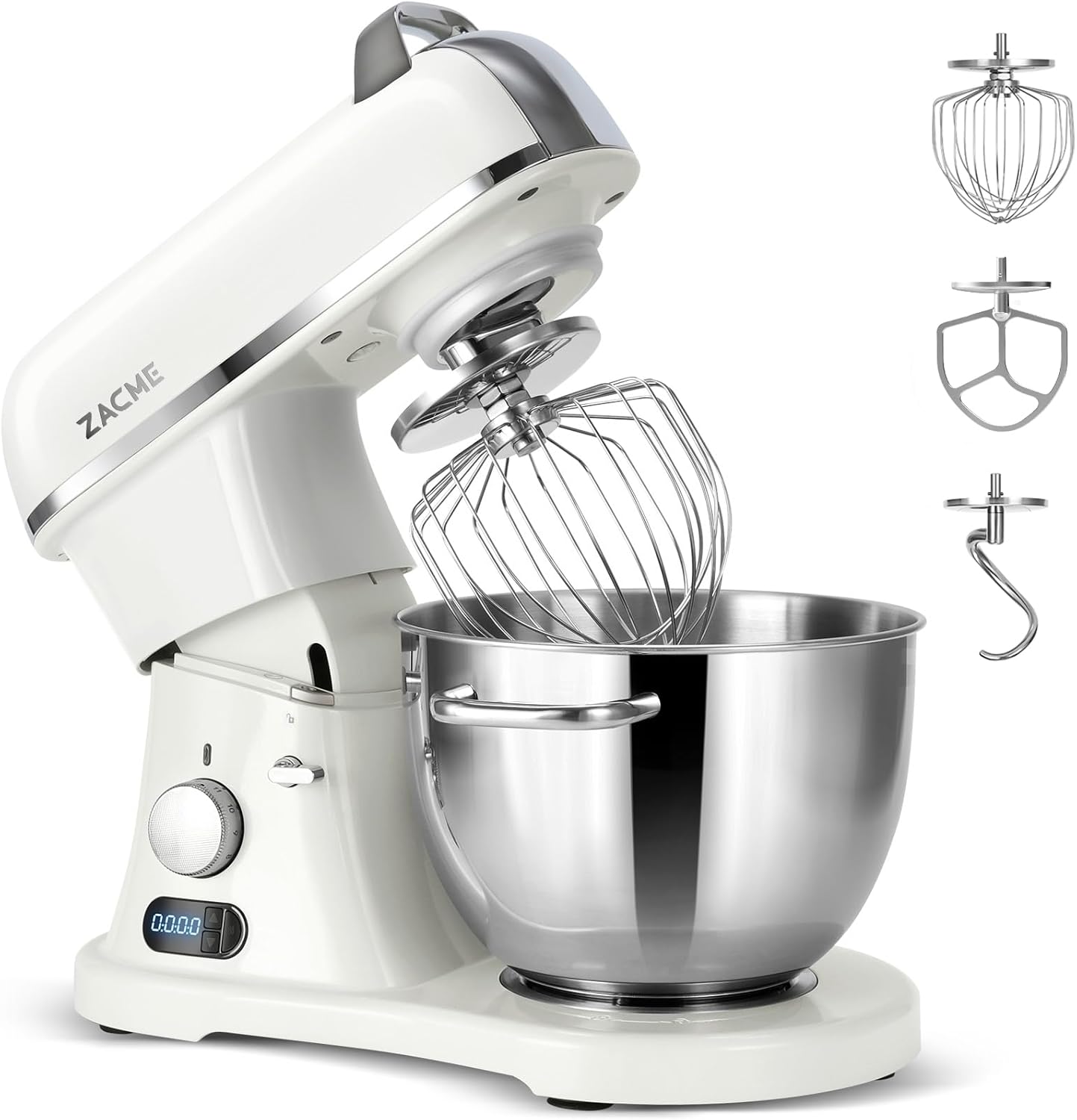
ZACME 8.4QT Commercial Stand Mixer
| Capacity | 8.4 quarts |
|---|---|
| Wattage | 800 watts |
| Number of Speeds | 11 |
| Noise Level | 48 db |
| Voltage | 120V |
This ZACME 8.4QT commercial stand mixer is built for heavy use in home or small commercial kitchens, pairing an 800W DC motor and metal gears with an aluminum die-cast body and stainless steel bowl. It handles large dough batches—up to about 3 kg—using planetary mixing to incorporate ingredients evenly without frequent scraping. The mixer offers 11 speed settings, a digital LCD with a countdown timer, tilt-head access for easy attachment changes, and included stainless steel dough hook, flat beater, and wire whip. Practical reliability features include dual cooling fans to prevent overheating during long runs, suction feet for stability, overload protection, and a noise rating reported around 48 dB on low speeds. The machine is heavier than consumer hobby mixers, so it feels stable and durable but is not convenient to move often. Buyers should note it is a sizable appliance and requires adequate counter space and electrical supply for sustained commercial use. For anyone needing consistent, large-batch mixing with a focus on build quality and longevity, this mixer delivers a lot of capability for the category.
Best for: Buyers who prioritize a durable, commercial-capable mixer for frequent large-batch baking and need a machine built to run reliably under heavy use.
Less Ideal for: Casual bakers who seldom make large quantities or who need a lightweight, easily storable mixer should consider smaller consumer models instead.
- Robust 800W DC motor with metal gears designed for heavy, continuous kneading
- Large 8.4-quart stainless steel bowl suitable for substantial dough batches
- NSF/ANSI 8-2023 compliant construction and aluminum die-cast body for commercial-grade durability
- Dual cooling fans and overload protection allow extended operation without overheating
- Digital timer and 11-speed control with tilt-head design for easy use and repeatable results
- Heavy and bulky, making it less portable and needing significant counter space
- Higher-noise levels on top speeds (up to reported 68 dB) compared with home-focused hobby mixers
Verdict: Choose this mixer when you need a sturdy, commercial-grade machine that reliably handles large batches and long mixing sessions.
Aucma 6.5QT Stand Mixer

| Wattage | 660 watts |
|---|---|
| Capacity | 6.5 quarts |
| Number of Speeds | 6 |
| Voltage | 120 volts |
| Noise Level | 76 db |
This Aucma stand mixer targets home bakers and small commercial kitchens that need a lot of mixing power without a heavy price tag. The 660W pure copper motor and six optimized speeds (plus pulse) handle everything from whipped egg whites to stiff cookie or bread dough, and the tilt-head design makes attaching the stainless steel whisk, beater, or dough hook straightforward. The 6.5-quart bowl with dual handles gives plenty of capacity for medium batches and the included splash guard helps keep prep tidy when adding ingredients. Controls are simple using a knob and a blue LED power indicator, and the attachments are dishwasher safe for easier cleanup. Noise is specified around 76 dB, so it is noticeable but not excessively loud for a powerful unit. Build uses ABS housing rather than full metal, so it feels lighter than commercial all-metal mixers and may show more wear under continuous heavy use. For someone comparing options using product reviews and performance claims, this mixer delivers strong real-world mixing power for frequent home or light commercial applications, but it is not a heavy industrial machine built for nonstop bakery production.
Best for: Buyers who want a review-backed, higher-power stand mixer for frequent home baking or light commercial dough work and who prioritize real-world performance evidence over premium all-metal construction.
Less Ideal for: Those running high-volume commercial bakeries or continuous production shifts should choose a purpose-built commercial all-metal mixer instead.
- Powerful 660W pure copper motor suitable for thick doughs and everyday baking tasks
- Large 6.5-quart stainless steel bowl with dual handles for medium-size batches
- Includes whisk, beater, dough hook and splash guard; accessories are dishwasher safe
- Tilt-head design makes inserting and removing attachments and bowl easy
- Six speeds plus pulse give good control for a range of recipes
- ABS housing instead of full metal construction may be less durable under continuous commercial use
- Specified noise level around 76 dB can be noticeable during heavy mixing
Verdict: Aucma’s 6.5QT mixer delivers strong, review-supported mixing power for frequent home bakers and small-scale dough work without the cost of a commercial-only machine.
VEVOR Commercial Food Mixer 30Qt

| Capacity | 28.5 liters |
|---|---|
| Wattage | 1100 watts |
| Number of Speeds | 3 |
| Noise Level | 70 db |
The VEVOR Commercial Food Mixer is a heavy-duty floor mixer designed for restaurants, bakeries, and other high-volume kitchens. It uses a gear-driven 1100W motor to deliver stable mixing across three preset speeds (130, 193, 458 rpm) and includes a 30 qt stainless steel bowl plus three attachments: dough hook, flat beater, and wire whisk. A lever lift makes raising and lowering the bowl quick, and a timer knob lets you set mixes up to 30 minutes with automatic shutoff. The safety guard and automatic shutdown when the cover is open add usable protections in a busy kitchen. Practical benefits include rust-resistant food-grade stainless components that simplify cleaning and a robust build intended for continuous use. Important limitations are its substantial weight and footprint, which require a permanent workplace and handling equipment to move, and the relatively simple three-speed control that lacks more granular speed settings for delicate tasks. Noise is listed around 70 dB, so it will be audible in tight prep areas.
Best for: Buyers who need a rugged, production-capable mixer for a commercial kitchen and prioritize reliability, simple controls, and easy cleaning over portability or fine speed tuning.
Less Ideal for: If you need a lightweight or portable mixer for occasional home use or require precise variable-speed control for specialized preparations, this unit is not the best fit.
- Powerful 1100W gear-driven motor for consistent mixing under load
- Large 30 qt stainless steel bowl suitable for batch production
- Three standard attachments (dough hook, flat beater, wire whisk) cover most commercial tasks
- Lever bowl lift and detachable parts make loading and cleaning faster
- Built‑in timer and safety guard with auto shutdown improve workflow and operator safety
- Heavy and bulky, not practical for kitchens without dedicated space or lifting equipment
- Only three speed settings limit fine control for some delicate mixing tasks
Verdict: Choose this VEVOR 30 qt mixer when you want a robust, safe, and easy-to-clean commercial machine built for steady daily production.
Choosing the Right Powerful Commercial Dough Mixer: Key Factors to Consider
Motor Power and Continuous-Duty Rating
Motor power and continuous-duty rating determine how well a mixer handles large, heavy doughs without overheating. Commercial doughs often demand sustained torque during long mixing cycles, so a motor rated for continuous operation at the intended load will maintain speed under strain and reduce the chance of thermal cutouts.
Higher torque improves dough development and shortens mix times, but it also increases electrical demand and may require three-phase power in some kitchens. Confirming the mixer's duty cycle and matching it to expected batch sizes prevents frequent interruptions and extends motor life.
Bowl Size, Speed Ratios, and Batch Throughput
Bowl capacity directly limits batch size and how many loaves or pizzas you can produce per run. Speed or gear ratios between attachments and the motor affect how quickly dough develops and whether the machine can accommodate slow, high-torque mixes without stalling.
Consider how many batches you need per hour and whether a single large batch or multiple smaller batches will be more efficient. Mixing smaller batches too often increases labor, while an oversized bowl may lead to poor ingredient incorporation for some recipes.
Construction Materials and Frame Design
A robust frame and corrosion-resistant materials matter for longevity in a commercial environment. Cast-iron or heavy-gauge steel frames reduce vibration and wear, while stainless-steel bowls and attachments resist corrosion from frequent cleaning and saline doughs.
Look for reinforcements around gearbox mounts and fasteners rated for frequent use. A sturdily built machine also maintains alignment over time, which preserves sealing surfaces and reduces gearbox stress.
Serviceability and Availability of Wear Parts
Easy access to common wear items like belts, gears, bearings, and seals minimizes downtime. Mixers designed with service panels and modular components let technicians perform routine maintenance faster and with lower labor cost.
Availability of replacement attachments and standard part sizes is important for operations that cannot afford extended outages. Consider whether the mixer allows in-place servicing versus requiring disassembly to a bench for common repairs.
Controls, Safety Interlocks, and Usability
Controls should be intuitive and robust for busy staff. Mechanical speed settings are simple and durable, while electronic controls and timers provide repeatability for consistent doughs. Safety interlocks that prevent bowl or head movement during operation protect staff and reduce accident risk.
Ergonomics matter too. Bowl lift mechanisms, attachment release systems, and clearly labeled controls reduce operator fatigue and training time. Evaluate how easy it is to secure the bowl and change attachments under live conditions.
Footprint, Noise, and Installation Requirements
A power mixer's physical footprint and weight affect where it can be installed and whether the floor can support it. Heavier, more powerful machines often require dedicated space and possibly a reinforced floor or mounting points.
Noise levels also matter in open kitchens or late-shift operations. Verify electrical requirements, including voltage and phase, before purchase so installation is straightforward and avoids last-minute retrofits.
Matching Mixer Capacity to Your Menu
Start by translating daily production goals into batch sizes. Calculate how many units you need per hour and work backward to the bowl capacity and cycle time required to meet that output. A mixer that can handle your largest dough formulation in one pass will minimize labor and handling.
Also consider the variety of items you make. If you produce both dense enriched doughs and lighter batters, ensure the mixer and its attachments can handle the full range without excessive operator adjustments.
- Estimate peak hourly demand, not average demand
- Factor in mixing, rest, shaping, and proofing to size capacity
- Consider attachments for different dough types
Installation and Power Considerations
Powerful commercial mixers may require higher-voltage wiring or three-phase power. Confirm electrical specifications and whether your facility needs upgrades before purchase. Proper wiring ensures reliable performance and reduces the risk of tripped circuits during peak operation.
Also plan physical installation. Place the mixer where ingredients, table space, and cooling or proofing areas are reachable to minimize staff movement. Allow clearance for bowl removal and for technicians to access service panels.
- Verify voltage, phase, and breaker requirements
- Plan clearance for bowl lift and attachment changes
- Locate near ingredient prep and proofing areas for efficiency
Cleaning, Sanitation, and Daily Upkeep
Routine cleaning practices affect both food safety and machine longevity. Stainless-steel bowls and attachments are easier to sanitize, while painted or cast surfaces should be sealed to resist moisture ingress.
Designate cleaning frequency and method for the gearbox and exterior. Avoid direct high-pressure washing on gear housings unless the machine is rated for washdown. Daily inspections for dough build-up and scheduled lubrication keep the mixer running reliably.
- Use food-safe lubricants for exposed fittings
- Wipe seams and crevices after each shift to prevent buildup
- Keep a spare set of common wear parts on hand
Attachment Options and Versatility
Standard attachments include dough hooks, paddles, and whips. Choose a mixer compatible with the attachments you need for your recipes, and check whether the machine supports quick-change mechanisms for faster workflow.
Some operations benefit from specialty attachments that increase versatility, such as spiral hooks for heavy doughs or beater paddles for batters. Evaluate the range of available attachments and how they attach to the drive system.
- Confirm attachment fit and locking method
- Consider accessory availability for future menu changes
- Check compatibility of attachment materials for sanitation
Noise and Operator Comfort
Noise is often overlooked but can affect staff comfort and communication on busy shifts. Machines with better damping and heavier frames typically run quieter because they reduce vibration. If the kitchen layout places mixers near staff workstations, prioritize models with lower noise output.
Also consider ergonomics like bowl height, lift assist, and control placement to reduce strain and speed up repetitive tasks.
- Test or review decibel levels if possible
- Prioritize lift assists for frequent bowl handling
- Choose controls that are reachable and intuitive for staff
How We Chose the Best Powerful Commercial Dough Mixer
We focused on capabilities that matter to commercial kitchens where a Powerful Commercial Dough Mixer is a daily workhorse. Primary filters included continuous-duty motor capacity and torque, bowl size and gear ratios that determine batch throughput, and construction materials that resist long-term wear in a high-use environment. We also prioritized mixers with straightforward serviceability, easy-to-replace wear parts, and safety controls appropriate for busy staff. Control types and programmability were weighed for operations that need repeatable mixes, while footprint and mounting options were considered for smaller back-of-house spaces. Excluded from consideration were countertop domestic machines and any units rated only for intermittent residential use. We also excluded specialty machines that are not optimized for standard dough mixing tasks. The resulting selections balance raw power, durable build, and everyday practicality. Evaluation criteria used to compare the shortlisted units align with measurable attributes like motor output, bowl capacity, materials and construction, ease of maintenance, and control sophistication.
Our full evaluation process is outlined in our review methodology.
FAQ
What mixer size is best for a small bakery producing 100 loaves per day?
That depends on loaf weight and your batching strategy. For 100 loaves daily, a bowl that can handle your standard dough weight in one or two batches will minimize labor. Calculate the dough weight per loaf, then multiply to find the required batch size and choose capacity with some headroom for variability.
Can I run a commercial dough mixer continuously during a long shift?
Many commercial mixers are rated for continuous or frequent heavy use, but you should verify the motor duty rating and recommended cycle times. Proper ventilation, correct electrical supply, and periodic breaks for cooling or inspection will extend motor life.
How important are programmable controls on a commercial mixer?
Programmable controls improve repeatability and reduce operator variability, which is valuable if you produce large volumes or complex recipes. However, mechanical controls are often more durable and easier to repair, so weigh programmability against serviceability needs.
What maintenance should be performed weekly on a commercial dough mixer?
Weekly tasks typically include inspecting seals and gaskets, checking gearbox oil levels if applicable, lubricating pivot points, and cleaning attachment hubs. Also inspect belts and fasteners for wear; addressing minor issues early prevents larger failures.
Do powerful mixers require three-phase power?
Some higher-capacity commercial mixers do require three-phase power because it delivers steady torque and is more efficient for heavy-duty motors. Check the mixer's electrical specifications and consult an electrician before purchase if your facility lacks three-phase service.
Final Verdict
Choosing a Powerful Commercial Dough Mixer means balancing motor capacity, bowl size, and durability against your kitchen's space and electrical constraints. Prioritize continuous-duty torque and a bowl capacity that matches your peak production, and verify serviceability and part availability to minimize downtime. Controls and safety features should reflect your staff's workflow and training level. Ultimately, focus on the attributes that reduce operator time and unexpected outages. A well-matched mixer will improve consistency, speed up production, and pay dividends in reliability during busy service periods.