
Note: This article contains affiliate links. If you click on these links and make a purchase, we may earn a small commission at no extra cost to you. This helps support our research and content. Read our full affiliate disclosure here.
If you bake frequently or run a commercial or high-volume home kitchen, a Powerful Spiral Dough Mixer can save time and improve dough consistency. The right model speeds up mixing, reduces operator effort, and helps develop gluten without overworking the dough. This guide focuses on shortlisted options that are designed for intensive mixing tasks and durable, long-term use. We evaluated models across motor output, bowl size, build quality, and maintenance demands to identify mixers suited to heavy daily use. Read on to explore the top picks and the criteria that matter when choosing a heavy-duty spiral dough mixer.
Top Picks at a Glance
| Best Overall The best all-around choice for most situations | BOSBAK 20Qt Spiral Dough Mixer |  |
| Best Quality Built to a higher standard if you want something more solid | TECHTONGDA Commercial Dough Mixer 25KG |  |
| Best Value The sweet spot between price and what you get | LTIGOAW 10L Spiral Dough Mixer |  |
| Best Budget The cheapest option that still gets the job done reliably | HXQWDQL Spiral Dough Mixer |  |
| Top Rated A top-rated pick with lots of positive feedback | Ooni Halo Pro Spiral Mixer |  |
| Most Popular A crowd favorite that many people choose with confidence | VEVOR Commercial Dough Mixer BDM8 |  |
| Best Seller A high-volume bestseller chosen again and again | VEVOR 15Qt Commercial Mixer |  |
BOSBAK 20Qt Spiral Dough Mixer
| Capacity | 20 liters |
|---|---|
| Wattage | 1100 watts |
| Voltage | 110 volts |
| Motor Power | 1.1 kW |
| Controls Type | Touch |
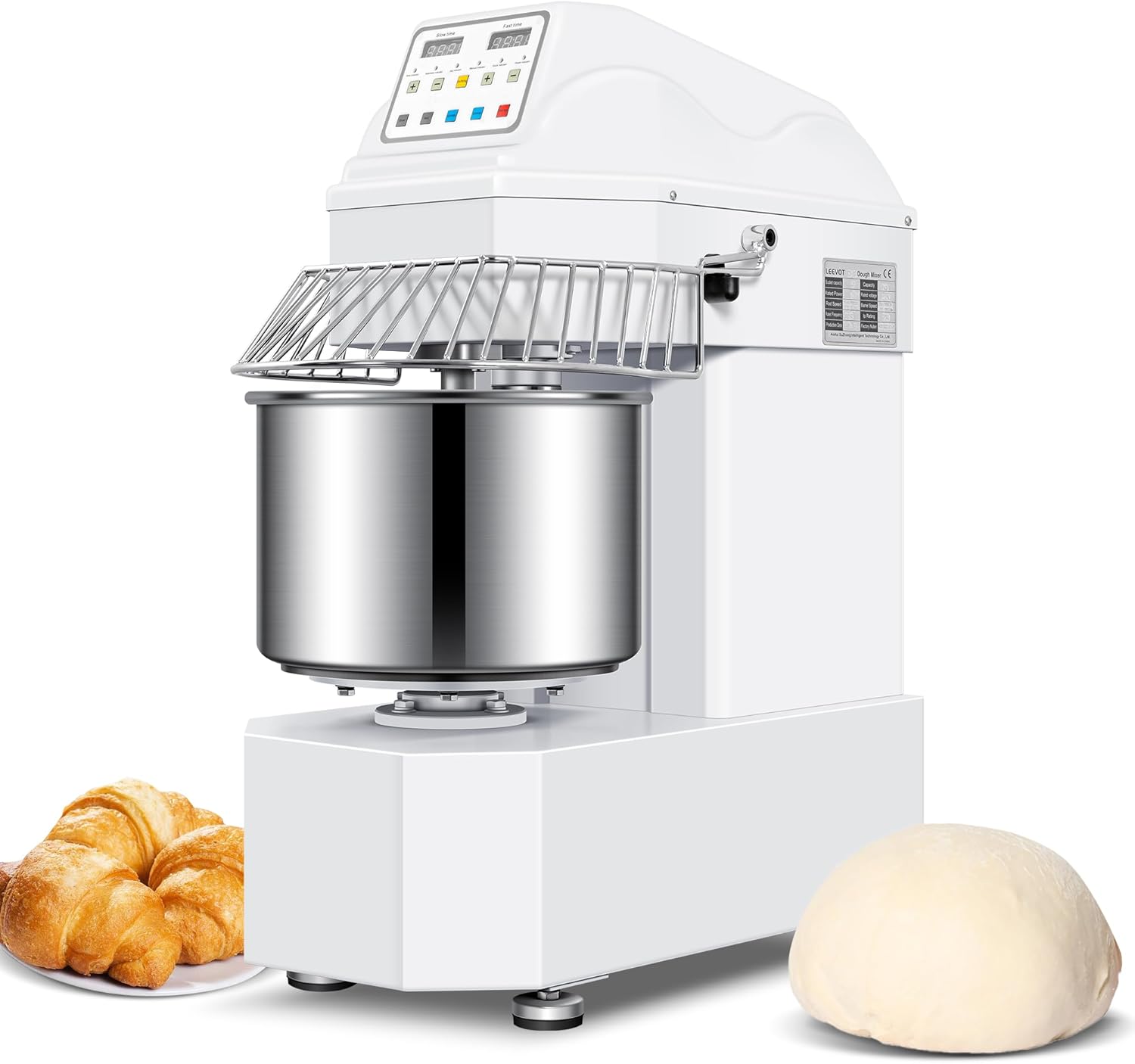
The BOSBAK 20Qt Spiral Dough Mixer is built for steady, high-quality dough production in small commercial kitchens. It uses a dual-speed co-rotating system (hook 157/264 rpm, bowl 16/25 rpm) and a spiral hook to mimic hand-kneading while running cooler than planetary machines, which helps develop gluten quickly and consistently for pizza and bread. Controls include a touch panel with a 0–45 minute timer, auto and manual modes, and a momentary reverse/jog function to release tangled dough without stopping the cycle. The 1.1 kW motor and 20-liter 304 stainless steel bowl handle up to about 27 lbs of finished dough per batch, and the fixed-bowl design, safety guard with auto-stop, and non-slip feet make it stable and safe in a busy prep area. It is heavy-duty in construction and practical for high-hydration or sticky doughs, but its large footprint and substantial weight mean it is intended for dedicated commercial counters rather than occasional home use and the bowl is not designed for routine removal.
Best for: Bakers and pizzeria operators who need a powerful, reliable spiral mixer that produces consistent dough quality and can run frequent batches in a small commercial kitchen.
Less Ideal for: Home bakers with limited space or users who need a lightweight, portable mixer for occasional household baking should look elsewhere.
- Spiral co-rotating design runs cooler and promotes fast, even gluten development
- Dual-speed hook and bowl with touch controls and 0–45 minute timer for repeatable batches
- 1.1 kW heavy-duty motor and 304 stainless steel bowl built for commercial use
- Reverse/jog function releases tangled dough without disassembly, improving workflow and safety
- Non-slip feet and safety guard with auto-off increase stability and operator protection
- Very heavy and large footprint, not suited to casual home kitchens
- Mixing bowl is not intended to be removed for routine handling or transport
Verdict: Choose this mixer when you need a heavy-duty spiral machine that reliably develops gluten fast for high-quality pizza and bread dough in a small commercial setting.
TECHTONGDA Commercial Dough Mixer 25KG

| Capacity | 25 kg |
|---|---|
| Voltage | 110 volts |
| Wattage | 2200 watts |
| Special Features | Adjustable Speed Control |
| Controls Type | Push Button |
This TECHTONGDA commercial dough mixer is built for heavy-duty dough work in small bakeries, restaurants, and other high-volume kitchens. It uses a twisted spiral-style mixing head that runs forward and reverse to mimic hand kneading, producing more uniform dough and making removal easier when you tilt the bowl 90 degrees. The machine is powered by a 2200W copper-core motor mounted low in the frame to reduce vibration, and a long transmission shaft and gear system increase mechanical stability under load. Controls are simple push-button operation with adjustable speed control, and the stainless steel bowl and attachments are food-safe and easy to clean. Important limitations are its single nominal speed setting and industrial footprint, which require dedicated counter or floor space and an understanding of safety procedures when loading and unloading large batches. For teams needing reliable, repeatable mixing of large batches, this mixer emphasizes power and durability over compactness or multi-speed finesse.
Best for: Bakers and small commercial kitchens that prioritize powerful, reliable mixing for frequent large batches and want a machine built for stability and throughput.
Less Ideal for: Home bakers with limited space or users who need multiple precise speed settings and compact, countertop equipment.
- High-power 2200W copper-core motor for heavy dough loads
- Forward and reverse spiral mixing head that imitates manual kneading for even gluten development
- 90-degree tilt bowl with locking pin for easy dough removal and cleaning
- Stainless steel bowl and components suitable for food preparation and durable use
- Only a single listed speed setting limits finer speed control for delicate mixes
- Large, heavy commercial footprint not suited to small home kitchens
Verdict: Choose this mixer when you need a robust, high-power machine that delivers consistent, heavy-duty dough mixing for commercial batch production.
LTIGOAW 10L Spiral Dough Mixer

| Capacity | 10 liters |
|---|---|
| Wattage | 750 watts |
| Voltage | 110 volts |
| Number of Speeds | 5 |
This LTIGOAW 10L spiral dough mixer is built for frequent, heavy kneading tasks in small commercial kitchens or serious home baking setups. The 750W copper-core motor drives a spiral stirring rod and a chain-drive system that rotates both the rod and bowl at two selectable speeds (100/200 rpm), producing a full 360° mixing motion that mimics hand kneading and improves dough elasticity. The stainless steel 10L bowl and freestanding design make it straightforward to handle batches up to about 2.2–11 lbs of dough, and the waterproof push-button controls plus rubber feet help keep operation stable and safe on busy countertops. Practical touches include an auxiliary rod to improve ingredient contact and a safety shield that cuts power if not closed. Expect reliable, even mixing and easier workflow when producing pizza, bread, or pastry dough, though the unit is relatively large and built for plug-in 110V operation, so it suits counters with space and a dedicated circuit. Cleaning is easier thanks to stainless construction, but this is a purpose-built spiral mixer rather than a multi-function stand mixer.
Best for: Buyers who prioritize efficient, repeatable dough production for small commercial operations or dedicated home bakers who optimize workflow and want a robust, purpose-built spiral mixer.
Less Ideal for: Casual bakers who only make occasional small batches or users who need a compact, multi-function countertop mixer should look elsewhere.
- Powerful 750W copper-core motor for heavy, consistent kneading
- 360° rotating bowl with spiral hook for uniform dough development
- 10L stainless steel bowl supports small commercial batch sizes
- Waterproof push-button controls and safety shield improve operator safety
- Rubber support feet provide stable, non-slip placement on countertops
- Designed specifically for dough and similar mixes so it lacks multi-purpose attachments
- Requires countertop space and a 110V outlet, limiting placement in small kitchens
Verdict: Choose this machine if you need a durable, high-efficiency spiral mixer that delivers consistent, commercial-style dough mixing for frequent small-batch production.
HXQWDQL Spiral Dough Mixer

| Capacity | 8 kg |
|---|---|
| Wattage | 2200 watts |
| Voltage | 110 volts |
| Special Features | Bidirectional Rotation & Timer Control |
This HXQWDQL spiral dough mixer is built for heavy mixing tasks in small bakeries, pizzerias, or busy home kitchens. The 2200W motor and bidirectional (forward/reverse) rotation simulate manual kneading to develop gluten and produce consistent, elastic dough, while a 1–30 minute timer lets you set and walk away. Its stainless steel bowl and auger are detachable for rinsing, and the basin locks to the machine with double buckles so it stays stable during operation. Push-button controls and a clear LED display make basic operation straightforward, and the unit includes ventilation to reduce overheating on longer runs. Expect a no-frills, utilitarian machine that focuses on power and durability rather than premium finishes or advanced electronics. The mixer is fairly heavy and sized for countertop use, so it works best where space and a stable surface are available; assembly and basic cleaning are simple but the machine does not offer multiple accessory types or sophisticated speed programs found on higher-end commercial models.
Best for: Buyers who want a powerful, workhorse spiral mixer on a budget for small commercial operations or frequent home baking and prioritize durability and straightforward controls.
Less Ideal for: Those who need a compact, lightweight mixer for occasional home use or expect programmable speed profiles and multiple accessory systems.
- High-power 2200W motor for consistent kneading of thick doughs
- Bidirectional rotation mimics hand kneading for improved dough elasticity
- Removable stainless steel bowl and auger for straightforward cleaning
- Timer control (1–30 minutes) enables unattended mixing
- Basic push-button controls with limited speed/program options
- Designed as a heavy countertop unit so it is less portable
Verdict: A rugged, high-power spiral mixer that delivers commercial-style kneading performance at a budget-friendly level.
Ooni Halo Pro Spiral Mixer

| Capacity | 7.3 quarts |
|---|---|
| Wattage | 650 watts |
| Number of Speeds | 58 |
| Noise Level | 65 db |
| Voltage | 110 volts |
The Ooni Halo Pro is a spiral-style stand mixer aimed at serious home bakers and small-scale pizza makers who want stronger gluten development without a commercial footprint. It uses dual-kneading spiral technology with a rotating bowl and spiral dough hook to replicate bakery mixing, and includes a breaker bar, flexible beater, geared whisk and splash guard so you can switch between dough, batter and whipping tasks. The touch controls provide 58 speed settings and time control, letting you dial in slow, gentle mixing up to high-speed whisking. A removable bowl and detachable spindle make cleanup and storage easier than fixed-head spiral machines, and the die-cast aluminum construction with stainless container feels durable. At 650 watts and a reported 65 dB noise level it balances power and reasonable noise for home kitchens, but its 14.6 kg weight means it is a heavier, less portable appliance. The mixer excels if you prioritize consistent, bakery-quality dough and versatile attachments, but buyers should expect a substantial unit that needs a stable countertop and occasional deeper cleaning around the spindle.
Best for: Home bakers and pizza enthusiasts who want a reliable, professional-style spiral mixer to produce consistently strong dough and who value precision control and durable construction.
Less Ideal for: Casual or infrequent bakers who need a lightweight, compact mixer for occasional use or those who prefer a lower-weight, simpler appliance for easy storage.
- Spiral dual-kneading system develops stronger gluten for bakery-quality dough.
- Wide speed range with 58 precise settings and time control for repeatable results.
- Includes four attachments for mixing, whisking and beating, increasing versatility.
- Removable bowl and detachable spindle simplify cleaning and attachment changes.
- Heavy and substantial weight reduces portability and requires a sturdy countertop.
- Higher power and professional-style action may be more than casual bakers need.
Verdict: If you want bakery-grade dough development at home, the Ooni Halo Pro delivers precise spiral mixing and versatile attachments in a robust, reliable package.
VEVOR Commercial Dough Mixer BDM8

| Capacity | 8 liters |
|---|---|
| Wattage | 450 watts |
| Voltage | 110 volts |
| Noise Level | 70 db |
| Special Features | Dual Rotation |
The VEVOR Commercial Dough Mixer is a compact industrial spiral mixer aimed at small bakery, pizzeria, and foodservice kitchens that need consistent dough development. It pairs a dual-rotation system—slow bowl rotation with a faster hook—with a 450W motor to simulate manual kneading and develop gluten more evenly than single-rotation machines. Controls are simple: a waterproof on/off, a 60-minute timer knob, and a reset button, while the included safety shield prevents operation unless closed. In practice the 8 L bowl handles roughly 3 kg (about 6.6 lb) of dough per batch, making it useful for small-batch production; nonslip feet and automatic shutoff add stability and safety during heavier mixes. Noise is listed around 70 dB, so it is audible but not unusually loud for commercial mixers. Limitations are the single speed setting and modest 450W motor, which mean it is best for typical doughs rather than very heavy high-hydration or large industrial batches, and the unit is fairly heavy, so it is not intended for frequent repositioning.
Best for: Bakeries, pizzerias, and small commercial kitchens seeking a compact spiral mixer that reliably develops dough for daily small-batch production and values safety features.
Less Ideal for: Large-scale commercial operations that need high-capacity, high-power mixers or users who require multiple speed settings and frequent portability.
- Dual-rotation spiral system improves dough development and mixes more evenly than single-rotation mixers
- Food-grade stainless steel bowl, hook, and rod resist rust and are easy to clean
- Safety shield with automatic shutoff prevents operation when open
- 60-minute timer and simple waterproof controls make operation straightforward in busy kitchens
- Single speed and 450W motor limit performance for very heavy or high-hydration doughs
- Unit is heavy and not designed for frequent moving or transport
Verdict: A compact, safety-minded spiral mixer that delivers reliable small-batch dough development with a dual-rotation system.
VEVOR 15Qt Commercial Mixer

| Capacity | 13.6 liters |
|---|---|
| Wattage | 500 watts |
| Number of Speeds | 3 |
| Noise Level | 70 db |
| Voltage | 110 volts |
The VEVOR 15Qt Commercial Mixer is a heavy-duty stand mixer designed for small commercial kitchens and serious home bakers who need to process larger batches. It pairs a 500W motor and gear-driven transmission with three basic attachments (dough hook, flat beater, wire whip) to handle dough, batters, and whipped mixtures. The unit offers three fixed speed settings tuned for kneading, mixing, and whipping, plus a 30-minute timer and a bowl lift mechanism for secure operation. A stainless steel bowl and metal attachments make cleanup straightforward and resist corrosion in regular use, while the safety guard and automatic shutoff when the cover is open reduce accident risk in busy kitchens. Noise is listed around 70 dB, and controls are push-button and simple to operate, so there is little learning curve. Expect a utilitarian, no-frills machine: it focuses on durability and capacity rather than advanced speed control or quiet operation, and its size and weight mean it needs a stable dedicated workspace.
Best for: Buyers who prioritize reliable, factory-quality mixing for bakery or restaurant-style batches and want a straightforward, durable machine rather than consumer-style features.
Less Ideal for: People who need a compact, lightweight, or very quiet countertop mixer or those who want fine-grain speed control and advanced electronic features.
- Large 15-quart stainless steel bowl suitable for batch mixing in commercial settings
- Durable metal attachments (dough hook, flat beater, wire whip) for a range of mixes
- 500W gear-driven motor designed for stable, even mixing
- Built-in 30-minute timer and bowl lift for hands-free operation and secure mixing
- Safety guard with automatic shutoff when not closed
- Only three fixed speeds limit fine control for delicate recipes
- Relatively loud operation at around 70 dB
- Large footprint and weight require a dedicated, sturdy workspace
Verdict: Choose this mixer when you need a robust, high-capacity spiral-style mixer built for regular commercial or heavy home use with simple, reliable controls.
Choosing the Right Powerful Spiral Dough Mixer: Key Factors to Consider
Motor Power and Torque
Motor power determines the mixer's ability to turn heavy, high-hydration, or enriched doughs without straining. Higher continuous horsepower and strong low-end torque help the spiral hook knead dense doughs consistently and reduce the risk of motor overheating.
When comparing power specs, look for rated continuous power rather than peak numbers. Strong torque at low speeds keeps the hook moving through stiff dough and shortens mixing time, which helps preserve dough structure and reduces batter heating.
Bowl Capacity and Shape
Bowl capacity should match how much dough you regularly produce. Oversized bowls can be inefficient for small batches, while undersized bowls risk overflow and inconsistent mixing. Consider both the maximum capacity and recommended working capacity for optimal results.
Bowl shape affects how the spiral hook contacts the dough. A well-contoured bowl encourages dough movement toward the hook and prevents dead zones, resulting in more uniform hydration and gluten development across the batch.
Durability and Construction Materials
Durability matters when machines run daily. Look for heavy-gauge steel frames, stainless-steel bowls and hooks, and commercial-grade bearings and gearboxes. These components resist wear, reduce vibration, and stand up to the stresses of high-volume use.
Weld quality, corrosion resistance of exposed parts, and robust fasteners all impact long-term reliability. Machines built with serviceable drive components are easier and cheaper to keep in regular operation.
Maintenance and Ease of Cleaning
Routine maintenance keeps a mixer safe and performing well. Design features that simplify cleaning—smooth surfaces, removable bowls and hooks, and accessible drive housings—reduce downtime and lower labor for sanitation.
Consider how seals and bearings are protected from flour and moisture, and whether lubricants or gearboxes require periodic service. Units that allow tool-free removal of wear parts speed routine tasks and reduce the chance of missed maintenance.
Controls, Safety, and Ergonomics
Controls should be intuitive and robust for frequent use. Variable-speed drives with clear markings let you adjust mixing intensity for different dough types. Important safety features include a reliable bowl guard, an emergency stop, and interlocks that prevent operation when the guard is open.
Ergonomic considerations such as bowl-lift mechanisms, easily reachable controls, and manageable bowl weights reduce operator fatigue and lower the risk of handling incidents during busy service periods.
Serviceability and Parts Availability
Even well-built mixers need occasional parts or servicing. Machines with documented parts lists, straightforward access to drive components, and common fastener types are simpler to repair. Consider the availability of replacement parts and whether routine servicing can be handled by local technicians.
A model that is easier to service will spend less time out of operation, which is especially important for commercial kitchens or serious home bakers who rely on consistent throughput.
How Spiral Mixers Handle Dough Differently
Spiral mixers rotate the bowl while a spiral-shaped hook turns the dough against stationary surfaces, which produces efficient gluten development and faster mixing times. This action keeps dough cooler than some other mixing methods, preserving yeast activity and improving final texture.
For heavy-duty applications, that gentler heat profile matters because it allows longer mixing times without compromising dough structure. Understanding this mechanical advantage helps you match machine capability to the styles of bread and dough you make most often.
- Spiral hook design reduces surface friction and dough heating
- Bowl rotation ensures uniform hydration and faster mixing
- Consistent low-temperature mixing benefits yeast-leavened doughs
Matching Mixer Size to Production Needs
Estimate your average batch size and peak output when choosing capacity. For intermittent home use, smaller capacities reduce waste and cleaning, while continuous or commercial workflows demand larger bowls sized for recommended working capacity rather than absolute maximum.
Also factor in how recipes scale. A machine that handles your current volume but offers extra headroom helps during busy periods or when testing new formulas.
- Consider typical batch volume and peak demand
- Plan for a safe working capacity below the bowl's max
- Allow margin for different hydration levels in recipes
Power Delivery and Drive Systems
Look beyond raw horsepower to the drive type and gearbox durability. Direct-drives with robust gearboxes transmit torque more reliably than flimsy belt drives in heavy use. Heat dissipation and motor cooling also affect long-term performance under repeated cycles.
Variable-speed capability with smooth control is important for transitioning between slow kneading and faster final integration. Reliable speed control prevents abrupt torque spikes that can stress mechanical components.
- Prefer durable gearboxes and stable motor mounts
- Smooth variable-speed control reduces mechanical stress
- Good cooling extends motor life under frequent operation
Cleaning Protocols and Sanitation Considerations
Commercial sanitation standards require equipment that can be cleaned thoroughly and quickly. Smooth, crevice-free surfaces on bowls and accessories reduce trapped flour and dough buildup. Removable components that withstand regular washing cut down cleaning time.
Think about how seals and bearings are protected from moisture. Designs that isolate lubricated parts from washdown zones minimize contamination risk and maintenance headaches.
- Choose stainless surfaces where possible for corrosion resistance
- Removable hooks and bowls speed sanitizing
- Check whether parts are dishwasher-safe or need manual cleaning
Installation, Footprint, and Workspace Integration
Measure available floor or bench space before selecting a unit. Heavier mixers may require dedicated countertops or floor reinforcement. Also check clearances for bowl removal and lifting, and plan for power supply requirements to ensure the mixer operates efficiently and safely.
Noise and vibration levels affect placement in open kitchens. Isolating pads and secure mounting reduce transmitted vibrations and prevent premature wear on fixtures and fasteners.
- Confirm electrical requirements and circuit capacity
- Allow clearance for bowl removal and operator access
- Consider vibration isolation to protect surrounding equipment
How We Chose the Best Powerful Spiral Dough Mixer
We focused on mixers built to handle frequent, heavy mixing cycles and prioritized technical specs and usability traits that matter in high-volume baking. Our evaluation emphasized motor power and torque because those determine how well a mixer handles high-hydration and dense doughs. Bowl capacity and bowl shape were another priority since correct volume matching prevents overfilling and ensures even mixing. Build quality and materials were assessed to gauge long-term durability under repeated load. We also considered maintenance friendliness, including ease of cleaning and access to serviceable components, plus safety features such as emergency stops and robust guarding. Products were excluded if they lacked clear motor specifications, were designed only for light home use, or omitted critical safety features. We filtered out units with poor serviceability or unclear warranty and parts support. The final shortlist reflects machines that balance raw mixing capability with practical daily operation, durability, and maintainable design.
Our full evaluation process is outlined in our review methodology.
FAQ
What bowl capacity should I choose for small-batch artisan baking?
For small-batch artisan work, pick a bowl sized so your usual batch is near the recommended working capacity rather than the absolute maximum. That ensures proper mixing action and reduces wasted space and cleaning.
How important is continuous motor rating versus peak horsepower?
Continuous motor rating is more meaningful because it reflects the power the motor can sustain during real mixing cycles. Peak horsepower often describes short bursts that are not helpful for long kneading tasks.
Can spiral mixers handle very high-hydration doughs?
Many powerful spiral mixers handle high-hydration doughs well if they have sufficient torque and the correct bowl-hook geometry. Higher torque and stable low-speed control are key to preventing stalling or uneven mixing.
How do I keep a commercial mixer sanitary?
Use removable components for routine washing, follow manufacturer guidelines for cleaning agents and procedures, and protect drive seals from water exposure. Regularly inspect and clean crevices where flour accumulates to prevent buildup.
What safety features matter most on a heavy-duty spiral mixer?
Reliable bowl guards, interlock switches that prevent operation when open, and clearly marked emergency stop controls are essential. Ergonomic bowl-lift mechanisms also reduce handling risks during loading and unloading.
Final Verdict
When choosing a Powerful Spiral Dough Mixer, prioritize sufficient motor torque and an appropriately sized bowl for the types of dough you make most often. Durable construction, accessible maintenance, and thoughtful safety features all reduce downtime and operating cost in demanding kitchens. Balance capacity and power with the workspace and sanitation needs to find the machine that fits your workflow. With those tradeoffs in mind, you can select a mixer that delivers consistent, heavy-duty performance for years.