
Note: This article contains affiliate links. If you click on these links and make a purchase, we may earn a small commission at no extra cost to you. This helps support our research and content. Read our full affiliate disclosure here.
If you make sticky rice often, the right pressure rice cooker makes a big difference in texture, mouthfeel, and batch-to-batch consistency. You want a cooker that produces evenly steamed, tender grains without overcooking or gummy centers. This guide highlights the top shortlisted pressure rice cookers for sticky rice, selected for consistent cooking performance, simple controls, and easy maintenance. Below you will find the core factors we evaluated and practical guidance to help you pick a model that matches your cooking habits and kitchen space.
Top Picks at a Glance
| Best Overall The best all-around choice for most situations | CUCKOO High Pressure Rice Cooker CRP-P0609S |  |
| Best Quality Built to a higher standard if you want something more solid | Zojirushi Pressure IH Rice Cooker NW-JEC10BA |  |
| Best Budget The cheapest option that still gets the job done reliably | Instant Pot 4QT RIO Mini |  |
| Top Rated A top-rated pick with lots of positive feedback | Cosori Pressure Cooker 6QT |  |
| Most Popular A crowd favorite that many people choose with confidence | Instant Pot Duo 6-Quart |  |
CUCKOO High Pressure Rice Cooker CRP-P0609S

| Capacity | 12 cups (cooked) |
|---|---|
| Wattage | 890 watts |
| Power Source | Corded Electric |
| Material | Stainless Steel |
The Cuckoo CRP-P0609S is a high-pressure rice cooker built for consistent, restaurant-style results and flexible meal prep. It uses elevated pressure (listed at one of the industry highs) and 12 cooking modes to deliver sticky white rice, brown rice, mixed grains, porridge and GABA rice with minimal monitoring. The stainless steel inner pot, removable cover and drain dish make cleaning easier than many older pressure models, and the auto steam-sterilization and safe steam release add practical daily convenience. Typical use is straightforward: measure rice and water with the included cup, pick a program and let the cooker run; high pressure shortens cook times and helps produce evenly sticky rice for sushi or other dishes. Trade-offs include a relatively heavy unit and the need to hand wash some parts, and advanced settings may take a few runs to learn for perfect sticky-rice texture, but the cooker rewards patience with reliably tender, clingy rice and dependable repeatability.
Best for: Buyers who want a reliable, pressure-driven cooker that consistently produces sticky, restaurant-style rice without constant attention and who value multiple preset programs for different grains.
Less Ideal for: People who need an ultra-light, compact cooker for small kitchens or those who prefer fully dishwasher-safe components and minimal cleaning effort.
- High-pressure cooking produces faster, more consistent sticky rice
- 12 built-in programs cover white, brown, mixed, GABA and porridge modes
- Stainless steel inner pot and removable cover for easier cleaning
- Safe, automatic steam release and steam sterilization for convenience
- Heavier, bulkier unit that takes more counter space
- Some parts require hand washing rather than dishwasher-safe cleaning
Verdict: Choose this Cuckoo pressure cooker if you want a program-rich, high-pressure machine that reliably makes sticky, restaurant-quality rice every time.
Zojirushi Pressure IH Rice Cooker NW-JEC10BA

| Capacity | 5.5 cups |
|---|---|
| Wattage | 700 watts |
| Voltage | 120 volts |
| Power Source | Corded Electric |
The Zojirushi NW-JEC10BA is a pressure induction heating (IH) rice cooker and warmer built to deliver consistent, high-quality rice with a focus on texture control. It uses IH combined with advanced fuzzy logic and AI to adjust cooking cycles and three automatic pressure levels plus four pressure settings to shape stickiness and plumpness for different rice types. Typical use is straightforward: add measured rice and water, choose the menu, and let the cooker apply precise heat and pressure; the detachable stainless steel inner lid and flat interior make cleanup easier after use. The unit includes a rice spatula, spatula holder, and measuring cup and is made in Japan. Practical benefits are reliably sticky short-grain rice for sushi or everyday meals, even cooking from start to finish, and a durable-feeling exterior and lid. Limitations are a relatively small 5.5-cup capacity for larger households and a 700-watt corded power requirement, so it may be slower than higher-wattage models for large batches.
Best for: Buyers who prioritize precise texture and consistent sticky rice for sushi or daily meals and want a cooker that fine-tunes pressure and timing automatically.
Less Ideal for: Those who regularly cook large batches or need a higher-capacity cooker for big families or entertaining.
- Pressure IH and multiple pressure settings produce sticky, plump rice textures
- Advanced fuzzy logic with AI adjusts cycles for consistent results across rice types
- Detachable stainless steel inner lid and flat interior for easier cleaning
- Includes spatula, measuring cup, and self-standing spatula holder
- 5.5-cup capacity may be too small for larger families
- 700-watt power draw limits speed when cooking larger amounts
Verdict: Choose this Zojirushi if you want a compact pressure IH cooker that reliably produces perfectly sticky, restaurant-quality rice every time.
Instant Pot 4QT RIO Mini

| Capacity | 4 quarts |
|---|---|
| Wattage | 800 watts |
| Control Method | Touch |
| Operation Mode | Automatic |
| Included Components | Lid, Sealing Ring, Cooking Pot, Cooker Base, Steam Rack, Condensation Collector |
The Instant Pot 4QT RIO Mini is a space-saving multi-cooker that handles pressure cooking, rice, steaming, sautéing, slow cooking, yogurt, and keep-warm functions in a single 800-watt unit. Its 4-quart stainless steel pot is sized for up to four servings and fits small kitchens, dorms, or couples who want rice and one-pot meals without a large appliance. The touch controls and mechanical knob make setting programs straightforward, and the included stainless steel steam rack and dishwasher-safe pot simplify steaming and cleanup. Safety features like an auto-sealing lid and overheat protection add peace of mind during pressure cycles. Because it is a smaller-capacity cooker with lower wattage, it heats and pressurizes more slowly than larger models and is best suited for modest batch sizes rather than big family meals. For sticky rice specifically, the pressure and rice functions give consistent, tender results when using the right water ratios, but you will need to work in small batches for optimal texture.
Best for: Buyers looking for an affordable, compact multi-cooker to make reliably cooked rice and small batches of sticky rice in tight kitchens or for two to four servings.
Less Ideal for: People who regularly cook large family portions, meal-prep many servings of rice at once, or need very fast heat-up times should choose a larger, higher-powered cooker.
- Compact 4-quart capacity fits small kitchens and makes small rice batches easily
- Multiple cooking functions (pressure, rice, steam, sauté, slow cook, yogurt, keep warm) increase versatility
- Stainless steel inner pot and dishwasher-safe parts make cleaning simple
- Auto-sealing lid and built-in safety protections reduce risk during pressure cooking
- Lower wattage and smaller volume mean longer pressure build times and limited batch size
Verdict: A budget-friendly compact multi-cooker that reliably makes small batches of sticky rice and versatile one-pot meals for small households.
Cosori Pressure Cooker 6QT
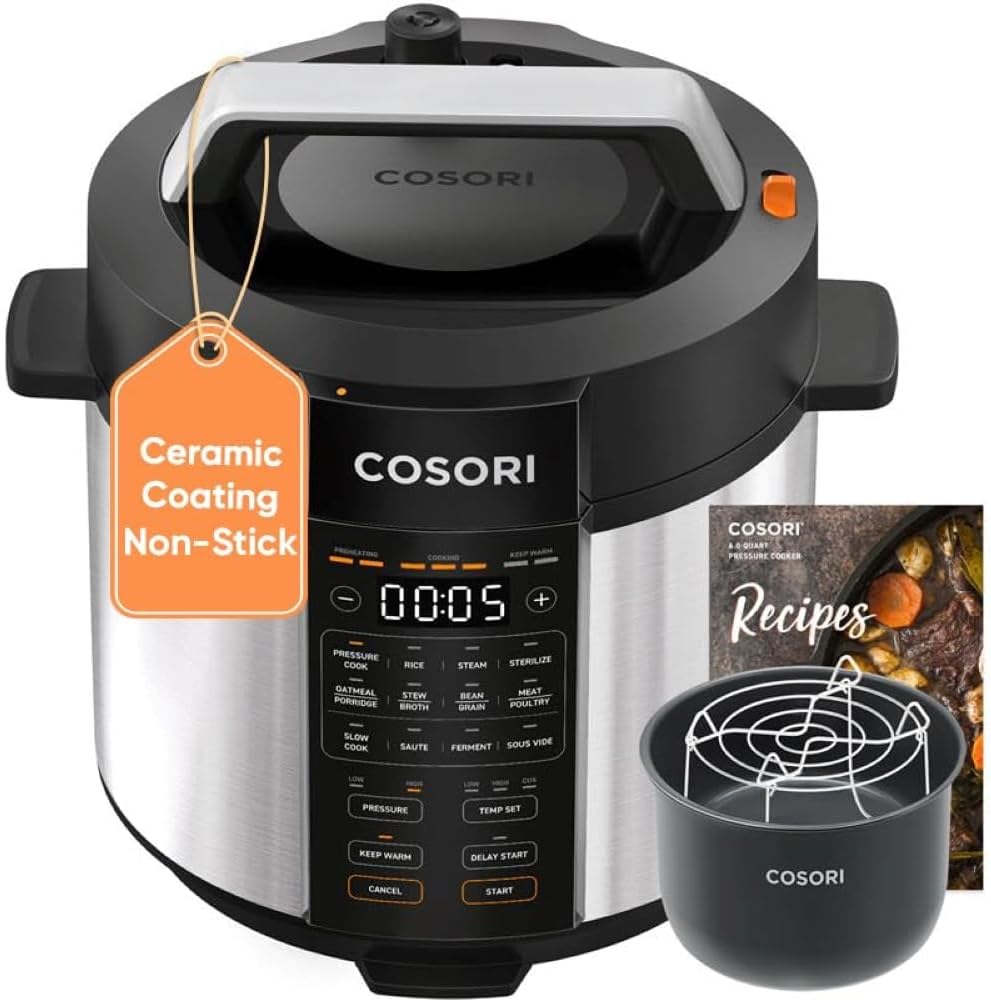
| Capacity | 6 quarts |
|---|---|
| Wattage | 1100 watts |
| Inner Pot | Ceramic nonstick |
| Control Method | Touch |
The Cosori 6QT pressure cooker is a versatile electric multi-cooker aimed at replacing several countertop appliances with a single pot. It offers 9-in-1 cooking functions plus 13 presets that cover pressure cooking, rice, steam, sous vide, slow cook and sauté, and it includes a steam rack and recipe book to get started. The 1100 W heater and touch controls let you cook rice and beans faster than a traditional rice cooker, while the ceramic nonstick inner pot is dishwasher-safe for easier cleanup. Safety features such as a backward-angled steam release, a seal/vent button offset from the valve, and multiple overheat protections make it a cautious choice for daily use. Practical limits are its 6-quart capacity if you regularly cook very large batches and the unit's physical footprint, which is typical for multi-cookers and needs counter space. For sticky rice specifically, the ceramic inner pot and rice preset should give consistent, non-sticky results when you follow recommended water ratios and recipes.
Best for: Buyers who prioritize a dependable, safety-minded multi-cooker that produces reliable rice and can replace several appliances in a small kitchen.
Less Ideal for: If you need a very compact single-purpose rice cooker or routinely cook very large batches for gatherings, a specialized larger unit would be a better choice.
- Multiple dedicated presets including a rice program for consistent results
- Ceramic nonstick inner pot that is dishwasher-safe and BPA-free for food contact
- 1100 W heating for faster pressure cooking compared with stovetop methods
- Built-in safety features and a safer venting design to reduce steam hazards
- Includes useful accessories and a recipe book to help dial in rice ratios
- 6-quart size may be limiting for very large families or batch cooking
- Physically larger footprint than single-purpose rice cookers
Verdict: A safety-focused, all-in-one 6-quart multi-cooker that reliably makes good rice while replacing several appliances in everyday kitchens.
Instant Pot Duo 6-Quart

| Capacity | 5.68 liters |
|---|---|
| Wattage | 1000 watts |
| Control Method | Touch |
| Material | Stainless steel |
| Voltage | 120 |
The Instant Pot Duo is a versatile 7-in-1 electric multicooker built around a 6-quart stainless steel inner pot and 1000-watt heating element. It functions as a pressure cooker, slow cooker, rice cooker, steamer, sauté pan, yogurt maker and warmer, and its 13 one-touch smart programs and touch controls simplify everyday use. For rice and particularly sticky rice, the pressure and rice modes shorten cooking time and reliably produce evenly cooked grains, while the pro-grade tri-ply bottom and stainless inner pot let you sear before pressure cooking. Safety features such as an easy-seal lid, easy-release steam switch and overheat protection reduce the worry associated with pressure cooking. Cleanup is straightforward because the inner pot and lid are dishwasher-safe. The main compromises are its physical footprint and weight compared with single-purpose rice cookers, and it lacks specialized fuzzy-logic algorithms dedicated only to delicate rice textures, so achieving the perfect sticky rice may require minor timing and water adjustments versus a dedicated sticky-rice cooker.
Best for: Buyers who want a trusted, well-reviewed all-in-one cooker that reliably handles family-sized rice batches while offering pressure-cooking convenience and strong safety features.
Less Ideal for: If you need a compact countertop unit solely tuned for perfect sticky rice textures or you prioritize the smallest possible footprint, a dedicated specialty rice cooker may be a better fit.
- Multiple cooking functions in one unit reduce the need for separate appliances
- 1000-watt power and tri-ply stainless steel pot enable good searing and even heat distribution
- Easy-seal lid and multiple safety mechanisms make pressure cooking less intimidating
- Dishwasher-safe inner pot and lid simplify cleanup
- Family-sized 6-quart capacity suits meal prep and batch rice cooking
- Not optimized with fuzzy-logic rice algorithms found in specialty rice cookers
- Larger and heavier than compact single-purpose rice cookers
Verdict: Choose the Instant Pot Duo if you want a proven, safe multicooker that reliably speeds up family-sized sticky rice cooking while doubling as a full-featured kitchen workhorse.
Choosing the Right Pressure Rice Cooker for Sticky Rice: Key Factors to Consider
Pressure Consistency
Stable, repeatable pressure is the single most important factor for reliable sticky rice. Fluctuations in pressure or a weak sealing gasket can create uneven cooking where some grains are overcooked while others remain underdone. When pressure is consistent, starches gelatinize evenly, producing the characteristic tender but slightly chewy texture that defines good sticky rice.
Evaluate the rice cooker's sealing system, steam-release valve design, and any pressure-monitoring features. Look for units that clearly indicate when full pressure is achieved and that maintain it through the programmed cycle. Consistent pressure reduces the need for repeated trial-and-error with water ratios and soak times.
Sticky Rice Texture Control
Different glutinous rice varieties and different serving traditions require slightly different final textures. Some cooks prefer a looser, fluffier sticky rice, while others want a denser, truly cohesive grain. A cooker that offers adjustable texture settings or a specific glutinous/ sticky-rice preset helps you dial in the result without manual timing.
Settings that control initial pressure time versus release behavior are useful because slow natural release often yields a softer finish, while quick release can lock in firmness. Consider whether the cooker allows customizing soak time, pressure duration, or keep-warm strategies to fine-tune texture.
Capacity and Batch Flexibility
Think about how much sticky rice you cook at once. Small households may only need a compact cooker while families or gatherings require larger-capacity models. Capacity affects not just quantity but also consistency; very small or very large fills can change how steam and pressure distribute in the pot.
Choose a cooker with capacity options that match your typical batch size and look for clear minimum and maximum fill indicators. Some models include removable bowls or multi-layer trays for steaming accompaniments, which can expand utility without sacrificing pressure performance.
Inner Pot Material and Coating
The inner pot material influences heat transfer, sticking behavior, and durability. Heavy-gauge aluminum or multilayer stainless constructions distribute heat more evenly, minimizing hotspots that can leave some grains undercooked. Nonstick coatings make cleaning easier and help prevent glutinous rice from bonding to the pot, but coatings vary in durability.
Prefer pots with reinforced nonstick surfaces or hard-anodized finishes if you cook sticky rice frequently. Also check whether replacement inner pots are available and how the lid and sealing surfaces are designed to minimize trapped rice and residue.
Ease of Cleaning and Maintenance
Sticky rice can cling to lids, steam vents, and inner pot surfaces, so a design that simplifies cleaning will save time and reduce wear. Removable lids or inner-lid components, accessible steam-release parts, and dishwasher-safe bowls are practical features that reduce maintenance effort.
Regular cleaning of the gasket and steam pathways prevents flavor transfer and helps maintain sealing performance. Consider how easy it is to inspect and replace wearable parts like gaskets or steam valves when evaluating long-term ownership effort.
Controls and Presets
Intuitive controls and useful presets reduce the learning curve for consistent sticky rice preparation. A clear sticky-rice or glutinous rice preset is ideal, but similarly effective are custom programs that let you set soak time, pressure duration, and release behavior.
Physical dials or straightforward button layouts minimize mistakes in busy kitchens. Also think about display readability, the availability of step-by-step guidance in the manual, and whether the cooker supports memory functions for your preferred settings.
How Pressure Changes Sticky Rice Texture
Pressure accelerates starch gelatinization and forces steam into each grain, creating a different texture than plain steamed rice. Under pressure, grains absorb moisture more uniformly, which helps achieve the classic sticky mouthfeel without extended steaming times.
Understanding how pressure time and release method affect moisture retention helps you adapt water ratios and soak times. A longer pressure phase with a gentle natural release usually yields softer, more cohesive rice, while shorter pressure or quick release can leave a firmer, slightly separated result.
- Natural release retains moisture and softens grains.
- Quick release stops cooking fast and can produce firmer texture.
- Longer pressure times increase cohesion but may risk gumminess if water is excessive.
Water Ratios and Soaking Tips for Sticky Rice
Sticky rice performs differently from regular white rice; it often benefits from soaking prior to cooking to hydrate the grains and shorten pressure time. Typical soak times range from 30 minutes to a few hours depending on rice age and dryness.
Start with manufacturer-recommended water ratios as a baseline, then adjust incrementally. If rice turns out too dry or undercooked, add a little extra water next time. If it is too gummy, reduce water or shorten soak time.
- Older rice may need longer soak times.
- Rinse glutinous rice until the rinse water runs mostly clear to remove excess surface starch.
- Record your successful ratio and soak time for repeatable results.
Cleaning Sticky Rice Residue Effectively
Preventing baked-on residue makes cleanup easier. Immediately soak the inner pot in warm water when possible to loosen stuck starch. Use a nonabrasive sponge to protect nonstick coatings and clean steam vents with a soft brush.
Regularly inspect the lid gasket and steam-release components for trapped rice. Routine care prevents odors and maintains the seal that pressure cooking depends on.
- Soak promptly after use to avoid hardened residue.
- Disassemble removable parts for thorough cleaning when manufacturer instructions allow.
- Avoid harsh scouring pads that damage nonstick surfaces.
Capacity Planning for Meals and Leftovers
Think beyond a single meal when selecting capacity. If you frequently prepare rice for meal prep or gatherings, a larger capacity reduces the need for multiple cycles. Conversely, if you only cook small portions, a compact cooker saves counter space and may use less energy per batch.
Also consider how leftover rice will be stored and reheated. Some cookers produce a slightly drier keep-warm result that reheats better, while others retain moisture that suits immediate serving.
- Match cooker capacity to typical servings per meal.
- Check minimum fill recommendations to avoid underfilling and inconsistent pressure.
- Consider whether steaming accessories expand utility without needing larger capacity.
Safety and Steam-Release Best Practices
Pressure cooking introduces higher temperatures and pressurized steam. Familiarize yourself with the cooker's steam-release mechanism and always follow safe release procedures outlined by the manufacturer. Keep hands and face clear of vent paths during release.
Regular maintenance of valves and gaskets is important for safety and performance. Replace worn seals promptly and ensure vents are unobstructed before each use.
- Use natural release when recipes call for it to avoid splatter.
- Follow the manual for pressure-cooking cycles and service intervals.
- Keep the cooker on a stable, heat-resistant surface with adequate ventilation.
How We Chose the Best Pressure Rice Cooker for Sticky Rice
We evaluated models that specifically support pressure rice cooking modes suitable for sticky or glutinous rice and prioritized features that affect final texture and usability. Key evaluation criteria included pressure cooking reliability, rice texture controls, capacity and batch flexibility, and the quality of the inner cooking pot and nonstick coating. We also considered user-facing controls and preset options that simplify repeatable results, plus ease of cleaning and maintenance since sticky rice can cling to surfaces. Durability of seals and steam-release mechanisms was part of the assessment because leaks or inconsistent sealing impact pressure and outcome. We excluded basic, non-pressure rice cookers and appliances that lack a dedicated sticky-rice or pressure mode since they do not deliver consistent results for this specific use. Models that required extensive manual monitoring or had poor sealing/release designs were also weeded out. The remaining picks balance reproducible texture, reasonable capacity options, and maintenance effort appropriate for cooks who prepare sticky rice regularly.
Our full evaluation process is outlined in our review methodology.
FAQ
Can I cook glutinous rice without soaking it first?
You can, but soaking generally improves texture and reduces cooking time. Shorter or no soak may require more water and a longer pressure phase to achieve even tenderness.
How should I adjust water ratios for sticky rice in a pressure cooker?
Start with the manufacturer's guideline for glutinous rice, then adjust in small increments based on results. If rice is too dry, add slightly more water next time; if too gummy, reduce water or soak less.
Is natural release always better for sticky rice?
Natural release often produces softer, more cohesive rice, but the best choice depends on your texture preference. Natural release retains more moisture, while quick release gives a firmer finish.
How do I prevent sticky rice from sticking to the inner pot?
Rinsing rice to remove surface starch, using a properly seasoned or good nonstick inner pot, and following correct water ratios reduce sticking. Soaking and immediate post-use soaking of the pot also make cleaning easier.
How often should I replace the gasket or steam valve parts?
Replace seals and wearable steam components when you notice leaks, persistent pressure issues, or visible wear. Frequency depends on use, but inspect these parts regularly as part of routine maintenance.
Final Verdict
For reliable sticky rice results, prioritize a pressure rice cooker with consistent sealing and pressure control, a dedicated sticky-rice setting or adjustable timing, and an inner pot that balances heat distribution with easy cleaning. Balance capacity with how often you cook and choose a model whose maintenance needs fit your schedule. Focus on pressure consistency and cleanup convenience to reduce trial-and-error and get repeatable texture every time.