
Note: This article contains affiliate links. If you click on these links and make a purchase, we may earn a small commission at no extra cost to you. This helps support our research and content. Read our full affiliate disclosure here.
If you prepare large volumes of deli meats, cheeses, or roasted meats, a professional meat slicer can dramatically speed prep and improve portion consistency. Choosing the right Professional Meat Slicer matters because blade construction, motor durability, and safety controls determine throughput, slice uniformity, and maintenance time. This guide covers the top shortlisted options for commercial and heavy-duty home use and explains the evaluation criteria we used. Read on for the factors that matter most when you need reliable, repeatable slicing performance.
Top Picks at a Glance
| Best Quality Built to a higher standard if you want something more solid | Hobart EDGE12-1 Meat Slicer |  |
| Best Value The sweet spot between price and what you get | CUSIMAX 8.7" Meat Slicer |  |
| Top Rated A top-rated pick with lots of positive feedback | BESWOOD 10" Meat Slicer BESWOOD250 |  |
| Most Popular A crowd favorite that many people choose with confidence | Borlebbi Meat Slicer SL-518M |  |
| Best Seller A high-volume bestseller chosen again and again | VEVOR Commercial Meat Slicer 10" |  |
Hobart EDGE12-1 Meat Slicer

| Blade Length | 12 inches |
|---|---|
| Motor Power | 1/2 hp |
| Operation Mode | Manual |
| Maximum Slice Thickness | 9/16 inch |
| Voltage | 120 Volts |
The Hobart EDGE12-1 is a rugged manual slicer built for steady, high-volume cutting in professional kitchens. It uses a 1/2 hp knife drive motor paired with a 12-inch chrome-plated carbon steel blade and a full 45 degree gravity feed to slice meat and cheese with consistent results; the large product tray and slide rod help you process bulky pieces without constant repositioning. Operation is straightforward with a simple start/stop control and a single-speed blade, which makes it reliable during long shifts but limits speed variation for delicate, ultra-thin work. The chrome-plated knife and heavy cast construction prioritize durability and edge retention, while the hand-wash care requirement means extra maintenance compared with dishwasher-safe components. Blade adjustments allow slices up to 9/16 inch thick, which covers most deli and prep tasks but is not geared toward wafer-thin slicing on demand. For shops that need a tough, no-nonsense slicer that holds up to frequent use, the EDGE12-1 delivers predictable performance and easy serviceability.
Best for: Professional kitchens and deli operators who prioritize robust, reliable slicing performance and long-term durability over variable speed control.
Less Ideal for: Home cooks or small-scale users who need compact, low-maintenance, or ultra-fine adjustable-speed slicing should consider lighter countertop slicers.
- Durable 12-inch chrome-plated carbon steel blade built for heavy use
- 1/2 hp motor provides steady power for continuous slicing
- Full 45 degree gravity feed and large tray ease processing of larger pieces
- Simple start/stop and single-speed design reduces operator complexity
- Single-speed operation limits control for extremely thin or delicate slices
- Requires hand washing and more maintenance than dishwasher-safe models
Verdict: Buy this Hobart if you need a heavy-duty, commercial-grade manual slicer that delivers consistent, durable performance for busy professional kitchens.
CUSIMAX 8.7" Meat Slicer

| Power | 200 watts |
|---|---|
| Voltage | 120 volts |
| Blade diameter | 8.7 inches |
| Thickness range | 1-20 mm |
The CUSIMAX 8.7" Meat Slicer is a compact countertop deli slicer aimed at home cooks who want professional-style slices. It uses a 200W motor to drive an 8.7-inch stainless steel blade and includes two removable blades plus a removable food carriage and pusher to simplify cleaning and switching between meats, cheese, bread and vegetables. Thickness is adjustable from 1–20 mm, which covers ultra-thin deli cuts up to about 3/4" for sandwiches or thicker roasts. Safety features include a blade guard, non-slip feet and a food pusher; the manufacturer recommends short continuous run times. The slicer is straightforward to set up and useful for prepping charcuterie, home-cured meats, or large sandwich batches, and removable components make cleanup and preventing cross-contamination easier. Limitations are the moderate 200W power and suggested 7-minute continuous run guidance, so it is best for regular home or light catering use rather than high-volume commercial kitchens.
Best for: Buyers who want a solid, easy-to-clean countertop slicer to produce consistent deli-style cuts for home entertaining, meal prep, or small-scale catering.
Less Ideal for: People who need a heavy-duty commercial slicer for continuous high-volume restaurant use or for slicing frozen or bone-in meats should look at professional commercial models instead.
- Adjustable 1–20 mm thickness for precise slices from paper-thin to about 3/4 inch.
- Removable blades, food carriage and pusher simplify cleaning and reduce flavor transfer.
- 8.7-inch stainless steel blade suitable for meats, cheese, bread and vegetables.
- Safety-minded design with blade guard, food pusher and non-slip feet.
- 200W motor and recommended short continuous run limit it for light-duty rather than heavy commercial use.
- Not intended for frozen meat, bones, or foods in wrappers.
Verdict: A versatile, easy-to-clean home deli slicer that delivers precise adjustable slices for serious home cooks and light catering tasks.
BESWOOD 10" Meat Slicer BESWOOD250
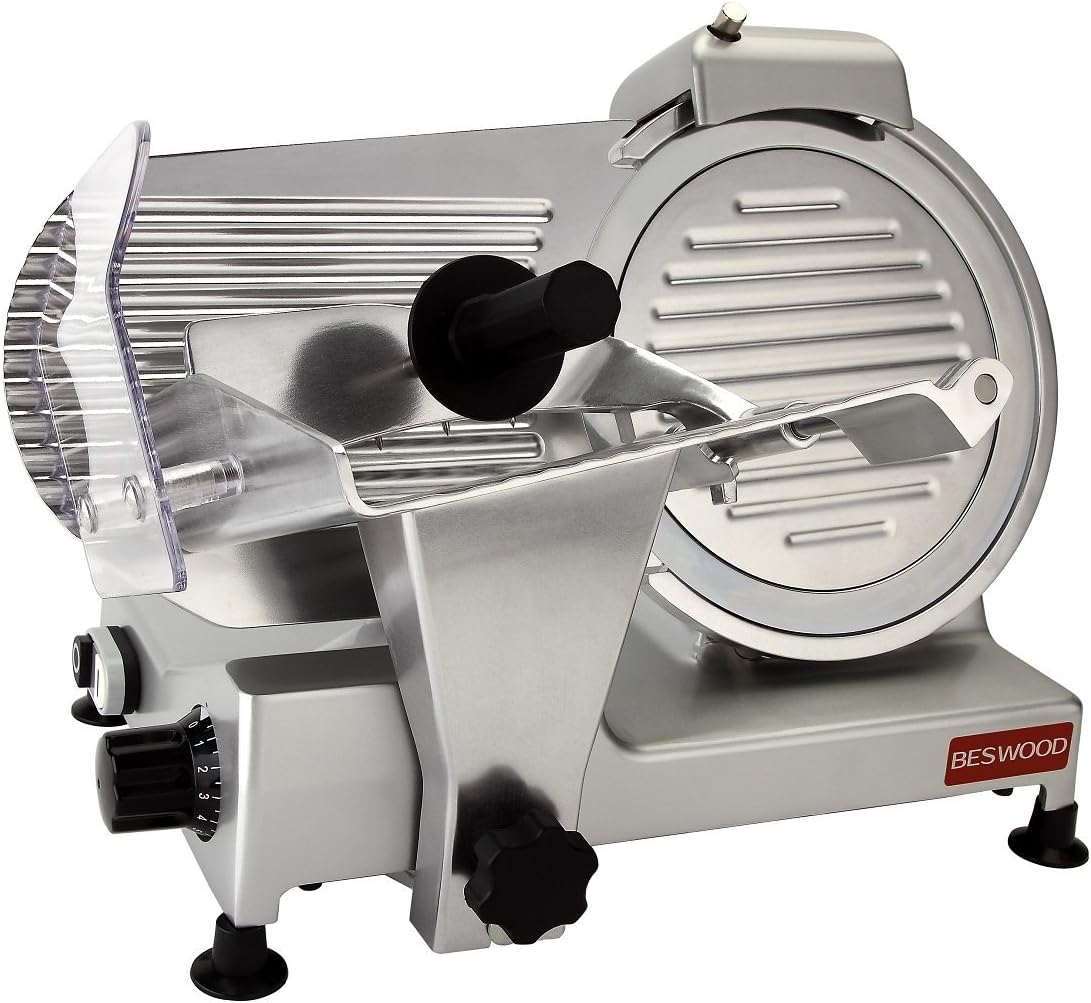
| Blade Diameter | 10 inches |
|---|---|
| Power | 240W (110-120V 60Hz) |
| Maximum cutting thickness | 12mm |
The BESWOOD 10" meat slicer is a heavy-duty deli slicer built to handle regular commercial-style use at a small-shop or serious home kitchen. It uses a 10-inch high-carbon, chromium-plated steel blade and a 240W enclosed motor to slice meats, cheeses, vegetables and fruit with a gravity-feed carriage and adjustable thickness control. Practical touches include a top-mounted two-stone sharpener so the blade can be maintained on-site, a removable product table for easier cleaning, skidproof rubber feet and a blade ring guard for safer operation. The aluminum body and V-belt construction aim to reduce vibration and noise during extended runs. Limitations include the unit weight and footprint that make it less convenient to move or store, and the manufacturer recommends hand-washing components which adds cleaning time compared with dishwasher-safe parts. For buyers who need a factory-quality blade and a slicer that stands up to frequent use, this model delivers reliable, restaurant-style performance without large commercial power requirements.
Best for: Buyers who prioritize a dependable, factory-quality slicer for daily deli or small commercial use and who plan to maintain the blade regularly.
Less Ideal for: Casual users who need a lightweight, easily stored countertop appliance or those seeking fully dishwasher-safe components.
- Chromium-plated high-carbon 10" blade resists corrosion and holds edge longer.
- 240W enclosed motor provides steady power for frequent slicing tasks.
- Built-in two-stone sharpener keeps blade serviceable without removing it.
- Aluminum body, V-belt design and rubber feet reduce vibration and improve stability.
- Removable product table and cleaning brush included for easier maintenance.
- Heavy and bulky at 33 pounds, not ideal for frequent relocation.
- Several parts require hand washing which increases cleaning effort.
Verdict: A durable, restaurant-style 10" slicer built for reliable daily use and easy on‑site blade maintenance.
Borlebbi Meat Slicer SL-518M

| Power | 200 watts |
|---|---|
| Voltage | 120 volts |
| Hertz | 50/60 Hz |
| Blade Diameter | 7.5 inch |
| Max Slice Thickness | 0.6 inch (15 mm) |
This Borlebbi slicer is a compact, restaurant-style electric slicer built around a 200W motor and two removable 7.5" stainless steel blades. It is used for slicing deli meats, cheeses, breads, fruits, and vegetables; a thickness knob lets you dial in paper-thin cuts up to about 0.6" (15 mm) for consistent results. The unit has a removable food carriage, blade and pusher for easier cleaning, a stainless steel tray to collect slices, and four suction rubber feet to keep the machine stable during use. Safety features include a recessed on/off switch and a food pusher that doubles as a blade guard. Because it is die-cast aluminum with stainless components the slicer feels durable while remaining compact enough for countertop storage. Expect good performance for home or light commercial use, but note the 200W motor is aimed at everyday kitchen tasks rather than continuous heavy-duty deli throughput and the parts require hand washing rather than dishwasher cleaning.
Best for: Buyers who want a compact, countertop slicer that delivers consistent, restaurant-style slices for home entertaining or small-batch commercial use and who prioritize proven user feedback when choosing appliances.
Less Ideal for: Not the best choice for high-volume, nonstop deli operations or users needing fully dishwasher-safe components for rapid turnaround.
- Two removable 7.5" stainless steel blades for switching between foods and easier cleaning
- Adjustable thickness control from nearly paper-thin to 15 mm for precise slicing
- Compact die-cast aluminum body with suction feet for stable countertop use
- Removable carriage, blade and food pusher allow more thorough hand-cleaning and sanitation
- 200W motor may struggle with long continuous runs or very dense hams
- Requires hand washing of removable parts rather than dishwasher-safe components
Verdict: A sturdy, compact slicer that delivers precise, professional-style slices for home cooks and small-scale pros looking for reliable, well-reviewed performance.
VEVOR Commercial Meat Slicer 10"

| Blade length | 10 inches |
|---|---|
| Motor load power | 240W |
| No-load power | 130W |
| Slice thickness range | 0–12 mm |
| Operation mode | Semi Automatic |
The VEVOR 10" commercial meat slicer is a semi-automatic countertop unit built to handle deli tasks in small commercial kitchens or serious home setups. Its 240W motor (130W no-load) spins a 45# carbon steel blade at roughly 350–400 RPM for steady, quick slicing of cooked, raw, or partially frozen meats. A thickness adjustment knob lets you set slices from paper-thin up to about 12 mm, and the integrated sharpening stone simplifies blade maintenance between runs. Parts that contact food are removable and the stainless tray wipes clean, which helps with routine sanitation. The machine is heavy-duty metal construction with a spiked food pusher and non-slip feet for stable, safe operation. Expect a sizable footprint and weight, so plan counter space and consider two people for initial placement. The unit requires hand cleaning for some components and has typical deli-slicer noise and power draw, so it is best suited where regular slicing justifies the bulk and effort of maintenance.
Best for: Buyers who prioritize reliable, pro-level slicing performance and predictable maintenance routines, and who need a durable countertop slicer for frequent deli or meal-prep work.
Less Ideal for: Those who need a compact, lightweight slicer for occasional use or who want a fully dishwasher-safe appliance should consider smaller or consumer-focused models instead.
- Powerful 240W motor delivers consistent slicing speed for a variety of meats
- 45# carbon steel 10-inch blade with built-in sharpener for long-term edge maintenance
- Adjustable slice thickness up to 12 mm for flexible portion control
- Removable food-contact parts and stainless tray that simplify cleaning and hygiene
- Sturdy metal build with spiked food pusher and non-slip feet for stable, safe operation
- Heavy and bulky, making it awkward to move or store
- Requires some disassembly and hand washing for full cleaning
Verdict: Choose this VEVOR 10" slicer if you want a rugged, pro-oriented countertop machine that delivers consistent, adjustable slices and easy blade sharpening for frequent deli work.
Choosing the Right Professional Meat Slicer: Key Factors to Consider
Blade Material and Diameter
Blade composition and diameter determine how smoothly the slicer cuts and how long the edge stays sharp. Stainless steel alloys with higher carbon content usually hold a sharper edge longer, which reduces the need for frequent resharpening and keeps slice quality consistent across a busy service period.
Larger diameter blades typically run cooler and allow longer continuous slicing before heat-related dulling becomes an issue. Consider whether the slicer supports replacement blades and if sharpening tools are included or readily available, since blade maintenance influences ongoing operating costs and downtime.
Motor Power and Duty Rating
Motor horsepower, torque, and the stated duty cycle indicate whether a slicer can handle continuous commercial workloads. Higher-torque motors slice dense or frozen items more cleanly and are less likely to bog down during extended runs, which keeps throughput predictable during peak periods.
Also check whether the motor is ventilated or enclosed in a way that resists food ingress and whether the manufacturer specifies continuous or intermittent duty. For heavy daily use, select a slicer with a commercial-duty motor and cooling features to avoid premature wear.
Carriage Design and Slice Accuracy
The carriage determines how easily you feed product and how consistent each cut will be. A smooth, low-friction carriage with secure food hold-downs produces even slices and reduces operator effort. Look for finely graduated thickness gauges and positive locking mechanisms so slice thickness does not drift during a run.
Reproducible slice accuracy matters for portion control and plating consistency. Features like calibrated stops, micrometer adjustments, or indexed detents help maintain repeatable results, especially when switching quickly between thicknesses.
Cleaning, Sanitation, and Maintenance Access
Effective cleaning access reduces food-safety risk and shortens downtime between shifts. Machines with removable food-contact parts, tool-free blade removal, and smooth, crevice-free surfaces are easier to sanitize thoroughly. Materials that resist corrosion also matter in wet cleaning environments.
Consider how often parts must be removed for cleaning and whether seals or bearings are exposed to food. Easier maintenance access lowers the labor burden for routine tasks like sharpening, lubrication, and bearing replacement, which in turn extends service life.
Safety Controls and Operator Ergonomics
Safety features protect staff during repetitive slicing tasks and can reduce liability. Look for blade guards, finger guards on the carriage, emergency stop buttons, and auto-stop features when guards are opened. Non-slip feet, ergonomic handles, and carriage stops reduce operator fatigue and the chance of errors.
Training and clear controls are part of the safety equation. A slicer with intuitive controls and visible safety labels helps new staff operate it correctly, and built-in lockouts or keyed switches prevent unauthorized use during cleaning.
Capacity and Throughput
Capacity considerations include the maximum product size the carriage will accept and the speed at which the slicer can produce consistent slices. Slicers designed for high throughput will have robust motors, larger blades, and durable carriage mechanisms that tolerate repeated loads without loss of accuracy.
Think about peak service demands and whether the machine will be used intermittently or continuously. Choosing a slicer with headroom above your typical workload helps avoid bottlenecks during busy shifts and reduces wear from constantly operating at the machine's limits.
Commercial Vs Heavy-Duty Home Use
Professional Meat Slicers span a range from true commercial units rated for daily, continuous use to heavy-duty machines suitable for serious home cooks. Commercial models are built with commercial-duty motors, larger blades, and serviceable components. Heavy-duty home units may offer similar cut quality but with lower duty-cycle ratings and more compact footprints.
When deciding between the two, assess how often you will slice and the typical volume per session. If you have sustained periods of high-volume slicing, prioritize commercial specifications and serviceability. For occasional large gatherings or frequent but short sessions, a heavy-duty home model may balance performance with a smaller footprint.
- Commercial units: higher duty cycle, larger blades, easier service access
- Heavy-duty home units: compact, lower continuous duty, still high slice quality
- Match machine rating to expected daily workload to maximize lifespan
Cleaning Routines That Keep Food Safety High
Establish a daily cleaning routine that includes disassembly of removable food-contact parts, thorough washing with approved sanitizers, and complete drying before reassembly. Pay special attention to the blade hub, carriage track, and any exposed bearings where debris can collect.
Avoid soaking electrical housings or motors. Instead, use damp cloths for non-food-contact surfaces and ensure that splash zones are designed to drain away from vents. Regularly inspect seals and replace them when worn to keep contaminants out of mechanical areas.
- Remove and sanitize blade and food carriage after heavy use
- Wipe down housings and controls with a food-safe cleaner
- Inspect seals and bearings regularly for wear or contamination
Sharpening and Blade Maintenance
Consistent edge maintenance preserves slice quality and reduces the effort required to cut denser items. Many professional slicers include built-in sharpening jigs or recommend specific procedures for safe sharpening. Follow the manufacturer guidance for angle and stroke count when resharpening to avoid removing excess material.
Keep a log of sharpening intervals under typical workloads to predict when blades will next need attention. Replace blades according to wear patterns rather than fixed calendar dates when possible, since usage varies greatly between kitchens.
- Use recommended sharpening tools or integrated sharpeners
- Monitor cut quality to determine resharpening intervals
- Replace blades when edge damage affects slice uniformity
Installation, Footprint, and Power Needs
Plan the installation site with sanitation and ventilation in mind. Ensure the work surface can support the weight and that there is enough clearance to operate the carriage safely. For commercial installations, check that the power supply matches the slicer requirements and that cord routing does not create trip hazards.
Measure the carriage travel and blade position relative to surrounding equipment so operators have unobstructed access. Consider whether the unit will be moved for cleaning or left stationary and select one with appropriate leveling feet or casters to match the workflow.
- Confirm electrical supply and outlet location before installation
- Allow clearance around the carriage for safe operation
- Choose a stable surface rated for equipment weight
Operator Training and Standard Procedures
Slicing is a repetitive task that benefits from standardized procedures. Train staff on the correct hold-down technique, safe blade handling during cleaning, and the steps for adjusting slice thickness. Regular refresher training helps prevent lapses that lead to inconsistent results or accidents.
Create simple, visible checklists for start-of-day and end-of-day routines that include inspection points for blade sharpness, guard integrity, and sanitation. Consistent procedures shorten onboarding time for new staff and improve overall safety.
- Provide hands-on training for carriage and blade handling
- Use visible checklists for cleaning and inspection
- Enforce lockout procedures during maintenance and blade changes
How We Chose the Best Professional Meat Slicer
We focused on attributes that directly affect commercial slicing performance and day-to-day usability. Key evaluation criteria included blade material and construction for edge retention and slice uniformity, motor power and duty cycle for consistent throughput under load, carriage and gauge precision for repeatable slice thickness, cleaning and sanitation features that influence downtime, and safety controls that reduce operator risk during repetitive tasks. We reviewed manufacturer specifications, user-serviceable features, and documented cleaning protocols to prioritize models suited to continuous use. Units that lacked adequate safety interlocks, had poor hygiene access, or specified motors not rated for commercial duty were excluded. We also favored machines with replaceable blades and clear maintenance access, since those affect lifetime operating cost and performance stability.
Our full evaluation process is outlined in our review methodology.
FAQ
How often should I sharpen a professional meat slicer blade?
Sharpening frequency depends on usage and the hardness of the products sliced. For heavy daily use, blades often need sharpening weekly or biweekly. Monitor slice quality and increase frequency if cuts become ragged or require more force.
Are commercial-duty motors necessary for restaurant use?
Yes. Commercial-duty motors are built to run longer and handle higher loads without overheating. For continuous or high-volume service, a motor rated for commercial duty reduces the risk of downtime and premature failure.
Can I clean a professional slicer with a pressure washer?
No. Pressure washing can force water into motor housings and electrical components. Use manual cleaning for food-contact parts and damp wiping for housings, following manufacturer sanitation guidance to avoid damaging seals and vents.
What safety features should I insist on?
Prioritize blade guards, carriage finger guards, emergency stop or keyed power switches, and interlocks that disable the blade when guards are removed. Clear labeling and easy-to-reach stops also improve operator safety during busy shifts.
How do I choose the right blade diameter?
Larger diameters generally allow longer continuous slicing and can run cooler, which is useful for high-throughput kitchens. If you expect frequent long runs, prefer larger blades; for occasional heavy use in smaller spaces, a mid-sized blade may suffice.
Final Verdict
When selecting a Professional Meat Slicer, prioritize blade quality, motor duty rating, and safety features that match your expected workload. Balance slice accuracy and ease of cleaning to minimize downtime and maintain food-safety standards. For commercial operations, choose equipment with serviceable components and cooling features that tolerate continuous use; for less intensive needs, a heavy-duty unit with strong blade and carriage design will deliver reliable results. Focus on the tradeoffs between throughput, maintenance, and operator safety so you can pick a slicer that performs consistently for your kitchen.