
Note: This article contains affiliate links. If you click on these links and make a purchase, we may earn a small commission at no extra cost to you. This helps support our research and content. Read our full affiliate disclosure here.
When you need steady heat without a noisy fan or rattling components, a quiet electric heater can make a big difference in comfort and concentration. Whether you want background warmth in a bedroom, a muted unit for a home office, or supplemental heat in a living room, the right choice delivers consistent comfort without drawing attention. This guide presents seven shortlisted quiet electric heaters chosen for low audible output and sensible energy performance. We evaluate each option across noise, heat output, and safety, so you can pick a heater that stays discreet while keeping your space comfortable. Read on for the factors that matter and how to match a unit to your room.
Top Picks at a Glance
| Best Overall The best all-around choice for most situations | WHISPERHEAT Under Desk Warmer DSK1300 |  |
| Best Quality Built to a higher standard if you want something more solid | DR. Infrared Heater DR-123 |  |
| Best Value The sweet spot between price and what you get | PELONIS Radiator Heater PHO15A2AGB |  |
| Best Budget The cheapest option that still gets the job done reliably | BREEZOME Space Heater MG31QN |  |
| Top Rated A top-rated pick with lots of positive feedback | DREO Space Heater HSH006 |  |
| Most Popular A crowd favorite that many people choose with confidence | GiveBest Portable Space Heater PTC-905 |  |
| Best Seller A high-volume bestseller chosen again and again | DREO Atom One Space Heater |  |
WHISPERHEAT Under Desk Warmer DSK1300

| Heating Method | Radiant |
|---|---|
| Power Source | ac |
| Number of Speeds | 3 |
| Recommended Uses For Product | Office |
The WHISPERHEAT Under Desk Warmer is a compact, upright radiant heater designed to warm legs and feet in small personal spaces. It uses fanless radiant heating so operation is very quiet, and three simple heat levels plus a 2- or 4-hour auto-shutoff timer make it easy to dial in comfort while at a desk. The slim foldable design and included standup brackets keep it stable and allow neat storage when not in use, and the manufacturer highlights spill resistance and tip-over and overheat protection for safer everyday use. Because it radiates heat rather than forcing air, it delivers steady localized warmth without moving dust or making noise, but it is intended for upright under-desk use only and will shut off if laid flat. Practical for office workers, dorm rooms, or nurseries, this unit is energy conscious for spot heating but will not replace a whole-room heater for larger spaces.
Best for: Buyers who want a quiet, energy-conscious personal heater to keep feet and lower legs warm while seated at a desk or workstation.
Less Ideal for: Users who need whole-room heating or want a heater for bathrooms, outdoor spaces, or continuous floor-mat use should choose a different product.
- Fanless radiant design provides very quiet operation for office or bedroom use
- Three heat levels plus a 2/4 hour auto-shutoff timer for simple, adjustable warmth
- Slim, foldable profile with sturdy brackets for easy placement and storage
- Safety features include tip-over and overheat protection and water-resistant surface
- Not intended to heat an entire room; only provides targeted under-desk warmth
- Cannot be used flat as a floor mat since it will auto-shutoff if not upright
Verdict: Pick this if you want a compact, whisper-quiet personal heater that delivers efficient, targeted warmth for desk-side comfort.
DR. Infrared Heater DR-123
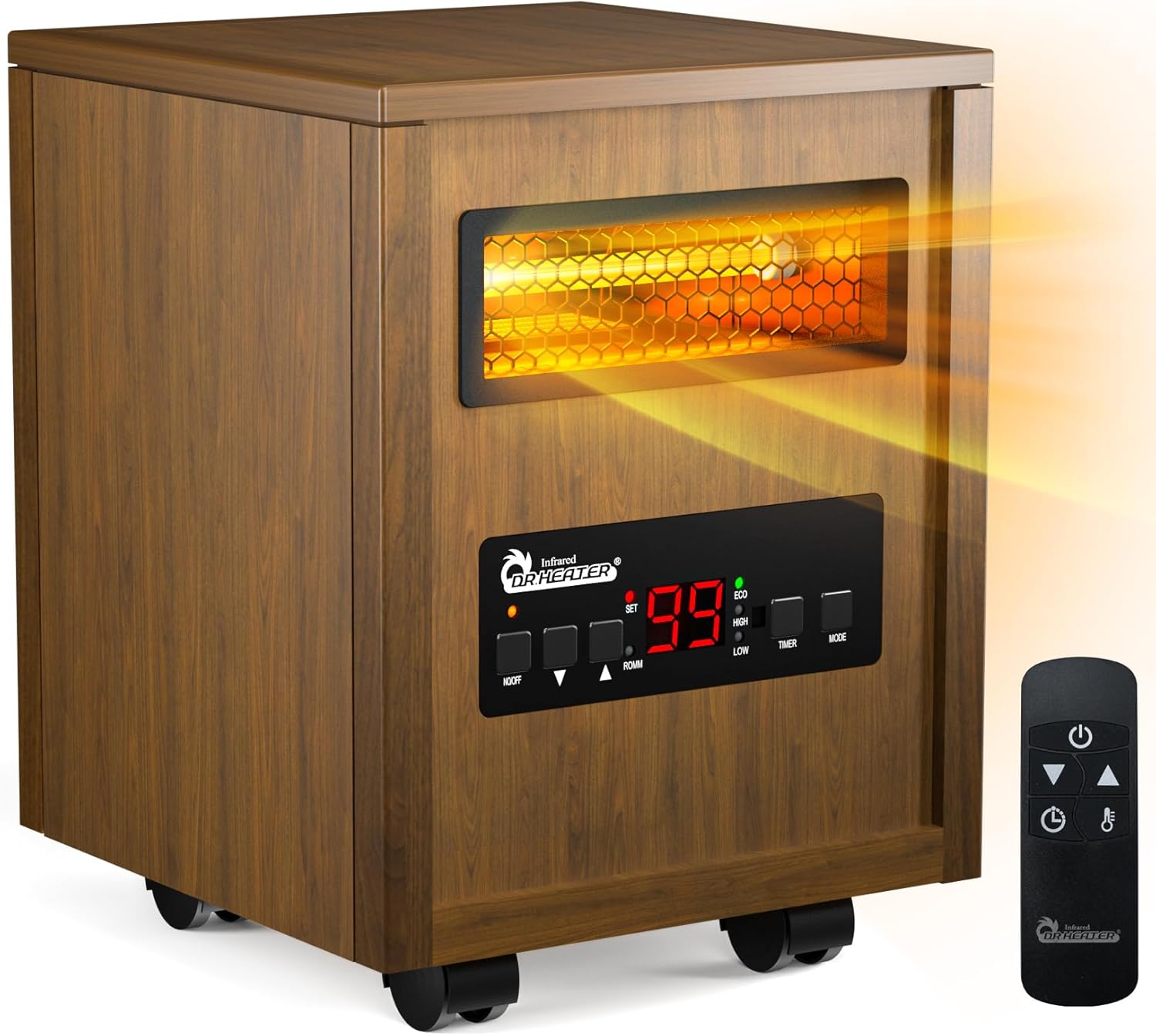
| Heating Coverage | 400 |
|---|---|
| Heat Output | 5200 btu_per_hour_per_foot_per_fahrenheit |
| Power Source | Electric |
| Number of Speeds | 3 |
| Min Temperature Setting | 30 °F |
The DR. Infrared Heater DR-123 combines infrared quartz and PTC fan-forced heating to deliver fast, evenly distributed warmth without drying the air. It is designed for portable whole-room use on caster wheels and is operated via onboard controls or the included remote, with a programmable 12-hour timer for scheduled heating. A digital thermostat (30°F–99°F) and three modes (Eco, High, Low) let you tune output and the Eco mode reduces power when full output is unnecessary. The unit emphasizes safety with UL listing plus tip-over and overheat shutoffs, and it runs quietly under 45 dB, making it suitable for bedrooms and offices. Practical touches include a six-foot cord and a lifetime filter that does not require replacements. On the downside the unit is relatively heavy for a portable heater and may be more power than needed for very small rooms, and it relies on a fan in some modes so absolute silent operation is not possible when the fan runs.
Best for: Buyers who prioritize effective, adjustable room heating that stays quiet enough for sleeping or working and who want a safety-focused, portable unit with programmable controls.
Less Ideal for: People who need a lightweight, ultracompact heater for occasional spot heating or those who require absolute zero fan noise at all times.
- Dual heating system (infrared quartz + PTC fan) for fast, comfortable warmth.
- Digital thermostat with 30°F–99°F range and three modes including an energy-saving Eco mode.
- Whisper-quiet operation below 45 dB suitable for bedrooms and offices.
- Portable on four caster wheels with a full-function remote and 12-hour programmable timer.
- Heavier than many portable heaters, which makes lifting awkward despite wheels.
- Fan-forced mode means it is not completely silent when the fan is running.
Verdict: A safety-minded, performance-oriented portable heater that delivers fast, quiet whole-room warmth with precise thermostat control.
PELONIS Radiator Heater PHO15A2AGB

| Heat Output | 1500 watts |
|---|---|
| Number of Speeds | 3 |
| Voltage | 120 volts |
| Min Temperature Setting | 41 °F |
| Max Temperature Setting | 95 °F |
The PELONIS PHO15A2AGB is an oil-filled radiator heater that delivers silent, steady radiant heat for bedrooms, home offices, and similar indoor spaces. It runs at 1500 watts with selectable 600W, 900W, and 1500W modes so you can scale output for comfort or energy savings, and the absence of a fan keeps noise below noticeable levels for overnight use. Controls are simple dual knobs and an adjustable thermostat lets you dial in a target temperature between the listed min and max. Safety features include tip-over shutoff and overheat protection, and the unit rolls on casters and has a carry handle for easy room-to-room repositioning. Because it uses oil as the heat reservoir it keeps warming after the element cycles off, offering gentler, drier air than forced-air heaters. The trade-offs are that it is a basic, mechanical design without digital timers or remote control, and it warms by radiant convection which can be slower to change room temperature than fan heaters in large open spaces.
Best for: Buyers who prioritize quiet, steady room heating and energy-conscious control for bedrooms or home offices and want a simple, reliable unit rather than smart features.
Less Ideal for: People who need rapid, directed heat for large open areas or who require programmable/timer features and remote control should consider other heater types.
- Very quiet operation suitable for bedrooms and offices
- Three power modes (600W/900W/1500W) for flexible energy use
- Adjustable thermostat for maintaining a steady room temperature
- Tip-over and overheat protection for safer unattended use
- Wheels and handle make it easy to move between rooms
- No digital controls, timer, or remote for scheduled operation
- Slower to change room temperature compared with fan-forced heaters
Verdict: Choose this PELONIS radiator if you want virtually silent, energy-scalable radiant heat for bedrooms or small home offices without extra digital frills.
BREEZOME Space Heater MG31QN

| Heat Output | 1500 watts |
|---|---|
| Heating Element | PTC Ceramic |
| Number of Speeds | 3 |
| Voltage | 120 volts |
| Min-Max Temperature | 59 °F – 95 °F |
The BREEZOME MG31QN is a small tabletop tower heater that uses a 1500W PTC ceramic element to deliver fast, even convection heating for personal spaces. It is typically used on desks, bedside tables, or in small bedrooms where quick warmth is needed without a lot of noise. Notable features include three heat levels, a programmable 24-hour timer, an adjustable thermostat (59 to 95 F), a 90 degree oscillation for broader coverage, and a low-noise motor that claims about 34 dB on its lowest setting. Practical benefits are its compact, lightweight footprint for easy relocation, the ECO thermostat mode for maintaining a target temperature while saving energy, and multiple safety protections including tip-over and overheat shutdown plus ETL certification. Limitations to expect are that 1500W heaters are best for small to medium rooms rather than whole-house heating, and the plastic tower design focuses on portability over premium materials. For buyers prioritizing a quiet, affordable heater for personal rooms, this model balances performance and safety well.
Best for: Buyers who want an inexpensive, low-noise personal heater to warm a bedroom, office, or bedside area and who prioritize safety and energy-conscious temperature control.
Less Ideal for: People needing to heat large open areas or whole apartments should choose a higher-capacity or whole-room solution instead.
- Powerful 1500W PTC ceramic element for quick warm-up
- Quiet operation (about 34 dB) suitable for bedrooms or offices
- Adjustable thermostat with ECO mode to maintain set temperature
- 24-hour timer and 90° oscillation expand usable coverage
- Multiple safety features including tip-over and overheat protection with ETL certification
- Best suited to small to medium rooms; not intended for whole-house heating
- Plastic tower construction is more utilitarian than premium
Verdict: A budget-friendly, very quiet 1500W tabletop heater that delivers fast personal warmth with solid safety and energy-saving controls.
DREO Space Heater HSH006

| Heat Output | 1500 watts |
|---|---|
| Heating Element | PTC Ceramic |
| Heating Coverage | 200 sq.ft |
| Number of Speeds | 4 |
| Min-Max Temp | 41 °F – 95 °F |
The DREO HSH006 is a compact tower heater designed to warm single rooms quietly and safely. It uses a 1500W PTC ceramic element and a brushless DC motor with a winglet fan to move heated air, and the company rates its coverage at about 200 sq. ft. Controls include a precise thermostat that sets from 41 to 95°F in 1°F increments, four fan/heat speeds, multiple heating modes (Power, ECO, Fan Only), a 12-hour timer and a remote for one-touch adjustments. Safety features are comprehensive for the category: tip-over detection, overheat protection, flame-retardant materials and an ETL listing. In real-world use the heater produces noticeable warmth within seconds and maintains target temperature without cycling loudly, which makes it suitable for bedrooms and home offices where low noise matters. The unit is lightweight and portable with a carry handle, but its small tower footprint limits how well it moves heat in very large or open-plan spaces and it runs on standard 120V power so peak output is capped at 1500W. If you need a quiet, feature-rich room heater with strong safety controls, this model delivers consistent, reliable performance.
Best for: Buyers who prioritize a quiet, reliable room heater with precise temperature control and strong safety features for bedrooms or home offices.
Less Ideal for: Those who need to heat very large, open spaces or want higher-than-1500W output for rapid whole-room heating should consider more powerful solutions.
- Brushless DC motor and winglet fan reduce operating noise for quiet operation.
- Adjustable thermostat with 1°F increments gives precise temperature control.
- Comprehensive safety package including tip-over detection, overheat protection and ETL listing.
- Remote control and 12-hour timer add convenience for bedroom or office use.
- Limited effective range for very large or open-plan rooms due to tower form factor.
- Maximum heat output capped at 1500W, so it cannot replace whole-home heating.
Verdict: If you want a quiet, safety-focused room heater that holds temperature precisely, the DREO HSH006 is a dependable choice.
GiveBest Portable Space Heater PTC-905

| Heat Output | 1500 watts |
|---|---|
| Heating Coverage | 200 sq.ft |
| Number of Speeds | 2 |
| Power Source | Corded Electric |
| Max Temperature Setting | 158 °F |
The GiveBest PTC-905 is a small ceramic fan heater built for spot heating in bedrooms, home offices, and other small rooms. It offers two heat modes (1500W and 750W) plus a cool fan setting, and an adjustable electronic thermostat that cycles the unit to hold a preset temperature. The PTC ceramic element and high-speed fan deliver fast, quiet heat that the brand rates for up to about 200 square feet, and the unit includes tip-over and overheat shutoffs and flame retardant housing for added safety. Its lightweight, tabletop design and built-in handle make it easy to move to the room you need without heating the whole house. The main compromises are that it is intended for small-to-medium spaces only and that the simple two-speed control and basic thermostat lack the fine programing or connectivity of pricier digital models. For buyers prioritizing quiet, effective personal heating and straightforward safety features, this is a reliable, no-frills option.
Best for: Buyers who want a quiet, portable heater to warm a single room or personal workspace and who prioritize reliable safety features and simple controls over smart features.
Less Ideal for: Those seeking whole-room or open-concept heating, advanced digital controls, or Wi-Fi/smart-home integration should consider a larger or more feature-rich model.
- PTC ceramic element with fast warm-up for quick spot heating
- Two heat settings plus cool fan for year-round use
- Electronic thermostat that cycles to maintain a set temperature
- Multiple safety protections including tip-over and overheat shutoffs
- Compact, lightweight design with built-in carry handle for easy relocation
- Designed for small to medium rooms so less effective for large open spaces
- Basic two-speed control and thermostat lack advanced scheduling or connectivity
Verdict: A compact, quiet ceramic heater that reliably warms a single room while prioritizing safety and simple operation.
DREO Atom One Space Heater
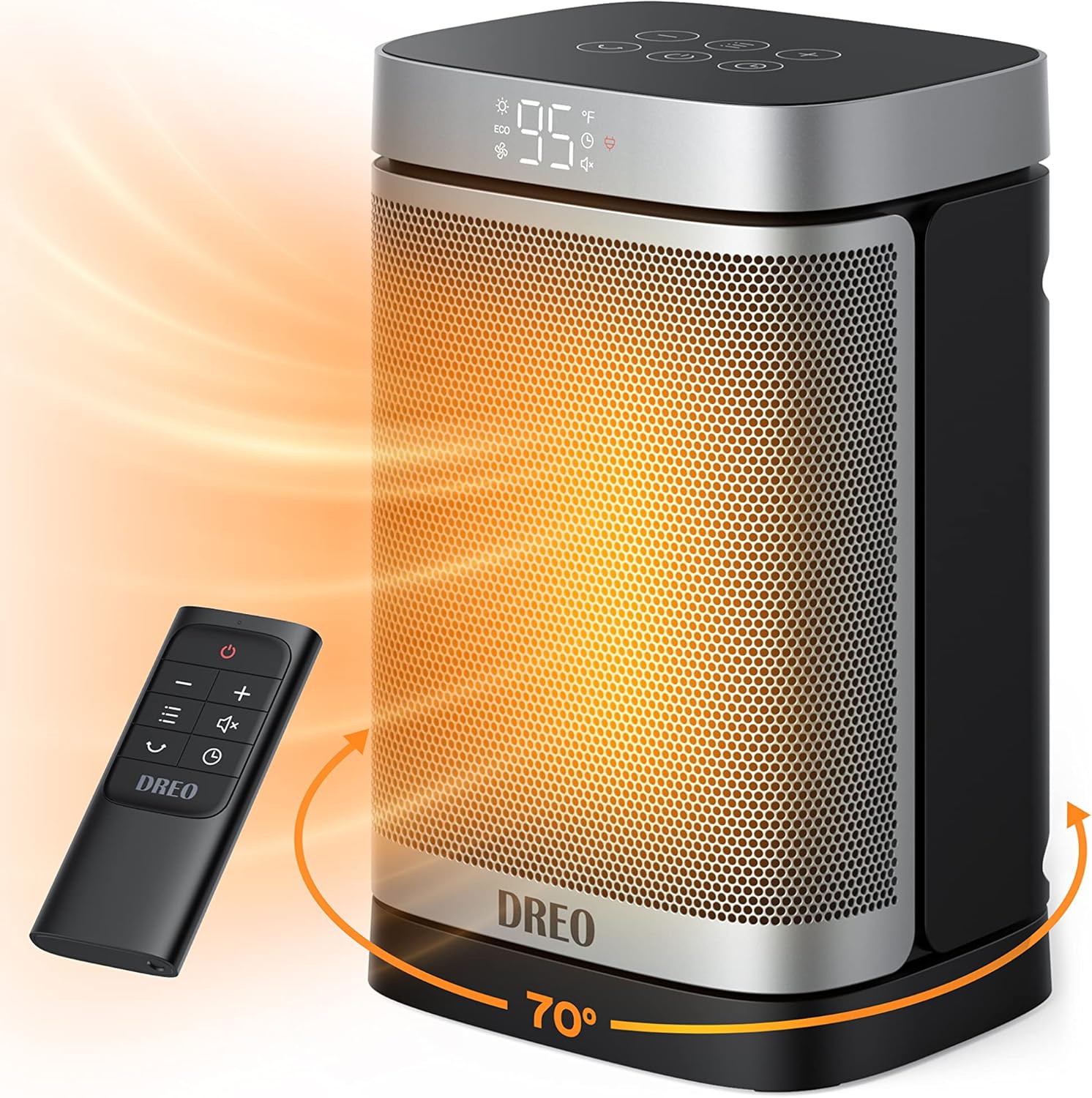
| Heat Output | 1500 watts |
|---|---|
| Heating Coverage | 200 sq.ft |
| Thermostat Range | 41-95 °F |
| Number of Speeds | 5 |
| Timer | 1-12 H |
The DREO Atom One is a small tower-style electric heater designed to deliver fast, targeted warmth for bedrooms, home offices and similar rooms. It uses PTC ceramic heating with up to 1500 watts and a digital thermostat adjustable from 41 to 95°F in 1°F increments, so you can set and maintain a precise comfort level. The unit oscillates about 70 degrees to spread heat across a wider area, includes five fan speeds and an ECO mode that cycles output to save energy. Safety features are robust for this class: ETL-listed protections for tip-over and overheating plus a flame-retardant housing and an enhanced safety plug. Practical conveniences include a detachable filter, a 1–12 hour timer and a small remote for hands-off control, and the company says the brushless DC motor and multi-blade design keep operation quiet enough for sleeping or working. Trade-offs are typical for compact forced-air heaters: it is best for single rooms up to the stated coverage, and like all 1500W electric heaters it will draw a full circuit on some outlets.
Best for: Buyers who prioritize a quiet, safety-focused portable heater for a bedroom or home office and want precise temperature control with simple remote and timer convenience.
Less Ideal for: People needing to heat very large open areas or who prefer the slow, sustained warmth of oil-filled radiators should consider other heater types.
- Precise digital thermostat with 1°F increments for stable temperature control
- 70° oscillation and multiple fan speeds spread heat more evenly across a room
- ECO mode and timer help reduce energy use during extended operation
- ETL-listed safety features including tip-over and overheat protection and flame-retardant materials
- Detachable filter and included remote add convenience and easy maintenance
- 1500W output limits effectiveness to single rooms rather than whole-house heating
- Forced-air design can feel less evenly radiant compared with oil-filled or convection heaters
Verdict: A compact, safety-minded and unusually quiet 1500W tower heater that gives precise temperature control for single rooms.
Choosing the Right Quiet Electric Heater: Key Factors to Consider
Noise Output (Decibels and Perceived Quiet)
Noise output matters because the whole point of a quiet electric heater is to stay out of the way. Look for documented decibel ratings or third-party measurements when available. Remember that perceived quiet depends on both absolute decibel level and the sound character. A constant low-frequency hum can be less distracting than intermittent clicks or fan gusts even at similar decibel levels.
Consider where you will use the heater. Bedrooms and study spaces demand the lowest audible footprint, so prioritize units described as whisper-quiet or specifically engineered for low-noise operation. If you are sensitive to tonal noise, choose models that rely on convection or silent ceramic elements rather than high-speed fans.
Heat Delivery Method
Electric heaters produce warmth via different methods: convection, radiant panels, ceramic elements with fans, or oil-filled radiators. Each method affects both noise and how heat feels in the room. Convection and oil-filled radiators often operate silently and provide even background warmth but can be slower to reach target temperature. Radiant and ceramic heaters deliver more immediate, directional heat and may include fans to disperse warmth faster.
Match the delivery type to your use case. For all-night bedroom heating, silent convection or oil-filled units that maintain temperature quietly are often preferable. For spot heating while you sit at a desk, a small radiant or ceramic option can provide fast, perceived warmth with minimal noise if it uses a low-speed or brushless fan.
Room Size and Heat Output
A heater's wattage and advertised coverage area indicate how well it will warm a space. Under-powering a larger room forces units to run at higher settings, which can increase noise and reduce lifespan. Overpowered units in small rooms may cycle frequently, creating clicks or fan noise during on-off transitions.
Estimate the square footage of the intended space and choose a heater with appropriate output for that size. For continuous low-noise operation, it is better to select a model that can maintain temperature on low or medium settings rather than one that must run at maximum output constantly.
Energy Use and Control Precision
Energy efficiency affects operating cost and how often a heater runs at high power. Models with accurate thermostats, multiple power levels, and programmable timers let you maintain comfort while minimizing runtime. A precise thermostat reduces frequent cycling and helps the unit run at lower, quieter settings more of the time.
Look for features like adaptive thermostats, eco modes, and multiple heat stages. These controls allow you to tune heat delivery to occupancy patterns so the heater delivers only the required energy and stays quieter overall.
Safety Features and Placement
Safety matters more than ever when a heater is left running in occupied spaces. Essential protections include tip-over shutoff, overheat protection, and cool-touch exteriors. Some units also include child locks, timer shutoffs, or automatic shutoff when blocked.
Consider placement constraints in your room. Low-profile units that fit against walls or radiators that stay cool to the touch reduce risk in homes with pets or children. Proper placement also affects airflow and heat distribution, which in turn influences how loudly the unit must run to keep the space comfortable.
Build Quality and Long-Term Reliability
A solidly built heater maintains quiet operation longer because loose panels, vibration, or degraded bearings in fan motors are common sources of noise over time. Durable materials and straightforward serviceability reduce the chance of rattles or squeaks developing.
Check for reviews that mention long-term quiet operation and well-designed housings. Even with good initial silence, a heater subjected to heavy use benefits from a robust design that resists loosening fasteners and wear on moving parts.
Best Heat Types for Quiet Operation
Not all heating technologies are equally quiet. Passive convection heaters and oil-filled radiators produce warmth with minimal moving parts and are typically the quietest options. They heat the air slowly but provide steady background warmth without fan noise.
If you need faster, localized heat, look for ceramic or radiant units that minimize fan speed or use brushless motors. These can deliver quick comfort without the persistent sound of conventional high-speed fans.
- Convection and oil-filled: slow, even, very quiet
- Radiant and ceramic: faster warmth, potentially quiet if low-speed fans are used
- Avoid high-speed fan-only designs for spaces that require silence
Placement Tips to Reduce Perceived Noise
Where you place the heater changes how loud it feels. Putting a unit near a hard wall or corner can amplify rattles or reflect sound into the room. Give the heater a little space from rigid surfaces to help dissipate any minor vibrations.
Elevating a small tabletop unit slightly can change how sound radiates. For floor units, position them so airflow is unobstructed and away from foot traffic to avoid accidental bumps that produce noise.
- Avoid tight corners that can amplify sound
- Keep clearance for airflow to reduce strain on the unit
- Place away from doors and windows that funnel outside noise into the room
How Thermostats Influence Quiet Performance
A precise thermostat reduces the need for the heater to rapidly cycle between on and off, which can cause clicking and transient fan power changes. Digital thermostats with small deadbands and adaptive control maintain steady operation at low power settings.
If you anticipate long stretches of background heating, prioritize models with reliable temperature control and incremental power stages. These features help the unit stay in low-noise modes more often.
- Digital thermostats often provide tighter temperature control
- Multi-stage power helps avoid full-power cycles
- Programmable schedules reduce unnecessary runtime
Safety Considerations for Continuous Use
If you plan to run a heater overnight or while away for short periods, safety features become essential. Tip-over and overheat protection are basic requirements. Some heaters also monitor internal temperature and adjust output to avoid dangerous conditions without abrupt on-off behavior that creates noise.
Keep combustible materials clear from the heater's intake and exhaust areas and follow manufacturer spacing guidelines. Regularly inspect cords and controls for secure connections to prevent electrical noise or mechanical issues that might develop into audible faults.
- Ensure tip-over and overheat protections are present
- Maintain clearances to prevent blocked airflow
- Inspect cords and mounting points periodically
Maintenance to Preserve Quiet Operation
Routine maintenance keeps a heater whisper-quiet. Dust buildup on elements and inside fan housings can change the sound signature and reduce efficiency. Clean accessible surfaces and any intake grills according to the product instructions.
Tighten loose screws and check for vibration-prone components if you notice new noises. If a fan-bearing starts to whine or rattle, address it promptly—repair or replacement will usually restore silent operation more effectively than continued use.
- Regularly clean grills and accessible internals
- Tighten loose fasteners to prevent rattles
- Address new or changing noises quickly to avoid further damage
How We Chose the Best Quiet Electric Heater
We focused on attributes that directly affect how unobtrusive and effective a quiet electric heater will be in everyday use. Primary criteria included measured or reported noise output in decibels, the heater's heat delivery method and output range, and energy efficiency as reflected by power settings and thermostat control. We also weighed safety features such as tip-over shutoff and overheating protection and examined the physical design for silent operation including brushless motors or passive convection. Usability factors such as thermostat precision, programmable timers, and ease of placement in typical rooms were considered as well. Products were excluded if they relied on inherently loud mechanical fans without noise-reduction design, if they lacked basic safety shutoffs, or if they failed to offer adjustable heat settings suitable for continuous low-noise use. Our shortlist favors units that provide steady warmth at low noise levels and include practical controls and protections that matter for daily home use.
Our full evaluation process is outlined in our review methodology.
FAQ
How many decibels is considered quiet for a heater?
Quiet heaters often operate below 40 decibels at typical seating distance. However, perceived quiet depends on frequency and consistency of the sound as well as the room's acoustics.
Are oil-filled radiators the quietest option?
Oil-filled radiators are among the quietest because they rely on passive convection and have no fans. They warm slowly but maintain steady, silent heat once up to temperature.
Will a quiet heater still warm large rooms effectively?
It depends on the heater's output rating and the room's insulation. Quiet models designed for larger spaces will have higher wattage or multiple heat elements. For large rooms, choose a unit rated for the square footage so it can run at low, quiet settings.
Can I leave a quiet electric heater running overnight?
Many modern heaters include overheat protection and timers that make overnight use safer. You should only leave units that include necessary safety features and follow the manufacturer's placement and operation guidelines.
Does placing a heater near furniture make it noisier?
Blocking airflow can make a heater strain or cycle more, which may increase sound. Also, contact with furniture can transmit vibrations and amplify noise, so keep adequate clearance.
Final Verdict
When choosing a quiet electric heater, prioritize noise output, heat delivery method, and safety features to match how and where you will use it. For bedrooms and study areas, silent convection or oil-filled options that maintain temperature on low settings usually offer the best balance of quiet and comfort. If you need faster localized heat, select ceramic or radiant designs that minimize fan speed and offer precise thermostatic control. Accept tradeoffs between immediate warmth and absolute silence and favor models with accurate thermostats and built-in protections. That approach will help you pick a heater that stays discreet while reliably keeping your space comfortable.