
Note: This article contains affiliate links. If you click on these links and make a purchase, we may earn a small commission at no extra cost to you. This helps support our research and content. Read our full affiliate disclosure here.
If noise matters as much as heat, a quiet heater can make the difference between comfortable downtime and a room that feels disruptive. Whether you need supplemental warmth for a bedroom, home office, or living space, low operating noise helps preserve sleep, concentration, and a calm atmosphere. This guide presents seven shortlisted Quiet Heaters chosen for their balance of effective heating, whisper-quiet operation, safety, and reasonable running cost. Below we explain the criteria used to evaluate each option and highlight the features that matter most when you want heat without the hum or fan roar.
Top Picks at a Glance
| Best Overall The best all-around choice for most situations | Vornado VC-01 Ceramic Heater |  |
| Best Quality Built to a higher standard if you want something more solid | Ballu Mica Infrared Panel Heater |  |
| Best Value The sweet spot between price and what you get | BREEZOME Space Heater MG37QN |  |
| Best Budget The cheapest option that still gets the job done reliably | Gaiatop Mini Space Heater SH-02 |  |
| Top Rated A top-rated pick with lots of positive feedback | DREO Space Heater HSH006 |  |
| Most Popular A crowd favorite that many people choose with confidence | GiveBest Portable Space Heater PTC-905 |  |
| Best Seller A high-volume bestseller chosen again and again | DREO Space Heater DR-HSH004 |  |
Vornado VC-01 Ceramic Heater

| Power Source | Electric |
|---|---|
| Heating Method | Convection, Forced Air |
| Number of Speeds | 4 |
| Voltage | 120 volts |
The Vornado VC-01 is a small tower-style ceramic heater built to push concentrated heat farther into a room than a typical personal heater. It offers two heating modes—Personal and Whole Room—plus four fan speeds and a 15° manual tilt so you can angle the output where you need it. Controls are simple and touch-based, and the low-speed setting runs quietly, making it suitable for bedrooms or home offices where silence matters. Safety is addressed with tip-over protection, automatic overheat shutoff, a cool-touch exterior and a reusable pre-filter to cut dust buildup. Because it focuses heat delivery rather than acting as a whole-house solution, it works best as a targeted room heater rather than replacing central heat. Expect straightforward performance without advanced smart features or multi-room connectivity, but with reliable, easy-to-use warming and a compact footprint that fits small spaces.
Best for: Buyers who want a quiet, compact room heater that delivers focused, farther-reaching ceramic heat for bedrooms, dorms, or home offices and value simple, reliable controls over smart features.
Less Ideal for: People who need to heat large open-plan spaces or want Wi-Fi/voice control and advanced scheduling should consider other options.
- Velocity Tuned Heat projects warm air farther than typical ceramic heaters
- Quiet low-speed operation suitable for bedrooms and offices
- Selectable Personal or Whole Room modes for flexible use
- Built-in safety features including tip-over protection and automatic overheat shutoff
- Reusable pre-filter reduces dust and is easy to maintain
- No smart home connectivity or programmable schedules beyond a basic timer
- Not intended to heat large open areas or replace central heating
Verdict: Choose the VC-01 when you want a quiet, easy-to-use ceramic heater that sends concentrated warmth across a room without complicated features.
Ballu Mica Infrared Panel Heater

| Heat Output | 1500 watts |
|---|---|
| Heating Method | Convection, Mica Far-infrared |
| Heating Coverage | 250 sq ft (Primary) Over 500 sq ft (Secondary) |
| Voltage | 120 volts |
| Min Temperature Setting | 40 °F |
The Ballu Mica Infrared Panel Heater pairs a mica far-infrared element with convection to heat medium to large rooms efficiently and quietly. In everyday use you can place it on the included casters to move between rooms or install it on the wall for permanent coverage; its 1500W output and 180° wide-angle design aim to warm up to about 250 sq ft quickly while still influencing larger areas. Controls are flexible: onboard digital display, remote, and a WiFi app with scheduling and voice commands let you set precise temperatures and timed runs, which helps reduce wasted runtime. Important safety features include tip-over shutoff, overheat protection, child lock, and a flame-retardant cord. The unit is relatively simple to operate but does not replace central heating for whole-house needs, and performance will depend on room insulation and layout. For buyers focused on quiet, steady room heating with smart control, this heater delivers practical, energy-conscious warmth.
Best for: Buyers who prioritize quiet, controllable room heating and want smart scheduling and voice control to maintain steady comfort in living rooms, bedrooms, or home offices.
Less Ideal for: People needing whole-house heating or high-output spot heat for very large, uninsulated spaces should look to higher-capacity or permanent HVAC solutions.
- Combines mica far-infrared and convection for even, penetrating warmth
- Whisper-quiet operation suitable for bedrooms and home offices
- WiFi, remote, and onboard programmable thermostat for precise scheduling
- Can be mobile on casters or mounted on the wall for flexible placement
- Multiple safety features including tip-over and overheat protection
- 1500W power may be insufficient as a sole heat source in very large or poorly insulated spaces
- Limited speed settings with only two fan/speed modes
Verdict: A quiet, smart 1500W panel heater that delivers steady, programmable warmth for medium to large rooms with minimal noise.
BREEZOME Space Heater MG37QN

| Heat Output | 1500 watts |
|---|---|
| Heating Element | PTC Ceramic |
| Voltage | 120 volts |
| Temperature Range | 59 °F to 95 °F |
| Number of Speeds | 2 |
The BREEZOME MG37QN is a small tower-style PTC ceramic heater designed for quick, personal-area heating. It delivers up to 1500 watts and uses a forced-air duct to spread warmth quickly across a room while offering three heat levels and an ECO thermostat mode that maintains a set temperature between 59 and 95 F. Controls include a 24-hour timer, remote, and an option to turn off the display for undisturbed sleep. Notable everyday benefits are fast warm-up from the high setting, a compact lightweight footprint for moving between desk, bedside, or office, and a very quiet low-speed mode rated around 34 dB. Safety features are robust for the price with tip-over and overheat protection, ETL certification, and a 24-hour automatic shutdown. Limitations include only two fan speeds listed in some specs and modest oscillation range, so it is best for heating single rooms or localized zones rather than large open spaces.
Best for: Buyers who want a quiet, portable heater to warm a bedroom, home office, or bedside area and value energy-conscious temperature control and safety features.
Less Ideal for: People needing to heat large living rooms, open-plan spaces, or multiple rooms at once should choose a higher-capacity heater or whole-room solution.
- Fast warm-up with 1500W PTC ceramic element for quick personal heating
- Very quiet low setting (~34 dB) suitable for sleep or focused work
- Remote control, 24-hour timer, and ECO thermostat for convenient temperature management
- Multiple safety protections including tip-over, overheat shutoff, and ETL certification
- Compact and lightweight for easy placement on desks, nightstands, or small floors
- Designed for single-room or personal use and not powerful enough to heat large open areas effectively
- Limited fan speed/options and modest oscillation may reduce evenness of heat in bigger rooms
Verdict: A quiet, safety-focused portable heater that delivers fast, efficient personal heating for bedrooms and home offices.
Gaiatop Mini Space Heater SH-02

| Heat Output | 500 watts |
|---|---|
| Power Source | Corded Electric |
| Heating Method | Convection |
| Max Temperature Setting | 100 °C |
The Gaiatop Mini Space Heater SH-02 is a small, portable 500W electric desk heater that uses a PTC ceramic element to produce quick convection heat for close-range personal use. It is intended for workspaces, dorm rooms, and small corners of apartments where you want near-instant warmth without heating an entire room. Notable features include a two-second fast-heat response, a quiet operation suited to offices, LED run indicator, and built-in safety protections such as 45 degree tip-over shutoff, overheat protection, V0 fireproof materials, and an anti-slip base. Because it runs at 500 watts and is compact, it warms a limited area quickly and is energy efficient for short bursts of use, but it will not replace a larger heater for whole-room heating. The lightweight, tabletop design makes it easy to move and position, and the simple corded plug setup is plug-and-play. If you need a discreet, low-noise personal heater that prioritizes safety and fast warmth, this model is a practical budget choice.
Best for: Buyers wanting an inexpensive, low-noise personal heater to provide quick warmth at a desk or in a small room without running a high-power appliance.
Less Ideal for: People who need to heat medium or large rooms or who want adjustable multi-zone temperature control should choose a higher-output model.
- Fast PTC ceramic heating that warms nearby air in seconds
- Quiet operation suitable for offices and sleeping areas
- Built-in safety features including tip-over and overheat protection
- Compact, lightweight tabletop design for easy placement and portability
- Low 500W output limits effective heating to small personal areas
Verdict: A compact, safe, and quiet 500W personal heater that delivers fast spot warmth on a tight budget.
DREO Space Heater HSH006

| Heat Output | 1500 watts |
|---|---|
| Heating Element | PTC Ceramic |
| Heating Coverage | 200 sq.ft |
| Number of Speeds | 4 |
| Sound Level | 34 dB |
The DREO HSH006 is a portable tower heater designed to warm small rooms quietly and with safety features aimed at everyday use. It delivers up to 1500 watts through a PTC ceramic element and forced-air circulation, offering multiple heat modes, an ECO setting, and a fan-only option for year-round use. The unit includes an adjustable thermostat that sets between 41 and 95°F in 1°F steps, a 12-hour timer, and a remote for hands-off control. Safety is well covered with tip-over detection, overheat protection, flame-retardant materials, and an ETL listing. Noise levels are low thanks to a brushless DC motor and winglet fan design that DREO rates at about 34 dB, making it suitable for bedrooms and offices where quiet operation matters. At the same time the heater is compact and lightweight for easy moving, though its 200 sq ft coverage means it is best for single rooms rather than open-plan spaces. There is no mention of Wi-Fi or smart-home integration, so expect manual or remote operation only.
Best for: Buyers who prioritize quiet, safe, and accurate heat for single rooms like bedrooms or home offices and want an easy-to-move heater with reliable safety features.
Less Ideal for: People needing to heat large open-plan areas or those who require smart home integration and app control should look elsewhere.
- Quiet brushless DC motor reduces noise to around 34 dB, suitable for bedrooms and offices
- Precise thermostat with 1°F increments between 41–95°F for better temperature control
- Multiple modes plus a 12-hour timer and remote for convenient operation
- Comprehensive safety features including tip-over detection, overheat protection, and flame-retardant materials
- Designed for rooms up to about 200 sq ft so not ideal for large or open-plan areas
- No smart connectivity or app control—remote and onboard controls only
Verdict: Choose this heater if you want a compact, safety-focused heater that runs quietly while giving precise temperature control for single rooms.
GiveBest Portable Space Heater PTC-905

| Heat output | 1500 watts |
|---|---|
| Heat modes | 1500W / 750W |
| Thermostat | Adjustable electronic |
| Coverage | 200 sq.ft |
| Number of speeds | 2 |
The GiveBest PTC-905 is a small ceramic space heater designed to provide quick, quiet warmth for single rooms and desks. It offers two heat modes (1500W and 750W) plus a cool-air fan, and an adjustable electronic thermostat that cycles the unit to hold a preset temperature without constant fiddling. The unit uses PTC ceramic heating and a high-speed fan to heat up to about 200 sq ft, and the housing is made from flame‑resistant ABS with overheat and tip‑over shutoff protections for safer everyday use. Its compact footprint and built‑in carry handle make it easy to move between a bedroom, home office, or small living room, and the manufacturer rates it as quieter than typical conversation levels so it can run while you sleep or work. Trade-offs are typical for a compact heater: it is best for localized heating rather than warming large open areas, and it uses a standard two-prong cord so placement depends on outlet location.
Best for: Buyers who prioritize a quiet, portable heater for personal spaces like bedrooms, home offices, or small living rooms and want a straightforward thermostat and safety protections backed by many user reviews.
Less Ideal for: People who need to heat large, open areas or who require integrated ground-fault protection for bathroom use should consider a different heater type.
- Two heat settings (1500W and 750W) plus cool fan for year-round use
- Electronic adjustable thermostat that cycles to maintain preset temperature
- Multiple safety features including overheat and tip-over automatic shutoff
- Compact, portable design with carry handle for easy room-to-room use
- Relatively quiet operation suitable for bedrooms and home offices
- Sized for single-room/local heating and not effective for large open spaces
- No grounded plug or GFCI/ALCI protection for wet locations like bathrooms
Verdict: A compact, quiet ceramic heater that delivers reliable localized warmth with useful safety features, ideal for bedrooms and home offices.
DREO Space Heater DR-HSH004
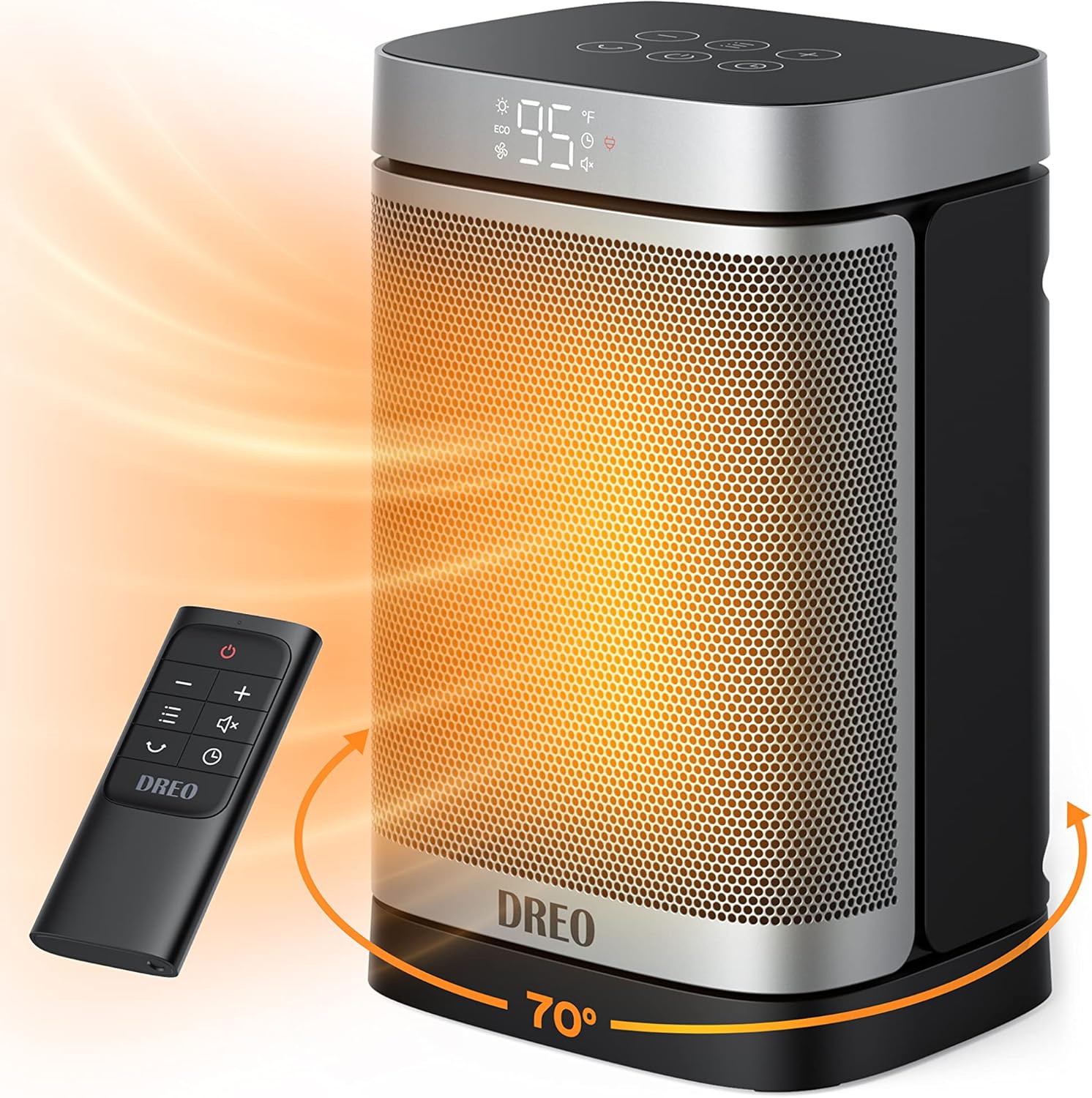
| Heat Output | 1500 watts |
|---|---|
| Heating Coverage | 200 sq.ft |
| Heating Element | PTC Ceramic |
| Oscillation | 70° |
| Thermostat Range | 41-95 °F |
The DREO DR-HSH004 is a compact tower heater that delivers quick, directed warmth using a 1500W PTC ceramic element and forced-air circulation. It is typically used on floors beside seating or on desks to warm a single room up to about 200 sq ft, and its 70° oscillation helps spread heat across a wider area. The unit includes a programmable digital thermostat adjustable from 41 to 95°F in 1°F steps, a 1–12 hour timer, ECO mode to reduce runtime and energy use, five fan/heat speeds, and a detachable filter for simple maintenance. Safety features include ETL listing, tip-over and overheat protection, and flame-retardant materials. The brushless DC motor and multi-blade design are engineered to run quietly around the mid-30 dB range, making it suitable for bedrooms or home offices. Limitations are predictable for its class: it is meant for single-room spot heating rather than whole-house use, and at full 1500W it will draw typical heater-level current on a standard 120V circuit.
Best for: Buyers who prioritize a quiet, safe, and easy-to-control heater for a bedroom or home office and want precise thermostat control and energy-saving modes.
Less Ideal for: People needing to heat large or multiple connected rooms or those who require a mains-free or portable fuel option should look at larger or different heater types.
- Rapid, efficient heat from a 1500W PTC ceramic element
- Programmable digital thermostat with 1°F increments for precise temperature control
- 70° oscillation spreads warmth across a room instead of a narrow beam
- Brushless DC motor designed for low noise making it suitable for bedrooms and offices
- Built-in safety features including tip-over and overheat protection and ETL listing
- Designed for single-room coverage (about 200 sq ft) and not intended to heat large open areas
Verdict: Choose this heater if you want a quiet, safety-focused tower heater with precise digital thermostat control for single-room comfort.
Choosing the Right Quiet Heater: Key Factors to Consider
Noise Level and Measurement
How loud a heater is during normal operation directly affects where you can use it. Bedrooms and home offices require the lowest audible output, whereas living rooms tolerate higher levels. Look for documented decibel ratings, descriptions of silent heating technologies, or fanless designs. When decibel numbers are not available, prefer heaters that advertise passive heating elements or oil fill because these designs typically produce only faint ticking or near-silent warmth. Consider that perceived noise depends on distance and background sounds; a small difference in decibels can be more noticeable in quiet environments.
Heating Type and Coverage
The heating method determines how heat is delivered and how evenly it spreads through a room. Convection heaters warm air and rely on circulation, which can be quicker but sometimes uses low-speed fans that add noise. Radiant or infrared panels heat objects directly and often feel warm immediately in their beam but may not heat whole rooms as evenly. Oil-filled radiators provide gentle, long-lasting heat and typically operate quietly. Check the recommended room size or power output so the heater can maintain comfortable temperatures without running at maximum all the time, which reduces noise and wear.
Thermostat and Control Options
Accurate thermostat control keeps the heater cycling efficiently and avoids continuous operation at high power, which can increase noise and energy use. Digital thermostats and programmable timers allow you to set precise temperatures and schedules for quiet hours. Multiple power settings help match heat output to room conditions and minimize operation at louder high-power modes. Consider whether controls are tactile and simple to adjust when the unit is in a bedroom or behind furniture, and whether an auto mode can maintain comfort quietly without frequent manual intervention.
Safety Features and Certifications
Safety features are essential for portable heaters used near furniture, bedding, or in occupied rooms. Tip-over shutoff prevents operation if the heater is knocked over, and overheat cutoff shuts the unit down if internal temperatures get too high. Cool-touch exteriors and insulated handles reduce burn risk if the heater is placed near pets or children. Look for units with clear safety certifications from recognized bodies, as those tests ensure basic electrical and thermal protections. Proper spacing and placement instructions also minimize fire risk and help preserve quiet operation by preventing airflow restriction.
Energy Use and Operating Cost
A heater that runs quietly but draws excessive power can be costly to operate, particularly during extended use. Compare wattage options and consider models with multiple heat settings so you can lower output once the room reaches the target temperature. Features such as efficient elements, programmable schedules, and good thermostat control reduce runtime and power consumption. For longer overnight use, choose a design that keeps heat without constant high-power cycling, as steady low-power operation usually wastes less energy and produces less noise.
Size, Placement, and Portability
The physical size and placement options influence both effectiveness and perceived noise. Small, lightweight heaters are easy to move between rooms but may have limited coverage and higher relative noise because the fan or element is compact. Larger oil-filled or panel-style heaters tend to be quieter and provide more even warmth but need more space. Consider handles or wheels for portability, cord length for placement flexibility, and whether the design allows safe placement near walls or furniture. Proper placement can reduce the need for higher power settings, lowering both noise and energy use.
Fanless Vs Fan-Driven Designs
Fanless heaters rely on convection, radiant heat, or thermal mass to transfer warmth and are usually the quietest choices. Without a moving fan, you avoid constant whirring and variable speeds that can be distracting during sleep or focused work.
Fan-driven models can heat a room faster and provide more even distribution, but you should look for low-speed or quiet-rated fans and multiple power stages so you can balance heat and noise. In small spaces, a low-power fan mode often gives the best compromise between comfort and silence.
- Fanless: quieter, slower to change temperature, often more efficient for steady heat.
- Fan-driven: faster room warm-up, better air movement, choose low-speed options for quiet use.
Placement Tips to Minimize Perceived Noise
Small changes in placement can change how loud a heater seems. Avoid corners where sound reflects and amplifies, and keep the heater away from hard surfaces that bounce noise. Placing a heater on a soft rug or mat can damp vibration from base elements.
For bedrooms, position the unit slightly farther from the head of the bed while ensuring adequate circulation. In offices, place the heater where airflow does not blow directly at microphones or video conferencing setups to prevent background noise pickup.
- Keep clearance around the heater for airflow and safety.
- Elevate slightly off hard floors to reduce vibration noise.
- Avoid enclosing the heater in cabinets or tight spaces.
Maintenance and Longevity for Quiet Operation
Regular maintenance keeps a heater operating quietly. Fan units benefit from occasional dusting of the intake and grille to prevent airflow noise caused by clogged vanes. Oil-filled units require very little maintenance but should be inspected for corrosion and kept upright.
Check cords and plugs for wear to avoid electrical noise or arcing. Replace or service components at the first sign of unusual sounds such as buzzing, rattling, or ticking that is not normal for thermal expansion.
- Dust fans and grilles periodically.
- Keep vents unobstructed to prevent strain noise.
- Inspect for loose panels or hardware that can vibrate.
Using Timers and Thermostats to Reduce Runtime
Program schedules and precise thermostats to avoid extended high-power operation, which increases noise. Setting a heater to warm a room before you arrive and then maintain a lower comfortable temperature reduces both energy use and audible output.
Some models include eco or auto modes that cycle heat intelligently. Use those features to keep background noise low during sleep or work periods while still preserving comfort.
- Use timers to avoid running at night unnecessarily.
- Set thermostats a few degrees lower and use supplemental blankets to lower runtime.
Safety Considerations Specific to Quiet Use
Quieter heaters are often used in bedrooms and near soft furnishings, so safety features are particularly important. Ensure any heater you choose includes tip-over protection and overheat shutoff to prevent accidents when the unit is out of sight or used overnight.
Quiet operation does not reduce the need for correct clearance and placement. Follow manufacturer spacing guidelines to avoid obstructing airflow and creating hot spots that can increase risk or cause the heater to cycle loudly when thermal cutoffs engage.
- Never place heaters near curtains or bedding.
- Use models with clear safety labels and automatic shutoffs.
How We Chose the Best Quiet Heater
We focused on heaters that combine low sound output with reliable heating performance and practical safety features. Our selection criteria prioritized measurable noise levels or design elements known to minimize sound, such as silent ceramic elements, oil-filled radiators, and infrared panels. Heating efficiency and coverage were judged by stated output and design suitability for small to medium rooms. Safety features like tip-over protection, thermal cutoffs, and cool-touch surfaces were required for inclusion. Ease of use and control options—thermostat accuracy, timer settings, and quiet fan control—factored heavily because they influence real-world comfort. Durability and build quality were considered through material choices and user-serviceable parts. We excluded units that relied solely on very loud fans, lacked basic safety shutoffs, or offered no documented noise information. The final list reflects heaters that meet both quiet operation and practical home heating needs.
Our full evaluation process is outlined in our review methodology.
FAQ
How quiet is a typical quiet heater in decibels?
Quiet heaters often operate in the 25 to 45 dB range depending on type and distance. Fanless or oil-filled designs tend to be at the lower end, while fan-driven units on high settings can reach higher levels.
Can I leave a quiet heater on overnight in a bedroom?
Many quiet heaters are designed for overnight use if they include tip-over protection and overheat shutoff. Still, follow placement and clearance instructions and use a reliable thermostat or timer to avoid prolonged high-power operation.
Which heater types warm a room fastest without being loud?
Fan-driven convection heaters heat rooms faster but can be noisier. To balance speed and silence, look for models with low-speed fans and adjustable power settings so you can start quickly and then switch to a quieter maintenance mode.
Does lower wattage always mean quieter operation?
Not always. Lower wattage reduces maximum heat output and often runs quieter, but design choices like fan quality and insulation matter more. A well-designed higher-wattage unit with good noise control can be quieter than a cheap low-wattage model.
How do I reduce noise from my heater if it starts buzzing?
Turn the heater off and inspect for loose panels, dust in the fan, or uneven surfaces causing vibration. Tighten hardware, clean vents, and ensure the heater sits on a stable, level surface to eliminate most buzzing or rattling.
Final Verdict
When choosing a quiet heater, prioritize models that demonstrate low noise output, precise thermostat control, and built-in safety features. Decide whether you need fast warm-up or steady, long-lasting heat and pick the heating type that matches that use case. Remember that placement, maintenance, and sensible runtime settings have big effects on both perceived noise and operating cost. Focus on the tradeoffs between speed, coverage, and silence to select the heater that best fits the rooms where quiet matters most.