
Note: This article contains affiliate links. If you click on these links and make a purchase, we may earn a small commission at no extra cost to you. This helps support our research and content. Read our full affiliate disclosure here.
When bedroom comfort and uninterrupted sleep matter, a fan that delivers steady airflow without adding noise makes a big difference. A quiet fan for sleeping can lower perceived temperature, create a consistent sound mask, and reduce night-time wakefulness. This guide presents five carefully shortlisted fans that prioritize low decibel output and steady circulation for bedrooms. We evaluated options across sound level, airflow distribution, and practical usability to help you pick the best fit for your sleep setup. Read on to compare key features and figure out which fan will help you sleep more soundly.
Top Picks at a Glance
| Best Overall The best all-around choice for most situations | Levoit Windi Mini Tower Fan |  |
| Best Budget The cheapest option that still gets the job done reliably | TriPole KW37 USB Desk Fan |  |
| Top Rated A top-rated pick with lots of positive feedback | DREO TurboPoly Fan 513S |  |
| Most Popular A crowd favorite that many people choose with confidence | Honeywell TurboForce HT-900 |  |
| Best Seller A high-volume bestseller chosen again and again | DREO Tower Fan DR-HTF007 |  |
Levoit Windi Mini Tower Fan

| Power Source | dc |
|---|---|
| Number of Speeds | 4 |
| Noise Level | 20 db |
| Wattage | 7.5 watts |
| Air Flow Capacity | 23 cubic_feet_per_second |
The Levoit Windi Mini is a compact tower fan designed to provide steady, directed airflow for bedside or desktop use. It uses a DC motor and VortexAir channeling to produce a focused breeze rated at up to 23 cubic feet per second while drawing as little as 7.5 watts, so it can run for long periods without a big energy hit. Controls include touch operation plus a remote, five speed levels with an extra Turbo setting, selectable oscillation angles (30, 60, 90 degrees), and a 12-hour timer and display-off option for night use. Noise is kept very low, with the brand citing 20 dB at the quietest setting, which makes it suitable for sleeping or working in close quarters. The unit is lightweight and portable with a handle, but it must stay plugged into an outlet and its small size means it is best for single rooms rather than cooling open-plan spaces. Overall, it balances quiet performance and energy efficiency in a small footprint ideal for bedrooms or home offices.
Best for: Buyers who prioritize a near-silent bedside fan that uses little power and delivers adjustable, focused airflow for single-room sleeping or light desk cooling.
Less Ideal for: People who need to move large volumes of air across open-plan rooms or who require cordless operation for patios or places without easy outlet access.
- Very quiet operation down to about 20 dB suitable for sleeping
- Energy efficient DC motor consuming around 7.5 watts
- Multiple speed settings plus Turbo and selectable oscillation angles for targeted airflow
- Portable, compact tabletop design with included remote and timer for night use
- Small airflow footprint—best for single rooms or close-range use rather than large areas
- Requires an AC adapter power connection and is not USB- or battery-powered
Verdict: A very quiet, energy-efficient mini tower fan built for sleeping and small-room airflow where low noise and adjustable, focused breeze matter most.
TriPole KW37 USB Desk Fan

| Power Source | USB Powered |
|---|---|
| Number of Speeds | 3 |
| Noise Level | 25 db |
| Wattage | 4 watts |
| Motor Type | Brushless Motor |
The TriPole KW37 is a small USB desk fan built for personal cooling at a desk or nightstand. It plugs into any 5V USB-A power source and offers three speed settings controlled by a push button, with a brushless motor that keeps noise low at about 25 dB. The head tilts and can rotate to aim airflow where you need it, and the wide base with silicone pads helps reduce vibration. Its 4.5-inch blade diameter and 4.9-foot fixed cord make it easy to position without taking much surface space, and the removable front cover simplifies occasional cleaning. The fan requires roughly 0.8A for full performance so weaker USB ports may limit the highest speed, and it does not remember settings after a power loss. For sleeping, the low noise figures and steady airflow make it suitable for a bedside setup, though it provides focused personal breeze rather than whole-room circulation.
Best for: Sleepers who prioritize a low-noise, space-saving bedside fan that provides steady, directed airflow without a bulky appliance.
Less Ideal for: People who need whole-room cooling, battery-powered portability, or a fan with memory/autostart features after power loss should consider other options.
- Very quiet operation around 25 dB suitable for low-noise environments
- Brushless motor for efficient, longer-lived operation
- Compact footprint and long USB cord for flexible placement
- Adjustable tilt and 360 degree head rotation to direct airflow
- Detachable front cover for easier cleaning
- Highest speed may not work from low-current USB ports (needs ~0.8A)
- Cord is non-removable so it must remain plugged in during use
Verdict: If you want an affordable, very quiet bedside fan that delivers focused airflow with a small footprint, the TriPole KW37 is a practical choice.
DREO TurboPoly Fan 513S

| Number of Speeds | 8 |
|---|---|
| Noise Level | 25 db |
| Wattage | 36 watts |
| Air Flow Capacity | 1100 cfm |
| Control Method | App, Remote, Touch, Voice |
The DREO TurboPoly Fan 513S is a connected pedestal fan built to move a lot of air quietly for bedroom use. It offers up to eight speeds and six preset modes, plus 120° horizontal and 105° vertical oscillation so you can direct airflow across a whole room or focus a steady jet for cooling. Controls include a phone app, remote, touchpad and voice assistants, and the brushless DC motor with a custom blade design is rated around 25 dB, which makes it well suited for nighttime use. The fan also supports timers and resets oscillation position after power-off for predictable behavior. Practical benefits include strong reported airflow (1100 CFM) with relatively low wattage (36 W), flexible positioning thanks to adjustable height, and multiple control options for hands-off operation. Consider that it is a pedestal-style unit that requires some assembly and takes floor space, and that advanced smart features add dependency on an app or network for full functionality. For sleepers who prioritize quiet but effective cooling, the 513S balances sound control with whole-room circulation.
Best for: Buyers who want a genuinely quiet, whole-room fan for sleeping and prefer a product that offers predictable smart controls and low-noise operation.
Less Ideal for: People who need an ultra-compact or wall-mounted solution or who avoid smart-connected devices and want only simple mechanical controls.
- Very low operating noise around 25 dB suitable for bedrooms
- Wide 3D oscillation (120° horizontal, 105° vertical) for even whole-room airflow
- Multiple control methods including app, remote, touchpad and voice
- Efficient brushless DC motor delivering high airflow (1100 CFM) at low wattage
- Pedestal footprint requires floor space and assembly
- Smart features rely on app/voice connectivity for some convenience functions
Verdict: Choose the 513S when you want powerful whole-room circulation with genuinely quiet DC-motor performance and flexible smart controls for sleeping environments.
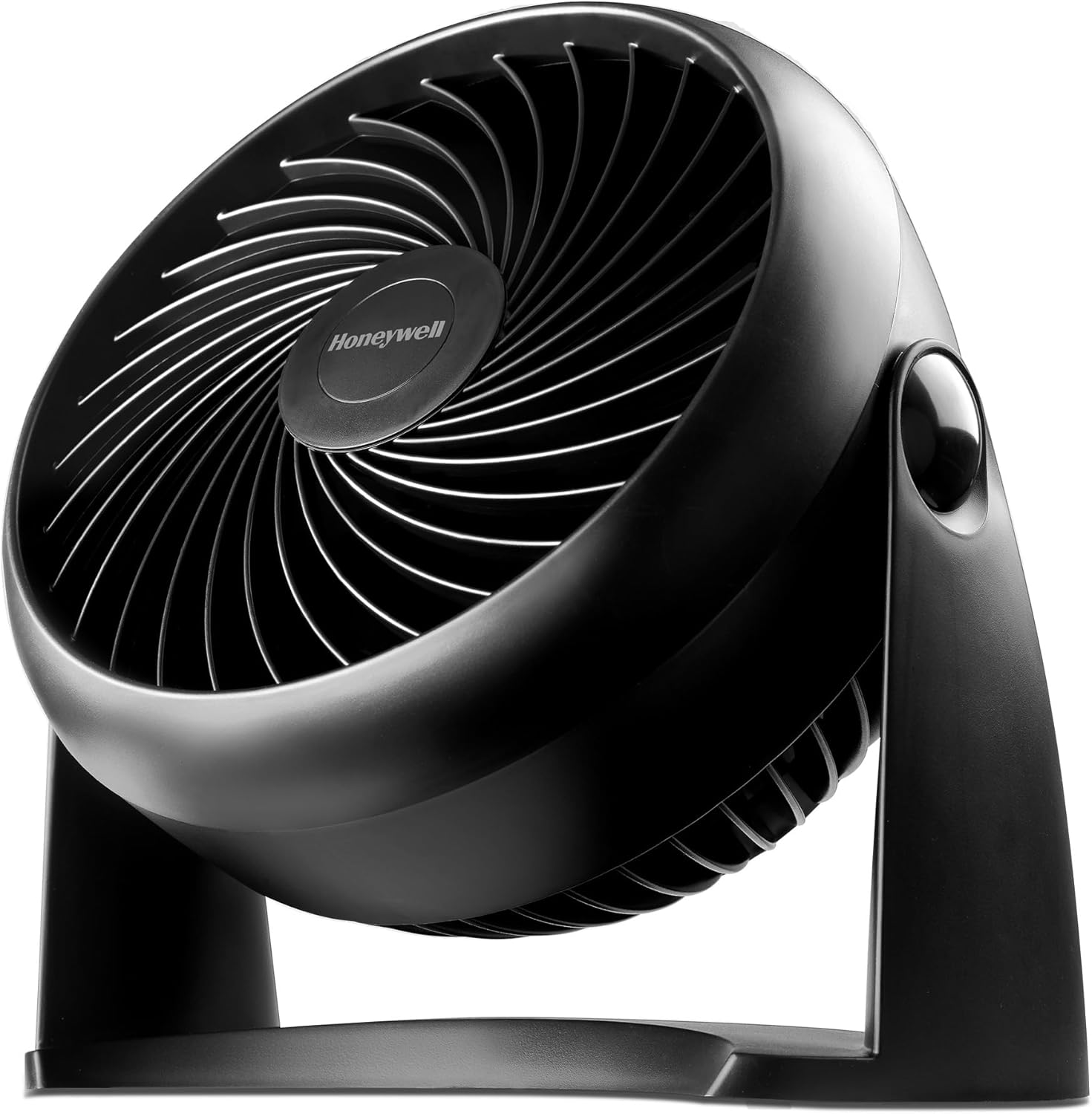
Honeywell TurboForce HT-900
| Number of Speeds | 3 |
|---|---|
| Wattage | 35 watts |
| Air Flow Capacity | 185 cfm |
| Motor Type | brushless |
| Installation Type | Tabletop or Wall Mount |
The Honeywell TurboForce HT-900 is a small, portable tabletop fan designed to move a surprising amount of air for its size while staying relatively quiet. It has an aerodynamic three-blade design driven by a brushless motor, three push-button speeds, and a 90-degree pivoting head so you can direct airflow toward a bed, desk, or seating area; it can also be wall-mounted. In real-world use it serves well as a bedroom or home-office fan for focused cooling or air circulation to complement an AC unit. Notable features include a measured airflow rating and a compact footprint that is easy to reposition and store. The unit is corded and uses a standard plug, so there is no battery maintenance or charging. Limitations are the lack of advanced controls like a timer or remote and a basic plastic construction, so it is a straightforward, no-frills option rather than a feature-rich appliance.
Best for: Buyers who prioritize quiet, proven performance and want a simple, reliable bedroom fan backed by wide user approval and long-term popularity.
Less Ideal for: People who need smart features, programmable timers, or a premium metal design should consider other models with those capabilities.
- Strong airflow for size with 185 cfm rating
- Quiet operation compared with similar small fans
- Three speeds and 90-degree pivot for targeted airflow
- Brushless motor for reliable, low-maintenance performance
- No timer, remote, or advanced controls
- Basic plastic build without premium materials
Verdict: A compact, very quiet table fan that delivers strong directed airflow for sleepers who want a simple, widely trusted bedside cooling solution.
DREO Tower Fan DR-HTF007

| Motor Type | Brushless |
|---|---|
| Number of Speeds | 8 |
| Modes | Normal, Natural, Sleep, Auto |
| Air Flow Capacity | 1408 cfm |
| Noise Level | 28 db |
The DREO DR-HTF007 is a compact tower fan built around an upgraded brushless DC motor that delivers strong airflow while keeping noise low, which suits nighttime use. It offers 8 speed settings and four modes (Normal, Natural, Sleep, Auto) controlled by a touch panel or included remote, plus a timer for scheduled shutoff. The fan's tuned airflow and 90° oscillation help move air across a room and work well when paired with an air conditioner to boost cooling without more energy. Practical features include a removable rear grille and impeller for easier cleaning and ETL safety certification with a fused plug and pinch-proof grille. Performance trade-offs are minimal for bedroom use: the unit uses plastic construction and is not designed as a heavy-duty industrial fan, and highest airflow settings will be louder than Sleep mode. For buyers prioritizing quiet overnight operation and simple, safe controls, this fan balances low-noise comfort and useful features in a small footprint.
Best for: Buyers who want a bedroom fan that prioritizes quiet, consistent airflow and easy, safe operation for overnight use.
Less Ideal for: People seeking a heavy-duty or industrial-strength fan for large open spaces should consider more powerful floor or box fans instead.
- Brushless DC motor for efficient, quieter operation
- Eight speed levels and four modes including Sleep for tuned nighttime airflow
- Remote and touch controls plus timer for convenient hands-off use
- Removable rear grille and impeller make cleaning straightforward
- ETL certification and safety features like a fused plug and pinch-proof grille
- Plastic construction may feel less durable than metal alternatives
- Maximum airflow settings are noticeably louder than Sleep mode
Verdict: A quiet, safety-minded tower fan that delivers flexible, low-noise airflow ideal for comfortable sleep.
Choosing the Right Quiet Fan for Sleeping: Key Factors to Consider
Noise Level and Perceived Loudness
Measured decibels tell part of the story, but perceived loudness depends on fan tone and frequency. Low-frequency hums or high-pitched whines can be more disruptive than slightly higher decibel readings with a steady white-noise character. Look for models with published sound data at multiple speeds and descriptions of sound character.
Also consider placement relative to your head and mattress. A fan that is exceptionally quiet at two meters may still be noticeable at bedside. Adjustable speeds let you find the lowest comfortable setting that masks ambient noise without becoming intrusive.
Airflow Pattern and Coverage
Airflow matters more than peak speed for bedroom comfort. You want a consistent, gentle circulation that reaches the sleeping area without creating cold drafts. Check whether the fan delivers broad, diffused airflow for whole-room circulation or a focused stream for targeted cooling.
Oscillation, tilt, and blade design all shape the airflow pattern. Broad coverage reduces the need to run a fan at higher, noisier speeds to move air around the room.
Control Options and Quiet Operation
Controls influence nighttime convenience and noise. Touch interfaces, soft-press buttons, or remote controls are preferable to loud mechanical toggles. Variable speed steps or infinitely variable controls give you finer tuning at low speeds where noise differences are most noticeable.
Additional features like timers, sleep modes that ramp down over hours, and programmable schedules reduce the need to handle the unit at night, preserving sleep continuity.
Size, Placement, and Mounting
Fan size and mounting options affect how and where you use the unit in the bedroom. Tower and bladeless designs often fit tight bedside spaces and produce smoother airflow, while pedestal or floor fans can reach higher and circulate more air in large rooms. Consider whether you need oscillation range or a compact profile for small rooms.
Placement also impacts safety and airflow. Units intended for bedside use should be stable, have protected blades or bladeless designs, and allow you to aim airflow without noisy adjustments.
Energy Use and Overnight Runtime
Since bedroom fans often run for several hours, efficiency matters for both energy consumption and heat output. Fans with efficient motors and lower wattage at usable speeds reduce electricity use. If you plan to run the fan all night, look for models with low power draw at the settings you typically use.
Battery-backed or USB-powered options offer portability but typically trade off airflow for runtime. Verify claims for continuous operation and whether the fan gets noticeably warmer during long runs.
Maintenance and Cleanability
Dust accumulation reduces performance and can create noise or odors. Choose fans with easily removable grills or blade-less designs that wipe clean. Simpler maintenance encourages regular cleaning, which preserves airflow efficiency and keeps sound characteristics consistent over time.
Also consider filter presence if allergies are a concern. While most bedroom fans do not include HEPA filters, some designs reduce dust circulation or integrate washable pre-filters to improve air quality.
How Noise Is Measured and What Numbers Mean
Sound levels are typically reported in A-weighted decibels, which approximate human hearing sensitivity. A difference of 3 dB is roughly perceptible, while a 10 dB increase sounds about twice as loud. For sleeping use, look for machines that list sound levels in the low 30s dB or quieter at usable speeds.
Beyond raw numbers, listen for tonal quality. A steady broadband sound is more likely to act as a sleep mask, while intermittent clicks, whines, or rattles will draw attention and disturb sleep.
- Compare sound measurements taken at bedside distance when available
- Ask whether noise specs are manufacturer-measured and at what speed
- Consider both the decibel value and the described sound character
Placement Tips for Best Sleep Comfort
Where you place the fan affects both perceived noise and cooling. For head-focused cooling, position the fan on a nightstand with oscillation or adjustable tilt to avoid a cold blast while still delivering airflow. For whole-room circulation, place the fan higher or use an oscillating mode to promote even distribution.
Avoid aiming the fan directly at the face for prolonged periods if you are prone to dry eyes or nasal irritation. A diffuse, angled airflow helps maintain comfort without causing dryness.
- Nightstand placement for personal cooling
- Corner placement on oscillation for whole-room circulation
- Tilt and angle adjustments reduce direct drafts
Sleep Modes, Timers, and Automation
Many modern fans include sleep modes that gradually lower speed overnight or timers that switch the unit off after a set interval. These features help balance noise, comfort, and energy use without needing manual interaction in the night.
Smart or programmable fans can integrate with home automation for scheduled operation tied to local sunset times or bedroom routines. If seamless overnight automation matters, prioritize models with reliable, quiet scheduling features.
- Use timers to avoid unnecessary overnight runtime
- Sleep modes reduce speed gradually to match falling room temperatures
- Remote control or app-based scheduling minimizes bedside handling
Design Tradeoffs: Blades, Bladeless, and Tower Styles
Bladed fans typically deliver strong focused airflow but can be bulkier and require more safety considerations. Bladeless or hidden-blade designs often run with smoother turbulence and less perceived noise, though they can cost more or produce slightly less raw airflow.
Tower fans are space-efficient and can provide broad circulation with quiet operation, but they may have narrower peak airflow compared with larger pedestal fans. Choose the form factor that matches your room size and bedside footprint.
- Bladeless for smooth, low-tone airflow
- Pedestal for stronger, adjustable airflow
- Tower for compact, whole-room circulation
Addressing Allergy and Air Quality Concerns
Fans circulate room air and will move dust and allergens unless they include filtration. If allergies are a concern, look for units with washable pre-filters or combine a quiet fan with a separate air purifier rather than expecting the fan to filter particulates.
Regular cleaning of grills and blades reduces allergen buildup and helps maintain quiet operation. If you have severe sensitivities, position the fan to move air toward an air purifier intake rather than directly at your face.
- Use washable pre-filters where available
- Clean grills and blades regularly to reduce dust
- Pair fans with air purifiers for best allergen control
How We Chose the Best Quiet Fan for Sleeping
We focused on the attributes that directly affect sleep quality and night-time comfort. Primary evaluation criteria included measured sound level at typical bedside distance, airflow coverage in a standard bedroom footprint, and control precision for adjusting speed and oscillation without introducing clicky noises. We also assessed runtime and power efficiency for overnight use, build and placement flexibility to suit bedside or floor mounting, and ease of cleaning since dust buildup affects long-term performance. Products were excluded if they lacked documented sound specifications, had limited speed control, or relied on noisy mechanical controls. We also excluded fans designed only for outdoor or workshop use because their noise and airflow profiles do not match bedroom needs. The final selections balance low measured decibels, meaningful airflow across a sleeping area, quiet user controls, and features that support regular overnight operation without excessive maintenance.
Our full evaluation process is outlined in our review methodology.
FAQ
How quiet is quiet enough for sleeping?
Quiet enough depends on personal sensitivity, but many sleepers find devices in the low 30s dB or quieter comfortable. Also consider the sound character; steady broadband noise is less disruptive than fluctuating or tonal sounds.
Will a fan dry out my eyes or throat overnight?
Direct, high-velocity airflow aimed at your face can cause dryness over long periods. Angle the fan or use a lower speed to maintain airflow without direct exposure. Using a humidifier concurrently can mitigate dryness in very dry environments.
Are bladeless fans actually quieter?
Bladeless designs often produce smoother, less tonal airflow, which many people perceive as quieter even if decibel readings are similar. They can reduce turbulence-related noise, but actual performance varies by design.
Can I run a quiet fan all night safely?
Generally yes, if the unit is designed for continuous operation and has stable ventilation and thermal protection. Check manufacturer guidance for continuous runtime and ensure the fan is placed on a stable surface away from bedding and obstructions.
Do sleep modes and timers affect noise levels?
Yes. Sleep modes typically ramp the fan down gradually, lowering noise as the night progresses. Timers let you shut the fan off after a set period to limit runtime and energy use, which can reduce overall exposure to noise.
Final Verdict
Choosing a quiet fan for sleeping means balancing low sound output, gentle airflow, and features that support overnight use. Prioritize models with published noise specs and smooth, broadband sound character, plus adjustable controls and placement options that avoid direct drafts. Consider energy use and ease of maintenance since bedroom fans often run for many hours. Focus on the tradeoffs that matter most to you: if you need targeted cooling, choose a unit with stronger directed airflow and fine speed control; if you value a consistent sleep mask, lean toward models with very low-tone sound and wide circulation. With the right priorities, you can pick a fan that helps you fall asleep faster and stay asleep longer.