
Note: This article contains affiliate links. If you click on these links and make a purchase, we may earn a small commission at no extra cost to you. This helps support our research and content. Read our full affiliate disclosure here.
If you want cleaner indoor air without a constant hum, choosing a quiet HEPA air purifier matters. A low-noise model makes it practical to run an air cleaner overnight or in shared living spaces while still removing fine particles, pollen, pet dander, and smoke. This guide covers seven shortlisted quiet HEPA air purifiers chosen for their combination of low operational sound, true HEPA filtration performance, and practical features for daily use. Read on to see the evaluation criteria and which features matter most when you need both whisper-quiet operation and effective air cleaning.
Top Picks at a Glance
| Best Overall The best all-around choice for most situations | Levoit Core 400S-P |  |
| Best Quality Built to a higher standard if you want something more solid | Coway Mighty AP-1512HH |  |
| Best Value The sweet spot between price and what you get | MOOKA B-D02L Air Purifier |  |
| Best Budget The cheapest option that still gets the job done reliably | FULMINARE H13 HEPA Air Purifier |  |
| Top Rated A top-rated pick with lots of positive feedback | ECOSELF HAP609 HEPA Air Purifier |  |
| Most Popular A crowd favorite that many people choose with confidence | Levoit Core 300-P |  |
| Best Seller A high-volume bestseller chosen again and again | VOOPNU HEPA Air Purifier DH-JH12 |  |
Levoit Core 400S-P

| Power Source | ac |
|---|---|
| Filter Type | Activated Carbon |
| Noise Level | 24 db |
| Particle Retention Size | 0.1 micrometer |
| Wattage | 24 watts |
The Levoit Core 400S-P is a large-room smart air purifier that combines a 3-stage filter, laser particle sensing, and app/voice control to keep indoor air clean with low operating noise. It is typically placed in living rooms, bedrooms, or open-plan spaces and runs continuously or in Auto Mode where AirSight Plus and the PM2.5 display adjust fan speed based on detected particles. Notable features include AHAM-verified CADR performance for smoke, dust, and pollen, a pre-installed 3-in-1 filter that captures ultrafine particles, and integration with the VeSync app plus Alexa support for remote control and schedules. Practical benefits are strong whole-room airflow, real-time air-quality feedback, and a true sleep-friendly low-noise setting around 24 dB for overnight use. Important limitations are the need to replace filters periodically and that advanced smart features rely on the companion app and network connectivity, which adds setup complexity compared with a simple plug-and-play purifier.
Best for: Buyers who want a quiet, high-performance purifier for larger rooms and value real-time air-quality feedback plus smart control for hands-off operation.
Less Ideal for: People who prefer the simplest no-network devices or who need an ultra-compact unit for very small rooms should consider more basic or smaller models.
- AHAM-verified CADR for smoke, dust, and pollen supports fast whole-room cleaning
- Quiet Sleep Mode with noise levels as low as 24 dB suitable for nighttime use
- AirSight Plus laser sensor and PM2.5 display provide continuous, real-time air-quality feedback
- Smart controls via VeSync app and Alexa voice control for scheduling and remote operation
- Filter replacements are required to maintain performance
- Full smart functionality depends on the VeSync app and network setup
Verdict: Choose the Core 400S-P when you want a quiet, AHAM-verified HEPA purifier that delivers fast whole-room cleaning with smart app and voice control.
Coway Mighty AP-1512HH

| Coverage | Up to 1,748 sq. ft. in 60 minutes |
|---|---|
| HEPA efficiency | 99.97% of 0.3μm particles |
| Filtration stages | Pre-filter, Deodorization, Bipolar Ionizer, HEPA |
| Filter lifespan | Up to 1 Year |
| Included filters | 1 HEPA, 2 Custom Filters |
The Coway Mighty AP-1512HH is a room air purifier built around a four-stage system: washable pre-filter, deodorization filter, bipolar ionizer, and a True HEPA that captures 99.97% of 0.3 micron particles. It is intended for continuous home use and can cycle the air in medium to large rooms quickly while the built-in air quality sensor drives Auto mode to raise or lower fan speed as conditions change. Practical benefits include a clear LED air quality indicator, an Eco mode that idles the fan when air is clean, and a timer and filter-life alerts that simplify maintenance. The washable pre-filter reduces ongoing consumable costs, and optional custom filters target pets, smoke, or VOCs. On the downside the unit is designed for up to about 1,748 sq ft in ideal conditions so expect slower cleaning in very large open-plan homes, and replacement custom filters are a recurring expense. Noise is low in Eco and low fan settings, but higher speed is audible when the unit is working hard to clear heavy pollution.
Best for: Buyers who prioritize measurable performance and automatic control will appreciate this machine for daily air cleaning in bedrooms, living rooms, and home offices where steady, effective filtration matters most.
Less Ideal for: People who need ultra-quiet operation at maximum cleaning power or those who require whole-house HVAC-level filtration should consider larger or ducted solutions instead.
- True HEPA filtration capturing 99.97% of 0.3 micron particles
- Auto mode with onboard air-quality sensor adjusts fan speed in real time
- Washable pre-filter lowers maintenance cost and is easy to clean
- Eco mode and timer help reduce power use and background noise
- Filter indicator provides clear, usage-based replacement alerts
- Replacement custom filters required for specialized contaminant removal
- Higher fan speeds produce noticeable noise when rapidly purifying heavy pollution
Verdict: A performance-focused, sensor-driven HEPA purifier that delivers reliable, measurable cleaning for medium to large rooms while keeping idle noise and power use low.
MOOKA B-D02L Air Purifier
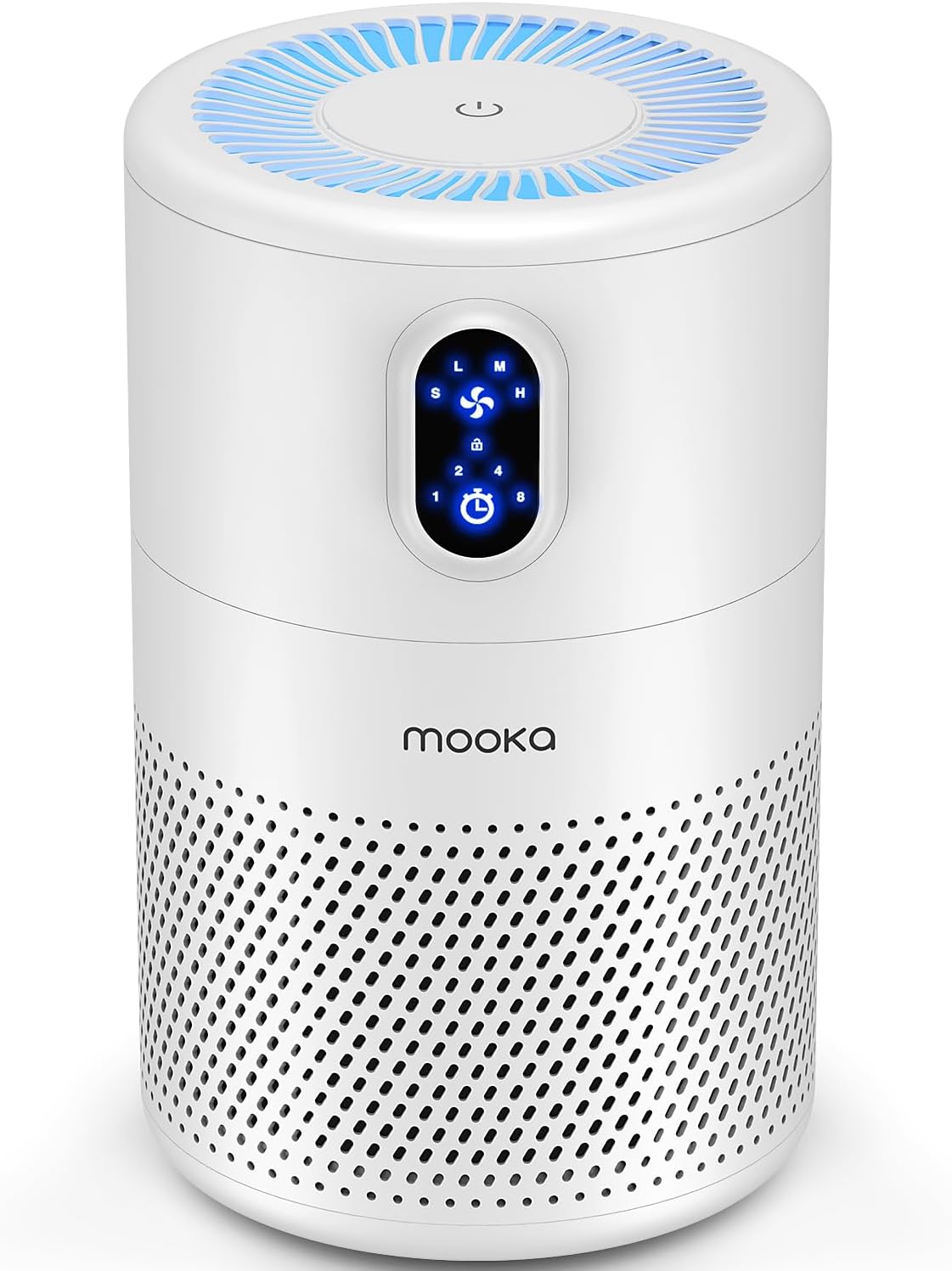
| Coverage (claimed) | Up to 1076 sq ft (1 ACH) |
|---|---|
| Filter type | H13 True HEPA + activated carbon |
| Fan modes | 4 speeds (Sleep/Low/Med/High) |
| Timer options | 1/2/4/8 hours |
The MOOKA B-D02L is a small, quiet HEPA air purifier intended to improve indoor air in bedrooms, living rooms, and offices. It uses a three-stage system — pre-filter, H13 True HEPA, and activated carbon — to capture particles down to 0.3 microns and reduce odors, pet dander, smoke, and pollen. Controls include four fan speeds (Sleep/Low/Med/High), four timer settings (1/2/4/8 hours), a child lock, and a soft night light that can be turned off. The unit is marketed as ultra-quiet thanks to a brushless motor with a noise floor around 20 dB on low, and it is energy efficient for continuous use. Filters are user-replaceable and the manufacturer recommends changing them every 3 to 6 months depending on environment. Limitations are the modest physical size and airflow: while the spec sheet cites coverage up to 1076 sq ft at one air change per hour, expect much smaller effective cleaning area at higher air-change rates typical for allergy or smoke clearance. Replacement filters are an ongoing cost and the night light may be unnecessary for some users.
Best for: Buyers who prioritize low noise and straightforward, energy-efficient air cleaning for bedrooms or home offices and want an easy-to-use purifier with timer and child-lock features.
Less Ideal for: Homes needing rapid, whole-house-level air turnover for heavy smoke or very large open-plan spaces should consider larger, higher-output purifiers instead.
- H13 True HEPA plus activated carbon for particle and odor removal
- Very quiet operation on low thanks to brushless motor
- Multiple fan speeds and timers for flexible daily use
- Child lock and simple top controls for safe household use
- Actual high-efficiency coverage for rapid air cleaning is limited by the unit's compact size
- Requires regular filter replacements every 3–6 months depending on air quality
Verdict: Choose the MOOKA B-D02L if you want a very quiet, energy-efficient HEPA purifier for everyday bedroom or office use where low noise and simple controls matter most.
FULMINARE H13 HEPA Air Purifier

| Filter type | H13 HEPA |
|---|---|
| Recommended room size | Up to 215 ft² / 20 m² |
| Noise level (low) | Around 24 dB |
| Timers | 2, 4, 8, 10, 12 hours |
The FULMINARE H13 is a small, bedroom-friendly air purifier built around an H13 true HEPA filter and a 360 degree outlet that helps refresh air in rooms up to about 215 sq ft. It runs quietly at low fan speeds — the sleep mode is claimed to operate near 24 dB — so it can sit on a nightstand without disturbing light sleepers. The unit is portable and plug-in powered, has selectable timers (2, 4, 8, 10, 12 hours) and an independent soft night light that doubles as a child-friendly feature. Practical benefits include effective particle capture for pet hair, smoke, and odors and a compact footprint that is easy to place. Limitations are predictable for a small purifier: coverage is intended for single rooms, filter changes are recommended regularly (about every three months depending on use), and there is no battery operation since it needs the included adapter to run. If you need whole-house cleaning or very high airflow, a larger model would suit better, but this unit is well matched to quiet bedroom or office use.
Best for: Buyers looking for a quiet, bedroom or office air purifier that removes particles and runs with minimal noise while providing a simple plug-in, portable solution.
Less Ideal for: Those who need high airflow for large open areas or a unit that runs without a power adapter should consider larger or different models.
- H13 true HEPA filtration for particle removal
- 360 degree air outlet with dual-channel design for even circulation
- Very low noise in sleep mode suitable for bedrooms
- Independent night light and multiple timer settings for convenience
- Compact and portable plug-in design that is easy to place
- Designed for single-room coverage only, not for whole-house cleaning
- Requires regular filter replacement (manufacturer suggests about every three months)
Verdict: A quiet, affordable H13 HEPA purifier made for bedrooms and small rooms where low noise and compact portability matter most.
ECOSELF HAP609 HEPA Air Purifier

| Model number | HAP609 |
|---|---|
| PM2.5 display | Yes |
| Noise level (Sleep Mode) | 20 dB |
| Timer | 1–24 hours |
The ECOSELF HAP609 is a compact HEPA air purifier designed to clean indoor air quietly and automatically. It draws air from all directions with a 360° intake, moves it through a multi-stage filter, and displays PM2.5 readings on a color-changing ring so you can monitor conditions at a glance. An auto mode uses the built-in sensor to boost fan speed when particles rise, then revert to a low-noise setting as air improves. A dedicated sleep mode turns off lights and drops noise to about 20 dB, making the unit suitable for bedrooms or other quiet spaces. It also includes a 1–24 hour timer for scheduled operation. The practical benefits are straightforward: visible air-quality feedback, hands-off automatic adjustment, and very quiet overnight performance. Limitations include a compact footprint that implies best performance in smaller rooms rather than large open-plan spaces, and filter replacement will be an ongoing cost not detailed in the listing.
Best for: Buyers who prioritize a quiet, set-and-forget purifier for bedrooms or smaller living spaces and want visible, automatic air-quality monitoring.
Less Ideal for: People needing high-volume purification for large open-plan rooms or whole-house coverage should consider larger units with higher stated CADR.
- 360° air intake for more even room circulation
- Built-in PM2.5 sensor with color ring and numeric display for real-time air-quality feedback
- Auto mode that boosts fan speed automatically when pollutants rise
- Sleep mode with lights off and noise down to about 20 dB for undisturbed rest
- 1–24 hour timer for scheduled operation
- Best suited to smaller rooms; not specified for large open areas
- Filter replacement frequency and cost are not provided in the product details
Verdict: Choose the HAP609 when you need a very quiet, automatic HEPA purifier that shows real-time PM2.5 readings and is optimized for bedrooms and small rooms.
Levoit Core 300-P

| Filter Type | 3 in 1 Filtration |
|---|---|
| Floor Area | 1073 square_feet |
| Noise Level | 24 db |
| Particle Retention Size | 0.3 micron |
| Wattage | 56 watts |
The Levoit Core 300-P is a small, straightforward HEPA air purifier built for everyday home use where quiet, reliable filtration matters. It pulls air through a 3-in-1 filter (pre-filter, HEPA-grade media, and activated carbon) to capture 99.97% of particles down to 0.3 microns and reduce odors, smoke, pollen, dust, and pet dander. A 56W motor with reported CADR ratings gives meaningful airflow for medium rooms and the unit is AHAM verified and CARB compliant, which helps set expectations for real-world performance. Controls are touch-based and include a near-silent Sleep Mode that drops noise to about 24 dB and turns off lights for bedroom use. Practical benefits include compact footprint, portability between rooms, and clear filter indicators that simplify maintenance. Limitations are that it lacks smart/auto modes on this model (manual speed control only) and replacement filters are recommended to retain rated performance, which is an ongoing cost to consider.
Best for: Buyers who prioritize proven, quiet particle removal for bedrooms or living rooms and who rely on certification and broad positive feedback to reduce risk when choosing an air purifier.
Less Ideal for: People who want built-in smart controls, automatic air-quality sensing, or whole-house coverage should look at larger or smart-enabled models instead.
- True HEPA-grade 3-in-1 filter captures fine particles and reduces odors
- AHAM verified CADR and certifications (CARB, ETL) support measured performance claims
- Very quiet Sleep Mode at approximately 24 dB suitable for bedrooms
- Compact and portable design fits small to medium rooms and moves easily between spaces
- No auto mode or smart connectivity on this Core 300-P model, requiring manual speed adjustments
- Requires periodic replacement filters to maintain rated efficiency
Verdict: Choose the Core 300-P if you want a compact, certified HEPA purifier that delivers quiet, proven particle removal for bedrooms and medium rooms.
VOOPNU HEPA Air Purifier DH-JH12

| Model | DH-JH12 |
|---|---|
| Filter type | H13 True HEPA + Activated Carbon |
| Noise level | 22 dB (lowest) |
| Coverage (claimed) | Up to 1,076 ft² |
The VOOPNU DH-JH12 is a compact HEPA air purifier built for everyday indoor use where quiet operation matters. It pulls air in through a 360 degree intake and passes it through an H13 triple-layer filter and activated carbon stage to capture particulates, pet hair, odors, pollen and smoke, with laboratory testing claiming it cleans 250 ft² every 15 minutes. Controls are simple with three speeds, a timer and an essential oil tray for light scenting, and the unit can run as quietly as 22 dB for bedroom or office use. It is small enough to sit on a desk or tuck into a corner, and certifications including ETL, CARB and FCC signal basic safety and emissions compliance. Expect to replace filters periodically and to run the purifier continuously for best results; like most compact purifiers it may be less effective at sustained heavy smoke or very large open-plan spaces despite the stated coverage number. The DH-JH12 is a practical, low-noise option for improving everyday indoor air where space is limited and quiet operation is a priority.
Best for: Buyers who want a low-noise, easy-to-use HEPA purifier for bedrooms, home offices, or small living spaces and prioritize clean air without complicated setup.
Less Ideal for: Not the best choice for people needing continuous high-capacity purification for very large open-plan homes or spaces with heavy smoke or industrial-level pollution.
- H13 true HEPA triple-layer filtration captures fine particulates and works with activated carbon for odors
- Very quiet operation down to 22 dB suitable for bedrooms and offices
- 360° intake and compact footprint make placement flexible in small rooms
- Simple control panel with three speeds and timer keeps operation straightforward
- Built-in essential oil tray adds mild scenting without additional accessories
- Manufacturer coverage claims are based on lab testing and may not match performance in very large or heavily polluted rooms
- Filter replacement cycle required and replacement cost is an ongoing expense
Verdict: If you need a compact, whisper-quiet HEPA purifier for a bedroom or small living area, the VOOPNU DH-JH12 delivers effective filtration with minimal noise.
Choosing the Right Quiet HEPA Air Purifier: Key Factors to Consider
Noise Level Across Fan Speeds
How loud the unit is at each fan speed directly affects where you can use it. A purifier that is quiet on the lowest setting may still be too loud at higher speeds, so look for easy-to-read dBA figures and multiple speed steps.
Manufacturers sometimes report noise only in subjective terms. Prefer models with measured decibel values and a sleep or night mode that drops fan speed to a genuinely whisper-quiet level for bedrooms and nurseries.
True HEPA Filtration and Filter Stages
True HEPA filters capture at least 99.97 percent of particles down to 0.3 microns, which is essential for removing common indoor allergens and many fine particulates. Check whether the unit uses a certified HEPA element rather than a HEPA-type claim.
Pre-filters and activated carbon layers matter too. A pre-filter prolongs HEPA life by trapping larger particles, and activated carbon removes odors and volatile organic compounds. The overall filter stack determines how comprehensively the purifier treats the air.
Clean Air Delivery Rate and Room Coverage
CADR quantifies how quickly a purifier can clean specific pollutants in a room. Match CADR numbers to the square footage of the room you plan to use the unit in. A quieter purifier may have a lower CADR at low fan speeds, so ensure the unit can still meet your room-size needs when running quietly.
Consider how many air changes per hour you want. For bedrooms you may accept fewer air changes at night, while for allergy relief or smoke removal you may need higher CADR and more frequent air turnover.
Energy Use and Continuous Runtime
Quiet operation often implies lower fan speeds and lower power draw, but not always. Look for units with published wattage at typical speeds or Energy Star ratings for continuous use. Lower energy consumption matters if you plan to run the purifier 8 to 12 hours per day or overnight.
Consider long-term operational costs as well as whether the unit has an auto mode that adjusts fan speed to conserve energy while maintaining air quality.
Controls, Automation, and Night Features
Control options determine how easy it is to keep the unit quiet. Features to look for include a true sleep mode that dims displays, timer functions, remote control or app-based scheduling, and air-quality sensors that allow the purifier to throttle automatically. Precise fan increments make it easier to find the quietest effective setting.
A distracting display or loud control beeps can defeat the purpose of a quiet air purifier, so verify whether controls can be silenced or disabled for overnight use.
Filter Replacement Cost and Maintenance
Ongoing filter costs affect the total cost of ownership. HEPA filters and carbon inserts need periodic replacement based on runtime and local air quality. Check how easy the filter is to access and whether the manufacturer provides filter life estimates.
Maintenance chores like cleaning pre-filters or vacuuming intake grilles can reduce noise from dust buildup and keep the unit operating quietly and efficiently over time.
How Quiet Ratings Translate to Real Rooms
Decibel ratings are useful but not the whole story. A 40 dBA rating in a large living room will be less intrusive than the same measurement in a small bedroom. Room acoustics, where the purifier is placed, and background noise levels all affect perceived loudness.
Place the purifier away from walls and corners to reduce reflected sound. Running on the lowest effective fan speed and combining the purifier with existing ambient noise such as a fan or white-noise machine often produces a more tolerable result for sleep.
- Compare published dBA at each fan speed rather than a single number.
- Consider placement and distance from the bed for overnight use.
- Use a small ambient noise source to mask steady low-frequency hum if needed.
Sizing for Bedrooms Versus Living Areas
Bedrooms generally require less CADR than open-plan living spaces, but because bedrooms are smaller and occupants are stationary, you may want a higher number of air changes per hour. For a quiet unit, check the CADR at the fan speed that qualifies as 'sleep' or 'night' mode.
For living areas, prioritize higher CADR figures even if it means occasionally running at a louder speed. If silence is essential in one room only, consider a dedicated purifier sized specifically for that room.
- Match CADR to room square footage and desired air-change rate.
- Verify CADR at low fan speeds when quiet operation is required.
Placement and Noise-Reducing Setup Tips
Placement impacts both performance and perceived noise. Avoid enclosing the purifier in cabinets or tight alcoves that can amplify sound and restrict airflow. Ideally, position the unit near the area where you spend most time and where pollutants originate.
Small changes reduce perceived volume. Elevating the unit a few inches off the floor, keeping intake and outlet clear, and placing it on a soft surface that absorbs vibration can lower the audible impact without affecting filtration significantly.
- Keep at least several inches of clearance on intake and exhaust sides.
- Avoid placing the purifier directly against hard walls or corners.
- Use rubber feet or a small mat to reduce vibration-induced noise.
Maintenance Routines That Preserve Quiet Performance
Dust buildup on pre-filters and intake grills increases motor load and can make units louder over time. Regularly check and clean pre-filters per the manufacturer guidance and replace HEPA and carbon filters when recommended.
Run a quick inspection every few months. Cleaning accessible surfaces and ensuring no obstructions are present helps maintain both low noise and efficient filtration for continued effective operation.
- Vacuum or rinse pre-filters as instructed to maintain airflow.
- Replace HEPA and carbon filters at manufacturer-recommended intervals.
- Perform occasional intake and exhaust checks to prevent blockage.
When to Prioritize Low Noise Over Maximum CADR
If your primary need is overnight use in a bedroom, prioritize units that deliver meaningful particle reduction on low settings. In that case, a slightly lower CADR that still meets room-size needs is preferable to a loud, high-CADR unit you will turn off at night.
For acute events such as wildfire smoke or heavy indoor pollution, temporary use of higher fan speeds is appropriate. Choose a unit that gives you both a quiet baseline and an effective high-power mode for occasional heavy-duty cleaning.
- Select for quiet baseline performance if nightly use is the priority.
- Ensure the unit can increase airflow for episodic heavy pollution removal.
How We Chose the Best Quiet HEPA Air Purifier
We focused on features that directly affect real-world use when quiet operation is a priority. Primary evaluation criteria included verified noise levels across fan speeds, true HEPA filtration efficiency for particles down to 0.3 microns, clean air delivery rate (CADR) relative to recommended room size, and airflow design that balances low sound with circulation. We also assessed control options including fan speed precision, night or sleep modes, and effectiveness of variable speed control. Additional practical filters were energy use in continuous operation, replaceable filter accessibility, and maintenance needs. Products were excluded if they lacked third-party or manufacturer-specified noise measurements, did not use a true HEPA filter, or had insufficient CADR data to size the unit for common room types. We prioritized units that demonstrated a clear compromise between measured low dBA and meaningful particle removal rates. The scoring emphasized measurable specs and user-impacting features rather than marketing claims.
Our full evaluation process is outlined in our review methodology.
FAQ
How quiet is a 'quiet' HEPA air purifier in decibels?
Quiet purifiers typically operate between about 20 and 40 dBA on their lowest settings. The exact perception of quiet depends on room size and background noise; 20 to 25 dBA is generally considered whisper-quiet for bedrooms.
Will running a purifier on low still remove allergens effectively?
Often yes for smaller rooms or continuous overnight use. Low fan speeds reduce air changes per hour, so ensure the CADR at low speed is sufficient for the room size to get meaningful allergen reduction.
Do sleep modes turn off displays and lights?
Many models include a sleep or night mode that dims or turns off LEDs and reduces control beeps. Confirm that the sleep mode explicitly silences indicators if a dark bedroom is important to you.
How often should HEPA and carbon filters be replaced?
Replacement intervals usually depend on runtime and local air quality but commonly range from 6 to 12 months for HEPA filters and similar or shorter for activated carbon inserts. Higher pollutant loads or continuous use will shorten the interval.
Can placement reduce perceived noise without degrading performance?
Yes. Keeping the unit away from hard walls and corners, elevating it slightly, and ensuring unobstructed airflow can reduce reflected sound and vibration without impairing filtration effectiveness.
Final Verdict
When quiet operation is a priority, balance measured low-noise performance with the unit's ability to deliver adequate airflow for the room you intend to clean. Prioritize verified dBA figures at sleep modes, a true HEPA filter, and CADR values that match bedroom or living-area sizing. Accept tradeoffs: the quietest settings will usually reduce clean-air delivery, so choose a model that offers a quiet baseline plus a higher-power mode for occasional heavy pollution. That approach gives you silent overnight use without sacrificing the ability to clean air quickly when needed.