
Note: This article contains affiliate links. If you click on these links and make a purchase, we may earn a small commission at no extra cost to you. This helps support our research and content. Read our full affiliate disclosure here.
If you want faster circulation and quicker removal of airborne particles, choosing an air purifier with an integrated fan changes how effectively your room breathes. These units combine filtration technology with deliberate airflow to move more air through the filter media so contaminants are captured sooner and coverage increases. This guide shortlists the seven best air purifiers with fan operation for whole-room use. We evaluated units across practical criteria you care about, including filtration efficiency, clean air delivery, noise at different fan speeds, and day-to-day usability. Read on to see the top options and what matters when matching a purifier to your space and ventilation needs.
Top Picks at a Glance
| Best Overall The best all-around choice for most situations | WINIX AT40 Air Purifier |  |
| Best Quality Built to a higher standard if you want something more solid | Dyson Purifier Cool TP09 |  |
| Best Value The sweet spot between price and what you get | MOOKA B-D02L Air Purifier |  |
| Best Budget The cheapest option that still gets the job done reliably | Crane Desktop Air Purifier Fan EE-5073 |  |
| Top Rated A top-rated pick with lots of positive feedback | KNKA APH4000 Air Purifier |  |
| Most Popular A crowd favorite that many people choose with confidence | Levoit Core 300-P |  |
| Best Seller A high-volume bestseller chosen again and again | VOOPNU Air Purifier DH-JH12 |  |
WINIX AT40 Air Purifier

| Coverage (AHAM) | Up to 1,968 sq ft in 1 hour |
|---|---|
| Filtration stages | 4-stage 360° all-in-one True HEPA + carbon |
| Particle capture | Down to 0.01 microns |
| Connectivity | Wi-Fi with Winix Smart App |
| Modes | Auto, Sleep, Manual fan speeds |
The WINIX AT40 is a tower-style air purifier designed to clean very large rooms quickly using a 360° four-stage filtration system and Winix PlasmaWave technology. It is typically run in Auto Mode where the built-in smart sensor monitors air quality and adjusts fan speed, and it also offers Sleep mode for quieter, lower-energy operation. Notable features include a True HEPA all-in-one filter set that Winix says captures down to 0.01 microns, a carbon layer for odors, a combined digital color-coded air quality display, and Wi‑Fi connectivity with the Winix Smart App for remote monitoring and filter life tracking. Practical benefits are fast coverage for open living areas, easily understood air-quality feedback, and convenience from app control and included extra filter sets that extend time between purchases. Limitations are typical for high-capacity purifiers: the unit footprint and fan output make it best for communal spaces rather than small bedrooms where lower-speed quiet operation may be preferable, and replacement filters for 360° cartridges are larger and may cost more than basic flat filters.
Best for: Buyers who want a high-capacity, app-connected purifier that routinely cleans large open living areas and values automatic sensor-driven operation and clear air-quality feedback.
Less Ideal for: People seeking an ultra-quiet, compact bedroom purifier or a bare-bones low-cost unit should consider smaller models optimized for low noise and minimal features.
- AHAM-verified large-room coverage and high clean-air delivery for fast air changes in open spaces
- 360° four-stage True HEPA plus carbon filter captures very small particles and reduces odors
- Smart sensor with color-coded display gives immediate, easy-to-read air-quality feedback
- Wi‑Fi and Winix Smart App allow remote control and filter-life monitoring
- Includes two all-in-one HEPA filter sets for up to two years of filtration under typical use
- Unit is sized and powered for large rooms so it may be louder or overkill in small bedrooms
- Replacement 360° all-in-one filters are bulkier and may be more expensive than simpler filter types
Verdict: Choose the WINIX AT40 when you need a fast, smart, app-controlled purifier built to handle very large living spaces with clear real-time air-quality feedback.
Dyson Purifier Cool TP09

| Power Source | Electric |
|---|---|
| Control Method | Remote |
| Filter Type | HEPA |
| Floor Area | 101 square_feet |
| Controller Type | Mobile App, Remote Control |
The Dyson Purifier Cool TP09 combines a HEPA filtration system with a catalytic formaldehyde-destroying filter and Air Multiplier fan to clean and cool larger rooms. It continuously senses particulates and formaldehyde, displays air quality on an LCD, and can be controlled by remote or the MyDyson app for scheduling and monitoring. Air Multiplier technology projects purified air across the whole room and offers selectable oscillation and a backwards airflow mode for purification without direct cooling. The unit includes night mode and programmable timers, and is engineered to run quieter than the prior model, which helps for overnight use. Practical benefits include low-maintenance, easily replaceable filters and automatic filter-life notifications. Limitations are typical for high-performance tower purifiers: it is a single-room device sized for roughly 101 square feet and has the price and running-cost profile expected of a premium branded purifier with replacement filters and active fan operation.
Best for: Buyers who prioritize measurable air-quality performance and want a combined purifier and fan that actively senses and neutralizes formaldehyde while delivering strong air projection in a primary living space.
Less Ideal for: People who need whole-home ventilation or the lowest upfront cost should consider simpler room purifiers or integrated HVAC solutions instead.
- Catalytic filter that continuously destroys formaldehyde rather than only capturing it
- HEPA filtration captures 99.97% of particles down to 0.3 microns
- Air Multiplier fan projects purified air across the whole room with adjustable oscillation
- App and remote control with scheduling, plus automatic filter-life notifications
- Designed for single-room coverage around 101 sq ft, not whole-house purification
- Premium price and ongoing cost for replacement filters
Verdict: Choose the TP09 if you want a high-performance room purifier that combines strong air projection with a catalytic formaldehyde-destroying filter and smart controls.
MOOKA B-D02L Air Purifier
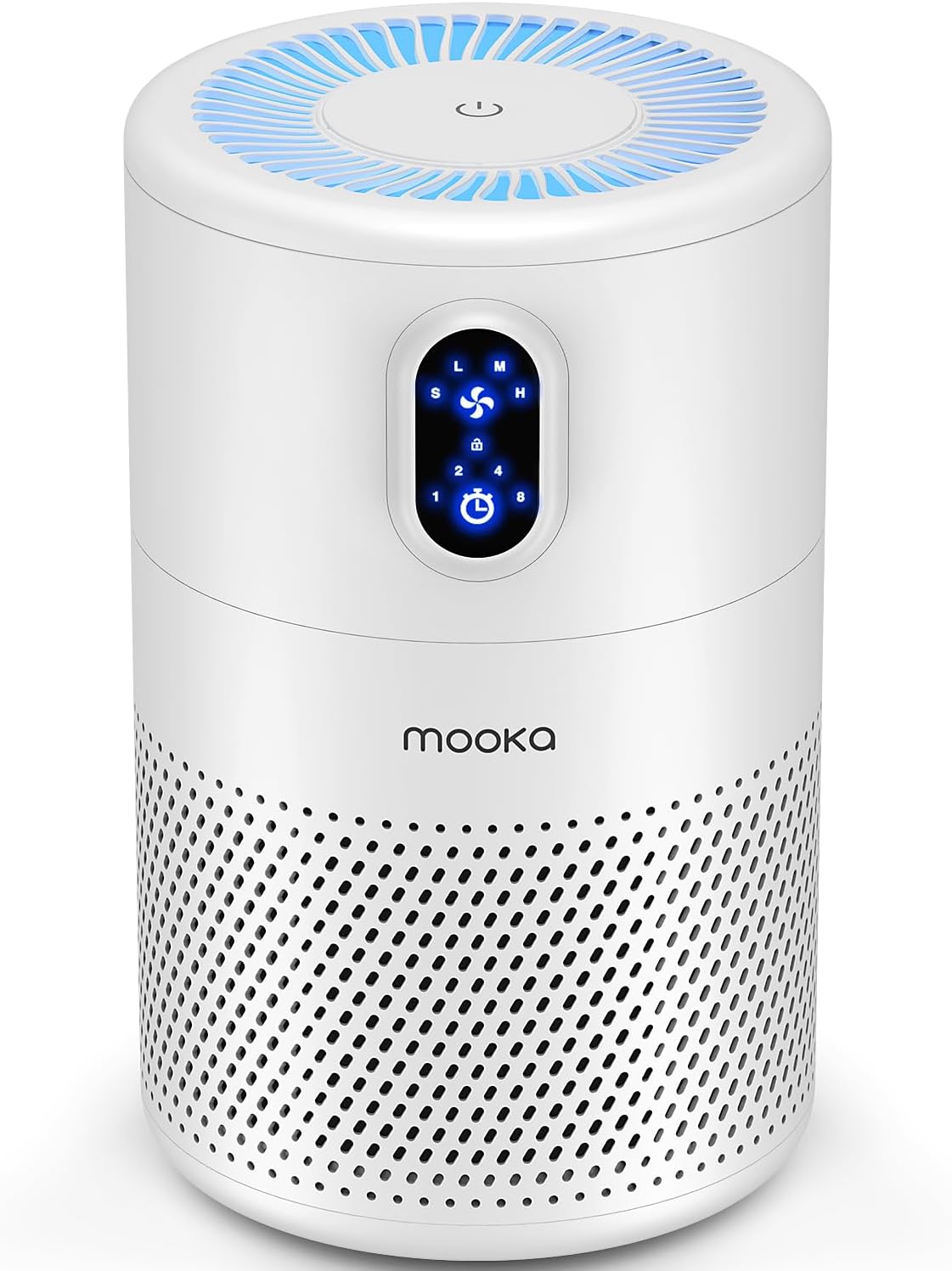
| Coverage | Up to 1076 sq ft |
|---|---|
| Filter type | H13 True HEPA + activated carbon + pre-filter |
| Fan modes | Sleep/Low/Med/High |
| Timer | 1/2/4/8 hours |
The MOOKA B-D02L is a portable air purifier built around an H13 True HEPA filter plus activated carbon and a washable pre-filter to capture dust, pollen, pet dander, smoke and odors. It is typically placed in living rooms, bedrooms, nurseries or offices and is sized to provide up to 6 air changes per hour in a 215 sq ft area and one air change per hour at the stated 1076 sq ft coverage. Controls include four fan speeds (Sleep/Low/Med/High), a 1/2/4/8-hour timer, child lock and a night light that can be disabled. The unit emphasizes quiet, energy-saving operation with a brushless motor and a claimed 20 dB low-noise sleep mode, useful for overnight use or work-from-home setups. Filters require periodic replacement every 3 to 6 months depending on environment, and the adapter is stored under the base. Trade-offs are routine for this class: replacement filters are an ongoing cost and the large-area coverage figure represents a low single air change rate at max square footage, so expect best performance in small to medium rooms rather than rapidly scrubbing air in very large open spaces.
Best for: Buyers who want a quiet, energy-conscious room air purifier with True HEPA filtration and simple controls for bedrooms, living rooms, or home offices.
Less Ideal for: People needing rapid whole-house air turnover or commercial-scale air cleaning should consider higher-capacity systems designed for multiple air changes per hour in large open spaces.
- H13 True HEPA plus activated carbon and pre-filter for particle and odor removal
- Multiple fan speeds and timer options let you balance cleanliness, noise and runtime
- Very quiet brushless motor with a low-noise sleep mode for nighttime use
- Child lock and a controllable night light add safe, family-friendly features
- Filters need replacement every 3–6 months which adds recurring cost
- Stated 1076 sq ft coverage corresponds to only one air change per hour at that size, so cleaning is slower in very large rooms
Verdict: A quiet, family-friendly True HEPA purifier that emphasizes low-noise, energy-efficient operation for small to medium home spaces.
Crane Desktop Air Purifier Fan EE-5073

| Power Source | AC/DC |
|---|---|
| Control Method | Touch |
| Filter Type | HEPA |
| Floor Area | 250 square_feet |
| Particle Retention Size | 0.3 micron |
The Crane Desktop Air Purifier Fan combines a small three-speed fan with a HEPA filter to deliver both airflow and particle filtration for desks, nightstands, dorms, and small bedrooms. It is intended for personal use where space is limited and quiet operation matters, offering a 90-degree tilt, touch/button controls, and filtration rated for particles down to 0.3 microns over roughly 250 square feet. The unit is easy to move and runs quietly enough for work or sleep while circulating air and capturing dust and allergens. Practical benefits include simple manual controls, compact footprint, and CARB certification for indoor air applications. Limitations are that this is a personal/tabletop device rather than a whole-room air cleaner, so expect modest airflow and filtration compared with larger standalone purifiers, and replacement filters and the UV bulb will be ongoing maintenance items. The design favors convenience and portability over high CADR performance.
Best for: Buyers seeking an affordable, space-saving unit that provides both a small fan and basic HEPA filtration for a personal workspace or small bedroom.
Less Ideal for: People who need high-capacity or whole-room air cleaning for larger living areas or severe allergy and asthma management should choose a larger, higher-performance purifier.
- Two-in-one design provides both fan airflow and HEPA particle filtration
- Compact and lightweight for easy placement on desks, nightstands, or in dorm rooms
- Quiet operation suitable for sleep or focused work
- Filter captures particles down to 0.3 micron and is CARB certified
- Modest airflow and purification capacity compared with larger room purifiers
- Requires periodic filter and UV bulb replacements
Verdict: A budget-friendly, compact fan-plus-HEPA purifier that delivers quiet personal cooling and basic particle filtration for desks and small bedrooms.
KNKA APH4000 Air Purifier

| Model | APH4000 |
|---|---|
| AHAM CADR (Smoke/Dust/PM2.5) | 226 CFM (384 m³/h) |
| AHAM CADR (Pollen) | 244 CFM (415 m³/h) |
| Room refresh rate | 4.8×/hr in 350 ft²; 1×/hr in 1695 ft² |
| Noise (Sleep Mode) | 22–24 dB |
The KNKA APH4000 is a room air purifier designed to move a lot of air quickly while handling particles, odors, and pet dander. It uses dual front-and-back cartridges with a three-stage system (washable pre-filter, high-efficiency HEPA-style filter, and activated carbon) and an indicator to remind you when to replace filters. The unit is AHAM-verified with separate CADR ratings for smoke, dust/PM2.5 and pollen and an airflow layout that intakes from front and back and exhausts from both sides to speed circulation. Useful modes include Pet, Eco, Auto, and an ultra-quiet Sleep setting that drops noise to the low 20s dB, and a real-time AQI display with color cues makes monitoring easy. Practical benefits are fast room refresh in typical living spaces, targeted pet-hair performance, and lower noise for night use. Limitations to consider are the need to replace the consumable filters every few months for peak performance and that the highest CADR claims translate to lower percent efficiency in very large open areas compared with smaller rooms.
Best for: Buyers who prioritize a dependable, high‑airflow purifier that consistently refreshes mid to large rooms and needs clear, automatic modes and air‑quality feedback rather than gimmicks.
Less Ideal for: People who need an ultra-compact unit for very small rooms or buyers seeking a purifier that requires minimal filter replacements over many years.
- AHAM-verified CADR ratings for smoke, dust/PM2.5, and pollen
- Dual intake and dual outlet airflow for faster room circulation
- Three-stage filtration with washable pre-filter and activated carbon for odors
- Dedicated Pet and ECO modes plus a very quiet Sleep mode
- Built-in AQI display with color-coded feedback and filter indicator
- Filters are consumable and recommended to be replaced every 3–6 months
- Performance percentage drops in very large open spaces compared with small-room efficiency
Verdict: Choose the KNKA APH4000 when you want a reliably fast, AHAM-verified purifier with targeted pet and quiet night modes and clear AQI feedback.
Levoit Core 300-P

| Power Source | Corded Electric |
|---|---|
| Filter Type | 3 in 1 Filtration |
| Floor Area | 1073 square_feet |
| Noise Level | 24 db |
| Wattage | 56 watts |
The Levoit Core 300-P is a small, fan-driven HEPA air purifier intended for bedrooms, living rooms, and other medium spaces. It uses a 3-stage Levoit original filter rated to capture 0.1–0.3 micron particles at 99.97% efficiency and a 56W motor that provides strong airflow performance for its size, with AHAM-verified CADR figures for smoke, dust, and pollen. Controls are touch-based and straightforward, and a near-silent Sleep Mode reduces noise to about 24 dB while allowing the unit to run overnight. Practical benefits include portability, a check-filter indicator, and a simple timer for scheduled runs. Important limitations are that this model does not include smart connectivity or Auto Mode, so fan speeds must be adjusted manually, and Levoit recommends using factory replacement filters to maintain CADR performance. For buyers prioritizing proven filtration and quiet nighttime operation, the Core 300-P is a reliable, no-frills choice; buyers wanting app control or automatic air-quality adjustments should consider other models.
Best for: Buyers who want a proven, quiet HEPA purifier with documented CADR performance and prefer well-reviewed, low-risk choices backed by certifications.
Less Ideal for: Users who need Wi-Fi control, automatic air-quality sensing, or hands-off fan speed automation should look at models with smart features and Auto Mode.
- HEPA-grade 3-stage filter captures 99.97% of 0.1–0.3 μm particles
- AHAM-verified CADR with measurable smoke, dust, and pollen removal
- Very quiet Sleep Mode at around 24 dB suitable for bedrooms
- Touch controls, timer, and filter check indicator for easy daily use
- No smart connectivity or Auto Mode; fan speeds are manual only
- Best performance depends on using Leovit factory replacement filters
Verdict: A compact, AHAM-verified HEPA purifier that delivers quiet, reliable particle removal for buyers who value proven performance and low-risk choices.
VOOPNU Air Purifier DH-JH12

| Filtration | H13 True HEPA 3-stage |
|---|---|
| Coverage | Up to 1,076 ft² per hour (250 ft² per 15 minutes) |
| Noise level | 22 dB (low) |
| Certifications | DOE, ETL, FCC, CARB, CE, ROHS |
The VOOPNU DH-JH12 is a small, straightforward air purifier intended to clean indoor air in living spaces and bedrooms. It uses a 3-stage H13 True HEPA filtration system with 360° intake to capture particles down to 0.3 microns and is lab-tested to clean roughly 250 ft² every 15 minutes, covering up to 1,076 ft² per hour. Controls are simplified to one-tap operation with three fan speeds, a timer, and a quiet lowest setting rated near 22 dB for overnight use. The unit includes an essential oil tray for light aroma and meets multiple safety and performance certifications such as ETL, CARB, FCC, DOE, CE, and RoHS. Practical benefits include easy placement thanks to a compact footprint and a washable or replaceable filter path with recommended replacement cycles. Limitations are its small physical size relative to high-CADR tower purifiers and the recommendation to run continuously to achieve best results, which could mean steady energy use and periodic filter replacements for sustained performance.
Best for: Buyers who prioritize a certified, easy-to-use purifier for bedrooms or small-to-medium rooms and want a quiet unit with simple controls and proven filtration.
Less Ideal for: People seeking a high-output whole-house solution or a purifier for very large open-plan spaces should consider more powerful tower models.
- H13 True HEPA 3-stage filtration captures 99.97% of airborne particles
- 360° air intake and lab-tested coverage of 250 ft² every 15 minutes
- Very quiet low setting (about 22 dB) suitable for bedrooms
- Simple one-tap controls with three speeds and timer for easy operation
- Essential oil tray allows light scenting while running
- Compact physical size means it may not perform like larger, high-CADR tower purifiers in open-plan homes
- Manufacturer recommends continuous operation for best results, increasing ongoing energy and filter costs
Verdict: A compact, certified, and quiet HEPA purifier that is a low-risk choice for cleaner air in bedrooms and small-to-medium rooms.
Choosing the Right Air Purifier with Fan: Key Factors to Consider
Filtration Type and Efficiency
The type of filter media determines what the purifier can actually capture. True HEPA or equivalent mechanical media remove the vast majority of fine particles including dust, pollen, and many smoke particles. Activated carbon layers are important for removing odors and some volatile organic compounds.
Higher filtration efficiency typically reduces particle concentrations more quickly, but it can increase resistance to airflow. When a purifier pairs high-efficiency media with sufficient fan power, you get both good capture rates and adequate room circulation. Consider the minimum particle size the filter targets and whether the manufacturer provides laboratory or third-party efficiency figures.
Airflow and Coverage (CADR)
Airflow determines how fast a unit can cycle the room's air through the filter. Clean Air Delivery Rate, or CADR, is the common metric that combines filtration efficiency with airflow to indicate how many cubic feet per minute of clean air the purifier produces. Higher CADR numbers mean faster removal of pollutants in a given room size.
Match CADR or stated room coverage to your actual room dimensions and desired air changes per hour. For living rooms and open spaces, choose units that sustain higher airflow without becoming noisy or losing filtration efficiency as fan speed increases.
Noise and Speed Control
Fan-driven purifiers create sound that varies by speed. Noise matters when placing a purifier in a bedroom or office. Look for models with multiple fan speeds, a quiet or sleep mode, and measured sound ratings across those settings.
Some purifiers maintain acceptable noise at moderate fan speeds while still providing good airflow. Others only reach target CADR on higher, louder settings. Consider whether variable speed control, an automatic mode tied to sensors, or timer scheduling is important for your use scenario.
Maintenance, Filter Life, and Cost To Operate
Regular filter replacement and occasional cleaning keep performance steady. Check how accessible the filters are, whether pre-filters are washable, and typical replacement intervals. Longer filter life reduces running costs but can come with higher upfront filter expense.
Energy usage at typical fan speeds affects operating cost if the unit runs many hours per day. Also consider the simplicity of indicator lights or apps that report remaining filter life and maintenance needs to avoid forgetting replacements.
Placement, Size, and Design
Where you place the purifier affects its effectiveness. Fan-driven units perform best with unobstructed intake and exhaust paths and should be positioned so airflow can circulate throughout the room rather than against a wall. Size and footprint matter for tight spaces and areas where aesthetics are a concern.
Also think about whether you need portable units that are easy to move between rooms or larger units intended for a single, consistent location. Design choices such as top or front air discharge influence how you can situate the purifier in a given room layout.
How Fan Operation Changes Purifier Performance
A built-in fan does more than push air through the filter. It determines how quickly a purifier can reduce airborne contaminants by defining the airflow rate and the number of air changes per hour in a space. Stronger fans paired with efficient filters reduce pollutant concentrations faster than passive designs.
Fan control also affects comfort and noise. Units with finely stepped fan speeds or adaptive automatic modes let you balance rapid cleaning when needed and quieter operation at night. Consider how often you will run the purifier at higher fan speeds and whether the unit sustains filtration efficiency under those conditions.
- Faster pollutant removal with higher airflow
- Need to balance fan speed with acceptable noise
- Adaptive modes can optimize run time and energy use
Sizing a Purifier for Real Rooms
To size a purifier, compare its stated CADR or room coverage to your room's square footage and ceiling height. Aim for a unit that can provide two to four air changes per hour in the room where you spend the most time. For bedrooms you might prioritize quieter operation over maximum CADR, while common areas can tolerate higher fan speeds for faster cleaning.
If you often move the purifier between rooms, choose a model with adequate portability and a coverage envelope that overlaps the different spaces. For open-plan areas, err on the side of larger coverage to prevent dead zones where airflow is limited.
- Use CADR and room volume, not just square feet
- Balance CADR needs with desired noise and energy use
- Portability helps if you need coverage across multiple rooms
Using Auto Modes and Sensors Effectively
Many purifiers with fans include sensors that detect particulate levels and adjust fan speed automatically. These modes reduce the need for manual control and can save energy by increasing airflow only when pollutant levels rise. Understand how responsive the sensors are and whether they detect the types of pollutants you are most concerned about, such as fine particles or visible dust.
Auto modes are useful in variable environments, like kitchens or rooms with intermittent traffic. However, sensor placement and calibration affect responsiveness. If you need consistent low background levels, consider supplementing auto operation with scheduled higher-speed runs at times of day when occupancy or pollutant sources peak.
- Auto modes adjust fan speed to pollutant levels
- Sensor type and placement determine responsiveness
- Combine auto mode with scheduled runs for best results
Placement Tips to Maximize Airflow
Position the purifier so that the intake and exhaust are not blocked by furniture or walls. A central location in the room or a spot with open pathways to the rest of the space helps the fan circulate air widely. Avoid placing units directly under shelving or in tight corners where airflow will be restricted.
If you have multiple purifiers, stagger them to create cross-room circulation rather than clustering them together. For rooms with directional airflow, such as those with HVAC returns, place the purifier where the fan can complement existing air movement to improve whole-room turnover.
- Keep intake and exhaust unobstructed
- Central placement promotes even circulation
- Coordinate placement with existing room airflow
Managing Noise Without Sacrificing Performance
If nighttime noise is a concern, compare measured sound levels at low and medium fan speeds rather than at maximum. Some models are engineered to provide respectable CADR at mid speeds that are acceptable in living spaces. A sleep mode that slightly lowers fan speed overnight while still circulating air can be a good compromise.
Use timers or smart schedules to run higher fan speeds during cleaning, cooking, or peak pollution times, and then drop to quieter settings for occupancy. Placing the unit slightly farther from a bed or desk can also reduce perceived noise without significantly affecting overall circulation.
- Assess sound at realistic operating speeds
- Use scheduling to limit high-speed runtime
- Placement can reduce perceived noise
How We Chose the Best Air Purifier with Fan
We prioritized measurable performance and real-world usability when choosing these air purifiers with fan operation. First, filtration efficiency was a primary filter: we focused on designs that use true mechanical filter media or equivalent tested methods for particulate capture, since effective particle removal is the core function. Second, airflow and clean air delivery were assessed, emphasizing units that move enough air to deliver multiple air changes per hour in typical room sizes. Next, noise across fan speeds and the ability to maintain quieter operation at lower settings were important for bedrooms and living areas. Ease of maintenance and filter accessibility were included to reflect ownership costs and convenience. Additional considerations were energy use on typical fan settings and the availability of multiple fan speeds or automatic modes for adaptive performance. We excluded units that rely solely on ionization without substantial airflow design, and those that list filtration claims without clear fan-driven CADR or airflow data. The final list balances documented filtration capability, measured or manufacturer-stated airflow performance, acceptable noise levels, and user-focused design.
Our full evaluation process is outlined in our review methodology.
FAQ
Do air purifiers with fans consume a lot of electricity?
Energy use depends on fan speed and motor efficiency. Running at high fan speeds increases consumption, but many modern units are designed to be energy-efficient at typical settings. Using auto modes and timers can reduce total runtime and lower electricity use.
How often should I change filters in a fan-driven purifier?
Filter life varies by usage, pollutant load, and filter type. Typical replacement intervals range from several months to a year. Check for pre-filter cleaning needs and follow indicator lights or manual inspection to avoid reduced airflow and efficiency.
Will a purifier with a fan remove odors as well as particles?
Fans move air through the filter, but odor removal requires specific media such as activated carbon. A fan alone will not remove gases and smells. Select a model with carbon or equivalent adsorbent media if odors are a priority.
Can I leave an air purifier with a fan running all day?
Yes. Many people run purifiers continuously to maintain lower background particle levels. To manage energy and noise, use lower fan speeds for continuous operation and reserve higher speeds for targeted cleaning or peak pollution events.
How do I know what fan speed to use?
Choose higher speeds for quick pollutant removal after activities like cooking or cleaning, and lower speeds for background maintenance or sleeping. If the unit has sensors and an auto mode, it can recommend or select appropriate speeds based on detected air quality.
Final Verdict
When choosing an air purifier with fan operation, prioritize the combination of effective filter media and sufficient airflow for your room size. Filtration efficiency determines what the unit can remove, while fan power and CADR determine how fast the air is cycled and cleaned. Balance noise, energy use, and maintenance needs against the coverage you require. For bedrooms, emphasize quiet operation and sensible CADR for the room volume. For common areas, favor higher airflow and adaptive controls to clear pollutants quickly. Use placement and scheduling strategically to get the best real-world results.